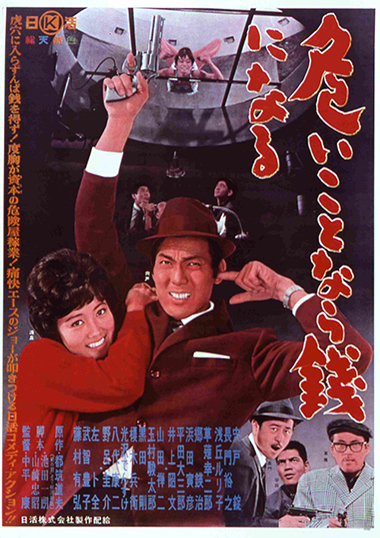
 Where there’s danger, there’s money! Or, maybe just danger, who knows but whatever it is, it certainly doesn’t lack for excitement. Ko Nakahira is best known for his first feature, Crazed Fruit, the youthful romantic drama ending in speed boat murder which ushered in the Sun Tribe era. Though he later tried to make a return to more artistic efforts, it’s Nakahira’s freewheeling Nikkatsu crime movies that have continued to capture the hearts of audience members. Danger Pays (AKA Danger Paws, 危いことなら銭になる, Yabai Koto Nara Zeni ni Naru) is among the best of them with its cartoon-like, absurd crime caper world filled with bumbling crooks and ridiculous setups.
The central plot gets going when a truck carrying watermarked paper destined for the mint is hijacked with force by armed thugs. They need a master forger though so they set out to recruit one of the best counterfeiters currently working on his way back from a business trip to Hong Kong. However, three petty crooks have also gotten wind of the scam and are trying to head off their rivals by kidnapping the old grandpa first.
The three guys are “Glass Hearted Joe” – a purple suited dandy with an aversion to the sound of scraping glass, Slide Rule Tetsu who walks with a cane and is a whizz with the abacus, and Dump-Truck Ken who’s a geeky sort of guy who also owns a dumper truck. Sakamoto, the forger, eludes their grasp when the better equipped professionals turn up, but none of them is willing to give up on the prize. A little later, Joe teams up with a female ally – Tomoko, who is keen martial artist and smarter than the other three put together. Eventually the four end up becoming an accidental team though it remains to be seen if they can really turn this increasingly desperate situation to their advantage.
Danger Pays is in no way “serious” though this is far from a criticism. Armed with a killer script filled with amazing one liners which are performed with excellent comic timing by the A-list cast, Danger Pays is the kind of effortlessly cool, often hilarious crime caper which is near impossible to pull-off but absolutely sublime when it works – which Danger Pays most definitely does. Though there is a large amount of death and bloodiness in the final third, the atmosphere remains cartoonish as our intrepid team of four simply step over the bodies to go claim their prize with only one of them left feeling a little queasy.
Nakahira maintains the high octane, almost breathless pace right through to the end. The finale kicks in with our heroes trying to escape from a locked room which is about to be filled with gas only to be trapped like rats in an elevator shaft where they engage in an improbable shootout whilst bodies rain down on them from above bathed in the red emergency light of the escape vaults. This is a hardboiled world but one cycled through cigar munching wise guys and tommy guns, it’s all fun and games until you’re trapped in a lift knee deep in corpses while blood drips from a couple more dead guys on the ceiling.
Ridiculous slapstick humour and broad comedy are the cornerstones of Danger Pays though it also makes its central crime conceit work on its own only to overturn it with a final revelation even as the credits roll. Excellently played by its four leads, this comic tale of “victimless crime” in the improbably colourful underworld of ‘60s Tokyo is one which is filled with absurd humour, cartoon stunts, and ridiculous characters but proves absolutely irresistible! If only modern day crime capers were this much fun.
Danger Pays is the second of three films included in the second volume of Arrow’s Nikkatsu Diamond Guys box set.
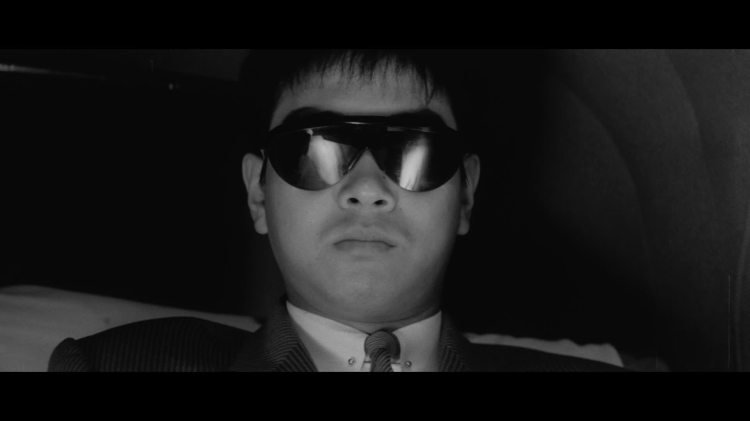 Loosely inspired by Julian Duvivier’s 1937 gangster movie Pépé le Moko, Toshio Masuda’s Red Pier (赤い波止場, Akai Hatoba) was designed as a vehicle for Nikkatsu’s rising star of the time, Yujiro Ishihara – later to become the icon of the Sun Tribe generation. On paper it sounds like a fairly conventional plot – young turk of a gangster comes to town to off a guy, sees said guy killed in an “accident”, and shrugs it off as one of life’s little ironies only to accidentally become acquainted with and fall head over heals for the dead guy’s sister. So far, so film noir yet Masuda adds enough of his own characteristic touches to keep things interesting.
 Windows on Worlds