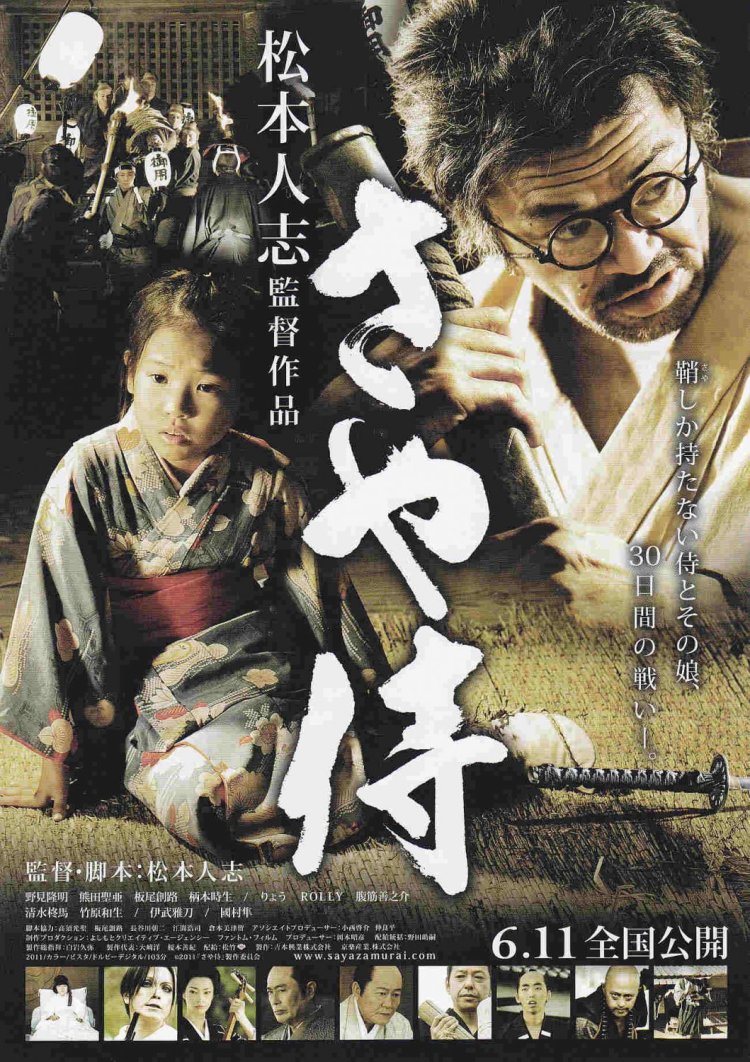
Scabbard Samurai (さや侍, Hitoshi Matsumoto, 2011)

scabbard samuraiA samurai’s soul in his sword, so they say. What is a samurai once he’s been reduced to selling the symbol of his status? According to Scabbard Samurai (さや侍, Sayazamurai) not much of anything at all, yet perhaps there’s another way of defining yourself in keeping with the established code even when robbed of your equipment. Hitoshi Matsumoto, one of Japan’s best known comedians, made a name for himself with the surreal comedies Big Man Japan and Symbol but takes a low-key turn in Scabbard Samurai, stepping back in time but also in comedic tastes as the hero tests his mettle as a showman in a high stakes game of life and death.

Nomi Kanjuro (Takaaki Nomi) is a samurai on the run. Wandering with an empty scabbard hanging at his side, he pushes on into the wilderness with his nine year old daughter Tae (Sea Kumada) grumpily traipsing behind him. Eventually, Nomi is attacked by a series of assassins but rather than heroically fighting back as any other jidaigeki hero might, he runs off into the bushes screaming hysterically. Nomi and Tae are then captured by a local lord but rather than the usual punishment for escapee retainers, Nomi is given an opportunity to earn his freedom if only he can make the lord’s sad little boy smile again before the time is up.

Nomi is not exactly a natural comedian. He’s as sullen and passive as the little lord he’s supposed to entertain yet he does try to come up with the kind of ideas which might amuse bored children. Given one opportunity to impress every day for a period of thirty days, Nomi starts off with the regular dad stuff like sticking oranges on his eyes or dancing around with a face drawn on his chest but the melancholy child remains impassive. By turns, Nomi’s ideas become more complex as the guards (Itsuji Itao and Tokio Emoto) begin to take an interest and help him plan his next attempts. Before long Nomi is jumping naked through flaming barrels, being shot out of cannons, and performing as a human firework but all to no avail.

Meanwhile, Tae looks on with contempt as her useless father continues to embarrass them both on an increasingly large stage. Tae’s harsh words express her disappointment with in Nomi, berating him for running away, abandoning his sword and with it his samurai honour, and exposing him as a failure by the code in which she has been raised. She watches her father’s attempts at humour with exasperation, unsurprised that he’s failed once again. Later striking up a friendship with the guards Tae begins to get more involved, finally becoming an ally and ringmaster for her father’s newfound career as an artist.

Tae and the orphaned little boy share the same sorrow in having lost their mothers to illness and it’s her contribution that perhaps begins to reawaken his talent for joy. Nomi’s attempts at comedy largely fall flat but the nature of his battle turns out to be a different one than anyone expected. Tae eventually comes around to her father’s fecklessness thanks to his determination, realising that he’s been fighting on without a sword for all this time and if that’s not samurai spirit, what is? Nomi makes a decision to save his honour, sending a heartfelt letter to his little girl instructing her to live her life to the fullest, delivering a message he was unable to express in words but only in his deeds.

Matsumoto’s approach is less surreal here and his comedy more of a vaudeville than an absurd kind, cannons and mechanical horses notwithstanding. The story of a scabbard samurai is the story of an empty man whose soul followed his wife, leaving his vacant body to wander aimlessly looking for an exit. Intentionally flat comedy gives way to an oddly moving finale in which a man finds his redemption and his release in the most unexpected of ways but makes sure to pass that same liberation on to his daughter who has come to realise that her father embodies the true samurai spirit in his righteous perseverance. Laughter and tears, Scabbard Samurai states the case for the interdependence of joy and sorrow, yet even if it makes plain that kindness and understanding are worth more than superficial attempts at humour it also allows that comedy can be the bridge that spans a chasm of despair, even if accidentally.


Currently streaming on Mubi

Original trailer (no subtitles)
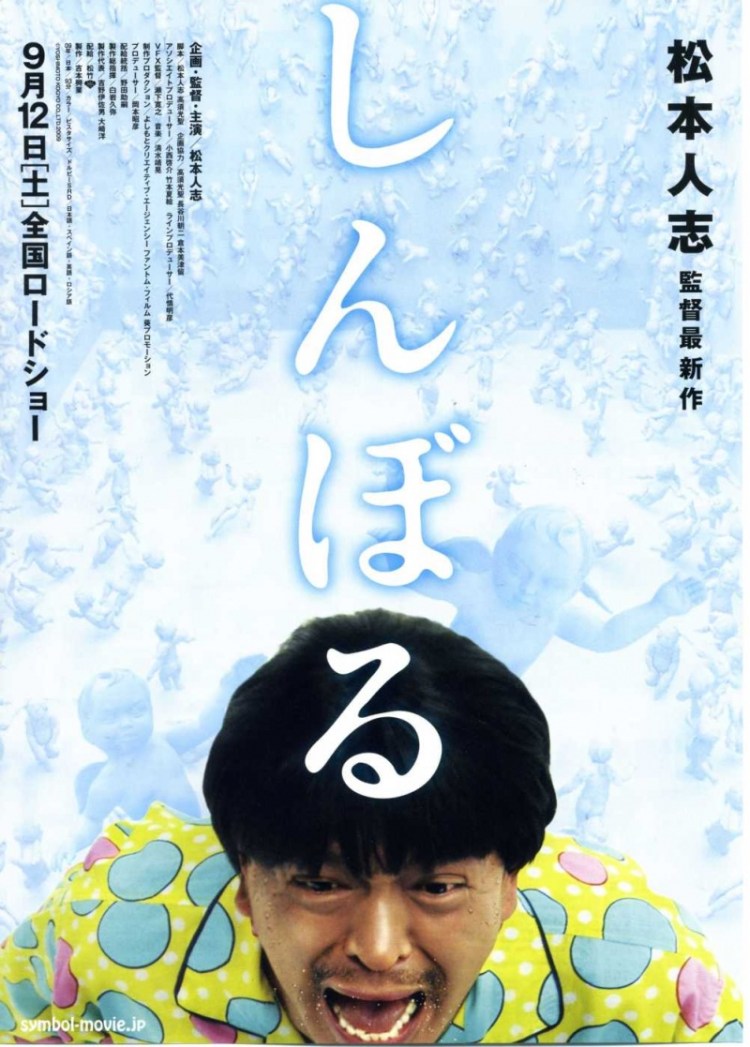
Symbol (しんぼる, Hitoshi Matsumoto, 2009)

kinopoisk.ruSymbol (しんぼる) – one thing which stands for another, sacrificing its own nature in service of something else. Hitoshi Matsumoto waxes philosophical in his follow up to Big Man Japan. Life, the universe, and everything converge in the seemingly unrelated tales of an unsuccessful Mexican luchador, and a confused Japanese man trapped in a surrealist nightmare. As expected, these two strands eventually meet, though not quite as one might expect.

The Mexican desert, a chain-smoking nun drives erratically towards a small house in which there lives a lucha libre wrestler by the name of Escargot Man (David Quintero) who has a big fight coming up but is worried because his opponent is much younger and stronger than he is.

Meanwhile, at an undisclosed location, a Japanese man wakes up in a pair of colourful polka dotted pyjamas inside an entirely white room. The man screams and rails but gets no reply. Eventually he notices a strangely shaped protrusion on the wall and taps it, at which point a host of tiny cherubs swarms around him before returning to the wall leaving only their tiny penises poking through. The man taps more penises and a host of objects begins to flood the room, each more useless than the last until the man begins to concoct a plan of escape.

Matsumoto lets his Mexican opening drift on indefinitely before abruptly cutting to the bright white walls of the mysterious room. The Mexican vistas are warm, wide, and open as the three generation family fret over the masked father’s destiny as a luchador with grandpa comforting the youngest who finds himself bullied over his dad’s profession while the mother is concerned by her husband’s nervous mood.

The mysterious room, by contrast, contains only a lone Japanese man even if just as strangely dressed. Matsumoto does not skimp on the surrealism as the man is bombarded with a series of totally useless accessories each time he presses one of the penis switches attached to the wall. Beginning with a toothbrush, the man is gifted a bonsai tree, hundreds of chopsticks, a sun lounger, toaster, and so on, each lacking any concrete purpose for his new life in the room save making him both more comfortable and also more frustrated. Irony rules as he receives a sushi lunch with no soy sauce only for a bottle to appear as soon as he’s finished, or he’s presented with the next-but-one volume of a manga he’s been reading but remains eternally unable to acquire the missing book. Eventually he finds a method of possible escape, conducts various trial and error attempts to make it work and then discovers it only leads to a second round gamesmanship with his invisible tormentor.

Unbeknownst to the man, his actions have consequences which begin with the improbable story of the Mexican wrestler and then flood around the world as he keeps tapping switches before literally ascending to a higher plane of existence. Random events are, perhaps, the result of a random button pusher in a far off land, trying and failing to escape his own captivity. Or then again, maybe he is us, endlessly tormented by unseen forces, desperately looking for a way out but left with no other mechanism than trial and error. We follow him through “learning” to “practice” and eventually to “future”, though what he learns through his strange evolution in an Escher-like world of inescapable repetition is debatable.

Strange, absurdist and defying interpretation, Symbol is a surreal escape game played on a universal scale. Matsumoto’s message is permanently unclear and possibly a long form joke, but its playfulness and somehow goodnatured attempt at cosmological exegesis is one which evokes a puzzled smile or exasperated laughter more than irritation at its appropriately obilque coda.


Currently streaming on Mubi.

Original trailer (dialogue free)

Hamon: Yakuza Boogie (破門 ふたりのヤクビョーガミ, Shotaro Kobayashi, 2017)

hamon posterConventional wisdom states it’s better not to get involved with the yakuza. According to Hamon: Yakuza Boogie (破門 ふたりのヤクビョーガミ Hamon: Futari no Yakubyogami), the same goes for sleazy film execs who can prove surprisingly slippery when the occasion calls. Based on Hiroyuki Kurokawa’s Naoki Prize winning novel and directed by Shotaro Kobayashi who also adapted the same author’s Gold Rush into a successful WOWWOW TV Series, Hamon: Yakuza Boogie is a classic buddy movie in which a down at heels slacker forms an unlikely, grudging yet mutually dependent relationship with a low-level gangster.

Ninomiya (Yu Yokoyama), a classic slacker, makes ends meet by acting as a kind of liaison officer between the normal world and the yakuza one. His contact, Kuwahara (Kuranosuke Sasaki), is a scary looking guy but as yakuza go not so bad to work with. Following the government’s organised crime crackdown, Ninomiya finds himself at more of a loose end and so when an elderly film director, Koshimizu (Isao Hashizume), comes to him and asks to meet a yakuza first hand, Ninomiya sets up a meeting. Yakuza and movies can be a dangerous mix but somehow or other Koshimizu manages to charm the pair and even gets Kuwahara’s boss, Shimada (Jun Kunimura), to invest some of his own money.

Unfortunately, this is when things start to go wrong. Koshimizu’s pretty “daughter” is really his mistress (as Kuwahara suspected) and the wily old bugger has taken off for the casino paradise of Macao with both the beautiful woman and suitcase full of yakuza dough. Kuwahara is now in a lot of trouble and ropes in Ninomiya to help him sort it out but in their pursuit of Koshimizu they eventually find themselves caught up in a series of turf wars.

Yakuza comedies have a tendency towards unexpected darkness but Hamon’s key feature is its almost childish innocence as Ninomiya and Kuwahara go about their business with relatively few genuinely life threatening incidents. Though the pair bicker and argue with Ninomiya always secretly afraid of his big gangster buddy and Kuwahara fed up with his nerdy friend’s lack of know how, the relationship they’ve developed is an intensely co-dependent one which fully supports the slightly ironic “no me without you” message. Eventually growing into each other, Ninomiya and Kuwahara move increasingly into the other’s territory before finally re-encountering each other on more equal footing.

These are less rabid killers than a bunch of guys caught up in a silly game. Shady film director Koshimizu turns out to be some sort of cartoon hero, perpetually making a sprightly and unexpected escape despite his advanced age while the toughened gangsters hired to keep him locked up find themselves one hostage short time after time. Ninomiya’s worried cousin Yuki (Keiko Kitagawa) keeps trying to talk him into a more ordered way of life which doesn’t involve so much hanging round with scary looking guys in suits, but Ninomiya is reluctant to leave the fringes of the underworld even if he seems afraid for much of the time. Kuwahara is a yakuza through and through, or so he thinks. This latest saga has left him in an embarrassing position with his bosses, not to mention the diplomatic incident with a rival gang, all of which threatens his underworld status and thereby essential identity.

Still, all we’re talking about here is having a little more time for solo karaoke, not being bundled into the boot of a car and driven to a remote location. Filled with movie references and slapstick humour this is a yakuza tale inspired by classic cinematic gangsters rather than their real world counterparts but it still has a few things to say about human nature in general outside of the fictional. An odd couple, Ninomiya and Kuwahara couldn’t be more different but besides the fact they don’t quite get along, they make a good team. No me without you indeed, solo stakeouts are boring, even if you do bicker and fuss the whole time it’s good to know there’s someone who’ll always come back for you (especially if you tell them not to) ready to take the wheel.


Hamon: Yakuza Boogie was screened at the 19th Udine Far East Film Festival.

Original trailer (no subtitles)

Policeman And Me (PとJK, Ryuichi Hiroki, 2017)

policeman 2The world of shojo manga is a particular one. Aimed squarely at younger teenage girls, the genre focuses heavily on idealised, aspirational romance as the usually female protagonist finds innocent love with a charming if sometimes shy or diffident suitor. Then again, sometimes that all feels a little dull meaning there is always space to send the drama into strange or uncomfortable areas. Policeman and Me (PとJK, P to JK), adapted from the shojo manga by Maki Miyoshi is just one of these slightly problematic romances in which a high school girl ends up married to a 26 year old policeman who somehow thinks having an official certificate will make all of this seem less ill-advised than it perhaps is.
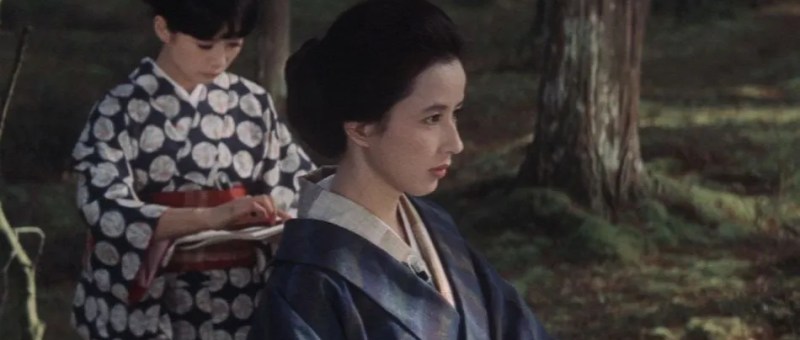
Kako (Tao Tsuchiya) is only 16 and, truth be told, a little innocent, even naive when it comes to love though she desperately wants to get herself a proper boyfriend. Dragged by a friend to singles mixer where she’s abruptly told that’s she’s 22 for the next few hours, Kako is bashful and dutifully refrains from underage drinking or inappropriate behaviour. Against the odds she hits it off with handsome policeman, Kota (Kazuya Kamenashi), who still thinks she’s 22 and that her reticence is a sign both of shyness and of maturity. Inadvertently blurting out her real age, Kako blows things with Kota who, as policeman, has no interest in dating a 16 year old. However, leaving Kako to walk home alone after the last train has left through a dodgy area of town is not a good idea and she’s soon beset by a gang of moody boys! Luckily, Kota’s policeman instincts have kicked in and he turns up to save the day with some delinquent moves of his own.

Despite the age difference, Kota and Kako have a genuine connection but Kota is anxious not to do anything dishonourable or untoward. Thus, facing the prospect of breaking up with his teenage sweetheart, he abruptly proposes marriage! After all, when the government rubber stamps something it must be OK and no-one can be accused of doing anything morally wrong, right? The surprising thing is, Kota puts on a fancy suit and goes to break the news to Kako’s parents only to have them give up almost without a fight. Her father may be angry to begin with but he’s soon won over and left with nothing other to say than please look after my girl (and try not to get her pregnant until she’s finished her education).

Kako is then placed in the incongruous position of being both a regular high school girl and a married housewife. Kota is stationed at the local police box with two other officers – one an older guy and the other a young woman who both support him in his new life as a married man. The couple live in an improbably large house inherited from Kota’s late parents but their relationship remains chaste and innocent. Perhaps realising that this unusual union will not be welcomed by all Kako has not told anyone at school about her marriage whilst she goes about trying to rescue the sensitive delinquent, Okami (Mahiro Takasugi), who accidentally put her in the hospital before she was valiantly rescued by Kota.

Okami and Kota lock horns over several things from Kako to the rule of law but they have more in common than it might first seem. Kota, once a violent teen himself, is nursing a huge debt to his policeman father killed in the line of duty. Taking on his father’s mission, Kota has dedicated himself to serving and protecting even if he once rebelled against that very thing as the kind of teenage punk Okami currently aspires to be. Okami has his own share of troubles at home which explain most of his behaviour as well as his aversion to law enforcement but Kako sees straight through his tough facade for the damaged boy inside. Kota too comes to find him more of a kindred spirit in need of rescue than a danger to society who needs locking up and also views him as an ally in being another of Kako’s admirers.

Ryuichi Hiroki thrives on this sort of uncomfortable drama, bringing a touch of moral queasiness to an otherwise cute story of innocent romance. Kota and Kako never particularly deal with the elephant in the room aside from Kako’s worries that Kota sees her a little girl who needs protecting rather than a wife who wants to stand alongside him as an equal. Then again Kako is quite happy in a subservient role, playing directly into her romantic fantasies. Hiroki directs all of this in true shojo style, keeping it all very chaste and innocent, overcoming all obstacles related to the inappropriateness in the central relationship and reaffirming the fact that true love is real, occurs in unexpected places, and is waiting for every romantic young girl who dreams of a tall guy in a dashing uniform. Unrealistic? Perhaps, but that’s shojo.


Policeman and Me was screened at the 19th Udine Far East Film Festival.

30s trailer (no subtitles)

With Beauty and Sorrow (美しさと哀しみと, Masahiro Shinoda, 1965)

with beauty and sorrwMasahiro Shinoda, a consumate stylist, allies himself to Japan’s premier literary impressionist Yasunari Kawabata in an adaptation that the author felt among the best of his works. With Beauty and Sorrow (美しさと哀しみと, Utsukushisa to Kanashimi to), as its title perhaps implies, examines painful stories of love as they become ever more complicated and intertwined throughout the course of a life. The sins of the father are eventually visited on his son, but the interest here is less the fatalism of retribution as the author protagonist might frame it than the power of jealousy and its fiery determination to destroy all in a quest for self possession.

Middle-aged author Oki (So Yamamura) is making a trip to Kyoto in order to hear the New Year bells but whilst there he wants to reconnect with someone very dear to him whom he has not seen for a long time. 15 years previously, Oki, already around 40 and married with a young son, had an ill advised affair with 16 year old Otoko (Kaoru Yachigusa). Oki’s indiscretion was discovered after Otoko fell pregnant and gave birth to an infant who sadly died after just a few months provoking Otoko’s own suicide attempt. Oki turned the traumatic events into a best selling novel which made his name and has not seen Otoko during the intervening years. Now a successful painter, Otoko has remained unmarried, still traumatised by her youthful experiences, and is currently in a relationship with a female student, Keiko (Mariko Kaga).

Keiko, a beautiful though strange young woman, will be the cause of much of the sorrow resulting from Oki’s decision to visit Otoko after all these years. Angry on her lover’s behalf, Keiko takes it upon herself to exact revenge for the wrong which was done to Otoko at such a young age, ignoring her lover’s pleas to leave the situation well alone.

Perhaps surprisingly, Shinoda avoids the temptation to retain Oki’s central viewpoint by attempting to survey the various threads which bind and contain each of the protagonists, locked into a complex system of love, jealously, pain and obsession. Oki sows the seeds of his own downfall in his improper relationship with a teenager over twenty years younger than himself whom he has no intention of marrying seeing as he is already married and even has a child. Little is said about the original affair save for the effect it had both on Otoko and on Oki’s marriage which endures to the present time even though it appears Oki continues to pursue other women outside of the home. Not only does Oki turn his scandalous love life into a best selling novel, but he makes his wife, Fumiko (Misako Watanabe), type it up for him, forcing her to read each and every painful detail of his relations with another woman.

During the writing of the novel, Fumiko begins to become ill, depressed and listless, but not out of suffering or disgust – what she feels is jealousy but of a literary kind. Fumiko laments that Oki has written an entire book about Otoko, but never thought to write one for her. Even if depicted as some kind of harridan or vengeful, shrewish woman, Fumiko wanted to be Oki’s muse and was denied. Otoko, by contrast never wanted anything of the sort and has lived quietly and independently ever since her traumatic teenage love affair with a married, older, artist. Her feelings, complicated as they may be, are the motivation for the actions of her obsessive lover, Keiko, determined on taking “revenge” for pain Otoko is not entirely certain she feels. Keiko’s jealously has been roused by Oki’s return and the possibility that it may reawaken Otoko’s youthful romantic yearnings. Unwilling to surrender her beloved to another, she sets about destroying that which may come between them, perfectly willing to destroy both herself and the woman she claims to love in the process.

Oki is, after all, a novelist and therefore apt to ascribe a kind of narrative to his life which may ignore its more ordinary baseness. His equally sensitive son, Taichiro (Kei Yamamoto), brings up the subject of Princess Kazu and the glass panel and lock of hair which were discovered with her body and muses on whether these belonged to her husband, as is said, or her “true love” as seems to be suggested by the evidence at hand. Loves true and false are played off against each other but the forces at play are less grand romances than petty lusts and obsessions. Keiko wants to own her lover absolutely but her games of revenge cause Otoko only more pain and take her further away from that which she most loves towards the film’s dark and ambiguous conclusion in which the innocent are made to suffer for other people’s transgressions.

Otoko’s suffering is largely ignored by all concerned though it’s clear that the loss of her child is a deep wellspring of pain which has become the dominant force in her life. Misused and abandoned, Otoko has sought only quietness and solitude living independently and without the need for male contact. Keiko, whilst crying out that she hates men and is going to destroy the family of the man who has destroyed her lover, acts only out of selfishness, refusing to see how far her actions are wounding the woman she loves even as she sets out to make a weapon of her beauty and turn it on the male sex.

Shinoda films with his characteristic aesthetics adopting a position of slight distance as his protagonists gaze at reflections of themselves and talk through mirrors yet refuse the kind of introspection which a novelist like Oki would be expected to project. A final moment of high drama is offered in a series of freeze frames, as if the emotions are too big and complex to be understood as a whole but can only be grasped in painful fragments snatched from among the resultant chaos. With Beauty and Sorrow conjures the idea of nobility in romance, enhanced by the inevitability of its failure, but for all of its aesthetic pleasures and enduring sadness this is not the elegant coolness of romantic tragedy but the painful heat of love scorned as it festers and corrupts, spreading nothing other than pollution and decay.


Original trailer (no subtitles, NSFW)

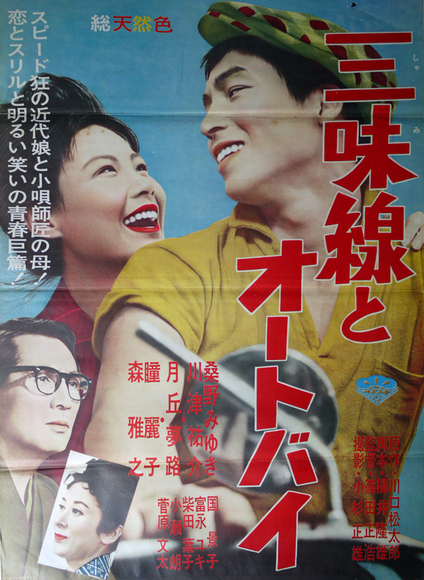
Love New and Old (三味線とオートバイ , AKA Shamisen and Motorcyle, Masahiro Shinoda, 1961)

shamisen and motorcycleMasahiro Shinoda’s first film for Shochiku, One-Way Ticket to Love, over which he’d been given a fairly free rein did not exactly set the box office alight. Accordingly, he then found himself relegated to studio mandated projects with set scripts designed with the studio’s house style in mind. Love New and Old (三味線とオートバイ, Shamisen to Otobai, also known as Shamisen and Motorcycle) is just one of these studio pictures, taking him away from the beginnings of a promising collaboration with avant-garde poet and playwright Shuji Terayama begun in Dry Lake (Youth in Fury) and Killers on Parade. Despite the banality of its melodramic tale of mother and daughter strife caused by changing times, secrets and social mores, Love New and Old plays into several of Shinoda’s recurrent themes and allows him to further indulge his tendency for visual flamboyance with a widescreen colour canvas.
Regular teenager Hatsuko (Miyuki Kuwano) hangs around with the “nice” kind of biker gang, clinging onto her upper class boyfriend Fusao (Yusuke Kawazu) as they ride around the city making use of all the new freedoms available to the young people of the day. Hatsuko lives alone with widowed mother Toyoeda (Yumeji Tsukioka), a minor celebrity known for giving lessons in traditional “kouta” singing on local television. Despite Hatsuko’s rather headstrong nature, she and her mother are very close and have a broadly happy life together in the small house they share which doubles as her mother’s studio.

Things change when Hatsuko and Fusao get into an accident on the bike which leaves them both in hospital. It just so happens that the doctor who ends up treating Hatsuko, Kuroyanagi (Masayuki Mori), is an old friend of her mother’s from before the war. During Hatsuko’s extended convalescence the pair rekindle their long abandoned romance but tension soon arises when the still youthful Hatsuko begins to resent this change in her familial relations. Having come to think of her mother as a kind of pure, saintly figure the idea of her as woman with a woman’s needs and desires profoundly disturbs her.

Shinoda frames this twin tale of women in love as series of embedded conflicts – between generations, between eras, and between a mother and a daughter whose relationship must necessarily change as one comes of age. There is also an additional burden placed on the relationship by means of a long buried secret regarding Hatusko’s birth, the man she had regarded as her father, and the newly resurfaced figure of the doctor who, it seems, has always been in Toyoeda’s heart. Despite the fact that one might assume all of the resentment towards a new relationship would come from the maternal side, Toyoeda is generally supportive of her daughter’s right to choose a boyfriend only warning her that the boy’s parents had acted with hostility following the accident and there may be class based trouble ahead given the fact that her mother is “only a kouta teacher”.

The doctor, a melancholy and perceptive figure, is the first to notice the effect his unexpected return is having on the previously happy mother daughter relationship. Correctly remarking that young people of Hatsuko’s age have much more clearly defined ideas about “morality”, especially as it relates to the older generation, Kuroyanagi can see why Hatsuko may have reservations about her mother remarrying. In this he is very much correct. Even setting aside the slight cultural squeamishness concerning second marriages, Hatsuko’s reaction to her mother’s new romance is one of deep disgust and confusion. Though she recognises that her feelings are unfair and will only cause her mother additional suffering, she cannot bring herself to accept the idea of her mother taking a lover and eventually bringing this new element into their extremely close relationship.

Eventually Hatsuko moves out to live with a friend while Fusao, who had been absent from the picture thanks to his parental machinations, finally reappears and seems to want to resume their relationship whatever the final cost to his own familial relations. Ending on a bittersweet note after which secrets are revealed, confessions are made, and hearts are bared, the film seems to want to remind us that life is short and unpredictable – there is no time for the kind of petty discomforts which lead Hatsuko to force her mother to choose between the man she loved and her daughter. After beginning with an innovative title sequence, Shinoda’s approach is more straightforward than in some of his more visually adventurous work of the period but makes good use of dissolves and interesting compositions to bring a little more substance to this otherwise generic Shochiku programme picture.


Nagasaki: Memories of My Son (母と暮せば, Yoji Yamada, 2015)

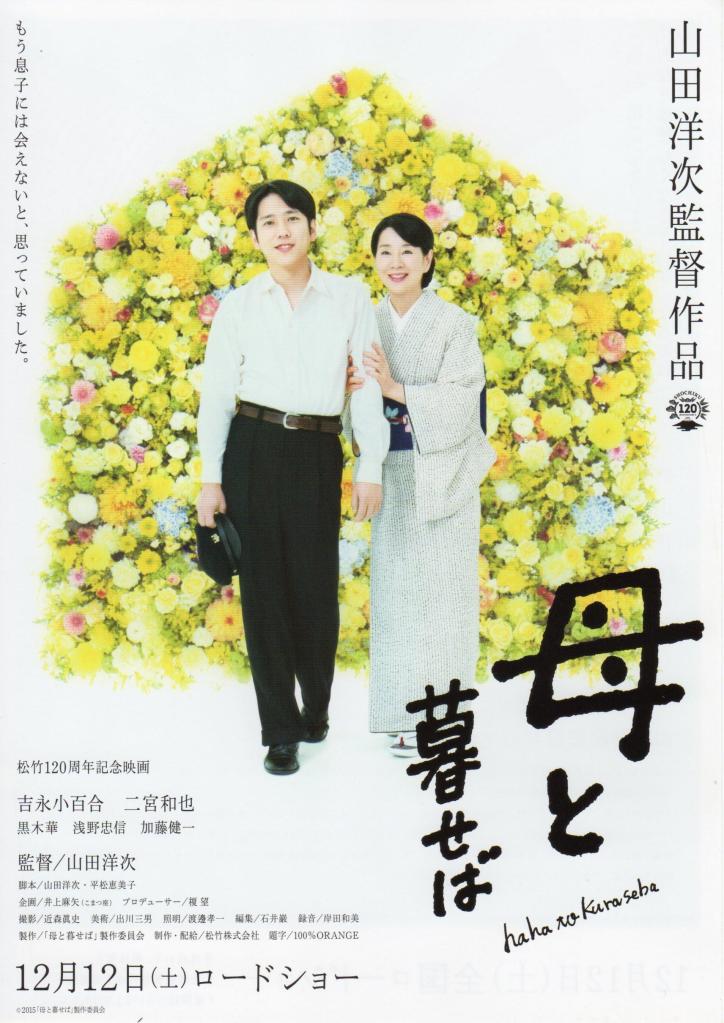
nagasaki-memories-of-my-sonAfter such a long and successful career, Yoji Yamada has perhaps earned the right to a little retrospection. Offering a smattering of cinematic throwbacks in homages to both Yasujiro Ozu and Kon Ichikawa, Yamada then turned his attention to the years of militarism and warfare in the tales of a struggling mother, Kabei, and a young a woman finding herself a haven from the ongoing political storm inside The Little House. Nagasaki: Memories of My Son (母と暮せば, Haha to Kuraseba) unites both of these impulses in its examination of maternal grief set amidst the mass tragedy of the atomic bomb and in the obvious reference hidden inside Japanese title (another Yamada trend) to the 2004 Kazuo Kuroki film The Face of Jizo (父と暮せば, Chichi to Kuroseba), itself based on a play by Hisashi Inoe. Whereas the young woman of Hiroshima found herself literally haunted by the image of her father to the extent that she was unable to continue living in the present, the mother at the centre of Nagasaki is approaching the end of her life but only now, three years after the bombing, is she ready to allow the idea of her son’s death to cement itself within her mind.

Nobuko’s (Sayuri Yoshinaga) son Koji (Kazunari Ninomiya) left as normal on that fateful morning, in a hurry as always, leaping onto the outside of a crowded bus that would take him to the university for a lecture on anatomy. That was three years ago and now it’s August again but in the absence of a body Nobuko has never been able to accept the death of her son, despite the picture on the altar and the two previous trips she’s made to the family grave on this date along with Koji’s girlfriend, Machiko (Haru Kuroki). Finally, Nobuko is beginning to feel it’s time to accept the inevitable, that her son is not lost somewhere and unable to find his way home but in some other world. This grudging acceptance of Koji’s death is the thing which returns him to her as the prodigal son suddenly appears one evening in spirit form to reminisce with his mother about the carefree pre-war days.

Kazunari Ninomiya’s Koji is, appropriately enough, a larger than life presence. A cheerful chatterbox, Koji blusters in to his old family home with the same kind of amusing energy he’d always lent it, laughing raucously to his mother’s polite but strange under the circumstances greeting of “have you been well?”. Reminiscences generally lean towards happier times but each time Koji becomes upset he suddenly disappears again, leaving his mother alone with all her sorrows. Nobuko lost both her sons to the war and her husband to TB and so she is quite alone now save for the kindhearted attentions of Machiko who continues to stop by and help her with house work or just keep her company.

The two women share an intense bond in their shared grief. Almost like mother and daughter Nobuko and Machiko help each other to bear the weight of their loneliness in the wake of such overwhelming tragedy. However, Nobuko is beginning to feel guilty in monopolising the life of this young woman who might have been her daughter-in-law or the mother of her grandchildren by now if things were different. Can she really ask her to sacrifice the rest of her life to a memory? Machiko swears that she has no desire to ever marry, preferring to remain loyal to her true love. “Shanghai Uncle” a black marketeer who brings Nobuko all the hard to find items not available through the normal channels, offers to set up an arranged marriage for the young woman but Nobuko is quick to turn it down on her behalf. In this new age of democracy, she says, young women ought to have the right to choose their own path whatever that may be. Nobuko respects Machiko’s choice, but after talking things over with Koji, urges her to consider letting the past go and honouring Koji’s memory by living fully while there is still time.

Interestingly enough, Machiko’s potential suitor, Kuroda – an injured war veteran and fellow teacher at the school where she teaches, is played by Tadanobu Asano who also played the shy researcher who began to reawaken the heart of the daughter at the centre of The Face of Jizo, Mitsue. Mitsue’s problem was more obviously one of survivor’s guilt, literally haunted by the friendly spirit of her genial father who continually urges her to embrace this last opportunity for happiness, to go on living even whilst others can’t. Nobuko’s journey is almost the reverse as she, essentially, attempts to cleave herself away from her life by ensuring Machiko is taken care of and knows that she has nothing to feel guilty about in seeking happiness even if it can’t be with Koji.

Despite the innovative opening sequence featuring the cockpit and targeting system of the plane which eventually dropped the bomb and the chilling effects sequence as it takes hold, Yamada then reverts to a kind of classical stateliness which is never as effective as Kuroki’s eerie magical realism. Adding in the Christian imagery associated with Nagasaki, the film takes a turn for the mawkish during the final sequence which descends into a series of heavenly cliches from fluffy white clouds to angelic choirs. Warm and melancholy, Nagasaki: Memories of My Son is a poignant exploration of life in the aftermath of preventable tragedy but one which also makes the case for moving on, honouring the legacy of the past with a life lived richly and to the full.


Original trailer (English subtitles)

An Autumn Afternoon (秋刀魚の味, Yasujiro Ozu, 1962)

an-autumn-afternoonAn Autumn Afternoon (秋刀魚の味, Sanma no Aji) was to be Ozu’s final work. This was however more by accident than design – despite serious illness Ozu intended to continue working and had even left a few notes relating to a follow up project which was destined never to be completed. Even if not exactly intended to become the final point of a thirty-five year career, An Autumn Afternoon is an apt place to end, neatly revisiting the director’s key concerns and starring some of his most frequent collaborators.
Returning to the world of Late Spring, An Autumn Afternoon once again stars Chishu Ryu as an ageing father, Shuhei, though this time one with three children – the oldest, a son, married and left home, the middle one a daughter not yet married at 24, and the youngest boy still a student living at home. Michiko (Shima Iwashita), like Noriko, is devoted to the family home and has no immediate plans to marry despite the urgings of her father’s good friend who has already picked out a good prospect for an arranged marriage.

Shuhei had been content with this arrangement, after all as a 50-something man of 1962 he’s in need of someone to look after him and likes having his daughter around the house. A class reunion with some of his friends and an old teacher begins to change his mind when “The Gourd” (as the boys liked to call him) speaks somewhat unkindly of his unmarried, middle-aged daughter, later regretting that he acted selfishly in turning down marriage proposals which came her way because he wanted to keep her at home for his own upkeep. Taking the extraordinarily drunk The Gourd home, Shuhei and his friend encounter the daughter for themselves (as played by frequent Ozu collaborator Haruko Sugimura) and find her just as embittered and shrewish as The Gourd had implied. What they don’t see are her tears of heartbroken frustration at being left all alone to deal with this hopeless case of her dead drunk, elderly father.

At the end of the film, following the inevitable marriage, Shuehei retreats to a friendly bar just as the father of Late Spring had done before him though this time he goes there alone, not wanting to return to his now much quieter home before time. Whilst there the mama-san (Kyoko Kishida) for whom Shuhei has developed a fondness as something about her reminds him of his late wife, notices his attire and asks if he’s just been to a funeral. “Something like that”, he replies. Shuehei is being a little maudlin and self indulgent but what he says is almost true – he has, in a sense, lost a daughter though the Japanese way of doing things does not quite allow for the rejoinder of gaining a son.

All of this is to be expected, it is the best outcome. Time moves on and the baton passes from one generation to the next, one family is broken so that another may be created. Ozu revisited this universally tragic element of the life cycle several times throughout his career and even echoes himself in the final shots as Chishu Ryu sits with his back to the camera, less visibly shaken than in Late Spring but no less bereft. What Ozu gives us next is not the image of transience in the ebbs and flows of a stormy sea, but a parade of emptiness in which Michiko is ever present in her absence. Shuehei is not alone, he has his younger son Kazuo, but the house is now a soulless and colourless place filled with uninhabited rooms and mirrors with nothing to reflect.

In the end, life is defined by this final loneliness as children depart, setting off on a path which has to be entirely their own. The Gourd laments that he is all alone despite having, in part, destroyed his child’s chances of personal happiness in order to maintain his own, but Shuhei and his friends are also left to reflect on the same problem as fathers who’ve each successfully married off daughters only to find themselves rendered obsolete in the new family order. The times have changed, but they have not changed in this. Shuhei is left alone with his memories of youth, trying to bully his sadness into submission by humming a popular military march from his wartime glory days but the pleasures of the past are always hollow and melancholy, at best a mirage and at worst quicksand.

Ozu maintains his trademark style, mixing humour with wistful sorrow, resigned to the inherent sadness of life but determined to find the warmth there too. His sympathies, however, have shifted as he reserves a little of his bite for the modern young couple as exemplified by Shuehei’s oldest son, Koichi (Keiji Sada), and his wife (Mariko Okada) whose concerns are material (refrigerators, vacuum cleaners, handbags and golf clubs) rather than existential as they struggle to attain the “aspirational” quality of life the burgeoning post-war boom promises and have to rely on frequent “loans” from Shuehei to maintain it. The world moves on apace and leaves old sailors behind, alone and adrift on seas now much quieter than they have ever been but the peace and solitude is the sign of a life well lived and in a strange way its reward as the time slips by unhurriedly and only as painful as it needs to be.


Original trailer (no subtitles)

A Silent Voice (聲の形, Naoko Yamada, 2016)

silent-voiceChildren – not always the most tolerant bunch. For every kind and innocent film in which youngsters band together to overcome their differences and head off on a grand world saving mission, there are a fair few in which all of the other kids gang up on the one who doesn’t quite fit in. Given Japan’s generally conformist outlook, this phenomenon is all the more pronounced and you only have to look back to the filmography of famously child friendly director Hiroshi Shimizu to discover a dozen tales of broken hearted children suddenly finding that their friends just won’t play with them anymore. Where A Silent Voice (聲の形, Koe no Katachi) differs is in its gentle acceptance that the bully is also a victim, capable of redemption but requiring both external and internal forgiveness.
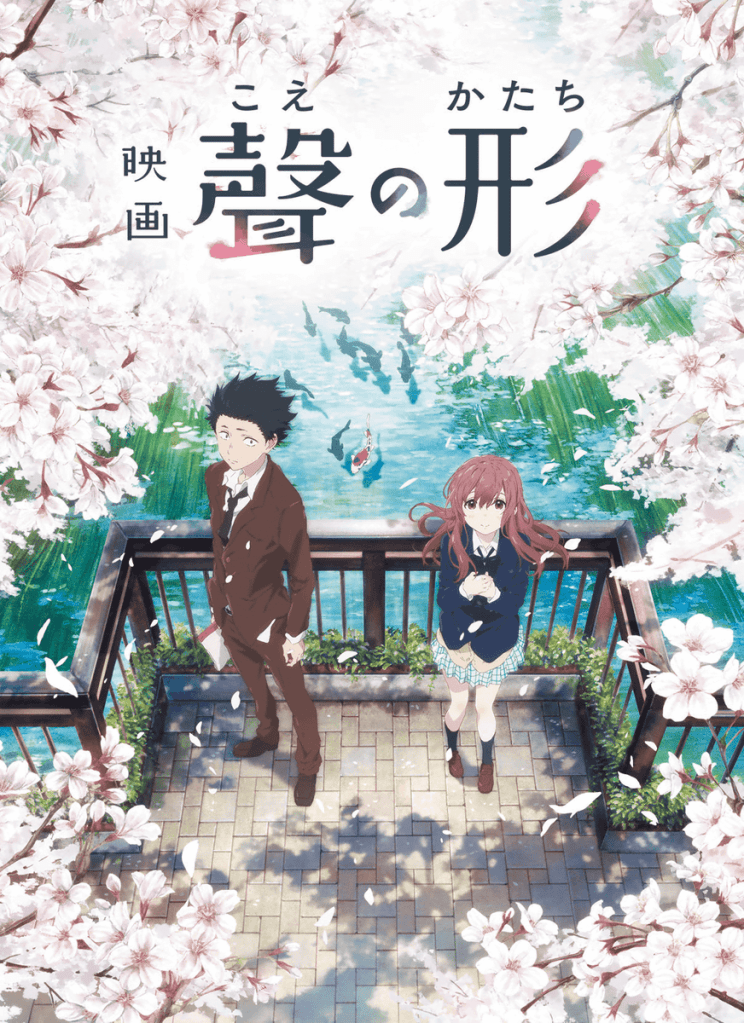
Classmates Shoko (Saori Hayami) and Shoya (Miyu Irino/Mayu Matsuoka) are almost mirror images of each other, sharing the first syllable of their names (at least phonetically) but representing two entirely opposite poles. Before Shoko transferred into his school, Shoya was the class clown, behaving disruptively and acting as the leader of a group of mean kids who, if not exactly bullies, certainly exert a degree of superiority over their meeker classmates. Shoko, hard of hearing, remains necessarily quiet, communicating through messages written on a notepad. Though some of the other pupils are fascinated by the novelty of someone like Shoko suddenly appearing, delighting in writing messages back and for and eagerly embracing the opportunity to learn sign language in order to communicate with her more easily, the mean kids, with Shoya as the ringleader, delight in making her life a misery just because they can.

Though some of the other children object to the way Shoya and the others are behaving, they do little to defend their new friend. Some of the more impressionable kids even halfheartedly join in, perhaps feeling bad about it but also enjoying being part of the angsty pre-teen group of nasty kids, but when it all gets too much and Shoko decides to move on everyone is suddenly struck with remorse and a need to blame someone else for the harm they’ve caused. Hence, Shoya gets a taste of his own medicine, ostracised by his peers as the lowlife who hounded a deaf girl out of school. Who’d want to hang around with someone like that?

Humbled, the stigma follows Shoya on into his next school as feelings of guilt and self loathing intensify until he reaches a point at which he can’t go on. Intending to finally end it all, Shoya unexpectedly runs into Shoko again and eventually manages to make a kind of motion towards an apology, attempting to make friends after all this time and making use of the sign language he’s taught himself to show his sincerity.

Isolated both by the continuing rumours of his primary school days and an intense personal feeling of unworthiness, Shoya finds it impossible to interact with his fellow students whose faces are each covered by a large blue cross. Bonding first with another lonely outcast, Shoya’s world begins to open up again but the spectre of his past continues to haunt him. Reconnecting with some of the other kids from primary school he finds that not everyone remembers things the same way they’ve become engraved in his mind. Though a few are anxious to atone, one of his former friends, Naoka (Yuki Kaneko), takes a different approach to the problem in continuing to blame Shoko – for the “attention” her condition attracts, the “requirement” for others to modify their behaviour to suit her, for simply existing in the first place enabling the behaviour which took place (about which Naoka remains unrepentant), and being the root cause that her merry band of friends fell apart.

If it seems like the tale disproportionately focuses on Shoya’s guilt and and redemption rather than Shoko’s suffering the balance shifts back towards the end as the pair truly mirror each other with another suicide attempt forming the climax of the second act. Shoko responds to her often cruel treatment with nothing other than friendliness, smiling with hands outstretched even whilst continuing to receive nothing but rejection. Though she may seem all smiles and sweetness, her overly genial persona is itself an act as she tries to overcompensate for the “burden” she feels herself to be causing through her need for “special treatment”. Eventually, Shoko snaps – firstly in primary school as her well meaning attempts to bring Shoya over to her side fail once again, and then later in a much more final way as she decides that there is nothing left for her in a world which fails to accommodate for difference.

The story of a girl who struggles to be heard, and a boy who refuses to listen, A Silent Voice is a quiet plea for the power of mutual understanding and reconciliation. Director Naoko Yamada and screenwriter Reiko Yoshida bring the same kind of quirky slice of life humour which made K-On and Tamako Market so enjoyable along with the raw visual beauty which has come to define Kyoto Animation to this often dark tale, perfectly integrating the more dramatic elements into the otherwise warm and forgiving world in a believable and natural way. Nuanced, complicated and defiantly refusing total resolution, A Silent Voice is one of the more interesting animated projects to come out of Japan in recent times and further marks out Yamada as one of its most important animation auteurs.


Screened as part of the Japan Foundation Touring Film Programme 2017.

Original trailer (English subtitles)

The Little House (小さいおうち, Yoji Yamada, 2014)

the-little-houseIf there is a frequent criticism directed at the always bankable director Yoji Yamada, it’s that his approach is one which continues to value the past over the future. Recent years have seen him looking back, literally, in terms of both themes and style with remakes of films by two Japanese masters – Ozu in his Tokyo Story homage Tokyo Family, and Kon Ichikawa in Her Brother. While he chose to update both of those pieces for the modern day, 2008’s Kabei sent him back to the traumatic years of militarism and warfare for a story of maternal sacrifice and national tragedy. The Little House (小さいおうち, Chiisai Ouchi) brings this recent meandering around the past full circle with its deliberately Ozu-esque aesthetic and flashback tale of atonement as one woman leaves the truth she could never bear to speak on paper as a last dying confession.

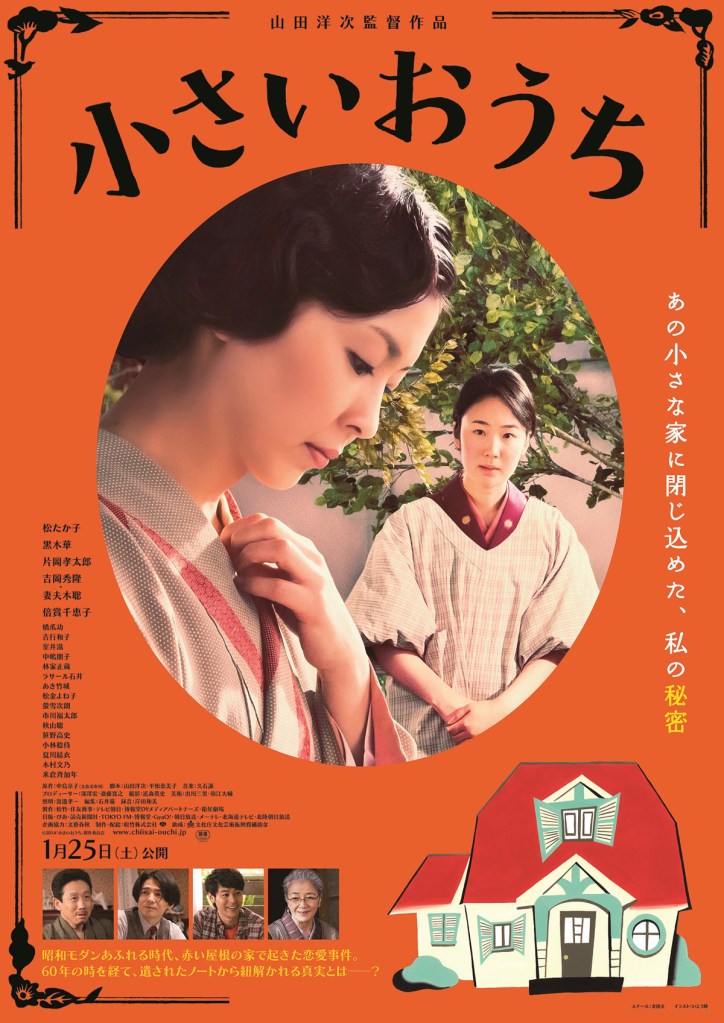
After the death of his great-aunt Taki (Chieko Baisho), who never married and has no other family besides himself, his sister, and father, Takeshi (Satoshi Tsumabuki) discovers a biscuit box with his name on it filled with keepsakes and the conclusion of a kind of autobiography he’d been encouraging Taki to write in the last few months of her life. Cutting back and forth between the contemporary interactions of the older Taki and her great-nephew, and the younger Taki’s (Haru Kuroki) life as a Tokyo maid from the mid-1930s to the end of the war, The Little House takes its cues from The Go Between as an innocent bystander becomes the unwilling guardian of a secret the holding of which will prove to be a lifelong burden.

An 18 year old girl in 1935 from a poor family in Japan’s frozen North, Taki’s options are few – early marriage, geisha house, or maid. All things considered, maid is the best option and Taki is thrilled to be travelling to the big city with all of its untold excitements. After a spell working for a famous novelist, Taki becomes the housekeeper of the “Little House” – a curiously cute Western style cottage with a bright red roof out in the suburbs. Her mistress, Tokiko (Takako Matsu), is an oddly flighty woman, fiercely independent of spirit but living within the confines of her time. Crisis approaches the family not with the onset of war but with the arrival of Mr. Hirai’s sensitive, artistic, colleague, Shoji (Hidetaka Yoshioka), whose softly spoken ways quickly find their way into Tokiko’s heart.

In fact, The Little House, is not a million miles away from an expansion of a similar narrative device previously employed in Kabei but this time Tokiko is no pillar of strength, singlehandedly upholding the traditionally saintly virtues of the Japanese mother but a flesh and blood woman caught in the storm of a turbulent era. Taki becomes our passive observer as she sits, almost invisibly, in the corner of every scene, unwilling chaperone or accidental accomplice. As she witnesses the growing attraction between Tokiko and Shoji begin to spark into something more dangerous she finds herself conflicted, not knowing the best way to help her mistress. Should Tokiko be discovered, it wouldn’t just be a scandal leading to the end of a marriage, but considering the stringency of the times the outcome could be far more serious for all concerned.

When Takeshi eventually meets Tokiko’s son Kyoichi (Masakane Yonekura), he echoes many of the older Taki’s sentiments but adds that it was an era in which everyone was “forced to make an unwilling choice”. Taki finds herself forced to choose between action and inaction and does something she thinks is for the best, but is then forced to live with the suffering of wondering if she did the right thing.

The film does not seem entirely clear on her motives for her choice – it half commits to a possible love triangle between Taki, Tokiko, and Shoji by emphasising Taki and Shoji’s shared Northern roots and by Shoji’s subsequent inclusion of both women in his artwork. Taki, however, seems to be looking more to her mistress than her suitor, wanting nothing other than to stay in the Little House with Tokiko and Kyoichi for evermore. A later scene featuring a “mannish” university friend of Tokiko seems to reinforce the directions of Taki’s unspoken desire, though if her declaration of loyalty to the Little House following a disastrous marriage proposal was intended to voice it, it falls on deaf ears.

This being the case, Taki and Shoji become almost mirrors of each other – each somehow on pause, still living inside the Little House long after it ceased to exist. The loss of the Little House is not just the destruction of a building but the obliteration of everything it stood for, not only in terms of Taki’s investment in the family who live there, but in its evocation of early Showa dreams, individuality and innocence.

As the well educated Takeshi points out, Taki’s memories are often too rosy to tally with the history books, but even given the grimness of the times as they seem in hindsight, she has a right to the romanticism of her youth. The increasingly difficult political circumstances rarely impinge on the female centred domestic environment, but are made felt firstly through the husband’s toy business which begins by chasing the Chinese market and then is reduced to making wooden toys only and trying to marry off its eligible employees to woo more investment, and through the family’s excitement about the upcoming Tokyo Olympic games which are subsequently canceled. Tokiko’s later exclamation of “Isn’t it awful everything’s disappearing” does not just refer to the sudden absence of luxury from soaps to previously ordinary foodstuffs, but to her whole bourgeois way of life suddenly brought crashing down by a series of events she has no control over.

Yamada channels Ozu with initially distracting obviousness both in the contemporary and period sequences, matching his famous compositions from the straight to camera dialogue to the mid level tatami mat view and propensity for shooting through corridors and doorways. The world of the Little House is a curiously artificial one as Yamada shoots on an obvious stage set complete with tiny twinkling lights for stars which both looks forward to the artwork at the film’s conclusion and signals its nature as an unreal, constructed, environment existing only within Taki’s memory. Were it not that the Ozu compositions creep into the contemporary sequences, it could almost be read as a representation of Takeshi’s internal dramatisation of Taki’s memoirs as mediated through classic cinema.

The Little House is, indeed, resolutely old fashioned. Far too subtle for its own good, The Little House is an exercise in restraint in which the central love triangle never even hits the simmer, let alone the boil. Given the well trodden nature of the narrative, even the most inattentive viewer will have correctly guessed the big reveal well before Takeshi puts two and two together, rendering the final explanatory segment entirely redundant. Never quite as affecting as it would like to be, The Little House is a muted experience, perpetually pulling back each time it approaches doing something more interesting with its material. Nevertheless, it does provide an interesting perspective on its period setting as its collection of tragically romantic heroes march forward blindly into a maelstrom of oncoming destruction.


HK trailer (English/traditional Chinese subs)