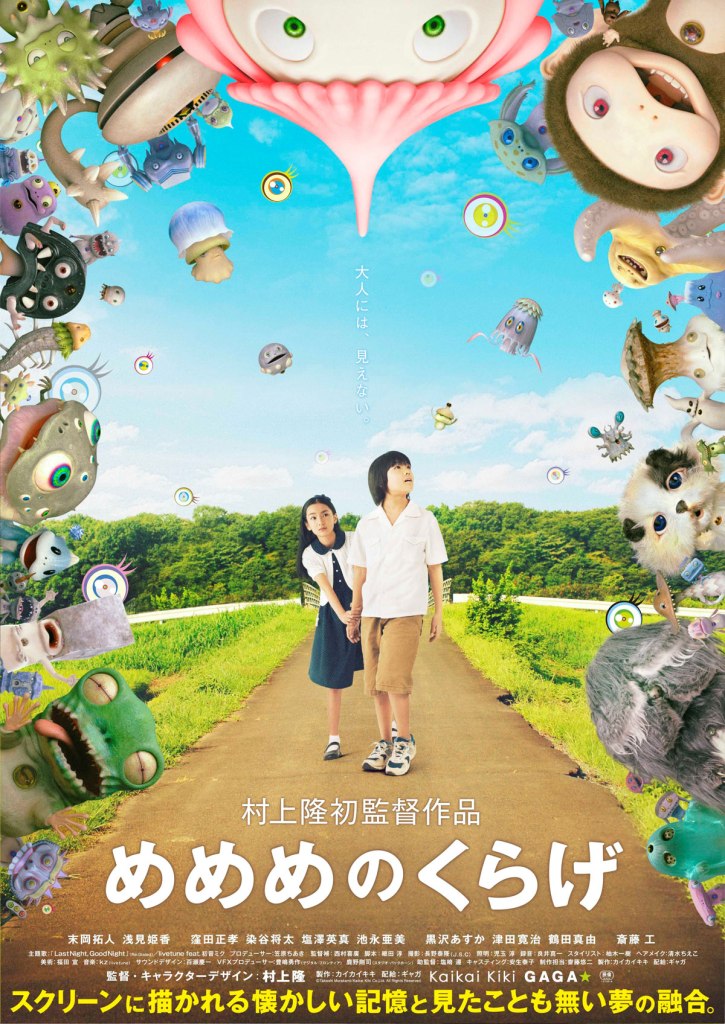
Jellyfish Eyes (めめめのくらげ, Takashi Murakami, 2013)

161244_01Jellyfish Eyes (めめめのくらげ, Mememe no Kurage) is the feature film debut of the internationally popular Japanese artist, Takashi Murakami. Well known for his cutesy character designs which are as likely to turn up in the world’s best regarded art galleries as they are on a kid’s backpack, Murakami is one of Japan’s most highly regarded art exports. Having unsuccessfully tried to raise interest in the more obvious totally CG animation, Murakami has enlisted the help of gore master Yoshihiro Nishimura for some director’s chair tips in creating a live action/CGI hybrid. Jellyfish Eyes is very definitely a kids’ movie, calling it a “family film” seems unfair when the age cut off is most likely around seven or eight years old but those who meet the (lack of) height requirement are sure to lap it up.

The story is set in post-tsunami Japan as Masashi (Takuto Sueoka) has finally moved out of the earthquake evacuation centre with his mother (Mayu Tsuruta) to live in a new town. As it will transpire, the two have moved there alone as Masashi’s father (Kanji Tsuda) has been killed in the tsunami and his mother has a brother (Takumi Saito) in the area. Not long after he moves in, the boy makes a new friend in the shape of a Jellyfish-like creature who floats in the air and loves eating the same kind of snacks as Mashashi. The creature, christened Kurage-bo (Jellyfish Boy), becomes a firm fixture in Masashi’s life and when he arrives at school Masashi realises Kurage-bo is not the only one of his kind. In this strange town all the kids have a weird little creature friend they can control by means of a smartphone app. Predictably some of the meaner boys use them to fight, but could there be a more sinister reason for the appearance of these very odd little guys? and what’s up with the bizarre religious cult that’s located right next to the creepy science lab? This is a very strange town indeed.

The film’s Japanese title, Mememe no Kurage, is a little reminiscent of the master work of the late Shigeru Mizuki, Gegege no Kitaro and like that perennially popular franchise the film focuses on the daily lives of children as they have strange adventures with supernatural creatures. The central premise is that a shady group of black clad scientific researchers (played by Masataka Kubota, Shota Sometani, Hidemasa Shiozawa, and Ami Ikenaga) claim to have found the key to surpassing natural disasters like earthquakes and it relies on the particles generated by the negative emotions of human children. Predictably it’s not long before things go from bad to worse and a giant kaiju-like creature descends on the town requiring the kids to work together to combat the marauding monster before it destroys the entire planet.

To be frank the film sounds a lot more entertaining that it turns out to be. Though undoubtedly very cute and not exactly uninteresting, it all ends up feeling, well, “superflat” only in an unintended way. The photography is generally basic though the CGI itself is of an extremely high quality and perfectly toned to match Murakami’s thematic concerns. Structurally it’s all over the place with the central ideas emphasised a little too strongly only to be thrown out of the window for the sugar rush finale of a million adorable monsters all fighting to the death for their cute as a button sad children masters. There’s quite a lot of darkness and melancholy lurking around the edges but the adorable little critters seem tailor-made for keeping the bad stuff in the background.

Like all good children’s movies the messages are the usual ones about the importance of friendship, sharing, teamwork and doing what’s right but it feels like Murakami has quite a lot of other things to say about reliance on forms of technology (and in particular what that can open the door to) and the state of post earthquake Japan that don’t quite come through. Having said that Jellyfish Eyes boasts some amazing visuals in its adorably cute cast of F.R.I.E.N.Ds and though a little messy is perfectly watchable. A festive treat for younger members of the family, Jellyfish Eyes is full of youthful idealism in the power of simple sincerity and genuine human feeling to win through against even the most terrifying of monsters but ultimately fails to offer much beyond its cutesy visuals.


Here’s a trailer – it says the creatures are invisible to adults but they aren’t (but some of them can make themselves transparent, if that makes sense).

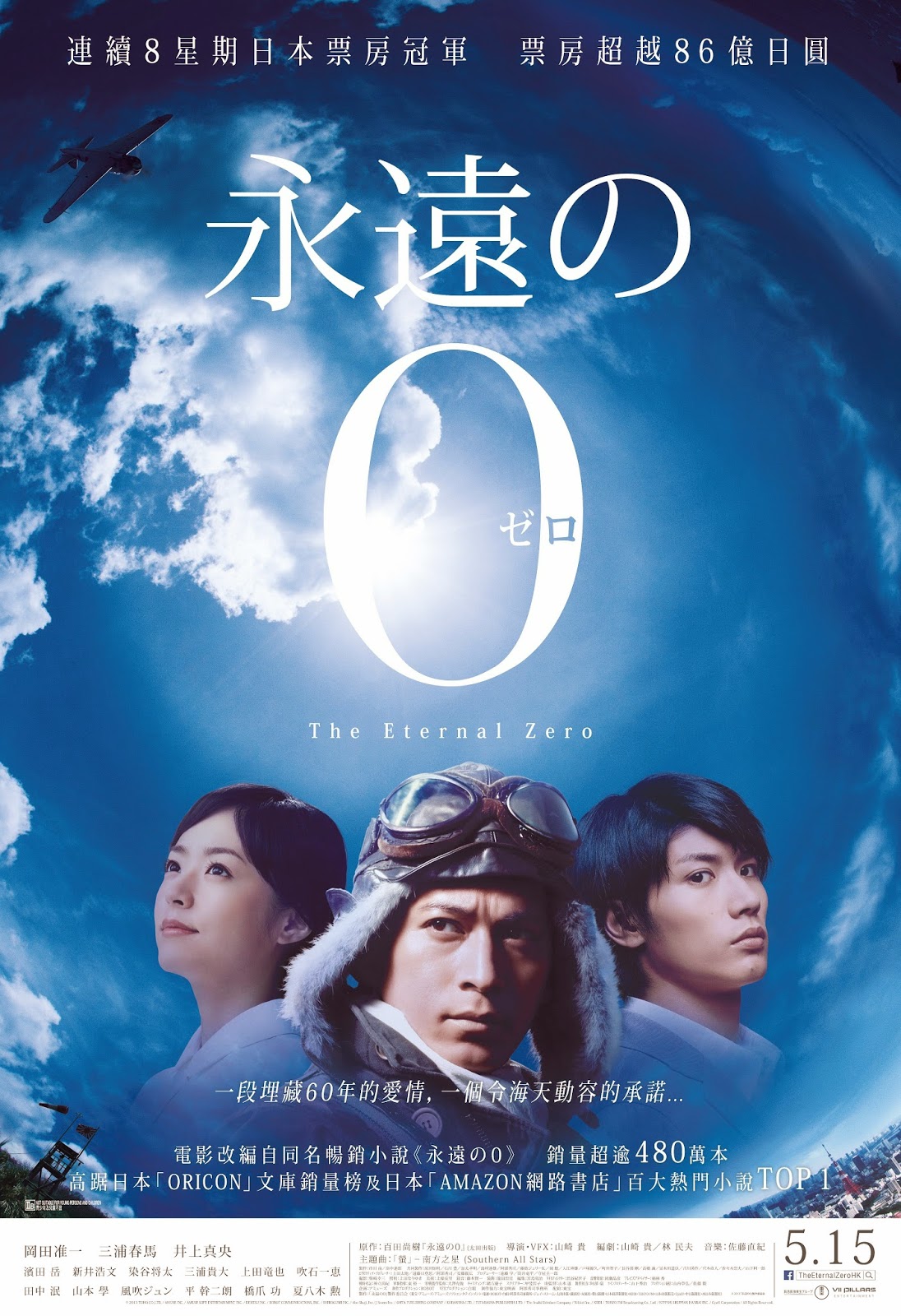
Wood Job! (Wood Job(ウッジョブ)神去なあなあ日常, Shinobu Yaguchi, 2014)

ff20140516a1aHe’s a lumberjack and he’s OK! Well, after a while anyway – climbing trees all day is not quite as much fun as it sounds in Shinobu Yaguchi’s latest comedy which sees a streetwise city kid randomly decide on a career on forestry. Not so much fish out of water as duck in a tree, Wood Job! is a heartwarming comedy drama which more than lives up to the puntastic comedy of its title.

Yuki Hirano is your typical slacker teenager. Like many guys his age, he’s run into something of a life crisis as he didn’t get into university and he hasn’t really thought about what to do. At first he thinks it’s no big deal, he’ll just take the tests again next year but after being abandoned by his girlfriend and seeing all his friends set off without him Yuki feels a little lost. That is until he notices a shiny magazine advertising a new life in the open air – “come and work with me!” it says next to a picture of a pretty girl. Yuki’s packed his bags and caught the next train before you can even say “Where’s the nearest combini”? but his new found occupation is a little more intensive than he was expecting and Yuki’s not sure he’s cut out for this no frills life. Then however he meets the girl from the advert herself – can Yuki really stick around long enough to convince her he’s not some city boy layabout but a real mountain man?

Wood Job! is that rare film that manages to mix a fair amount of slapstick comedy with the kind of naturalistic, everyday humour that can’t help but give it an endearingly warm quality. Taking the classic fish out of water approach as its basis, the film highlights the absurdity of country life (at least to eyes more accustomed to the city) but crucially never mocks it and seems to have a profound respect for the rural way of life and all that entails. Neither does it shy away from the fact forestry is hard work which is often dangerous and requires an extremely specific skill set – you can’t just rock up one day because you’ve seen a picture of a pretty girl on a poster and instantly become a man of the mountains over night. The villagers are all too used to people who turn up in the country with romantic ideas about getting back to the land or living a more simple life but go home after a week or so because they can’t adapt to this very different environment. Already pre-conditioned to expect disappointment, their approval is hard to win but worth all the more because of its rarity.

Yuki Hirano is something of a departure for Sometani who ranks as one of Japan’s most promising young actors. Having hitherto made a name for himself playing “intense” characters, Wood Job!’s laid back slacker couldn’t be more different than the tortured soul of Himizu though Sometani carries off this seeming 180 degree turn with aplomb further proving his versatility as an actor. He’s also surrounded by an equally talented cast including Hideaki Ito (most recently seen as the sociopathic teacher in Lesson of Evil, also alongside Sometani in a small role) as his hard tasking forestry mentor as well as Ken Mitsuishi and Akira Emoto in smaller roles and Masami Nagasaki as Yuki’s longed for poster girl for the world of forestry. Filled with realistically drawn characters near perfectly pitched by its well put together cast, Wood Job! manages to achieve just the right comedy-drama balance which makes some its more outlandish moments seem perfectly plausible.

It may be a very conventional film in many ways, but Wood Job! succeeds in doing what it set out to do incredibly well. Filled with warmth and good humour, director Shinobu Yaguchi manages to breath new life into this old idea to create a charming and engaging tale of the virtues of country life. Any film which manages to pack not one, but two distinct puns into its title alone has to be worth a look but Wood Job! more than lives up to the comedic promise of its name.


This is playing as part of the Japan Foundation Touring Film Programme so it’ll be a bunch of places between now and the end of March including:

  • MAC Birmingham (24th February)
  • Dundee Contemporary Arts (25 February)
  • Tyneside Cinema Newcastle (15th march)
  • Nottingham Broadway (25th March)
  • Brewery Arts Centre Cumbria (25th March).

So if you’re near any of these be sure to check it out! Also because people always say this – if the festival isn’t coming near you it’s most likely not Japan Foundation deliberately snubbing you, get in touch with your local indie cinema and try and convince them to book some of these films. If you don’t have a local indie cinema you’re probably out of luck though as the big chains often won’t take these kinds of special screenings :(. In short, support your local indie (or a not so local one if it’s your only option).

http://www.youtube.com/watch?v=ypQi69XGs6U

Review of the forestry themed comedy Wood Job! up at UK Anime Network. I love how many puns they managed to pack into the title of this film, it wins just for that.

The Eternal Zero 永遠の0

eternal_zero

It’s difficult to think of a recent film that’s caused quite as much controversy as The Eternal Zero (save perhaps Hayao Miyazaki’s own World War II epic The Wind Rises). Written by a right wing pundit and close ally of current Japanese prime minister Shinzo Abe, Naoki Hyakuta, The Eternal Zero definitely has an ambiguous stance on several things that most people just don’t really want to talk about. However, it would also be fallacy to pretend that anybody else’s war movies are completely unbiased, or willing to look at the complexities of any given war beyond jingoistic drum beating which has often been the point of a war film. In truth, The Eternal Zero is actually more or less a-political for most of its running time save a possibly misjudged epilogue which does its best to undo the entirety of the film’s message up until right before the fatal flaw. Setting politics to one side, how does The Eternal Zero fare when it comes to taking this most American of subjects, in the most American of ways? Pretty OK, to be frank, not bad at all.

Like a lot of Japanese films tackling the recent past, the film starts in the present with little lost boy Kentaro (Haruma Miura) attending the funeral of his grandmother whereupon he discovers the heartbroken man he’d assumed to be his biological grandfather (Isao Natsuyagi) was in fact his grandmother’s second husband and not his mother’s true father at all. Mind truly blown, Kentaro is talked into further investigations by his older sister in which he discovers his biological grandfather was an air force pilot who died in a kamikaze mission during the war. On talking to some of his fellow officers, Kentaro and sister first hear that their grandfather was a coward, a supposedly skilled pilot who hid in the clouds during sorties and endangered the lives of his comrades through his negligence. Until that is, they chance upon those closest to him who tell a different story – that Kyuzo Miyabe (Junichi Okada) was the bravest of men. A man who knew the war was pointless and wasn’t afraid to say so, who simply wanted to survive and get back to protecting what was most important to him – his wife and child. Why then, would this man who was so desperate to survive finally give his life in a suicide mission for something he did not believe in?

To deal with the most obvious question first – no, The Eternal Zero is not “a propaganda film” in the truest sense of the term. Yes, it ignores the external context because it simply wants to focus on the nature of war and what it does to those who conduct it (as well as those who only stand and wait) which *is* a form of propaganda in a sense because of all the things that it refuses to acknowledge. However, for 90% of the running time, the film has a thoroughly modern sensibility where the overriding feeling is absurdity, that this war is a crazy waste of youth that no one should have to have gone through. The original group of pilots that brand Miyabe a “coward” are shown up for a group of brainwashed idiots and Miyabe portrayed as the soul prophet who sees things as they are and has the courage to speak his mind. Later, there are other headstrong boys who think they’re men and don’t understand what they’re getting themselves into but the main thing is just how stupid all of these ideas of honour and sacrifice really are when all it will likely mean is leaving destitute women crying and starving at a home you’ve failed to protect. However, all of these more “liberal” ideas are totally undercut in the last five minutes of the film which seeks to glorify an act that the previous two hours have branded an idiotic waste of life. Politically confused, Eternal Zero doesn’t quite know where to put itself when acknowledging the tremendous sacrifice that was made by an entire generation without quite wanting to see just what those sacrifices were in name of.

To be fair to it, it isn’t as if most most Hollywood war movies don’t also do the same thing to a similar extent – present the heroism and perhaps the personal conflict without acknowledging all that goes with it. In truth, what The Eternal Zero most resembles is a classic Hollywood war film which is quite invested in remorse for the loss of life (and sometimes even for that on all sides) but also in not wanting feel any lives were lost in vain. Thus there is a feeling towards the end of the film that young people of today still owe a debt to these men, that they owe it to them in return for the sacrifice that was made to live their lives freely and to the utmost. To spend so long saying that war is a cruel game that makes pawns of young men’s lives only to turn around and say it’s the job of the youngsters of today to make those pawns kings is a little perverse, but understandable on a human level.

The Eternal Zero is blockbuster movie in every sense, the budget and shooting style are also aping your typical Hollywood epic though doing it fairly well. The script is clunky with its inelegant switching between time periods and to be frank the entire “modern” section feels a little superfluous and underwritten.  It’s a little long at over two and a half hours and does occasionally fall into a televisual rhythm – there is a great deal of talking and explaining which probably would have had more impact if it were done in a less bald way. Nevertheless, what The Eternal Zero sets out to do, it does pretty well. It may speak to something dangerous, but it is not dangerous in and of itself. For the most part excellently filmed with its fair share of stand out sequences, The Eternal Zero will appeal most to fans of old-fashioned (and uncomplicated unless you want to really think about it) war films but may struggle to maintain the interest of more jaded viewers.

Brain Man 脳男

imgnewly1-187l

Based on the Edogawa Rampo award winning novel by Urio Shudo, Brain Man is a stylish psychological thriller which addresses such themes as guilt, redemption and the effects of childhood trauma. Are some people just born bad, can even those who’ve committed terrible crimes be rehabilitated? People on opposite sides of the legal system seem to have some conflicting ideas but perhaps the answer is never going to be as simple as ‘yes’ or ‘no’.

While a series of explosions rock a small provincial town, forensic psychologist Mariko Washiya (Yasuko Matsuyuki)  is the head of a research programme which aims to help convicted felons come to terms with their crimes through interacting with the victim’s families and there by coming to feel a kind of empathy for all the hurt and destruction they have caused. After leaving the office one day she races to catch the bus only to miss it by seconds while a bunch of bratty kids make faces through the window. Moments after the bus pulls away, it explodes killing all on board. Becoming an unwitting witness to events, Mariko finds herself at odds with the hardline policeman investigating the crime. When the police arrest the perfect suspect, a strange, near silent man discovered at the site of an explosion, Mariko is called upon to examine him. Ichiro Suzuki (Toma Ikuta) presents himself robotically, answering each of Mariko’s questions at face value no matter how strange and otherwise remaining motionless. That is, until something disturbs his sense of justice and he breaks out some killer martial arts moves. As might be expected, nothing is quite as cut and dried as it might seem on the surface and something convinces Mariko that there might be something more ‘human’ locked away deep down in Ichiro’s psyche.

First and foremost Brain Man is pretty mainstream thriller which means it isn’t totally free of a few melodramatic turns and far fetched plot developments but by and large it gets away with them. The first plot line centred around the bombings quickly gives way to the mystery surrounding Brain Man himself before getting back to the bombers towards the end. The two narrative strands sometimes seem at odds with each other and don’t feel as cohesive as they perhaps should. Though having said that though the “bombers” plotline is definitely the film’s second strand it gives ample room for Fumi Nikaido’s gloriously crazed depiction of a drug addled lesbian terrorist which she manages to play in a refreshingly restrained way (well, as far as the part allows – it is a particularly well pitched performance). There is also even a third subplot regarding Mariko’s prestige project of a young man who’s shortly to be released from a young offenders institute (played by Shota Sometani) seemingly rehabilitated and eager rejoin society all thanks to Mariko’s new therapy program which plays in conjunction with a fourth subplot concerning Mariko’s family and its own past traumas. Undoubtedly, there’s a lot to juggle but Brain Man makes a surprisingly valiant attempt at getting it all to work together.

Director Tomoyuki Takimoto is probably best known for his previous film Ikigami: The Ultimate Limit – a low budget though similarly impressive adaptation of a manga. Brain Man has a slightly higher budget and its fair share of flashy direction both of which impress from the get go. Even more so Takimoto has amassed a cast of up and coming stars who each turn in well rounded performances ranging from the completely out there extremes of the aforementioned Fumi Nikaido to Shota Sometani’s small but complicated patient and, of course, Toma Ikuta’s powerful portrayal of the near silent and emotionless killing machine the Brain Man not to mention Yasuo Matsuyuki’s warm hearted doctor.

Although a little slow to get going initially and excusing the odd lacuna brought about by throwing the points on the great train track of narrative, Brain Man manages to pack in a decent amount of excitement into its relatively tightly plotted structure. In many ways it isn’t particularly original, but it does what it does pretty well and mixes in enough twists and turns to keep even the most jaded mystery enthusiast interested. Perhaps a little bit too crazy for its own good, Brain Man is another classy Japanese thriller that isn’t afraid that isn’t afraid to go to some pretty strange places in the name of entertainment.

The Snow White Murder Case (白ゆき姫殺人事件, Yoshihiro Nakamura, 2014)

Review of The Snow White Murder Case (白ゆき姫殺人事件, Shiro Yuki Hime Satsujin Jiken) published on UK-anime.net


The sensationalisation of crime has been mainstay of the tabloid press ever since its inception and a much loved subject for gossips and curtain twitchers since time immemorial. When social media arrived, it brought with it hundreds more avenues for every interested reader to have their say and make their own hideously uniformed opinions public contributing to this ever growing sandstorm of misinformation. Occasionally, or perhaps more often than we’d like to admit, these unfounded rumours have the power to ruin lives or push the accused person to a place of unbearable despair. So when the shy and put upon office worker Miki Shirono (Mao Inoue) becomes the prime suspect in the brutal murder of a colleague thanks some fairly convincing circumstantial evidence and the work of one would-be microblogging detective, the resulting trial by Twitter has a profound effect on her already shaky sense of self worth.

The body of Miki Noriko (Nanao) has been found in a wood burned to a crisp after being viciously stabbed multiple times. Beautiful, intelligent and well connected, Noriko seems to have been well loved by her colleagues who are falling over themselves to praise her kind and generous nature, proclaiming disbelief that anyone would do such a thing to so good a person. One of these co-workers, Risako (Misako Renbutsu), happens to have gone to school with TV researcher, Akahoshi (Go Ayano) who’s a total twitter addict and can’t keep anything to himself, and decides to give him the lowdown on the goings on in her office. Apparently the offices of the popular beauty product Snow White Soap was a hotbed of office pilfering filled with interpersonal intrigue of boy friend stealing and complicated romantic entanglements. Working alongside Noriko and Risako was another ‘Miki’, Shirono (Mao Inoe), who tends to be overshadowed by the beautiful and confident Noriko who shares her surname. Shy and isolated, Shirono seems the archetypal office loner and the picture Risako paints of her suggests she’s the sort of repressed, bitter woman who would engage in a bit of revenge theft and possibly even unhinged enough to go on a stabbing spree. Of course, once you start to put something like that on the internet, every last little thing you’ve ever done becomes evidence against you and Shirono finds herself the subject of an internet wide manhunt.

In some ways, the actual truth of who killed Noriko and why is almost irrelevant. In truth, the solution to the mystery itself is a little obvious and many people will probably have encountered similar situations albeit with a less fatal outcome. Safe to say Noriko isn’t quite as white as she’s painted and the film is trying to wrong foot you from the start by providing a series of necessarily unreliable witnesses but in many ways that is the point. There are as many versions of ‘the truth’ as there are people and once an accusation has been made people start to temper their recollections to fit with the new narrative they’ve been given. People who once went to school with Shirono instantly start to recall how she was a little bit creepy and even using evidence of a childhood fire to imply she was some kind of witch obsessed with occult rituals to get revenge on school bullies. Only one university friend stands up for Shirono but, crucially, she is the first one to publicly name her and goes on to give a lot of embarrassing and unnecessary personal details which although they help her case are probably not very relevant. Even this act of seeming loyalty is exposed as a bid for Twitter fame as someone on the periphery of events tries to catapult themselves into the centre by saying “I knew her – I have the real story”.

Of course, things like this have always happened long before the internet and social media took their primary place in modern life. There have always been those things that ‘everybody knows’ that quickly become ‘evidence’ as soon as someone is accused of something. Some people (usually bad people) can cope with these accusations fairly well and carry on with their lives regardless. Other people, like Shirono, are brought down in many ways by their own goodness. What Risako paints as creepy isolation is really mostly crippling shyness. Shirono is one of those innately good people who often puts herself last and tries to look after others – like bringing a handmade bento everyday for a nutritionally troubled colleague or coming up with a way for a childhood friend to feel better about herself. These sorts of people are inherently more vulnerable to these kinds of attacks because they already have an underlying sense of inferiority. As so often happens, this whole thing started because Shirono tried to do something she already thought was wrong and of course it turned into a catastrophe which resulted in her being accused of a terrible crime. The person who manipulated her into this situation likely knew she would react this way and that’s why meek people like Shirono are the ultimate fall guy material.

Like Yoshihiro Nakamura’s previous films (Fish Story, The Foreign Duck, The Native Duck and God in a Coin Locker – both available from Third Window Films), The Snow White Murder Case is full of intersecting plot lines and quirky characters and manages to imbue a certain sense of cosmic irony and black humour into what could be quite a bleak situation. The Twitter antics are neatly displayed through some innovative on screen graphics and the twin themes of ‘the internet reveals the truth’ and ‘the internet accuses falsely’ are never far from the viewer’s mind. It’s testimony to the strength of the characterisation (and of the performances) that Shirono can still say despite everything she’s been through ‘good things will happen’ in attempt to cheer up someone who unbeknownst to her is the author of all her troubles, and have the audience believe it too. A skilful crime thriller in which the crime is the least important thing, The Snow White Murder Case might quite not have the emotional pull of some of the director’s other work but it’s certainly a timely examination of the power of rumour in the internet age.


Original trailer (English subtitles)