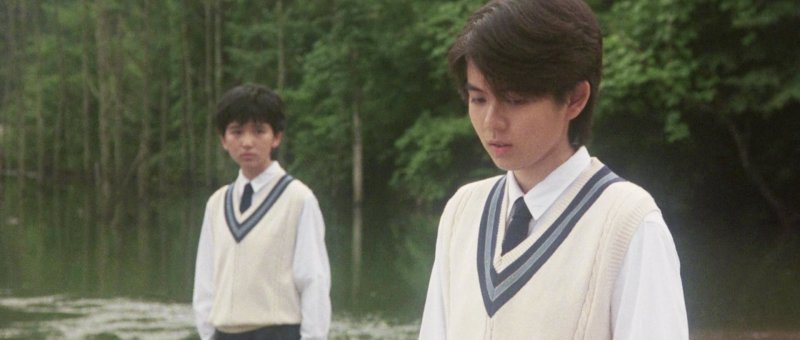
Summer Vacation 1999 (1999年の夏休み, Shusuke Kaneko, 1988)

The curious thing, or perhaps a curious thing among many, about Shusuke Kaneko’s loose adaptation of Moto Hagio’s The Heart of Thomas Summer Vacation 1999 (1999年の夏休み, 1999 Toshi no Natsuyasumi) is that it takes place in a theoretical future that is also quite clearly an imaginary past. In a second introductory sequence, the voice of an adult man tells us that his is his memory, a fragment of the past kept alive by the clarity with which he remembers it. We don’t know who this voice belongs to, though the images encourage to think it must be the man the boy on screen, like the others played by a girl, will one day become but in another sense this boy doesn’t really exist either or at least is the bearer of several different identities.

The fact he travels to this remote mansion in the countryside on an otherwise empty train signal’s the place’s unreality and detachment from the regular world. We’re told it’s 1999, a year that was still to come on the film’s release in 1988, and inevitably hints at a millennial dread along with the new dawn the writer describes himself having in experienced in what is otherwise a summer holiday movie. However, in the opening sequence we witnessed a boy who looked very like this one slip what is later assumed to be a suicide note under another boy’s door before walking through the gothic space of the country mansion and out to a rugged cliff where he takes his own life by jumping into a nearby lake. The name of the boy who died, apparently brokenhearted and filled with despair after his romantic overtures to another boy were rebuffed, was named Yu (Eri Miyajima). This one claims his name is Kaoru (also Eri Miyajima) and is different in temperament in character to the boy who may have died, his body has not been found, though to the others staying at the school over the summer holiday he seems somehow like a vengeful ghost arriving to take them to task for Yu’s death. 

Kaneko specifically frames the school as haunted through the gothic photography of its billowing curtains and 19th century European aesthetics but also through its emptiness. The sound of children laughing, the boys who have left and returned somewhere else, echo through empty corridors further framing it as a place of memory and it seems true enough that the other boys who remain are trapped here in the same way they are trapped within themselves in their inability to express their emotions. The youngest of the boys, the sensitive Norio, (Eri Fukatsu) intensely resents Kazuhiko (Tomoko Otakara) who is as he describes beloved by all but himself cannot bear to be loved and may have contributed to Yu’s suicide through the abruptness of his romantic rejection. 

Later Kazuhiko recalls a memory of himself watching the sunset as a child in which he felt so terribly alone, as if he were the only person left on earth and there was no one with whom he could share this beauty. This sense of loneliness and isolation is further symbolised by the remote nature of the boarding school which seems to exist outside of time itself. Inspired by the setting of the novel, the boys dress in a fashion more associated with 19th century aristocracy than the late 1980s yet they are surrounded by machines and makeshift, retro futuristic technology in which they spend their days programming some kind of computer system. The leap into the lake is also into memory, but otherwise a kind of rebirth or rebaptism which allows Kazuhiko to make sense of himself and the other boys to come to an acceptance of Yu, Kaoru, and everything he embodies in relation to themselves. 

Even so, the elliptical nature of the film’s ending hints that this is a continually looping story replaying endlessly in the memory of a now much older man recalling the journey into adolescence in which he ruptured the shell of his ignorance much as the caterpillar becomes a butterfly even if that butterfly was something that Kaoru wanted to kill without harming its beauty. Perhaps in away that’s what the man has done in preserving this memory with its all of its gothic shades of billowing curtains and shadowy corridors amid the ethereality of the twilight of youth.


Summer Vacation 1999 screened as part of this year’s Queer East.

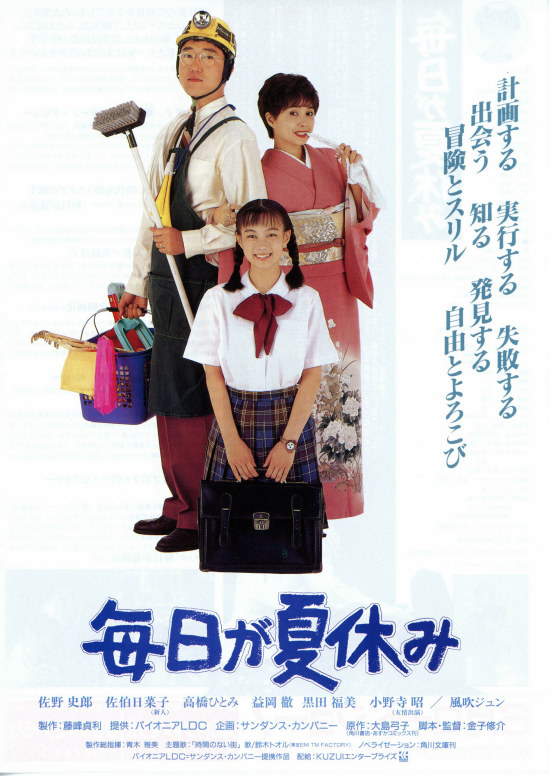
Summer Holiday Everyday (毎日が夏休み, Shusuke Kaneko, 1994)

Summer Holiday EverydaySummer Holiday Everyday – It’s certainly an upbeat way to describe unemployment but then everything is improbably upbeat and cheerful in the always sunny world of Shusuke Kaneko’s adaptation of Yumiko Oshima’s shoujo manga. Published in the mid-bubble era of 1988, Oshima’s world is one in which anything is possible but by the time of the live action movie release in 1994 perhaps this was not so much the case. Nevertheless, Kaneko’s film retains the happy-go-lucky tone and offers note of celebration for the unconventional as a path to success and individual happiness.

Told from the point of view of 14 year old Sugina (Hinako Saeki) who offers us a voiceover guide to her everyday life, Summer Holiday Everyday (毎日が夏休み, Mainichi ga Natsuyasumi) follows the adventures of the slightly unusual Rinkaiji family. Sugina’s mother is divorced from her father and has remarried a successful salary man, himself a divorcee, ten years ago. The family lives in fairly peaceful domesticity and Sugina’s mother, Yoshiko (Jun Fubuki), even remarks how glad she is that her daughter gets on so well with her step-father, Nariyuki (Shiro Sano), though Sugina claims this is largely because she can’t remember actually speaking to him very much over the last ten years.

The pair are about become closer though it risks tearing their perfectly normal family apart. Sugina has been skipping school due to bullying and spends her days in the local park where, unbeknownst to her, her step-father has also been wasting his days after quitting a job he could no longer stand. After getting over the embarrassment of this accidental encounter, Sugina and Nariyuki confess everything to each other and Nariyuki makes a bold decision. Sugina can quit school (seeing as her grades were terrible anyway) and come work with him in his new enterprise – the Rinakaiji Heart Service, helping the community 24/7 with assistance in those difficult to handle odd jobs everyone needs doing.

Quitting a lucrative and secure job for the risk associated with staring a new business is a difficult decision in any society but is more or less unthinkable in Japan. Yoshiko is beyond stunned by her husband’s decision, not to mention the fact that her daughter has been deceiving her by skipping school and faking her report cards to make it look like her grades were much better than they are. Immediately worrying about what the neighbours will think, Yoshiko finds it hard to deal with the embarrassment of her husband and teenage daughter going door-to-door and doing menial work in the community, especially when she overhears the snickers of gossipy housewives in the local supermarket. For Yoshiko, whose sense of self worth was bound up with having a successful husband employed at a top tier company, Nariyuki’s sudden lurch towards individual freedom has destabilised her entire existence. Her world ceases to make sense.

Yoshiko’s sense of displacement is deepened when the fledgling company’s second job offer comes from Nariyuki’s ex-wife. Beniko (Hitomi Takahashi) left Nariyuki for another man because she failed to appreciate Nariyuki’s gentle charms and he was too mild mannered to fight for his wife even if he loved her deeply. What’s more, Nariyuki’s unconventional approach to life has earned him a spot in the papers and brought the family back to the attention of Sugina’s father, Ejima (Akira Onodera).

Early on Nariyuki states that life’s true radiance is only visible through suffering and later says that pain and suffering are essential parts of human existence. Nariyuki, now making a stand for himself for the first time in his life, remains philosophical in the face of hardship though perhaps has more faith in Yoshiko’s ability to follow him down this untrodden path than was wise. As a son and then a husband, Nariyuki may be a methodical sort but he’s unused to the idea of caring for himself as his comical attempts at doing the housework show. After almost burning the house down several times, Nariyuki does indeed figure out an efficient way of managing the household chores and seeing to Sugina’s education whilst also allowing his wife become the family breadwinner. However, Yoshiko’s new line of work is one she finds both unpleasant and degrading and she probably hoped that Nariyuki would strenuously try to stop her doing it so it’s not quite as much of a progressive approach as might be hoped.

After countless setbacks, humorous adventures, and a major fire Nariyuki’s enterprise begins to catch on. Brought together in shared crisis, the family unit only becomes stronger and more committed to their shared destinies. In fact, the family expands as Sugina rebuilds her relationship with birth father and even gains a new aunt figure in the form of her step-father’s youthful ex-wife. When you love what you do everyday is a holiday, and Sugina’s path, unconventional as it is, is one that leads her into the sunlight guided by Nariyuki’s oddly philosophical wisdom.


Original trailer (no subtitles)

The Family Game (家族ゲーム, Yoshimitsu Morita, 1983)

TFG_DVD_jk_ol“Why do we have to make such sacrifices for our children?”. It sounds a little cold, doesn’t it, but none the less true. Yoshimitsu Morita’s 1983 social satire The Family Game (家族ゲーム, Kazoku Game) takes that most Japanese of genres, the family drama, and turns it inside out whilst vigorously shaking it to see what else falls from the pockets.

The “ordinary” middle class Numata family consists of the salaryman father Kosuke, the regular housewife mother Chikako and their two sons – older brother Shinichi and younger brother Shigeyuki. Right now the focus of attention is very much on Shigeyuki as he approaches the difficult period of sitting entrance exams for high school. To be frank, Shigeyuki’s prospects are dismal. He ranks near the bottom of the class and though certainly bright has little interest in studying. Therefore, the family have decided to bring in a home tutor to help boost his grades. They’ve already tried several to no avail but have high hopes for Mr. Yoshimoto, a local university student, but little do they know that he’s going to end up teaching each of them a little more than they cared to learn.

Morita breaks down the modern family into its component parts and finds only archetypes representing the kinds of roles which are rigidly enforced by Japan’s conformist society. Let’s start with the “father” who is supposedly the head of the household yet barely has anything at all to do with it. He believes his role is simply to go to work and shout commands which his “family” are supposed to follow unquestioningly. His realm is everything outside the house, everything inside is the responsibility of his wife and he won’t in any way get involved with that. When he has a problem with the kids (and this problem will only be that they aren’t performing to expectation), he will tell his wife and she is expected to take care of it on her own. Of course, his authority is hollow and dependent on his family falling in with his preconceived ideas of their “individual” roles.

The wife, then, is more or less a glorified housekeeper in charge of domestic arrangements and expected to remain within the home. Barked at by her husband and treated like a servant by her own children, her existence is often a fairly miserable one. She remarks that she wishes she’d had her children later – there were so many things so wanted to do that now are denied her because she’s forced to “play the role” that’s expected of her as a wife and mother.

Of the two kids, the older brother, Shinichi, starts the film as the one who plays his pre-ordained role to the level that’s expected of him. He’s a bright boy who studies hard and got into the top high school no problem. As the film goes on and everyone’s obsessed with Shigeyuki, Shinichi’s mask begins to drop as he encounters various typically teenage phenomenons which interfere with his role as over achieving big brother.

Shigeyuki, however, refuses to play the game at all. He just does not care. He loves to get under people’s skin and takes pleasure in annoying or outsmarting them such as when he cons his mother into letting him skip school (his pancreas hurts!) which she lets him do probably knowingly because she’s still playing her role as the worried mother. Finally he only begins to study when he realises it annoys a fellow pupil when his grades improve.

When tutor Yoshimoto enters the picture he tears a great big hole through the centre of this perfect family photo. He starts by behaving very strangely with Mr. Numata by grabbing his hand and calling him “father” whilst leaning in far too close for a casual acquaintance. Similarly when he first meets Shigeyuki he leans right in and then remarks that he has “a cute face”. He proceeds to invade Shigeyuki’s physical space by regularly touching him to a degree which is odd for a teacher/pupil relationship and is almost a prelude to molestation. When Shigeyuki tries to troll him by filling pages of his notebook with the same word over and over again, Yoshimoto reacts coolly before punching him in the face. From now on, when Shigeyuki isn’t pulling his weight, he’ll get a bloody nose.

Gradually Yoshimoto begins to take over the parental roles of the household firstly by instigating the masculine discipline through violence that Mr Numata is never there to deal out as well as offering the original role of teacher/mentor which might ordinarily be found in a grandfather or uncle. Later he usurps the big brother’s place by trying to talk frankly about sex and teaching Shigeyuki how to defend himself against playground bullies which also helps the boy cement a friendship with a sometime rival. Finally, he takes on the maternal mantle too when Mrs Numata asks him to go down to the school and talk to Shigeyuki’s teachers on her behalf. By the time that his original mission is completed he’s well and truly infiltrated the household allowing him to, literally, overturn its sense of stability.

Morita’s screenplay is witty affair full of one liners and humour born of unusual frankness. Family is a fake concept which forces each of its members into predefined roles and is largely divorced from genuine feeling. What matters is the appearance of normality and the acquisition of status – i.e getting into the better university, not so much as a path to success but as a way of avoiding the embarrassment of not getting there. An absurdist social satire, The Family Game is a biting critique of the social mores of the early 1980s which punches a gaping hole through the foundation of traditional Japanese society.