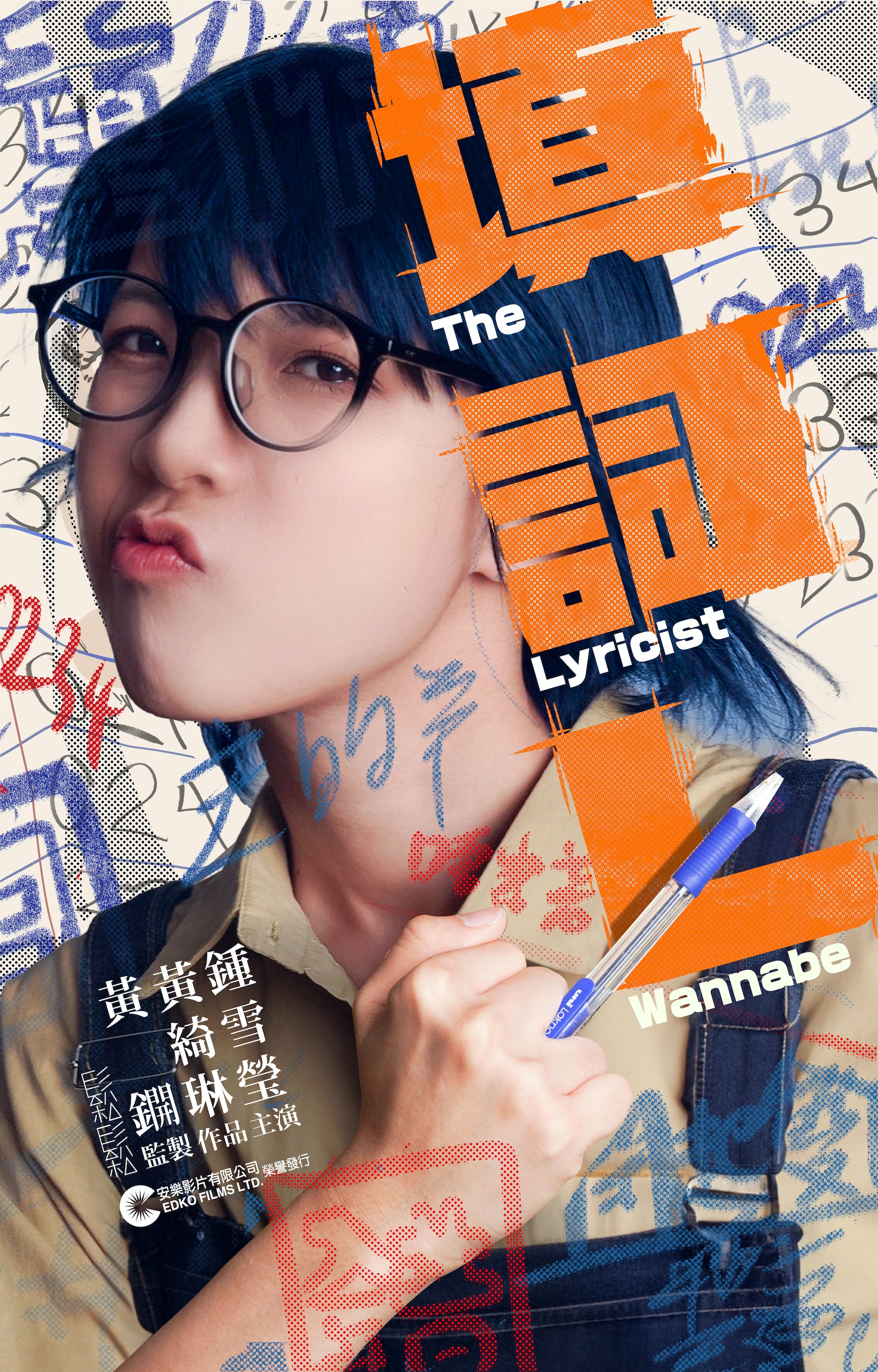
The Lyricist Wannabe (填詞L, Norris Wong, 2023)

Sometimes a dream might have come true only we never really noticed. In Norris Wong’s autobiographically inspired drama The Wannabe Lyricist (填詞L), a young woman battles her way towards becoming a Cantopop songwriter yet perhaps she already is one by virtue of her constant act of lyric writing. What she craves is the validation of having a song published, yet experiences setbacks at every step of the way that encourage her to doubt her talent or the right to continue chasing her dreams.

At a particularly low point after being taken on by a music producer to work with a spoilt influencer who’s getting studio time as some kind of favour, Sze (Chung Suet Ying) is told that her lyrics are no good and that after struggling so hard for six years perhaps she ought to take the hint and accept she isn’t suited to this line of work. It’s an act of intense cruelty, though one in part motivated by a well-meaning faux pas. In her excitement, she told the influencer she’d write lyrics for her album for free just to be published, but the palpable sense of desperation seems to have put the influencer off unable to have confidence in the work that Sze herself has devalued.

She encounters something similar during a partnership with an aspiring pop star who says he likes her lyrics but then drops the bombshell that he plans to sing in Mandarin because it’s a bigger audience. Ironically, on a trip to Taipei to sell his album she’s told that his accent is no good for the local market and while they like the song she worked on she later realises that they hired another lyricist for “real” release without even telling her. What’s more, tones don’t matter while singing in Mandarin whereas lyric writing in Cantonese is a painstaking process of trying to ensure that the tone of the word fits the melody. Aside from its political implications, not only does the pop star’s arbitrary decision to just sing it Mandarin ruin the lyrical flow she spent so long perfecting but entirely disrespects her work.

After deciding to take a break from trying to make it in music, Sze gets a job working at a ridesharing app startup where she’s roped in to create a jingle but once again her hopes are dashed when the business strays into a legal grey area and several of the drivers are arrested. While the app’s creator silently cries in his office, his female colleague ponders going somewhere else, “anywhere that doesn’t punish dreamers” which seems like a nod not only towards an oppressive capitalism that values only marketability but equally the increasingly oppressive atmosphere of the nation’s political realities. In a way this is what Sze ends up doing too, putting geographical distance between herself and the failure of her dreams by returning to the land which as the farmer says never lies to you, you reap what sow.

Yet for all her drive and perseverance there are others who view Sze’s obsession with her dreams as selfish and self-involved complaining that she rarely considers the feelings of others and neither notices nor cares if she may have hurt or inconvenienced them. She’s told that her lyrics are hollow because she lacks life experience but also is incapable of empathising and cannot see anything outside of her quest to become a lyricist. She watches other people move on, her brother getting married, friends enjoying career success etc while she’s still stuck looking for her big break only for something to go wrong just as everything was about to go right.

Wong signals the playful qualities of her fantasies though use of onscreen illustrations and even a karaoke-style video along with the nostalgic quality of the early 2000s setting of Sze’s schooldays with its MSN messenger and ICQ. Sze may be “dragged along by the melody” in more ways than one as she tries to make peace with her dreams and her future and find some way of living in harmony with the rhythms of the world around her but eventually comes to realise that she was a lyricist all along no matter what anyone else might have tried to convince her she was.


The Lyricist Wannabe screened as part of this year’s Osaka Asian Film Festival and opens in UK cinemas 15th March courtesy of Cine Asia.

Original trailer (Traditional Chinese / English subtitles)

Table for Six 2 (飯戲攻心2, Sunny Chan Wing-Sun, 2024)

“It’s okay to be screwed, we’ll unscrew you later,” youngest brother Lung (Peter Chan Charm Man) comforts his dejected brother in an accidental advocation of what means to be a family in Sunny Chan’s followup to the phenomenally successful comedy  Table for Six. Like the previous film and in true Lunar New Year fashion, Table For Six 2 (飯戲攻心2) explores the concept of family in a wider sense along with contemporary attitudes to marriage and traditional gender roles.

Even so, it has to be said this table is now uneven as oldest brother Steve has literally run away from his romantic dilemmas taking off for Africa leaving new girlfriend Miaow (Lin Min-Chen) behind claiming she’s too far out of his league and it’s not fair of him to waste her youth. Ironically enough, Bernard (Louis Cheung) has now started a wedding business helping people pull off extravagant public proposals such as the sort of fake one he prepares for Monica (Stephy Tang Lai-yan) as a publicity stunt featuring him dancing in a 90s-style music video. As part of the campaign, they’ve set up Lung and Miaow as a fake couple hoping to build a following for their romance online much to unexpected chagrin of Josephine (Ivana Wong) who has begun to embrace her dreams by becoming a well-known quirky chef who makes food disguised as other food. Though they had agreed to separate so the could both follow three dreams at the end of the previous film, Josephine suddenly proposes leading Bernard to put on an extravagant wedding as promotion for his business. 

In a way, Bernard’s company symbolises the performative qualities of marriage as couples put themselves through a stressful and expensive ritual more out of obligation than real desire. When Lung is prevented from reaching the ceremony on time, Bernard ends up impersonating him in a full body costume making plain that the spectacle is more for show than sentiment and it could really be anyone up there simply fulfilling a role. In fact, no one even checks the certificates were properly signed. Then again, just as in Josephine’s cooking sometimes the “fake” and can actually contain the “real” just in a different way than expected. She may say that once a relationship has cooled the spark can’t be regained, but that doesn’t necessarily mean a new, different, spark couldn’t be found. 

Perhaps that’s what happened for Bernard and Monica who’ve now overcome the awkwardness of Monica having been in a longterm relationship with oldest brother Steve. Ironically enough, they’d more or less decided not to get married only to be blindsided by their reactions to the “fake” proposal but as it turns out more because of the emotional baggage from their parents’ failed relationships that have left them too afraid to get married. Monica is still traumatised by her father’s extra marital affair which resulted in a half-brother she’s never met but has since become a Cantopop star, while Bernard still has bad memories of being treated as a “red-headed” child and like Steve is preoccupied with a desire to keep the family together while worried that he isn’t really up to it. 

The lesson Bernard learns is that family is a burden that’s carried together so he didn’t need to save it on his own and that it’s alright to mess things up because his family will be there to take care of him. Miaow meanwhile is left in the same place as Steve had been in the first film, wondering how long she should wait for love or if Steve is ever coming back, trying to decide whether to accept a promising job offer in Japan or stay in Hong Kong. Part of her reluctance to move on is that she’s become wedded to the family and fears losing her place within it but as Monica says her status wasn’t dependent on blood or relationships and that she’s already been accepted into the family just for being herself. 

Then again, families can also be annoying as Bernard remembers after inviting his gangsterish uncles to one of the weddings only for them to muscle in as a major sponsor for another own insisting on designs the dress themselves complete with a par of shark fin wings to promote their business none of which meshes well with Monica’s passion for conservation. In any case, as Monica reflects family means you can embarrass yourselves together so maybe wearing a stupid dress for a few minutes isn’t such a big deal. Heartfelt and zany, Chan’s farcical drama shifts past the performative aspects of marriage and family to what lies beneath which, like Josephine’s cooking, may not always be what it first appears.


Table for Six 2 is in UK cinemas from 9th February courtesy of CineAsia.

UK trailer (English subtitles)

Lonely Eighteen (我們的十八歲, Tracy Choi Ian-Sin, 2023)

Looseley inspired by the experiences of star Irene Wan, Tracy Choi’s meandering drama Lonely Eighteen (我們的十八歲) charts the friendship between a pair of women trying to make their way in the ‘80s Hong Kong entertainment industry. Somewhat incoherent, the film positions itself awkwardly in its complicated gender politics while also ambivalent about the heroine’s commitment to her art and the things it may have cost her if also selling a mild message about female empowerment and independence.

Elaine and Ying meet as children, each from poor families and bonding in a shared sense of frustration. While Ying later moves away, Elaine’s family plan to sell her to a wealthy man though this does not appear to actually take place and she remains under the roof of her incredibly moody and abusive father. It’s her father who wanted to sell her and who makes her life a misery, yet the later part of the film will focus heavily on her love for him and guilt that her job prevented her from getting to the hospital in time when he passed away. In any case, after reuniting as teenagers, Ying introduces Elaine to a film producer she’s met through her clubland connections and the pair are signed as fledging starlets at a studio that mainly produces Cat III erotic movies. 

The film is very clear on the dichotomy between Elaine, wholesome and transcending her humble origins, and Ying who is earthier and trapped by the bad patterns of her childhood. Elaine soon progresses towards success as an actress, but Ying is somewhat traumatised by being cajoled into full frontal nudity by producer Ben and thereafter unable to shake off the label of erotic actress. Meanwhile she’s also trapped by her relationship with Shing, a guy she met at the club and wants to spend her life with but has a destructive gambling problem that disrupts her career.

In the film’s present day, it’s Elaine (now in her 50s) who is vacillating over marriage and what it might mean for her work as an actress and independence as a woman. Her manager seems to imply she won’t be getting work after the wedding, though her fiancé also seems rather controlling and disapproving of her career preferring she become a stereotypical housewife. It’s this that Elaine begins to rebel against, wanting to rediscover herself as an actress by taking on more challenging work even if her agent would prefer she stick to the commercial, while uncertain if she really wants to get married at the price of her career. The film ends with a fantasy wedding that reechoes the film’s lowkey conservative attitudes as Elaine’s fiancé effectively gives her permission to continue acting but only if she’s “transparent” with him. 

Elaine keeps saying that she wasn’t successful as an actress and feels guilty about letting her father down, though she appears to be working steadily and lives in a well appointed home whereas Ying has struggled with mental health issues and now works part time in a supermarket. The pair of them are subject to a hypocritical double standard and the vagaries of a sexist, largely unregulated industry. Ying never escapes the label of erotic actress, while Elaine’s attempt to break out of stereotypical roles in TV drama by agreeing to appear nude in a CATIII slasher backfires and leaves her exasperatiedly explaining that what she’s made is art and not porno. 

There are rumblings in the background, mentions of the Handover and the clearing of the slum where Elaine grew up which her father defiantly resists, yet the film can’t seem to find much of a through line or sense of purpose save the implication that the two women’s lives were largely defined by their family background with the perhaps unpalatable suggestion that Elaine used hers to propel herself forward while Ying’s continued to drag her down. Meanwhile, it’s also implied that Elaine’s “obsession” with acting has cost her in terms of her relationships, not only with Ying but not having said goodbye to her father because she needed to finish a scene while also remaining childless and unmarried at a comparatively late age. The resolution may point to her gaining the best of both worlds, claiming happiness on her own terms but also skews somewhat conservative in her fiancé’s chauvinism and the notion that she should be married even if she doesn’t really want to be. Even so, it does gesture at the enduring qualities of female friendship as Elaine and Ying patch up their differences while preparing to move on to a happier future.


Lonely Eighteen screened as part of this year’s London East Asia Film Festival.

Original trailer (Traditional Chinese / English subtitles)

Over My Dead Body (死屍死時四十四, Ho Cheuk-Tin, 2023)

As the opening voiceover of Ho Cheuk-Tin’s darkly comic farce Over My Dead Body (死屍死時四十四) points out, the world is already quite an absurd place. A lot of us know that it’s absurd, but somehow we just roll with it without really asking why. If you stop to think about it, it really is absurd to spend every waking minute scrabbling for money to pay a mortgage on a flat you barely occupy because you’re always at work, but at least it’s less absurd than living with the constant uncertainly of arbitrary rent rises and sudden eviction. 

At least that’s the way it’s always seemed to the residents of 14A Seaside Heights, a swanky apartment block with all the mod cons and a touch of European sophistication. Technically the flat is owned by Ms. So (Teresa Mo Sun-Kwan), though home to daughter and son-in-law Yana (Jennifer Yu Heung-Ying) and Ming (Wong Yau-Nam) plus their small daughter Yoyo and Yana’s paranoid brother Kingston (Alan Yeung Wai-Leun) who is in the process of launching a “brand” selling a special “stealth suit” that can make you invisible to surveillance cameras. The obvious fact is, the flat is far too small for all these people and Ming and Yana want to move out not least so they stop having to sneak around like teenagers to get a little personal time. 

They have each, however, suffered amid the precarities of the post-pandemic economy with Yana losing her job as an air hostess when the airline she worked for went bust, while Ming’s removals business has taken a serious hit and is unlikely to recover as Mrs So points out with so many people leaving Hong Kong due to the ongoing political uncertainty. The young couple propose mortgaging Mrs. So’s flat for the downpayment on their own which they’d be paying a second mortgage on, which is why it’s incredibly bad news when they discover the naked corpse of a random man propped up against their door. 

The film plays with a minor pun in which the word for male corpse sounds like that for “Blue Ribbon”, a name for pro-government supporters during in the protests, the implication being you wouldn’t want one of those turning up on your doorstep either. In any case, any idea of calling the police or an ambulance is quickly abandoned on realising the flat would become known as a “murder house” and dramatically drop in value. The only thing to do is drag the unfortunate man to a neighbour’s door instead and let them deal with it. This goes about as well as could be expected with the whole floor eventually involved in the plan to move the body until they eventually hit on the idea of dumping it on a rundown social housing estate where people often go to commit suicide because no one’s going to notice one more corpse and no one owns those flats anyway so it doesn’t really matter if they ruin their property value. 

It is an incredibly dark and cynical sense of humour, but in its own cheerfully absurd in all the farcical shenanigans trying to remove the body from the building with no one really stopping to ask how it got there in the first place beyond connecting it with the mad streaker the security guard has been desperately trying to catch. Ho’s previous film, stylish true crime drama The Sparring Partner, had similarly had an absurdist vein of dark comedy running underneath it but Over My Dead Body does eventually rediscover a sense of hope if only in irony as it leans in to a New Year comedy-style celebration of family and community as the neighbours find themselves having to work together to protect their property investments. Even the materialistic Mrs So is forced to reflect that actually she’s lucky to be able to feel tired and frustrated, giving her blessing to her daughter and son-in-law to move out, while they in turn reflect that maybe it’s not that bad if they have to stay a little longer. It might seem like an overly saccharine conclusion for a biting satire about the rabid capitalism of a status obsessed, consumerist society but then again as an equally cynical ironic twist reveals maybe the residents are the ones who haven’t quite woken up despite their newfound solidarity. 


Over My Dead Body opens in UK cinemas on April 21 courtesy of CineAsia.

UK trailer (Traditional Chinese / English subtitles)