Terror in the Streets (悪魔が呼んでいる, Michio Yamamoto, 1970)

How much bad luck can one person have before they start thinking someone’s out to get them? Released as part of double bill with The Vampire Doll and based on a novel by Kikuo Tsunoda, Terror in the Streets (悪魔が呼んでいる, Akuma ga Yondeiru) draws inspiration from contemporary folk horror and the paranoia thriller as one young woman finds herself in the crosshairs of mysterious forces seemingly hellbent on derailing her otherwise very ordinary and aspirational existence. 

Yuri (Wakako Sakai) worries that her status as an orphan has set her back in life, attributing her inability to find permanent employment after managing to put herself through university by working as tutor to a societal stigma against people with no families. Up to now, things had been going pretty well. Though she was only a temp, she had a good gig as office admin staff at big company in the city, lived in a modest but homely flat complete with a small television, and was dating her college sweetheart. But then one day her boss looks at her with an odd expression and then abruptly drops the bombshell that he’s terminating her contract without offering a reason why. When Yuri calls her boyfriend he gives her the same look and says he’s breaking up with her, also refusing to give any kind of explanation aside from not wanting to see her anymore. If all that weren’t enough, her landlady then explains that someone else is very interested in her flat and will pay double for it so she wants Yuri out by the end of the month. 

It’s undoubtedly been quite a bad day, but Yuri tries to stay upbeat reflecting that she didn’t particularly like the job anyway and intends to apply for a position as an editor on literary magazine which would suit her better. But after that nothing quite goes to plan and everything she tries to improve her situation backfires until she finally considers taking her own life at railway crossing only to be rescued by a mysterious man, Fujimura (Takashi Fujiki), who appears as her saviour but then convinces her to take some kind of pill to calm her nerves which predictably leaves her dazed and confused. He then takes her back to her apartment and claims they’re legally married, but when Yuri wakes up the following morning he’s dead with a knife in his chest. 

It’s not the first time that Yuri has experienced an apparent gap in her memory which causes her re-evaluate her sense of reality. She’s beginning to feel as if something or someone is out to get her, realising that Fujimura was the same sinister man she’d caught sight of before staring into her window. Meanwhile, she often hears a strange tune played on an ocarina that sounds like a medieval fugue. The film’s Japanese title is “the Devil calls” and it’s not a huge stretch to assume that Yuri’s been caught up in some kind of dark magic or supernatural curse, yet it’s also the collision of outdated and feudalistic notions of class and patriarchy that have her in their clutches. All of these weird men seemingly want to marry her or at least make her theirs with less than romantic overtures while chief among her aggressors Katagiri (Hideji Otaki) describes himself as an Earl and insists that noble blood is the most valuable thing in the world.

But far as she knows Yuri has no noble blood and is alone and friendless as an orphan with only a “distant relative” she mentions in passing who does not live in Tokyo. She has in effect been made a pawn in a cruel and ironic game played by a distant aristocracy which makes sport of the innocent and powerless by wielding the privileges of wealth and class. The only way she can escape is by renouncing her claim on its legacy, declaring herself uninterested in their games or rewards while ceding the prize to another woman who seems to have been driven out of her mind by a similar series of torments that may have lasted her entire adult life. Yamamoto films the contemporary city in an eerie light, a place of greed and darkness inhabited by sinister and shady forces that prey on the innocent and earnest like Yuri but then there is something to be said for the idea that in the end you can’t con an honest man and Yuri’s pure hearted rejection of unearned wealth just might be her salvation.


Original trailer (no subtitles)

The Angry Street (怒りの街, Mikio Naruse, 1950)

As its opening text explains, Mikio Naruse’s The Angry Street (怒りの街, Ikari no Machi) takes place in a world in which a love of justice and faith in others has been crushed under foot. That might equally apply to any other of Naruse’s films and well enough reflects his generalised philosophy that the world in which we live betrays us, but in this case it’s more than usually true as he adopts the trappings of film noir to consider the series of reversals that have taken place amid post-war chaos chief among them class and gender. 

Sociopathic student Shigetaka’s (Yasumi Hara) primary motivation is to earn money for his family, once upper middle-class but now fallen on hard times, but he’s also engaged in an act of class warfare taking revenge on the “nouveau riche” who he feels have usurped his class privilege. His chief weapon is his good looks along with his seductive charm which he puts to full use on the dance floor flirting with naive young women to whom he sells sob stories of his poverty to extort money out of them. He and his friend Mori (Jukichi Uno) have an “agreement” that what they’re doing’s alright as long as they only take advantage of the women financially rather than sexually though at this point Shigetaka seems to have little interest in that anyway insisting that women are just business to him so he little cares for their feelings. 

Their sense of class resentment is rammed home by their mocking of their classmates who have to do “humiliating” jobs to support themselves such as selling lottery tickets in the streets. Trying to get them to attend a meeting about student employment, their classmates describe them as “privileged” suggesting they may feel it’s not their problem because they don’t need to work little knowing that each of them is impoverished and dependent on exploiting women for their income.

There is however also a gender reversal in play as Shigetaka misogynistically takes on a feminised role, playing the gold digger in attempting to manipulate women, who are now in a position of power, into supporting him financially. He even tells some of them that he’s being forced into a financial marriage by his “old-fashioned” family, playing the damsel in distress and hoping that his target will swoop in to rescue him. When one of the women writes to his home after he abandons her, his grandmother is scandalised by the idea that he might have formed an attachment to a woman to whom he had not been formally introduced but equally that he might have been frequenting “effeminate” places such as dance halls. Unmanliness is something he’s accused of several times but also the tool which he uses to seduce women who are taken in by his feminine features and graceful dancing. Closely echoing Alfred Hitchcock’s Rope, it’s near impossible not to read both Shigetaka and Mori as queer coded and the relationship between them filled with homoerotic tension as Mori looks on in jealously while Shigetaka goes about his business seducing naive young women they’ll swindle together. 

A point of crisis arrives when the pair bite off more than they can chew in getting involved with a woman who is slightly older and sophisticated in her dealings with men. An independent woman, Tagami (Yuriko Hamada) claims to be a dentist but actually makes her money through smuggling and the black market if drawing her line at drugs. Shigetaka thinks he’s using her, but Mori warns him she’s really the one in charge and playing him at his own game planning to drop him once she’s got what she wanted which in this case is his youthful flesh (realistically the only thing he could possibly offer her). Tagami draws him into a wider and more dangerous world of crime than he’s equipped to deal with just as Mori receives twin blows that break the spell and encourage him to want out of Shigetaka’s schemes firstly in discovering that one of their targets, Kimiko (Mayuri Mokusho), is the sweetheart of an old war buddy, and then into running into Shigetaka’s earnest sister Masako (Setsuko Wakayama) who is the film’s de facto moral authority pulling him away from Shigetaka’s dark machinations back towards a more conventional morality. 

In a series of flashbacks, he remembers more innocent times before the war when he too sold tickets on the street and worked in a shop washing windows while going on innocent dates with Masako. The implication is that it’s his wartime service along with the world he came back to that have filled him with nihilistic cynicism while he later says that he indulges in Shigetaka’s schemes as a means of staying close to him and earning his favour. But Shigetaka is already far too corrupt, filled with class resentment over his lost privilege along with a deep-seated misogyny as a reflection of his sense of emasculation in this new world in which young women wield significant economic power. Kimiko in particular is brash and insensitive even aside from her naivety remarking on the piles of money that turn up at her home every day before virtually throwing cash at Shigetaka with seemingly no thought as to how that might make him feel even if he weren’t conning her in offending his pride and masculinity. 

Mori wonders how he can save himself if Shigetaka remains so irredeemable and is instructed by Masako that they must work together and live honestly though even she hangs on to her ideas of social class scandalised by the revelation that her mother too has begun selling things in the street, in her case knitted socks which is a fairly labour intensive activity for an incredibly small profit margin. Echoing film noir, Naruse opens and closes with scenes of the present day city teeming with life yet in a way that seems more ominous than exuberant even in the myriad dance halls where youngsters come to look for love but soon find themselves lost amid the contradictions and confusions of a rapidly changing city.


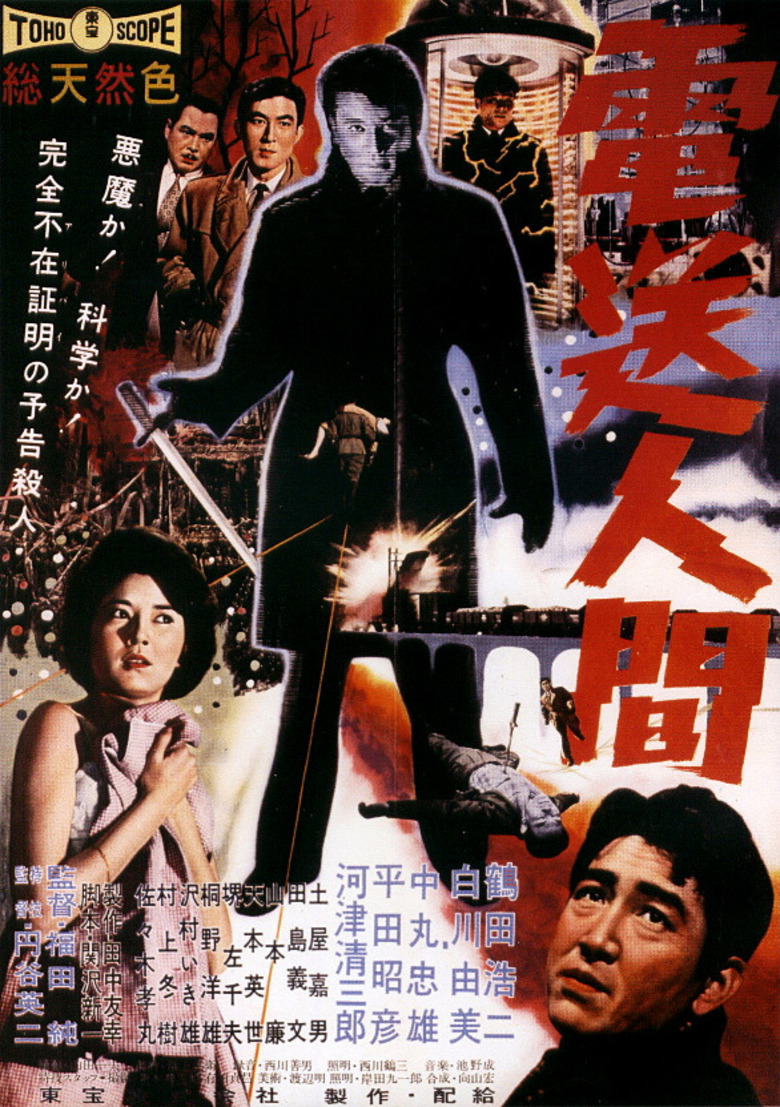
The Secret of the Telegian (電送人間, Jun Fukuda, 1960)

The-Secret-of-the-Telegian-images-df0ac23f-302b-4e88-8ec7-5423f55f51cPlaced between The H-Man and the Human Vapor, The Secret of the Telegian (電送人間, Denso Ningen) is another in Toho’s series of “mutant” movies in which “enhanced” humans find themselves turning monstrous because of ill-advised scientific endeavours. Like many in the series, Telegian has an ambivalent attitude towards scientific research, both proud and fearful. This might be 1960, but the roots of the threat once again stem back to wartime crimes and the impossibility of trust as a man long thought dead teleports himself out of his fictitious grave to wreak a terrifying and bloody revenge on those who have wronged him.

People running screaming out of the “Cave of Horrors” might not be such an unusual sight but this time it’s not papier-mâché ghosts or fancy tricks which have produced such a reaction but a real life bloody murder. The dead man, Tsukamoto, has the end of a bayonet in his chest and a cryptic letter in his pocket asking him to come to this very spot in order to learn “the truth about what happened 14 years ago”. The police are baffled, as is science journalist Kirioka (Koji Tsuruta) who is excited to discover a strange wire at the crime scene. Eventually, the trail leads to a nationalistic, military themed cabaret bar run by former lieutenant Onishi (Seizaburo Kawazu).

The bar is more or less a front for Onishi’s smuggling operation but what has him worried is that a former associate, Taki (Sachio Sakai), may think that he and another former solider, Takahashi, may have reclaimed some stolen gold and declined to share the proceeds. Onishi, Takahashi, and Taki have all received ominous gold discs which seems to point back to their failed bid to pocket some of the Emperor’s gold during the last days of the war. Charged with looking after a top scientist working on teleportation technology, Onishi decided he’d rather have the cash instead stooping so low as to kill both the researcher, Nikki (Takamaru Sasaki), and one of his subordinates who tried to stop him – Tsudo (Tadao Nakamaru). The gang were interrupted stealing the gold but went back a year later only to find the bodies and the treasure vanished without a trace.

Tsudo, now living under an alias, is hellbent on revenge not only against the men who left him for dead but indirectly against their entrenched treacheries as betrayers of their duty, country, and morality. Unlike the the villain of The Invisible Man Vs Human Fly, Tsudo is not among those who feel themselves betrayed or abandoned by their country, left out in the cold in the new post-war world, but one who has a deep seated need to make those who’ve wronged him pay for their treachery. Onishi’s strange militarism themed bar only adds insult to injury given his extremely unpatriotic conduct, though it is perhaps in keeping with the traditionally opportunist nature of nationalists throughout history.

Despite the familiar setup, the science takes a back seat as Fukuda pushes the procedural over the sci-fi and so it remains unclear to what extent, if any, the presence of the teleportation equipment is responsible for Tsudo’s strange behaviour. The teleporting Tsudo is, it has to be said, an odd man. Turning up to complain about late deliveries of the refrigeration equipment he needs for the special metals involved in the experiments,  Tsudo’s manner is creepy in the extreme, robotic yet somehow malevolent. Predictably he develops a fondness for the saleswoman, Akiko (Yumi Shirakawa), who coincidentally lives near to the first murder victim and also becomes the love interest of intrepid reporter Kirioka.

Fukuda keeps things simple over all, stopping to pay an extensive homage to Jacques Tourneur’s Cat People, though there’s a wry sense of humour at play in the bizarre fairground beginning and odd production elements such as the incongruous club and its dancing girls who are, ironically enough, entirely painted in gold. Eiji Tsuburaya’s involvement is largely limited to the transportation effect which is extremely impressive in its execution and has an appropriately unsettling feeling. Not quite as coherent as other examples of its genre, The Secret of the Telegian has a slight tonal oddity in its almost nationalistic discussion of false nationalism, literally taking aim at those who preach patriotism yet cynically betray their country, robbing it not just literally but spiritually. Even so, Fukuda’s take on the mutant formula has enough tongue in cheek humour and sci-fi inflected drama to keep most genre fans happy.


Original trailer (no subtitles)

Mothra (モスラ, Ishiro Honda, 1961)

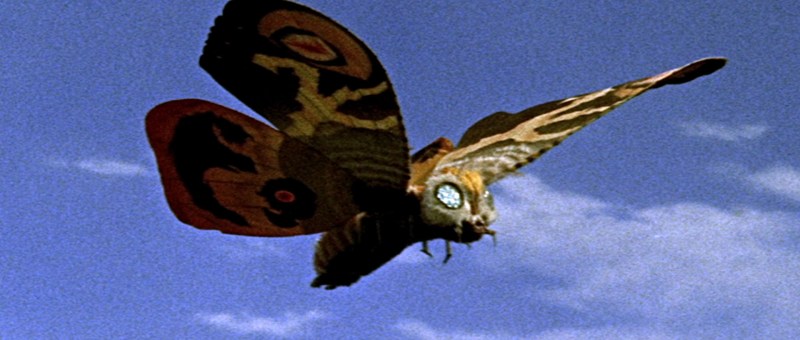
mothra-poster.jpgJapan’s kaiju movies have an interesting relationship with their monstrous protagonists. Godzilla, while causing mass devastation and terror, can hardly be blamed for its actions. Humans polluted its world with all powerful nuclear weapons, woke it up, and then responded harshly to its attempts to complain. Godzilla is only ever Godzilla, acting naturally without malevolence, merely trying to live alongside destructive forces. No creature in the Toho canon embodies this theme better than Godzilla’s sometime foe, Mothra. Released in 1961, Mothra does not abandon the genre’s anti-nuclear stance, but steps away from it slightly to examine another great 20th century taboo – colonialism and the exploitation both of nature and of native peoples. Weighty themes aside, Mothra is also among the most family friendly of the Toho tokusatsu movies in its broadly comic approach starring well known comedian Frankie Sakai.

When a naval vessel is caught up in a typhoon and wrecked, the crew is thought lost but against the odds a small number of survivors is discovered in a radiation heavy area previously thought to be uninhabited. The rescued men claim they owe their existence to a strange new species of mini-humans living deep in the forest. This is an awkward discovery because the islands had recently been used for testing nuclear weapons and have been ruled permanently uninhabitable. The government of the country which conducted the tests, Rolisica, orders an investigation and teams up with a group of Japanese scientists to verify the claims.

Of course, the original story of the survivors was already a media sensation and so intrepid “snapping turtle” reporter Zen (Frankie Sakai) and his photographer Michi (Kyoko Kagawa) are hot on the trail. Zen is something of an embarrassment to his bosses but manages to bamboozle his way into the scientific expedition by stowing away on their boat and then putting on one of their hazmat suits to blend in before anyone notices him. Linguist Chujo (Hiroshi Koizumi) gets himself into trouble but is saved by two little people of the island who communicate in an oddly choral language. Unfortunately, the Rolisicans, led by Captain Nelson (Jerry Ito), decide the helpful little creatures are useful “samples” and intend to kidnap them to experiment on. Refusing to give up despite the protestations of the Japanese contingent, Nelson only agrees to release the pair when the male islanders surround them and start banging drums in an intimidating manner.

The colonial narrative is clear as the Rolisicans never stop to consider the islanders as living creatures but only as an exploitable resource. Nelson heads back later and scoops up the two little ladies (committing colonial genocide in the process) but on his return to Japan his intentions are less scientific than financial as he immediately begins putting his new conquests on show. The island ladies (played by the twins from the popular group The Peanuts, Yumi and Emi Ito) are installed in a floating mini carriage and dropped on stage where they are forced to sing and dance for an appreciative audience in attendance to gorp.

Zen and Michi may be members of the problematic press who’ve dubbed the kidnapped islanders the “Tiny Beauties” and helped Nelson achieve his goals but they stand squarely behind the pair and, along with linguist Chujo and his little brother Shinji (Masamitsu Tayama), continue to work on a way to rescue the Tiny Beauties and send them home. The Tiny Beauties, however, aren’t particularly worried because they know “Mothra” is coming to save them, though they feel a bit sad for Japan and especially for the nice people like Zen, Michi,  Chujo, and Shinji because Mothra doesn’t know right from wrong or have much thought process at all. 100% goal orientated, Mothra’s only concern is that two of its charges are in trouble and need rescuing. It will stop at nothing to retrieve them and bring them home no matter what obstacles may be standing in the way.

The island people worship Mothra like a god though with oddly Christian imagery of crosses and bells. Like many of Toho’s other “monsters” it is neither good or bad, in a sense, but simply exists as it is. Its purpose is to defend its people, which it does to the best of its ability. It has no desire to attack or destroy, but simply to protect and defend. The villain is humanity, or more precisely Rolisica whose colonial exploits have a dark and tyrannical quality as they try to insist the islands are uninhabited despite the evidence and then set about exploiting the resources with no thought to the islanders’ wellbeing. The Japanese are broadly the good guys who very much do not approve of the Rolisicans’ actions but they are also the people buying the tickets to see the Tiny Beauties and putting them on the front pages of the newspapers. Nevertheless, things can only conclude happily when people start respecting other nations on an equal footing and accepting the validity of their rights and beliefs even if they include giant marauding moth gods.


Original trailer (no subtitles)

Battle in Outer Space (宇宙大戦争, Ishiro Honda, 1959)

battle in outer spaceIshiro Honda returns to outer space after The Mysterians with another dose of alien paranoia in the SFX heavy Battle in Outer Space (宇宙大戦争, Uchu Daisenso). Where many other films of the period had a much more ambivalent attitude to scientific endeavour, Battle in Outer Space paints the science guys as the thin white line that stands between us and annihilation by invading forces wielding superior technology. Far from the force which destroys us, science is our salvation and the skill we must improve in order to defend ourselves from hitherto unknown threats.

In 1965 Japan is a hit in space. Having launched their first space station, things are going well but after it is destroyed by flying saucers there is cause for concern. The problem intensifies as strange events occur across the Earth with bridges suddenly collapsing, boats being lifted from the sea and the waters of Venice conspiring to drown the town. World leaders gather in Tokyo to come up with a plan but one of the scientists’ key assets, Iranian professor Dr. Ahmed, is possessed by the Natalians via their high-tech remote control radio waves and procedeeds to do their dirty work for them. The Natalians will settle for nothing less than enslavement of the entire planet and have even set up a base on the moon to make it happen! Time to put those shiny new spaceships to good use!

Scientists may be the heroes of this particular story but the scientific basis for their actions is just as silly as your average B-movie. According to our top professor, the Natalians’ anti-gravity shenanigans can be put a stop to by means of a freeze ray – gravity is, of course, caused by the movement of atoms which is impeded by cold hence the freeze ray. A likely story, but it’s the best they’ve got. The other major problem is that the Natalians are able to possess various people and force them to do their bidding, apparently through “radio waves”. Less about the enemy within, the possibility of becoming a Natalian sleeper agent is more plot device than serious philosophical discussion.

Battle in Outer Space is, in this sense at least, one of the most straightforward of Toho’s B-movie leaning SFX extravaganzas. There is little hidden message here bar the importance of international collaboration as the whole world comes together to fight the alien threat – Middle Eastern and Indian scientists are at the forefront of research and Japan leads the charge flanked by Americans one side and Russians on the other.

Our intrepid band of scientists are the vanguard sent to see off the Natalian threat by jetting off into space and fighting them in their own territory. Honda and Tsuburaya outdo themselves with the special effects which are pretty astounding for 1959 making use of large scale models and matt painting. The scientists travel to the moon to look for the Natalians’ base only to encounter them in space and engage in exciting dogfight. Eventually landing they meet the Natalians face to face and discover they are very tiny and sort of cute but also hellbent on enslaving the Earth. Engaging them in a firefight using heat rays and laser guns, the scientists manage to escape but the Natalian threat follows them all the way back to Tokyo. In true Toho fashion, buildings are destroyed and people knocked flying as the Natalians take the city but our brainy scientists have thought of that and so the aliens have a whole barrage of heat ray guns to welcome them to Earth.

Battle in Outer Space might not have an awful lot going on in the background, but it makes up for it with sheer spectacle both in its effects and in production design. The Natalians are a scary bunch, until you actually meet them, but this time science is on our side as the good guys manage to figure out a way to save the Earth rather than destroy it through fear and angst. In the end it is determination and togetherness which finally lets the Natalians know humanity is not a good prospect for colonisation, only by coming together and making the best of their collective strengths is humanity able to triumph over a superior force – sadly a still timely lesson.


Original trailer (no subtitles)