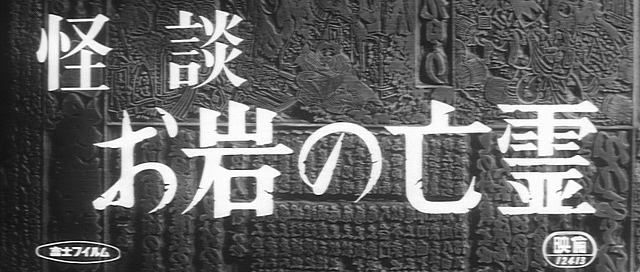
The Tale of Oiwa’s Ghost (怪談 お岩の亡霊, Tai Kato, 1961)

Yotsuya Kaidan is among the most well-known and enduringly popular of Japanese ghost stories. Originating as a kabuki play first staged in 1825, it has inspired countless film adaptations though Tai Kato’s The Tale of Oiwa’s Ghost (怪談 お岩の亡霊, Kaidan Oiwa no Borei) from 1961 is accounted among the most faithful despite the variation in its title. Usually regarded as a cautionary tale about a man whose ruthless ambition destroys his humanity earning him supernatural retribution, Yotsuya Kaidan is also a tale of female vengeance as Kato’s slight refocussing makes plain. In this version of the tale, all of Tamiya Iemon’s problems are, aside from the offscreen murder for which he has already been exiled from his family before the film begins, caused by female subjugation.

Having married into Oiwa’s (Yoshiko Fujishiro) family, Tamiya (Tomisaburo Wakayama) is in a rueful mood even as the film begins. After randomly killing a man in a fight some time previously, Oiwa has left him because, quite reasonably, she does not want to be in a relationship with a murderer nor do her family wish to be associated with someone stained with such a serious crime. Noticeably ragged, Tamiya swears he’s going to get Oiwa back because he’ll “never find another woman with such a beautiful body”. He wants her firstly because she has rejected him and his pride is wounded, secondly to regain his status, and thirdly because for the moment she is a glittering prize though he’ll later come to tire of her. 

Tamiya is hanging around because he wants to talk to his father-in-law about reinstatement but he is currently meeting with a “masseuse”, unbeknownst to Tamiya planning to sell his second daughter Osode (Hiroko Sakuramachi) to a brothel in order to pay a debt. He has been assured that his daughter will not be expected to participate in sex work but will be running a toothpick stall near the temple. Needless to say, both he and Osode are very much mistaken and once the money has changed hands Takuetsu (Atsushi Watanabe), doctor and owner of the brothel, can do whatever he likes. Tamiya doesn’t much care about Osode, encouraging his lusty friend elixir pedlar Naosuke (Jushiro Konoe) who declared her the more beautiful of the sisters to buy her body that very night. You wouldn’t think Naosuke could afford it but he decides to do just that, only to be gazumped by Osode’s conflicted fiancé Yomoshichi (Sawamura Sojuro) who is about to depart for Edo with the lord for a year the very next day. Rather than save her, Yomoshichi merely takes her virginity and asks her to wait for his return in a year’s time, leaving her in the brothel. 

Both Oiwa and Osode are essentially made to pay for their attempt to refuse male subjugation. Naosuke has “bought” Osode’s body and feels entitled to have it, attempting to rape her while she violently refuses him. His resentment leads him to plot Yomoshichi’s murder, but he mistakenly ends up killing his friend instead while Tamiya takes the opportunity to kill his father-in-law and reunite with his wife under the pretext of revenge for a crime he himself committed, essentially gifting Osode to Naosuke as a kind of reward. But Tamiya isn’t satisfied because he remains poor and lowly. His wife may be from a previously well respected samurai family, but he’s having to resort to making umbrellas to get by and now that Oiwa has given birth to their child he no longer finds her so “beautiful”. Bearing out the misogyny in their society, the men joke that Tamiya had been hoping his wife would die in childbirth so he’d be free of her at last. 

It’s at this point that he is offered an opportunity. Oume (Yumiko Mihara), the daughter of the wealthy Ito family of merchants fell in love with Tamiya when he returned her comb to her after a tussle in the square. Moving in nearby, the Itos are keen to persuade Tamiya to marry Oume but he has a wife and child already. The source of Tamiya’s heartlessness is it seems a kind of toxic masculinity, his intense sense of insecurity and a need to prove himself through promotion that fuels his obsession with advancing up the ranks to serve the shogun. As much as this is about inhumanity, it’s also about a society in flux. Unlike Naosuke, Tamiya is a samurai. The Itos are members of a new middle class whose increasing wealth is beginning to threaten the social order of the tightly regimented feudal society. Mr. Ito wants to make his daughter happy, or so he says, but marrying her to a samurai and therefore into the ruling class even if that ruling class is impoverished and possessed of only illusionary power is certainly advantageous. It is however somewhat irrational to encourage a man to murder his first wife so he can marry your lovestruck daughter, it does not bode well for her future safety. In any case, Tamiya is aware that “one’s reputation affects one’s promotion prospects” and so is unwilling to simply kill Oiwa without “a good reason”, later deciding to try and frame her for adultery which would make her death not only permissible but in fact socially mandated.  

In this age a woman’s life has no value, as Oiwa eventually sees. Tamiya gets the adultery idea after catching sight of the bodies of a samurai woman murdered for having an affair with a servant, marking her double transgression against the social order in both advancing her own agency over her body and her love for a man who was not of her own social class (assuming of course that there was any kind of relationship at all and they haven’t simply been killed on pretext by a man like Tamiya). Oiwa’s ruined face, caused by poison disguised as medicine, is symbolic of her social disfigurement, turning her into a “monstrous” woman who vows revenge on the man who has so maliciously wounded her. She asserts her own agency only in her death, choosing to pursue her vengeance from beyond the grave.

Yet it’s not only Tamiya who must pay, but the Itos too for their attempt to cheat the class system. Unlike other retellings, there is little suggestion that Tamiya’s torment is psychological, he is quite literally haunted, taunted into ruining his bright future by exorcising the demon of crime. Unusual for a Toei programmer of the time, Kato’s camera has New Wave verve, replete with handheld photography and swooping zooms while making use of his characteristic low angle composition but the final confrontation precipitated by a literal storm and earthquake which implodes the transgressive world Tamiya and the Itos are forging, is realised with expressionist ferocity. Tamiya tries to atone by taking refuge in a temple, but is undone not perhaps by guilt but by regret in realising he has destroyed his much hoped for chance of advancement and thereby rendered his existence meaningless. 

Returning the play to its roots, he dreams his relationship with Oiwa as kabuki dance until woken by the sight of her ruined face, demanding to be freed from his torment. Yet vengeance comes in realer terms and it is Osode who strikes the blow, striking back on behalf of her sister and herself as a representative of all wronged women, while Naosuke can only lament that “this life had nothing good in it” as he too pays for his transgressions. Osode reclaims her mother’s comb and with it restores the social order while simultaneously rejecting her subjugation at the hands of duplicitous men, laying Oiwa’s unquiet ghost to rest as she leaves the venal past behind for a (presumably) less inhuman world. 


Original trailer (no subtitles)

Edogawa Rampo’s Beast in the Shadows ( 江戸川乱歩の陰獣, Tai Kato, 1977)

Edogawa Rampo (a clever allusion to master of the gothic and detective story pioneer Edgar Allan Poe) has provided ample inspiration for many Japanese films from Blind Beast to Horrors of Malformed Men. So synonymous with kinky terror is his name, that it finds itself appended into the title of this 1977 adaptation of his novel Beast in the Shadows (江戸川乱歩の陰獣, Edogawa Rampo no Inju) by veteran director Tai Kato best known for his work in the yakuza genre. Mixing classic European detective intrigue with a more typically Japanese obsession with method over motive, Beast in the Shadows, like much of Edogawa Rampo’s work twists and turns around the idea of atypical sexuality, one side cerebral and another physical as the “Westernised” sadomasochism of the heroine’s husband becomes the driving force of the narrative.

Our hero, Koichiro Samukawa (Teruhiko Aoi), is a best selling author who likes to describe himself as the creator of “serious” mystery novels. In this he contrasts himself favourably with the coming younger generation who rely on sensationalised tricks and twists rather than the intricately plotted, traditionally constructed crime stories which Samukawa prides himself on writing. The particular object of his rage is a recently successful rival, Shundei Oe, who is making quite a splash in literary circles in part due to his mysterious persona. Refusing all in-person contact, Oe’s whereabouts are completely unknown and though he supplies a “real name” at the back of each book, there is great speculation as to who he really is, how he lives, and where he might be.

Down south to supervise a movie shoot based on one of his novels, Samukawa is thrilled to run into a fan – particularly as she’s such a beautiful young woman. Shizuko (Yoshiko Kayama) is the wife of a wealthy businessman, Oyamada, who has recently returned from an extended spell abroad though he doesn’t share her passion for literature even if he brings home such luxuries as fancy European gloves. The relationship moves beyond mutual appreciation when Shizuko asks for Samukawa’s help in investigating a series of threatening letters she’s been receiving from an old boyfriend who may or may not also be stalking her. The real kicker is that the letters purport to be from Shundei Oe – apparently the pen name being used by a man who fell deeply in love with Shizuko when he was a student but couldn’t take no for an answer when his creepy behaviour became too much for the then school girl. Though Samukawa is sure the letters are all talk and commits himself unmasking Oe for the perverted cretin he is, Shizuko’s husband is eventually murdered just as the letters threatened.

Though the final twist is one which most seasoned mystery lovers will have seen coming, Kato keeps the audience on its toes with plenty of intrigue and red herrings as Samukawa attempts to discover the truth behind the death of Shizuko’s husband as well as taking the opportunity to indulge in a little intellectual vanity by unmasking his rival. The movie subplot quickly gets forgotten but Samukawa is also helped/hindered by his publisher, Honda (Tomisaburo Wakayama), who keeps reminding him about the looming deadline for his latest work. The case at hand provides ample distraction for the harried writer whose writer’s block is only made worse by thoughts of Shundei Oe’s growing success and his resentment of this new, sensationalised form of crime novel which seems to be eclipsing his own.

If the way he acts in “real life” is anything to go by, Samukawa’s detective novels owe much to the European tradition but still, there’s a persistent fear of the foreign underlining much of the proceedings despite the heavy presence of Westernised clothing, music and culture which seems to diffuse itself throughout daily life. Shizuko’s husband may have just returned from abroad but it seems he brought back much more with him than some fancy gloves and an elegant English mistress (pointedly named Helen Christie). The English style riding crop in Oyamada’s study is not mere affectation but the cause of the nasty looking wound on Shizuko’s shoulder which first caught Samukawa’s attention. Oyamada’s sadistic tendencies are posited as a credible reason he could himself be masquerading as Oe, getting off on driving his wife half crazy with fear, but his eventual murder would seem to rule that out.

Nevertheless the game is one of pleasure and pain as Samukawa comes to the realisation that he is integral to the plot. Challenged by his literary rival to a game of minds, Samukawa is putting his detective abilities to the test as his rival is writing their latest story in reality rather than on the page. Love, lust, betrayal, violence and tragedy all come together for a classic gothic detective story which looks ahead to noir with its melancholy fatalism yet remains resolutely within the dark and ghoulish world of the gothic potboiler. Kato shoots a prestige picture with the undercurrent of repressed eroticism in his strange low level angles and unusual compositions which bind, tie and constrain the elusive Shizuko within the window panes and doorways of her home. Light levels fluctuate wildly, isolating the haunted protagonists in their supernatural gloom until we hit the expressionism of the theatrical finale which takes place in an entirely red, almost glowing attic space. The atmosphere is one of profound unease as Oe is thought to be perpetually watching, hidden somewhere in the house, out of sight.

The Beast in the Shadows does not just refer to the unseen voyeur but to the repressed eroticism which his actions symbolise and is perhaps brought out in the various sadomasochistic relationships created between each of the protagonists. Then again, where are we in all this – sitting in the dark, watching, undetected, seeing things we had no right to see. Kato takes our own voyeuristic tendencies and serves them back to us with visual flair in a late career masterpiece which perfectly captures Edogawa Rampo’s gothic world of repressed desire and brings it to its cinematic climax as two detectives go head to head in a game so high stakes neither of them quite realised what it was they were playing.


Original trailer (no subtitles, NSFW)

By a Man’s Face Shall You Know Him (男の顔は履歴書, Tai Kato, 1966)

by a man's faceJapanese cinema has not been as shy as might be supposed in examining uncomfortable topics concerning the nation’s mid 20th century history but perhaps prefers to tackle them from a subtle, sideways viewpoint. By a Man’s Face Shall You Know Him (男の顔は履歴書, Otokonokao wa Rirekisho) is, in essence, a fairly straightforward gangster pic – save that the rampaging gangsters are a mob of “zainichi” Koreans rather than post-war yakuza or petty hoodlums. Less about what it is to be an outsider or the quest for identity in second generation immigrants, Kato’s film is about what it says it is about – a man’s face.

The film begins in the contemporary era when morose doctor Amamiya is contemplating a transfer to an island posting which proves unappealing to him. Shortly after, a badly injured man is brought in following a car accident and, though Amamiya originally suggests the man be taken to a hospital as his chances of survival are slim, he changes his mind after lifting the sheet and recognising the man on the stretcher. The two men go back a long way – firstly to the battlefield where “Shibata” was a private in the army serving alongside Amamiya and secondly to an incident which dictated the rest of Amamiya’s life when he ran the local GP’s office and also happened to own the deeds to some land a bunch of Korean gangsters wanted to get their hands on. Thanks to their earlier association, “Shibata” now returning to his Korean name “Choi” was able to assist Amamiya in mitigating the gangster onslaught as he himself was a member of the gang.

Perhaps more to do with the production styles of the time, all of the “Korean” gangsters are played by Japanese actors and only ever speak Japanese even to each other. Nevertheless, they all want “revenge” for Japan’s treatment of Korea and Koreans during the years of occupation and warfare. In 1949 Japan is still in ruins and the gangsters see this as a prime opportunity to finally take Japan apart and presumably also profit in the process. The leader of this particular gang has set his sights on taking over the “New Life Marketplace” (a pregnant title if ever there was one) with the intention of turning it into an “entertainment district”. His guys, including one totally crazy foot soldier played by a particularly manic Bunta Sugawara, run roughshod over the town until finally raping and murdering Japanese women which they dismiss as par for the course given Japan’s treatment of Korean women over the past thirty years.

This is not a subtle examination of Korean Japanese relations in the post-war environment, these are gangsters and movie gangsters are generally all the same. They say they want to destroy Japan but ultimately they want what all gangs want – to control the area and extort maximum profit. Choi, and the young female Korean Gye, were born in Japan, have never even been to Korea and can’t really claim to have a great deal of Korean cultural knowledge. All they have are their names, now reclaimed after Japan’s wartime defeat. Throughout the war years, Choi used the Japanese version of his name “Shibata” and tried to pass himself off as Japanese (apparently successfully) but is now committed to embracing his Korean heritage even if it once again sees him placed in a subjugated position.

Amamiya returned from the war and took over his father’s medical clinic in his home town. He’s cynical and apathetic. He treats the people who come in to his clinic without discrimination but he doesn’t care very much about the area either. The only thing he really cares about is his nurse, Maki, with whom he’s been having a passionate affair and seems to be deeply in love. Amamiya makes an enemy of the Koreans early on when he fights off some guys who are hassling his nurse proving that he’s no pushover. The title deeds for the land the market is built on also belong to Amamiya who is unlikely to surrender them. The townspeople first turn to the regular Japanese yakuza who are unable to help with their currently depleted manpower leaving Amamiya as their only form of salvation.

When Amamiya’s hotheaded brother turns up and starts causing all sorts of trouble with the Koreans as a way of avenging Japan’s wartime defeat, Amamiya is dragged into a battle he had no desire to fight. Shunji was too young to fight in the war but is a representative of the younger generation who can’t accept the new post-war society and what they see as their older siblings failure to support the nation. Though a strong attraction develops between Shunji and Gye, their love story becomes another casualty of the harsh post-war world. Reluctantly, Amamiya becomes the last defender of these put upon people leading to a High Noon style solo stand against the Koreans whilst the terrified populace look on in fear and hope.

Kato creates a colourful world rich in symbolism such as the early scene in which Choi’s red blood drips down the white sheet accidentally recreating the Japanese flag. Amamiya’s prominent scar becomes both a plot point and a symbolic motif as it echoes the film’s title in bearing out his “history”. A man’s life is indeed written on his face, and Choi’s wife’s urging to her daughter that they watch Choi’s face as he fights for his life is another indication that one’s true nature is seen most clearly in times of duress. The film closes on an ambiguous note, in one sense, but closes its thematic line neatly. Amamiya faces a choice and no choice at the same time but through his face we know him and so we understand.