After killing a suspect in a shootout at a bar, a policeman finds himself haunted by the dead man’s vengeful spirit in Seijun Suzuki’s made for TV noir Fang in the Hole (穴の牙, Ana no Kiba), adapted from a story by Takao Tsuchiya and scripted by Atsushi Yamatoya who also wrote Branded to Kill. Undergoing a process of transformation, a once earnest cop slowly takes on the persona of the man he killed while driven out of his mind by his ironic transgression.
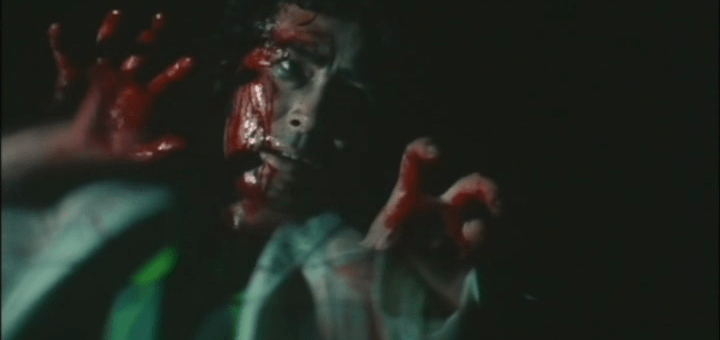
Shida (Yoshio Harada) is a sleazy yakuza wanted for killing his boss. With his face splashed across the papers, he takes refuge in a bar with an old girlfriend, but for whatever reason she declines his requests stay with him. In any case, the bar’s owner (Yasuyo Matsumura) contacts police detective Togura (Makoto Fujita), also a regular of the bar, who arrives to arrest Shida. Shida, however, draws a gun on Togura who shoots him in the head leading him to become impaled on a nearby stained glass window, spraying blood all over har hostess Miyuki (Junko Inagawa).
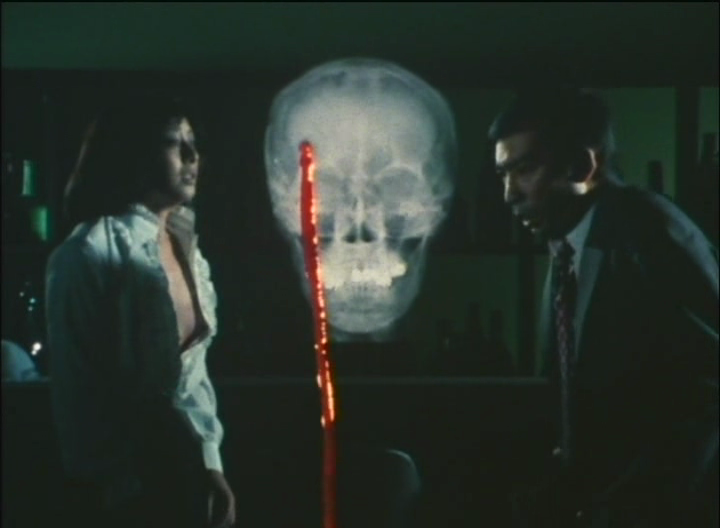
There may be a central irony in the idea of a policeman shooting a suspect, not least because it makes him the same as Shida. It’s this kind of transgression that hangs over Togura as he struggles to deal with the aftermath of having killed a man and is haunted by Shida’s vengeful spirit. Suzuki bathes the entire film in an eerie green that lends it a supernatural air, as if Togura had entered a slightly different world as he falls deeper into this barbed hole that leads all the way to hell. He slowly seems to take on some of Shida’s characteristics, becoming fixated on Miyuki and later being caught with a series of erotic photos that make him seem sleazy and exploitative. Both Miyuki and the bar owner paint him as a dirty cop and sex pest misusing his authority to intimidate and exploit.
Yet to begin with, Togura had seemed to be an ordinary family man, reminding Miyuki that he doesn’t want to do anything to jeopardise his career and pension. He calls his wife from the bar and lies that he’s working late so likely won’t be home, but perhaps there’s something in Togura that also resents his ordered life and is looking for an escape from conventionality. The more he tries to beat Shida’s curse, the deeper he falls into the trap that’s been set for him only to exclaim that he’s climbed out of Shida’s hole at the very moment of his downfall.
Togura’s transformation is completed when he considers taking the missing money from a case he’s been investigating rather than reporting its whereabouts having already been kicked out of the police force. Losing the cigarette lighter with his name engraved on it that had been given to him by sympathetic colleagues is symbolic of a less literal kind of lost identity. He comes to believe that it fell into the hole with the bodies of the dead criminals and that he will now be implicated in their deaths. The conclusion, however, hints at cosmic irony as the film’s title takes on a new meaning in the presence of a neighbour’s magpie dog.
Nevertheless, whether the haunting is real or a manifestation Togura’s guilt and suppressed desires, Suzuki’s eerie ghost effects take on a theatrical quality as the kuroko open the shoji behind Togura to expose a hellish space resembling a dank basement with water pouring from above while Shida’s ghost towers over a defeated Togura foreshadowing his eventual fate. The fact that the police never found the bullet that killed Shida which is said to have rattled around his brain and then exited from the same hole it entered by suggests that in reality it was always heading straight back at Togura. Surreal and haunting, Suzuki’s noirish tale has a stickiness about it as Togura sinks deeper into madness and discovers that he cannot, in fact, climb out of the pit of his moral transgressions.

