White Flowers and Fruits (白の花実, Yukari Sakamoto, 2025)

The abrupt suicide of a young woman at a protestant Christian boarding school causes those around her to reassess their reality in Yukari Sakamoto’s poetic drama White Flowers and Fruits (白の花実, Shiro no Kajitsu). Perhaps done a disservice by the literalness of its English language title, the film is on one level as the Japanese title implies about the disconnect between form and content, or the extent to which we project ourselves onto others and see only what we want or expect to see.

Anna (Miro) is someone who says she can see “what others can’t”. This most obviously refers to her ability to see ghosts, though of course we can’t be sure whether she is telling the truth or hallucinating reflections of her own anxieties. In any case, she has a rebellious streak which is why her mother has transferred her to a Christian boarding school. “It’s your last chance,” she tells her, implying that Anna has already been expelled from several other institutions for her refusal to conform. Anna, however, promptly discovers an angry ghost hovering directly behind her new roommate Rika (Nico Aoto) and thereafter refuses to the “pointless” rules of the school including wearing her ribbon necktie.

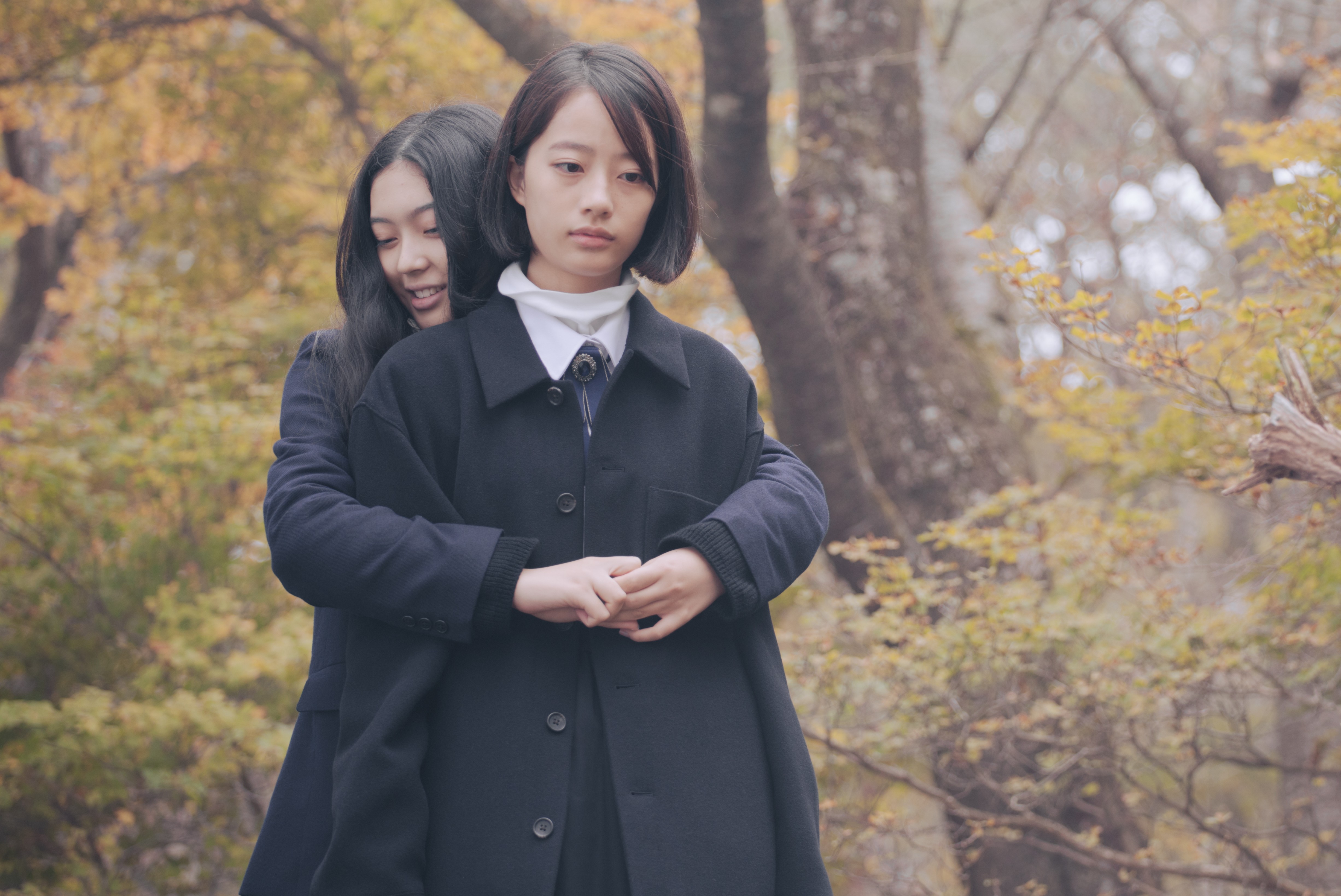
She and “lovely” Rika are then contrasted as model student and its reverse. It’s Rika who remarks that being at odds with everyone all the time must be exhausting and her life might be easier if she made more of an effort to get along with people, but Anna claims that she is simply unlike Rika and this is something she is unable to do even if she wanted to. “Why don’t you try being me?” Rika asks after putting her own ribbon around Anna’s neck, as if she were lifting a burden from herself and placing it onto Anna in a moment of forced conformity if also a well-meaning rather than oppressive gesture. When Rika takes her own life by jumping from the bell tower not long after, it provokes a degree of soul-searching among everyone at the school but most especially Anna and Rika’s best friend Shiori (Anji Ikehata).

After reading Rika’s diary, Anna begins seeing a blue orb she believes to be Rika’s spirit which eventually settles in her chest and begins to alter her personality to become a little more malleable and conformist as expressed by the Edwardian-style high collars of her uniform and newly deferent personality. It’s never quite clear if this is “real”, Anna’s delusion, a manifestation of her attempt to come to terms with grief, or deliberate subterfuge as she begins to develop a friendship with Shiori in part based on the notion that she has been possessed by Rika. The pair are both trying in one sense to get a handle on the sides of Rika that they didn’t have access to in order to understand why she died. 

But Rika’s diary is full of insecurity. She feels herself under pressure training to train for the school’s traditional dance show and is paranoid that she makes those around her worry when she doesn’t perform well enough. The dance itself is strangely sensual and witchy, earthy and rooted in nature in contrast to the religious setting of the school. On reading the diary, Shiori realises that shortly before she died Rika tried to confess her feelings for her, but Shiori simply didn’t understand and worries this accidental and insensitive rejection may have contributed to her desire to take her own life. It is not especially the religiosity of the school that is repressive, however, so much so as the enforced conformity of their social class. 

Aside from their association with “Class S” lesbian romance literature, these kinds of boarding schools are associated most closely with upper-class women who are being trained to become wives of important men. As such it is important that they learn to be, unlike Anna, meek and obedient. On a return home, Shiori attends a dinner party at which only her sister is dressed in red and seated across from a man to whom she has evidently been betrothed for an arranged marriage. Shiori is mildly horrified, but her sister just seems to stare on vacantly as if resigned to her fate. But it’s also this image of properness that may have prevented Rika getting the help she needed before she died as her animosity towards her family and fear of her father were ignored because of their social standing. Rika’s apparently distraught father is determined to retrieve the diary presumably because he fears what might be written inside it. Rika’s role as a model student might then have been a persona that marked her attachment to alternate familial home and a desire to escape sexual abuse at the hands of her father.

A video is leaked showing a young girl smoking in one of the school’s bedrooms with many believing it to be Rika, though it isn’t really clear who is it just as it is often unclear whether Anna is Rika or a version of herself. A final moment of rebellion, Anna challenges the enquiry into Rika’s death accusing them of using Rika’s death for their own ends to explore questions about themselves rather than directly confronting their own realities, though perhaps this is what she too has been doing. In an ironic way, it’s through letting Rika go that Anna and Shiori are able to move forward with their lives, but in other ways they take her with them as if she really had settled somewhere in Anna’s chest. Anna has learned how to dance for herself and come to some kind of accommodation with the world, while Shiori has been presented with a picture of herself that is also a picture of Rika in its reflected gaze. Sakamoto leans into J-horror territory in capturing the gothic atmosphere of the school, though as Anna later says, the ghosts themselves are not really frightening so much as an expression of that which remains unknown an acceptance of which defines adult enlightenment.


White Flowers and Fruits screened as part of this year’s JAPAN CUTS.

Trailer (no subtitles)
Numb (しびれ, Takuya Uchiyama, 2025)

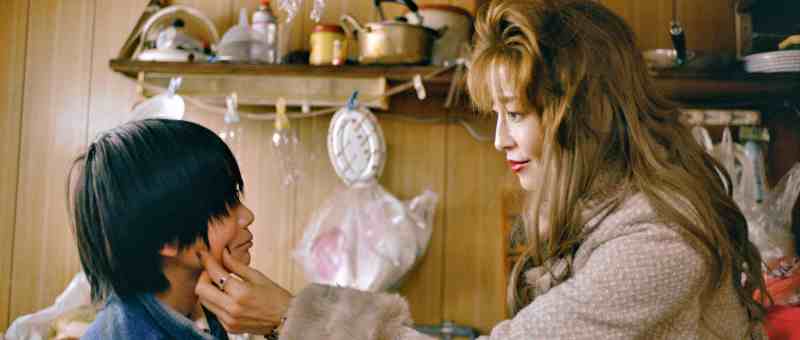
At 11-years old, Daichi (Anji Kato / Tsukasa Enomoto / Takumi Kitamura as a child, teen, and adult respectively) is mostly living alone as his bar hostess mother is absent for days at a time leaving him with only a small amount of money to feed himself until the next time she returns. Rendered mute by the childhood trauma of his father’s domestic violence, he lives an almost entirely isolated experience, shying away from contact with adults and no longer attending school.  Given his circumstances, he has become used to shoplifting and pilfering from neighbours, but even this is perhaps partly born of his desire to avoid potentially dangerous interactions.

Unlike similar Japanese dramas, Takuya Uchiyama’s semi-autobiographical film Numb (しびれ, Shibire) is less interested in the ways that a boy like Daichi has been failed by society than his subjective experience. It is, however, notable how easy it seems to have been for him to fall through the cracks. No one ever seems to get in contact to ask why he hasn’t been in school nor does anyone appear to investigate his living standards. The landlord of his building takes advantage of the situation to extract sexual favours from his mother, Aki (Rie Miyazawa), who grants them in order to ensure they can stay in their home, a prefab shed on the roof where the water is often cut off because she hasn’t paid the bill. Though just a child, Daichi drags a canister that would normally hold kerosene down to the river, fills it, then has to carry it home and up the stairs to the roof all alone. He washes his mother’s clothes and dries them in the stairwell. Despite having no money, he spends his last coins on beer and cigarettes from a vending machine for her.

Yet at the same time, his mother’s circumstances are also caused by her trauma of suffering domestic abuse at the hands of his father (Masatoshi Nagase) who seems to have at point abandoned them. Working as a bar hostess necessarily means she is often absent at night, though her increasing dependency on drugs and alcohol along with their precarious living situation forces her into acts of casual sex work. To that extent, the course of her life is directly contrasted with that of her older sister with whom the pair later move in. Tomoko has become a Jehovah’s Witness and religious obsessive who does not exactly treat the pair with kindness or compassion. A line of red tape divides the apartment with Aki and Daichi occupying the living area but forbidden from crossing the threshold into Tomoko’s religious sanctuary. She appears judgemental of her sister and is at least party to her signing a Do Not Resuscitate order, though she insists that has nothing to do with her religious beliefs and was entirely Aki’s decision. Nevertheless, she coldly tells Daichi to get out of town once his mother dies and implies she finds his existence an embarrassment.

Denied any kind of emotional connection with parental figures, Daichi’s only source of positive input comes from a Russian labourer who discourages him from hanging around near the construction site which he says is dangerous due to the high levels of Russian drug users. Ivan gives him fatherly advice and comfort despite their apparently only meeting twice, but at the same time it’s clear that by virtue of his presence in Japan he has at least physically been absent from the life of his son back in Russia. Nevertheless, he presents an image of positive paternity to counter that from each of the men Aki becomes involved with who are violent towards her and tell Daichi that they’ve always hated his eyes, presumably because they are filled with contempt and remind them of what utter failures they have become. 

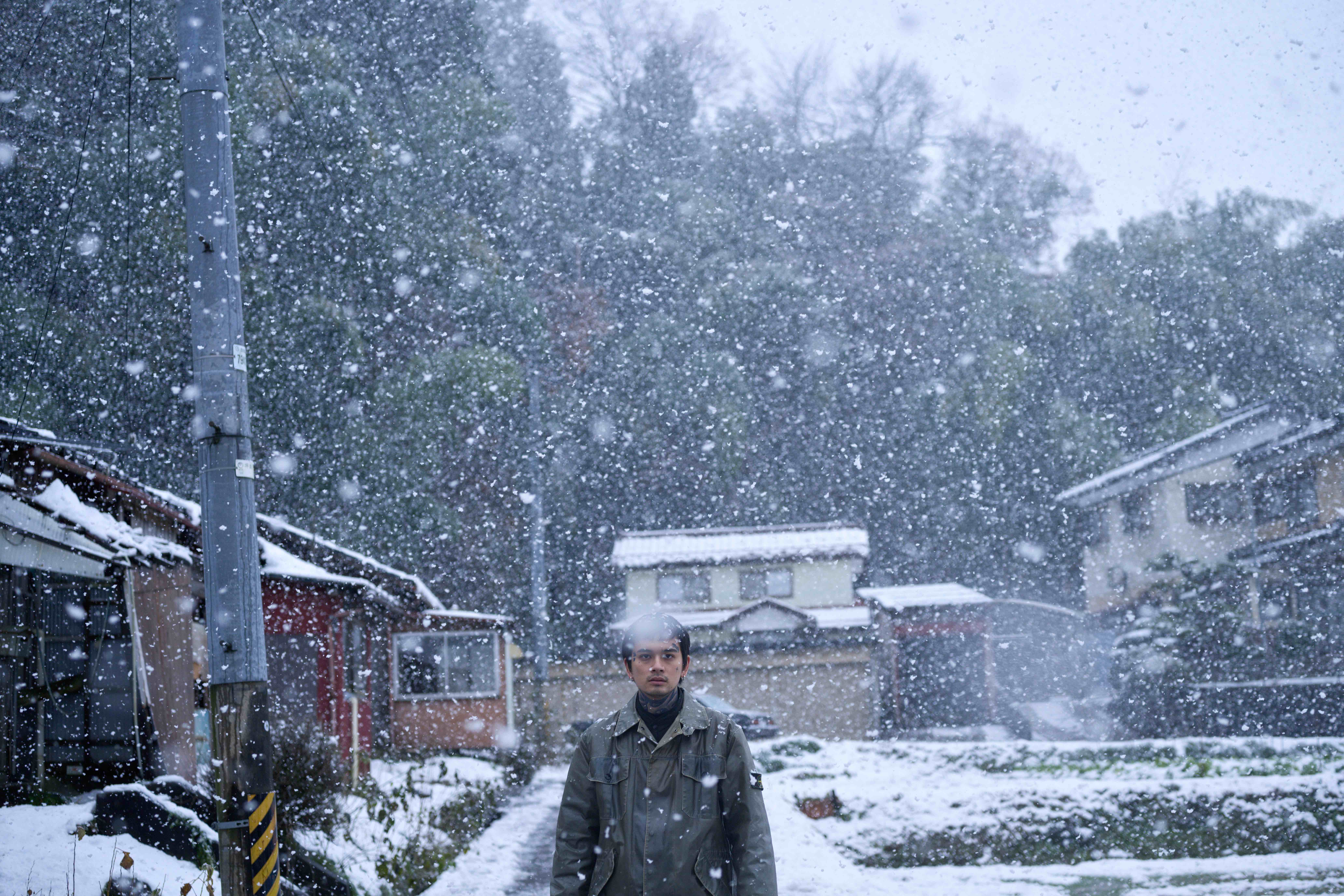
Forced into an early adulthood, the older Daichi makes ends meet covertly dealing drugs as a barman and appears to be trapped in a state of inertia by unresolved childhood trauma. A violent confrontation with his father solves nothing, though a kind of release arrives in finally letting go of his mother and taking her advice to move on. Shot on 16mm, the film captures the bleakness and isolation of Daichi’s life in snowy Niigata where it always seems to be Christmas for everyone but him as he slowly embarks upon a path towards recovering his voice.


Numb screens as part of this year’s JAPAN CUTS.

Burn (炎上, Makoto Nagahisa, 2026)

“You may not be okay, but neither is anyone else,” a well-meaning young woman advises neatly encapsulating the world of the Toyoko kids in Makoto Nagahisa’s second feature, Burn (炎上, Enjo). A little less anarchic than his debut We Are Little Zombies, the film is one of several exploring the fate of these displaced teens the media has often liked to demonise as means of deflecting the fact that society has largely failed them and the adults who should be helping often only make things worse.

This contrast is clear in the opening scenes in which Jurie’s (Nana Mori) Christian parents sing a hymn about the world being full of light, but Jurie’s father (Kanji Furutachi) is a crazed authoritarian who beats her and her sister with a belt while insisting that Jurie’s persistent stammer is a reflection of her “tainted soul”. Ironically, asking her sister if she believes in God, Jurie starts to pray for her father’s death. “If God exists, He took his fucking time,” she quips when her father finally drops dead a few years later. But the abuse doesn’t end. Her mother takes her father’s place and begins to beat them just as she was beaten. 

Shinjuku, is one sense, a place full of light given its brightness and shining signs, but in the real world you can’t have light without shadow. After running away, Jurie is taken in by a community of similarly displaced teens led by an adult Fagin-like character known as Kami (Wataru Ichinose), which is ironically the same as the word for “God”. He describes himself as a guardian angel who whose job it is to make everyone feel safe, yet there’s something disingenuous about his warm-hearted claims that this is a place that accepts everyone and that no matter what society may choose to reject, he is glad that they were born. His golden fangs seem to hint at something cruel and greedy echoed in his reluctance to left Jurie leave, insisting that she won’t make it in the real world despite having told her she needs to become independent.

Mitsuba (Aoi Yamada), who has a disability stemming from a traumatic childhood incident, similarly finds her attempt to find escape through a relationship with a host foundering. Ironically named “Hikari” which means light, he justifies himself to her in insisting that he’s a victim too having been abused by his mother as a child, though in the end Mitsuba’s need to be loved can only be satisfied transactionally as she deludes herself into thinking her relationship with Hikari is “real” even as he continues to exploit her. To earn the money pay him, she ironically takes to sex work and encourages Jurie to join her in an effort to earn a million yen and then go back to save her sister. One of their clients presents them with a strange-looking dildo that sort of resembles a wand used by magical girls in anime which they wave as though transforming, but later describe themselves as performing an exorcism after meeting clients.

The men that buy their services are just another symptom of an exploitative society. When Jurie almost overdoses and is taken to hospital, the police don’t send her back to her family but do place her in a childcare facility where she feels imprisoned. The implication is that society would rather hide these children away rather than attempt to help them. Jurie longs for the freedom of the city and escapes to return, but in the end discovers only darkness. The film shares its Japanese title with Kon Ichikawa’s adaptation of Mishima’s The Temple of the Golden Pavilion, Conflagration, which is also about a young man who decided to burn it all down in protest against a profane world, though Jurie seeks escape from the collective punishment of the contemporary society along with the traumatic legacy of her father’s abuse. Nagahisa mixes iPhone social media footage capturing the kids’ world from their perspective with dreamlike imagery and a video game aesthetic as Jurie looks for a way out of the labyrinth of her trauma while setting the world ablaze in her mind. What she discovers in the ashes, however, maybe a renewed hope for the future and the possibility of a different kind of salvation.


Burn screens as part of this year’s JAPAN CUTS.

Trailer (Engliish subtitles)