Pressure of Guilt (白と黒, Hiromichi Horikawa, 1963)

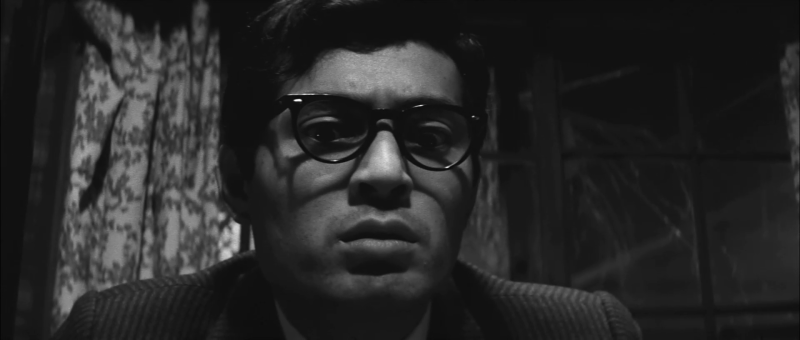
When a lawyer’s wife is found strangled at home, the police immediately arrest a “suspicious person” who is found to be carrying jewellery stolen from her room. Open and shut case, some might say, and prosecutor Ochiai (Keiju Kobayashi) agrees. But in reality nothing is really so black and white in the contemporary society of Hiromichi Horikawa’s crime drama, Pressure of Guilt (白と黒,, Shiro to Kuro). Perhaps ironically, the film opens in the same way as Tai Kato’s later I, the Executioner, with a man’s hands stretching around a piece of rope, and also features a law enforcement officer who is distracted from his duties by a bad case of piles he refuses to get treated.

Ochiai says his haemorrhoids are born of sitting down thinking too much, but the problem might be that he doesn’t think enough or that he suppresses thoughts which might prove inconvenient. There’s something that bothers him about the idea of Wakida (Hisashi Igawa) being the killer, but he shoves his doubts out of his mind and continues questioning him until he confesses. Some of this is born of prejudice. Wakida has a long criminal record mainly for burglary, and has been in and out of prison the whole of his adult life. Currently suffering from TB, he appears to be one of the young men who came to the city in search of work but found only exploitation and eventually had no option but to turn to crime. That he stole the jewellery is not in dispute, but Wakida continues to insist he didn’t kill Mrs Munakata (Koreya Senda). His lack of cooperation puzzles Ochiai, but it confuses him still more that Wakida keeps changing his story. He is, it seems, trying to tell him what he wants to hear, but finally becomes fed up with the whole thing after receiving a letter from his mother telling him to confess. She evidently thinks he did it too. Falling into hopelessness, Wakida declares that he no longer cares who did it and might as well be him because his life is essentially already over. In his condition he won’t last long in prison. There’s no prospect of turning his life around, either. So a death sentence won’t make any difference.

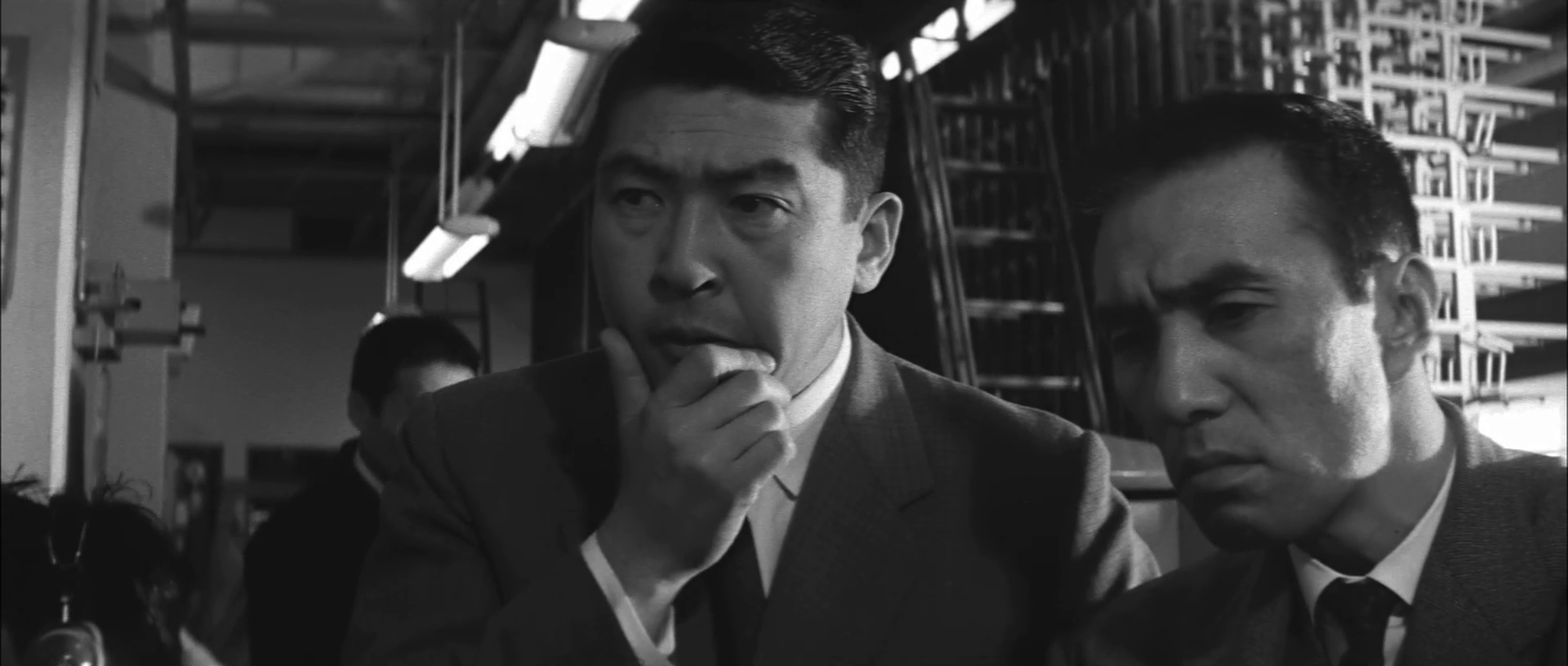
The funny thing is that it’s realising his fiancée must have figured out he did because she’s covering up for him that forces Hamano (Tatsuya Nakadai) into a confession. He’s plagued by guilt that Wakida might die for his crime, but not enough to exonerate him by coming forward. Nevertheless, he tries to talk Wakida round, asking why he confessed and if he was pressured by the prosecutors. The Japanese legal system places confessions above all else, but the issue is that Wakida’s confession is the only evidence that links him to the murder. Just because he stole the jewellery doesn’t mean he killed Mrs Munakata. Ironically enough, he’s defended by the victim’s husband (Koreya Senda), an anti-death penalty activist lawyer who agrees to represent him in part to vindicate his principles. Wakida only agrees to cooperate with Munakata and Hamano who is acting as his assistant when he confirms they’re not trying to help out of pity but only for their own self-interest. 

Yet Ochiai might have a point asking why Hamano is certain that Wakida didn’t do it, or why, on beginning to suspect him, he’s trying so hard to exonerate a man who was going to pay for his crime. It’s Hamano’s own suspiciousness that leads him to question his judgement about Wakida and ask himself if his thinking wasn’t too black and white and he should have investigated more thoroughly rather than pressuring Wakida into a confession and charging him. On realising he may have made a mistake, Ochiai puts the prosecution in a difficult position as his boss warns him of the potential reputational damage to the police and prosecutors if they’re shown to have made a mistake with the mild implication that, as he had assumed someone in Hamano’s position would want to, he should just keep quiet and let Wakida hang. 

Surprisingly, however, it only seems to improve the public’s view of the prosecution to be able to see them admit that they made a mistake and try to fix it rather than refuse to change their position. Mystery writer Seicho Matsumoto makes a cameo appearance as a TV pundit who says he admires Ochiai, while the film also uses a real TV show host to interview Ochiai boosting the sense of realism. As it turns out, there was more to the story than even Ochiai or Hamano thought, but still he declares that it’s better to be a fool than a hopeless idiot and that he was right to look for the truth even if it ended up biting him in the behind. The pressure of Hamano’s guilt, however, never really dissipates even as he struggles with himself, trying to find a way to save Wakida and avoid becoming a murderer twice over, without giving himself away. Nothing’s really that black and white after all, and this case wasn’t exactly open and shut, but the conviction that it had to be based on prejudice and circumstantial evidence might be the biggest crime at all no matter how it actually turned out.


Cash Calls Hell (五匹の紳士, Hideo Gosha, 1966)

“Life is made of gambles” according to the villain of Hideo Gosha’s 1966 Shochiku Noir Cash Calls Hell (五匹の紳士, Gohiki no Shinshi). Sometimes dismissed by contemporary critics for the wilful vulgarity of his late career yakuza films, Gosha was most closely associated with jidaigeki but here makes a rare foray into B-movie crime, a genre which perhaps aligned with the so-called “manly way” philosophy which imbued much of his work. Led by frequent star Tatsuya Nakadai the men of Cash Calls Hell are indeed all suffering manfully, each desperately floundering in the post-war society while quietly resentful in being locked out of its growing prosperity. 

The hero, Oida (Tatsuya Nakadai), is the son of a meek civil servant whom he resented for his passivity. Oida was determined to make something of himself, and so he invested his efforts not in hard work and dedication but in personal relationships, seducing the boss’ daughter in order to win her hand and thereby advancement and security. Meanwhile, he was preparing to unceremoniously ditch the bar hostess who’d been supporting him while he made his way to the top, only after arguing with her on a car drive home he gets into an accident in which a father and his little girl are killed. Oida’s bright future is ruined in an instant. He’s asked to backdate a resignation letter, his engagement is cancelled, and he also owes compensation to the widowed mother Natsuko (Miyuki Kuwano) whose face, filled with rage and resentment, he is unable to forget. With no money to pay her, he winds up in prison which is where he meets soon-to-be released Sengoku (Mikijiro Hira) who has a proposition for him but refuses to give any further details, instructing him to find a woman named Utako (Atsuko Kawaguchi) as soon as he’s released. 

As Utako relates, the job involves knocking off the three men on her hit list for which he will be paid a cool 15 million yen (5 million each). Advised to not to ask any further questions, Oida decides to go along with it after all he has nothing left to lose, but as he begins his investigations he becomes increasingly confused and conflicted. As we discover, the men were all part of a gang that robbed a syndicate of Hong Kong drug dealers, and it doesn’t take a genius to figure out that Sengoku wants them out of the way so he won’t have to divide the loot when he gets out. The money is many ways beside the point, what the men wanted was a way to kick back against the various forces which oppressed them and took their revenge on society through crime. The first, Motoki (Hisashi Igawa), is a former policeman who ran off with a gangster’s wife and subsequently went all the way to the dark side. Umegaya (Kunie Tanaka) is the son of a career criminal who wanted some control over his life and to care for the woman he loved. Embittered former boxer Fuyujima (Ichiro Nakatani) had his dreams shattered when gangsters crushed his hand because he refused to throw a fight. 

Sengoku, who was left lame after being injured in the aerial bombing during the war, recruited them all by exploiting their resentment. Fuyujima describes the men as wandering like ravenous dogs. They are already imprisoned, framed by the chainlink fence which divides them from the well-to-do salarymen killing time at the driving range. “Life is half made of luck and circumstances” Sengoku tells them, echoing his words to Oida, handing them agency in crime in asking them to “bet” on him. “We can’t sink any lower” he rationalises, “now we must get back on our feet”. Oida is much the same. He’d sunk as far as he could and thought nothing of taking these men’s lives to save his own, but resents being used by Sengoku and is probably figuring out that a man who doesn’t want to split his loot in four won’t be keen to split it in half either. He is also burdened by a sense of guilt and responsibility, both to the widow of the man he killed in the accident and to Motoki’s small daughter Tomoe (Yukari Uehara), about the same age as the little girl who died with him. 

Natsuko, it turns out, has since become a bar hostess, herself sinking in the cruelty of the post-war landscape, now wearing a sparkly cheongsam in echo of the “Golden Dragon” syndicate running the club where Umegawa works and the Hong Kong gangsters hot on Oida’s trail. Indulging in a stereotypical B-movie Sinophobia, the implication is that crime is a foreign phenomenon, the threat lurking in the shadows dressed oddly more like a 30s bootlegger from a Hollywood gangster flick than a triad drug trafficker and killing with the point of his umbrella. Oida’s redemption is sparked by his sense of responsibility towards the orphaned little girl who continues to follow him around, latching on to him as a sympathetic figure entirely unaware of his relationship to her father. In the end he declares that he wants the money in order to buy back his soul having sold it to Sengoku in agreeing to take on the job without knowing what it was, but also wants to make restitution to Natsuko which he later does in a poetic if perhaps insensitive fashion that implies he can in a sense restore the child he killed by substituting it with another. 

Oida is one of Gosha’s “manly” heroes, surviving at all costs but finally defending his sense of honour in regaining his humanity. Nevertheless, Gosha is also keen to demonstrate the various ways the women suffer at the hands of irresponsible men, each of the wives endangered by their husbands’ transgressions and Natsuko forced onto the fringes of the sex trade by Oida’s thoughtless crime. Opening in a bold negative with the heist that started it all, Gosha shoots in true noir style all shadows and canted angles through a series of episodic set pieces including a chase pregnant with symbolism through a “purification station” scored by moody jazz before ending on a fatalistic POV shot. Life is a gamble after all, but is this a loss or a victory? With the world the way it is, who could really say.


Illusion of Blood (四谷怪談, AKA Yotsuya Kaidan, Shiro Toyoda, 1965)

vlcsnap-2017-07-01-00h50m36s347Shiro Toyoda, despite being among the most successful directors of Japan’s golden age, is also among the most neglected when it comes to overseas exposure. Best known for literary adaptations, Toyoda’s laid back lensing and elegant restraint have perhaps attracted less attention than some of his flashier contemporaries but he was often at his best in allowing his material to take centre stage. Though his trademark style might not necessarily lend itself well to horror, Toyoda had made other successful forays into the genre before being tasked with directing yet another take on the classic ghost story Yotsuya Kaidan (四谷怪談) but, hampered by poor production values and an overly simplistic script, Toyoda never succeeds in capturing the deep-seated dread which defines the tale of maddening ambition followed by ruinous guilt.
As usual, Iemon (Tatsuya Nakadai) is a disenfranchised samurai contemplating selling his sword due to his extreme poverty. Iemon had been married to a woman he loved, Oiwa (Mariko Okada), whose father called her home when Iemon lost his lord and therefore his income. Oiwa’s father is also in financial difficulty and Iemon has now discovered that he has been prostituting Oiwa’s sister, Osode (Junko Ikeuchi), and plans a similar fate for Oiwa.

Still in love with his wife, Iemon decides that his precious sword is not just for show and determines to take what he wants by force. Murdering Oiwa’s father, Iemon teams up with another reprobate, Naosuke (Kanzaburo Nakamura), who is in love with Osode and means to kill her estranged fiancee. Framing Osode’s lover Yoshimichi (Mikijiro Hira) as the killer, Iemon resumes his life with Oiwa who subsequently bears their child but as his poverty and lowly status continue Iemon remains frustrated. When a better offer arrives to marry into a wealthier family, Iemon makes a drastic decision in the name of living well.

The themes are those familiar to the classic tale as Iemon’s all consuming need to restore himself to his rightful position ruins everything positive in his life. Tatsuya Nakadai’s Iemon is among the less kind interpretations as even his original claims of romantic distress over the loss of his wife ring more of wounded pride and a desire for possession rather than a broken heart. Selling one’s sword is the final step for a samurai – it is literally selling one’s soul. Iemon’s ultimate decision not to is both an indicator of his inability to let go of his samurai past and his violent intentions as the fury of rebellion is already burning within him.

Iemon defines his quest as a desire to find “place worth living in”, but he is incapable of attuning himself to the world around him, constantly working against himself as he tries to forge a way forward. Oiwa’s desires are left largely unexplored despite the valiant efforts of Mariko Okada saddled with an underwritten part, but hers is an existence largely defined by love and duty, pulled between a husband and a father. Unaware that Iemon was responsible for her father’s death, Oiwa is happy to be reunited with him and expects that he will honour her father by enacting vengeance. Only too late does she begin to wonder what her changeable husband’s intentions really are.

An amoral man in an amoral world, Iemon’s machinations buy him nothing. Haunted by the vengeful spirit of the wife he betrayed, Iemon cannot enjoy the life he’d always wanted after purchasing it with blood, fear, and treachery. Despite the odd presence of disturbing imagery from hands in water butts to ghostly presences, Toyoda never quite achieves the level of claustrophobic inevitability on which the tale is founded. Hampered by poor production values, shooting on obvious stage sets with dull costuming and a run of the mill script, Illusion of Blood has a depressingly unambitious atmosphere content to simply retell the classic tale with the minimum of fuss. Only the final scenes offer any of Toyoda’s formal beauty as Okada appears under the cherry blossoms to offer the gloomy message that there is no true happiness and her husband’s quest has been a vain one. Achieving her vengeance even whilst Iemon affirms his intention to keep fighting right until the end, Oiwa leaves like the melancholy ghost of eternal regret but it’s all too little too late to make Illusion of Blood anything more than a middling adaptation of the classic ghost story.


At This Late Date, the Charleston (近頃なぜかチャールストン, Kihachi Okamoto, 1981)

At this late date, the charlestonKihachi Okamoto first made his name with his samurai movies but his output was in fact far more varied in tone than the work most often screened outside of Japan might suggest. Marked by heavy irony and close to the bone social commentary, Okamoto’s movies are nothing if not playful even in the bleakest of circumstances. He first teamed up with Japan’s indie power the Art Theatre Guild for The Human Bullet in 1968 which recounted the absurd final days of the war in true Okamoto fashion and then bounced back to the Edo era for Battle Cry before deciding on the very contemporary satire At This Late Date, the Charleston (近頃なぜかチャールストン, Chikagoro Nazeka Charleston) in 1981.

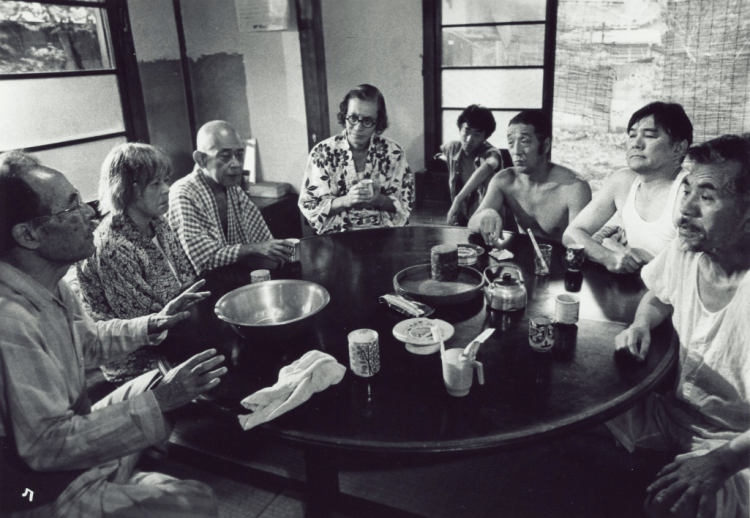
Shot in 4:3 and a stately looking black and white, At This Late Date, the Charleston begins when Jiro – a slightly strange younger son of a wealthy family, punches out a girl’s boyfriend whilst the pair are sitting on a bench and subsequently chases her through the park util he eventually gets himself arrested on a charge of “attempted rape”. He then gets thrown into a cell with a gang of crazy old guys who took the decision sometime ago to secede from the state of Japan and create their own independent nation known as the land of Yamatai. Consequently, they all refer to each other by their “cabinet titles” such as Foreign Minister and Army Minister etc each inspired by their former lives which is why they have a minister for mail (he used to be a postman). They’re in jail because they tried to make a “state visit” to the Diet building and whilst there enjoyed some of the canteen food but as this was an official event they didn’t see why they should pay for any of it (and their Finance Minister was busy at the races).

Soon enough everyone gets released – the old guys when the Finance Minister turns up to pay their bill and Jiro when he’s bailed out by his older brother and the family housemaid (who quickly realises the “victims” aren’t quite what they seem). However, in a fantastically weird coincidence it turns out that the government of Yamatai have commandeered a house on the estate of Jiro’s father for their sovereign territory. Jiro’s brother is desperate to evict them but there’s also the problem that their multimillionaire dad has been missing for months and no one’s quite sure what might have happened to him…

Crazy old guys (and gal) who’ve become so disillusioned with their nation that they’ve started a new one on their own, missing industrialists, a Lupin III-like policeman who’s so obsessed with looking cool that the suspects always run away while he’s left striking a pose – Okamoto really knows how to pile on the strangeness, but somehow it all seems to make perfect sense. Madcap doesn’t even begin to do justice to crazy cartoon world Okamoto has created but it’s all so effortlessly funny that it hardly matters what you’d call it.

After initially being captured and branded a spy when he marches on over to Yamatai to ask them about his father, Jiro finds himself defecting to become “Minister of Labour” (this seems to involve doing all of the old guys’ menial tasks). As the youngest member of the group, he becomes the repository for their stories which mostly date back to the days of their youth from the fun loving Charleston era to the rise of militarism and eventually the war itself. This comes to the fore even more as the events take place in August, meaning that there’s both the anniversary of the atomic bomb and of the end of the war raising painful memories for this group of older folks, even if not quite so relevant to the younger contingent. The gang are planning a special trip to a hot spring on the 15th, but first they have to defend their micro-country against the onslaught of gangsters and bailiffs who are trying to “invade” their sovereign territory.

The old folks are pacifists, more or less (they didn’t really want an “Army Minister” but it was argued that no one would take them seriously without means of defence) but are still determined to protect their ideal state of Yamatai all the while clamouring for a silent kind of diplomatic immunity. They have some very unusual ideas but they know what’s what and having made an unlikely ally in the form of an unhappily married and soon to be retired policeman, have even managed to expose a little corruption and evil corporate shenanigans in the process of defending their own freedom. A vote for dancing cheerfully over a military march, At This Late Date, The Charleston is a warm and funny tale of eccentric oldsters who’ve seen it all before and finally decided it’s all kind of ridiculous anyway which can’t help but get your own toes tapping, whatever age you are.


Several unsubtitled trailers for the price of one: