The Woman Who Touched Legs (足にさわった女, Yasuzo Masumura, 1960)

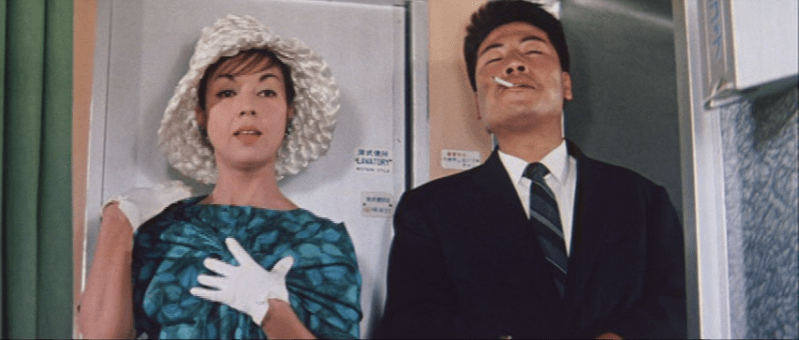
Busho Sawada’s serialised novel had been adapted several times before with the first released shortly after its publication in 1926, but this “modernised” version directed by Yasuzo Masumura, The Woman Who Touched Legs (足にさわった女, Ashi ni Sawatta Onna), is tailor-made for the post-war era as the titular woman heads off in search of the old Japan only to learn that it no longer exists and what little of it remains is being sold off for golf courses and ever expanding American airbases whose noisy aircraft fly constantly overhead.

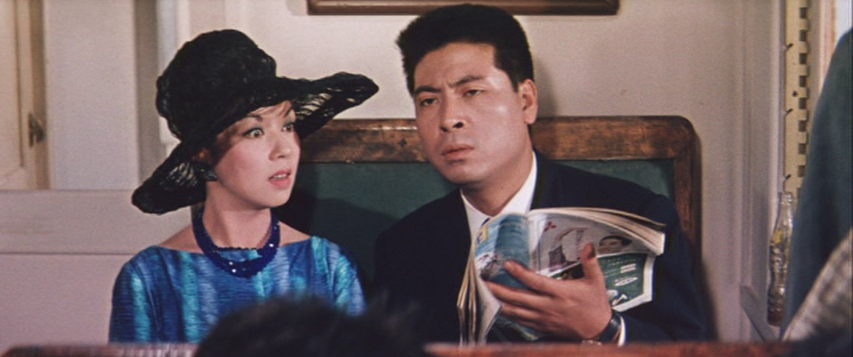
To that extent, Saya (Machiko Kyo) is an embodiment of aimless post-war youth. Her father was accused of being a spy and took his own life while her mother worked herself to death when she was just a child. Though she travels with a rather dim young man who refers to her as his older sister, they are not actually related by blood and seem to have belonged to the same community of street criminals in Osaka along with their “big sister” Haruko (Haruko Sugimura) who has since moved back to Atsugi which is Saya’s “hometown”. Since her parents’ deaths, she’s been obsessed with the idea of revenge and pickpocketing money to save for a giant memorial service to show the relatives who chased her family out of town how well she’s done for herself. But when she arrives, she can’t even find the place she’s looking for. A policeman flips through a series of ancient, handwritten ledgers looking for evidence of people with her surname and suggests they’ve all left town. Even the last one left is the wife of an adopted son who plans to move to Tokyo after their house is purchased by developers who want to build a golf course.

The golf course may be a symbol of Japan’s increasing prosperity, but the airbases seem to hint more at a sense of corruption and oppression. Saya’s “hometown” is a mythical concept that belongs to an idealised vision of a pastoral Japan before the war that she unconsciously wants to return to. Her mother spoke of a small settlement of perhaps 30 houses, a village society with a river running through it. The village has now, however, been swallowed by the airbase and, in fact, erased so that no one even quite remembers it. Saya is left feeling that she no longer has a hometown, and ironically asks policeman Kita to arrest her so she can go back to prison, which is, perhaps, where her heart truly lies. At least, it’s much quieter than here without any noisy aircraft flying overhead.

Nevertheless, Kita (Hajime Hana) is a fairly bumbling policeman and the film opens with what turns out to be part of a book set in a lawless Japan where people gamble, party, and openly sell guns on an ordinary train. Kita is currently on holiday, which he’s been forced to take even though he doesn’t really want to. He’s technically powerless for the moment, but continually complains that he’s not allowed to arrest Saya unless he catches her in the act of pickpocketing. It’s clear that the pair have feelings for each other it’s inconvenient to admit, and all this talk of “arrest” maybe more a kind of metaphor in which Saya secretly wants to be caught by Kita with the snapping of the handcuffs akin to the putting of a ring on a finger. The pair effectively lead each other on a merry dance with Saya ironically eventually chasing the policeman rather than the other way around.

The film does open rather salaciously with a closeup of a woman’s legs in fishnet tights followed by a kickline, and Machiko Kyo does indeed play up her sexy image to play the beautiful pickpocket who uses her body as a tool to mesmerise much to Haruko’s disapproval. Besides Kita, she’s followed by a rather louche writer (Eiji Funakoshi) who declares that he doesn’t need models, though evidently captivated by her, while declaring himself too successful and overworked. He doesn’t want more money, he just wants some free time and no one seems to want to let him have any, though he doesn’t exactly get a lot of writing done on this wild goose chase looking for Saya’s missing hometown. Absurd as it is, this unlikely rom-com between a beautiful pickpocket and bumbling policeman does at least end in a moment both of constraint and liberation as Saya finds herself content with her famous legs cuffed and Kita content to wear a different hat as they ride off on a decidedly unusual honeymoon.
Warm Current (暖流, Yasuzo Masumura, 1957)

Never one to tread the beaten path, Yasuzo Masumura studied film abroad in Italy before, perhaps counter intuitively, entering the Japanese studio system apprenticing at Daiei where he’d remain until its bankruptcy in the early ‘70s forced him into freelancing. His 1957 debut Kisses was a response to the taiyozoku or sun tribe craze of nihilistic youth movies though it was in its own way quietly hopeful and even sweet, at least in contrast to some the more cynical views of romance which colour some of the director’s later work, but again despite being positioned as precursor to the New Wave is also very much in the classical tradition if owing something to contemporary European art house. Masumura’s second film Blue Sky Maiden continued in the same vein, an ostensibly cheerful take on Sirkian melodrama in which the plucky heroine finds self-actualisation while dealing with her difficult family history. Warm Current (暖流, Danryu), meanwhile, builds on the same Sirkian foundations, remaking a popular weepy which had proved a big hit for Kozaburo Yoshimura 20 years earlier, but further undercutting it with a sense of ironic inconsequentiality as the heroes engage in a background battle for the post-war future. 

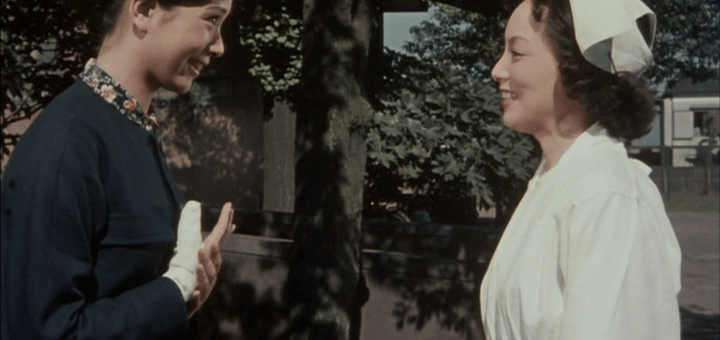
The film opens with a suicide, a nurse discovered dead on a bench after apparently having poisoned herself. She is, however, not the focus of the story and all too quickly forgotten in favour of the return of Keiko (Hitomi Nozoe), the daughter of the hospital’s director who has until recently been studying abroad. She’s come to the hospital because she has a piece of a sewing needle somehow embedded in her finger which needs rather more treatment than one might expect. Anyway, while there she attracts the attentions of handsome doctor Sasajima (Ryuji Shinagawa) and meets up with old schoolfriend Gin (Sachiko Hidari) who has since become a nurse. The problem is that the hospital is in big financial trouble and Keiko’s father Shima (Toranosuke Ogawa) is secretly terminally ill with cancer. He brings in Hibiki (Jun Negami), a pharmaceuticals executive he’s been supporting as a favour to his late father, as a consultant to streamline the business, while sidelining his rather feckless son Yasuhiko (Eiji Funakoshi), an orthopaedics doctor who might be assumed to take over were he not so entirely useless. 

Introduced rather late, Hibiki is positioned almost as a villain, a destabilising force within this very bourgeois world of the hospital determined to strip it of the corrupt entitlement of the surgical class. To that extent, he comes in like a new broom to apply modern business thinking to the ancient art of medicine but does so with rather old-fashioned ideas of gratitude and loyalty to Shima, always acting in the best interests of the family while positioning himself as a servant retainer. This the minor conflict that defines his complicated relationship with the equally confused Keiko who too has returned from abroad with taste for Western individualism but is uncertain how to live her life as a woman in still conservative Japan. All her friends ask her about blue-eyed boyfriends, and though it seems that she is immediately smitten with Hibiki she quite rudely dismisses him for his slightly condescending manner later remarking that she was turned off by a sense of his overconfidence. 

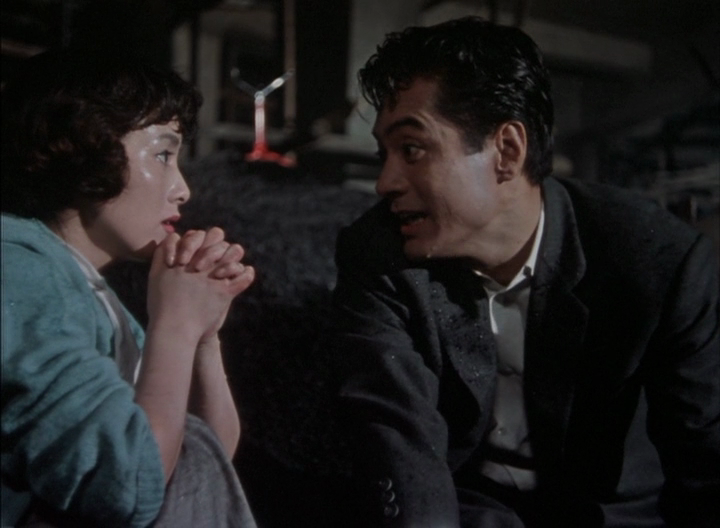
Keiko tells her father she’s no plans to marry and has come back to Japan intending to continue her studies. For his part, Shima is all for a woman working but not as he puts it if it causes her to become a “brainy spinster”. Eventually courted by Sasajima she finds herself torn, even as he tells her that, unexpectedly, he has no issue with her desire to work or study were she to become his wife, uncertain in her attraction to Hibiki while drawn back towards conservatism in knowing that her father favours marriage and that Sasajima is her class-appropriate match. Despite his own attraction to her, Hibiki says nothing even on hearing of her engagement precisely because of this increasingly outdated sense of social inferiority. Meanwhile, he remains seemingly oblivious to the fact that Gin, who like him is a war orphan, has fallen in love with him which is why she continues to help him as a “spy” within the hospital. 

In response to her war trauma, Gin has developed the habit of laughing loudly, an especially unusual trait in a generally reserved culture, and often remarks on her own “stupidity”, the childlike excitability which so clearly positions her as a mirror to the elegant Keiko. Yet the push and pull between the two women has little rancour in it, save that Gin is already aware that Sasajima was responsible for the suicide of the nurse on the rooftop but has chosen not to say anything hoping they’ll marry and Hibiki will be hers. As Keiko later discovers, Sasajima is fairly brazen in his “modernity”, having lived with an aspiring model who declines to marry him because it would adversely affect her career but has no problem with him marrying someone else confident that their physical relationship will continue. Sasajima turns up while Keiko is visiting her, but calmly sits down on the bed and explains that he essentially plans to have two wives, the model for the bedroom and Keiko to be his companion of the mind. He brands her vulgar and small-minded in her conservatism when she proves unconvinced, laying bare an essential misogyny when he echoes that brainy women are “boring”, which is why he “needs” the model to satisfy himself sexually. Nevertheless, Keiko is not that kind of “modern” and in any case not so in love with Sasajima nor deluded enough to think she needs him to agree to his arrangement. 

Gin meanwhile echoes something of the model’s passive resignation when she too declares that she doesn’t care if Keiko marries Hibiki because she’s certain he’s supposed to be with her in the end because they are “alike”. There is no class conflict between them, and as they are both war orphans they share a sense of displacement in the post-war society. Unlike Keiko Gin is open in her feelings, declaring her love for Hibiki even chasing after him at the station and calling out across the ticket barriers that she’ll wait forever even if she only becomes his mistress. Earlier on, Keiko had been reading a foreign romance about a woman courted by two men she was unable to choose between only making up her mind when one of the men’s accent slipped, but in essence it’s Hibiki who finds himself torn if earnestly, thinking himself in love with Keiko but prevented from pursuing her because of his class anxiety rather than attracted to her precisely because of her class standing and everything it represents which is in a sense the target of his “revolutionary” reforms at the hospital. Tempted, he is eventually pulled back towards the side of “passion”, won over by Gin’s slightly scary if unwavering love for him. 

Yet this is no grand weepy, just the romantic confusion of three young(ish) friends who eventually find direction in their lives as mediated through “love”. Keiko reassumes her stance as a thoroughly modern woman, explaining to her rather naive mother that Yasuhiko, who has wrested control of the estate away from Hibiki, is not capable of looking after them even if he had the desire and so she intends to work, apologising to her father for her intention to become a “brainy spinster” after all. Hibiki loses out in the hospital too which is quickly retaken by the same corrupt forces Shima brought him in to combat. “I understand a woman’s feelings” Hibiki somewhat patronisingly claims as a result of his experiences, immediately proving that he doesn’t in misreading Keiko’s intentions while she, ironically, claims that she is no longer afraid of being overwhelmed by male authority. Unable to change their respective futures, the only option that remains is to abandon them for new ones of their own making but this is far from a tragedy, merely the ironic fate of the post-war generation remaking itself in real time, letting the door close behind them as they walk away from the irredeemably corrupt. 


Original trailer (no subtitles)

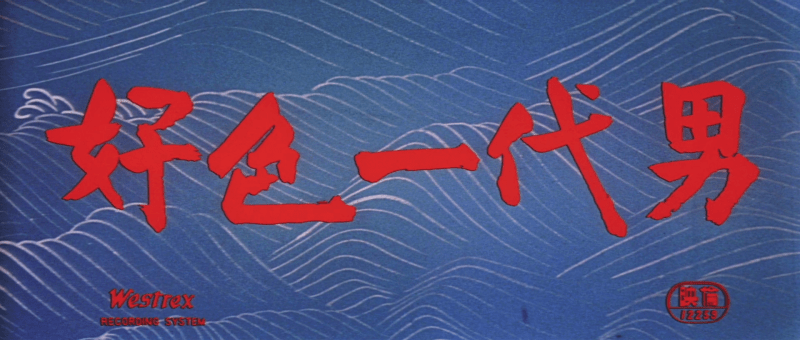
A Lustful Man (好色一代男, Yasuzo Masumura, 1961)

“Why are women in Japan so unhappy?” the carefree Casanova at the centre of Yasuzo Masumura’s 1961 sex romp A Lustful Man (好色一代男, Koshoku Ichidai Otoko) laments, never quite grasping the essential inequalities of the world in which he lives. Masumura is best known for extremity, a wilful iconoclast who flew in the face of golden age cinema’s genial classism, but shock was not his only weapon and he could also be surprisingly playful. Adapted from a well known novel by creator of the “floating world” Ihara Saikaku, A Lustful Man finds him indulging in ironic satire as his hero sets out to “make all the women in Japan happy” chiefly by satisfying their unfulfilled sexual desire while resolutely ignoring all of the entrenched patriarchal social codes which ensure that their lives will be miserable. 

Set in the Edo era, the film opens not with the hero Yonosuke (Raizo Ichikawa) but with his miserly father who berates a servant after discovering a single grain of rice on the hall floor. According to him, the central virtues necessary to become rich are endurance, diligence, and vitality. You must treasure each and every grain of rice in order to accumulate. A cruel and austere man who only thinks of money, Yonosuke’s father keeps his wife in earnest poverty despite their wealth, angrily grabbing an obviously worn kimono out of her hands and insisting that it’s still good for another year, apparently caring nothing for appearances in the otherwise class conscious Kyoto society. It’s this meanness that Yonosuke can’t seem to stand. He hates the way his father disrespects his mother, and her misery is a primary motivator in his lifelong quest to cheer up Japan’s melancholy women though the weapon he has chosen is sex, a convenient excuse to live as a genial libertine to whom money means essentially nothing. 

Yonosuke’s father has set him up with an arranged marriage into a much wealthier family, which is not something he’s very interested in despite the fact she seems to be quite pretty but on learning that she has transgressively found love with the family butler he determines to help her instead, ending the marriage meeting by chasing her round the garden like a dog in heat. Several similar stunts eventually get him sent away from his native Kyoto to Edo but he takes the opportunity to escape, travelling all over Japan making women “happy” as he goes. 

As the first example proves, Yonosuke genuinely hates to see women suffer. His own pleasure, though perhaps not far from his mind, is secondary and he never seeks to take advantage of a woman’s vulnerability only to ease her loneliness. Despite that, however, he remains essentially superficial opting for the transience of postcoital bliss while ignoring the very real societal factors which make an escape from misery all but impossible. During an early adventure, he spends all of the money he conned out of his new employer on redeeming a geisha (at more than three times the asking price) so that she can be with the man she loves, but he continues to visit sex workers without interrogating their existence as indentured servants, “merchandise” which is bought and sold, traded between men and entirely deprived of freedom. In fact, he proudly collects hair cuttings from the various geishas he has known as a kind of trophy only to later discover the grim truth, that the hair likely doesn’t belong to the geisha herself but is sold to them by middlemen who get it by digging up dead bodies. 

Yonosuke remains seemingly oblivious to the duplicitous hypocrisy of the yoshiwara, but is repeatedly confronted by the evils of Edo-era feudalism with its proto-capitalist cruelty where everything is status and transaction. He is often told that as he is not a samurai he would not understand, but seems to understand pretty well that “samurai are idiots” and that their heartless elitism is the leading cause of all the world’s misery. To some a feckless fool, Yonosuke refuses to give in to the false allure of worldly riches. As soon as he gets money he spends it, and does so in ways he believes enrich the lives of women (even if that only extends to paying them for sex), eventually getting himself into trouble once again reneging on his taxes after trying to prove a geisha is worth her weight in gold. 

Yogiri (Ayako Wakao) complains that women are but “merchandise”, valued only as toys for men. “Japan is not a good country for women” Yonosuke agrees, suggesting they run away together to find a place where women are respected, indifferent to Yogiri’s rebuttal “no, wherever you go, no one can change women’s sad fate”. Yonosuke’s naive attempts to rescue women from their misery often end in disaster, a runaway mistress is dragged back and hanged, the woman he was set to marry goes mad after her father and lover are beheaded for having the temerity to speak out about corrupt lords, Yogiri is killed by a samurai intent on arresting him for tax evasion, and his own mother dies seconds after his father only to be immediately praised as “the epitome of a Japanese wife”. Yet he remains undaunted, wandering around like an Edo-era Candide, setting off into exile to look for a supposed female paradise without ever really engaging with the systems which propagate misery or with his own accidental complicity with them. Nevertheless, he does perhaps enact his own resistance in refusing to conform to the rules of a society he knows to be cruel and unfair even if his resistance is essentially superficial, self-involved, and usually counterproductive which is, in its own way, perfectly in keeping with Masumura’s central philosophies on the impossibilities of individual freedom within an inherently oppressive social order.