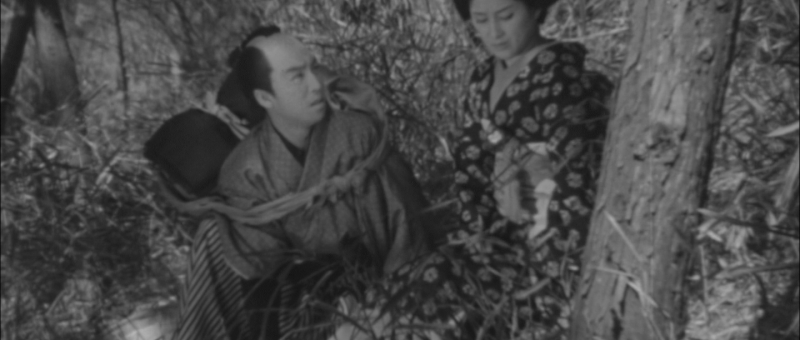
“It’s a rough and difficult road.” The heroes of Mikio Naruse’s Okuni and Gohei (お國と五平, Okuni to Gohei), adapted from a kabuki play by Junichiro Tanizaki, are two displaced between the old world and the possibility of a new one if only they were brave enough to step away from the beaten path. Unbeknownst to them, they are being followed by the man they are seeking whose shakuhachi playing haunts them wherever they go as if taunting them with its presence.
In this iteration of the tale, Tomonojo (So Yamamura) takes on a slippery quality almost if he were some supernatural devil sent to torment Okuni (Michiyo Kogure) and Gohei (Tomoemon Otani) leading them either towards or away from their salvation or damnation. In Okuni’s flashback, which is obviously coloured with her own nostalgia and regret, he’s a sensitive young man who promised himself in marriage to Okuni. But she is forced to refuse him. Her father rejects Tomonojo because he is without standing or prospects, and instead demands she marry a wellborn man of his choosing, Iori (Jun Tazaki). Iori is then killed in the street, uttering only Tomonojo’s name before he dies. It could then be that this is Tomonojo’s revenge on a society that has rejected him and robbed him of his love, yet the Tomonojo we later meet is much different than this idealised version in Okuni’s memory. He never denies killing Iori and offers no justification for it, but corners Okuni when she’s alone to tell her to free herself by dropping her quest for revenge. He’s also subtly blackmailing her, implying he heard her having sex with her manservant Gohei the previous night and in reality wheedling away pleading for his life.
For her part, Okuni seems torn in her motivations, uncertain whether she’s looking for Tomonojo to reunite with him or kill him, or perhaps is deliberately avoiding finding him at all. She was not married to Iori for very long and he was at the very least an insensitive and emotionally distant husband who spent most of his time at his friend’s house, claiming that it was “boring” to stay home with her. She has no great emotional desire for revenge, but has been told she must accomplish it in order to return to the samurai world, having been condemned to a kind of limbo as the widow of a murdered man. Even so, she has tired of her quest and asks herself what’s to become of them if Tomonojo is already dead. She repeatedly hints to Gohei that they should give up on finding him and on returning home, instead contenting themselves with their life on the road or else find somewhere to settle together in a new world in which a lady and her retainer could live as man and wife.
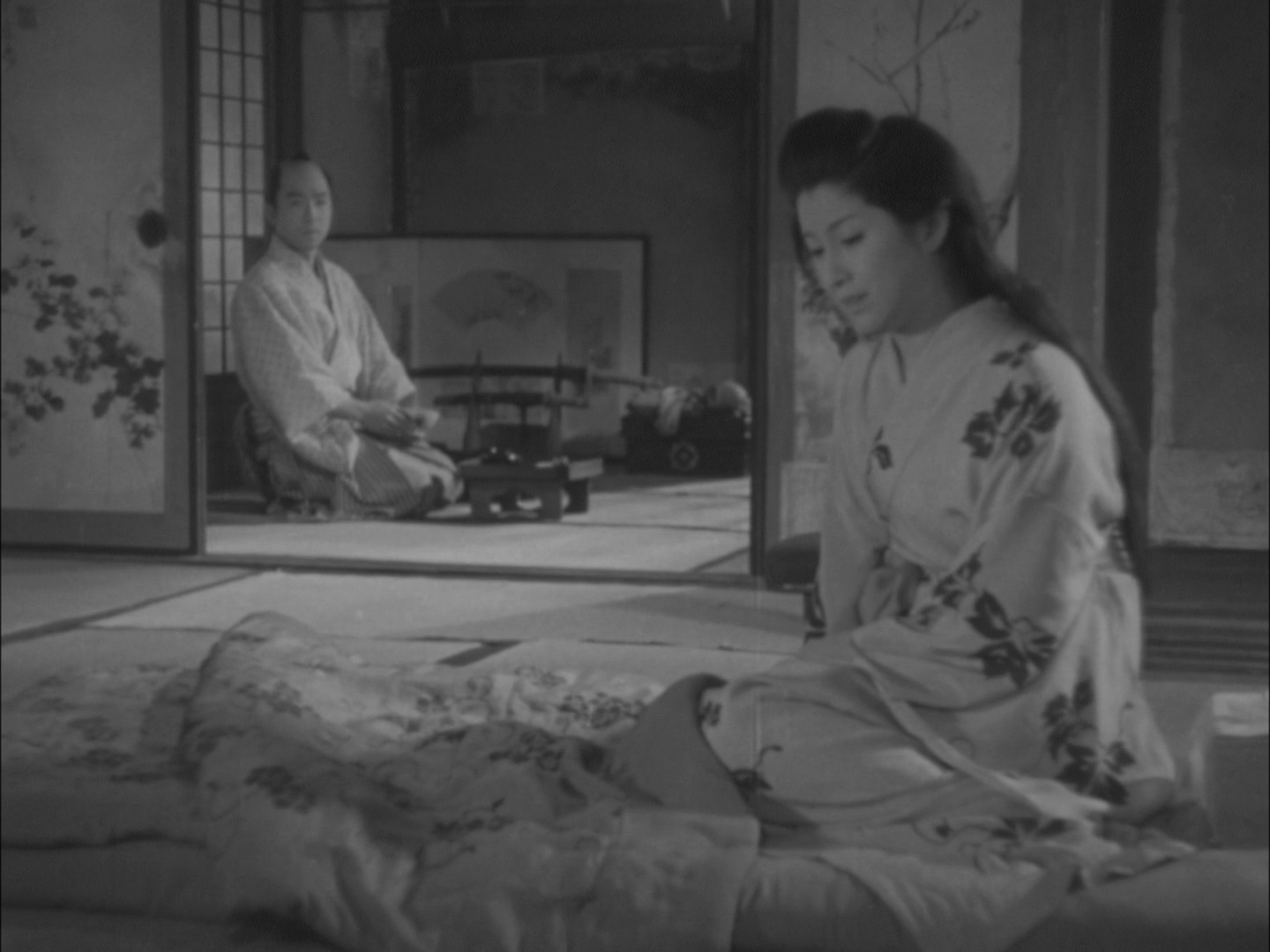
The film is both coy and somewhat transgressive in its depiction of the growing sexual tension between Okuni and Gohei from his taking hold of her injured foot and tender care for her when she falls ill, to the way they draw closer and then instinctively move apart. Passion later gets the better of them and it’s heavily implied that they sleep together, but Gohei instantly regrets it and cannot accept his class transgression. Given this development in their relationship, Okuni asks him to stop calling her “madam” but as she does so she is on one side of the fusuma and he on the other, so they remain in separate rooms divided by the ridge in the tatami. Gohei cannot let go of the old ways and is desperate to complete their quest so that his debt to Iori will be repaid and he can return in glory to be rewarded with position and the esteem of being a true samurai. Even if he tells Okuni that this quest has been his happiness in being on the road with her and knows that killing Tomonojo will end it, he does not turn back.
But the implication is that they can never escape Tomonojo who will, in fact, forever be following them. He taunts the pair with his shakuhachi and visits them in disguise. When they catch up to him, he tries again to convince them to give up their quest and live quietly together in a place free from the constraints of the samurai world, but Gohei cannot do it. Okuni first picks up her dagger and one wonders whether she about to use it on herself, but then turns on Tomonojo though it’s uncertain whether she now does so out of resentment or as revenge of herself for the way Tomonojo has again ruined her life. Just as she was a pawn of her father married off against her will to an indifferent man, she is further imprisoned by patriarchal social codes as Tomonojo needles Gohei that he had slept with her before her marriage. She has in fact already confessed to this to Gohei who transgressed by asking her what exactly Tomonojo was doing with his “shakuhachi” when they were courting, though she did so obliquely in telling him to remember his place and that he should “forget about the past.” Nevertheless she denies it now, but Gohei continues to see her as a “loose” woman with Tomonojo’s words ringing in his ears as a final revenge on the morally compromised lovers.
Their inability to let go of the quest, to do as Okuni suggests and continue on as they are along the rough and difficult path to a more egalitarian future spells their damnation. You can’t go back again. Their “home” is already lost to them. As a pedlar tells the pair along the way, they’ve already been forgotten and the village is filled with other gossip, but now they really have nowhere to go. The message may be for the coming post-occupation era that they shouldn’t try to turn back but keep moving forward into the new Japan or else risk becoming lost in a purgatorial world of confusion like Okuni and Gohei haunted by the choice to betray love for the outdated ideal of samurai honour. Haunted alternately by Tomonojo’s shakuhachi and the words of the villagers who told them they couldn’t be accepted until they fulfilled this quest, they find themselves displaced, unbalanced and uncertain amid the shifting power dynamics of class and gender, their duty and their feelings, but ultimately trapped by their cowardice in their unwillingness to cross the threshold to claim their freedom and happiness.

 Windows on Worlds