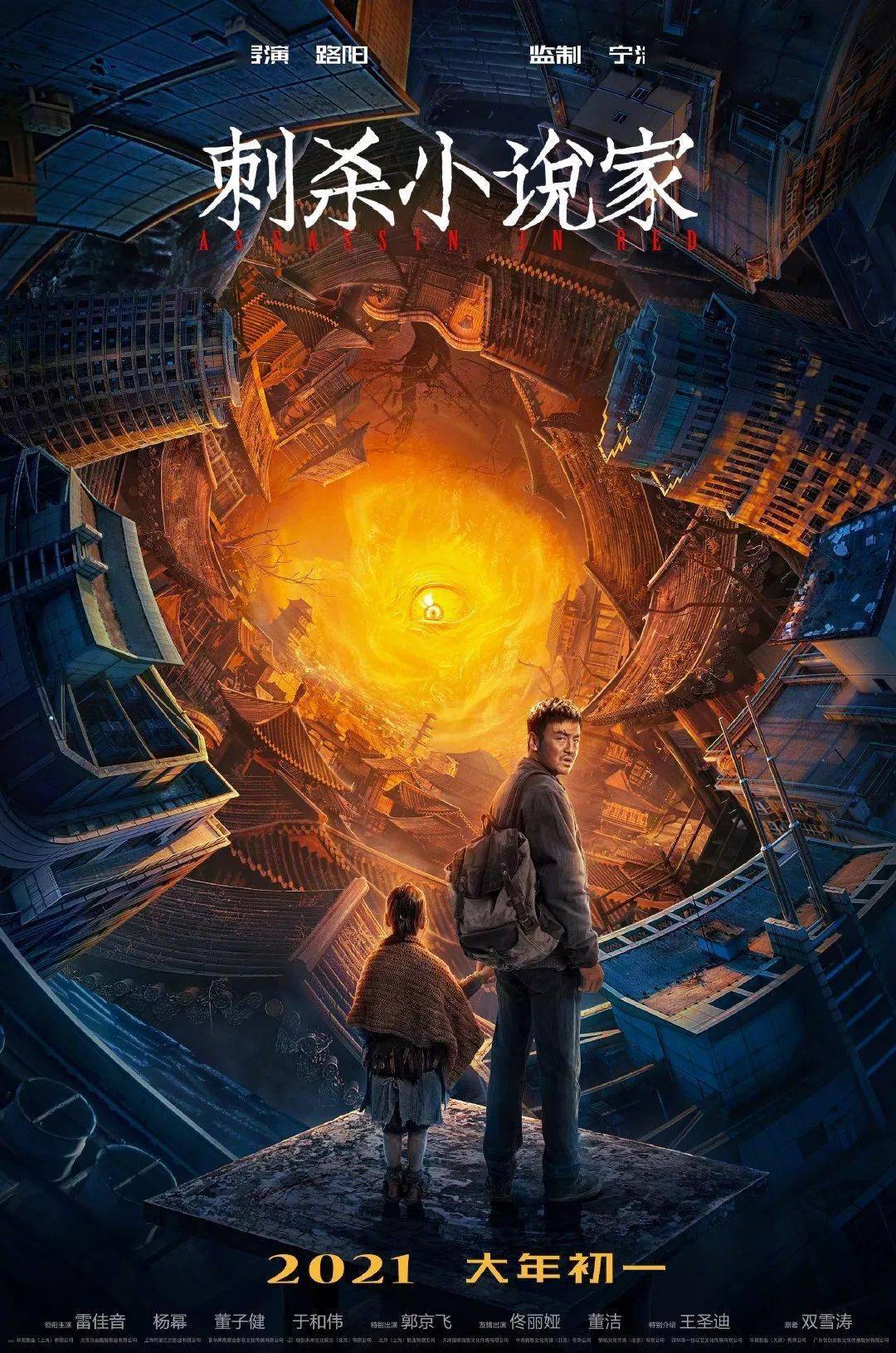
A Writer’s Odyssey (刺杀小说家, Lu Yang, 2021)

“As long as I keep writing, my existence has meaning,” according to the titular writer at the centre of Lu Yang’s action fantasy, A Writer’s Odyssey (刺杀小说家, cìshā xiǎoshuōjiā). His art, though derided as trivial, is it seems the best form of resistance to the feudalistic capitalism that has overtaken the authoritarianism of the communist past. Broken father Guan Ning (Lei Jiayin) desperately searches for his daughter Tangerine who has been missing six years, assumed to have been swallowed by China’s child trafficking network, only to find himself plagued by bizarre dreams of a fantasy city.

The city is, it seems, that of Kongwen’s (Dong Zijian) fantasy novel series which he live streams over the internet. Whenever something bad happens to the evil despot at the story’s centre, Lord Redmane, it’s visited on the CEO of vast corporation Aladdin (read: Alibaba), Li Mu (Yu Hewei), which has just launched the Lamp App which will they claim “resculpt time” so that time and distance are no longer an issue. Li Mu is panicked because Kongwen has said he’s going to end the series in three days and it doesn’t look good for Lord Redmane, so he’s fearful for his life. Noticing that Guan Ning has some sort of super power in which he can hurl rocks with unusual accuracy, he leverages Tangerine’s disappearance to convince him to knock off Kongwen in exchange for his daughter’s location.

Of course, the fantasy world and the “real” are connected in more ways than one with Ranliang conjuring visions of the Cultural Revolution in which the despotic leader is literally protected by hordes of mindless “Red Guards” while pitting one district against another and seemingly destroying all art. Li Mu, meanwhile, is destroying human innovation with his apps and treats the lives of others with callous disregard. His right-hand woman Tu Ling (Yang Mi), originally resentful of Guan Ning in blaming him for losing his child having been abandoned by her own parents, becomes disillusioned with his tactics on realising that he lied to Guan Ning and the candidates he picked for Tangerine are five random girls none which is likely to be her. Figuring out that she’s probably next after Li Mu knocks off Kongwen, who is also the son of his former business rival that he seemingly betrayed to take control of the company, and gets rid of Guan Ning for good measure, her allegiances begin to change creating a kind of parallel with Tangerine and the mysterious boy hanging around with her.

Meanwhile, in the fantasy world, Kongwen teams up with a demonic suit of armour that feeds on his blood but is also a near unbeatable killing machine that may or may not be evil. Guan Ning comes to believe that the fantasy world may be the only place he can find Tangerine and switches side from agreeing to kill Kongwen to deciding to protect him so that he can finish the story and possibly write a better ending for his fantasy character who as yet remains undefined. He’s later revealed to be a member of the brainwashed Red Guard, which may be appropriate as his former job was a banker which is to say a soldier of capitalism. Only art can break his programming in the form of Tangerine’s flute playing which reawakens his humanity and memory. 

The implication seems to be that China cannot escape either its communist past or capitalist future except through the liberation that comes with artistic endeavour. When Guan Ning is tasked with killing Kongwen, he follows him about town and hears his neighbours run him down as a “parasite”, a man of almost 30 with no real job and no income who is still being financially supported by his mother. This information might be offered to make it seem less bad to kill him, as if in this hyper-capitalistic society his life is worth nothing because that’s what he contributes. Kongwen feels this a little himself and has suicidal thoughts, but also insists that his life has meaning precisely because he writes and expresses all of this frustration with the contemporary society along with his buried resentment towards Li Mu for the death of his father and theft of his birthright. Shot like a video game, the film’s sprawling fantasy-esque world hints at still more adventures to come in this David and Goliath competition in which Kongwen and Guan Ning attempt to overthrow this cruel and corrupt order to find a way to free themselves from its authoritarian cruelties if only in their minds.


Trailer (English subtitles)
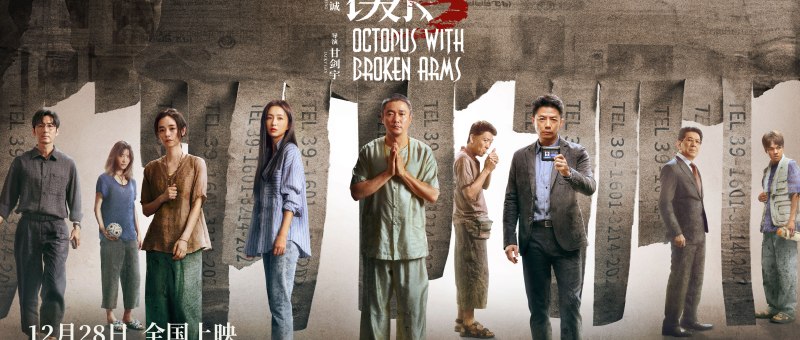
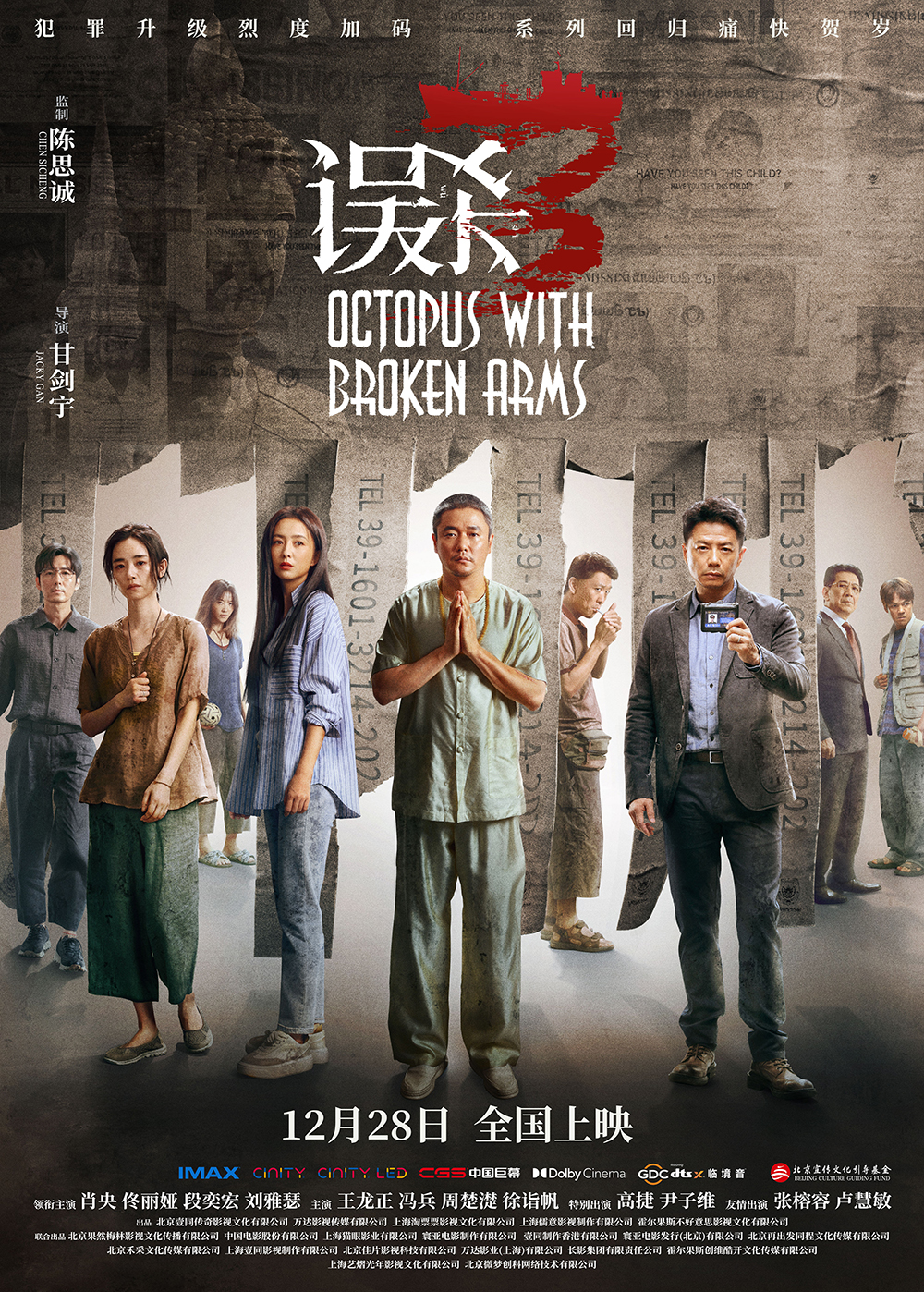
Octopus with Broken Arms (误杀3, Jacky Gan Jianyu, 2024)

It’s quite surprising, somehow, that Octopus with Broken Arms (误杀3, wùshā 3) gets away with as much as it does simply being another recent mainstream movie set in an unidentified South East Asian nation where, conveniently enough, almost everyone speaks Mandarin. The third in the Sheep Without a Shepherd series, it quite clearly takes aim at the tendency of authoritarian governments to cover things up and deny the public the truth in any situation. Ordinarily, the censor’s board wouldn’t like that pointed out, nor would it like implications of police violence and corruption though as this is all taking place in “Not Mainland China”, it seems to have passed them by.

Then again, by setting itself overseas the film also deflects the implications of its focus on child trafficking which is a huge and well documented problem on the Mainland though here it becomes something that only happens overseas. The closing title cards in English offer a series of statistics about missing children worldwide, but avoid mentioning the statistics in China where the One Child Policy contributed to a phenomenon of children being kidnapped from the cities to be raised on rural farms while the preference of sons often saw daughters otherwise sold off.

In any case, Bingrui (Xiao Yang) is an ethnic Chinese refugee raised in an orphanage who got a huge capital injection from a gangster after finding his missing child and turned it into an internationally successful cosmetics corporation. When his own daughter Tingting is kidnapped, he seems to know immediately that he’s not been targeted simply because he’s a wealthy man and suspects the involvement of Fu-an (Feng Bing), an old “friend” with whom he’d had “a few issues” who had approached him for money for his son’s heart transplant which he had given him. 

It doesn’t take long to figure out that Bingrui must have been involved in something untoward even if he’s now a devout Buddhist who’s just trying to be a good father having lost his wife in childbirth. Fed a series of clues to find his daughter, it’s clear he’s being led towards a kind of confrontation with his past along with a test of character. He may be able to say that he did the things he did because he had no other choice. If he had not joined the side of those acting against all common notions of humanity, he would simply have become one of their victims. But there is a choice involved all the same, and Bingrui chose survival through the sacrifice of other lives. 

The fact that the kidnapper lives streams much of the chase suggests they’re less interested in the money than truth and ultimately want Bingrui to blow the whistle on a vast conspiracy which otherwise can’t be investigated because it’s burrowed deep into the police force and perhaps beyond. As one of those working against him later says, there are too many secrets destined to remain so that should be brought out into the light. A newsreader, however, remarks on hearing about a possible cover up of the deliberate murder of a number of trafficked children passed off as “refugees”, that what he most fears is that the people have lost faith in their government. Nevertheless, there might be something quite subversive about the lengthy scenes of citizens expressing discontent with blatant lies from the authorities and openly begging for the truth given the famously tightlipped CCP’s usual approach to public information.

In any case, the more we learn about Bingrui the harder it is for us to sympathise with him and the film then becomes more about proper paternity and the willingness of a parent to surrender their own life for that of their child. The film takes its English title from an incredibly elaborate school play little Tingting is involved in at the beginning of the film about how Octopuses are all orphans because their parents abandon them soon after birth and then pass away. Bingrui wasn’t exactly an orphan, like many of the children he was kidnapped from a loving family, but became one and lost his sense of humanity in the process. The question is whether he will be able to abandon his instincts for self-preservation to save his daughter or if, in the end, he will choose to save himself just as he did when chose to join those who kidnapped him rather than become a victim. Like many similarly themed thrillers of recent years, the film is built around a series of outrageous twists many of which are startlingly obvious but in their way serve the shocking quality of those that aren’t. What’s truly shocking is the depth of this conspiracy which hints not just at children being stolen and sold to overseas adopters, but trafficked into sexual exploitation or for illegal organ harvesting. The barbarity knows no bounds, and while the actions of Tingting’s kidnappers are in themselves brutal it’s clear they have no other way to ensure the injustice they face will be addressed. Indignant but avoiding sentimentality, Jacky Gan Jianyu’s slickly designed B-movie thriller nevertheless ends on a note of karmic retribution that the “hero” may not have earned but does at least allow him to make good on his promise and symbolically atone for the all the pain and suffering his callousness self-interest has caused. 


Trailer (English subtitles)

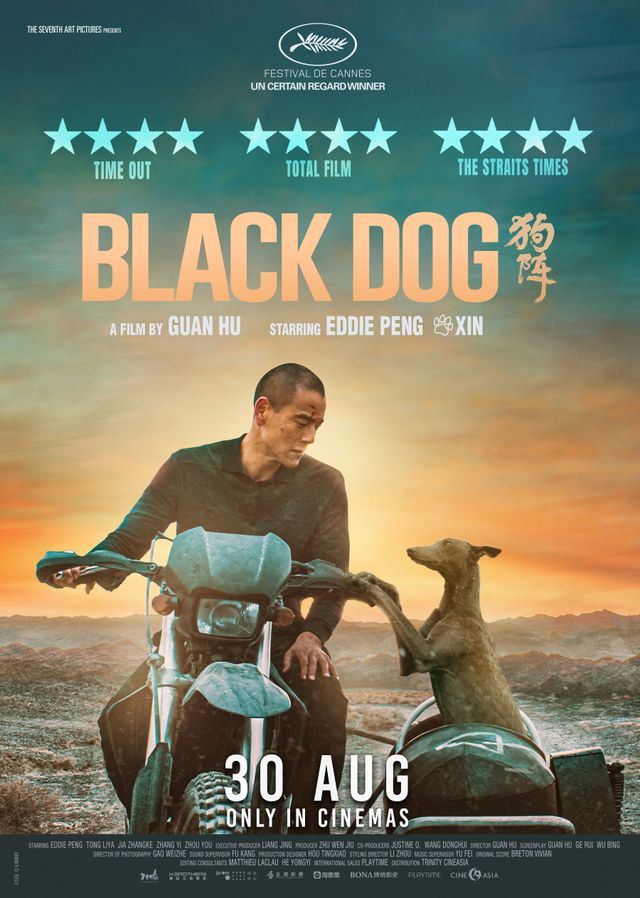
Black Dog (狗阵, Guan Hu, 2024)

When a dusty sign pops up in Guan Hu’s Black Dog (狗阵, gǒu zhèn) advertising the upcoming 2008 Beijing Olympics, you’d be forgiven for thinking it’s a relic of a long forgotten past. On the edge of the Gobi desert, Chixa has a post-apocalyptic aesthetic, a kind of reverse frontier town for a society in retreat. It takes on an almost purgatorial quality for prodigal son Lang (Edward Peng Yu-Yan) who returns after spending nearly a decade in prison for an incident that seems like may not have been entirely his fault but for which he continues to face enmity and a petty vendetta from a local gangster/snake farmer Butcher Hu.

Lang himself is aligned with the stray dogs who have begun to reclaim the town which has long since been abandoned by industry. The moribund zoo where his father has taken to living is testament to the prosperity the area may once have had though now it’s a ghost town of China’s industrialising past strewn with the disused factories of Socialist era dealt a deathblow by the economic reforms of the ‘90s. Yet we’re also told that the reason the stray dogs must be expelled is so the town can be redeveloped and new factories take the place of the old which does not seem to hold the kind of promise for the townspeople one might expect. 

Constant references to the Olympics and its slogan “Live the Dream” only emphasise the irony. Geographically distant from Beijing, Chixa exists in an entirely different space from the Chinese capital and appears as if it were about to collapse in on itself. Half the town is plastered with demolition signs and in the end it’s the people who are displaced as much the dogs. Guan often rests on ominous visions of the strays standing on a small hilltop and then recalls the image in the film’s closing scenes as the dogs are replaced by townspeople watching a once in a generation total eclipse on the eve of the opening of the games.

With nothing much else to do, Lang, a former rockstar and motorcycle stuntman in the town’s more prosperous days which themselves even seem to echo the 1950s more than the late ‘90s, joins the campaign to beat the canines into retreat at the behest of local gangster Yao (played by director Jia Zhangke) but begins to identify and sympathise with them especially once it becomes obvious that the new regulations are exploiting dog owners by forcing them to pay to have their animals registered. Those who can’t or won’t have their pets confiscated, Lang silently rescuing one girl’s little’s pet pooch while her grandmother tries to argue with the dog catchers before they take them all to what is effectively a concentration camp for dogs. The film’s Chinese title is in fact “Dog Camp,” and it becomes clear that it’s Lang who’s stuck there, trapped by his past and the dismal realities of the socioeconomic conditions of late 2000s China.

Hoping to earn a little extra cash he decides to try catching a wanted fugitive, the Black Dog of the title who is mistakenly believed to have rabies only to end up bonding and identifying with it. At several points, Lang echoes the movements of the dog such as placing his head on the chest of his dying father as the crowd below his hospital room prepare to welcome the opening the Olympics via a large screen in the town square. His relationship with the dog begins to restore his sense of compassion and humanity while a tentative connection with a young woman equally trapped by her transient existence and toxic relationship with a fellow circus performer opens his eyes to new possibilities of a life of freedom on the open road no longer bound by the constraints of a society in flux. Elegantly lensed grainy photography and the occasional use of synth scores lend the film an elegiac, retro quality that recalls the cinema of the fifth generation while casting a subversive eye over the compromises of the modern China itself trapped by its past and trading on former glory from which stray dogs like Lang can find escape only by running from the pack. 


Black Dog is in UK cinemas from 30th August courtesy of CineAsia.

UK trailer (English subtitles)

My People, My Country (我和我的祖国, Chen Kaige, Zhang Yibai, Guan Hu, Xue Xiaolu, Xu Zheng, Ning Hao, Wen Muye, 2019)

My People My COuntry poster 3Oct. 1, 2019 marks the 70th anniversary of the People’s Republic of China. Supervised by Chen Kaige, My People, My Country (我和我的祖国, Wǒ hé Wǒ dě Zǔguó) presents seven short films by seven directors featuring several notable historical events from the past 70 years though not quite one for every decade (perhaps for obvious reasons). Though different in tone, what each of the segments has in common is the desire to root these national events in the personal as they were experienced by ordinary people rather than how the history books might have chosen to record them.

Told in roughly chronological order, the film opens with the founding of the Republic as comedian Huang Bo plays an eccentric engineer charged with ensuring the operation of an automatic flag pole doesn’t embarrass Chairman Mao at the big moment. In the context of the film as a whole which is fond of flags, this is rather odd because every other flag in the film is raised by hand usually by a soldier taking the responsibility extremely seriously. Yet the point is less the flag itself than the symbolic pulling together of the community to find a solution to a problem. Realising the metal on the stopper is too brittle, the engineers put out an appeal for more with seemingly the entire town turning up with everything from rusty spoons to grandma’s necklace and even a set of gold bars!

This same sense of personal sacrifice for the greater good works its way into almost all of the segments beginning with the story of China’s first atom bomb in the ‘60s for which a pure hearted engineer (Zhang Yi) first of all sacrifices his one true love and then the remainder of his life when he exposes himself to dangerous radiation all in the name of science, while in the film’s most charming episode a young boy is devastated to realise his crush is moving abroad and has to choose between chasing after her and fixing up a TV aerial so his village can see China beat the US at volleyball during the ’84 Olympics. Visions of flag waving glory eventually convince him where his duty lies, but his sacrifice is later rewarded twice over as he becomes a little local hero even if temporarily heartbroken in the way only a small boy can be.

Then again, some people are just a little self-centred like the hero (Ge You) of Ning Hao’s Welcome to Beijing who keeps trying to reconnect with his earnest teenage son only to end up connecting with a fatherless young boy during the 2008 Beijing Olympics. Chen Kaige’s sequence, meanwhile, is inspired by the story of two earthbound astronauts but similarly finds two roguish, orphaned young men connecting with a patient father figure who is able to bring them “home” by showing them a space miracle in the middle of the desert, and in the final and perhaps most directly propagandistic sequence, a tomboyish fighter pilot eventually overcomes her resentment at being relegated to a supporting role to rejoice in her colleagues’ success. Despite the overly militaristic jingoism of the parades with their obvious showcasing of China’s military power, Wen Muye’s “One for All” is in its own sense surprisingly progressive in its advancement of gender equality and mildly subversive LGBT positive themes were it not for a shoehorned in scene featuring a milquetoast “boyfriend”.

Sensitivity is not, however, very much in evidence in the sequence relating to the extremely topical issue of the Hong Kong handover. Out of touch at best, the constant references to the continuing reunification of the One China are likely to prove controversial though admittedly those they would most upset are unlikely to want to sit through a 2.5hr propaganda epic celebrating the achievements of Chinese communism. Nevertheless, it is a little galling to see the “return” to China so warmly embraced by the people of Hong Kong given current events in the city. This perhaps ill-judged sequence is the most overt piece of direct propaganda included in the otherwise unexpectedly subtle series which, despite the flag waving and eventual tank parade, tries to put the spotlight back on ordinary people living ordinary lives through the history of modern China. Of course, that necessarily also means that it leaves a lot out, deliberately refusing to engage with the less celebratory elements of China’s recent history, even as it closes with the fiercely patriotic song of the title performed by some of the ordinary heroes who have inspired its various tales of everyday heroism.


Original trailer featuring Faye Wong’s cover of the well known patriotic anthem from 1985 (no subtitles)

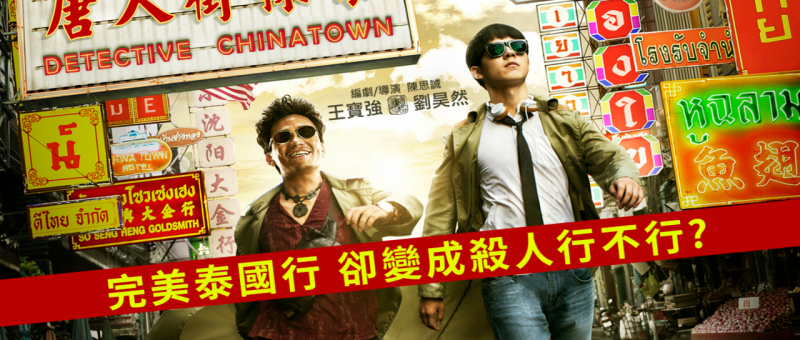
Detective Chinatown (唐人街探案, Chen Sicheng, 2015)

detective chinatown posterCrime exists everywhere, but so do detectives. When one young man fails his police exams because of an unfortunate impediment, he seeks refuge abroad only to find himself on a busman’s holiday when the relative he’s been sent to stay with turns out to be not quite so much of a big shot as he claimed and then gets himself named prime suspect in a murder. Detective Chinatown (唐人街探案, Tángrénj Tàn Àn) is one among many diaspora movies which find themselves shifting between a Chinese community existing to one side of mainland culture, and a mainland mentality. This time the setting is Bangkok but second time director Chen Sicheng is careful not to surrender to stereotype whilst also taking a subtle dig at men like uncle Tang Ren who can unironically refer to Thailand as a paradise while indulging in many of the aspects which might leave other residents with much more ambivalent emotions.

Qin (Liu Haoran), a young man with a fierce love of detective fiction, has his dreams shattered when his interview to get into the police academy is derailed by his stammer and an unwise tendency towards reckless honesty. His doting grandma who raised him suggests Qin take a holiday to take his mind off things by going to stay with his uncle who is, apparently, a hot shot detective in Bangkok – Qin might even get some valuable experience whilst thinking about a plan B. Sadly, uncle Tang Ren (Wang Baoqiang) has been sending big fish stories back home for years and though he claims to be the best PI in Chinatown, he’s really a petty marketplace fixer with a bad mahjong habit and a side hustle in “finding” lost dogs. When Tang Ren accepts an errand to transport a statue from a workshop, he accidentally finds himself the prime suspect in the murder of the sculptor who is himself the prime suspect in a heist of some now very missing gold. Qin, tainted by association, vows to use his awesome detective skills to find the real killer (and the gold) to clear his uncle’s name whilst generally serving justice and protecting the innocent.

Despite the fact his secret is clearly about to be exposed, Tang Ran greets his long lost relative with immense enthusiasm (which is, as it turns out, how he does everything). Wang Baoqiang commits absolutely to Tang Ren’s cynical good humour attacking his larger than life personality with gusto though one has to wonder why Qin’s poor unsuspecting grandma thought Tang Ren would be a good guardian for her teenage grandson, especially as his first act is to take him to a strip club and spike what might actually be the first real drink of his life. Qin, quiet (that stammer) and introspective, is not a good fit for the loud and brassy world of insincerity his uncle inhabits, but forced into some very challenging situations, the two men eventually manage to combine their respective strengths into a (hilariously) efficient crime fighting team.

Meanwhile, Qin and Tang Ren are also contending with some serious political shenanigans in the local police department. Two Chinese cops are currently vying for a promotion and the job has been promised to whichever of them manages to identify the murderer and locate the missing gold. Luckily or unluckily, cop 1 – Kuntai (Xiao Yang), is a good friend of Tang Ren’s and doesn’t want to believe he is secretly some kind of criminal genius (but could well believe he killed a guy by mistake). Cop 2 (Chen He) is a hard-nosed (!) type who, for some reason, dresses like a cowboy and has a crush on Tang Ren’s landlady (Tong Liya) with whom Tang Ren is also in love. What this all amounts to is that everyone is stuck running circles around each other, trapped inside the wheel of farce, while the gold and the killer remain ever elusive.

Qin, finally beginning to overcome his stammer, puts some of his hard won detective nouse to the test and eventually figures out what’s going on but, by that point, he’s also warmed to his uncle enough to let him do the big drawing room speech. Filled with slapstick and absurd humour as it is, Detective Chinatown is also a finely constructed mystery with an internally consistent solution that offers both poignancy and a degree of unexpected darkness when the final revelations roll around. It is, however, the odd couple partnership between the sullen Qin (secretly embittered) and larger than life Tang Ren (secretly melancholy) that gives the film its winning charm, ensuring there will surely be more overseas adventures for these Chinatown detectives in years in to come…


Currently available to stream in the UK & US via Amazon Prime Video.

Original trailer (English subtitles)

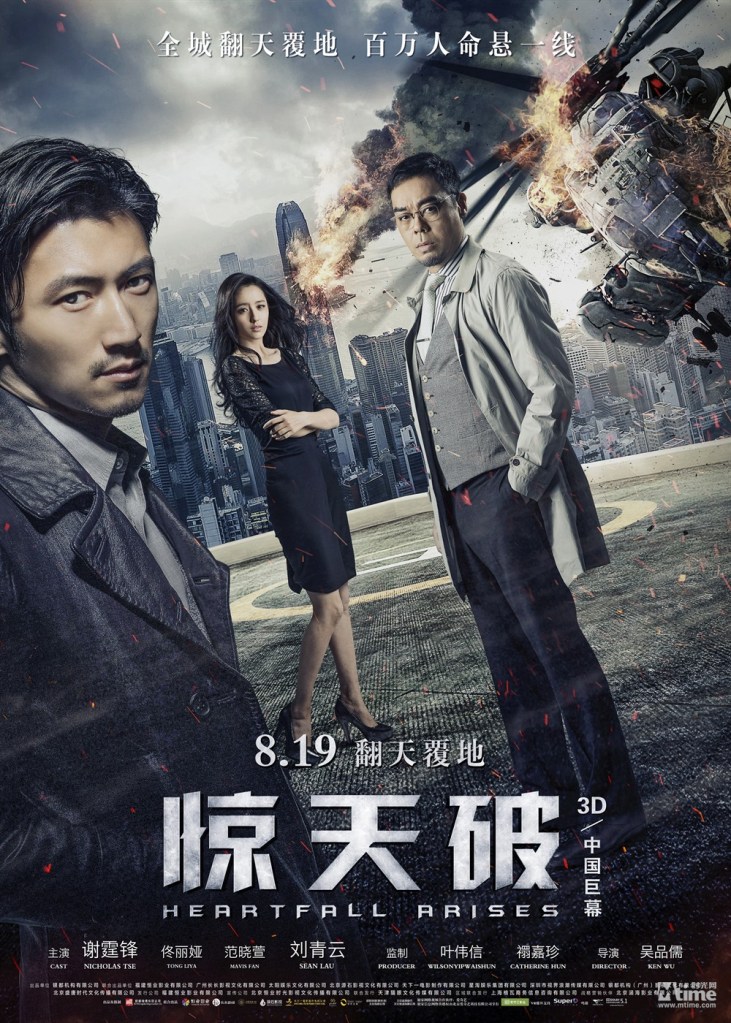
Heartfall Arises (惊天破 / 驚心破, Ken Wu Pinru, 2016)

Sean Lau Ching-wan and Nicholas Tse are together again after being denied the opportunity to reteam for a sequel to the acclaimed The Bullet Vanishes but if Heartfall Arises (Mainland China – 惊天破  / HK – 驚心破) was intended to repeat the successful buddy cop pulp of Bullet it sadly fails. A very modern tale of chess playing genius detectives, Heartfall Arises tantalises with some bizarre B-movie antics but remains intent on becoming this year’s big arthouse leaning crime thriller. Unfortunately Wu’s highly stylised approach, though often impressive, only serves to highlight the weaknesses inherent in the film’s construction.

Taking the lead this time, Tse plays snappy dresser and maverick cop John Ma who, when we first meet him, is busy giving a chess lesson to a little boy on a park bench while the rest of the Hong Kong police department is hot on the trail of a serial killer, The General (Gao Weiguang), who’s been targeting “evil” corporate big wigs. Ma wades in to save the day but, tragically, he and the killer are caught in a face-off in which both fire their guns at the same time with Ma securing a headshot only to be shot in the heart. Luckily Ma is saved by medical science thanks to a heart transplant from, you guessed it, The General.

Whilst in the hospital Ma meets police psychoanalyst, Calvin Che (Sean Lau Ching-wan), who (besides being another chess expert) has a theory about cell memory and the possibility that personality traits can be inherited through organ transplant. Ma has been relegated to desk work since returning to the police force but gets a chance to return to active duty when a spate of incidents occur eerily mimicking The General’s crime spree. Could his new heart really help them catch a killer, or will Ma too find himself crossing the line from law enforcement to vigilante avenger?

Though the personality transplant logic sets us up for a series of silly B-movie shenanigans, the idea is never treated with anything less than total seriousness. Thus when Ma realises that he suddenly likes spicy food we’re supposed to be worried – doubly so when he starts having visions of a pretty girl he doesn’t know frolicking on a romantic beach, especially as his nice doctor girlfriend has already gone out of her way to tell us she doesn’t mind very much about Ma’s new tastebuds. Figuring out the girl becomes key but, it seems, Ma is incorruptible when it comes to love making this particular drama ally a dead end.

Drama is where Heartfall Arises truly flatlines. Despite having played such a large part in the success of The Bullet Vanishes, Tse and Lau never generate the same kind of chemistry which made their previous collaboration so enjoyable. Both characters are hugely underwritten with Tse bundled into expensive looking fashionable outfits proving a mismatch with his cerebral policeman persona whereas Lau sports a scrabbly chin beard more in keeping with a hipster hacker than an uptight shrink. The cardinal sin is that Heartfall Arises actually pinches one of its central twists from The Bullet Vanishes but does it so clumsily as to completely undermine everything which has gone before.

Heartfall Arises wouldn’t be the first Hong Kong thriller to get away with a nonsensical plot but its relentless pretentiousness robs it of the possibility of escaping rigour through style. Slickly shot, Wu aims for a swanky, upscale noir from the well appointed office blocks to fancy apartments and Ma’s strangely dapper attire but the elite cops vibe remains decidedly low stakes as Ma and Che swap philosophical quotes and talk chess until the potentially explosive finale. A buggy chase in Thailand proves particularly unexciting as Wu fails to make the action scenes compensate for the weakness of the plot, and though he has some intriguing visual ideas they’re often ones which don’t serve the film. Taking itself far too seriously, Heartfall Arises would be more fun if it allowed itself to revel in the ridiculousness of its premise but becomes far too caught up looking at itself in the mirror to notice that the villain has escaped by grapple gun and taken the audience’s suspension of disbelief with him.


HK Trailer (English subtitles)