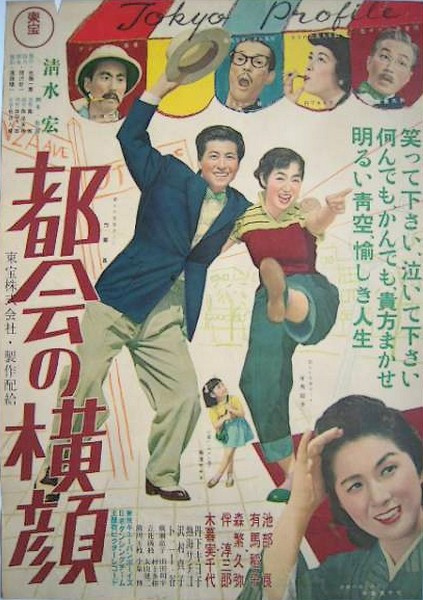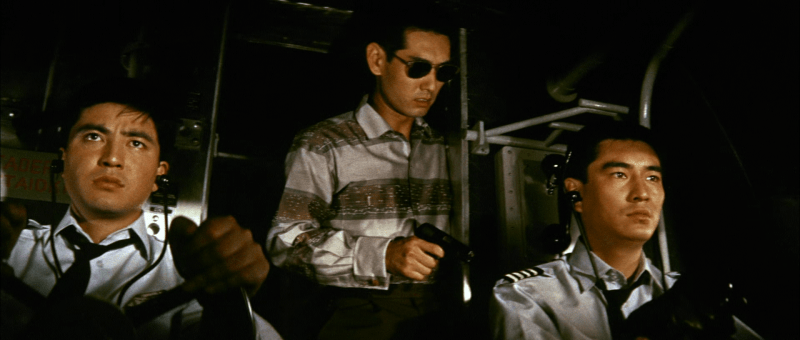
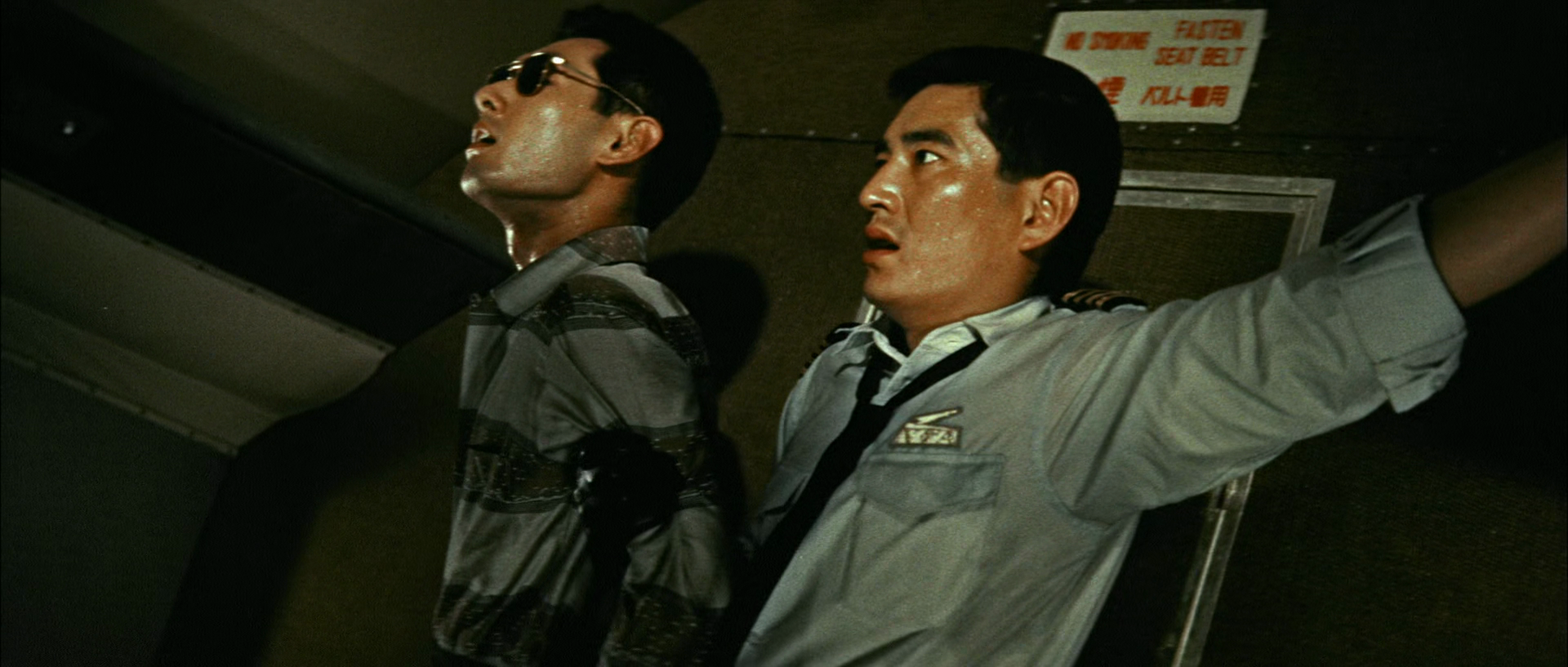
Four Hours of Terror (高度7000米 恐怖の四時間, Tsuneo Kobayashi, 1959)

It seems quite strange now to think of a time when air travel was both new and exciting and as easy as catching a bus. It’s this juxtaposition that Tsuneo Kobayashi’s hijacking thriller Four Hours of Terror (高度7000米 恐怖の四時間, Kodo Nanasen Metoru: Kyofu no Yojikan) plays with as an armed fugitive takes a passenger plane hostage in an attempt to escape after committing a murder while those on board struggle to accommodate themselves to this new form of transportation. 

This sense of exoticisation is obvious from the opening voiceover which sings the praises of Haneda airport as the gateway to a newly internationalised Japan though in actuality the flight in question is a domestic service travelling from Tokyo to Sapporo. The voiceover also introduces us to each of the passengers which come from differing strata of society and even includes a middle-aged American couple. There are in fact three generations of couples on board who seem to represent different stages of life from the newly wed students so wrapped up marital bliss that they barely notice anything else, to a long-married reporter and his wife on their first holiday together since their honeymoon, and an elderly couple returning from a trip to the capital who are mystified by this new age of mass media and air travel. The newlyweds apparently won this free trip on an aeroplane after agreeing to have their wedding broadcast on television in an early example of reality TV, reinforcing the sense of irony that they weren’t necessarily supposed to be on this doomed flight after all. 

Neither was car saleswoman Kazuko (Hitomi Nakahara) who has apparently been pulled away to Sapporo by a short notice business opportunity. She gets a standby ticket, as does her boyfriend/rival Fujio (Tatsuo Umemiya) who is also on track to the same opportunity. Weirdly, Kazuko is not overly sympathetic having randomly kicked a basket containing a little dog about to be smuggled on the plane by its doting owner, but does perhaps represent something of a more independent post-war womanhood even as she effortlessly deflects unwanted attentions from a client she may also have been exploiting in order to obtain his business. Having boarded the plane, she ends up sitting next to another man who requested a standby ticket and was using a surname that was the same as hers but evidently turns out to have been assumed. So lax is the security, you don’t necessarily have to travel under your legal name. In any case, she briefly flirts with him as an overture to a business relationship and also to annoy Fujio before overhearing a news report about the escaped fugitive on her portable radio.

Kida (Fumitake Omura), the fugitive, is dressed like a stereotypical yakuza which makes it odd that no one treats him with suspicion until they spot he’s carrying a gun which he had no trouble at all bringing on board. Though hijackings are not exactly unheard of, they aren’t particularly common either so no one would really suppose anyone had any reason to take a domestic flight to the provinces hostage, and really that was never Kida’s intention merely a last resort after being discovered. Later he gives a partial justification for his life of crime in that his mother beat him and then threw him off a cliff which is why he has a false leg. In any case, there’s a small moment of potential redemption towards the end when the kindly old lady tells him he can’t undo what he’s done, but could still resolve to change assuming they all survive this difficult situation with the plane which now has mechanical problems thanks to the gun going off. 

Even so, it’s the passengers who tie Kida up after the pilot ,Yamamoto (Ken Takakura), manages to disarm him by weaponising the plane. By flying to a high altitude, they knock him out with the air pressure, but are then faced with the mechanical failure of the landing gear which seems to be linked to with Yamamoto’s wartime trauma. A secondary drama revolves around his stoical character with one of the stewardesses apparently in love with him while simultaneously wary of his iciness given that he apparently showed no emotion after receiving the news his wife had passed away but simply flew the plane home as normal. Some see this as his devotion to the aircraft which is in a way a commitment to his duty over his human feelings, the factor that perhaps allows him to save the plane and get the passengers home safely. He is however saved by his love for his late wife with the cigarette case that contains her photo saving him from the worst effects of a bullet. 

The same may go for the co-pilot Hara (Kenji Imai) who is dragging his feet over his marriage to Yamamoto’s sister because he wants to achieve 3000 flight hours before getting married so he can call himself a real pilot. Though the film plants the seeds of these random plot threads and the social commentary that goes with them, it does not particularly engage while the hijacking itself remains fairly low key given that Kida is not a particularly “bad” bad guy. He just wants to go to a random place where the police won’t be waiting for him, but otherwise refrains from harassing the passengers save threatening a little boy travelling on his own to return to his parents after visiting his grandfather in Tokyo. In essence, there’s a kind of innocence and naivety in play which speaks to something of post-war hopefulness and a wonder in the frantic pace of progress in which the day is saved by keeping calm and carrying on even in the face of severe adversity.


Trailer (no subtitles)
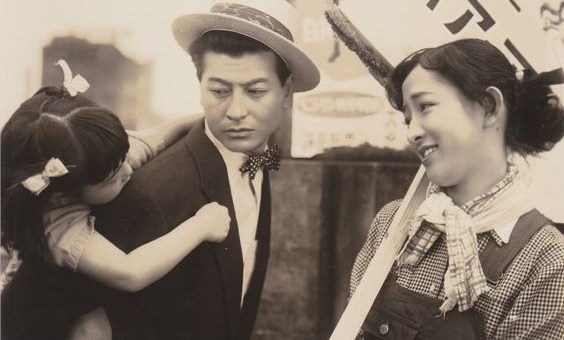
Tokyo Profile (都会の横顔, Hiroshi Shimizu, 1953)

Tokyo Profile posterJudging by the vision presented in the cinema of the time, the Japan of 1953 was one still fighting to emerge from post-war disillusionment and destruction. Set in the glittering Ginza, Hiroshi Shimizu’s Tokyo Profile (都会の横顔,Tokai no Yokogao) is, like much of the director’s work, a more cheerful affair. This world is a very different one from the dingy attics and rundown tenements of the average social drama in which the struggling urban poor battle economic impossibilities while earnestly investing in their future, a somewhat barbed aspirational comedy which lays bare the increasing gap between rich and poor but in a humorous, perhaps resigned fashion save for its strangely cutting finale.

Shooting once again almost entirely on location, Shimizu opens with a lengthy shot captured from the back of a tram traveling through contemporary Ginza – then and now an elegant and refined part of town home to numerous upscale department stores from all around the world. It’s an ordinary Saturday afternoon and the streets are only middling busy. A crowd has gathered around something mysterious, gradually attracting more people and becoming a spectacle in its own right. Thankfully there hasn’t been an accident. A shoeshine girl (Ineko Arima) is trying to comfort a crying child, Michiko (Sachiko Atami), who has become separated from her mother. Michiko is five years old and knows her parents’ names by rote, but all she can tell the concerned people trying to help about her home is the general vicinity it might be located in and that it’s next to Yoshiko’s house, which is not very helpful. Luckily a young man, nicknamed “Mr. Sandwich”  (Ryo Ikebe) because he’s one of Ginza’s many sign carriers, offers to take her to the police station while looking around and attracting attention with his sign (and patented silly walk) in case they spot her mum in the street.

Meanwhile, Michiko’s mother Asako (Michiyo Kogure) is wandering around frantically terrified she might never see her daughter again. Unfortunately she is accosted by a pushy neighbour who promises to help her look for Michiko but keeps pulling her into other business before finally landing her with the bill for two cream sodas which, needless to say, she cannot afford (and didn’t even want).

Michiko and her family are from Meguro which is quite a way out from the centre of the city and one gets the impression this is quite a rare day out for them. Michiko is very excited when she tells the shoeshine girl that they came to buy her a hat and a pair of red shoes, but as we later hear from Asako, Michiko’s presents are tiny splash of luxury in an otherwise economically anxious home. Shinji, Michiko’s father, was a Lieutenant-Commander during in the war but like many of his generation found himself unwanted after its end and struggled to find proper employment. Much to the family’s relief, he’s recently got a steady job as an accountant, but it still doesn’t pay enough to live on. Wanting to buy summer clothes for the children, Shinji worked overtime and walked to work rather than taking the train but little Yoshiko’s parents have bought her little red shoes and now Michiko wants a pair too. Doting parents, Asako and Shinji feel dreadful that they aren’t able to buy their daughter the things that other children have, but today she’s come to Ginza to see what she can do with what she has (which isn’t much either way).

Shimizu follows Michiko as she travels round the city with various adults looking for her mum but also having a grand adventure. Though she was originally quite distressed, Michiko is a clever little girl and quickly decides to start having fun instead of being sad. The sandwich man takes her all around Ginza, bumping into various people that he knows including a philandering boyfriend and the girl waiting for him, the girl he was with who has several boyfriends but has the most fun when standing them up, a shady gangster type not normally around during the day (he’s on his way to Osaka), and a geisha girl who’s taking classes in English for the “service” industry from an extremely camp instructor.

The irony is that Michiko and her family aside, the sandwich man, shoeshine girl, and everyone else they meet are people with no money who earn their living on the streets where rich people come to play. The gangster offers sandwich man a cigarette and he takes it, only to consider throwing it away when he sniffs it and realises it’s a cheap and nasty variety. Meanwhile, Asako’s horrible neighbour convinces her to ask a streetside psychic to help finding Michiko but he keeps interrupting their consultation to chase after discarded cigarette butts which he puts in a big pot and later smokes with the help of his pipe-like cigarette holder. The people who come to Ginza to play don’t care about smoking their cigarettes down to the last because they know they can buy more. Streetside psychics can’t even afford to buy any.

Nevertheless, no one seems to be unhappy with their life in Ginza. Sandwich man is nursing a crush on shoeshine girl which she might or might not return. So obviously good with children he longs for many, which is a problem because the one thing shoeshine girl dislikes about the city is that there are too many people – she only wants two. His desire for a big family means he doesn’t envisage spending the rest of his life as a sandwich man, but then it seems to be alright for the time being while he waits for something better to come along (which he seems to think it will). Shimizu takes us on a jaunty journey through the glitzy Ginza, taking in the musical halls and cafes while now famous tunes celebrating the area play unironically in the background, but as much as he celebrates the aspirational swankiness of the recovering city he’s always keen to remind us that not everyone who lives here lives in the same world and little girls like Michiko risk getting left behind for good if no one stops to think about that.