Mom, Is That You?! (こんにちは、母さん, Yoji Yamada, 2023)

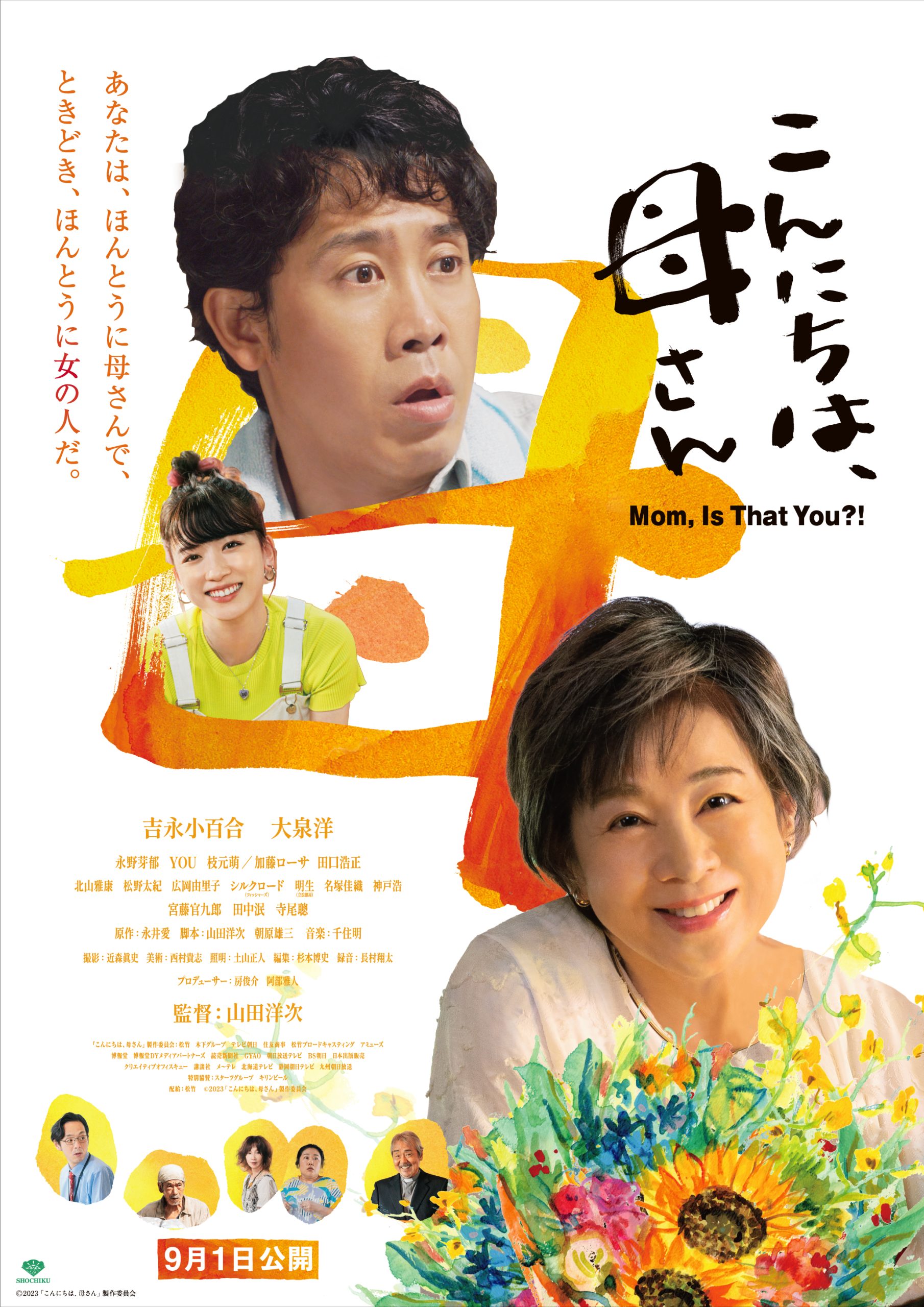
“People of my generation can’t throw anything away,” an older woman admits on her hearing her daughter-in-law has just been featured in a TV series about decluttering. Inspired by Ai Nagai’s 2001 play, the latest from veteran director Yoji Yamada Mom, Is that You? (こんにちは、母さん, Konichiwa, Okasan) seems to hint at a series of circular generational divides while suggesting that the children of the Bubble-era in particular are too quick to get rid of things they don’t think they don’t need anymore.

That’s the irony of soon-to-be 50-year-old Akio’s (Yo Oizumi) salaryman job in HR. It’s his job to cut dead wood from the company and this current round of polite requests to employees of a certain level to take early retirement includes his uni friend Kibe (Kankuro Kudo) who doesn’t take kindly to what he sees as a personal betrayal. Unlike Akio who is beginning to tire of the salaryman dream, Kibe fiercely fights for his position and identity as an executive at a big company even when faced with banishment room treatment and disciplinary dismissal after an altercation with the boss.

But what Kibe doesn’t know is that Akio is already facing a series of crises. His marriage has collapsed and his university student daughter Mai (Mei Nagano) is having a crisis of her own. Fresh from her tidying success, her mother has told her that all she can do is get good grades followed by a boring salaryman job like her dad’s which doesn’t seem to be what she wants which is why she’s run off to stay with her grandmother Fukue (Sayuri Yoshinaga) who runs a traditional shop selling tabi socks near the Sumida River. Fukue has a kindly, laid-back attitude remiscent of the shitamachi spirit found in other Yamada films in contrast to the stressed out uptightness of Akio who hasn’t told her about his impending divorce nor work troubles but finds himself paying a visit home in an attempt to sort himself out only to find Fukue keeping herself busy with a local charity group and nascent relationship with a church pastor. 

Fukue’s charity work is emblematic of a waste not want not philosophy that has otherwise disappeared from the modern society as they pick up the things other people don’t want and donate them to the needy even if it sometimes seems a little simplistic or patronising. Biting into some reject crackers from the local rice cracker shop, Akio reflects that they’re something that’s made to console people and it’s work that has meaning unlike his soulless corporate job that gives him nothing other than stress and money. At the time the play was written, the fallacy of the salaryman dream was clear for all to see in the post-Bubble society but to a man like Akio getting a company job was a big deal and his success is still the talk of his mother’s friends even he starts to wonder if he still has time to start again and discover a more meaningful way of living.

Some of these ideas, and the timescales involved, make much more sense for the play’s millennial setting rather than the film’s apparent present day given the references to the firebombing of Tokyo which would require the older protagonists to be their late 80s to even remember. Akio dismisses his mother’s charity work and insists that the homeless are only those who opted out of the competitive society he too has come to doubt or else were excluded from it, while he’s resentful of her attachment to the pastor in contrast to Mai who is excited by the prospect of her grandmother’s love affair and enduring possibilities of age while Fukue is beginning to fear not death but dependency if her health should suddenly decline. 

It’s in the midst of her heartbreak that the film affords Fukue a new beginning if in coming full circle, Akio choosing to make a clean break with the unhappiness in his life and Mai embracing her youth while falling for the old world charms of her grandmother’s tabi sock shop almost exclusively catering to sumo wrestlers, who as someone points out never waste anything, and people trying ceremony for the first time at 60. Like most of Yamada’s work, the film has a gentle humanity and melancholy poignancy but also a sense of hope and continuity that run contrary to an overly corporatised society in which young and old are already losing faith.


Mom, Is That You?! screened as part of this year’s Toronto Japanese Film Festival.

Original trailer (No subitles)

Don’t Call it Mystery (ミステリと言う勿れ, Hiroaki Matsuyama, 2023)

Totono once again finds himself at the centre of of conspiracy in the big screen edition of the popular drama based on the manga by Yumi Tamura, Don’t Call it Mystery (ミステリと言う勿れ). Embroiled in what first looks like a family succession drama as he points out recalling The Inugami Family, he soon discovers there’s more in play than might be expected but also that the wounds of the past are slow to heal and often cause people to act in unexpected ways.

In any case, he ends up getting involved care of Garo (Eita Nagayama) who is still on the run following the end of the TV series so unable to help a teenage girl, Shioji (Nanoka Hara), who is one of four grandchildren in line to inherit her grandfather’s legacy if only she can fulfil the bizarre quest he left for them in his will. Her worry is that, as family law dictates one person inherits everything, there will inevitably be deaths and violence involved as the cousins battle each other for the prize of a giant estate near Hiroshima where Totono also just happened to be on a day trip.

Once again, the running gag is that mystery just seems to find Totono who only wants to get on with living his peaceful life as a student eating curry and going to museums though there are some tantalising clues to his own backstory littered through the piece such as his unexpected familiarity with the city of Hiroshima. The case this time as also has a link to Totono’s famously curly hair which only adds to his Kindaichi-esque sense of eccentricity deepened by his reluctance to allow Shioji’s family to do his laundry or to a take a bath in another person’s home. But these foibles are, as he points out to those around him, reflective of a conflict in what is considered considerate behaviour. They think they’re being nice by offering to do his laundry, but he doesn’t want them to so it’s just additional inconvenience for him much in the same way as you if offer someone a lift to the station thinking that’s easier for them and they accept not to cause offence but are secretly disappointed because they were looking forward to the walk.

Totono’s defining characteristic as an accidental detective is indeed his emotional intelligence and ability to pick up on the slightest things that might be bothering those around him, often prone to lengthy monologues that advocate for a more compassionate world and better understanding between people. As the mystery becomes clear, he begins to realise that the parents of the grandchildren were trying to protect them from the toxic legacy of tradition and end the ridiculous family succession drama that apparently led to the deaths of some of their immediate relatives. He gives similar advice to Shoji’s cousin Yura (Ko Shibasaki) on hearing her father tell her that women are happiest as wives and mothers and she should drop what she’s doing to pay more attention to her husband and daughter. Totono takes him to task for his sexist thinking and tells him it’s unfair, advising Yura that she might not unwittingly want to pass these ideas on to her own daughter by suppressing herself to conform to her father’s outdated idea of conventional femininity.

As Totono says, children are like wet cement and the things dropped on them leave their mark for the rest of the child’s life. It seems that the family was in a sense haunted by a child they’d wronged and worried would someday come back to wreak their revenge as a phantasmagorical embodiment of their latent guilt and shame about how they usurped their fortune. What the grandchildren come to realise, is that their late parents did actually understand them and wanted them to be happy following their own paths rather than bound by tradition or outdated notions of properness regardless of whatever happens with the grandfather’s more literal legacy and the buried skeletons it contains. Filled with the same kind of gentle intrigue and mystery along with the compassionate spirit of the TV series and manga, the big screen edition features another difficult case for Totono that also begins to illuminate his own troubled past and the secrets behinds his empathetic soul.


Don’t Call it Mystery screened as part of this year’s Toronto Japanese Film Festival.

Original trailer (English subtitles)

Missing (ミッシング, Keisuke Yoshida, 2024)

Why is it that we rush to judgement rather than empathy? When a little girl disappears during a short walk from a local park to her home, less than helpful members of the public are quick to turn on the parents while news media, eager for ratings and clicks, is only too happy to give the people what they want casting aside ethical concerns in their exploitation of the parents’ pain all while the little girl remains missing.

In this society, it’s quite normal culturally for children of Miu’s age, six, to walk short distances alone and be left unsupervised at home at for short periods of time. Nevertheless, the public is quick to blame the mother, Saori (Satomi Ishihara), because she had gone to a concert that night and didn’t notice frantic calls from her husband worried because Miu was not at home when he got back from work at 7pm. Soari too blames herself, as is perhaps natural, but it’s unreasonable to expect anyone to never go out for an evening again after having children. Her husband comes in for less scrutiny, which might be surprising, though her brother, Keigo (Yusaku Mori), soon finds himself the prime suspect having been the last to see Miu and allowed her to walk home alone though he would previously have walked her back.

The family find themselves under scrutiny with their every move judged by an unforgiving society. When they dare to buy fancy pastries, online trolls suggest they can’t be all that bothered about Miu after all and are living the high life with the extra money they no longer need to spend on her. Given all that, it might be surprising that they turn to the media for help but in their desperation to find Miu they will leave no stone unturned. Idealistic reporter Sunada (Tomoya Nakamura) seems to want to help them, but is constantly undermined by his bosses who pressure him to take the story into more sensational territory. Though he wanted to write a human interest piece supporting the parents and raising awareness about Miu’s disappearance, he ends up placing them in the firing line for even more trolling and particularly of Saori’s brother Keigo who is an introverted, awkward man not suited to appearing on television. 

Sunada says he wants to help, but it’s undeniable that the media is exploiting the parents’ desperation raising serious ethical concerns as to how they safeguard sources and subjects while shaping the narrative around sensitive issues. Sunada takes a producer to task for placing images of a cement mixer and the sea into the ident for the piece as if it were hinting at what might have happened to Miu but really what the station is most interested in is digging up dirt on the family rather than drawing out new information on the case. A fellow journalist is having great success with a salacious story about the mayor’s son committing fraud, but his piece is less crusading investigative journalism than gossip inviting judgement. Disliking his flippant attitude, Sunada reminds him their job’s not to make people laugh, but his colleague gets a fancy promotion to head office while Sunada is stuck doing random feel good stories about seals.

Their treatment at the hands of the media also exposes a divide within the couple with Saori often frustrated by her husband’s attitude, feeling as if he isn’t invested enough. Yutaka (Munetaka Aoki) suggests simply not reading the online comments and ignoring the trolls while Saori feels compelled to defend herself. He is also warier of pranks and scammers, unwilling to simply jump on every lead out of desperation when so many people seem intent on causing them further pain. Perhaps it makes people feel more in control of their lives to blame the parents, as if something like this couldn’t happen to them because they make what they feel to be better choices, rather than accept that life is random and unfair and little girls can disappear into thin air mere steps from their own door. Unable to find her own daughter, Saori begins defending other people’s children getting a job as a crossing guard to ensure they reach home safely while simultaneously frantic and afraid, handing out fliers to a largely disinterested populace ever hungry for novelty and excitement and embarrassed by her pain even as they continue to feed on it.


Missing screened as part of this year’s Toronto Japanese Film Festival.

Original trailer (English subtitles)

(Ab)normal Desire (正欲, Yoshiyuki Kishi, 2023)

There’s a pun embedded in the Japanese title of Yoshiyuki Kishi’s heartfelt drama (Ab)normal Desire in that first character in the word for “sexual desire” (seiyoku, 性欲) has been replaced by one that can be read the same but has the meaning of “correct”, or “proper”. But “normal” is also relative construct that implies conformance with the majority even if that may not actually be the case. As one of the protagonists later remarks “everyone is pervy” though they themselves feel such a degree of shame and otherness that it’s largely prevented them from living any kind of life at all.

In that sense it may be hard to understand why a fetish for water would invite such severe self-loathing in that it causes no harm to others if admittedly resulting in ridicule if exposed. Then again, society can be a fierce watchdog. Department store shop assistant Natsuki (Yui Aragaki) is taken to task by her pregnant colleague who refuses to take her seriously when she says she’s not really interested in getting a boyfriend before giving her a lecture about her biological clock. Though Natsuki appears uninterested in her vacant prattling, the woman later becomes upset and harshly tells her that she was only trying to be “nice” because she felt “sorry” for her and that making people be nice to you in this way is actually a form of harassment which, whichever way you look at it, is some particularly twisted logic.

Her alienation seems to stem from the fact that she feels “abnormal” and that her fetish for water is a part of herself she must be careful to hide. Her parents watch a news report on Tokyo Rainbow Pride and marvel at the idea that there are now choices other than marriage and children but even among the young there remains confusion and shame amid an inability to reconcile the seemingly opposing concepts of “normality” and “diversity” as they struggle to define themselves. A plan to have a male dancer who usually dances in a masculine style dance in a more feminine way backfires when he points out that asking someone to dance in a way they don’t want to doesn’t really do much to advance “diversity”.

But diversity isn’t considered an ideal by all and parents of young children find themselves confused and conflicted when their kids begin to reject conventionality at an early age by asking to withdraw themselves from school and instead focus on other kinds of education that align with their interests. Challenged by his wife about why he never listens to their son’s concerns, prosecutor Hiroki (Goro Inagaki) replies that he should “just be normal” and later describes people who are “unable to live normal lives” as bugs in the system which must eradicated. A symbol of lingering authoritarianism, Hiroki is an intensely conservative man obsessed with properness who thinks it’s his job to decide which crimes everyone is guilty of rather than make any attempt to understand the world around him outside of binary terms like right and wrong or normal and abnormal. When his assistant passes him information on fetishes as a potential explanation for the case of a man who repeatedly steals taps, he simply rolls his eyes and dismisses it.

Yet he perhaps has his own fears and internalised shame as evidenced by his outrage on discovering that another man has been coming to the house to help his wife with tech setup for their son’s new outlet in livestreaming and not only that, he was able to blow up the balloons that Hiroki himself failed to inflate. It’s his rigid authoritarianism that eventually alienates his wife and son who come to see him only as an oppressive bully unable to accept anything that differs from his own definition of “normal”. Finally, he’s the one who is isolated, imprisoned by his own repression and lack of understanding or unwillingness to accept those around him.

Even so, despite its positive messages that no one should feel themselves alone or that society has no place for them the film muddies the waters by introducing fetishes that are necessarily problematic in that they cause harm to others who do not or cannot consent and could not and should not be accepted by mainstream society though oddly those that have them seem to feel less shame only fearing being caught because acting on their desires is against both moral and judicial laws. In any case, in discovering togetherness, that they are not alone, those who feel their desires to be “abnormal” can begin to ease their loneliness and find a place for themselves in an often judgemental world.


(Ab)normal Desire screened as part of this year’s Toronto Japanese Film Festival.

Original trailer (English subtitles)

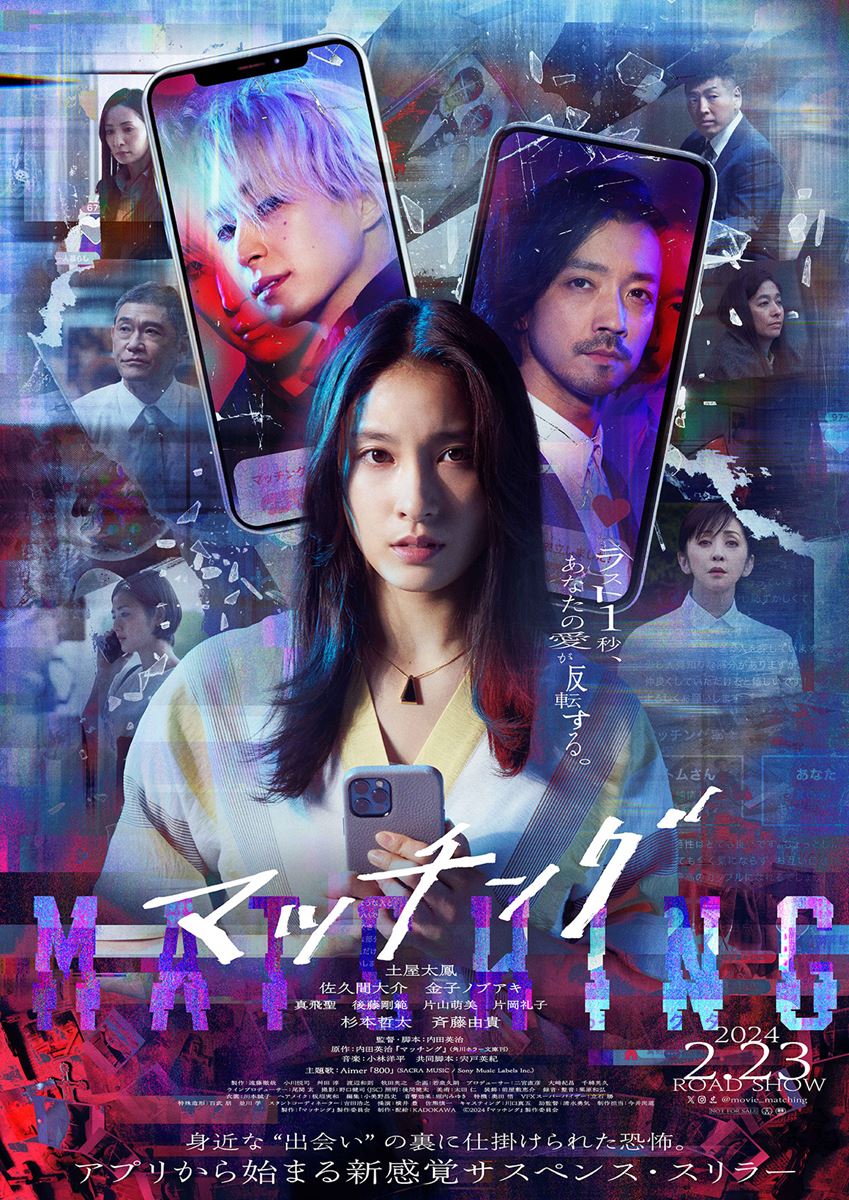
Matched (マッチング, Eiji Uchida, 2023)

The dangers of online dating are, as Eiji Uchida’s Matched (マッチング) suggests, a blurring of the lines between romantic fantasy and “real” organic love that threatens to spiral into dangerous obsession. Part stalking drama, part technophobic thriller, the film seems certain that dating apps are bad but perhaps also critiques another kind of romantic mania that leads people to believe there’s something wrong with not being coupled up and maybe it’s worth the risk of encountering someone dangerously unhinged in the desperation to find Mr. or Mrs. Right.

Rinka (Tao Tsuchiya) originally had no interest in dating apps, though she’s beginning to feel awkward about still being single at 29 and spending her free time drinking with her father (Tetta Sugimoto). His advice that romance isn’t really her thing and that’s alright doesn’t really go down all that well with her, yet the fact remains that on a baseline level it’s not really something she actively wants for herself. This is in part ironic as she works as a wedding planner running around satisfying her clients every whim to give them the big day they’ve always dreamed of only to see the man she’s long been carrying a torch for, her old high school teacher, marry a woman he met through an app.

Rinka’s intense resentment might cause us to wonder if she has something to do with the spate of serial killings targeting newly wed couples who got together through the Will Will dating app only after her friend signs her up on in, she too becomes a kind of victim after matching the decidedly creepy Tom (Daisuke Sakuma) who lurks around in the shadows declaring that he was born under bad star and abandoned in a coin locker as an infant. When the school teacher is murdered and she’s somehow linked to the case by a tabloid media article, Rinka’s life begins to spiral out of control while she can only believe that it must be Tom, who continues to stalk her relentlessly with ominous messages, that’s behind it with only the support of Will Will engineer Tsuyoshi (Nobuaki Kaneko) to rely on.

The really mystery is why Will Will doesn’t seem to have a block function or at least why Rinka wouldn’t use it unless she genuinely fears for her safety and thinks their message history will be good evidence. Her friend Naomi’s (Moemi Katayama) constant swiping hints at the superficiality of app-based dating, judging only by a photograph on gut feeling alone. To that extent, Rinka’s offline connection with Tsuyoshi should then be the rightful path to love but he’s a little odd too. Even given Rinka’s situation and his theoretical ability to help her because of his access to the app, he comes across as somewhat possessive and over eager announcing to Rinka in a record store after a single date that she need never fear anything again because he will protect her. 

It’s men that may be the problem, along with the inherent temptations presented by technology as evidenced by the legacy of a romance that bloomed during the chatroom boom and eventually turned about as toxic as it’s possible to get. The other problem with dating apps is that they’re full of people who are already attached and looking for romantic fantasy to escape from the monotony of their everyday relationships along with the stress and burden of responsibility that comes with having a family. These are sins that have quite literally been visited the children, but to come full circle the film may eventually suggest that you can’t really trust anyone and that people can often be callous and indifferent such as the young man inspecting the room where his uncle hanged himself and dismissively tossing away a photo of happier times. 

We never really find out the motives behind the serial killings beyond a suggestion of resentment that these people have supposedly found “love” online in a way others couldn’t having been rejected for what they see as superficial reasons. Meanwhile, the line between a devoted boyfriend and a controlling stalker already seems quite thin, and there are times when Rinka may think the stalker is the lesser of two evils no matter how creepy he might otherwise seem. In any case, love is serious business and you’ll pay a heavy price for betraying it. Ideally, it’s the fantasy and reality that have to match but Rinka at least seems a little lost between the two despite the increasing surreality of the events which have engulfed her.


Matching screened as part of this year’s Toronto Japanese Film Festival

Original trailer (English subtitles)