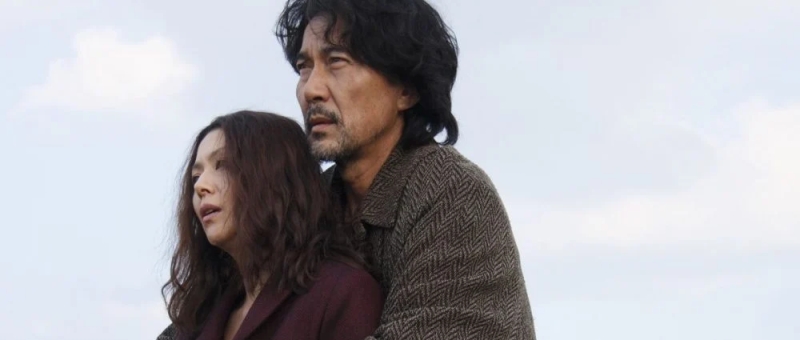

Tokyo Sonata (トウキョウソナタ, Kiyoshi Kurosawa, 2008)

Orphaned salarymen are the soulless ghosts haunting an increasingly empty city in Kiyoshi Kurosawa’s eerie tale of urban anxiety Tokyo Sonata (トウキョウソナタ). Undermining the certainty of the traditional family, Kurosawa paints it as a simulacrum dependent on each member playing their respective role blindly or otherwise, though in this case the integrity of the family unit is shaken by an economic intervention in which the accepted rules of the society have been upended with a vindictiveness that seems inexplicably unfair. 

This is the bargain of the salaryman dream. A man like Sasaki (Teruyuki Kagawa) now aged 46 came of age at the tail end of an era of economic prosperity. He was brought up in an atmosphere of jobs for life in which the corporate family was almost more “real” than the emotional which is one reason why it comes as such a shock when his boss effectively divorces him. He’s found someone new, planning to outsource Sasaki’s entire department to China while less than kindly explaining that as he has no other skills he of no more use to the company. Sasaki immediately clears his desk in anger, walking home early with a pair of carrier bags then, after meeting his son in the street, attempting to climb in through an upstairs window to avoid alerting his wife, Megumi (Kyoko Koizumi), to the fact he’s home early.

Sasaki is unable to tell her that he’s lost his job in part because of the acute embarrassment it would cause him. Somewhat dazed and confused, he’s become one of many disenfranchised salarymen who survived the 15 years of economic stagnation only to have the rug pulled out from under them. Being a salaryman was in a way his whole identity and without it he doesn’t know who he is, which is one reason he puts on a suit every day and goes to sit in the park surrounded by other similarly dressed men with briefcases who now seem to haunt the city like crows ominously dotting the horizon. In a repeated motif, Kurosawa shows us people trapped in kafkaesque queuing situations shuffling around buildings while prevented from moving forward but forced to keep pace with the increasingly glacial environment. At the moment an old school friend he runs into, Kurosu (Kanji Tsuda), seems to give up he is swept into a great parade of the suited and hopeless while Sasaki hovers on its edges. 

It’s this threat to Sasaki’s masculine pride which is largely founded on his economic ability to support a family that kickstarts a chain reaction in his home even he becoming increasingly violent and authoritarian in an effort to overcome the sense of humiliation and powerlessness he feels after being made “redundant”. His younger son, Kenji (Kai Inowaki), tells him he wants to learn the piano but Sasaki irritably shuts him down either because he’s now worried about the money or simply sees it as a frivolous waste of time. Later when Megumi asks him why he won’t he change his mind he insists that he has to stick to his original decision otherwise it would undermine his patriarchal authority as a father. 

But this “authority” was perhaps already largely illusionary given that an intense work schedule meant he was rarely home to do much parenting. After finding out Kenji spent his lunch money on piano lessons behind his back he ironically shouts at him for lying and keeping secrets even though this is obviously what he himself has been doing in keeping up the illusion of his identity as a conventional salaryman. His older son, Takashi (Yu Koyanagi), was keeping secrets too his being his desire to join the US military believing that Japan no longer has a future for him in an atmosphere of stagnation not only economic but emotional and spiritual. Takashi tells his mother she should leave Sasaki, but to her question of who would play the role of mother replies that it makes no difference simultaneously encouraging her to reclaim an individual identity and perhaps robbing her of one just as Sasaki lost his in being shorn of his salaryman credentials. 

Lying on the sofa one evening she raises her arms and poignantly asks someone to lift her up but Sasaki has already gone to bed without even looking at her. Her life as a housewife is thankless and emotionally unfulfilling. Donuts she spent ages making go uneaten while her husband and sons brood on their own problems alone. At a car dealership, the salesman shows her a people carrier explaining that it’s perfect for family camping trips while she gravitates towards a red convertible, mesmerised by the way the roof can just disappear as if it were literally freeing her of her stultifying existence. On showing Takashi the shiny new driving license she’s just got as a symbol of her desire for independence, he scoffs that she’ll never use it but she counters him that it’s for “ID” which it is in more ways than one.

The family is imploded, the illusions of a conventional middle-class life upturned as Sasaki and Megumi each ask themselves if there’s a way to start again and escape their sense of middle-aged futility and disappointment. Cracking under the weight of conventionality, the foundations begin to fracture but the family nevertheless finds itself returning if with greater degrees of clarity and perhaps with less inclination to play the play the roles assigned to them rather than those they might wish to play as embodied by Kenji’s moving performance at the piano capturing all of the chaos and confusion of the world around him but finding in it also harmony and a gentle breeze that feels almost as if the city itself were breathing once again.


Tokyo Sonata screens Feb. 18 as part of Family Portrait: Japanese Family in Flux

International trailer (English subtitles)

The Scythian Lamb (羊の木, Daihachi Yoshida, 2017)

Scythian Lamb posterSometimes life hands you two parallel crises and allows one to become the solution to the other. So it is for the bureaucrats at the centre of Daihachi Yoshida’s The Scythian Lamb (羊の木, Hitsuji no Ki). The prisons are overcrowded while rural Japan faces extinction thanks to depopulation. Ergo, why not parole some of those “low risk” prisoners whose problems have perhaps been caused by urban living and lack of community support on the condition that they move to the country for a period of at least ten years and contribute to a traditional way of life. The prisoners get a fresh start where no one knows them or what they might have done in the past, and the town gets an influx of new, dynamic energy eager to make a real go of things. Of course, there might be some resistance if people knew their town was effectively importing criminality, but that’s a prejudice everyone has an interest in resisting so the project will operate in total secrecy.

Not even civil servant Tsukisue (Ryo Nishikido), who has been tasked with rounding up the new recruits, was aware of their previous place of residence until he started to wonder why they were all so unusual and evasive. Tsukisue likes to think of himself as an open-minded, kind and supportive person, and so is disappointed in himself to feel some resistance to the idea of suddenly welcoming six convicts into his quiet little town, especially on learning that despite being rated “low risk” they are each convicted murderers. Thus when a “murder” suddenly happens in the middle of town, Tsukisue can’t help drawing the “obvious” conclusion even if he hates himself for it afterwards when it is revealed the murder wasn’t a murder at all but a stupid drunken accident.

The ex-cons themselves are an eccentric collection of wounded people, changed both by their crimes and their experiences inside. Many inmates released from prison find it difficult to reintegrate into society, especially as most firms will not hire people with criminal records which is one of the many reasons no one is to know where the new residents came from. Yet, there are kind and understanding people who are willing to look past the unfortunate circumstances that led to someone finding themselves convicted of a crime such as the barber (Yuji Nakamura) who reveals his own difficult past and happiness in being able to help someone else, or the woman from the dry cleaners (Tamae Ando) who is upset by other people’s reaction to her new recruit who, it has to be said, looks like something out of Battles without Honour. Tsukisue doesn’t know anything about these people save for the fact they’ve killed and has, unavoidably, made a judgement based on that fact without the full details, little knowing that one, for example, killed her abusive boyfriend after years of torture or that another’s crime was more accident than design.

Tsukisue later becomes friends with one of the convicts, Miyakoshi (Ryuhei Matsuda), whose distant yet penetrating stare makes him a rather strange presence. Miyakoshi is the happiest to find himself living in the small coastal town, enjoying the lack of stimulation rather than resenting the boredom as some of the other new residents do. Despite his obvious inability to “read the air”, Miyakoshi is quite touched by Tsukisue’s kindness and by the way he treated him as a “normal” person despite his violent criminal past, excited to have made a real “friend” at last. Trouble begins to brew when Miyakoshi joins Tsukisue’s garage band and takes a liking to another of its members – Aya (Fumino Kimura), another returnee from Tokyo with a mysterious past though this time without a prison background. Tsukisue has had a long standing crush on Aya since high school but has always been too shy to say anything. He thought now was his chance and is stunned and irritated to realise Miyakoshi might have beaten him to it and, even worse, given him another opportunity to disappoint himself though doing something unforgivable in a moment of pique.

The bureaucrat in charge of the scheme wanted it kept secret in part because he was afraid the criminals might find each other and start some sort of secret murderer’s club (betraying another kind of prejudice) which actually turns out not to be so far fetched, though the main moral of the story is that kindness, understanding, and emotional support go a long way towards keeping the peace. Meanwhile, another of the convicts has taken to “planting” dead animals inspired by a plate she finds on a refuse site featuring a decoration of a “Scythian Lamb” – a plant that grows sheep which die when severed from their roots, and the evil fish god Nororo sits atop the cliffs in reminder of the perils of the sea. The Scythian Lamb is a poignant exploration of the right to start again no matter what might have gone before or how old you are. It might not always be possible to escape the past, and for some it may be more difficult than others, but the plant withers off the vine and there’s nothing like good roots for ensuring its survival.


Screened at the 20th Udine Far East Film Festival.

Original trailer (English subtitles)

After School (アフタースクール, Kenji Uchida, 2008)

after school posterKenji Uchida is well known for intricately constructed farces but he takes intrigue to new heights in After School (アフタースクール), allowing a mid-way twist to completely reverse everything you thought you knew. Yet at heart Uchida’s film is as uncynical as it’s possible to be even when our heroes find themselves embroiled in a large-scale conspiracy of corporate corruption, organised crime, and police machinations. What begins with a confession spirals outwards into a complicated web of deception and counter-deception proving it really is all connected, even if not quite in the way you first thought.

A salaryman, Kimura (Masato Sakai), enters a reverie staring at the pregnant woman (Takako Tokiwa) sitting opposite him over breakfast, flashing back to a breezy middle school day when she (presumably) nervously handed him a letter.  Kimura leaves for work and borrows the fancy Porche belonging to his high school teacher middle school friend, Jinno (Yo Oizumi), to go to a work meeting in Yokohama. While he’s away the woman goes into labour leaving Jinno to take care of everything but alarm bells start ringing when no one can reach Kimura the following morning. Meanwhile, Kimura has been seen with a mysterious woman at a hotel which seems to have right royally spooked his bosses who have hired a shady private detective, Kitazawa (Kuranosuke Sasaki), to track Kimura down. Kitazawa thinks his best bet is to start at Kimura’s old middle school – which is where he runs into Jinno who agrees to help look for his friend.

As might be assumed, all is not quite as it seems. Shady PI Kitazawa is in deep with the yakuza to whom he apparently has massive gambling debts. At a low ebb, he decides to ask his male assistant to run away with him to Sapporo (which he agrees to do) but this case just might be his salvation, especially once he works out that both ends are connected and he could technically double his pay out with a little strategic blackmail. Kitazawa is as cynical as they come. He thinks nothing of invading Kimura’s life and is fully prepared to make use of Jinno’s seeming innocence, claiming that naivety and pureheartedness make him sick. Later he attempts a pathetic act of petty revenge against Jinno for no real reason that could have ruined his entire life but instead ends up another cog in the grand wheel of Uchida’s finely crafted farce.

Kitazawa’s cynicism is eventually what leads to his downfall. His detective brain so wired for motives and gains is unable to process the idea that some actions are merely altruistic and offer no further reward than the pleasure of helping a friend. Jinno, at first a goofy school teacher with an improbably expensive car, soon becomes the film’s MVP and the only still point in a constantly turning world. Taken to task by Kitazawa for his continuing goodness, Jinno offers a perfectly schoolmasterly reply to the effect that there’s a snotty kid like him in every class, sneering away too cool for school and decrying everything as boring when really the problem isn’t school, it’s Kitazawa.

What eventually looked like a sordid affair turns into a beautiful romance as the truth is gradually revealed. The title refers not just to the setting of the initial flashback, but also to the entirety of adult life. Jinno’s innocence and goodness are belittled by Kitazawa who accuses him of being stuck in middle school with a childishly naive way of seeing the world. This is in a sense true, Jinno has never lost his childlike sense of justice and fair play, willing to go great lengths to help his friends even if it puts him in danger and forces him into some sticky situations which are not his natural milieu, but Jinno’s faith and loyalty are the qualities which eventually see him through and make possible the poignant, hopeful ending despite all that has gone before. Corrupt politicians preaching “family values” whilst associating themselves with dodgy corporations who are taking back handers from the yakuza, hidden policemen, shady PIs – there’s certainly a lot of darkness here but if anything is going to beat it, it’s sincerity and goodness rather than guile and cunning.


Screened as part of the Japan Foundation Touring Film Programme 2018.

Screening again:

  • Queen’s Film Theatre – 18 February 2018
  • Filmhouse – 6 March 2018
  • Showroom Cinema – 18 March 2018

Original trailer (no subtitles)

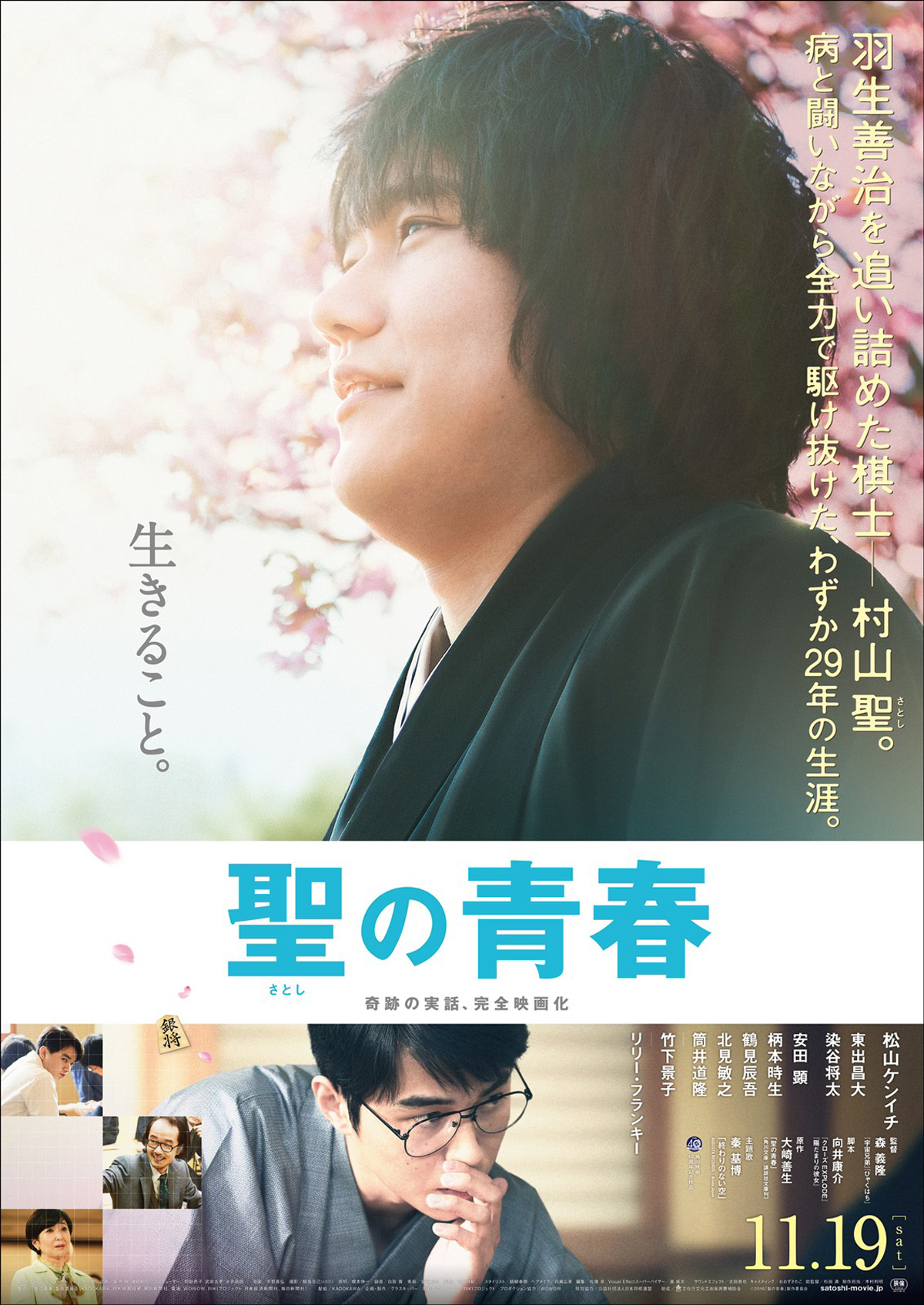
Satoshi: A Move for Tomorrow (聖の青春, Yoshitaka Mori, 2016)

satoshiThere’s a slight irony in the English title of Yoshitaka Mori’s tragic shogi star biopic, Satoshi: A Move For Tomorrow (聖の青春, Satoshi no Seishun). The Japanese title does something similar with the simple “Satoshi’s Youth” but both undercut the fact that Satoshi (Kenichi Matsuyama) was a man who only ever had his youth and knew there was no future for him to consider. The fact that he devoted his short life to a game that’s all about thinking ahead is another wry irony but one it seems the man himself may have enjoyed. Satoshi Murayama, a household name in Japan, died at only 29 years old after denying chemotherapy treatment for bladder cancer in fear that it would interfere with his thought process and set him back on his quest to conquer the world of shogi. Less a story of triumph over adversity than of noble perseverance, Satoshi lacks the classic underdog beats the odds narrative so central to the sports drama but never quite manages to replace it with something deeper.

Diagnosed with nephrotic syndrome as a child, the young Satoshi spent a lot of time alone in hospitals. To ease his boredom his father gave him a shogi set and the boy was hooked. Immersing himself in the world of the game, Satoshi read everything he could about tactics, practiced till his fingers bled and came up with his own unorthodox technique for playing that would eventually take him from his Osaka home to the bright lights of Tokyo. Determined to become the “Meijin”, beat top shogi player Habu (Masahiro Higashide), and get into the coveted 9th Dan ranking Satoshi cares for nothing other than the game, his only other hobbies being drink, junk food, and shojo manga.

Undoubtedly brilliant yet difficult, Satoshi is not an easy man to get along with. Years of medical treatment for nephrosis have left him pudgy and bloated, and an aversion to cutting his hair and nails (poignantly insisting that they have a right to live and grow) already makes him an unusual presence at the edge of a shogi board. He’s not exactly charming either with his overwhelming intensity, aloofness, and fits of angry frustration. Yet the shogi world fell in love with him for his encyclopaedic yet totally original approach to the game. His friends, of which there many, were willing to overlook his eccentricities because of his immense skill and because they knew that his anger and impatience came from forever knowing that his time was limited and much of life was already denied to him.

This insistent devotion to the game and desire to scale its heights before it’s too late is what gives Satoshi its essential drive even if the road does not take us along the usual route. Reckless with his health despite, or perhaps because of, his knowledge of his weakness, Satoshi operates on a self destructive level of excessive drink and poor diet though when he starts experiencing more serious problems which require urgent medical intervention, it’s easy to see why he would be reluctant to get involved with even more doctors. Eventually diagnosed with bladder cancer, Satoshi at first refuses and then delays treatment in fear that it will muddy his mind but the doctors tell him something worse – he should stay away from shogi and the inevitable stress and strain it places both on body and mind. For Satoshi, life without shogi is not so different from death.

Satoshi has his sights set on taking down popular rival Habu whose fame has catapulted him into the Japanese celebrity pantheon, even marrying a one of the most beloved idols of the day. Habu is the exact opposite of Satoshi – well groomed, nervous, and introverted but the two eventually develop a touching friendship based on mutual admiration and love of the game. On realising he may be about to beat Satoshi and crush his lifelong dreams, Habu is visibly pained but it would be a disservice both to the game and to Satoshi not to follow through. Outside of shogi the pair have nothing in common as an attempt to bond over dinner makes clear but Habu becomes the one person Satoshi can really talk to about his sadness in the knowledge that he’ll never marry or have children. As different as they are, Satoshi and Habu are two men who see the world in a similar way and each have an instinctual recognition of the other which gives their rivalry a poignant, affectionate quality.

Despite the game’s stateliness, Mori manages to keep the tension high as elegantly dressed men face each other across tiny tables slapping down little pieces of wood featuring unfamiliar symbols. Japanese viewers will of course be familiar with the game though overseas audiences may struggle with some its nuances even if not strictly necessary to enjoy the ongoing action. Matsuyama gives a standout performance as the tortured, tragic lead even gaining a huge amount of weight to reflect Satoshi’s famously pudgy appearance. Rather than the story of a man beating the odds, Satoshi’s is one of a man who fought a hard battle with improbable chances of success but never gave up, sacrificing all of himself in service of his goal. Genuinely affecting yet perhaps gently melancholy, Satoshi: A Move for Tomorrow is a tribute to those who are prepared to give all of themselves yet also a reminder that there is always a price for such reckless disregard of self.


Satoshi: A Move for Tomorrow was screened as part of the Udine Far East Film Festival 2017.

Original trailer (English subtitles)

https://www.youtube.com/watch?v=dNN7OrXsrvI

Wandering Home (酔いがさめたら、うちに帰ろう, Yoichi Higashi, 2010)

wandering homeAlcoholism is not a theme which has exactly been absent from the history of cinema. From the booze drenched regret of Days of Wine and Roses to the melancholic inevitability of Leaving Las Vegas and the disdaining irony of Barfly, there has been no shortage of unsympathetic portrayals of drunkenness when it comes to the silver screen. Yoichi Higashi’s Wandering Home (酔いがさめたら、うちに帰ろう, Yoi Ga Sametara, Uchi Ni Kaerou) walks something of a middle road here as it embraces the classic “issue drama” mould but also aims for a naturalistic character study in adapting the true life memoirs of photojournalist Yutaka Kamoshida (husband of well known mangaka Reiko Saibara).

The film begins with a touch of magical realism as Tsukahara (Tadanobu Asano) literally falls off his barstool and has a vision of his wife and two children urging him to get up. Of course, they aren’t “real”. Tsukara lives with his mother after his marriage to a successful mangaka broke down due to his alcoholism. Returning home and ignoring his mother’s advice to get something to eat, Tsukarahara has another drink whilst swearing that this time he’ll be sober when he sees his kids but shortly after retreats to the bathroom to vomit where he experiences a massive haemorrhage and is taken to hospital. Things have already gone too far, he’s told he’s lucky to be alive and the next time this happens he will die.

Swearing to finally come off the booze, Tsukahara goes home but is immediately tempted by a side dish in a restaurant which contains alcohol. He makes the wise choice not to buy the vodka in the off-licence but eventually talks himself into buying beer which he drinks right away and then falls over and hits his head on the way home. His ex-wife, Yuki (Hiromi Nagasaku), and his long suffering mother have gone through this too many times before to even be disappointed. Eventually, they ship Tsukahara off to a residential facility in the hope that they can finally help him beat the booze for good.

Wandering Home is inspired by the real life story of a photojournalist which has also inspired a few other films including the following year’s Kaasan which told the same story from the point of view of Kamoshida’s mangaka wife. Therefore, the ending of this story might perhaps be known to you already but needless to say it isn’t an altogether happy one. The film doesn’t go into the reasons Tsukahara started drinking save for emphasising that it’s rarely one root cause that starts someone on the road to alcohol addiction. Tsukahara’s father had been an alcoholic and had also behaved violently in the home – something which Tsukahara despised and yet he ultimately became exactly like his dad. Having started to drink as a young teenager he drifted into an aimless life and then witnessed a number of traumatic events in his career as a photojournalist which also left their mark on him.

Though the film is never shy about the disruption Tsukahara’s drunkeness causes to his family, it mitigates the effects by casting them as surreal episodes such as the only scene in the film where Tsukahara is shown to be violent towards his wife in which another soot covered version of himself emerges from a zipper in his back to shout abuse and trash the place as his children retreat in horror to their bedroom. It’s not Tsukahara, it’s the alcohol, the film tries to say but actually lays the message on a little thick and often neglects the trauma that his behaviour is, in turn, causing to his own son and daughter.

That said, there is remarkably little animosity between Yuki and her ex-husband despite the way that he has behaved. Yes, the pair are divorced but Yuki is called right away when Tsukahara is taken to hospital and when she brings the children to visit him the couple talk warmly with no bitterness or recrimination. The children too are happy to see their father and do not seem afraid of him in any way at all.

Higashi does, however, fall into standard “issue drama” tropes and perhaps spends too much time exploring the rehab facility where Tsukahara is sent for treatment. Though hearing something of the other characters’ paths to alcohol dependency is enlightening, it can’t help but feel more like a public information film at times than the affecting character drama it should be. Small touches like Tsukahara’s longing for something a simple as being able to enjoy curry again like everyone else on the ward or his more frequent difficulties of being able to distinguish a hallucination from something he’s doing for real lend weight to the central story but they can’t quite save it.

Higashi’s tone is generally straightforward and mostly avoids melodrama or sentimentality except during the film’s ending. This sounds like a strength but turns out to be a weakness as something about Tsukahara’s plight never quite grabs the heartstrings in the way it seems to want to. The film’s unsentimental depiction of alcohol dependency and one man’s struggle to try and regain his place within his own family is an admirable one, but Wandering Home ultimately falls far short of its intended destination.


The Japanese dvd/blu-ray release of Wandering Home includes English subtitles!

Unsubtitled trailer:

Noriben – The Recipe for Fortune (のんちゃんのり弁, Akira Ogata, 2009)

noribenIt used to be that movies about marital discord typically ended in a tearful reconciliation and the promise of greater love and understanding between two people who’ve taken a vow to spend their lives together. These endings reinforce the importance of the traditional family which is, after all, what a lot of Japanese cinema is based on. However, times have changed and now there’s more room for different narratives – stories of women who’ve had enough with their useless, deadbeat man children and decide to make a go of things on their own.

So it is for the heroine of Noriben: The Recipe for Fortune (のんちゃんのり弁, Nonchan Noriben). Inspired by Kiwa Irie’s popular manga, Noriben follows the adventures of Komaki – a woman in her early 30s who gets her daughter dressed for school one morning but secretly takes her to the train station instead where they board a train headed for Komaki’s hometown. Having left her husband who has literary aspirations and consequently no job (the couple were living off, and with, his parents), Komaki has no firm plans other than moving back in with mother. Used to living off scraps and leftovers, she knows how to make her food go further and is also an excellent cook so the unusual layered bento boxes she makes for her little girl, Noriko, prove a big hit with the kids, and later the staff, at the local school.

Hooking back up with a former crush and now local photographer, Komaki ends up tasting the best meal of her life at a tiny eatery and suddenly hatches on the idea of opening a mini bento shop of her own. Of course, it’s a steep learning curve especially for a woman in her thirties with almost no work experience and no real knowledge of how to set up and run a business which is completely leaving aside the need to hone her cookery skills. If there’s one thing you can say about Komaki, it’s that once she’s set her mind on something she will make it happen and so her new life in her old town is just beginning.

Noriben addresses a lot of themes which are becoming fairly common at the moment including the “boomerang daughter” who suddenly arrives home following the breakdown of a marriage. Komaki’s soon to be ex-husband is not an enticing proposition and it seems that most, if not all, of what she says about him is true. He’s a layabout whose dreams of becoming an author are very unlikely to come true and, as his parents seem content to go on supporting him, his promises of getting a real job are most likely hollow too. There’s no real idea of the couple reconciling and when the husband suddenly turns up and starts behaving in an irresponsible way the situation ends in a bizarre marital street fight which does at least seem to clarify for the pair that their marriage really is well and truly over.

Komaki begins a tentative romance with her high school crush Takeo who took over his family’s photography studio though with the advent of digital technology and home printing the shop’s days are numbered. However, Komaki’s uncertain marriage status and Takeo’s diffidence both prove stumbling blocks to the path of romantic bliss and the film seems to imply that Komaki’s own headstrong character is also a problem when it comes to building relationships. Here, the film doesn’t quite know what it wants to say. Perhaps wanting to emphasise Komaki’s strides towards becoming a truly independent woman, it has her side step romantic entanglements but it also seems to declare the need for choice where there isn’t one.

In essence Noriben is a perfectly pleasant, if slightly bland, film that meanders its ways towards a bittersweet ending. Presumably intended to be a celebration of female empowerment as this ordinary woman makes a break from an unrewarding relationship to prove that she can do better on her own, the film only partly fulfils this message as it also comes with an air of sadness and sacrifice where Komaki also has to give up on various other parts of life in order to pursue her dream. That said, Noriben does offer a degree of playful comedy and down home style wisdom that make it a fairly enjoyable, if forgettable, experience.


Reviewed as part of the Japan Foundation Touring Film Programme 2016.