 1973 is the year the ninkyo eiga died. Or that is to say, staggered off into an alleyway clutching its stomach and vowing revenge whilst simultaneously seeking forgiveness from its beloved oyabun after being cruelly betrayed by the changing times! You might think it was Kinji Fukasaku who turned traitor and hammered the final nail into the coffin of Toei’s most popular genre, but Sadao Nakajima helped ram it home with the riotous explosion of proto-punk youth movie and jitsuroku-style naturalistic look at the pettiness and squalor inherent in the yakuza life – Aesthetics of a Bullet (鉄砲玉の美学, Teppodama no Bigaku). This tale of a small time loser playing the supercool big shot with no clue that he’s a sacrificial pawn in a much larger power struggle is one that has universal resonance despite the unpleasantness of its “hero”.
Kiyoshi Koike is a former chef with a gambling problem and a living room full of rabbits that he bought hoping to sell as pets but his sales patter could use some work and the business is not exactly taking off. Getting violent with his girlfriend after borrowing money from her to play mahjong and then getting annoyed when she doesn’t seem keen to lend him more to change his rabbit business into a dog business, Kiyoshi is at an impasse. So, when the local gangsters are looking for a patsy they can send into enemy territory as a “bullet” Kiyoshi’s name is high on the list. They need someone “hotblooded, must have daredevil courage, when he flips he should make a huge racket” – Kiyoshi more than fits the bill, and more to the point he has no idea what he’s doing.
Given a large amount of money and a gun, Kiyoshi gets a haircut and buys some fancy suits to play his part as a super cool gangster who doesn’t take any shit from anyone. He goes around telling everyone his name and gang affiliation very loudly, waving his pistol and acting like a big shot despite the fact he obviously has no name and no reputation. The plan is he fires his gun, gets killed, his gang swoop in for a gang war and wipe out the opposition. Only, when Kiyoshi gets too invested in his part and beats up a rival gangster, the local boss apologises and offers him a knife to make things even with the guy who just disrespected him…
If he fires his gun, it’s game over but what exactly is keeping his finger off the trigger – fear, or self preservation? Either way, Kiyoshi is way over his head in a game he never understood in the first place.
This is no ninkyo eiga. There’s no nobility here, these men are animals with no humanity let alone a pretence of honour. Kiyoshi is a loser, through and through, but once the gun is in his hand he transforms into something else. The gun becomes an extension of himself, a symbol of his new found gangster hero status. A fancy suit and a fire arm are handy props for a method actor but the performance only runs so deep, what is Kiyoshi now, a man, or a bullet?
Whatever he is, he’s no hero. In his untransformed state he violently beat his girlfriend whom he also forced to work as a prostitute, and even after getting the gun he witnesses a woman being gang raped yet appears to be more amused than anything else. He ends up getting into a fight with the other two guys waiting for their go and seems to feel heroic after the woman gets away but his intention was never to rescue her. Indeed, bumping into her again he makes a clumsy attempt at subtle blackmail though she gets a kind of revenge on him in the end. Even his “romantic” encounter with the glamorous former photo model girlfriend of the rival gang boss ends with a bizarre sex game in which he makes her get on all fours and bark like a dog.
When the time comes, Kiyoshi can’t contemplate the idea of returning to his old loser self and is fixated on reaching the peak of Kirishima which is said to be the place where the gods descended to Earth. When the bullet finally emerges, it heads in the wrong direction. Self inflicted wounds are the name of the game as an aesthetically pleasing, poetic end to this tragic story follows the only trajectory available for a classic yakuza fable.
After beginning with a montage of people sloppily eating junk food set against a proto-punk rock song dedicated to the idea of living the way you please and not letting anyone get in your way, the film contrasts the independent, non-conformist yakuza ideal of total freedom with Kiyoshi’s lowly status in an increasingly consumerist environment. The yakuza life would indeed prove a passport for a man like Kiyoshi to jump into the mainstream, but this fantasy world is one that cannot last and one way or another the curtain must fall on this expensive piece of advanced performance art.
Aesthetics of a Bullet has, like its hero, been abandoned on the roadside. Whereas the Battles Without Honour series has become a landmark of the yakuza genre, Aesthetics of a Bullet has never even received a home video release in Japan and has received barely a mention even the histories of ATG movies. This is surprising as its noir style and art house approach ought to have made it one of ATG’s more commercially viable releases even with its sleazy, nihilistic tone. Opting for a more naturalistic approach, Nakajima nevertheless breaks the action with expressionistic sequences as Kiyoshi fantasises a glorious death for himself, climaxes through gunshot, or remembers the student riots through a blue tinted sequence of still photographs. A complex yet beautifully made, genre infused character piece, Aesthetics of a Bullet is a long lost classic and one in urgent need of reappraisal.
Title sequence and first scene (unsubtitled)
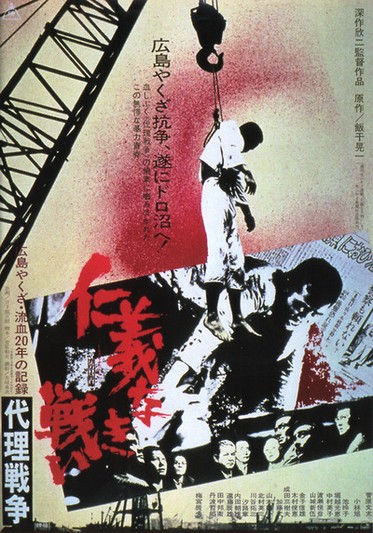 Three films into The Yakuza Papers or Battles Without Honour and Humanity series, Fukasaku slackens the place slightly and brings us a little more intrigue and behind the scenes machinations rather than the wholesale carnage of the first two films. In Proxy War we move on in terms of time period and region following Shozo Hirono into the ’60s where he’s still a petty yakuza, but his fortunes have improved slightly.
 When it comes to the history of the yakuza movie, there are few titles as important or as influential both in Japan and the wider world than Kinji Fukasaku’s Battles Without Honour and Humanity (仁義なき戦い, Jingi Naki Tatakai). The first in what would become a series of similarly themed movies later known as The Yakuza Papers, Battles without Honour is a radical rebooting of the Japanese gangster movie. The English title is, infact, a literal translation of the Japanese which accounts for the slightly unnatural “and” rather than “or” where the “honour and humanity” are collected in a single Japanese word, “jingi”. Jingi is the ancient moral code by which old-style yakuza had abided and up to now the big studio gangster pictures had all depicted their yakuza as being honourable criminals. However, in Fukasaku’s reimagining of the gangster world this adherence to any kind of conventional morality was yet another casualty of Japan’s wartime defeat.
 Windows on Worlds