The Yakuza Papers Vol. 2: Hiroshima Death Match (仁義なき戦い: 広島死闘篇, Kinji Fukasaku, 1973)

81ZkRgBFyyL._SL1378_If you thought the story was over when Hirono walked out on the funeral at the end of Battles Without Honour and Humanity think again – we’ve barely scraped the surface of the post-war Hiroshima criminal underworld chaos. The aptly named Hiroshima Death Match runs in parallel with the events of Battles Without Honour taking place in roughly the same time, 1950-1955, but features a new protagonist relegating Bunta Sugawara’s Hirono to the sidelines where he appears as a weary observer of the cruel yakuza world. This time our hero, Yamanaka, is younger – too young to have offered his life as a kamikaze in the war as he apparently wanted to, and is one of the thousands of young men who’ve found themselves alone and without futures thanks to both the after effects of World War II and the ongoing Korean War.

Hiroshima Death Match ties itself into Battles Without Honour and Humanity quite neatly when the protagonist, Shoji Yamanaka (Kinya Kitaoji), is sent to prison after taking a knife to a room full of guys who accused him of cheating in a gambling den. There he comes into contact with the first film’s hero, Hirono (Bunta Sugawara), who offers him some food whilst in solitary but then disappears for the vast bulk of the film. When he gets out, Shoji finds himself in trouble again when he can’t pay for his meal in a restaurant and offers to work off the bill. The waitress, Yasuko (Meiko Kaji), refuses and tells him to just forget about the money and leave when he’s done but Shoji is insulted by her “charity” and things kick off between him and a gang of yakuza also in the restaurant at the time. Yasuko turns out to be the widowed niece of a yakuza boss and after recovering in her care Shoji agrees to join the Muraoka gang to get revenge on the guys who beat him up.

Whereas Battles Without Honour and Humanity took as its protagonists the young men who’d returned from the war to a ruined and defeated country, Hiroshima Death Match focuses on the generation below who were too young to fight themselves but have still been marked by the after effects of the conflict. At the beginning of the film Shoji has nothing, he’s ashamed of cheating and gets upset when caught which only fuels his youthful and violent anger. He doesn’t seem to have any family to help him or honest work to go to and so, of course, he ends up a yakuza. Once again, the yakuza take the place of a traditional family offering both a place to belong and a degree of emotional and financial support – for a price.

When Shoji inevitably falls in love with Muraoka’s widowed niece, he discovers his surrogate father’s love is not quite unconditional. Yasuko has a young daughter and was married to a man who died a kamikaze war hero. Muraoka does not want her to remarry lest she shame her husband’s memory unless he keeps it in the family by marrying her off against her will to her huband’s brother. Shoji’s affair with Yasuko continues to cause a rift with Muraoka and he’s torn between a desire for a peaceful future with the woman he loves and loyalty to his gang boss to whom he owes so much. Muraoka’s own morals are shown to be far from the traditional yakuza ideals and he’s not above using Shoji’s strained loyalties to his own advantage eventually with tragic consequences.

Like Battles Without Honour and Humanity, Hiroshima Death Match is shot in the same quasi-documentary style with a weary sounding narrative voice over and frequent freeze frame captions identifying the characters along with their gangs and positions as well as their dates of demise at the appropriate time. The ruined Atomic Bomb Dome (now the Hiroshima Peace Memorial) continues to loom large over the proceedings as we’re reminded at the end that this isn’t the only blood that’s been shed here. Even more so than with Battles, Fukasaku rams home the senselessness and futility of violence. The film ends with Hirono attending another funeral (though this time in a black suit and melancholic air) where the bosses reap in consolation money and gamble at the wake. He gives his old bosses a sideways look as they laugh and joke while a young man who they all now account as some kind of legendary yakuza hero lies dead for no reason at all. What does this sort of life amount to in the end? The only reward for a life of violence is a lonely grave.


Hiroshima Death Match is available on blu-ray in the UK as part of Arrow Video’s Battles Without Honour and Humanity: The Complete Collection box set.


The Yakuza Papers Vol. 1: Battles Without Honour and Humanity (仁義なき戦い, Kinji Fukasaku, 1973)

Snapshot-2015-12-07 at 11_06_36 PM-930280086When it comes to the history of the yakuza movie, there are few titles as important or as influential both in Japan and the wider world than Kinji Fukasaku’s Battles Without Honour and Humanity (仁義なき戦い, Jingi Naki Tatakai). The first in what would become a series of similarly themed movies later known as The Yakuza Papers, Battles without Honour is a radical rebooting of the Japanese gangster movie. The English title is, infact, a literal translation of the Japanese which accounts for the slightly unnatural “and” rather than “or” where the “honour and humanity” are collected in a single Japanese word, “jingi”. Jingi is the ancient moral code by which old-style yakuza had abided and up to now the big studio gangster pictures had all depicted their yakuza as being honourable criminals. However, in Fukasaku’s reimagining of the gangster world this adherence to any kind of conventional morality was yet another casualty of Japan’s wartime defeat.
The story begins with a black and white image of a mushroom cloud with the film’s bright red title card and now famous theme playing over the top. This is Hiroshima in 1946. Things are pretty desperate, the black market is rife and there are US troops everywhere. Shozo Hirono (Bunta Sugawara) has just returned from the war (in fact he’s still in his uniform). He gets himself into trouble when he intervenes as an American soldier attempts to rape a Japanese woman in broad daylight in the middle of a crowded marketplace. He manages to cause enough of a commotion for the woman to escape but the Japanese cops just tell him not to mess with the GIs. Things don’t get much better as one of Hirono’s friends is assaulted by a yakuza. They get some rival yakuza to help them get revenge and in the commotion Hirono accidentally kills someone and is sent to prison for 12 years. In prison he meets another yakuza who wants to escape by pretending to commit harakiri and promises to get his yakuza buddies to bail Hirono out if he helps. From this point on Hirono has become embroiled in the new and dangerous world of the Hiroshima criminal underground.

Battles Without Honour and Humanity has a famously complicated plot entered around the various power shifts and machinations between different groups of yakuza immediately after the end of World War II. The film begins in 1946 and ends in 1956 though many of its cast of tough guys don’t last anywhere near as long. The picture Fukasaku paints of Japan immediately after the war is a bleak one. Even if some of these guys are happy to have survived and finally reached home, they’ve seen and done terrible things. Not only that, they’ve been defeated and now they’re surrounded by foreign troops everywhere who can pretty much do what they want when they want. They just don’t have a lot of options – if they don’t have connections to help them find work when there’s not enough to go around then it isn’t surprising if they eventually fall into to crime. Also, having spent time in the military, the yakuza brotherhood provides a similar kind of camaraderie and surrogate family that you might also find in an army corps.

It all gets ugly quite fast. Largely the yakuza are making their money profiting from the political instability, resenting the US occupation yet reaching deals with them to support their efforts in the Korean war and then selling new and untested drugs at home (with less than brilliant results). Betrayals, executions, assassinations in previously safe places like a bath house or the barbers – these are a long way from the supposedly honourable gangsters of old. One minute Hirono is offering to cut off his finger as a traditional sign of atonement (though no one knows exactly what you’re supposed to do in this situation and it all ends up seeming a little silly) and taking the rap for everyone else’s mistakes, but his friend faked harakiri to get out of jail and everyone is double crossing everyone else whichever way you look.

The whole thing is filmed in an almost documentary style with captions identifying the various characters and giving the exact time of their demise (if necessary) as well as a voice over giving background information about the historical period. The film is inspired by real life yakuza memoirs and there are parts which feel quite like a bunch of old guys sitting in a drinking establishment and recounting some of their exploits.

This new postwar world of heartless gangsters is a tough one and almost devoid of the old honour-bound nobility, however somehow Fukasaku has managed to make it all look very cool at the same time as being totally unappealing. You wouldn’t want to live this way and you definitely don’t want to get involved with any of these guys but somehow their self determined way of life becomes something to be admired. That said, there’s a sadness too – that even in the criminal underworld there used to be something noble that’s been obliterated by the intense trauma of the war. You can rebuild, you can move on from the destruction left by the war’s wake but there’s no going back to those days of “honour and humanity” – if they ever existed, they’re gone forever now.


Battles without Honour and Humanity is available in blu-ray in the UK as part of Arrow Video’s Battles Without Honour and Humanity: The Complete Collection box set.


Ryuzo and the Seven Henchmen (龍三と七人の子分たち, Takeshi Kitano, 2015)

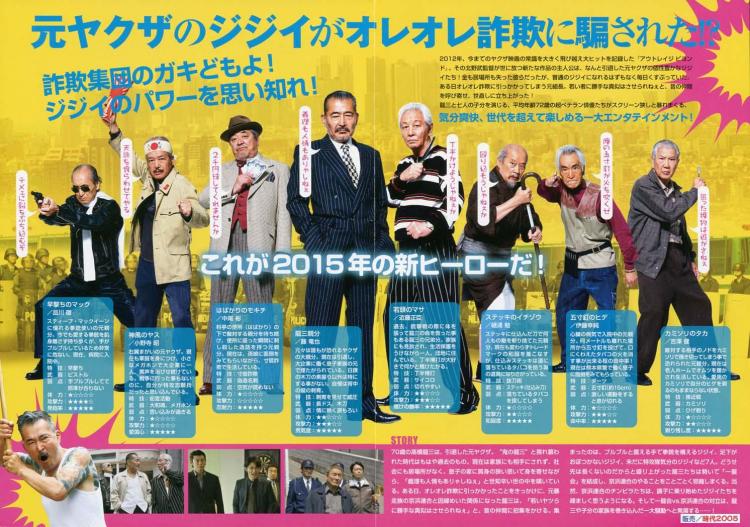
142984037484393493178_ryuzo-7nin-kobuntachi-g4First published on UK Anime Network – review of Takeshi Kitano’s Ryuzo and the Seven Henchman (龍三と七人の子分たち Ryuzo to Shichinin no Kobuntachi) from LFF 2015.


Most people probably know Takeshi Kitano best for his series of ultra violent ’90s gangster movies, his role as the sadistic teacher in the controversial Battle Royale or as the host of bizarre Japanese endurance game show Takeshi’s Castle. However, in Japan he’s probably best known as a comedian though few of his comedy films have ever made it overseas. This may change with his latest effort, Ryuzo and the Seven Henchmen, which both takes him back to his yakuza roots and celebrates his comedic talents.

Ryuzo “the demon” was once a yakuza more feared the than respected whose very name alone made women swoon and struck fear into the hearts of men. Now though, he’s a grumpy grandpa living with his ultra conservative son who’d rather the neighbours didn’t know he had a gangster living in his house. After some punks make the mistake of trying an “ore ore” scam on him, Ryuzo gets back into the spirit of his gangster days and takes the guy down in a classic intimidation play. However, some of his other yakuza buddies also seem to be getting into trouble with upstart youngsters and once again it’s up to Ryuzo and his seven old timer yakuza buddies to set the town to rights.

The world has changed since Ryuzo and his guys were ruling the streets. In the old days the yakuza were a family, they had rules and ethics and they stuck to them. They saw themselves both as heroic outlaws and as defenders of the rights of ordinary people (even if they made their money through extorting those very people they claimed to protect). This new brand of crooks doesn’t care about honour, or morality or human kindness – they aren’t above conning the vulnerable into falling for obvious telephone scams or loaning large amounts of money to desperate people at ridiculously high interest just to make a buck. These guys are “business men” running a “legitimate enterprise” where the only rules are that you get rich and stay rich.

Ryuzo and co may be old, but they still have their honour and their pride. Watching the old guys trying to relive their former glory days is often funny, if a little sad as their grand schemes take on the absurd quality of little boys playing cops and robbers. It goes without saying that the film is hilarious though perhaps takes certain instances of low humour a too little far. Each of the main eight old timer yakuza has his own particular strength which endures despite their advanced ages though perhaps in slightly different forms and even if they’re coasting on former glory none of them has forgotten their former status.

Though not quite a return to the artistic highs of Sonatine or Hana-bi, Ryuzo and the Seven Henchmen is nevertheless an entertaining mix of Kitano’s tough guy yakuza and absurd comedian personas. Unlikely to walk away with any awards or lasting praise, Ryuzo and the Seven Henchmen is sure to be remembered fondly for its expertly timed and often gleefully absurd humour.


Reviewed at LFF 2015.


Pigs and Battleships / Stolen Desire – Eureka MOC Blu Ray Review


contains mild spoilers

 Pigs and Battleships, Shohei Imamura’s 1961 absurd portrait of the transformation of a small fishing port during the American occupation is a biting indictment of postwar society. Kinta (Hiroyuki Nagato), the young would be Yakuza, is excited when he is given responsibility over the gang’s latest asset – a herd of pigs, which they plan to fatten up and sell back to the Americans at an inflated price. His girlfriend, Haruko (Jitsuko Yoshimura), is unhappy about his connection to gang and constantly urges him to get a proper job. Kinta, however is unwilling to do this because he doesn’t want to end up like his father, sacked from his long time factory job after becoming ill, or be just another ordinary low age worker living hand to mouth. He seems to want to be something, someone more than that but also seems unable to do anything about it other than follow the gang. He likes the respect and the feeling of being the big man that the gang affords him but is unable to see that it’s illusionary, his status is only that of expendable fall guy in a petty gang of punks. Haruko’s family on the other hand are unhappy with her relationship with Kinta and constantly urge her to become the kept mistress of a wealthy American who’s shown an interest in her. For obvious reasons this isn’t something Haruko is very interested in doing but her mother’s quite violent instructions are becoming harder and harder to defy. Eventually Kinta agrees to go with Haruko to an uncle in another town who might be able to find them work, after he’s completed one final gang related task which he hopes will provide them with money to take with them. However, predictably things do not go to plan and the young couple’s hopes are frustrated.

There are only really two things going on in this town, the pigs and the battleships. Everyone is completely (and quite desperately) dependent on the Americans, they drive the entire town’s economy. The red light district in which the film is set is dedicated to catering for the foreigners on shore leave, and most of the women in the picture are engaging in either casual or outright prostitution, encouraged by their petty yakuza boyfriends or families. Even our heroine Haruko at one point, angry with Kinta but also with her family, decides to give this a go with disastrous results which leads to one of the most masterful shots of the film – the much praised spinning top shot which perfectly articulates the chaos and horror of that terrible situation. The entire town has become like pigs running toward a feeding trough, the final scene of the town’s women running to greet the newly arrived ship, desperate for attention and the material benefits that attention might bring. The only hope in this final scene is with Haruko finally leaving her overbearing mother, defiantly marching straight ahead through this crowd of baying women to start again in a new town, with a proper honest job away from all these corrupting influences.

Pigs and Battleships is a masterful film and in fact quite darkly humourous, highly recommended  for anyone interested in the history of Japan or Japanese Cinema. The Blu Ray release from Eureka’s Masters of Cinema series is top notch, the picture quality is mostly excellent  as is the soundtrack (the disc comes with optional English subtitles which are also very good).

Also provided is Imamura’s debut feature for Nikkatsu, Stolen Desire, the story of a middle class young man (also played by Hiroyuki Nagato) who ends up joining a traveling Kabuki (though leaning more and more towards burlesque elements) group, not so far away from the directors own youthful experiences. This is a more typical Nikkatsu B Movie, a ribald comedy with jokes about randy peasants, vain/difficult actors, misplaced love and the sort of tensions present within a traveling group  of artists who’ve hit upon slightly low times. However there are the uniquely Immamura elements that lift this above the rest, the documentary like opening for example and the genuine warmth with with he paints the earthy peasants in all their unbridled vitality. This is the first time this film has been available commercially available with English subtitles in the West and is definitely well worth seeing, its transfer, whilst not quite as strong as that of Pigs and Battleships is certainly very good. There is the odd cut or damage in the frame and the image is certainly a bit softer but it’s still an excellent transfer given the nature of the material. Both releases are accompanied by a booklet containing essays by Tony Rayns about each film which are very useful and informative. This is another fantastic release from MOC, very much deserving of a place in every collection. Fantastic.


Masahiro Shinoda’s Pale Flower (Kawaita Hana) Criterion Collection Blu Ray

Masahiro Shinoda’s 1964 film Pale Flower (Kawaita Hana) is a total break from the romanticised yakuza films that had been common prior to its release. Heavily influenced both by American Film Noir and by the French New Wave, Shinoda’s gangster underworld is dark and empty. There maybe pretty girls and oh so shiny fast cars but these yakuza spend their off time in bowling alleys and in other ordinary daily pursuits not so different from your average salaryman. As the film begins we meet recently released Muraki (Ryo Ikebe) who is traveling back to Tokyo having completed a three year sentence for committing a murder ordered by his gang boss. We hear him reflect less than fondly on his crime, but at the same time wonder why he’s been punished for ‘slaughtering one of these stupid animals’ which crowd around him, seemingly barely alive. On arrival he pays a visit a to an old girl friend who seems to be much more fond of him than he is of her. Then he goes gambling and sees the young, beautiful but perhaps just as empty as he is, Saeko (Mariko Kaga). Presumably from a wealthy background, Saeko spends her nights gambling vast sums of money, little caring if she wins or loses, living only for the brief thrill of chance. Together Mariko and Saeko wander aimlessly through night time Tokyo desperately trying to find some kind of meaning to this chaos but pushing each other ever further down into a spiral of thrill and transgression.

Shinoda’s direction and Masao Kosugi’s photography are really fantastic here. The Noirish light and shadows perfectly depict this murky, uncertain and claustrophobic world the protagonists are constrained by and totally establish this mood of alienation which is so central to the film. This is further assisted by the wonderful score provided by Toru Takemitsu. Relying heavily on dissonance and incorporating exaggerated or found sounds – tap dancing over the sound of the cards for example, the score brilliantly brings out the underlying menace of this environment. Indeed, the sound design is one of the most distinctive attributes of this film and is extraordinarily important in establishing the mood. The final set piece accompanied by a section from Purcell’s Dido and Aeneas is absolutely pitch perfect and has obviously become hugely influential.

This new blu ray release from the Criterion Collection is absolutely stunning, the picture quality and clarity are excellent. The contrast in the black and white photography is beautiful to behold. The remastered lossless sound is also richly delivered, with no problems of audibility. This fascinating film is a must for any fan of Japanese Cinema, Film Noir or New Wave. Highly recommended.