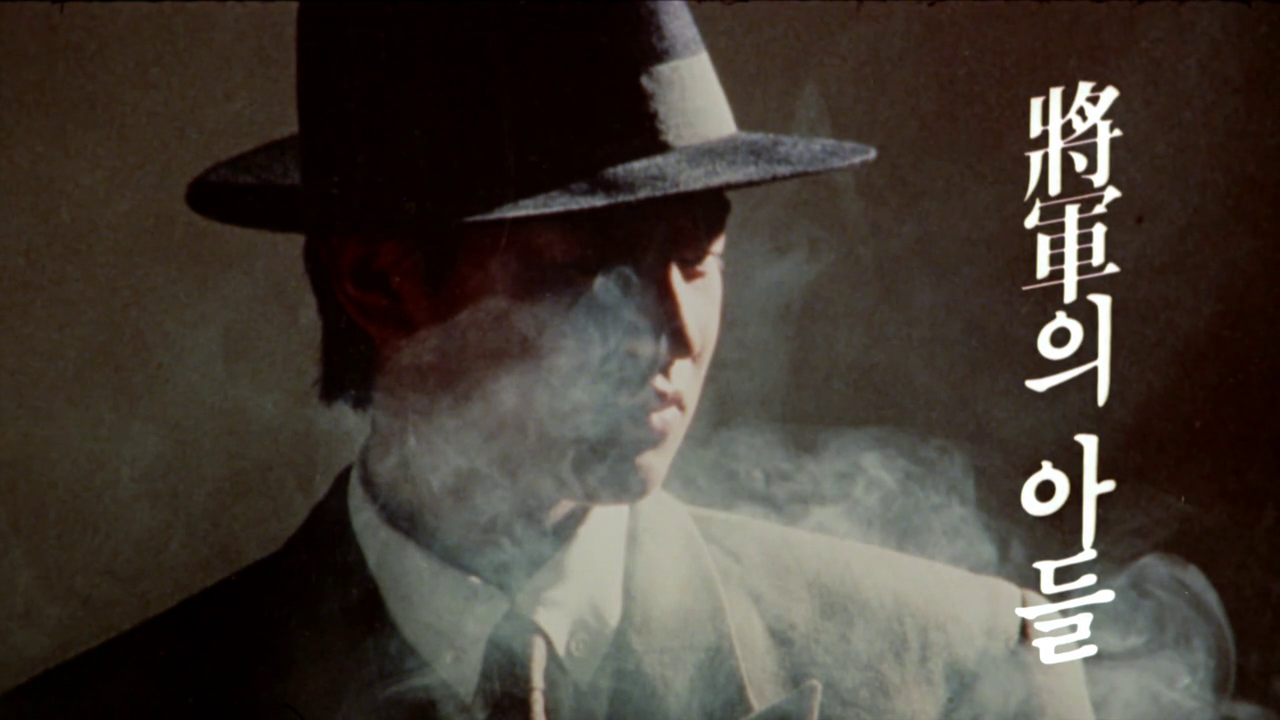
General’s Son (將軍의 아들 / 장군의 아들, Im Kwon-taek, 1990)

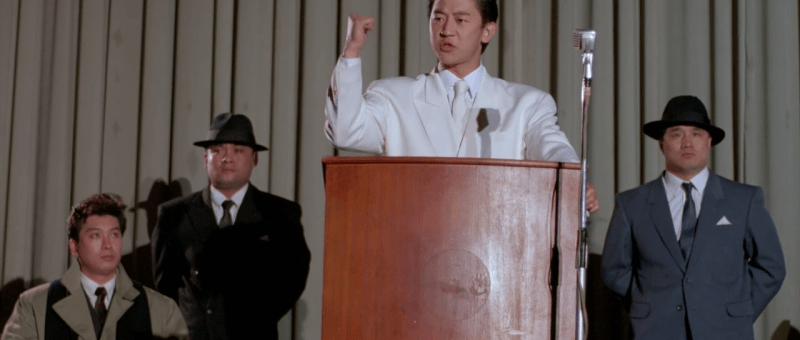
Im Kwon-taek may have been among the first Korean film directors to secure a spot on the international festival circuit, but his long and meandering career began with action cinema which is where his early ‘90s blockbuster trilogy General’s Son (將軍의 아들 / 장군의 아들, Jangguneui Adeul) returns him. Quite clearly influenced by recent Hong Kong martial arts movies, ninkyo eiga yakuza dramas from Japan, and episodic fighting comics, General’s Son creates legend from recent history in further mythologising a real life street king who eventually shifted into politics in the 1950s which might be one shift too far in terms of the film’s complicated politics. 

This first instalment in the trilogy opens with Doo-han (Park Sang-min) being released from prison after apparently having been picked up for sneaking into a Japanese cinema and getting into some kind of fight. An orphan, Doo-han has spent his life on the streets as a beggar but also has a deep love of the movies and is determined to get a job at the cinema, eventually landing one as a sandwich board/announcements guy parading through the streets shouting about what’s currently on for which he gets two tickets on top of his pay. The tickets become a bone of contention when some lowlife punks try to cheat him out of them, but Doo-han is a handy boy and so he manages to beat the guys up and get the tickets back despite being stabbed in the thigh. The altercation brings him to the attention of a local gang boss who decides to recruit him because he’s in need of street muscle and even helps him get a job at the cinema which turns out to be a hub for the local organised crime community. 

The complication is that this small area of Jongno which is ruled by the gangs is also the last remaining outpost of a “free” Korea where Japanese interference is apparently minimal. There is, however, a Japanese gang presence in the form of traditional yakuza led by the youthful and handsome Hayashi (Shin Hyun-joon), who becomes the central if not direct villain. In typical gangster origin fashion, Doo-han climbs the ranks by using his fists, taking down one big boss after another but, crucially, only while his own guys collectively decide to make way for him. As one after the other is killed or arrested, they each affirm that their era has passed, they’ve been beaten, and it’s all up to Doo-han now. In fact, in this highly ritualised setting, most fights ends with the defeated party solemnly admitting that they have lost and will politely leave Jongno at their earliest opportunity. 

As for Doo-han himself, he belongs to the noble brand of gangster and becomes something of a folk hero for his spirited defence of the ordinary man in the face of “Japanese tyranny”. Of course, that ignores all the ways in which the gangsters themselves could be quite oppressive and the film does indeed resist any mention of how they make their money other than a veiled allusion to collecting protection from the market traders in order to keep them safe from harassment by the Japanese.

At the end of the film, Doo-han receives an explanation for all the crytic hints to the film’s title to the effect that he is the son of a legendary general in the Independence Movement. His role is, in effect, to be the general in Jongno holding back the Japanese incursion and saving the soul of Korea from being despoiled by colonisers intent on erasing its essential culture. Just as his father is fighting in Manchuria, Doo-han is “fighting for our liberty” on the streets of Jongno while standing up for the oppressed wherever he finds them, including the gisaeng one of whom he saves from being sold into a Chinese brothel by her father by robbing wealthy Japanese officials to pay her debt. What he’s mostly doing, however, is fighting with fellow gangsters, proving himself in tests of strength which leave his opponents breathing but humiliated and thereafter removing themselves from the game in graceful defeat. It’s unlikely the Japanese will do the same, but Doo-han will be monitoring the streets until they do.
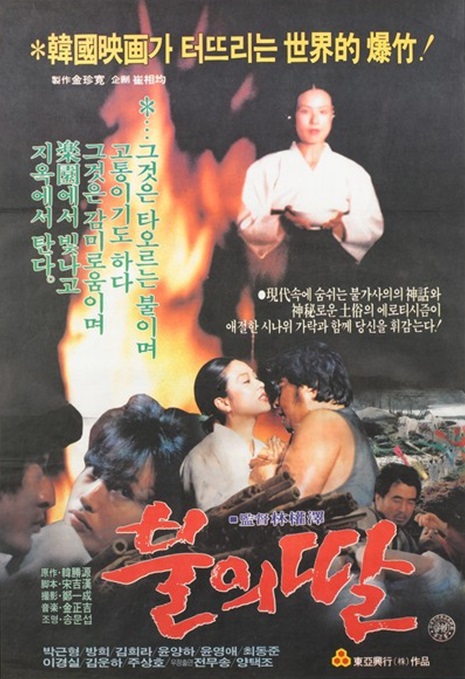
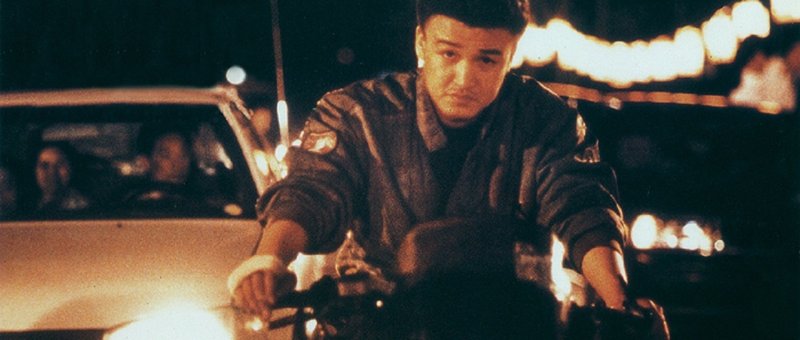
Daughter of Fire (불의 딸, Im Kwon-taek, 1983)

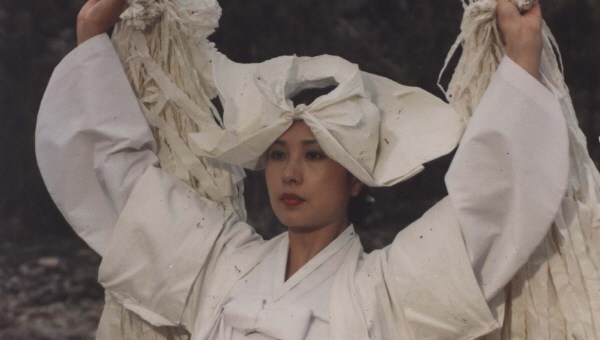
“Doctor, is it possible in our modern society for someone to suffer from that kind of illness?” the conflicted hero of Im Kwon-taek’s Daughter of Fire (불의 딸, Bul-ui ttal) asks his psychologist, plagued by nightmares of the mother who abandoned him at 11 and suffering what seems to him to be the call to shamanism, only what place could such a backward and superstitious practice have in “our modern society?”. In many ways, it’s exactly that question which Im seems to find so essential, implying in a sense that even in the politically repressive but increasingly prosperous Korea of the late ‘70s that they have perhaps lost something of their essential Koreanness in their abandonment of their ancestral beliefs in favour of modern “sophistication”.

Listening to his troubles, the disinterested psychiatrist reassures Hae-joon that it’s just a “minor neurosis” caused by “frustration” which can easily be cured. On his way home, however, Hae-joon is accosted by an older woman dressed in shaman’s clothing who addresses him as a son, reminding him that he has the blood of shamans running in his veins and try as he might he’ll never be able to escape it. Her intervention perhaps links back to an earlier encounter with the pastor at his wife’s church who explained to him that his wife is at the end of her tether, embarrassed by his lack of faith believing that it reflects badly on her as a religious woman hoping to lead others towards the lord if she cannot at least count her husband among the saved. So great is her distress that she has apparently even considered divorce. This is perhaps one reason Hae-joon is so keen to exorcise his shamanistic desires, though it’s also clear that his presence in his home is intensely resented, his wife later only warmly greeting him by hoping that he’ll be able to let go of his “dark and diabolical life” for something brighter and more cheerful, ie her religion though the grey uniformity and intense oppression of her practice only make her words seem more ironic. 

The pressing problem in his family is that his daughter is also sickly, seemingly with whatever it is which afflicts Hae-joon. She has begun sleepwalking and later suffers with fits and seizures which to a certain way of thinking imply the onset of her shamanistic consciousness. Hae-joon’s Christian family, in a touch of extreme irony, are convinced that an exorcism in the form of a laying on of hands will cure her, yet they like many others view the ritualised religious practice of the shaman as a backward relic of the superstitious past. The ironic juxtaposition is rammed home when Hae-joon is sent to cover a supposed miracle for his newspaper that his wife and her friends from church regard as the second act of Moses, standing ramrod straight and singing hymns while a noisy festival of shamanic song and dance occurs further along the beach apparently a rite to appease both the sea god and the vengeful spirit of an old woman accidentally left behind when her community migrated to another island to escape an onslaught of tigers. Stuck in the middle, Hae-joon exasperatedly explains to his photographer that this parting of the seas isn’t any kind of miracle at all, merely a natural result of low tide revealing that which would normally be hidden. 

Yet despite his unsatisfactory visit with the psychologist, Hae-joon becomes increasingly convinced that only by finding his mother can he come to understand what it is that afflicts him. Speaking to the various men who knew her from the step-father he later ran away from to escape his abuse after his mother disappeared, to a blacksmith who cared for him as an infant, and the men she knew after, Hae-joon begins to understand something of her elemental rage. Driven “mad” by the murder of her lover by the Japanese under the occupation, she wandered the land looking for fire to exorcise her suffering only later to lose that too when the oppressive Park Chung-hee regime outlawed shamanism entirely in his push towards modernity. Consumed by the fires of the times in which she lived, there was no place in which she could be at peace and nor will there be for Hae-joon or for his daughter until they embrace the legacy of shamanism within. 

“Shamanism will not disappear and die” Hae-joon later adds, now able to see that there is or at least could be a place for it in “our modern society” or perhaps that it’s the modern society which must change in order to accommodate it. Despite his long association with depictions of Buddhism, it is the shaman which Im considered the foundation of Korean culture, something he evidently thinks in danger to the perils of a false “modernity”, Hae-joon eventually professing his concerns that without it Korea will forever be oppressed by foreign influence. Only by accepting the shaman within himself can he hope to find freedom in an oppressive society. 


Daughter of Fire streams in the UK until 11th November as part of this year’s London Korean Film Festival.

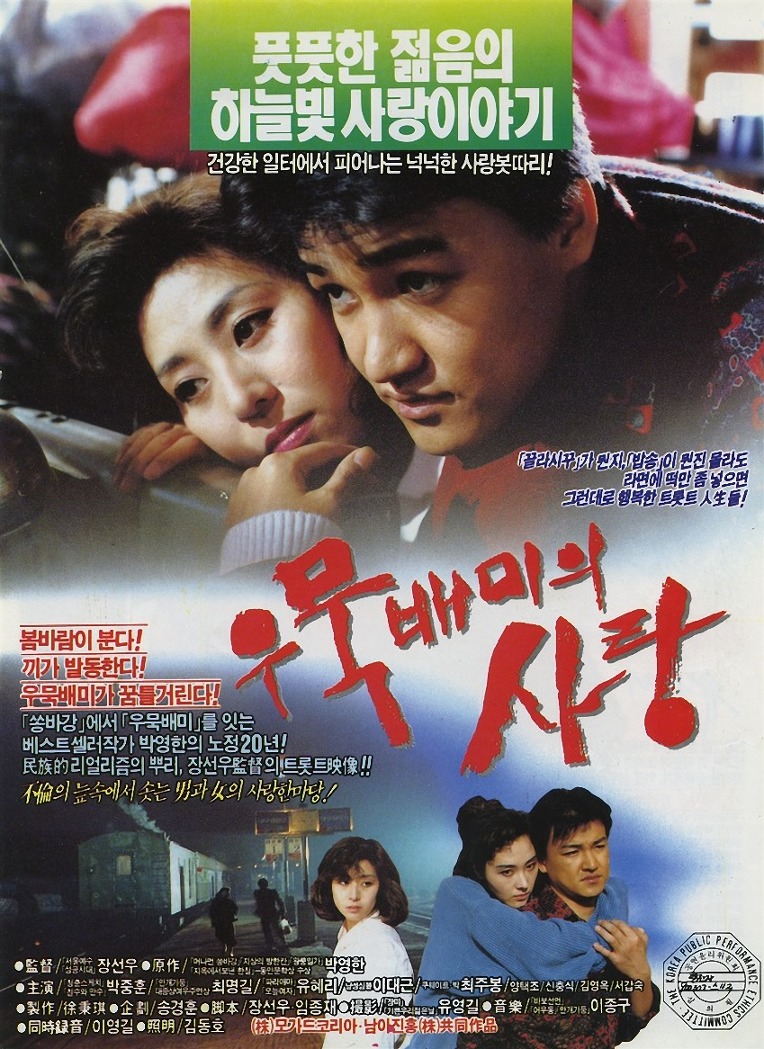
Lovers of Woomuk-Baemi (우묵배미의 사랑, Jang Sun-woo, 1990)

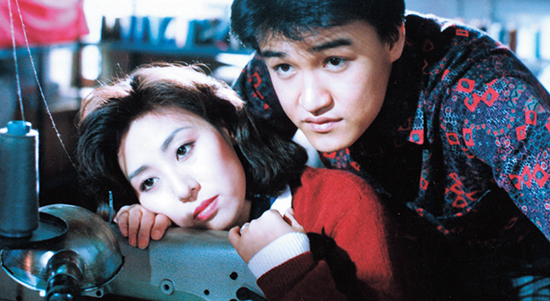
The Lovers of Woomook-baemi posterJang Sun-woo, a former political activist and underground filmmaker, is best remembered for formal experimentation and pointed social commentary, but his third feature The Lovers of Woomook-Baemi (우묵배미의 사랑, Umukbaemi Eui Sarang), stands out in his filmography in its fiercely naturalistic portrayal of working class life on the margins of a society in flux. Based on a novel by Park Yeong-han, The Lovers of Woomook-baemi, is a classic melodrama with infidelity at its core but it’s also a story of futility, the destructive effects of patriarchal social codes and toxic masculinity, and the frustrated promises of a new era for those excluded from its various benefits.

Jang begins his tale in the middle as Bae Il-do (Park Joong-hoon), a frustrated husband, returns home late to a troubled “wife” (Yoo Hye-ri) who promptly kicks him out again. Complaining furiously, Il-do dreams of another woman, Gong-ryae (Choi Myung-gil), with whom he had a brief affair, idly thinking that he might have been happy if he hadn’t got his current partner pregnant and got himself stuck with her for life even if they aren’t technically “married” in the legal sense.

Moving backwards, we see Il-do, having failed in Seoul, returning to his home village with his common-law wife Sae-daek and infant child after an offer of work in a small seamstressing firm. The only man among a room full of mostly elderly women, Il-do is something of a novelty but is also taken by the woman on the machine next to him, Gong-ryae, who he later learns is also unhappily married and intensely lonely in her small-town existence. After some initial indecision, the pair embark on an affair, (still illegal at the time of the film’s release) but their prospects for future happiness seem slim given the restrictive quality of their lives.

The world that Jang depicts, for all its naturalistic flair, is intensely misogynistic. Il-do’s early recollections of Gong-ryae revolve around her bad marriage to an impotent man (Lee Dae-Geun) who mercilessly beats her. Indeed, we later see Gong-ryae turning up for work after suspicion has arisen about her relationship with Il-do with a black eye and bruises on her face while the other women giggle over the obviously awkward gossip. Domestic violence is, however, just a part of life in the village and the older women in particular view it as a sign of a healthy marriage. One woman even exclaims that she wishes she had a man to beat her, but thinks she’s unlikely to find anyone given her age and the fact that she already has numerous children.

Il-do, by contrast, proves somewhat popular among the ladies at the shop because of his relative lack of machismo. Like Gong-ryae, Il-do is also a victim of domestic violence. His wife beats, slaps, and attacks him verbally, later even dragging him home by the testicles along a very public walk of shame. He is not above violence or aggression, but as in much of Jang’s work, male violence is a sign of weakness rather than strength and each of Il-do’s violent episodes is more to do with defeat and repressed emotion than it is about strength or conquest. This also seems to be true for Gong-ryae’s husband whose violence and jealously is perhaps a reaction to his impotence, but when we later meet him we find a man much like Il-do. Chastened, Gong-ryae’s husband politely asks the man who bedded his wife if he knows where she is and if he sees her to please tell Gong-ryae that he’s sorry and wants her to come home.

As he does with Gong-ryae’s husband, Jang plays with our sympathies and allegiances, switching perspective to reveal to us that villains and victims are often one and the same. Sae-daek originally seems like our villain, a shrewish, henpecking “wife” who won’t let our hero go despite the evident toxicity of the pair’s non-marriage, but seen from her point of view we understand her plight. After running away from a violent home environment she winds up a bar hostess in the city where she builds up a spiky relationship with Il-do which goes south when he gets her pregnant. Despite this being the age of illegal adultery, it’s not so much a marriage certificate that binds a man and a woman together for good or ill but a child. As a neighbour puts it, a woman might leave her husband, but what sort of woman leaves a child? Sae-deok cannot care for her child alone and she cannot abandon it with Il-do and so she must keep him no matter how much personal suffering she must endure as the common law wife of a no good philandering ne’er do well.

Il-do likes to drift off into philosophical reveries in which he idly remarks on the futility of his existence, but in a very real sense he’s not wrong. He tried life in the city but it didn’t want him and he came home. Sae-deok, oddly enough, likes it in the village with its sense of community especially among the other put upon and oppressed women who attempt to support each other (whilst accidentally supporting the mechanisms which continue to oppress them), but there’s no pretending there’s anything more to life in Woomuk-Baemi than work and drink. Il-do knows this, as does Gong-ryae, and it’s their mutual sense of existential ennui which finally forces them together in an impossible attempt to rebel against the futility of their existence through transgressive sex and an attempt at emotional connection.

In the end, Il-do is dragged (by the short and curlies) back into the past, literally, as Sae-deok takes him back to his mother’s house to complain about the terrible way she’s been treated. Creating a scene outside, Sae-deok eventually manages to get through to her mother-in-law who had previously rejected her because of her lowly peasant background and history of sex work, enabling the two women to bond in their shared disappointment with Il-do who has now failed as a “man” on every possible level. Briefly reuniting with Gong-ryae in the greenhouse in which they used to meet, now reduced to ruins, Il-do declares that his love is like a mummy, wrapped so well it will endure for thousands of years without decay, but it’s already too late. Choices have been made, implicitly, which cannot be reversed. Jang leaves his protagonist where he started, frustrated and inert, suffering without hope in an oppressive environment which he knows, in his heart, he does not possess the courage to resist.


Available on region free blu-ray courtesy of the Korean Film Archive which also includes an audio commentary in English from film scholars Darcy Paquet and Marc Raymond, and Tony Rayns’ documentary The Jang Sun-woo Variations, as well as a 36 page bilingual booklet featuring essays by Rayns and film critic Lee Yeon-ho. Also available to stream via the Korean Film Archive’s YouTube Channel.

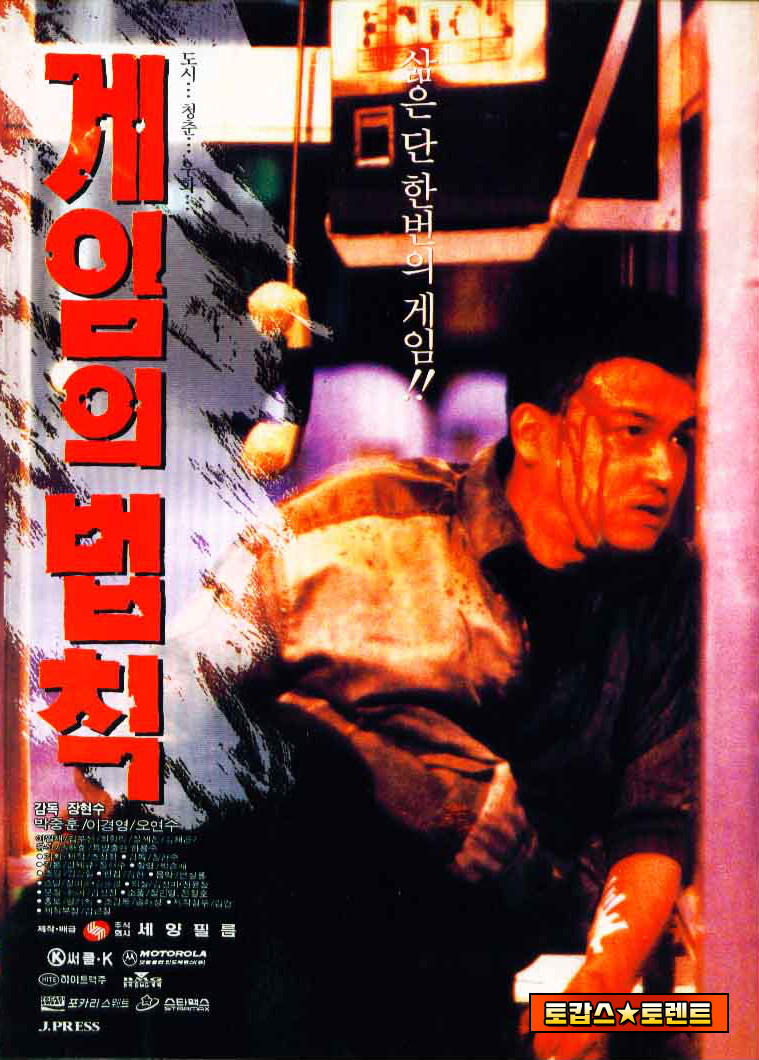
The Rules of the Game (게임의 법칙, Jang Hyun-soo, 1994)

Rules of the GameEvery game has its rules, but then again perhaps the game lies in learning how to bend them to one’s advantage. Owing a debt to a Pacino/De Palma diptych – Scarface and the later but then just released Carlito’s Way, Jang Hyun-soo’s Rules of the Game (게임의 법칙, Gameui beobjig) was the first in a resurgence of contemporary action dramas which had gone out of fashion since their 1970s heyday. The story is a timeless one of a young man looking for gangland fame, his loyal girlfriend, and the duo’s loveable third wheel of a degenerate gambler whose sob story may actually turn out to be truer than it seemed.

Young-dae (Park Joong-hoon) is a young upstart in a tiny town. Bored with his life of daily drudgery washing cars, he decides to upsticks to the city, taking his adoring girlfriend Tae-suk (Oh Yeon-su) with him. Young-dae plans on engineering a meeting with famed ganger Gwang-cheon and pledging his allegiance to him, hoping to set himself on the road to gangland success. Things get off to a bad start when the pair of naive country bumpkins run into to smooth talking conman Man-su (Lee Kyoung-young) on a train. Man-su claims to know Gwang-cheon and writes a letter of recommendation before suddenly announcing they’re at his stop and jumping off the train leaving Young-dae and and Tae-suk with a healthy dinner bill.

The city proves particularly hostile to the out of towers as Young-dae realises joining a gang is not as simple as marching in, dropping to your knees and exclaiming “I will die for you, please accept me”. Repeatedly striking out, Young-dae distances himself from Tae-suk who ends up working as a hostess for the gangster Young-dae still hasn’t been able to meet. Finally spotting an opportunity to prove himself by interrupting a gang raid, Young-dae gets a foot on the ladder but as an outsider in an established gang he’s always going to be a liability.

Meanwhile, Man-su has continued to get himself into trouble with cards and is a constant thorn in the side to Gwang-cheon’s guys. After a beating leaves him crippled, Man-su turns to Young-dae for retribution. Young-dae, Man-su, and Tae-suk form an odd, sometimes volatile trio as they try to survive and make Young-dae’s gangster dreams come true while Man-su dreams to going to Saipan where the sun shines everyday and everything is palm trees and summer fruits.

It doesn’t take a genius to realise Saipan is a place Young-dae will never go, no matter how much he might want to. After getting into the gang and reuniting with Tae-suk, Young-dae does seem to be getting himself together but success soon goes to his head. He begins dressing in snappy suits moving from brown, to blue, to white, and drives a BMW around town as if he really owned it. As Tae-suk points out, he’s just a driver – a driver for a top gangster, but a driver all the same. In his desperation to reach the top, Young-dae makes himself a figure of suspicion in the mind of the boss he is so desperate to impress, inadvertently placing a target on his own back.

Jang may have pegged De Palma as an influence, one which is very much felt in the Tony Montana-esque story arc and Carlito’s Way denouement, but his shooting style is pure Hong Kong by way of John Woo – frantic action shot in slow motion. Young-dae is a slap-happy lover of violence, never one to let to the opportunity of getting into a fight pass him by. This is quite a good quality in an aspiring foot soldier, even if not in a potential boyfriend though Tae-suk does her best to tame him, but his impetuosity and naive faith in others’ ability to abide by the “rules” of gangsterdom are at the heart of his eventual downfall. His later decision to mistreat a fellow would-be minion who echoes his own phrase back to him “I will die for you, please accept me” is a clear indicator of how far he has moved away from the scrappy boy who left his village full of angry dreams even if something of his youthful innocence is later returned in his desire to leave the gangster world far behind for a life of ease and friendship with Man-su and Tae-suk in tranquil Saipan. The rules of the game, however, rarely reward missteps and Young-dae will pay heavily for his misplaced faith.


Screened at London Korean Film Festival 2017.