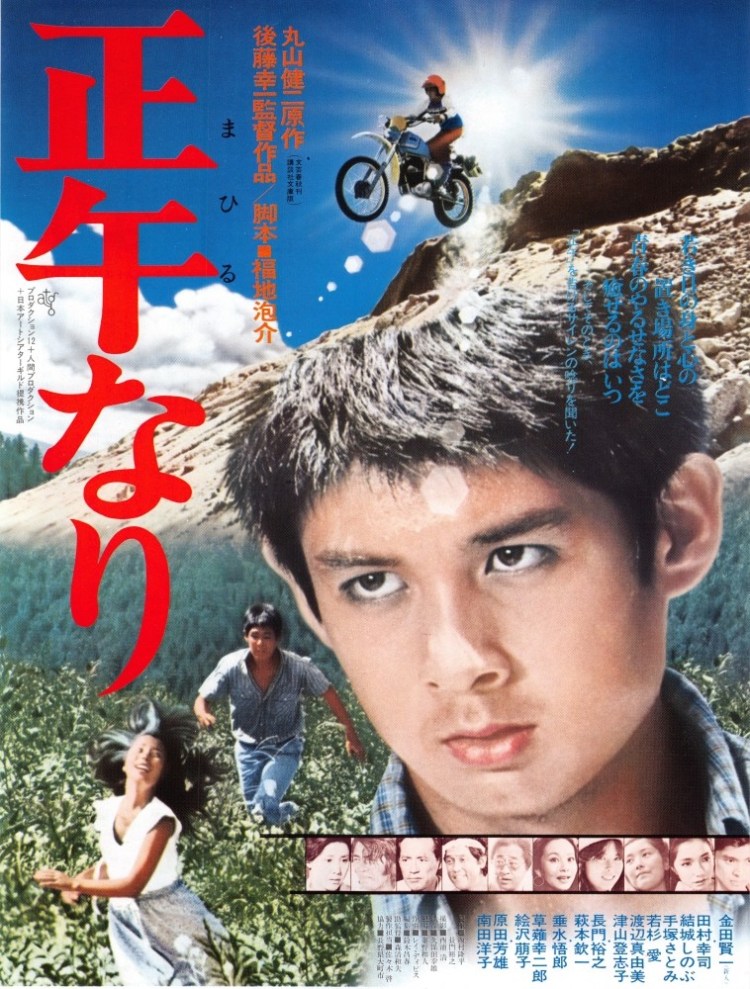
 Koichi Goto’s Art Theatre Guild adaptation of Kenji Maruyama’s 1968 novel At Noon (正午なり, Mahiru Nari) begins with a young man on a train. Forlornly looking out of the window, he remains aboard until reaching his rural hometown where he makes a late entry to his parents’ house and is greeted a little less than warmly by his mother. The boy, Tadao, refuses to say why he’s left the big city so abruptly to return to the beautiful, if dull, rural backwater where he grew up.
There’s little work here for a young man, which is why Tadao left in the first place. After using some family connections to try and find a job, he finally decides to make use of his abilities by fixing radios and TV sets for a local electronics store. To begin with he doesn’t want to see his old friend, Tetsuji, perhaps out of a sense of shame at having returned home but the pair later strike up their old friendship – that is, until Tetsuji suddenly announces his plans to run away with a local bar hostess.
It’s never quite revealed what happened to Tadao in Tokyo but it seems to have been something serious enough to change the course of his entire life and send him reeling back home depressed and angry. In many ways he’s a typical young man, if slightly sullen, but he’s developed a serious number of sexual hangups which have turned him into some kind of repressed, misogynistic, pervert. He appears to have made a deliberate decision to dislike the idea of women, or at least the idea of women with sexual appeal. He thinks women are trouble, that no good comes of love, but can’t stop himself from spying on the female tourists staying in an upper room. He’s always looking, staring invasively, but resolved not to touch.
Tadao has already been to the city and evidently found it not quite to his liking but his friend, Tetsuji, feels bored in the village and trapped by his parents who need his help in their orchards. When Tadao realises Tetsuji is taking the hostess with him when he skips town, he asks for the money he just agreed to lend him back and tells him to forget about running away and just to go home. Unfortunately for Tetsuji, Tadao’s advice proves sound as his city dreams don’t work out the way he planned either. To end his frequent attempts to escape, Tetsuji’s family float the idea of an arranged marriage which originally horrifies both boys but after meeting his prospective bride, Tetsuji changes his mind. Tadao doesn’t approve, but after meeting the girl in question and seeing that she is quite lovely changes his mind too and is happy for his friend – that is, until he realises Tetsuji has only introduced him to her as a pretext of getting her on her own to enact his marital rights a little ahead of schedule. This breach of morality proves the final straw for Tadao who does not like the idea of his wayward friend deceiving and then ruining this innocent young flower who’s far too good for him anyway.
Tadao’s fascination with another damaged bar girl, Akemi, continues as the two find themselves both looking at the sad figure of a tethered eagle imprisoned at the local zoo. Akemi says she likes to look at the bird as she feels perhaps somehow that helps him escape. She feels like a caged bird too – trapped in a bad relationship with a useless boyfriend who has a vague plan of turning manure into an energy source while she supports them both by working at a hostess bar and hating every second of it. Tadao feels trapped in a hundred different ways, by his town, by his parents, by whatever happened in Tokyo, and by his own pent-up frustrations. By this point, he’s a one man powder keg ready to explode and after blowing his final safety caps, tragedy is the only possible outcome.
At Noon begins with its epilogue, but uncomfortably frames its protagonist’s despicable final actions with an odd kind of heroism as his head eclipses the sun leaving him with a radiant halo. He may have satisfied himself in some way, put to rest some of that inner turmoil, but what he’s done is something truly dreadful and driven by an intensely animalistic instinct. At Noon may have something to say about the dangers of frustrated young men with no work to go to, no ambition to follow, and no luck with the ladies but displays an oddly ambivalent attitude to its deranged protagonist that makes for often uncomfortable viewing.
By the way, After Noon has music by Ray Davis of The Kinks!
Unsubbed Trailer:
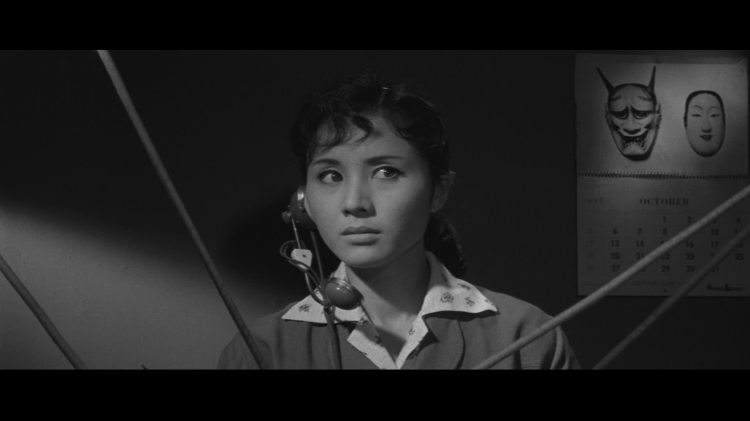
 Bunraku playwright Chikamatsu Monzaemon had a bit of a thing about double suicides which feature in a number of his plays. Though these legends of lovers driven into the arms of death by a cruel and unforgiving society are common across the world, they seem to have taken a particularly romantic route in Japanese drama. Brought to the screen by the great (if sometimes conflicted) champion of women’s cinema Kenji Mizoguchi, The Crucified Lovers (近松物語, Chikamatsu Monogatari) takes its queue from one such bunraku play and tells the sorry tale of Osan and Mohei who find themselves thrown together by a set of huge misunderstandings and subsequently falling headlong into a forbidden romance.
 Windows on Worlds