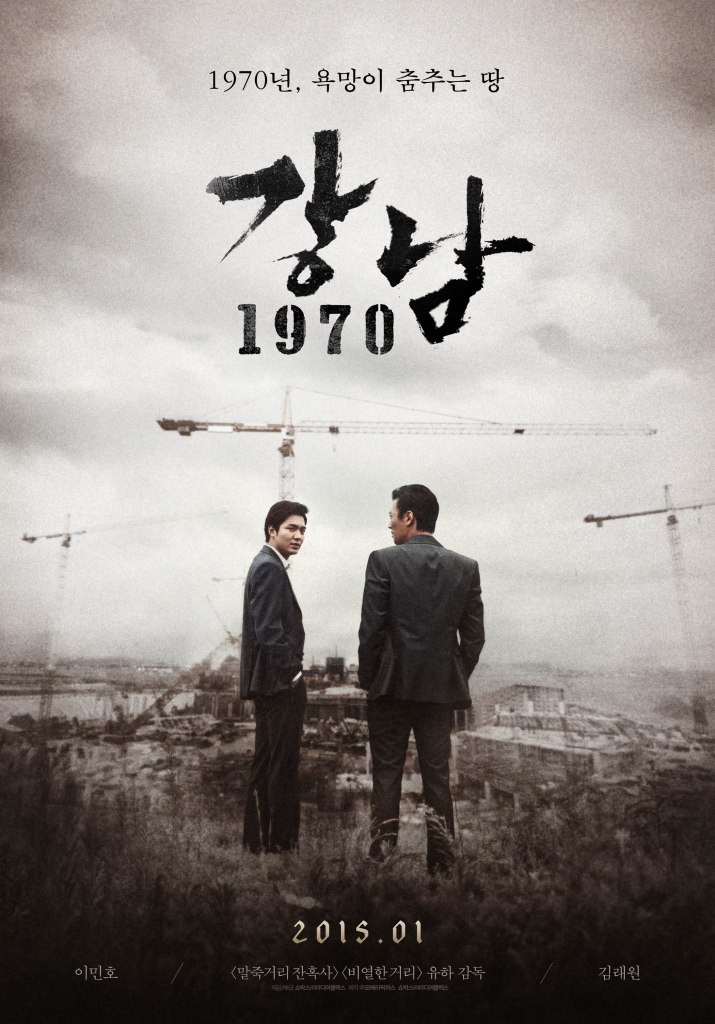
Gangnam Blues (강남 1970, Yoo Ha, 2015)

gangnam-bluesYoo ha takes us back to the 1970s for some Gangnam Blues (강남 1970, Gangnam 1970) in a sorry tale of fatherless men caught up in dangerous times of ambition and avarice, very much at the bottom of the heap and about to be eclipsed by the “new world” currently under construction. Back then, Gangnam really was all just fields, owned by farmers soon to be cheated out of their ancestral lands by enterprising gangsters engaged in a complicated series of land grab manoeuvres, anticipating the eventual expansion of the bursting at the seams capital. Far from the shining city of today, Gangnam was a wasteland frontier town, the sort of place where a man can make a name for himself trading on his wits and his fists alone.

In 1970, Jong-dae (Lee Min-ho) and Yong-ki (Kim Rae-won), sworn brothers from the same orphanage, are two street rats trying to survive in straightened times. When the shack they were squatting in is demolished and they come in to contact with a petty gangster, Kang (Jung Jin-young), the pair end up getting a one off job as thugs sent to smash up a political rally but get separated when the police arrive. Jong-dae finds himself taken in by Kang and his daughter Seon-hye (Kim Seol-hyun AKA Seolhyun) as a surrogate son and brother, repaying their affection by saving Kang’s life during an assassination attempt which later prompts his decision to retire from the criminal world altogether. Yong-ki joins the rival gang instead and seems to be making a success of himself but both find themselves at the mercy of an increasingly corrupt, dishonourable system hellbent on progress but only for the few.

Gangnam Blues has an overly complex, intricate narrative overlaying the generic brotherhood and betrayal theme that runs through the film. Dipping into a particularly dark period of history, Yoo is not afraid to step back into those difficult days marked by both rapid progress and increasing inequality furthered by complicated systems of interconnected corruption. The gangsters are at the service of the politicians but it’s always debatable who is running the show. Jong-dae’s participation in the land grab scheme is painted as amusing cleverness (at least at first) but little attention is paid to the farmers who are being “convinced” to sell their land off cheaply to gangsters who are each competing for the prime sections. Modern day Gangnam was built on blood and extortion, by men like Jong-dae and Yong-ki, even in the knowledge that they will be discarded as soon as their usefulness has been exhausted.

Jong-dae and Yong-ki are the bottom of the pile, orphaned and without family connections they have only each other to rely on yet their brotherly bond is repeatedly tested. The ‘70s Philippine folk song, Anak by Freddie Aguilar, which forms the film’s major musical motif has some very poignant lyrics about parents and their children but neither Jong-dae nor Yong-ki are able to find the kind of family they’re looking for. Both end up opting for the fraternal bond of a crime syndicate to replicate the kind of support usually offered by the family unit with Jong-dae finding a father figure in Kang who eventually takes him into his household as a son outside of the criminal world, and Yong-ki eventually marrying and soon to become a father himself. Forced into crime by their poverty, each becomes an outcast, permanently shut out from the thing they most want even whilst living a life of material comfort.

Yoo opts for a highly stylised approach filled with beautifully photographed, expertly choreographed scenes of violence including the traditional mass brawl in the rain, and a sequence of intercut killings each artfully sprayed with blood. Lee Min-ho acquits himself well enough in his first leading role as the noble hearted gangster Jong-dae with quality support from Kim Rae-won as the much less noble Yong-ki though the superfluity of secondary characters leads to an avoidable lack of depth. Relative newcomer Kim Seoul-hyun also does well with her underwritten role of the film’s most tragic character even if her domestic violence themed subplot seems like one too many. Another classic slice of gangster action from Korea, Gangnam Blues is an unflinching look back at a difficult era with uncanny echoes of the present day, and a suitably period tinged tale of melancholy ‘70s bleakness in which brotherhood and honour are merely words misused by men trying to justify their own ambitions.


International trailer (English subtitles)

Freddie Aguilar’s Anak as featured in the film:
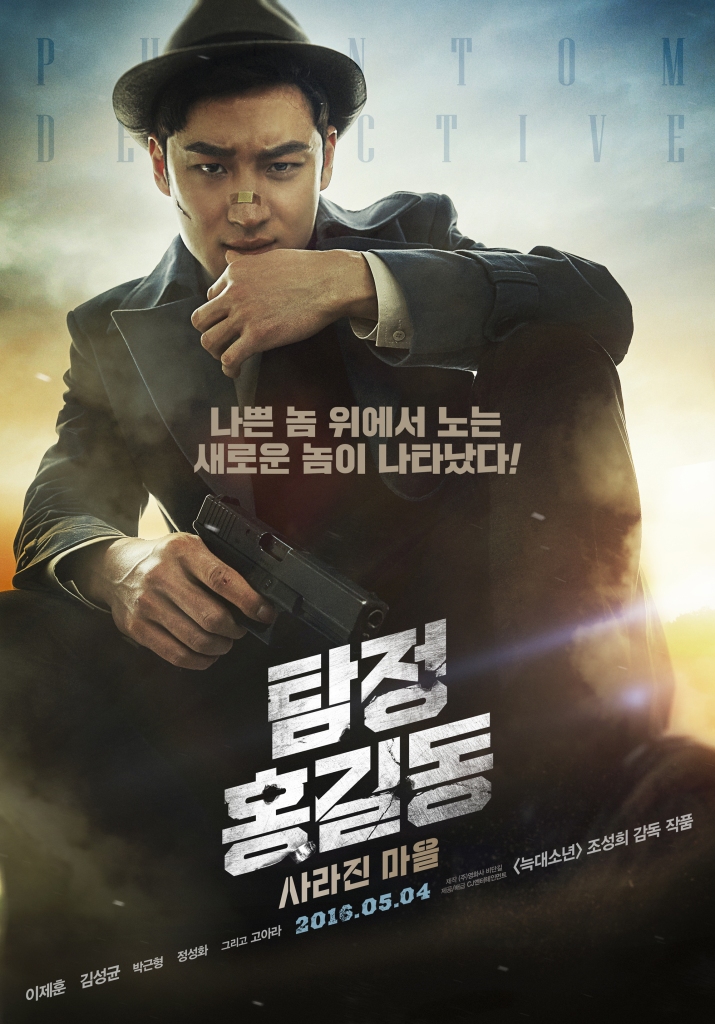
The Phantom Detective (탐정 홍길동: 사라진 마을, Jo Sung-hee, 2016)

su0mhpqReview of Jo Sung-hee’s The Phantom Detective (탐정 홍길동: 사라진 마을, Tamjung Honggildong: Sarajin Maeul) first published by UK Anime Network.


Comic books and film noir are, in many ways, a match made in heaven. Tough guys lurking in the shadows, larger than life villains and an ever present sense of the strangeness of criminality, lend themselves particularly well to the extremes of both genres which is why the combination is not exactly an uncommon one. In The Phantom Detective , director Jo Sung-hee adds an extra layer of meta textuality in naming the amnesiac hero Hong Gil-dong which is both the Korean “John Doe” and the name of a legendary Robin Hood figure from the 16th century. Like his namesake, this Hong Gil-dong is a preternaturally gifted detective with a faultless memory and an almost supernatural ability to stay ahead of the game, but he’s also a classic film noir hero with a damaged past and hollow heart…

In an alternate 1980s Korea, Hong Gil-dong (Lee Je-hoon) is an ace detective about to break a trafficking ring, which is righteous enough, but he also has another motive – these men may be able to offer him a clue to tracking down a target he’s been chasing for over 20 years. A one eyed man, Kim Byung-duk (Park Geun-hyung), contributed to Gil-dong’s origin story by murdering his mother right in front of him. At least, he thinks so – Gil-dong can’t remember anything about that day save for the visions he sees in his nightmares. In fact, he doesn’t even know his real name or who he really is.

When he finally gets to Byung-duk’s location, Gil-dong discovers he’s already been kidnapped by someone else leaving his two young granddaughters, Dong-yi (Roh Jeong-eui) and Mal-soon (Kim Ha-na), all alone. Taking off with the kids in tow, Gil-dong vows to track down “grandpa” but still has revenge in his heart. As the investigation progresses Gil-dong finds himself getting involved with the strange residents of a tiny town who may be about to fall victim to a dastardly doomsday plan engineered by a shady cult leader…

Ever since his mother’s death, Gil-dong has been unable to sleep thanks to constant nightmares and has lost the capacity for fear and empathy (qualities which serve him well in his line of work). Fiendishly clever, Gil-dong also has a sweet tooth and a sarcastic personality but despite his protestations, usually does the just thing when comes down to a straight choice. Byung-duk’s adorable granddaughters pose something of a problem for him as he begins to warm to their straightforward earnestness, yet his revenge rests in killing their beloved grandfather to avenge his mother’s death. The kids quickly take to Gil-dong, for some reason believing in his essential goodness. Dong-yi follows him around like a deputy detective, meticulously noting everything down in her notebook, whereas Mal-soon has figured out Gil-dong’s talent for deception but hilariously almost blows the gang’s cover on several occasions through her total lack of investigatory acumen.

Through investigating his lead on Byung-duk, Gil-dong hopes to recover his own memories of his early life and the mother he only remembers in his nightmares. The path he finds himself on is a dark one leading straight towards a powerful cult populated by fascism fetish sociopaths. Sure that the “New World is Coming”, the cult have planned a large scale event which threatens the lives of most of the residents of a small, strange town. Now Gil-dong has several reasons to get to the bottom of this long standing mystery ranging from his own desire for answers and revenge to saving the lives of these ordinary people and making sure no one else comes under threat.

Taking inspiration from the comic book world, The Phantom Detective makes use of highly saturated color schemes and deliberately artificial looking backgrounds. Though the approach remains bright and colourful for much of the film which adds to its slightly surreal atmosphere, there’s still ample room for noir with faces cast in shadow, light striking glasses so as to eerily block out the eyes, and Gil-dong’s classic detective outfit and occasional weary voiceover. The pulpy plot doesn’t worry too much about internal consistency, but blusters along well enough on its own even if coasting on Gil-dong’s wisecracking tough guy antics as he unexpectedly bonds with the two plucky little girls temporarily in his care. Cute and funny but also filled with innovative action sequences, The Phantom Detective acts as a worthy secondary origin story for its titular hero whose return will be eagerly awaited!


Reviewed at the 2016 London Korean Film Festival.

International trailer (English subtitles)

Tunnel (터널, Kim Seong-hun, 2016)

TunnelIn 1925 an avid cave explorer, Floyd Collins, became trapped in a narrow crawl space. Though he was discovered and help came with food and water, a cave in left him sealed off down there and fourteen days later he died of thirst and exposure. As tragic as this obviously is, Floyd Collins is remembered for another reason – his rescue became one of the earliest mass media crazes. The surrounding media furore also inspired the 1951 Billy Wilder classic Ace in the Hole in which a grizzled reporter attempts to manipulate the fate of a man trapped in a cave for the maximum media coverage with the consequence that his delays cost the man his life. Jung-soo, a father on his way home with a birthday cake for his young daughter is about to join the marooned underground club when a shoddily built tunnel collapses sealing him inside. Unfortunately for Jung-soo, he finds that times have not changed all that much.
Jung-soo (Ha Jung-woo) was having a good day. He’d closed an important deal and has a birthday cake in the back of his car ready for his little girl when he gets home. He also ends up with two free bottles of water for not making a fuss when a hard of hearing old timer working at the petrol station gives him a full tank rather the $30’s worth he’d asked for. It all comes crashing down, literally, when he starts hearing strange noises shortly after entering a newly completed tunnel. Driving as fast as he can, Jung-soo is still trapped under falling debris and unable to escape though otherwise uninjured. Luckily, Jung-soo’s phone still works and he’s able to get enough signal to dial the emergency services but as he’ll discover, the matter of coming to his rescue may not be as straightforward as one might hope.

Just before Jung-soo heads into the tunnel which has only been open for around a month, there’s a sign testifying to happy and safe construction. It transpires that the tunnel was completed far too quickly, corners were cut, and public safety not properly respected. Corporate corruption and margin squeezing become a constant theme as more and more faults are discovered with the tunnel’s structure right down to missing manuals and incorrect blueprints. As one sardonic construction worker puts it, who follows the rules these days anyway? In light of recent tragedies, the government can no longer be trusted to assure public safety by insuring that its infrastructure, and the third party companies which run it, are fit for purpose and operating in line with public safety standards. The fact is that the construction of the sister tunnel to this one is already underway and there have also been hundreds of other recorded safety incidents in other facilities around the country. Construction means jobs, and money, and progress – who would want to let a little thing like safety stand in the way?

If money grabbing culture and government laissez-faire are two of the greatest evils, the third leg of the tripod is mass communications who see only the story and not the human. In fact, the first people to call Jung-soo back after his emergency call are the reporters parked in their van directly outside the tunnel’s entrance. Even Jung-soo’s wife, Se-hyun (Bae Doona), only discovers her husband’s fate from a TV displaying breaking news at a supermarket. Once she drops everything to get to him, she’s quickly trotted out for endless photo-ops with government officials and rescue workers to sell the story that the entire country is behind Jung-soo in his horrendous ordeal and working hard to get him out of there. The mouth of the tunnel is now a media circus as reporters parasitically dig in, raking up whatever kind of news they can spin for good copy. When it looks like Jung-soo may be rescued, one reporter even seems upset that he hasn’t quite broken the record set by the survivors of the Sampoong Department Store collapse in 1995 (notably also directly caused by corporate greed).

Jung-soo himself accepts his situation with a stoic calmness. Sensibly rationing out his water and battery life on his cellphone, he beds in for the long haul. Before long, the TV news has even declared him a national hero for maintaining his compassionate humanity even in the face of crisis. More resourceful than most, Jung-soo is making the best of things when all he can do is wait, hoping that the authorities will finally come to his rescue. Unfortunately the authorities he’s waiting on are largely the same ones responsible for this entire mess and aside from the valiant commander of the rescue squad Dae-kyoung (Oh Dal-su) are more interested in being able to resume construction on the sister tunnel (which involves more of the blasting that may have destabilised the tunnel in first place) and deflecting the embarrassment of this high profile infrastructure project having gone so catastrophically wrong.

Kim Seong-hun keeps the tension high as Jung-soo fights for his life by simply trying to survive long enough for someone to reach him. Genuinely fraught and claustrophic, Tunnel is not without a healthy dose of black humour lightening the mood in even the bleakest of circumstances. The political subtext is refreshingly subtle yet perfectly clear as Jung-soo finds himself literally buried underneath a national scandal and branded an inconvenient truth by those whose interests lie in maintaining the illusion of compassionate government anchored by friendly corporations. Tense, thrilling, and frightening on more than one level, Tunnel is an unexpectedly thoughtful disaster movie detailing one good man’s struggles to escape from underneath the destruction caused by pervasive social ills.


US release trailer (English subtitles)

Black House (검은집, Shin Terra, 2007)

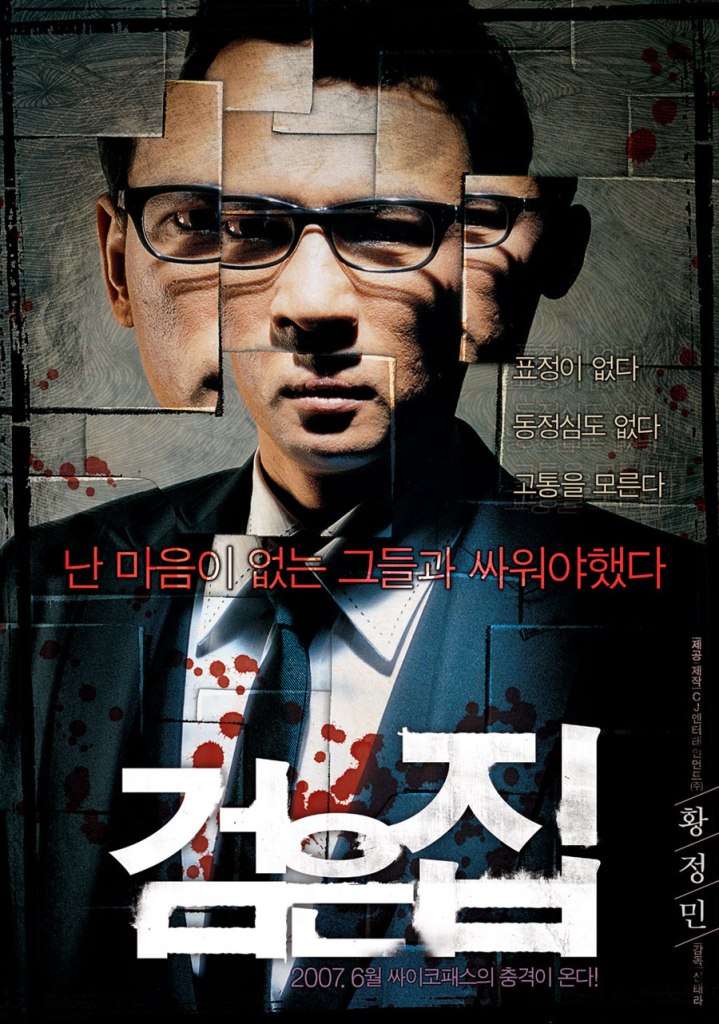
Black House (korea)Yusuke Kishi’s Black House source novel was previously adapted by Yoshimitsu Morita in its native Japan back in 1999, but eight years later the tale made its way to Korea by way of director Shin Terra who opts for a much more straightforward approach than Morita’s characteristically bizarre take. Sold as K-horror, the tone is closer to nasty thriller only giving way to classic slasher action in the final stretch. In eschewing Morita’s idiosyncratic tendency to insert himself into the material, Shin crafts a more mainstream aesthetic, but loses the various layers of social and psychological commentary that went with it.

Juno (Hwang Jung-min) is a mild mannered insurance clerk, new on the job and extremely naive. His first case involves a visit to a hospital with his boss to visit a persistent claimant whom they believe is deliberately scamming the system and possibly with the hospital’s help. In many ways, Juno is an innocent, he believed in insurance as a safety net and a power for social good so he’s shocked that anyone would deliberately manipulate the rules in this way – particularly when he discovers some people will go so far as to deliberately maim themselves just to claim on their insurance policies.

Not long after he starts working at the company, Juno gets a strange phone call from a man asking if insurance policies pay out in case of suicide. It’s possible, Juno says – he’ll need to check the policy to make sure. Suddenly worried the person he’s talking to is in a dark place, he starts trying to dissuade him from the idea of taking his own life and unwisely gives a lot of first hand advice despite the highlighted section in his employee guide cautioning him never to reveal personal information to clients. Soon enough, a client has asked for him personally to go out to their remote house and chat about a policy. When he gets there he receives a nasty surprise as the man’s young son has apparently hanged himself in the back room. Appalled, Juno waits to greet the police but becomes convinced the man has deliberately killed the boy, who was his step-son, to get the payout on his life insurance.

Juno refuses the claim but Choong-bae, the claimant, won’t give up and starts coming to the office everyday to ask for his money. Choong-bae is a scary looking guy and frightens most of the other staff with his vacant staring. He also has an insurance policy on his wife leading Juno to fear that she is next but his decision to try and alert her to her husband’s plans will prove a mistaken one, drawing him into the web of a dangerous and psychopathic serial killer.

Shin’s adaptation is most likely closer to the original novel but he is far less interested in the psychological or social implications than Morita was. There is no explanation offered for the actions of the killer though the childhood sequences with their reliance on dreams and hearsay remain intact, only with lesser impact. The question of insurance fraud and scamsters, people so desperate for money that they will literally sacrifice an arm or a leg, only exists as background and isn’t presented as a societal problem so much as just something that happens because there are some shameless people out there who would rather play the system than do an honest days work. Juno has also been given his own tragic backstory which tries to play him off as a mirror of the killer though somehow this never quite works and Juno’s own flashbacks are overplayed.

Beginning as a slow burn thriller where Juno plays the nervous, softhearted neophyte as yet uninured to the murkiness of the insurance world, Black House (검은집, Geomeun Jip) takes a huge detour during the final third which sends it into slasher territory when Juno decides to travel to the titular Black House, alone, during the middle of the night, because the police won’t listen to him and there are people in danger. When he gets there he finds a veritable house of horrors with body parts and nooses hanging from the ceiling, blood and carnage everywhere. Then it’s a straightforward fight to the death as Juno faces off against the psychopathic terror despite his nervous disposition culminating in some unexpectedly gory business with a key.

Like most slasher movies, Black House has several endings and finishes on a note of uncertainty but it never quite manages to make its sudden descent into violence work in its favour. Lacking the depth of Morita’s adaptation, Shin’s Black House may have stronger genre influences but with nothing to back them up all that remains at the end is a darker than usual serial killer tale with mild slasher tendencies. A decent enough mainstream thriller, Black House has a lot to offer despite stumbling in its final third but nevertheless lacks a distinctive element to mark it out from similarly themed genre efforts of recent times.


Unsubbed trailer: