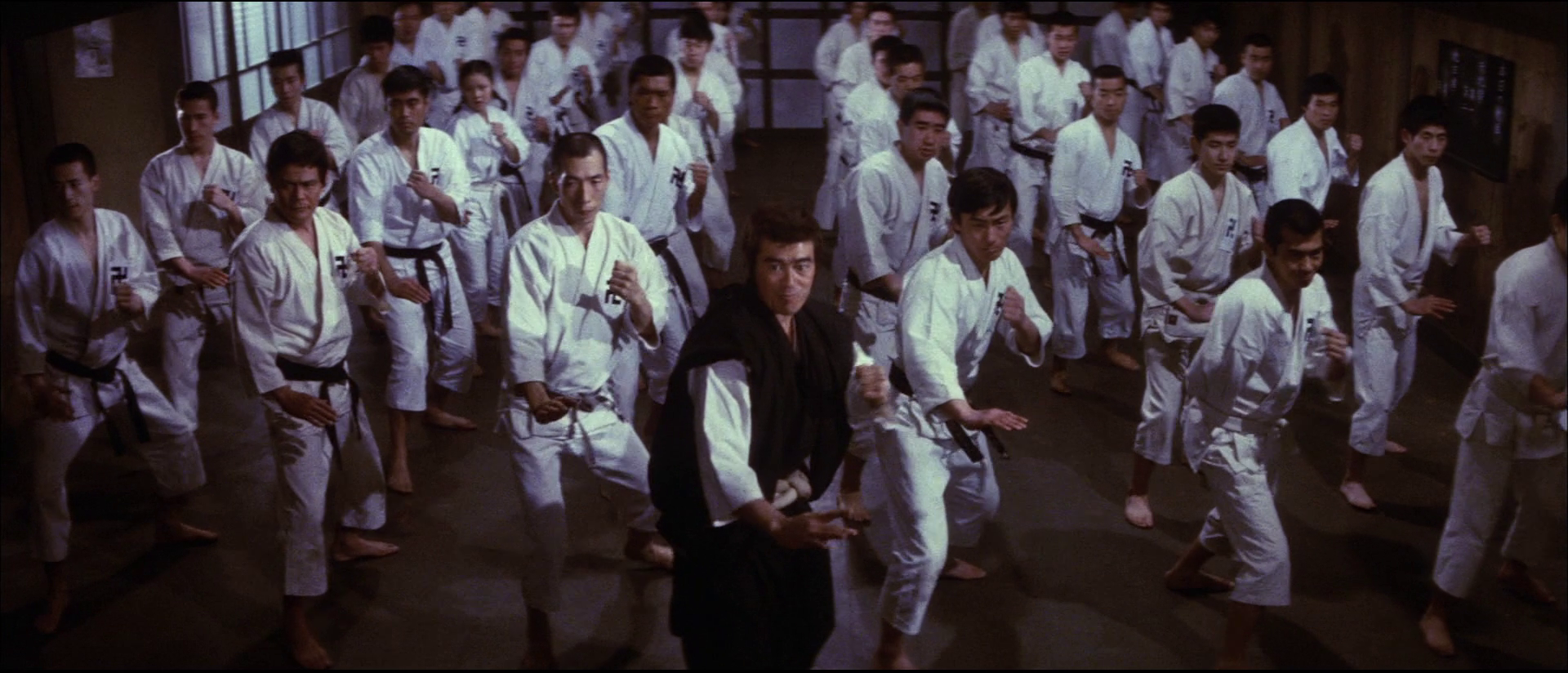
The Killing Machine (少林寺拳法, Norifumi Suzuki, 1975)

“As long as somebody like you is around, there’s hope for Japan,” an oddly sympathetic prison warden says to the last patriot standing in post-war Osaka. The title of Norifumi Suzuki’s Sonny Chiba vehicle The Killing Machine (少林寺拳法, Shorinji Kempo) maybe somewhat inappropriate or at least potentially misleading as the film is deliberately constructed as a martial arts parable emphasising the spiritual philosophy of self-improvement and compassion that is inextricable from its practice.

To that extent, the hero, Soh Doushin (Shinichi Chiba), is trying to fight his way out of the miasmas of the immediate post-war era. As may be apparent, Soh has taken a Chinese name, though Soh was apparently his along and belonged to a former samurai family whose nobility has been crushed by militarism. As the film opens, however, he’s a Japanese secret service operative in Manchuria blindsided by the news of Japan’s surrender. Soh is it seems a nationalist and a patriot, but a fairly revisionist one who stands up to the abuses of the Japanese army. He later says that he protested the way that the local Chinese population were often treated and he does indeed raise a fist toward an officer who wants to sell a young Japanese woman to a Chinese soldier in return for a guarantee of their safe passage to a boat heading out of the country. The young woman’s mother protests that she is an innocent virgin, a fact that has some later relevance. Soh refuses to let the officers take her, though evidently separated from her later.

When he meets the young woman again in the bomb-damaged backstreets of Occupation Osaka, she is dressed in Western clothing as opposed to the smart kimono she wore in Manchuria and is about to become a “pan pan” or streetwalking sex worker catering to American servicemen. Of course, Soh can’t let this happen either, but as she later tells him, she was raped by Russian soldiers during the retreat and now feels herself to be despoiled. She never wears kimono again and becomes a kind of symbol for a despoiled nation that Soh is reluctantly forced to accept he cannot save in part because his philosophy, which is still uncomfortably rooted in the philosophy of militarism, only valued strength when it should have valued love. The kind of love that Kiku (Yutaka Nakajima) had for her brother that made her willing to sacrifice herself for his wellbeing. 

Even so, Soh is doing his best to issue a course correction by caring for a small group of war orphans and helping them support themselves by running a rice soup stall so they won’t end up becoming dependent on the yakuza or the black market. It’s the yakuza and their increasingly corporatising nature that become Soh’s chief enemies, though standing right behind them are the Occupation Forces. They are, of course, just the biggest gang, as we can see when one of the kids steals a few tins from the gangster’s crate which is marked with text making it clear it came from the mess hall at the American base. The backstreets are full of sleazy soldiers and pan pans or otherwise the starving and dejected, sometimes violent demobbed soldiers filled with despair. It’s these men that Soh wants to buck up, telling them to rediscover their fighting spirit and giving them the opportunity to do so through learning Shaolin martial arts.

Of course there are those who don’t want to learn Chinese kung fu in the midst of their defeat, but what Soh is advocating is something that has a greater spiritual application even than karate can also have. It’s a kind of humanitarian riposte to the futility of the post-war society that might sometimes fail to recognise the depths of the impossibility faced by many in insisting they can be faced by discipline and moral fortitude but at the same time is not really judgemental except toward those who have deliberately abandoned their humanity, such as the trio of goons who rape a school for amusement (the girl is later seen among the students at Soh’s school along with the children from Osaka). The girl’s father reports it to the police, but the police and the gangsters are in cahoots, so nothing gets done. Soh cuts the guy’s bits off so he won’t be doing that again. Strength without justice is violence, he realises. But justice without strength is inability. Strength and love like body and mind should never be separated. The closing shots show an entire mountain covered in white-clad figures practising Shaolin kung fu and joining the humanitarian revolution rather than the cruel and selfish one represented by the gangsters with their red-light districts and black markets. It may be a simplistic solution, but it is in its way satisfying and at least a rejection both of the militarist past and the capitalistic future.


*Norifumi Suzuki’s name is actually “Noribumi” but he has become known as “Norifumi” to English-speaking audiences.
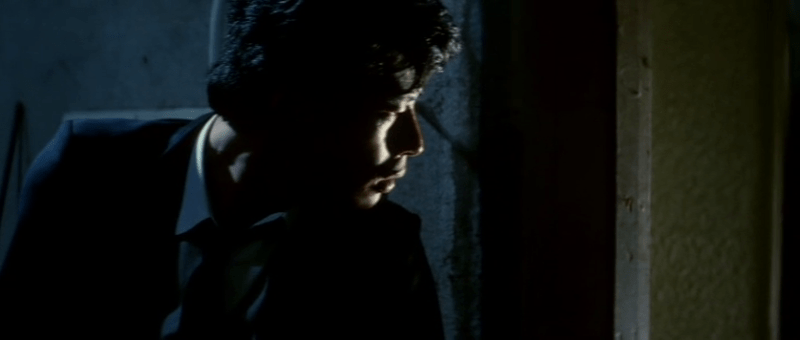
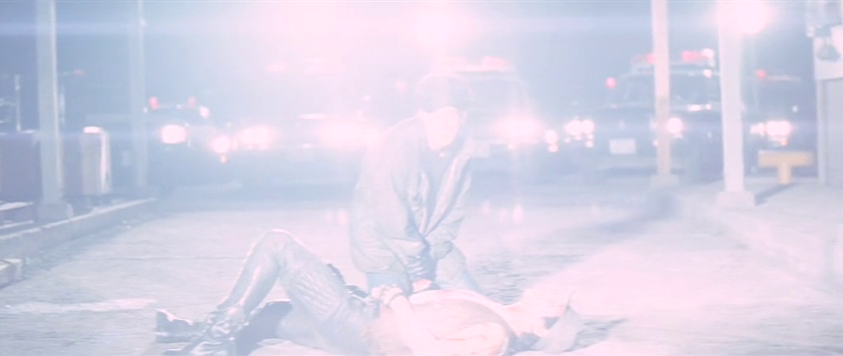
Target (薔薇の標的, Toru Murakawa, 1980)

By 1980 Toru Murakawa was an in-demand director thanks largely to his extremely successful collaborations with late ‘70s icon Yusaku Matsuda. Fresh off the back of the Game series, Toei Central Film hired him to do for their aspiring star Hiroshi Tachi what he’d done for Matsuda with grimy noir Target (薔薇の標的, Bara no Hyoteki). Interestingly enough Target shares its Japanese title with the 1972 drama The Target of Roses, a truly bizarre thriller in which a hitman stumbles on an international nazi conspiracy that was penned by the same screenwriters but is otherwise entirely unconnected with the earlier film and shares no common plot elements whatsoever. 

Set firmly within the contemporary era, the action takes place in Yokohama and is essentially a tale of proto-heroic bloodshed as the hero, Hiroshi (Hiroshi Tachi), seeks vengeance for the death of his best friend, Akira, during a drug deal which is ambushed by a third party who make off with both the drugs and the money killing Akira in the process. Hiroshi goes to prison for four years and then sets about getting some payback on his release by chasing down the Idogaki gang through gunman Yagi who he believes was directly responsible for Akira’s death. 

The plot is perhaps straight out of the Nikkatsu playbook, a little less honour than you’d find in the usual Toei picture though also cynical and nihilistic in keeping with the late ‘70s taste for generalised paranoia. Hiroshi is soon targeted by the Idogaki gang, but is saved by an old prison buddy, Kadota (Ryohei Uchida), who is a little older than he is and to an extent has a noble reason for his life of crime in that he has a son who became disabled after contracting polio and wants to get enough money together to make sure he’ll be alright when he can no longer look after him. Kadota then adds a third a man, Nakao, a former narcotics cop who jokes that he was kicked off the force for rape but according to Kadota was forced out for noble reasons after his attempt to help a friend backfired. The three men team up to turn the tables on Idogaki by ambushing his own drug deal with, in a throwback to ‘60s Sinophobia, gangsters from Shanghai. 

Meanwhile Hiroshi is caught between the life he had before and the contemporary reality in reuniting with his former girlfriend Kyoko (Yutaka Nakajima) who has evidently become the mistress of a wealthy man and is presumably the mysterious benefactor who paid all his legal fees. After a meet cute at a florist he also strikes up a tentative relationship with a wealthy young woman, the daughter of a CEO who plans to move to Mexico. Despite the rising prosperity of Japan in the early ‘80s, pretty much everyone has their sights set on going abroad, Kadota planning to head to Canada after making sure his son is well provided for. Yet Hiroshi is trapped in the Japan of the past, obsessed with vengeance for his friend while torn by his relationship with Kyoko who similarly wants to exit her comfortable yet compromised life to return to a more innocent time at Hiroshi’s side while unbeknownst to him the mistress of high ranking Idogaki boss Hamada. 

What becomes clear is that there is no prospect of escape from contemporary Japan, not even perhaps in death, Hiroshi left alive but dead inside at the film’s conclusion having committed a kind of spiritual suicide born of the dark side of what remained of his honour in seeking vengeance for the death of his friend who had seemingly only participated in the drug deal at Hiroshi’s command in an effort to improve the fortunes of their gang. Once again produced by Toei’s subsidiary Toei Central Film, Target has lower production values than the films Murakawa was making with Matsuda (who has a small yet memorable cameo as a rockstar whose life has been ruined by drugs) with non-synchronised dialogue and a grimy aesthetic which only adds to its sense of fatalistic nihilism otherwise enlivened by Murakawa’s artful composition and atmosphere of moral ruin in which there is no more humanity nor justice. 

Call from Darkness (真夜中の招待状, Yoshitaro Nomura, 1981)

“In today’s society, everyone is warped in some way” according to the investigative psychologist at the centre of Yoshitaro Nomura’s Call From Darkness (真夜中の招待状, Mayonaka no Shotaijo, AKA Midnight Invitation). Adapted from the novel by Shusaku Endo, Nomura’s late career psychological mystery places the dark past at the centre of familial implosion as increasingly estranged brothers find themselves falling victim to the same “curse”, called to destruction by the extreme resentment of one who feels himself wronged both personally and on a familial level. 

The film opens, however, with the heroine, Keiko (Asami Kobayashi), visiting a psychiatrist and visibly perturbed by the strange, twitching figures which surround her in the waiting room. The patient immediately before her is irritated by the psychiatrist’s “childish games”, eventually leaving the room in exasperation with the medical staff who refuse to take his symptoms seriously, convincing him that his pain is all in his mind and his lame leg is merely a manifestation of repressed trauma. Nevertheless, Keiko has not come for herself but for her fiancé, Tamura (Kaoru Kobayashi), who has suffered a nervous breakdown after all three of his brothers mysteriously disappeared leaving him feeling as if he must be next. As Dr. Aizawa (Etsushi Takahashi) points out, disappearances are a matter for the police but he does agree to help treat Tamura’s paranoia in the belief that his family circumstances are a series of unfortunate and improbable coincidences rather than a concerted effort to wipe out his bloodline. 

As it turns out, that is not quite true and Tamura perhaps has reason to worry but then there is no one targeting him, in fact no one very interested in him at all, but still he will be sucked into a vortex of guilt and pain despite having, as it turns out, a different name and minimal connection to those who are his brothers by blood. The youngest of the four boys, Tamura was adopted into another family who had no children of their own at eight years old. His mother had already passed away and after his father too died not long after his adoption he never returned to his ancestral home in Kumamoto and had little contact with either of his brothers besides Kazuo (Tsunehiko Watase) with whom he had remained close and who would often visit him when he came to Tokyo on business. The fact of his brothers’ disappearances does not perhaps concern him emotionally, at least until Kazuo too goes missing, as much as its strangeness threatens his ordinary, conventional life not to mention his engagement to Keiko whose parents do, as expected, urge her to reconsider in light of the dark shadows around Tamura’s family history. 

That’s perhaps one reason Keiko is so keen to delve to the bottom of the mystery, not only to cure Tamura’s depression but to defend her choice of husband and therefore the future direction of her life. Aizawa, meanwhile, proves a strange and slightly dubious guide despite his presentation as a figure of infinite authority. He persuades the pair that the answer lies in dreams, intrigued by a recurring nightmare Kazuo had apparently been having about travelling through tunnels and valleys towards a mysterious castle, a dream that Tamura eventually begins dreaming too. Aizawa and Keiko find themselves making a bizarre visit to a spirit medium, while Aizawa later recommends experimental hypnotherapy treatments, diagnoses based on glanced body language, and describes the oldest brother, Junkichi (Makoto Fujita), as a probable misanthropic sadist based on a series of drawings he made of a man with serious deformities. He later walks back some of these statements as strategy in his quest to help Tamura, but you have to admit that his practice is esoteric to say the least. 

Central to events, the deformed man turns out not to be an invention of Junkichi but a very real “victim” and perhaps symbol of the “warped” society Aizawa alludes to at the film’s conclusion. We learn that the young man suffered from rheumatism and was recommended experimental treatment which led to his deformity and apparently left him brain damaged, unable to look after himself. The mysterious calls the brothers receive late in the night are reminders of the harm they have caused, beckoning them towards a spiritual retribution though there is of course no real way to atone, the young man can never be restored. It’s this sense of dread that leads Aizawa and others to describe what’s happened to the brothers as a “curse” though it’s one largely self-imposed if perhaps precipitated by the intense resentment of the wounded parties which sends itself through the air, and the telephone lines, to convince the brothers they must pay though, in real terms, the young man’s fate is not really their fault only that of the doctors who developed the drug and administered it if, as Aizawa implies, they were aware of what could happen if they went too far. 

Nevertheless, it seems that responsibility must be taken though the extents of that responsibility, rather than the secrecy or the events themselves, eventually corrupt the previously pure and strong relationship between Keiko and Tamura. He wants to end it with money, she is disappointed in his cynical conservatism and lack of compassion. Aizawa meanwhile, believes that the brothers were drawn to death, tired of the business of living and perhaps looking for an exit and an excuse to give in to despair. Nomura slips into painful negative for his explanatory flashbacks, while undercutting a sense of reality through the dissolves and superimpositions of his ethereal dream sequences, but finally returns us to the “warped” society of the present day as the survivors look for new ways of living with a newfound darkness. 


The Killing Game (殺人遊戯, Toru Murakawa, 1978)

the killing gameFollowing the success of The Most Dangerous Game, the second in what was to become a trilogy arrived within the year and once again stars Matsuda as the ice cold hitman Narumi. Sunnier in outlook, The Killing Game (殺人遊戯, Satsujin Jiken) unfolds along the same pattern as the first instalment as Narumi is dragged out of the shadows to intercede in a gang war only to find himself surplus to requirements.

Narumi (Yusaku Matsuda) has been retired from the killing game for the last five years and now lives a life of poverty and dissipation. Gone are his swanky apartment and stylish suits, now he lives in a bare hovel which is covered in dust and cobwebs, and he dresses like a farm boy in a white vest and jeans with a straw hat hanging on his back. He’s trying to lie low, but gets pulled into the kind of hostess bar he can’t really afford where he meets the first of two familiar faces which threaten to send him back into the middle of chaos. Akiko (Kaori Takeda), now a hostess at Bar Tako, is the daughter of the chairman Narumi bumped off in his last job before retiring but far from bearing a grudge against him, Akiko is grateful to have been set free. The second familiar face belongs to the same chairman’s former secretary/mistress, Misako (Yutaka Nakajima), who is now a mama-san at a bar popular with the local goons. All those years ago Narumi let Misako go in a moment of weakness and now regrets it but attempting to “reconnect” is going to land him right back in the thick of things.

Murakawa begins with a prologue which takes place in the noirish urban darkness of The Most Dangerous Game, but shoots in dreamy soft focus to emphasise that this is all memory before jumping forward five years. Exactly why Narumi has decided to give up a career in assassination is not revealed, nor is what he’s been doing the last five years, but he has apparently got himself an annoying sidekick who, in contrast to Narumi’s intense reserve, does not shut up. The first half of the movie is Narumi and his buddy trying to get by as outlaws including one humorous skit where they get themselves a van with a nudie pinup on the front plus a loudspeaker to humiliate debtors into paying up.

Things take a darker turn when Narumi runs into Misako – a chance meeting that seems almost like fate. Gradually the old Narumi begins to reappear. Deciding to pay Misako a visit he runs into her new man, gang boss Katsuda (Kei Sato), who figures out who he is and wants him to bump off another old gang boss. Narumi needs to get back in shape which he does via the tried and tested method of a training montage, lifting weights and running through the town with his trademark perm returning to its stylish buoyancy. This time around Narumi has buddy to help out, even if he only ends up being a liability, but the same strange dichotomy occurs – he may be an ace hitman, but Narumi is a mess without a gun in his hand.

Perhaps weathered by his experiences, Narumi is also much less cocky and much more unwilling to take a chance on trust. Once again he is betrayed by clients who’d rather not pay up and forced to play a “dangerous game” to bring the whole saga to a close in such a way as to keep both his life and the money. Rather than the surprising and largely inexplicable devotion of Dangerous’ Kyoko, Narumi finds himself torn between two women – the youthful Akiko who is grateful to Narumi for releasing her from an overbearing father, and the jaded Misako whose feelings for Narumi are complex, mingling fear, gratitude, attraction, and resentment into an irresistible storm of ambivalence. Again Narumi’s cool, animalistic aggression seems to be the key to his mysterious sex appeal but this time around there are no flickers of response as there were for the devoted Kyoko, these “relationships” are opportunistic and transactional.

Ironically titled, The Killing Game makes plain that Narumi will never be able to escape his chosen profession even if he wanted to. Without a gun in his hand Narumi is a pathetic wastrel, playing around at tuppenny schemes with his rather dim but talkative friend, and trying to play the big shot by buying out a hostess bar he is entirely unable to afford despite his recent windfall. The setting may be brighter, but Narumi’s word is still a nihilistic one in which he’s conditioned to expect betrayal and the only remaining vestiges of his humanity are his strange friendship with his bumbling sidekick and his ongoing fecklessness at coping with everyday life. Matsuda is as cool as ever in his effortless ability to cope with any given situation and kill with ruthless efficiency, but as Narumi edges ever closer to machine it is clear there is only one way to beat The Killing Game.


Original trailer (no subtitles)

https://www.youtube.com/watch?v=-fjYrwzafxw

Resurrection of Golden Wolf (蘇る金狼, Toru Murakawa, 1979)

resurrection-golden-wolfYou know how it is. You work hard, make sacrifices and expect the system to reward you with advancement. The system, however, has its biases and none of them are in your favour. Watching the less well equipped leapfrog ahead by virtue of their privileges, it’s difficult not to lose heart. Asakura (Yusaku Matsuda), the (anti) hero of Toru Murakawa’s Resurrection of Golden Wolf (蘇る金狼, Yomigaeru Kinro), has had about all he can take of the dead end accountancy job he’s supposedly lucky to have despite his high school level education (even if it is topped up with night school qualifications). Resentful at the way the odds are always stacked against him, Asakura decides to take his revenge but quickly finds himself becoming embroiled in a series of ongoing corporate scandals.

Orchestrating a perfectly planned robbery on his own firm in which Asakura deprives his employers of a large amount money, he’s feeling kind of smug only to realise that the bank had a backup plan. The serial numbers of all of the missing money have been recorded meaning he can’t risk spending any of it. Accordingly he decides the “safest” thing to do is exchange the problematic currency for the equivalent in heroine. His plan doesn’t stop there, however. He also knows the big wigs at the top are engaged in a high level embezzlement scam and seduces his boss’ mistress, Kyoko (Jun Fubuki), for the inside track. Asakura is not the only game in town as another detective, Sakurai (Sonny Chiba), is blackmailing some of the other bosses over their extra-marital activities. Playing both sides off against each other, Asakura thinks he has the upper hand but just as he thinks he’s got what he wanted, he discovers perhaps there was something else he wanted more and it won’t wait for him any longer.

Based on a novel by hardboiled author Haruhiko Oyabu, Resurrection of Golden Wolf is another action vehicle for Matsuda at the height of his stardom. Re-teaming with Murakawa with whom he’d worked on some of his most famous roles including The Most Dangerous Game series, Matsuda begins to look beyond the tough guy in this socially conscious noir in which an angry young man rails against the system intent on penning him in. A mastermind genius, Asakura is leading a double life as a mild mannered accountancy clerk by day and violent punk by night, but he has every right to be angry. If his early speech to a colleague is to be believed, Asakura worked hard to get this job. A high school graduate with night school accreditation, he’s done well for himself, but despite his friend’s assurance that Asaukura is ahead in the promotion stakes he knows there’s a ceiling for someone with his background no matter how hard he works or how bright he is.

Under the terrible wig and unfashionable glasses he adopts for his work persona, Asakura has a mass of unruly, rebellious hair and a steely gaze hellbent on revenge against the hierarchical class system. He is not a good guy. Asakura’s tactics range from fisticuffs with street punks to molesting bar hostesses, date rape, and getting his (almost) girlfriend hooked on drugs as a means of control, not to mention the original cold blooded murder of the courier he stole the company’s money from in the first place. The fact he emerges as “hero” at all is only down to his refusal to accept the status quo and by his constant ability to stay one step ahead of everyone else. When the system itself is this corrupt, Asakura’s punkish rebellion begins to look attractive despite the unpleasantness of his actions.

Adding in surreal sequences where Asakura dances around his lair-like apartment in a quasi-religious ritual with his silver mask, plus bizarre editing choices, eerie music and incongruous flamenco, Murakawa’s neo-noir world is an increasingly odd one, even if not quite on the level of his next film, The Beast Must Die. Very much of its time and remaining within the upscale exploitation world, Resurrection of Golden Wolf is necessarily misogynistic as its female cast become merely pawns exchanged between men to express their own status. The tone remains hopelessly nihilistic as Asakura nears his goal of the appearance of a stereotypically successful life with an executive job and possible marriage to the boss’ daughter only to find his conviction wavering. Hopelessly bleak, dark, and sleazy, Resurrection of Golden Wolf is, nevertheless, a supreme exercise in style marrying Matsuda’s iconic image with innovative direction which is hard to beat even whilst swimming in some very murky waters.


Again, many variations on the English title but I’ve gone with Resurrection of Golden Wolf as that’s the one that appears on Kadokawa’s release of the 4K remaster blu-ray (Japanese subs only).

Original trailer (English subtitles)

https://www.youtube.com/watch?v=75mO5ysfwAc