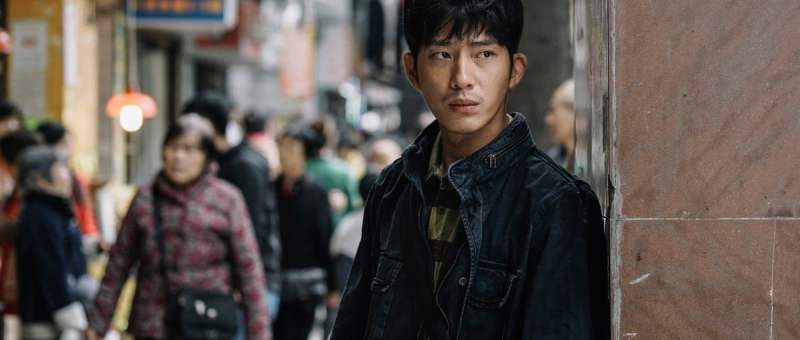
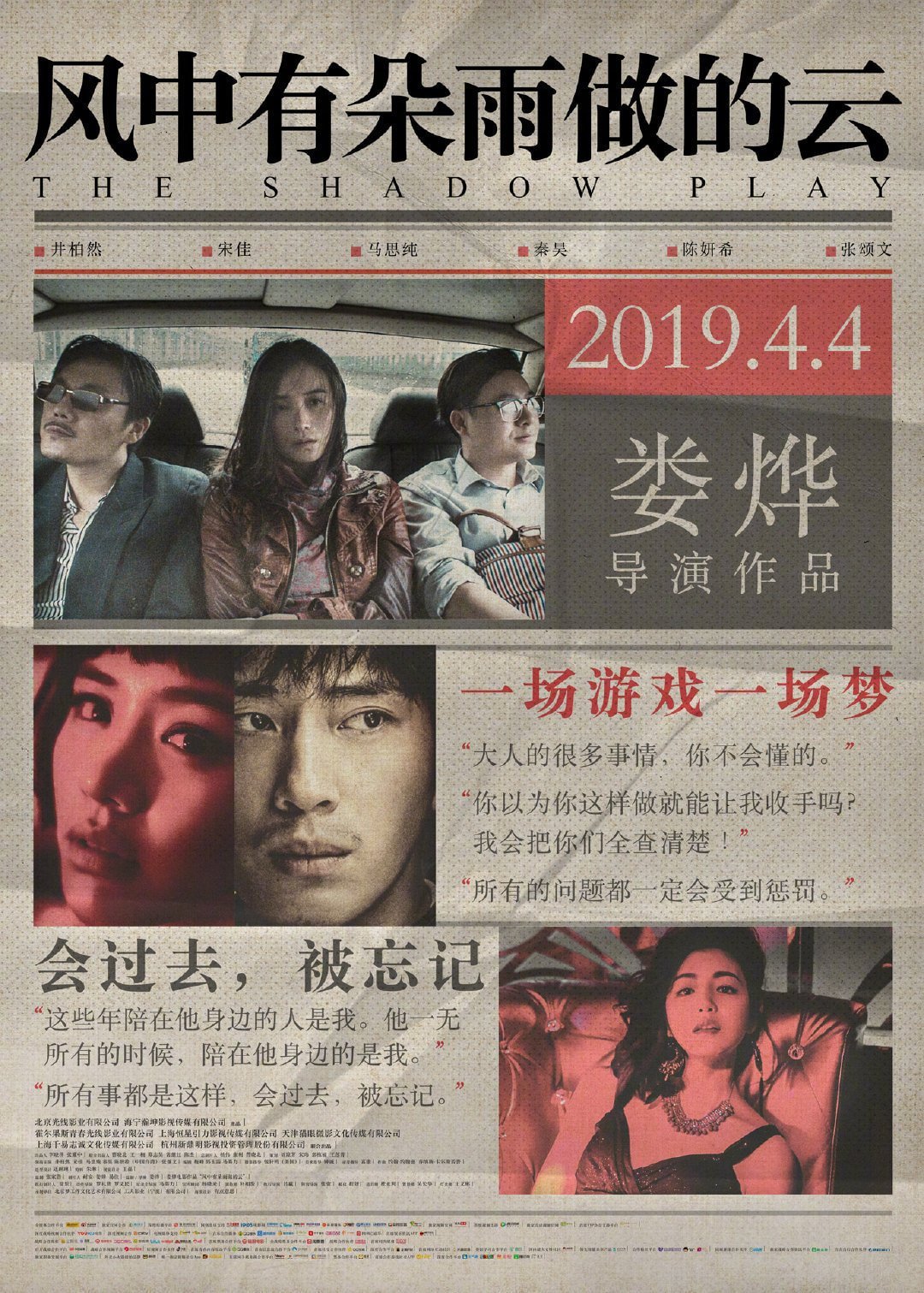
The Shadow Play (风中有朵雨做的云, Lou Ye, 2018)

The forever rebellious Lou Ye has had his share of troubles with the Chinese censors board. Suzhou River was banned on its release, while he received a five-year filmmaking sanction for screening his provocative Tiananmen Square drama Summer Palace in Cannes without clearing official permission first. Stuck in censorship limbo for two years, the aptly named The Shadow Play (风中有朵雨做的云, fēng zhōng yǒu yù zuò de yún), taking its title from characteristically well-placed retro pop song, sees Lou steeping into the increasingly popular genre of Sino-Noir once again critiquing the the corrosive corruption of the Modern China through the prism of crime. 

Many of Lou’s films pivot narrative around a single implosion from which everything radiates like cracks in a pane of shattered glass. The Shadow Play is no different only there are perhaps three distinct, interlinked points of fracture each connected in a complex web of corruption and frustrated desires. He opens therefore with a moment which occurs in the mid-point of the narrative, the accidental discovery of decomposing body by a young couple venturing into the wilds of nature for a little privacy. The action then moves to the “contemporary” present of 2012 in which a small village is engulfed by “rioting” as residents attempt to protest the demolition of their community by the Violet Gold Real Estate Company. CEO Tang (Zhang Songwen) turns up to do some ineffectual damage control, slipping into Cantonese as he reminds them he’s a local boy too and only wants to bring about “the transformation of our community” insisting that the “beautiful future” is possible only by tearing down the old. As he’s speaking, however, protestors manage to knock down the neon sign bearing his company’s name from the building behind him and later that night Tang himself is found dead, impaled its framework after apparently “falling” from the rooftop. 

Young and idealistic policeman Yang (Jing Boran) was assigned to the detail that night and thereafter to the investigation into Tang’s death, quickly growing suspicious over his ties to shady property tycoon Jiang (Qin Hao). As a brief montage sequence explains, Tang and Jiang who met at university in 1989 each prospered from the capitalist explosion of China’s ‘90s reforms but their complicated relationship is founded on resentment and dependency partly connected to their mutual love for campus sweetheart Lin Hui (Song Jia) who first dated Jiang but as he was apparently already attached later married Tang. Many suspect that Jiang has something to do with Tang’s death even as others point out that he needed him to preserve his access to government bureaucracy, but the investigation is further complicated by witness sightings of a third person thought to be Jiang’s Taiwanese former lover/business partner Ah-yun whose mysterious disappearance in 2006 Yang is convinced is connected to the traffic accident which left his veteran policeman father in a catatonic state. 

The Shadow Play is in some respects unusual in its strong yet often implicit hints of police corruption perhaps mitigating its mild attack on the mechanisms of state through Yang’s idealistic, though flawed, goodness. Seduced by the lonely Lin Hui, he finds his name blackened but refuses to give in even when forced on the run after being framed for murder. Like Lin Hui’s daughter Ruo (Ma Sichun) however he is also representative of the post-90s generation who have grown up in the world created by men like Jiang and Tang. He is obviously uncomfortable in being introduced as his father’s son but also carries with him a desire for justice that lies adjacent to revenge. Ruo, meanwhile, though now an adult, longs for the restoration of her family despising her father Tang while obviously close to Jiang who has been supporting her financially by funding her education, using his wealth to game the system. “She’ll be happier than we are,” Jiang insists, ironically echoing Tang’s insistence that the village must be destroyed so they can give their children better futures. 

Tang meanwhile is a representative of China’s resentful petty bureaucrats forced into a middle-man existence unwilling to admit that he owes everything to Jiang, the man he knows to be sleeping with his wife. His toxic sense of male inferiority sees him take out his frustrations those with the least power, subjecting Lin Hui to years of domestic abuse before eventually having her locked up in a psychiatric institution claiming that she self-harms and is mentally unbalanced. The facade of the elegant, prosperous middle class family is well and truly imploded while it becomes difficult to tell if Tang is just a sleaze, exposing his misogyny in bringing up Ah-yun’s bar girl past, or his ill-advised pass at her is an attempt to get back at Jiang for his relationship with his wife while undercutting his rival’s manhood by sleeping with his woman. There is widespread impropriety in this incestuous world of corporate politics, but there’s also personal pettiness, hurt, and heartbreak that eventually blossoms into an ugly violence. 

In characteristic non-linear fashion Lou zips between the three points of fracture from the trio’s meeting in a 1989 through the disappearance of Ah-yun and the death of Tang, the layers of corruption deepening as the two men make themselves rich taking advantage of the unregulated capitalism of the modern China while slowly destroying themselves in their mutual unhappiness. It’s no surprise that the film found itself on the wrong side of the censors with its brutal footage of anti-redevelopment riots, hints of political corruption, and the depiction of the destruction of a body though we get the now customary title cards appearing at the end reminding us that the guilty parties have been caught and punished outlining exactly how long for everyone went to jail even if Lou subtly undercuts the sense of the State in action the card is intended to portray. Elliptical and somehow hard, ending like Summer Palace on the innocent image of the trio dancing back in 1989, The Shadow Play is cutting indictment of a morally bankrupt society and the corrosive effects of corruption but perhaps implying that the younger generation will in one way or another have its revenge for the ravages of their parents’ greed. 


Original trailer (no subtitles)
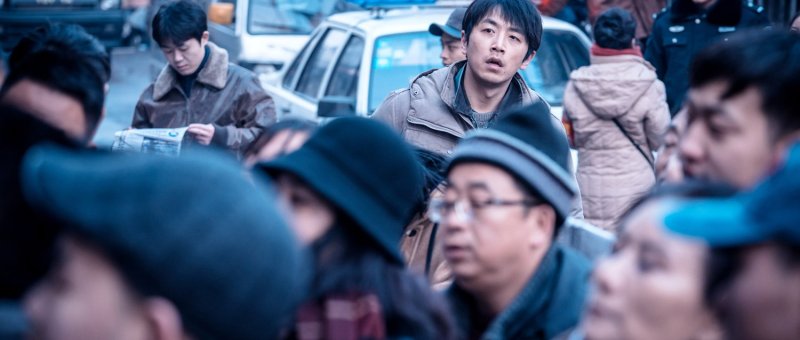
The Best is Yet to Come (不止不休, Wang Jing, 2020)

A man denied a fair chance in life because of his impoverished background comes to identify with the plight of those carrying the hepatitis B virus in Wang Jing’s true life drama, The Best is Yet to Come (不止不休, bùzhǐ bùxiū). Inspired by the story of Han Fudong, a journalist who exposed the societal prejudice against those with a previous diagnosis of the disease, the film’s Chinese title “no pause no rest” makes clear how tirelessly he strived to reveal the truth even at the potential cost of destroying his dream of becoming a professional reporter. 

Han Dong (Bai-Ke) came to Beijing in 2003 in the hope of landing a job at a paper, but just like everywhere else journalism is a largely closed profession almost impossible to break into without elite qualifications and connections. At a jobs fair, Han Dong tries to pass off his reluctance to hand over a CV as a recruitment tactic to get people to remember him, circulating copies of his portfolio instead though recruiters quickly lose interest on realising they are all self-published articles posted online. Once he admits that he only finished middle school, it’s game over no matter how talented a writer and investigator he may turn out to be. 

It’s this sense of unfairness, of being turned away on the grounds of a few words on a piece of paper that eventually leads him to sympathise with those carrying the hepatitis B virus after investigating a company that claims it buys blood, discovering that they provide a service helping people to forge health certificates for job and school applications. Vox pop-style interviews recreated in the manner of the time feature several people describing the various ways their lives have been ruined simply because they happen to carry the virus, many of them infected since birth or early childhood. One man has been trying to apply for jobs and graduate schools for several years but finds the offers are always withdrawn after the health screening, while another woman recounts that her fiancé cancelled their engagement because his family could not accept someone with hepatitis B. 

This is also in the immediate aftermath of the SARS epidemic which perhaps caused a preoccupation with infectious disease which may be largely unfounded in the relative difficulty of passing on the hepatitis B virus. After landing a golden opportunity of an unpaid internship compensated only with 50% article fees, Han Dong finds himself conflicted. He knows the forgery operation is illegal and a threat to public health, but also cannot blame the people who make use of it when their lives have been rendered so impossible that is difficult for them simply to live. An early assignment had seen him cover a mine collapse and witness a destraught mother bounced into accepting compensation for her son’s death while shouted at by the foreman (played by film director Jia Zhangke who also produced) for having the temerity to ask to see his body. Han Dong got a front-page byline as co-author with his mentor figure, Huang (Zhang Songwen), but wonders what the point is if nothing ever changes and the truth is not enough on its own. 

For obvious reasons, films about crusading journalists are rare in Chinese cinema given that whistleblowing is not regarded as a virtue and those who try to expose wrongdoing are often shouted down or hounded into silence as seen with the doctor who drew attention to the poor medical practices in rural blood clinics that caused an HIV epidemic in farming communities, and most recently with the physician who tried to raise awareness of the new respiratory illness that later developed into a global pandemic. Journalists who report problematic stories can also find themselves facing prosecution and imprisonment. Han Fudong’s writings did however lead to an eventual change in the law and the destigmatisation of hepatitis B while he himself overcame the educational elitism of the contemporary society to achieve his dreams of becoming a professional reporter. As such, Wang’s dramatisation of his life may be in a way subversive if subtly so in hinting at a greater role for a currently not so free press in the modern China while also embracing a central philosophy that one need not simply accept an unacceptable status quo but actively reject and challenge it and that by doing so something might actually change. 


The Best is Yet to Come screens in Chicago Sept. 30 as part of the 17th season of Asian Pop-Up Cinema 

International trailer (English subtitles)

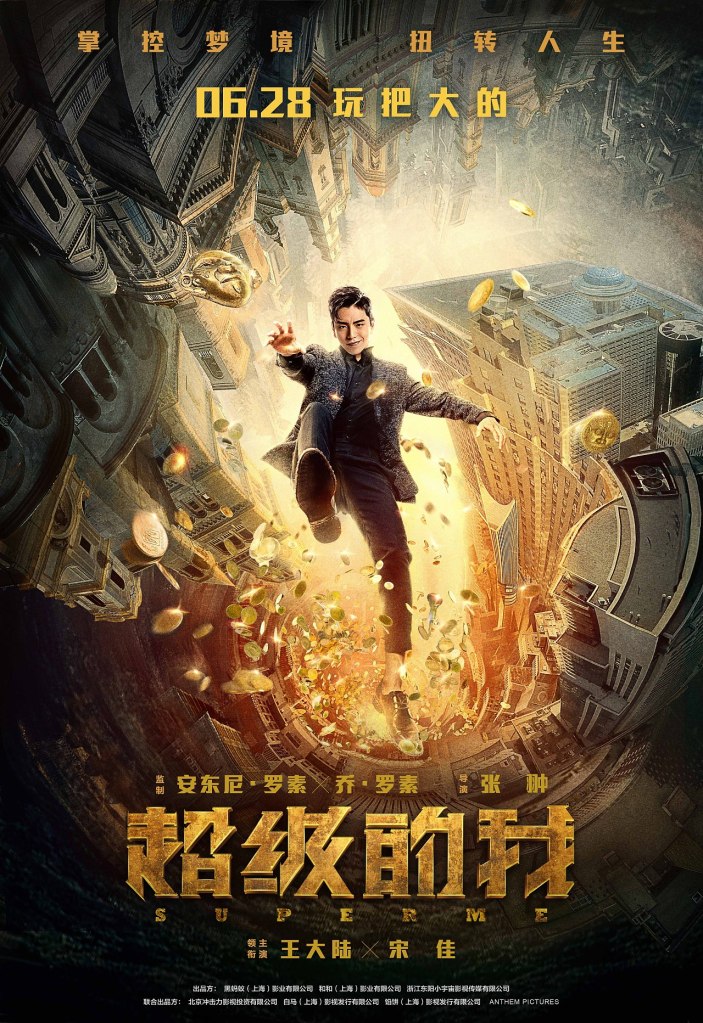
Super Me (超级的我, Zhang Chong, 2019)

Can you dream yourself into a better reality, or should you concentrate on being your best self in this one? That’s a dilemma that the hero of Zhang Chong’s Super Me (超级的我, Chāojí de Wǒ) barely has time to think about as he battles despair-fuelled hopelessness and possibly unrequited love for the beautiful woman who runs his local cafe. If only I were rich, he might well think, but though poverty is undoubtedly a factor in his malaise it’s his sense of inferiority which has him beaten down and all the money in the world won’t change that. 

We first meet Sang Yu (Darren Wang Talu) on a subway train where he recites a mantra to himself about how he’s “not an ordinary man”, he has the ability to work under pressure, and though his parents died and he has no friends those are merely tests from God which he has overcome. He is “brilliant and talented, diligent and motivated”, he expects success will soon arrive only he hasn’t slept a wink in the last six months because of the constant night terrors which plague him such as the one we’re about to witness. Sang Yu is asleep, and a nightmare is stalking him. 

Killed by having his head plunged through the train’s floor, Sang Yu wakes up and we realise his waking life is also quite depressing. A 20-something screenwriter, he’s behind on his rent and in debt to his friend/agent while unable to work because of his insomnia. Wandering around in a daze after being evicted from his apartment and getting his laptop stolen, he writes a note to his friend telling him he’ll have to pay him back in the next life and prepares to jump off the roof opposite the cafe where his true love, Hua (Song Jia), works, only to be saved by the intervention of the jian bing seller (Chin Shih-chieh) from down below who advises him to try waking up from his dreams before he gets killed by reminding himself that he is dreaming. Sang Yu takes him at his word and manages to emerge from the dreamworld unscathed clutching the weapon that once belonged to his attacker. After selling the antique sword to weapons brokers, he realises he’s sitting on a cash cow, routinely looting the dreamworld of many of its treasures and quickly harnessing its power to become a wealthy and successful man. All of which gives him the courage to finally approach Hua, wielding his newfound economic power to invest in the apparently failing cafe. 

A modern day take on Jack and the Beanstalk, Super Me finds its nice guy hero corrupted by his wealth, abandoning his artistic dreams and becoming a debauched playboy living in a five star hotel even if he continues to pine for Hua while his friend, Sangge (Cao Bingkun), reverts to being something like a minion riding on his coattails to enjoy the life of the rich and famous without really having to do anything. The irony is that the money and the fancy clothes give Sang Yu the confidence to talk to Hua, but those aren’t things she particularly cares about and may in a sense actually turn her off. Enjoying romantic evening walks, she guesses he’s a screenwriter from his veiled hints about robbing the dreamworld and is interested more in his artistic self than the wealthy man of mystery, all of which gives Sang Yu the inspiration to finish that screenplay which of course becomes a hit beyond his wildest dreams. 

After a while, Sang Yu starts to suspect there must be a cost involved in all this good fortune, realising that he’s traded some of his life away in return for riches and will perhaps never be free of his nightmares. Yet, as a cruel gangster tells him, everyone’s wealth comes at the sacrifice of life, echoing his earlier thoughts that those who are successful are either those who’ve chosen to sacrifice things that others won’t or are unscrupulous thieves and exploiters. “A person who betrays himself can never control his own destiny”, according to the gangster. Asleep or awake, Sang Yu realises he’s battling himself, that there are no quick fixes, and illusionary success is as hollow and as fleeting as the dreamworld from which he has perhaps failed to learn the appropriate lessons. As the old man told him, perhaps what he needs is to wake up, not only to life’s possibilities but to his own. Echoing his earlier The Fourth Wall, Zhang allows Sang Yu to walk through a door into a “better” reality which is perhaps the one he inhabited before but was too intimidated to actually live in. He hasn’t definitively beaten his demons, but perhaps subdued them while his new life seems determined to reward him for his choice in unexpected ways. Nevertheless, can you trust this reality more than any other? There may be no way to know, but you’ll have to learn to trust it all the same. 


Super Me is represented by Fortissimo Films.

Original trailer (no subtitles)
An Inspector Calls (浮華宴, Raymond Wong & Herman Yau, 2015)

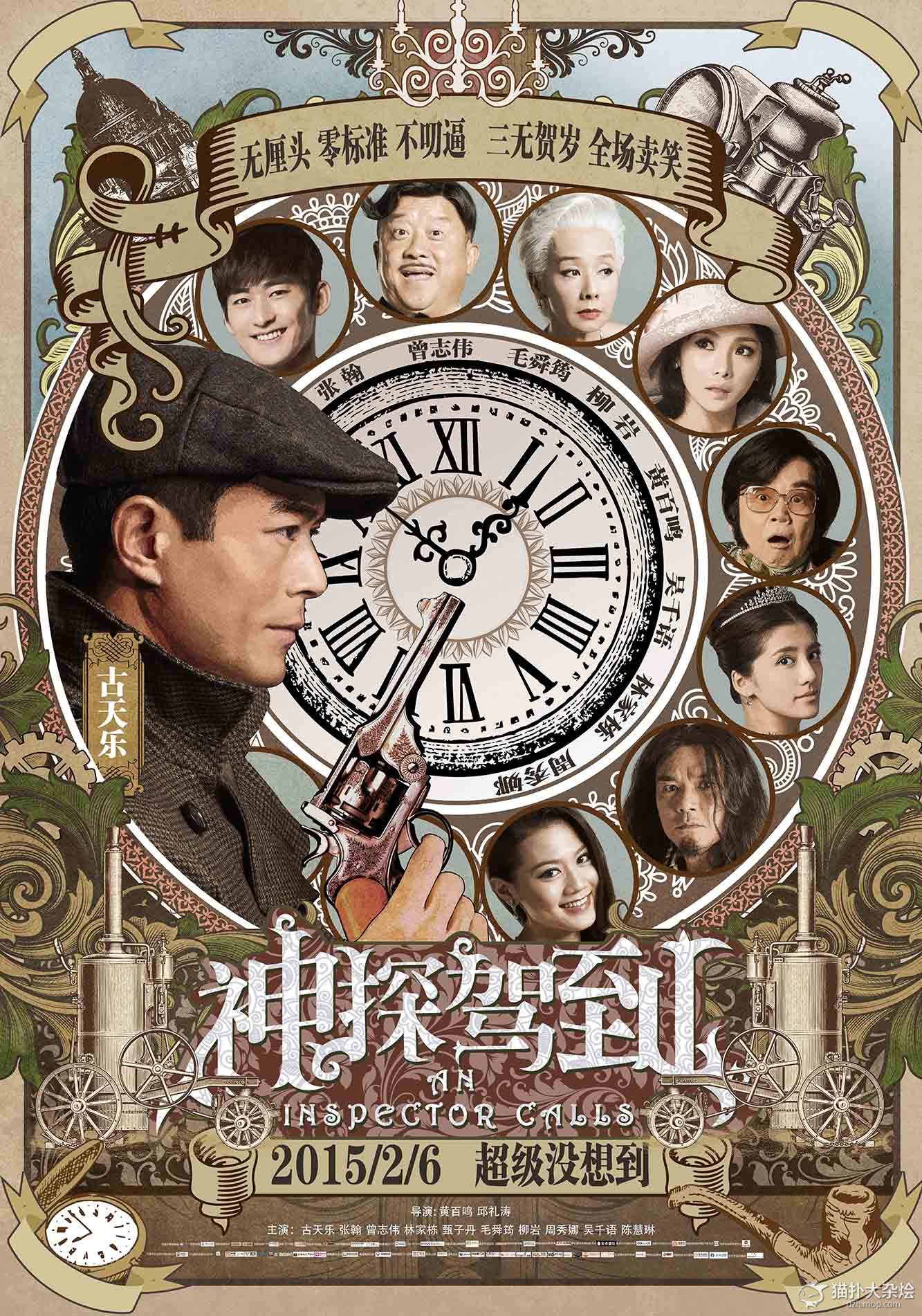
Inspector Calls poster 1J.B. Priestley’s An Inspector Calls found itself out of favour until a phenomenally successful stage production brought it back into the national consciousness in the early ‘90s, but even if some decry its inherent melodrama as a relic of another era the play’s comments on the entrenched classism of British society sadly still ring true. An Inspector Calls is many things, but one thing it defiantly is not is funny – a series of concentric tales of betrayals and oppressions, Priestley’s drama lays bare the callousness with which the privileged bolster their position through the story of one faceless factory girl standing in for an entire social class whose lives are often at the mercy of those “above” them.

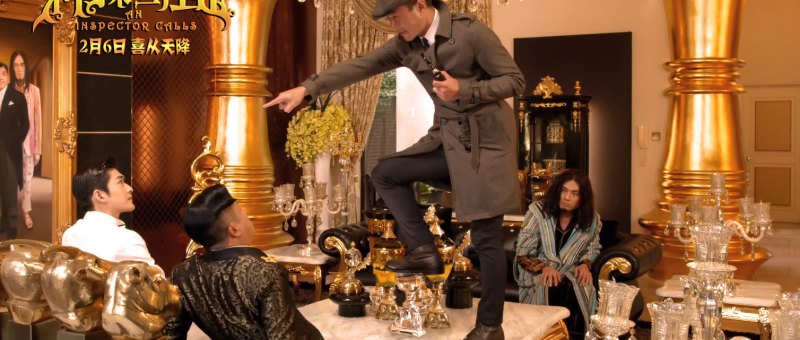
In adapting Priestley’s play as a Chinese New Year movie (a strange concept in itself), Herman Yau and Raymond Wong relocate to contemporary Hong Kong, re-conceiving it as a broad comedy of the kind one might expect for the festive period. The setup is however still the same. The Kau family will be receiving a visitation – this time from Inspector Karl (Louis Koo Tin-lok) who has some difficult news for each of them. Three hours previously, a young woman committed suicide in her apartment by drinking bleach, taking the child she was carrying with her. Inspector Karl views this as a double murder and, based on the diary they found at the crime scene, has brought the reckoning over to the Kaus’.

The Kaus, at the present time, are preparing an engagement party for daughter Sherry (Karena Ng) who will be marrying the handsome younger brother of a factory owner, Johnnie (Hans Zhang Han). What no one can know is that the family business is going under, the Kaus are broke, mum and dad don’t get on, and all of this finery is merely rented affectation. The only member of the family who still seems to have something like a social conscience – Tim (Gordon Lam Ka-tung), the 27-year-old younger son, is viewed by all as a feckless and naive hippy, hiding out in his childhood bedroom, still all fluffy cushions and toy soldiers.

As the Inspector explains, he holds Mr Kau (Eric Tsang Chi-wai) responsible because the woman once worked in his factory and he fired her for participating in a strike for better pay and conditions. Sherry got her fired too when she worked in an upscale fashion store. Johnnie knew her during an unfortunate period as a bar hostess, and Tim as a masseuse. Mrs Kau (Teresa Mo Shun-kwan), who heads up a woman’s charity and publicly espouses tolerance while privately judgmental, once turned her down for familial support seeing as the father of her child was still living. She advises holding him to account and if he won’t pay, forcing his family to take responsibility on his behalf. The irony being that the father is likely her own son and that if this poor woman had rocked up at the Kaus’ with a sad story and an infant in her arms, she would have been met with nothing more than contempt save perhaps some hush money to send her on her way.

The Kaus are merely a series of examples of the various ways the wealthy mistreat the poor, wielding their sense of entitlement like a weapon. Yau and Wong adopt an oddly Brechtian approach in their expressionist production design with the faceless masses identified only through titles – the word “labour” on the workers’ caps, “manager” in the fashion store, “secretary” at the foundation. None of these people are really worthy of names because they will always be “less” while the Kaus are “more” in more ways than one. Actions, however, have consequences. The family console themselves that this is all far too coincidental, that they couldn’t all have known the “same” woman in different guises, but that in many ways is the point – she isn’t one woman but all women, used, abused, and discarded not only by heartless men but by jealous and judgemental members of her own sex too. Better than her than me, they might say, but that’s no way to run a healthy society as the sensitive, slightly damaged Tim seems to see.

Like the Birlings, the Kaus attempt to brush the Inspector’s warning off, thinking it’s all been some elaborate prank that can they laugh about and then forget, but there will be a reckoning even if they attempt to gloss over the various revelations regarding their moral failings. Wong and Yau’s vague gesturing towards the outlandish greed of the hypocritical super wealthy is undercut by the ridiculous New Year slapstick of it all despite the Metropolis-like production design and expressionist trappings, giving in to an excess of its own in an extremely unexpected musical cameo from a martial arts star and the decision to end on a social realist photo of an innocent, pigtailed proletarian woman dressed in red. Nevertheless, strange as it all is the bizarre adaptation of Priestley’s play has its own peculiar charm even if it’s outrageousness rather than moral outrage which takes centre stage.


Currently available to stream online via Netflix in the UK and possibly other territories.

Original trailer (English / Traditional Chinese subtitles)

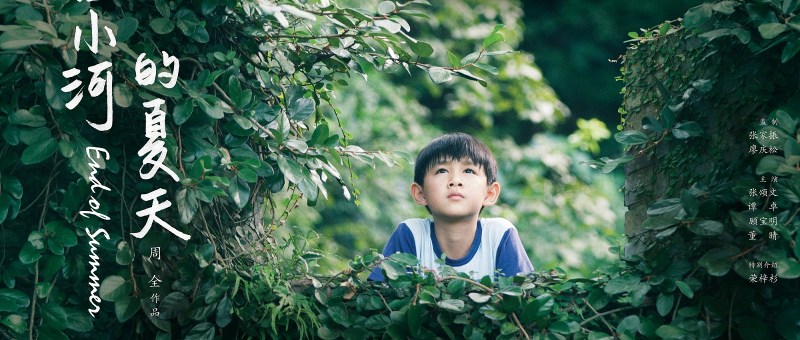
End of Summer (西小河的夏天, Zhou Quan, 2017)

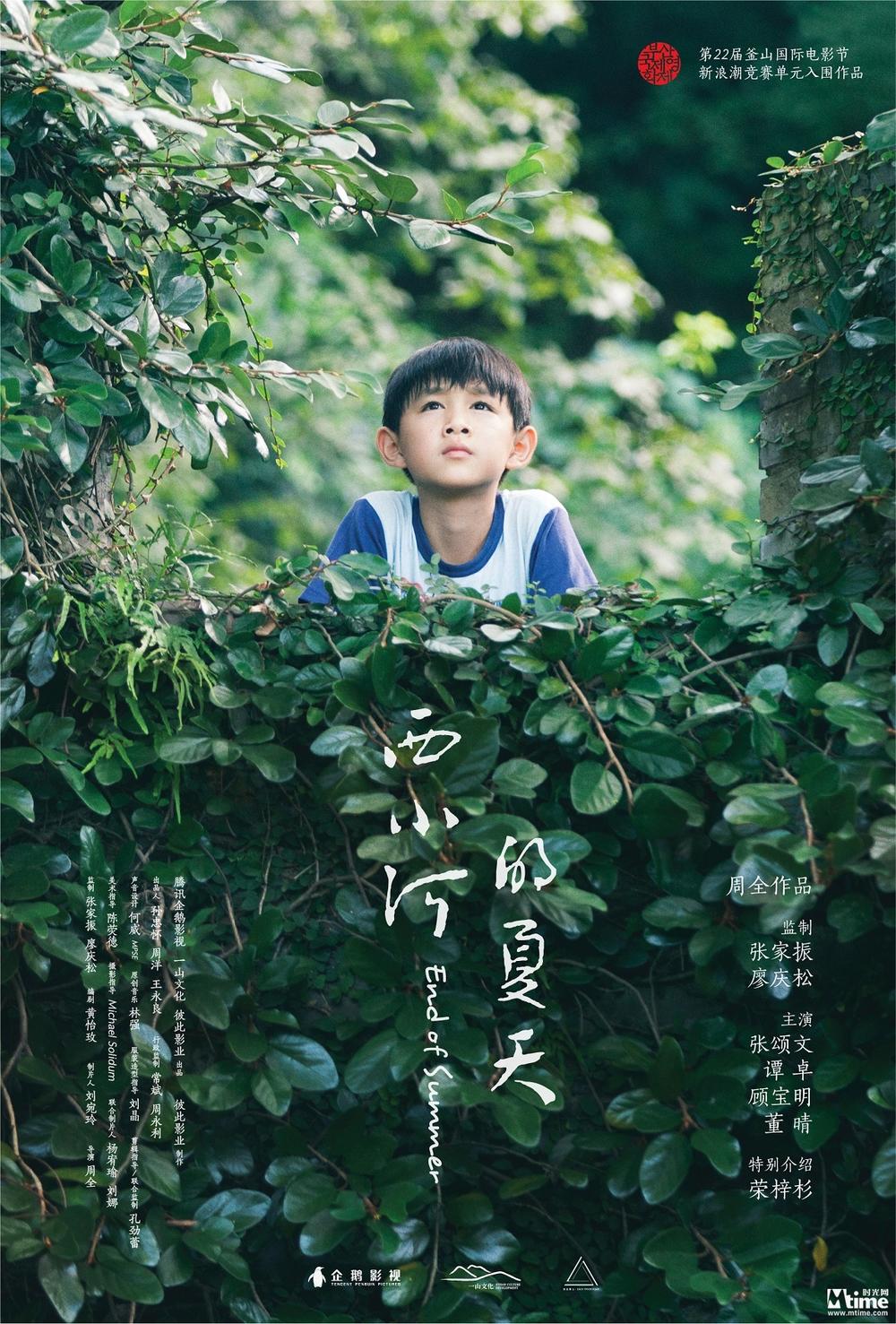
The End of Summer posterMany things were changing in late ‘90s China. For one little boy in the summer of 1998, however, nothing much mattered beyond the World Cup which was being broadcast in its entirety for the very first time. Part nostalgia fest for a more innocent world, Zhou Quan’s End of Summer (西小河的夏天, Xī Xiǎo de Xiàtiān) is, as the title implies, a story of befores as its various protagonists attempt to resolve a series of personal crises that will lead to great changes preceding the autumn of 1998.

Football obsessed little boy Xiaoyang (Rong Zishan) has to keep his love a secret because his dad, Jianhua (Zhang Songwen), thinks all sports are frivolous and has forbidden his son to play with the other children. Jianhua is also a high ranking teacher at Xiaoyang’s school and demands high levels of discipline and commitment from his family, even forcing Xiaoyang to dob one of his friends in under heavy questioning about a playground fight. Bored and lonely at home, Xiaoyang has begun to bond with an older man at their courtyard who also loves football and has promised to help Xiaoyang train for the upcoming school tryouts next term if only he can persuade his dad to sign the consent form.

Meanwhile, there’s trouble brewing on the home front. Xiaoyang’s mother Huifang (Tan Zhuo) is a successful Peking Opera performer whose career is skyrocketing now that she’s been nominated for a prestigious award. Jianhua has also been earmarked for a promotion at work and is covering for a sick colleague, but the arrival of a new teacher threatens to dangerously unbalance the carefully won equilibrium of the Gu family.

Miss Shen (Dong Qing) is indeed a harbinger of social change. The polar opposite of Huifang, Miss Shen is a hippyish free spirit who plays the guitar and sings folk songs in a local cafe with her boyfriend. She teaches the children English through singing songs and playing games, always cheerful and energetic with an adorable smile and easy going personality. Xiaoyang proves himself unusually astute for his years when he misinterprets an innocent scene between Miss Shen and his father, correctly guessing that Jianhua has developed a mild crush on the lovely young woman though perhaps not realising that Miss Shen is merely naive and entirely oblivious to her boss’ ulterior motives.

The camera first catches Xiaoyang caught between two football teams, standing motionless and staring vacantly ahead. He remains caught between two worlds while prompted a little early towards the compromises of adulthood as he experiences the moral outrage of realising his rigid, authoritarian father maybe breaking all the rules of conventional morality by stepping out on his mum. A victim of China’s one child policy, he is often intensely lonely, left alone at home with nothing to do but study while his mother is out rehearsing and his dad increasingly staying out late to offer “guidance” to Miss Shen.

Xiaoyang’s loneliness finds a mirror in the grumpy old man from across the way, Zheng (Ku Pao-Ming), who appears to have fallen out with his family and is missing his own absent grandson, Bao. Zheng picks up the fatherly responsibilities Jianhua has failed to fulfil – supporting Xiaoyang in his football dreams, giving him little bits of life advice, listening intently to his worries regarding his parents’ marital problems without trying to sugarcoat the seriousness of the issues or making a pretence of humouring a perspicuous little boy as they turn detective and catch Jianhua in the act but just miss out on his humiliating defeat and the epiphany which accompanies it as he is forced to confront the fact that he has become a sad old man. Jianhua’s major problems stem from an intense lack of self confidence as his growing son begins to reject his rigid authority and his wife’s increasing success punches a hole through his male pride. Temporarily boosted by the possibility of a promotion, he decides to try rebelling by chasing a younger woman who is very much not his type, little knowing that she sees him only as a venerable teacher and is shocked by his improper interest in her.

Meanwhile change is on the horizon everywhere. The courtyard is earmarked for “redevelopment”, and Mr. Zheng’s family are constantly trying to convince him to come and live with them in the city. By the end of the summer everything will have changed, some things for the better and some perhaps not but there will at least be a shift as each is forced into a reconsideration of their present circumstances. End of Summer is gentler than its title would suggest, a wistful look back one dramatic summer in the childhood of a sensitive little boy, but what it lacks in impact it makes up for with sincerity and a good deal of warmth.


End of Summer was screened as part of the New York Asian Film Festival 2018.

International trailer (English subtitles)

Interview with director Zhou Quan from the 2017 Busan Film Festival.