Dongji Rescue (东极岛, Guan Hu & Fei Zhenxiang, 2025)

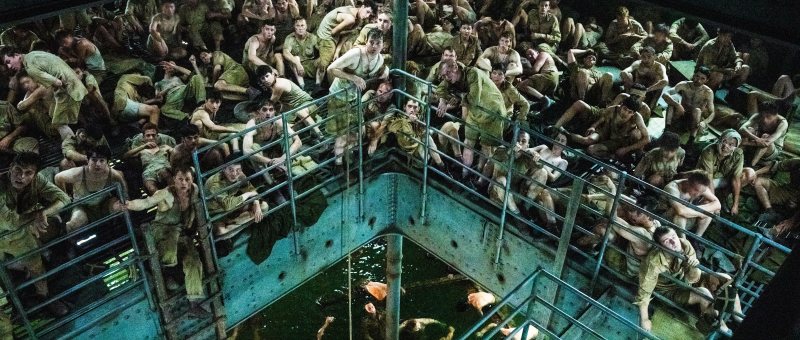
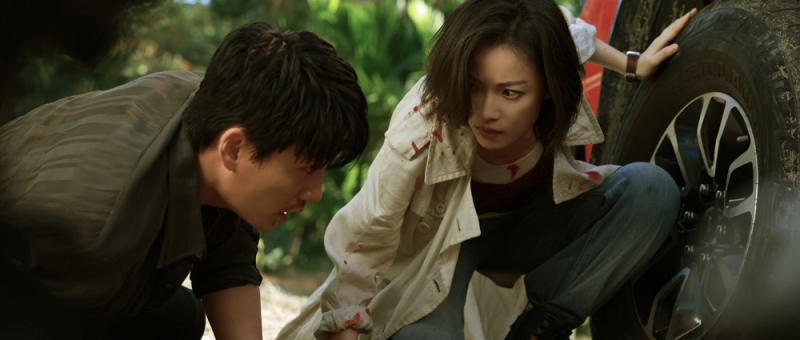
If someone’s drowning, then you save them no matter what language they speak or where they come from. Such is the simple logic of the Dongji fisherman who risked their lives to rescue British prisoners of war when the boat they were travelling on was torpedoed in the waters near Zhoushan. Inspired by this historical event, Guan Hu and Fei Zhenxiang spin a tale of resistance and righteousness with an unexpected advocation for borderlessness and freedom as the two orphaned pirate brothers at the film’s centre finally find their way back to their home in the sea.

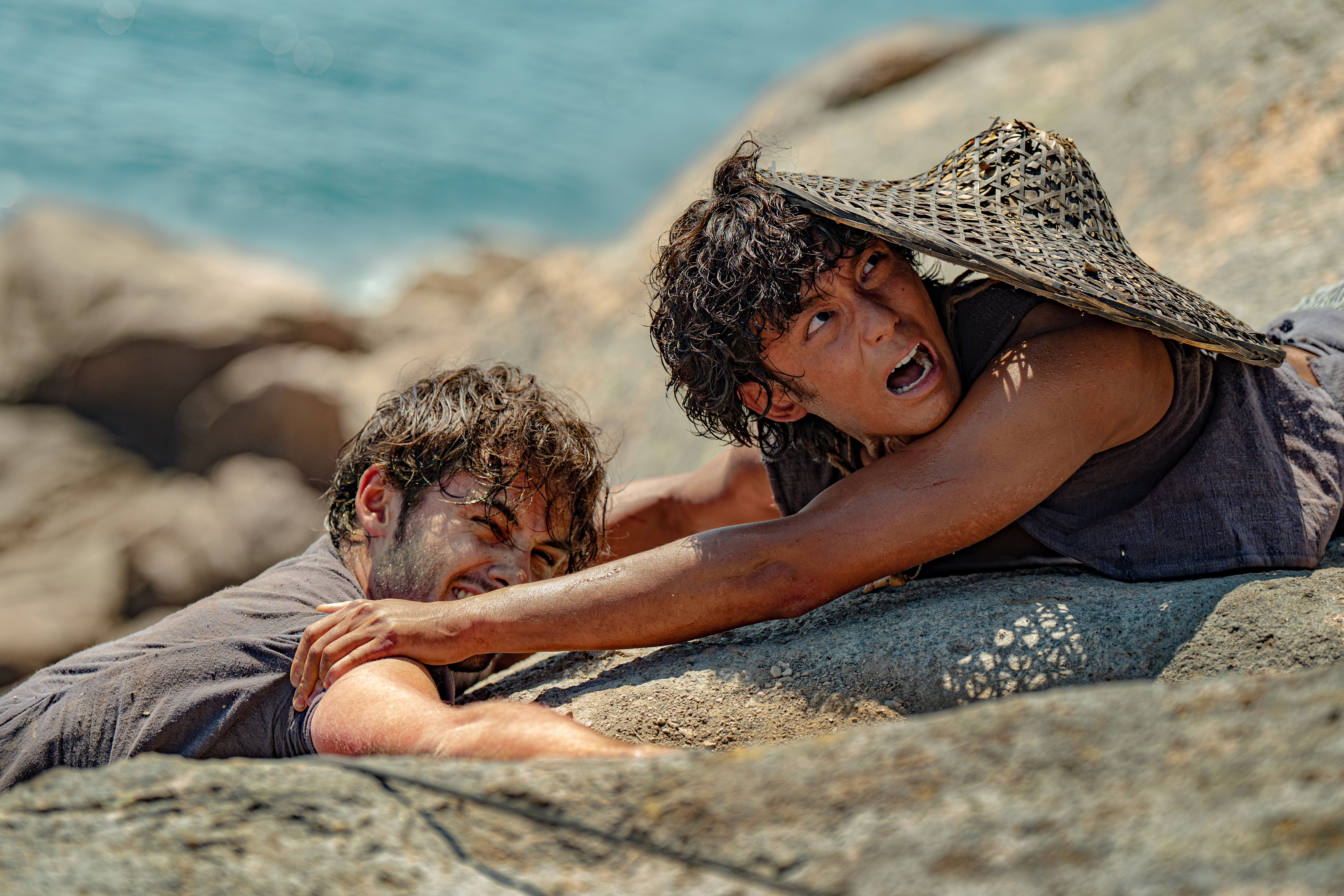
It’s Ah Dang (Wu Lei), the younger of the brothers, who fishes a British soldier out of the water and tries to rescue him, while the older, Ah Bi (Zhu Yilong), refuses and tries to throw the man back. Ah Bi may appear heartless, but considering the risk the presence of the British soldier poses to the islanders perhaps Ah Bi’s callousness is perfectly understandable. Nevertheless, Ah Dang stashes the young man, Thomas Newman, in their cabin and seems fascinated by his blue eyes and a vision of the wider world that he seems to represent. Thomas desperately tries to communicate with Ah Dang but though he knows some Cantonese cannot get through to him that there are men trapped on the sinking boat. Meanwhile, Japanese troops turn up on the nominally occupied island erroneously looking for a blond, blue-eyed man missing from the ship. Convinced the islanders must be harbouring him, they start taking hostages and executing villagers until Thomas finally knocks out Ah Dang so he can give himself up to save them.

Though the island was not in fact occupied in real life, here the villagers are placed under incredibly oppressive rule despite there only being two Japanese soldiers standing guard. The fishermen are no longer allowed out to fish and are, they say, stuck on land like turtles unable to practise their traditional crafts or way of life. Old Wu led the resistance before, but didn’t end well and now even he has been cowed into submission. The rescue is then as much for the islanders as anyone else as an act of resistance to authoritarian oppression in their following their belief that those in peril on the sea must be saved in defiance of the Japanese’s prohibition on sailing. The same is doubly true of Ah Bi’s girlfriend Ah Hua (Ni Ni), Old Wu’s adopted daughter who takes up his place and breaks a taboo about women going to sea to lead the rescue mission. 

She, Ah Bi, and his brother are all technically outsiders on the island who were never fully embraced by the community. The brothers were held at arms’ length because of their possibly pirate origins, while Ah Bi’s dream had been to escape to Shanghai with Ah Hua. Ah Dang is then touched by Thomas’ constant attempts to talk to about “home” though he perhaps doesn’t quite have one while Ah Bi’s “home” more than anything else is simply Ah Dang. Rather than the expected definition of a homeland of the greater China, the brothers’ “home” is later redefined as “the sea” which is to say a place of boundless freedom where national borders don’t exist. 

These elemental origins also give the brothers a mythical quality that adds to the sense of heroism in the rescue as Ah Bi goes after the Japanese and attempts to save the remaining POWs, some of whom can’t swim, marooned in the middle of the sea. The Japanese, meanwhile, are intent on covering the incident up which means everyone must die from the POWs to the residents of Dongji Island, though it isn’t really clear who the islanders would tell anyway considering that they live on a fairly remote island. In any case, the heroism of the Chinese fisherman is directly contrasted with the craven callousness of the Japanese who are still trying to pick off the POWs like fish in a barrel and only stop on realising that there are too many Chinese fisherman and if they were to kill them all it would get out and they’d look very, very bad. Epic in scope and impressively staged with some truly stunning underwater photography, there is a sense of genuine poignancy and human solidarity in standing up to oppression and cruelty no matter how ironic or jingoistic it might otherwise seem as ordinary villagers rise to up to help those from a distant land they don’t even know at the risk of their own lives and livelihoods.


Dongji Rescue opens in UK cinemas 22nd August courtesy of CineAsia.

Trailer (English subtitles)

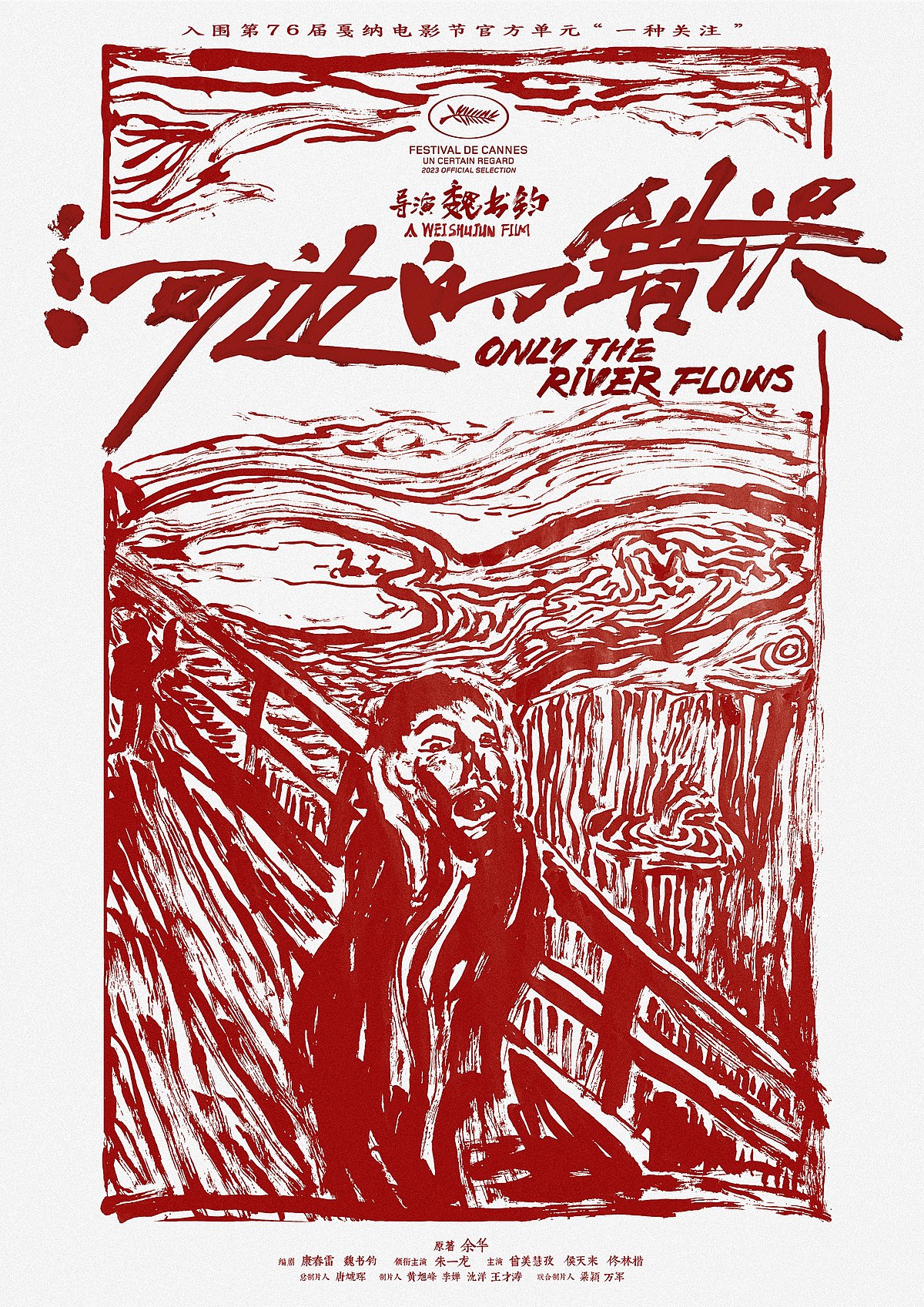
Only the River Flows (河边的错误, Wei Shujun, 2023)

Spoiler warning

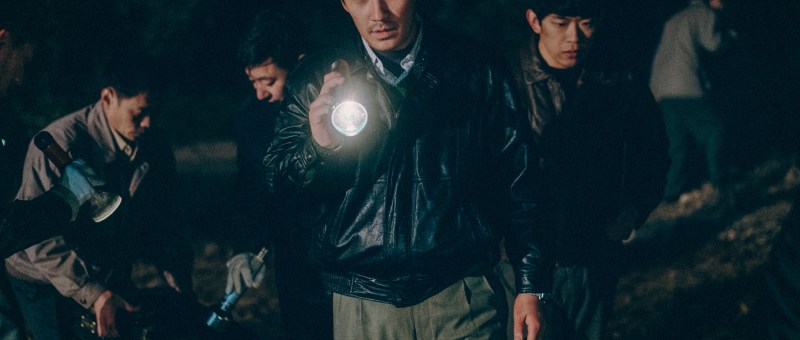
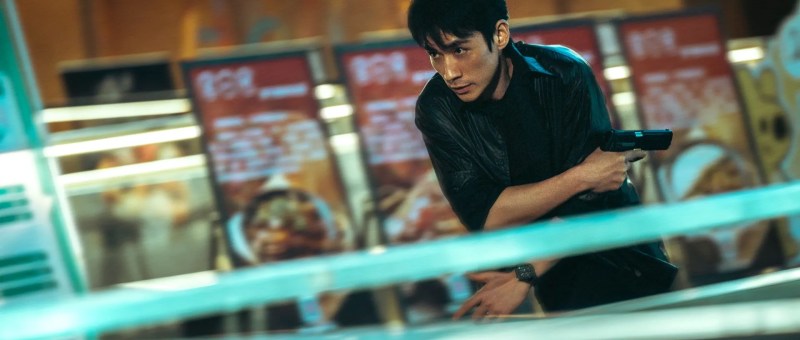
In the opening moments of Wei Shujun’s Only the River Flows (河边的错误, Hébiān de Cuòwù) children run through an abandoned building playing cops and robbers amid the ruins of a changing China. One could argue that detective Ma Zhe (Zhu Yilong) is little different from the boy who chases after the other children with a plastic toy gun in his hand and an apparent love of justice in his heart only to enter a room and find himself on the edge of precipice looking down on a digger several floors below already sweeping up the rubble while Ma and his police partner look on obliviously. 

Wei fully recreates the aesthetics of sixth generation cinema, filming on grainy 16mm with a score that immediately echoes the films of the 1990s. Yet this small town in southern China is also a noirish place full of dank corridors and crumbling buildings that reflect the slow death of the old factory system along with the accompanying anxiety and displacement. Ma Zhe is also somewhat displaced. As he’s first introduced it’s as the only plainclothes detective in a room full of policemen in military uniform. His genial boss sells a message of “collective glory” that sounds somewhat outdated and is continually undermined by the fact he seems to do little himself and in fact continually instructs Ma to close the case he is working on even if he isn’t really convinced that primary suspect really is the guilty party. 

Based on a novel by Yu Hua, the film’s Chinese title more accurately means “a mistake on the river bank” which could refer to the murder itself, a strange case of an apparently well liked old lady killed with a sharp object, or to an encounter Ma later has with the suspect who is referred to only as “The Madman”. Apparently adopted by the old woman, Granny Four (Cao Yang), to stave off loneliness after her husband’s death (presumably they had no children of their own) the Madman is middle-aged with some kind of learning difficulties and otherwise mute and docile never having displayed any signs of violence or volatility. Yet in his way Ma is also a “madman”, increasingly out of touch with objective reality and driven near out of his mind by his preoccupation with the case. 

Pushed past his limit, Ma feels himself stalked and eventually descends into a lengthy dream sequence in which he watches his recollections projected on a cinema screen only for the negative to dissolve in flames as if it were burning a hole in his memory. His own perceptions are not reliable as confirmed by the confusion surrounding a commendation he received at a previous posting that he can no longer find, while a friend he contacts says he can’t remember him every receiving it and would have been surprised if he had as back then Ma was drinking quite heavily. Overburdened by the case, he begins drinking again and is also filled with paternal anxiety while his pregnant wife spends her time to trying to construct the image of their family by completing a jigsaw puzzle featuring a picture of a mother and child. 

The couple are told, by a very unsympathetic doctor, that there is a small chance the baby may be born with a genetic abnormality that could result in cognitive impairment. While Ma leans towards an abortion (the one child policy in this era perhaps influencing his decision) his wife is determined to keep it, calling Ma a heartless man but also suggesting that the fate that has befallen him is some kind of karmic retribution. He feels the Madman in himself echoed in the fate that awaits his child and is unwilling to accept it, wondering what their life would be like with the world the way it is.

His sense of “madness” is centred in his individuality as the member of a collective and something that he finds echoed in the frustrating dead ends of his case. Several witnesses saw the body but did not report it, fearful of their own secrets being exposed. More deaths soon occur, not exactly related to the first but somehow as a result of it as if murder were catching and Ma is a point of infection bringing a hidden truth to light that accidentally exposes something others would have preferred remain private. Ma’s quest is to quell the madman within himself, as perhaps he does in once again putting on his uniform and joining the collective even if it means accepting their truth above his own or the doubts in his heart. A brief coda featuring Ma and his wife happily bathing their son in an atmosphere of warmth and comfort might suggest that order has been restored were it not for the unsettling look in the child’s eyes in the film’s final frame. Beguiling and mysterious, the film lends itself to multiple viewings in its consistently slippery realities and noirish sense of existential dread as Ma attempts to find himself amid the contradictions of ‘90s China in a land very much under construction. 


Only the River Flows screened as part of this year’s BFI London Film Festival and will be released in UK & Irish cinemas in spring 2024 courtesy of Picturehouse Entertainment.

International trailer (English subtitles)

Lost in the Stars (消失的她, Cui Rui & Liu Xiang, 2023)

A desperate husband with five days left on his visa finds himself at the mercy of a foreign police department when his wife suddenly disappears into thin air during their honeymoon in a fictional South East Asian nation in Liu Xiang & Cui Rui’s hugely entertaining mystery thriller Lost in the Stars (消失的她, xiāoshī de tā). Produced and co-scripted and produced by Detective Chinatown’s Chen Sicheng, the film draws inspiration from the 1990 Russian drama Trap for a Lonely Man which was itself adapted from a 1960 French play, Piège pour un homme seul, which Alfred Hitchcock had once been interested in adapting. 

It’s not difficult to see why seeing as the film revolves around a classic “wrong man” in frantic husband He Fei (Zhu Yilong) who like so many Hitchcock heroes is left feeling like the only sane man in an insane world when he wakes up next to a woman who claims to be his missing wife only he’s never seen her before and is adamant that something untoward must be going on though all the evidence points to the contrary and no one really believes him. The film never really entertains the possibility that the “fake” wife (Janice Man) is indeed telling the truth and Fei is undergoing some kind of psychotic break but does leave a question mark over his mental state and credibility on revealing that he is suffering from a neurological condition caused by his work as a diving instructor for which he is on serious medication. 

In any case, the film opens with him bursting into a local police station exasperated with their lack of interest in his wife’s disappearance. In something of a trope in recent Mainland cinema, the action takes place in a fictional South East Asian nation which has shades of Thailand and Indonesia where the implication is the authorities don’t really care very much about a missing tourist. A Chinese policeman, Zheng (Du Jiang), eventually admits as much confessing that the police department is massively understaffed and only investigates “criminal” cases which they don’t believe his wife’s to be, rather that she most likely got fed up with Fei and has gone off of her own accord. Their lack of concern echoes a persistent theme in mainstream Mainland movies that the safest place for Chinese citizens is at home, an idea only reinforced by the film’s melancholy conclusion and the implications of Chen Mai (Ni Ni), a top international lawyer Fei meets by chance, who suggests that his wife may have been taken by an international trafficking ring. 

Nevertheless, in its various twists and turns the film also has a few things to say about class disparities in contemporary China in which as someone later says money may even buy the Devil’s soul. With his visa running out, Fei insists that he won’t leave without finding out what’s happened to his “real” wife and what’s going on with the “imposter” who soon drops any pretence and openly admits that she’s out to get Fei for reasons he finds unclear though assumes to be financial. Then again, we start to realise that perhaps he hasn’t been a hundred percent honest even with the information he’s giving Mai who is the only person interested in helping him find his wife who may or may not be at the mercy of vicious international gang backed by important people against whom an ordinary tourist like Fei or even an international figure like Mai has little power. 

While the film noticeably carries a strong anti-gambling message perfectly in tune with the censors’ sensibilities, it also has a surprising queer subtext in the quite obviously coded persona of super lawyer Mai who makes a dramatic motorbike entrance and then more or less steals the film as she tries to ascertain the whereabouts of Fei’s missing wife. Nothing is quite as it first seems, subterfuge piles on on subterfuge along with altered realities and personal myth making though the film’s title takes on a poignant note in the closing moments in which another starry image is presented in an attempt to evoke an emotional reaction from an otherwise heartless villain. Boasting excellent production values and elegant production design, the film is careful never to lose itself in its various twists and reversals before quite literally dropping the curtain on its extremely satisfying conclusion in which we discover just how far some are willing to go in pursuit of the stars.


Lost in the Stars is in UK cinemas now courtesy of CineAsia.

Trailer (Simplified Chinese / English subtitles)

Lighting Up the Stars (人生大事, Liu Jiangjiang, 2022)

An immature young man recently released from prison for assaulting his girlfriend’s lover finally begins to grow up when unexpectedly saddled with looking after a grumpy little girl otherwise unwanted by her remaining family members in Liu Jiangjian’s feel good tearjerker, Lighting Up the Stars (人生大事, Rénshēng Dàshì). As much a tale of finding an accommodation with death and learning to move on as it is of the joys of forged families and unexpected connections, Liu’s drama is as the Chinese title suggests very much about the big things and what it takes to realise what they are. 

At this point in his life, San (Zhu Yilong) hasn’t been giving much thought towards the big things largely because he is consumed by resentment and a sense of inadequacy. He’s keen on getting back together with old girlfriend Xi (Janice Wu Qian) but sends her worryingly controlling voice notes and later becomes violent when she tries to break up with him before discovering that she is pregnant and plans to marry the guy he went to prison for beating up. “I can’t see you becoming a good father” she explains, regarding him as too immature to support the family she is keen to start. San is stung by the suggestion, as he is by his elderly father’s constant needling and refusal to hand the family funeral business over to him, but also has to concede she has a point. 

Nevertheless, there is a kind of tenderness to him as seen in his gentle washing of the body of an elderly woman still lying on the bed where she died while her son and his incredibly callous wife try to organise an express funeral so they can take their spoilt son to Beijing to participate in an academic competition. Meanwhile, little Xiaowen (Yang Enyou) watches while hiding in a cupboard before bursting out and demanding to know what they’ve done with her grandma. It seems that no one has taken the time to explain to Xiaowen exactly what’s happened or what’s going to happen to her now seeing as her grandmother had been raising her. Charging around like Nezha pointing her spear at everyone she meets, Xiaowen sets off to rescue grandma by chasing San’s van and eventually ending up at the funeral parlour which she then refuses to leave. Her uncle comes to fetch her but shockingly decides to leave her there with San and his two friends, asking them to look after her until they get back despite having absolutely no idea if they are suitable people to be looking after a little girl. 

These tears in the fabric of the traditional family are in some ways a result of a contemporary society. Xiaowen’s aunt point blank refuses to have her, insisting that she doesn’t want to expend resources on someone else’s child while blaming her husband for paying too much attention to his niece and not enough to their bratty son who lets them all down by humiliatingly failing the Beijing exam. Her hyperfocus is a reflection of the One Child Policy and rising consumerism as she seeks to express her status as a mother through her son’s success while simultaneously ruining their familial relationships with her constant nagging and hard-nosed practicality. Xiaowen’s henpecked uncle simply goes along with it for a quiet life, obviously very upset by his mother’s death but unable to defy his wife. San meanwhile is at odds with his father and sister who think he’s no good, will never be able to settle down and live a conventional life, and is incapable of accepting the responsibility of the family business. San may think some of this too, living with a sense of inadequacy feeling as if he doesn’t measure up to his absent elder brother, while seemingly floundering in his attempts to make something of himself. 

Through his relationship with Xiaowen he finally begins to come into his own in accepting the responsibility of fatherhood, caring for her both physically and emotionally while repairing his fracturing relationship with his own father and coming to terms with the past. He teaches Xiaowen about death and how to accept it, but also reminds her that her grandmother’s never really gone and will always be with her. Finally, San begins to think about the big things but about the small things too, planting stars in the sky as Xiaowen puts it as they prepare to get on with the business of living even in the presence of death.


Lighting Up the Stars streams for free in the US and Canada Jan. 22 to Feb. 5 as part of Asian Pop-Up Cinema’s Lunar New Year celebration.

International trailer (Simplified Chinese, English subitles)

Embrace Again (穿过寒冬拥抱你, Xue Xiaolu, 2021)

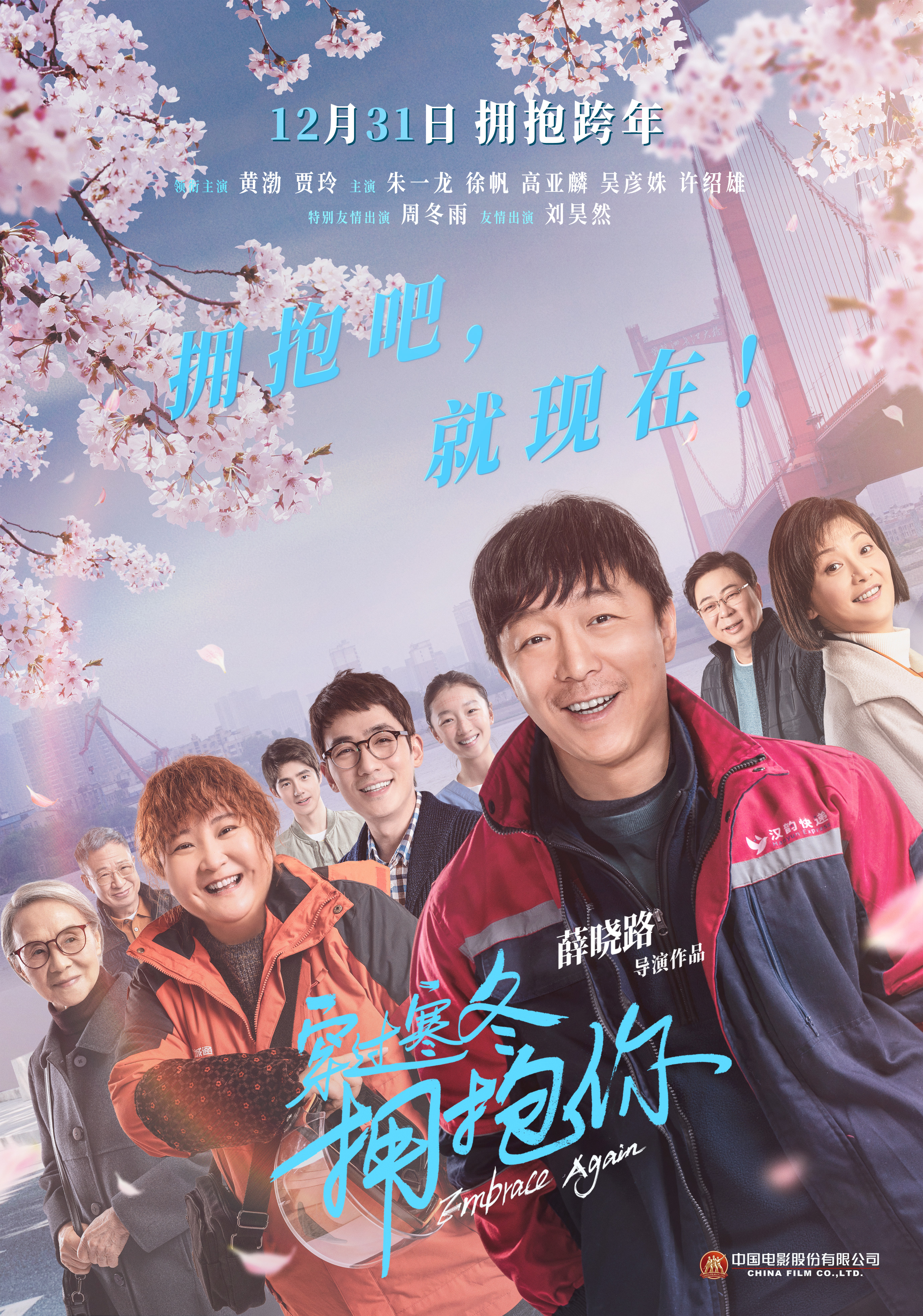
Another in the recent line of “Main Melody” features celebrating ordinary heroism during the extraordinary period of the pandemic, Embrace Again (穿过寒冬拥抱你, chuānguò hándōng yōngbào nǐ) is dedicated to the volunteers who risked their own safety to support frontline workers in the early days of the Wuhan lockdown. Though sometimes bittersweet, the film is noticeably lighter in tone and somewhat rosy in comparison to other similarly themed dramas such as Ode to the Spring but it is in its own way prepared to concede that the initial response was not handled perfectly and that fear, chaos and panic were the defining features of New Year 2020 even if it does so to throw the heroism of those who stepped up to help in stark relief. 

Like other pandemic films, Embrace Again is comprised of a series of interlocking stories connected by the volunteer effort helmed by A-Yong (Huang Bo) who has something of a hero complex and is caught in a mini war with his feisty wife who is quite understandably upset with him seeing as he’s left her all alone with their son during these difficult times while he runs around helping other people having decided to stay elsewhere so as not to expose them to further risk of disease. As he ferries people around, it becomes clear that there were not so many people like him in the beginning with most preferring to keep to themselves out of fear leaving the medical staff who were risking their own lives to protect those suffering from the virus with nowhere to turn for support.

A-Yong’s heroism is contrasted with the indifference of wealthy businessman Li (Gao Yalin) who rudely tells him where to go when A-Yong rings up trying to organise food donations for hospitals. Li is at odds with his wife (Xu Fan) whose successful tourist business has been all but destroyed by the virus, unable to understand her decision to keep her staff on payroll with full salaries and resentful of her insistence on calling in a longstanding loan from an old friend of his. Yet like so many his attitude is gradually changed by witnessing responses to the pandemic, allowing him to regain his social conscience becoming a volunteer himself and agreeing to donate a significant proportion of his stock to frontline workers while rediscovering his love for his wife who started her own business not for the money but for her dignity after being called a “stupid housewife” by their daughter now soon to be a mother herself and trapped overseas in New Zealand by the lockdown. 

Nicknamed Brother Wu (Jia Ling) because of her forthright character and robust frame, a female delivery driver associate of A-yong’s experiences something similar as she firstly befriends a cheerful young nurse, Xiaoxiao (Zhou Dongyu), working at the hospital and engages in a tentative romance with a sensitive divorcee, Mr. Ye (Zhu Yilong), she picks up prescriptions for. In a pleasantly progressive plot strand, Wu is forever telling people she’s trying to lose weight but both Xiaoxiao and Mr. Ye make a point of telling her that she’s fine as she is and has no need to. When Xiaoxiao gifts her lipstick, it’s not a suggestion that she is unfeminine but the reverse allowing her a means to reclaim her femininity for herself and believe that she is both beautiful and desirable exactly as she is. 

Similarly, an elderly woman (Wu Yanshu) living with her widowed son-in-law and grandson is given permission to begin moving on with her life when when she’s called out of retirement to return to the hospital as a midwife. While telling her son-in-law that he shouldn’t feel guilty about seeking new happiness, she too finds love with a Cantonese chef (Hui Shiu-hung) who ends up becoming a volunteer solely so he can deliver her lovingly prepared meals direct to the hospital. Each of these tales are essentially about people finding love in unexpected places while rediscovering their ties to the community, setting greed and self-interest to one side as they risk their own safety to preserve that of others. Wuhan is cut off from the rest of the world, but receives support in the form of external supplies celebrated by A-Yong and the small core of volunteers pitching in to keep the city running. Ending on a bittersweet note acknowledging a sense of loss but also that of a new beginning, the film closes with touching scenes of community in action before giving way to the now familiar stock footage of the real volunteers celebrating Wuhan’s reopening with a sense of joy and relief that might in retrospect seem premature but is also a perfect encapsulation of the view from April 2020.


Embrace Again screens in Chicago on Sept. 10 as part of the 15th season of Asian Pop-Up Cinema.

International trailer (English subtitles)

Cloudy Mountain (峰爆, Li Jun, 2021)

In recent years, Chinese big budget disaster extravaganzas have dedicated themselves to celebrating the selfless heroism of the undersung branches of the emergency services, firemen for example in Tony Chan’s The Bravest or the coast guard in Dante Lam’s The Rescue. Li Jun’s Cloudy Mountain (峰爆, Fēng Bào) features its fair share of fearless rescue teams, but is nevertheless dedicated to the rather unlikely source of pride, the Rail Soldiers whose lives, at least according to the closing credits, were sacrificed in large numbers to complete the infrastructure necessary for the expansion of the Chinese state yet in 1984 they were renamed “China Railway Construction Corporation” a development the film at least seems to regard with a surprising degree of ambivalence. 

This becomes most obvious in the conflict between the two heroes, an estranged father and son burdened by personal trauma, one a former Rail Soldier and the other a high tech engineer working for a commercial enterprise on the building of a high speed railway network through terrain known to be geologically volatile. Grandpa Hong (Huang Zhizhong) is set to visit his son Yizhou (Zhu Yilong) for New Year, though he doesn’t really want to see him knowing that his father will only criticise his work on the tunnel leading to another intergenerational argument. Meanwhile, Yizhou also finds himself unpopular at work for requesting additional safety checks many seem to regard as a pointless waste of time, and oddly they might have a point seeing as Yizhou’s monitoring fails to detect a shift in the rock formation which causes water to flood the almost complete tunnel during routine blasting. 

The fact is Hong was a Rail Soldier and is also one of those old men who think they know best about everything. He kicks off at a bored young lady at service station because she doesn’t want to accept payment in cash and has no change to offer confused as to why Hong can’t just pay with Alipay or WeChat like everyone else. Despite his years of hands-on experience, he no longer understands the modern high tech engineering industry and thinks his son is somehow unmanly with his scientific data and use of drones, believing that if you want to solve a problem you just get in there and do it. This causes a minor problem when a manmade earthquake strikes just after his arrival as he pushes rescue crews out of the way to set about rescuing everyone trapped underground on his own only to end up trapped himself. 

The film is almost on his side, definitely ambivalent about the state of modern Chinese infrastructure. Mrs. Ding (Chen Shu), the female manager of the tunnel project, is initially positioned as a villain, insisting that the tunnel must be completed on schedule and they can’t be wasting money on things like safety checks, hinting at the nation’s notoriously lax approach to public safety and widespread corruption in the construction industry. One might even ask if it was a good idea to build this tunnel at all given the geological volatility of the local area, yet Mrs. Ding later becomes something of a hero in finally agreeing to sacrifice 10 years of her own work when it becomes clear a nearby town cannot be evacuated before disaster strikes. Stepping into propaganda mode she advances that while Westerners may pin their hopes on Noah’s Ark, Chinese men move mountains convincing the workmen to blow up the tunnel they’ve been spent the last decade working on by reminding them that they can simply build it again. 

Meanwhile, Yizhou and Hong begin to sort out their father/son problems underground most of which go back to the death of Yizhou’s mother for which he blames himself but also his father for failing to return home when his wife was ill because he had important nation building work to do. This minor barb might hint at a conflict between selfless dedication to the State and familial responsibility, which would seem to run against the secondary message that unchecked capitalism is doing the same thing while also endangering public safety. One reason the crews didn’t want to fall behind through “needless” safety checks was because they’d already agreed to sacrifice New Year with their families to get the tunnel done on time. Nevertheless the only way to save both the tunnel and the town depends on father and son working together, a mix of Yizhou’s high tech data analysis and Hong’s hands-on experience as they perilously climb up the slide of a sheer rock face in torrential rain to blow up an entirely different mountain to create a protective shield. 

The major villain, if there is one, is personal greed born of irresponsible capitalism, and its only cure is, paradoxically, a recommittal to the State as Mrs Ding offers inspirational messages about the legacy of the Rail Soldiers while self-sacrifice for the public good is held up as the only moral responsibility. In any case, Li piles on the tension with a series of possible negative outcomes from the tunnel disaster not only swamping the town and killing off the local population but also endangering an adjacent chemical plant, never quite making the case for why the tunnel is so necessary in the first place even as it swaps its literality for the metaphorical in allowing the reconnection of father and son overcoming a generational divide to find an ambivalent accommodation with the demands of the modern China. 


Cloudy Mountain screens at ChiTown Movies Drive-in Chicago on Nov. 13 courtesy of Asian Pop-Up Cinema.

Original trailer (English subtitles)

My People, My Country (我和我的祖国, Chen Kaige, Zhang Yibai, Guan Hu, Xue Xiaolu, Xu Zheng, Ning Hao, Wen Muye, 2019)

My People My COuntry poster 3Oct. 1, 2019 marks the 70th anniversary of the People’s Republic of China. Supervised by Chen Kaige, My People, My Country (我和我的祖国, Wǒ hé Wǒ dě Zǔguó) presents seven short films by seven directors featuring several notable historical events from the past 70 years though not quite one for every decade (perhaps for obvious reasons). Though different in tone, what each of the segments has in common is the desire to root these national events in the personal as they were experienced by ordinary people rather than how the history books might have chosen to record them.

Told in roughly chronological order, the film opens with the founding of the Republic as comedian Huang Bo plays an eccentric engineer charged with ensuring the operation of an automatic flag pole doesn’t embarrass Chairman Mao at the big moment. In the context of the film as a whole which is fond of flags, this is rather odd because every other flag in the film is raised by hand usually by a soldier taking the responsibility extremely seriously. Yet the point is less the flag itself than the symbolic pulling together of the community to find a solution to a problem. Realising the metal on the stopper is too brittle, the engineers put out an appeal for more with seemingly the entire town turning up with everything from rusty spoons to grandma’s necklace and even a set of gold bars!

This same sense of personal sacrifice for the greater good works its way into almost all of the segments beginning with the story of China’s first atom bomb in the ‘60s for which a pure hearted engineer (Zhang Yi) first of all sacrifices his one true love and then the remainder of his life when he exposes himself to dangerous radiation all in the name of science, while in the film’s most charming episode a young boy is devastated to realise his crush is moving abroad and has to choose between chasing after her and fixing up a TV aerial so his village can see China beat the US at volleyball during the ’84 Olympics. Visions of flag waving glory eventually convince him where his duty lies, but his sacrifice is later rewarded twice over as he becomes a little local hero even if temporarily heartbroken in the way only a small boy can be.

Then again, some people are just a little self-centred like the hero (Ge You) of Ning Hao’s Welcome to Beijing who keeps trying to reconnect with his earnest teenage son only to end up connecting with a fatherless young boy during the 2008 Beijing Olympics. Chen Kaige’s sequence, meanwhile, is inspired by the story of two earthbound astronauts but similarly finds two roguish, orphaned young men connecting with a patient father figure who is able to bring them “home” by showing them a space miracle in the middle of the desert, and in the final and perhaps most directly propagandistic sequence, a tomboyish fighter pilot eventually overcomes her resentment at being relegated to a supporting role to rejoice in her colleagues’ success. Despite the overly militaristic jingoism of the parades with their obvious showcasing of China’s military power, Wen Muye’s “One for All” is in its own sense surprisingly progressive in its advancement of gender equality and mildly subversive LGBT positive themes were it not for a shoehorned in scene featuring a milquetoast “boyfriend”.

Sensitivity is not, however, very much in evidence in the sequence relating to the extremely topical issue of the Hong Kong handover. Out of touch at best, the constant references to the continuing reunification of the One China are likely to prove controversial though admittedly those they would most upset are unlikely to want to sit through a 2.5hr propaganda epic celebrating the achievements of Chinese communism. Nevertheless, it is a little galling to see the “return” to China so warmly embraced by the people of Hong Kong given current events in the city. This perhaps ill-judged sequence is the most overt piece of direct propaganda included in the otherwise unexpectedly subtle series which, despite the flag waving and eventual tank parade, tries to put the spotlight back on ordinary people living ordinary lives through the history of modern China. Of course, that necessarily also means that it leaves a lot out, deliberately refusing to engage with the less celebratory elements of China’s recent history, even as it closes with the fiercely patriotic song of the title performed by some of the ordinary heroes who have inspired its various tales of everyday heroism.


Original trailer featuring Faye Wong’s cover of the well known patriotic anthem from 1985 (no subtitles)