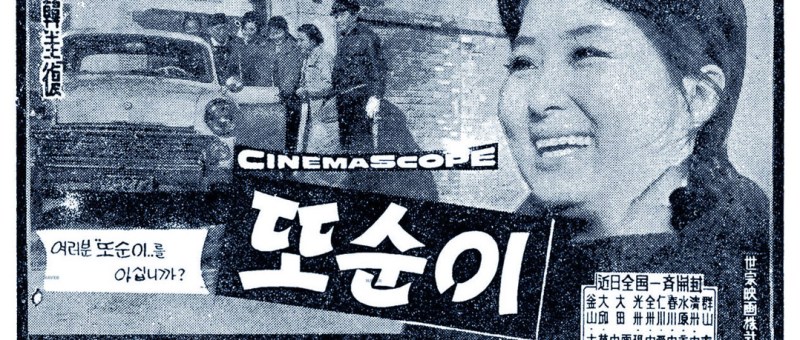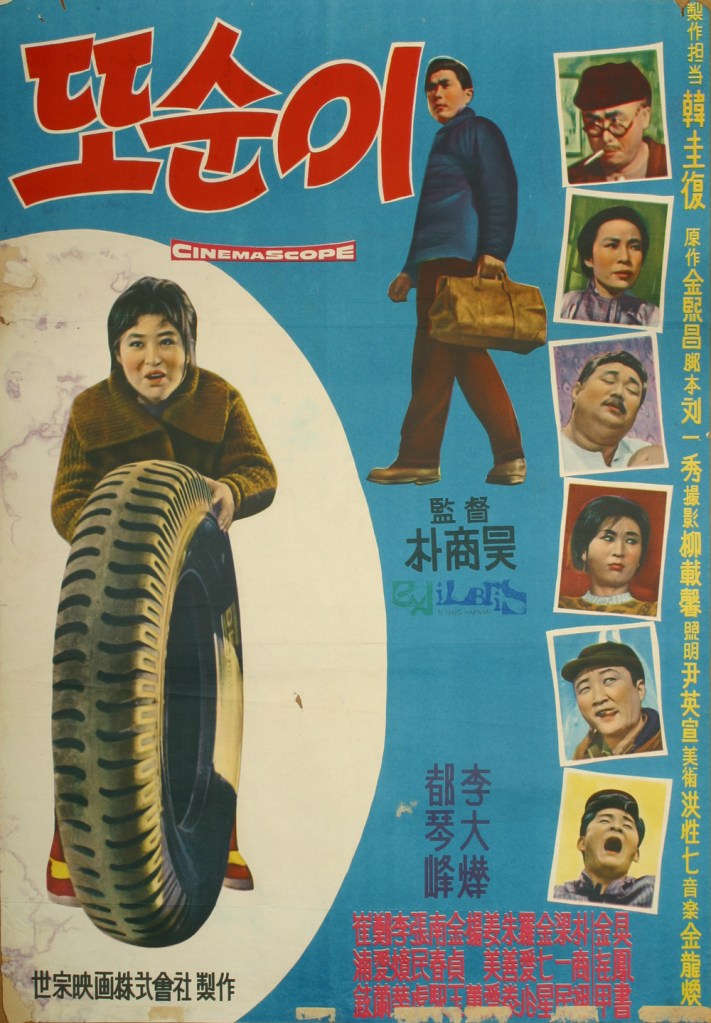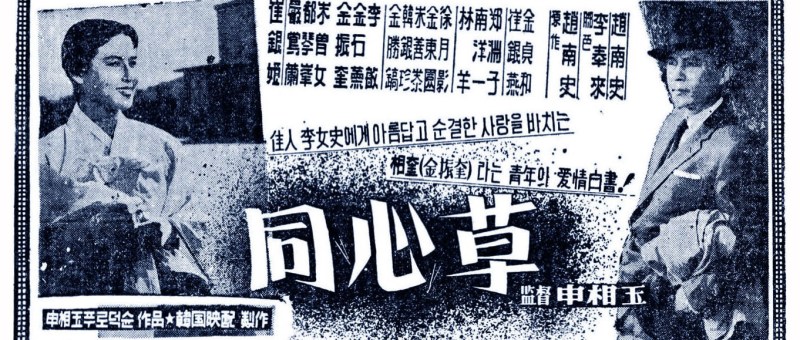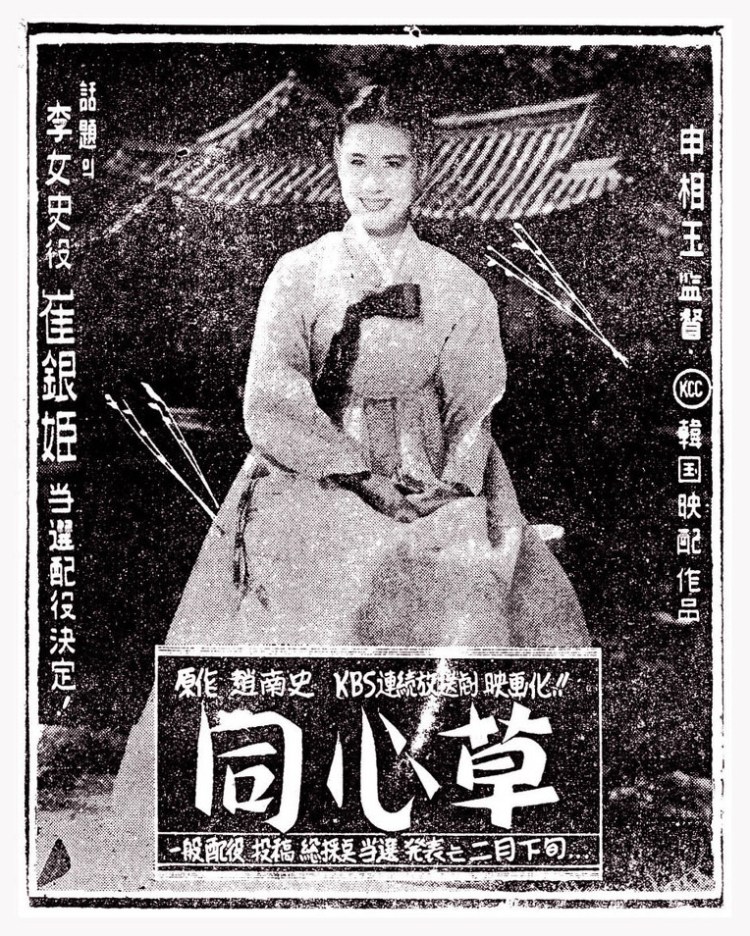
Dongsimcho (동심초, Shin Sang-ok, 1959)

The Korea of 1959 was one of change, but the hardest thing to change is oneself and oftentimes the biggest obstacle to personal happiness is the fear of pursuing it. The pure hearted heroine of Shin Sang-ok’s Dongsimcho (동심초) describes herself as “a woman who thirsts for love, yet foolishly gives in to fear first”. A war widow, she’s fed up with society’s constant prejudice but too afraid of what they might think if she chose to choose love, embrace her desire, and marry again for no other reason than personal happiness. Yet for all that she’s a mother with a grown up daughter, she’s a woman too, and young, only 38, but nevertheless consigned to a life of loneliness because of a series of outdated social codes. 

When we first meet Suk-hee (Choi Eun-hee) she’s rushing to the station but arrives too late and can only watch the man she loves board a train through an iron gate that perpetually divides them. Her husband having died in the Korean War, Suk-hee once had a dress shop but was conned out of all her money and the business failed. The kind hearted brother of a friend, Sang-gyu (Kim Jin-gyu), helped her out. Through the course of his managing her affairs, they became close and fell in love, but Sang-gyu is now engaged to the boss’ daughter, Ok-ju (Do Keum-bong), and their romance seems more impossible than ever. 

Suk-hee never quite dares to hope that Sang-gyu might break off his engagement, decide against a bright middle-class future, and start again with her. She’s an old fashioned kind of woman. Despite the fact she once owned a dress shop, she only ever wears hanbok and lives in an improbably spacious Korean-style house alone with her college student daughter, Kyeong-hee (Um Aing-ran), and a maid. The debt that exists between herself and Sang-gyu is the force that both binds them and keeps them apart. The money rots their relationship, but neither of them want it to be repaid because then they’d have no more excuse to continue meeting. They are both perfectly aware of each other’s feelings but entirely unable to acknowledge them because in some sense they already know that their future is impossible. 

On discovering her mother’s “secret”, Kyeong-hee is mildly scandalised, confronted by the realisation that a mother is also a woman just as she is now. She worries about the moral ambiguities of her mother’s position and of what people might say, but quickly reconsiders, deciding to be happy for her and actively support her chances of a happier future. As a younger woman coming of age in the post-war era, Kyeong-hee feels freer to shake off social convention and strike out for personal happiness rather than being content to be miserable while upholding a series of social codes which lead only to additional suffering. 

Only slightly younger than Suk-hee, Sang-gyu is beginning to feel the same. His widowed older sister, Suk-hee’s friend, has turned to religion to escape her loneliness while staking all of her hopes on Sang-gyu’s economic success. It’s she who’s set him up with the marriage to Ok-ju and is pressuring him to accept it because it will assure her own future seeing as she is obviously not planning to defy convention and remarry. Sang-gyu, however, is filled with doubts. Eventually he tells his associate, Gi-cheol (Kim Seok-hoon), that he cannot go through with the marriage, adding that he doesn’t want advice or a warning he merely needed to tell someone. In a strange coincidence, Gi-cheol was once Kyeong-hee’s tutor, and has a surprisingly conservative attitude. Questioned by Ok-ju, he tells her to “act more lovingly” to cure Sang-gyu’s obvious lack of enthusiasm for their relationship, explaining that love doesn’t just happen but is a result of concerted effort. He tells Sang-gyu that he’s being childish and irresponsible and should think about “social ethics and morality”. In short, he should forget about the past and marry Ok-ju like a good boy. But Sang-gyu quite reasonably asks him who’s going to be responsible for what happens after that. If he marries Ok-ju now, he will merely be condemning her to a cold and loveless marriage filled with intense resentment in which the spectre of the woman he loved and lost will always stand between them. 

Kyeong-hee unexpectedly arrives part way through the conversation having followed Gi-cheol with whom she has perhaps also begun to fall in love despite the difference in their attitudes. She jumps in to defend Suk-hee, taking Sang-gyu’s side in berating Gi-cheol for insulting her mother, asking if he thinks a woman like her has no worth. Her mother is a woman too, and though she was originally confused and scandalised, after getting to know Sang-gyu and giving it some thought she’d like to give them her blessing though of course they don’t need it. Kyeong-hee is still young enough to fight for love, and the world in which she lives gives her the courage to believe it might be possible. 

The generation gap between herself and her mother, who it has to be remembered is only 38, cold not be more obvious. Suk-hee struggles against herself. She loves Sang-gyu, but the world tells her that it’s wrong and she must deny her feelings for the sake of social propriety. She can’t stand the way people look down on war widows, and she’s too afraid to give them any more ammunition. Given the relative mildness of the sanction on their relationship, in moral terms at least, it would be easy enough to read it as a metaphor for something else, especially with the repeatedly pregnant dialogue about the pain of not being permitted to marry the person that you love, that no one has the right to judge others for their personal lives, Sangyu’s sister’s aside about being “one of those people”, and finally Sang-gyu’s rather strange confession to Ok-ju that he “may have a personality disorder” in being unable to give up on his love for Suk-hee. It is definitely the case, however, that the gate that stands between them is a rigid an unforgiving society which denies love in fear of disrupting the social order.  

Suk-hee feels guilty not only for her feelings, but feeling as if she’s getting in the way of Sang-gyu’s bright and rightful future. Meanwhile, no one seems to give much thought to poor Ok-ju, used as a pawn by all while pinning for Sang-gyu despite her conviction that he’s in love with someone else and will never truly be with her. Even Gi-cheol implies it’s her own fault not being “loving” enough, while she is left with nothing but sympathy for Suk-hee as another woman forever separated from Sang-gyu because of what other people think. This world is not, it seems, entirely ready for love. Suk-hee makes the “right” choice by many people’s reckoning, one filled with nobility and self sacrifice, yet it’s a choice that becomes increasingly impossible to accept and stands only in stark condemnation of the society which convinced her that misery was virtue. 


Dongsimcho is the second of three films included in the Korean Film Archive’s Shin Sang-ok’s Melodramas from the 1950s box set. It is also available to stream via the Korean Film Archive’s YouTube Channel.
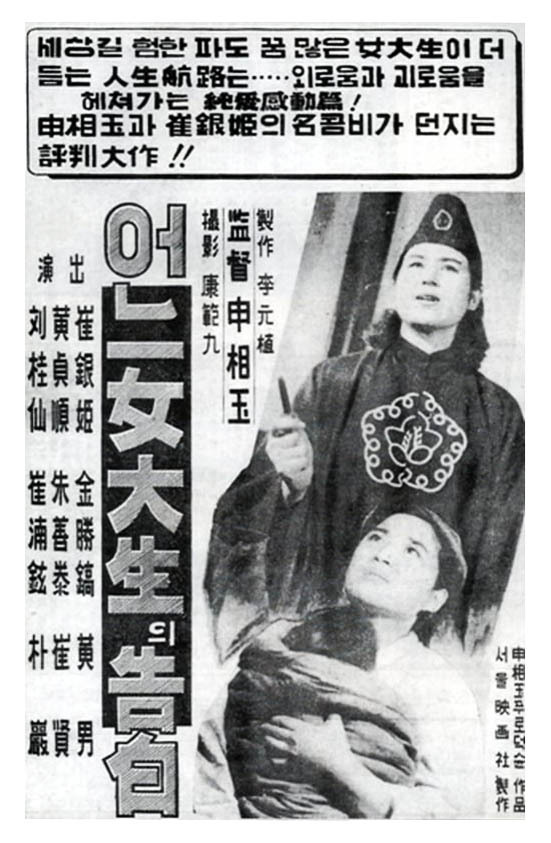
A College Woman’s Confession (어느 女大生의 告白 / 어느 여대생의 고백, Shin Sang-ok, 1958)

Five years after the end of the Korean War, South Korean society was both economically unstable and battling the increasingly authoritarian government of Rhee Syngman. Nevertheless, there was perhaps an aspiration for a brighter democratic future which many hoped would materialise after the protests which eventually brought down Rhee’s regime in 1960 but unfortunately led only to the even more repressive Park Chung-hee era. Released in the same year as Flower in Hell, Shin Sang-ok’s A College Woman’s Confession (어느 女大生의 告白 / 어느 여대생의 고백, Eoneu Yeodaesaengui Gobaek) is perhaps a reflection of that aspiration in its broadly humanist condemnation of an inherently unfair, rigidly patriarchal society which forces good people to act in ways which offend their sense of justice solely in order to survive. 

From a poor family, law student So-young (Choi Eun-hee) finds herself in dire straits after her grandmother who’d been supporting her and paying her tuition fees suddenly dies. She tries to find a part-time job that will let her carry on with her studies, but is either turned away or placed in difficult situations with men who abuse her trust. A sleazy boss interviewing her for a secretarial position pauses after hearing she’s a student after part-time work to suggest a “night job”, crudely leaning over as he offers her money to become his mistress. So-young slaps him across the face and leaves, but faces something much the same from the husband of her landlady who promises to stop pressuring her for the back rent in return for sexual favours. She turns him down too, but even though he backs off in fear she’ll tell his wife that he tried it on, his suddenly relaxed attitude only makes her landlady suspicious. 

At her wits end and about to quit school, So-young turns to her comparatively better off friend Hee-sook (Kim Sook-il) who dreams of becoming a novelist. Hee-sook brings up a diary she’s been reading that was found in some old furniture sold to her family’s store which recounts the sad life story of a girl who was seduced and betrayed by a man who left her to marry a wealthy woman. With too much time on her hands, Hee-sook has identified the man in the diary as prominent politician Choi Rim (Kim Seung-ho) and taken it upon herself to send him a letter telling him that he has a daughter named So-young from the love of his youth. Despite the fact that the diary says the woman’s baby died, Hee-sook suggests So-young pose as Choi’s long lost daughter so he’ll support her through the rest of uni. So-young is not convinced, but finds herself heading over to visit Choi after exhausting all her other options and being reluctant to go back to the boarding house without money. Choi absentmindedly turns her away, only to think better of it and send his secretary after her, but she ends up getting hit by a car trying to avoid yet another creepy old man who sees her in distress in the street and offers her money for sex. 

Creepy men are indeed everywhere. Even the wily Hee-sook finds herself bothered by an unpleasant man in a cafe who repeatedly pesters her even after she makes a point of ignoring him and pointedly switches seats. He doesn’t give up even after So-young arrives, abruptly offering to buy both women dinner, after which Hee-sook ushers So-young out declaring that this cafe is too “weird” to stay in any longer. Men are, it seems, content to exploit the desperation of vulnerable women for their own satisfaction. As So-young puts it in trying to defend another woman after she’s successfully become a lawyer, “vulgar men see women only as objects to satisfy their sexual desires”. 

This feeds back in to the sin the otherwise kindhearted Choi is trying to expiate. He made a choice in his youth, sometime in the colonial era, to abandon a woman he claimed to love to make a dynastic match. Though it’s not clear whether or not he knew there was a child, he seems to harbour a deep sense of guilt over his decision to essentially use two women in different ways. Faced with the “resurfacing” of So-young, he immediately explains everything to his wife (Yoo Gye-seon) but tries to pass it off as “all in the past” while earnestly asking her to help him make amends by accepting So-young into their home in place of the daughter they apparently lost. She fires back at him that it must be very convenient for men who can forget about things that are “all in the past” while women have to live the rest of their lives with the harm that they cause. Choi doesn’t argue with her, but nor does he ask for forgiveness, only understanding. Mrs. Choi answers that she ought to tell him no in revenge for the all the wrongs he’s done her (this appears not to be a terribly happy marriage), but agrees that it’s not So-young’s fault and so of course she can come because “it’s the right thing to do as a human being”. 

Mrs. Choi, however, remains suspicious, unconvinced by So-young’s story but also by her distance from her. That could of course be explained by embarrassment in being the child of the “other woman”, but Mrs. Choi is right to sense guilt in her reserve as she becomes ever more conflicted about the necessity of deceiving people who have been nothing but kind to her. It’s this sense of guilt which is intensified after she becomes a lawyer and achieves her dream of helping other disadvantaged women by defending a single-mother, much like the woman from the diary, who was seduced and betrayed by a man whom she later killed in a crime of passion. In her passionate defence of the extremely repentant Soon-hee (Hwang Jung-seun) is who is around the same age as she is, So-young reflects on the relative similarities between them and that the only reason they are standing in their respective positions is circumstance. 

“The purpose of the law is not only punishment but to awaken goodness in all our hearts” So-young reminds the judges, determined to offer “an earnest plea on behalf of desperate women”. Soon-hee admits her guilt and asks for no leniency, but is brought to tears as So-young outlines the social factors which explain why she found herself stabbing the man who had caused her so much suffering and then got on with his life without giving her a second thought. Her only transgression being sex before marriage, Soon-hee did everything else right but was condemned to a life of poverty and forced to consider sex work in order to buy medicine for her sickly baby. As a pure hearted woman, she can’t go through with it and considers robbery instead (apparently a “lesser” crime) only to bump into an old friend but be too ashamed to ask her for help. 

Earlier on, after her graduation ceremony, So-young had explained her ambitions to help women and children in poverty to Choi’s kindly secretary Sang-ho (Choi Hyeon) who has obviously taken a liking to her. He’s broadly supportive, but reminds her that if she wants to improve society perhaps she should think about fostering greater social change through political action (as he is perhaps doing), but she shakes her head and points out that he’s never known what it is to be hungry or desperate and that there are people who need the kind of help that only she can give them, such as women like Soon-hee. Yet in defending another woman she’s reminded only of her own “sin” in having wilfully deceived Choi and his wife, burdened by the need to keep her secret and convinced the only thing she can do is to confess all. 

Yet Mrs. Choi proves unexpectedly supportive, explaining that she’s known all along that So-young lied and has come to love her as a daughter anyway. She can see how happy she makes Choi who is proud and excited to have such an amazing young woman in his life, and finding out the truth would only break his heart. So-young’s confession would be for herself alone, to ease her own conscience, while the burden of carrying this secret is perhaps the price of her happiness. In an odd way, So-young has repaired their marriage, and with her success in the courts has perhaps completed the integration of their family with the implication that Sang-ho may later join it too. Fiercely condemning the evils of a patriarchal society, A College Woman’s Confession suggests that the literal truth might not be as important as the emotional, and that a rigid morality serves no one, while offering the vision of a brighter, more equal society founded on compassion and understanding rather than cold authoritarian paternalism. 


A College Woman’s Confession is the first of three films included in the Korean Film Archive’s Shin Sang-ok’s Melodramas from the 1950s box set. It is also available to stream via the Korean Film Archive’s YouTube Channel.
Sunshine Family (Kim Tai-sik, 2019)

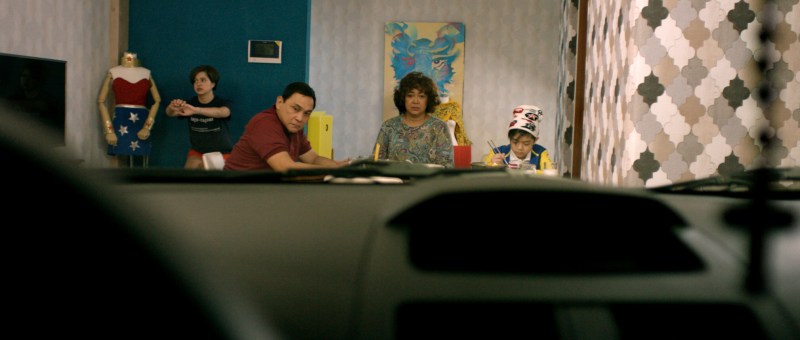
Sometimes it’s easy to lose track of what’s really important while chasing illusionary success, but you’ll remember soon enough if you hit a crisis. So it is for the members of the “Sunshine Family”, the Mapalads currently living overseas in Seoul where dad works for a travel company. The Mapalads are finally preparing to move back to Manila with a house already paid for, but when dad has an accident in his car it throws all of their plans into disarray. Yet in needing to come together to combat adversity, the family is in a sense repaired as they each come to appreciate each other for who they are while remembering that they have a collective responsibility. 

That “accident” occurs one Christmas while dad Don (Nonie Buencamino) is driving home after a work/leaving party. He’s had a little bit too much to drink and is distracted by a phone call from his boss when a woman suddenly jumps out into the road and collides with his car. Don is obviously upset, hugging the oversize snowman plushie he was travelling with for comfort as he stops to check on the woman who he is certain is either dead or at least in a very bad way. Frightened of getting into trouble he drives off and leaves her, calling his dependable wife Sonya (Shamaine Buencamino) for support. 

Sonya, understandably unamused, berates her husband for never having cared enough for his family. If only he hadn’t spent so much time drinking with colleagues, playing golf, and singing karaoke, he might not have got himself into this kind of mess. Sonya hijacks a passing forklift truck and shifts the damaged vehicle into their home through a window, planning to dismember it to hide the evidence of Don’s transgression so they can all go home together as planned. 

As in most family dramas, it’s Sonya who has a plan and is determined to ensure the survival of the family. Unlike the 1992 Japanese comedy Hit-and-Run Family which apparently inspired the film, the Mapalads are strangers in a strange land though they’ve also become estranged from each other while Sonya feels increasingly unappreciated seeing as her kids are growing up and her husband is always working. As Don later points out, the crisis gives her a new sense of purpose as she formulates a series of ingenious plans to cover up Don’s crime. “Nothing is important if we’re not together” she tells him. Family means leave no man behind. 

Don, meanwhile, is forced to confront a potential failure of paternity. It is indeed he who has endangered the integrity of his family through his carelessness, but he’ll also have to admit that he’s been neglecting his responsibilities in a mistaken belief that bringing home the bacon is all that’s required of a “good father”. He hasn’t noticed that his wife is lonely and unhappy, or that his children each have secrets of their own. His waking up to all of those facts is a gradual, not always positive process, but eventually leads him to realise that it’s time for him to be a “real” father which obviously means recommitting to his family. 

In perhaps a change from the norm, that’s also true for the kids who need to rediscover a sense of solidarity and acceptance in the family unit. Oldest and now grownup daughter Shine (Sue Ramirez) has been secretly dating a Korean policeman (Shinwoo), which presents a dilemma now that the family is set on moving back home. She’s worried her conservative father might not accept her new love, but the situation is of course further complicated by the ongoing crisis and his proximity to law enforcement. Meanwhile, little Max (Marco Masa) has been caught wearing lipstick at school. Sonya doesn’t understand why that’s a problem but the school seem to think it’s not appropriate and might cause offence to other pupils. Always keen to support her kids, Sonya puts on her Wonder Woman outfit to tell Max that it’s OK to be different, and in any case his family will always love him no matter what, while also doing her best to react to her daughter’s romantic crisis in a broadly supportive manner. 

In fact, the family also end up adding an additional member in the form of the old grandpa from next-door (Han Tae-il) who has mild dementia and keeps wandering off because his daughter-in-law (Park Se-jin) isn’t very invested in looking after him. Eventually, everyone is wearing overalls and helping to dismantle the car, a symbol of the empty consumerism which has divided them. Don, meanwhile, is torn about the best way to serve his family – do the “right” thing and turn himself in, or continue covering up his crime so they can all go home to the Philippines together. In predictable fashion, the crisis resolves itself with the help of benevolent law enforcement, while even the nosy neighbour from next-door seems like she might have learned some lessons about familial bonding or at least be about to move past a crisis of her own. Thanks to their brush with crime, the Mapalads have rediscovered the meaning of family and can finally go “home” at last. 


Sunshine Family was screened as part of this year’s Osaka Asian Film Festival.

Original trailer (English subtitles)

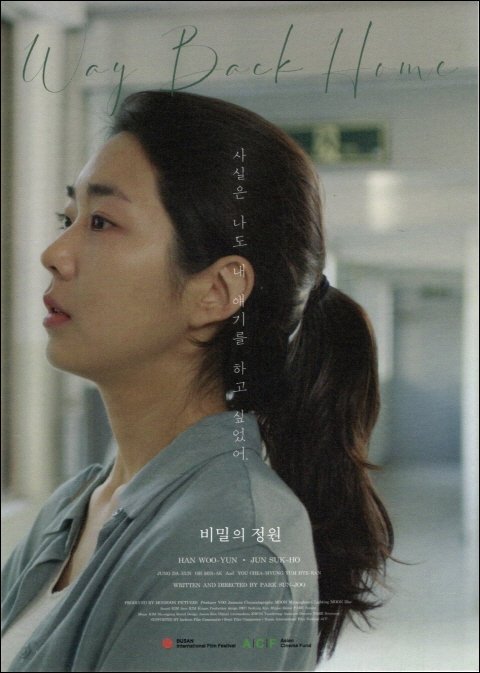
Way Back Home (비밀의 정원, Park Sun-joo, 2019)

Can you ever really “move on” from trauma, or do you simply have to learn to live with it? The heroine of Park Sun-joo’s Way Back Home (비밀의 정원, Bimil-eui Jeong-won) thought she’d made peace with the past by trying her best to forget it, but an unwelcome intrusion reminds her that it’s not only the echoes of something terrible that happened to her when she was very young that shaped her life, but everything that happened afterwards. Now preparing to move into a new phase, she realises that in order to start a new family she’ll have to repair her fractured relations with the old. 

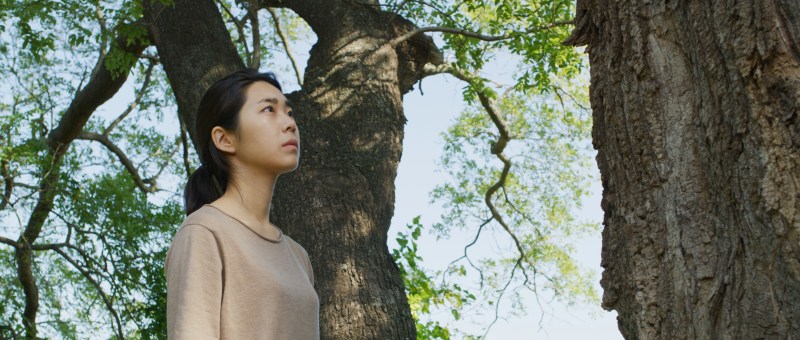
As a high school student, Jeong-won (Han Woo-yun) was abducted and raped by a stranger who was never caught. 10 years later, she’s in her mid-20s and is preparing to move into a family home with her husband, Sang-u (Jun Suk-ho), a carpenter who works with her uncle (Yoo Jae-myung) and aunt (Yum Hye-ran) in their studio while she also has a job as a swimming instructor. The couple are currently trying for a baby, but Jeong-won recently had a miscarriage and fears that the assault may have affected her ability to bear a child despite the doctor’s assurances that there is nothing medically wrong. Then, she gets an unexpected phone call from a detective in her hometown informing her that they’ve had a hit on the DNA from her case and think they’ve caught the man who raped her but need her to come in and verify a few details. 

Not really wanting to revisit the past she’d convinced herself she’d moved on from, Jeong-won ignores the policeman’s calls but after he contacts her mother (Oh Min-ae) and turns up at her door, alerting Sang-u, she has no choice but to face the matter head on. Sang-u is understandably blindsided, not quite sure how to deal with this very sensitive new information, wanting to be there for his wife but frustrated that she doesn’t seem to want him involved. He tries to talk to her about it, but she flatly explains that it’s not something she’s prepared to discuss with him. 

Intellectually understanding that his wife needs space, Sang-u can’t help but feel shut out, hurt that Jeong-won doesn’t feel comfortable allowing him into this extremely vulnerable space. Jeong-won begins to pull away, pretending that everything’s fine, getting on with packing for their move as if nothing had happened. Meanwhile, he begins to piece things together, realising that her past trauma must have something to do with her strained relationships with her mother and So-hui (Jung Da-eun), the younger sister she always seems to be reluctant to see. 

The traumatic event in itself is not the central source of Jeong-won’s suffering but the sense of rejection she felt from her family along with an internalised shame. Jeong-won’s mother sent her to live with her uncle and aunt because she thought it might be easier to move on in a different environment, but all Jeong-won felt was that her family no longer wanted her around. Jeong-won’s aunt thinks the reason she doesn’t want to see So-hui, who is around 10 years younger and therefore around the age she was at the time of the attack, is resentment in feeling that her mother sent her away to protect her younger sister from the social stigma of being involved with a case of sexual assault, but as might be expected the situation is far more emotionally complex than anyone is able to intuitively understand. 

So-hui, meanwhile, is also hurt, travelling to the city on her own to make sure her sister is alright because she isn’t answering her calls. Fearing rejection, Jeong-won distances herself from Sang-u, mourning the relationship she had with him which was founded partly on the fact he didn’t know and therefore existed in world in which the assault had never happened. She resents being worried over because other people’s concern only reminds her of her victimhood. During his summing up at the trial, the prosecution lawyer argues that Jeong-won’s life stopped in 2008 while her attacker went on living guilt free, leaving her to suffer alone. Jeong-won might not quite agree with that assessment, she thought she’d moved on and lived an otherwise happy, normal life despite the terrible thing which happened to her, but if she wants to move forward she will indeed have to face not only the source of her trauma but the familial fracturing which followed it, finding the way back home through emotional openness and understanding along with a willingness to be vulnerable in a place of safety.


Way Back Home screens on March 11/15 as part of this year’s Osaka Asian Film Festival.

Original trailer (English subtitles)

Introduction to the film by director Park Sun-joo from the Busan International Film Festival (activate English subtitles from the subtitle button)

Yellow Ribbon (당신의 사월, Ju Hyun-sook, 2019)

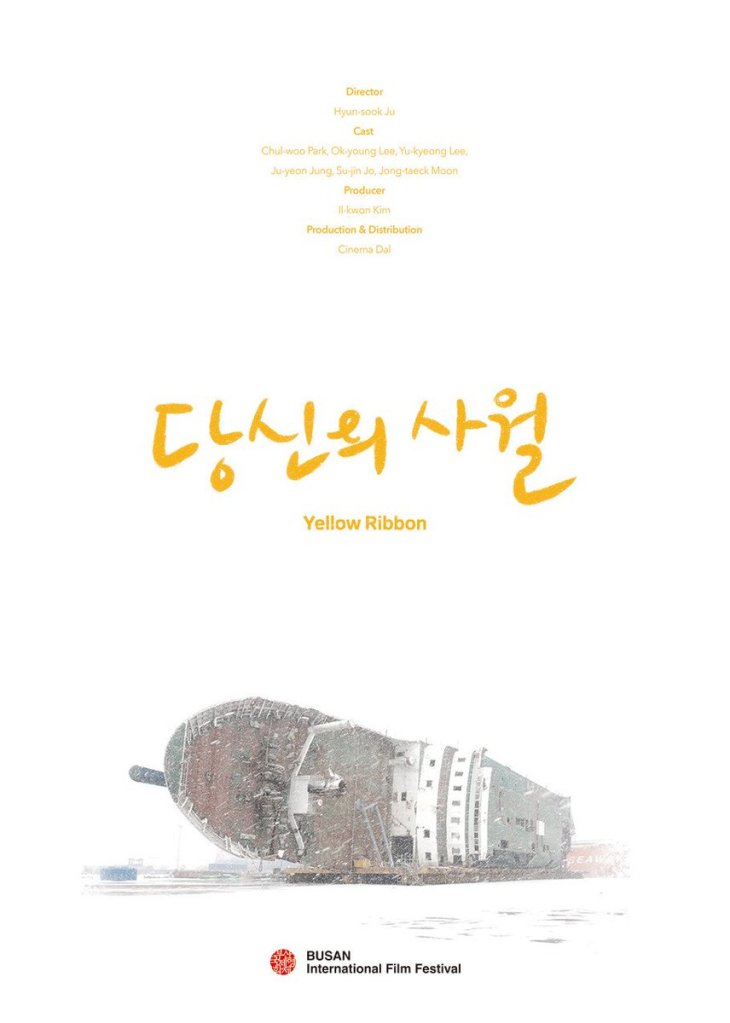
On 16th April, 2014, a ferry en route from Incheon to Jeju Island sank taking the lives of 304 passengers many of whom were high school students on a school trip. The Sewol Ferry Disaster went on to have wide-scale political ramifications, eventually feeding into the discontent with the government of Park Geun-hye who, it was discovered, had been uncontactable for seven hours during the height of the crisis, later refusing to account for her whereabouts. Ju Hyun-sook’s documentary Yellow Ribbon (당신의 사월, Dangsin-eui Sawol) is, in some senses, usual in that it follows not those directly bereaved by the tragedy but those caught on its edges, ordinary men and women who find themselves haunted by national trauma. 

What each so clearly recalls is the sense of helplessness that they felt as bystanders watching from the shore. All of them believed the passengers would be rescued, no one envisioned a tragedy unfolding, and so they were lulled into a false sense of security by the media’s mistaken reports that everyone had been saved. Fisherman Lee Ok-young was among the first to realise that the information being given out by the media was incorrect when he sailed out towards the ferry and saw the shadows of those trapped inside. In fact, many of those who were rescued from the wreck were saved by good samaritan boats who came to help, Korea’s coastguard didn’t show up until 40 minutes later. Ok-young is, however, among the most directly affected, later finding the body of one of the students caught on a rope he was using for seaweed farming. 

Ever present in the background, usually taking photos, is the young woman’s father – a constant reminder of the scale of the tragedy. It was dignity of the families which first struck Park Cheol-woo, the owner of a coffee shop in Korea’s political centre near the presidential residence of the Blue House. Hearing that the families were due to make a visit, he felt very strongly that they must be protected. Jung Ju-yeon, a woman in her 50s working in human rights education, felt something much the same and decided to participate in the protests alongside the bereaved parents in a show of solidarity. 

The government, meanwhile, continued to pursue its authoritarian line allowing pundits to brush off the disaster as no different from a traffic accident while trying the shame the protestors into silence. Hoping to blacken his name, the conservative press discredited a hunger striking father by bringing up the fact he was divorced, as if lying the tragedy at his own feet in an attempt to deflect the government’s responsibility for the failure to protect the children. The sense of abnegated responsibility is something which continues to weigh on teacher Jo Su-jin who finds herself meditating on the selfless teachers who sacrificed their lives trying to save their students. She wonders what she would have done in their position, reflecting on the choices which must have passed through their minds knowing that they too had family waiting for them.  

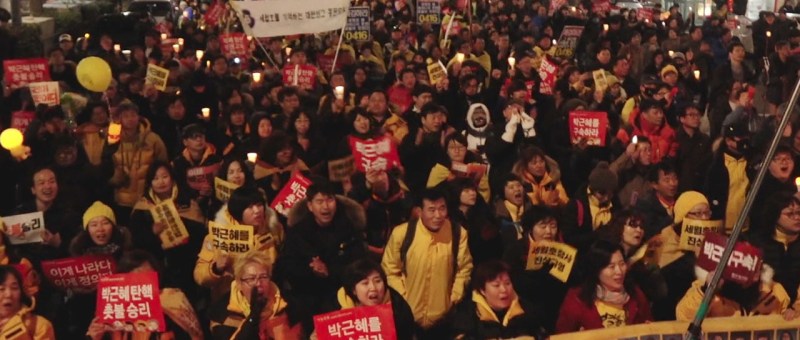
Park Cheol-woo wishes he could forget, but is haunted by the spectre of the tragedy, as is the husband of Jung Ju-yeon who was hired to create a series of illustrations and forced to relive the pain and suffering of all who were involved. The weight of indignation eventually fed into the Candlelight Protests which ultimately brought down the government of Park Geun-hye but the feelings of helplessness have not dissipated because justice has not been served and too many unanswered questions remain. There are no explanations for the confluence of circumstances which allowed the tragedy to happen, nor for the failure of authority which proved itself incapable of protecting its citizens.

Yet there are signs of hope. Lee Yu-kyeong was a high school student herself when the tragedy occurred, watching helplessly on a TV screen as hundreds of other kids just like her lost their lives. They trusted the authorities to protect them and they did as they were told, but the authorities let them down. Lee Yu-kyeong is now an archival studies student, hoping to contribute by honouring their memories, making sure they are never forgotten so that nothing like this ever happens again. Yellow Ribbon is a document of national trauma, but also perhaps of healing as those touched by tragedy attempt to look forward by building a safer society founded on a sense of mutual protection. 


Yellow Ribbon screens in Amsterdam on March 6/8 as part of this year’s CinemAsia Film Festival.

Trailer (English subtitles)

Introduction by director Ju Hyun-sook from the Busan International Film Festival (activate English subtitles by pressing subtitle button)

Princess Aya (프린세스 아야, Lee Sung-gang, 2019)

Animation made for children can often be a subversive affair, offering surprisingly progressive messages sometimes at odds with an otherwise conservative industry. Though quite obviously taking its cues from Frozen in terms of aesthetics and atmosphere despite its desert setting while drawing inspiration from classic fairytales, Princess Aya (프린세스 아야) is a sterling example, keen to sell the message that it’s OK to be different while emphasising that it’s prejudice and social exclusion which are the real enemy, creating only pain and resentment while those rejected by an intolerant society may eventually be consumed by their sense of betrayal. 

Long ago in a feudal society, a strange curse begins to affect children born in the small kingdom of Yeonliji which causes them to turn into animals after coming into contact with animal blood. Some believe that the curse is the revenge of animals hunted for sport, while the cursed children are, ironically enough, abandoned to live as beasts in the forest or perish. The Queen, however, cannot bear to part with her child, Princess Aya (Baek A-yeon), and sacrifices some of her own life force in return for a magical bracelet from a tree god that will prevent the curse from manifesting. Years later, Aya grows up into a feisty teenage girl, while the kingdom is threatened by an oncoming incursion from desert nation Vartar who want its water. The Vartan prince, Bari (Park Jin-young), has proposed a dynastic marriage with one of Aya’s younger sisters to broker peace, but Aya has no intention of letting her sisters face such an uncertain fate and insists on going herself. 

Of course, what she discovers, in true Korean period drama fashion, is that there’s intrigue in the court. Bari is not, as she feared, a hideous monster but a kind and handsome young man who is actively trying to prevent a war and protect Yeonliji (which is obviously what she wants too), but his treacherous uncle is ruling as a regent and secretly working against him. Meanwhile, attempts have been made on Aya’s life, and she’s lost the precious bracelet which allows her to keep her true nature hidden. 

The curse appears to be a punishment manifested on mankind for its cruel treatment of animals, forcing Aya to feel the suffering of living creatures in pain and close to death. While Aya does her best to fight the darkness, another creature known as the “Beast” has allowed it to consume him, feeding on sorrow and determined to take revenge on the society which has abandoned and rejected him. It’s rejection that Aya too fears, as perhaps does everyone and most especially young women, but hers is a deeper seated anxiety in that she’s uncertain what will happen if her true nature is discovered. 

Nevertheless, she moves towards an acceptance that her curse could also be a gift while beginning to believe that “no matter who I am I can be loved”. Yet she also feels a sense of guilt in using her amulet, knowing she is deceiving the prince, whom she’s come to admire, while fearing his reaction if she tells him the truth. Bari, meanwhile, is not so much hiding a secret as a lone figure of traditional nobility in a court filled with scheming intrigue. While his uncle plans to subjugate Yeonliji, Bari has been secretly drilling in the desert looking for water, admiring the flowers where they bloom even in adversity. 

Bari refuses to make his men slaves of war, while Aya insists that they need to rebuild their society with a greater sense of compassion. She is afraid of her “difference” and her destiny, longing to be free but afraid of being seen. Eventually she realises that connection can be a strength and not a weakness as can authenticity and mutual understanding. She refuses to abandon the Beast as her society had done despite his wickedness, still hoping to save and bring him into her hopefully kinder world. Princess Aya shows kids that being “different” is nothing to be ashamed of, that no one is unloveable (even evil Beasts), and that the Princess is perfectly capable of saving herself but it’s no weakness to accept help when you need it or to give it when others are in need. A charming musical fairytale, Princess Aya wears its progressive values on its sleeve, always allowing its heroine to chart her own destiny while finding self-acceptance along the way.


Princess Aya screens in Amsterdam on March 7/8 as part of this year’s CinemAsia Film Festival.

International trailer (English subtitles)

Moonlit Winter (윤희에게, Lim Dae-hyung, 2019)

It goes without saying that the world is very different now than it was 20 years ago, but change happens slowly and primarily benefits those who come later rather than those trying to live as it’s happening. The two women at the centre of Lim Dae-hyung’s Moonlit Winter (윤희에게, Yoon-hee-ege) are a case in point, painfully separated and forced into self-isolation born of internalised shame while perhaps filled with unspeakable longing. In a sense, they each live within that moonlit winter, a cold and lonely place yet not without its beauty. 

In Japan, an older woman, Masako (Hana Kino), mails a letter she finds lying around in her niece’s room, unsure if she’s doing the right thing but perhaps hoping for a kind of shift. Presumably, Masako cannot read the contents of the letter as they’re written in Korean (though later read to us in Japanese), and addressed to a “Yoon-hee”. It’s Yoon-hee’s daughter Sae-bom (Kim So-hye), however, who first picks it up and begins to realise, perhaps for the first time, that her rather distant, lonely mother is a woman too with a painful past she knows nothing of. Written with a kind of melancholy finality and the sincerity of a letter never quite intended to be sent, the heartfelt words hint at a past heartbreak in which the author, Jun (Yuko Nakamura), hopes that she won’t make the recipient uncomfortable but felt that she had to write to let her know that she still thinks and dreams of her after all this time. 

Finally receiving the letter, Yoon-hee (Kim Hee-ae) is not “uncomfortable” or at least in the way that Jun had feared she might be. Recently divorced after years of unhappy marriage to a drunken policeman (Yoo Jae-myung), Yoon-hee has a job in a canteen at a factory and lives alone with her teenage daughter who is in the last year of high school and preparing to head off to university in Seoul. Intrigued by the letter, Sae-bom begins to become curious about why her mother is the way she is. She tries asking her uncle, but he’s fantastically unhelpful, and then questioning her father but he only tells her that her mother is the kind of woman who makes others feel lonely. That strikes Sae-bom as ironic because she chose to stay with her mother after her parents’ divorce precisely because she thought she seemed the lonelier.

Jun, meanwhile, is a lonely figure too but perhaps wilfully so. She tells her aunt Masako with whom she’s been living all this time that she chose to come to Japan with her father after her parents split up because he didn’t care about her (hence why she’s always lived with the unmarried aunt), while she was all her mother ever cared about. In retrospect, it sounds as if, as she said in the letter, she ran away, afraid that her mother would notice something in her she did not want to be noticed. Perhaps Masako has noticed something too which is why she sent the letter, though she’d never bring it up directly. A well-meaning though tone deaf and entirely insensitive relative (Sho Yakumaru) tries to use the occasion of her father’s funeral to talk Jun into a blind date with his Korean friend, an offer she flatly refuses but he keeps badgering her anyway. Eventually she stops the car and insists on walking home at which point he realises you probably shouldn’t be matchmaking at a funeral but she cuts him off again, telling him that’s not the reason for her intense annoyance but stopping short of explaining what is. 

Jun has one of those faces, slightly mysterious, pensive as if she’s about to say something important but never actually does. Another woman (Kumi Takiuchi) thinks she recognises that quality in her and edges towards a kind of confession but Jun shuts her down, brutally telling her that the only secret she’s keeping is being half-Korean, advising that if she too has a “secret” she’d best keep it to herself. Even more than Yoon-hee, Jun has lived a life of isolation, too afraid to be her real self and terrified of being seen. 

But for the younger generation things are perhaps different. Sae-bom is at a romantic crossroads of her own, acknowledging that her high school romance may be about to end seeing as nice but bland boyfriend Kyung-soo (Sung Yoo-bin) is not exactly her intellectual equal and cannot accompany her to a university in Seoul. After realising that the sender of the letter is female, Sae-bom seems unfazed, still curious about this hidden part of her mother’s life and rooting for her to find a kind of happiness. In the habit of taking photos (using a camera which turns out to have been a present given to Yoon-hee as an apology from her mother for the family’s belief that there was no point in sending a girl to university) Sae-bom declares that she only photographs beautiful things rather than people, but takes photos of her mother all the time, capturing her at her most mysterious but rarely smiling. Railroaded into a life of conventional success that eventually failed, Yoon-hee has become an empty, directionless shell unable to live her own life while filled with an internalised sense of shame that leaves her feeling guarded and worthless.

Yet through the arrival of the letter she begins to reconnect with her younger self, her repressed desires, and impossible longing for Jun. With the gentle support of a daughter and aunt respectively, the two women begin to rediscover the courage to live, not necessarily in embracing romance, but accepting themselves for who they are and rejecting the sense of shame that has defined each of their lives. The winter may at last be ending and they may not yet have it in them to ask for the stars, but they’ll always have the moon. 


Moonlit Winter screens in Amsterdam on March 6/8 as part of this year’s CinemAsia Film Festival.

Original trailer (English subtitles)

Parasite (기생충, Bong Joon-ho, 2019)

“So metaphorical!” the ambitious son at the centre of Bong Joon-ho’s class war melodrama Parasite (기생충, gisaengchung) is fond of saying, and he’s right – it really is. “Hell Joseon” rears its ugly head again, only it’s not just the young who can’t climb out but mum and dad too. Sticking together all the way, this enterprising family have realised that the only way they’re going to enjoy the fruits of the modern society is by becoming hangers on, feeding off someone else’s perhaps unfairly gotten success, and if that means stomping on a few others just like them to get there then so be it. There’s no room for love or fairness in a class war. 

The Kims – mum Chung-sook (Chang Hyae-jin), dad Ki-taek (Song Kang-ho), and grown up kids Ki-woo (Choi Woo-shik) and Ki-jung (Park So-dam), all live together in a tiny semi-basement apartment in a rundown slum. Unable to find steady jobs, the family make ends meet with casual jobs like folding pizza boxes while cadging wi-fi to look for better opportunities. Better opportunities only arise, however, thanks to Ki-woo’s upper middle-class college kid friend Min (Park Seo-joon) who brings them a special gift from his dad of a stone said to attract wealth, and a hookup for Ki-woo with a possible job coaching the pampered daughter of a superrich tech entrepreneur. After faking his credentials, Ki-woo gets the job, and wastes no time at all bringing in his sister as an “art tutor” for the couple’s apparently “troubled” young son. Together, they conspire to get the chauffeur fired so dad can take over, and then plot to do the same to the housekeeper so mum can come too, colonising the house and living alongside the wealthy Parks with a view to someday ousting them. 

The house, a fabulously modern take on the traditional designed by a famous architect who sold it to the Parks when he moved to France, is a kind of “host” in itself. We might not all admit it, but there are few of us who would not want to live in a house like this, especially if we feel it has been deliberately placed out of our reach. The Kims are envious, yes, but not perhaps malicious. They simply want a kinder life, one free of the anxiety of always having nothing and then getting that taken away from you too. In a running gag, a drunk keeps peeing right in front of the Kims’ window, and later they literally find themselves drowning in a river of shit when torrential rain causes the local sewer system to backup and flood their fetid, low-lying slum forcing everyone into a makeshift “evacuation” centre where insincere public servants try to make excuses about not being bothered enough to make sure those with no money don’t drown just because it rained. 

The Kims aren’t bad people, but their desperation means they can’t afford to be kind. The true “villains” of Parasite aren’t the Parks or the Kims themselves, but the system which forces one set of oppressed people to oppress another. The Kims know they’re responsible for displacing people just like them – getting the driver fired, going after the housekeeper, etc, but they can’t afford to think about it, pausing only to wonder if maybe they found other jobs once they themselves start to feel comfortable. “She’s rich but still nice” Ki-taek says of Mrs. Park (Cho Yeo-jeong), only for his wife to counter no, “she’s nice because she’s rich”. Mrs. Park can afford to be nice because she has plenty. She has no need to worry about taking things from others, and is secure enough not to have to worry about people taking things from her. That makes her easy pickings for a family like the Kims, but it also hints that “niceness” is the natural condition of being human, the way we’re supposed to behave to each other in an ideal world where none of us are hungry or afraid. 

Then again, the Parks are not wholly “nice” even if they are polite in a superficial, wholesome sort of way. Mr. Park (Lee Sun-kyun) in particular has a curiously feudal outlook in which he is perpetually preoccupied with the idea of his servants “crossing the line”, making it plain that there is a clearly defined border between those who rule and those who serve. The Parks’ young son is the first to notice that the Kims all smell the same even if he does so innocently, they all obviously use the same soap and detergent after all. Mr. Park, however, later takes it further, complaining about the way Ki-taek stinks up his car, resenting the smell of “poverty”, the mustiness born of living with damp and mould. To him, the Kims are not so much different from stink bugs, squatting in his home, members of “the great unwashed” unfit for his society. 

He does, however, need them. The Parks are as dependent on the Kims as the Kims are on the Parks, and they all need the house. Unfortunately, peaceful coexistence seems to be a distant possibility in a world of such fierce inequality as to encourage the most casual of cruelties. “All you have to do is walk up the stairs” Ki-woo later tells his father, but that’s easier said than done, especially when everything is telling you that you’ll always belong in the basement. 


Parasite is released in UK cinemas on 7th February.

UK release trailer (English subtitles)

Tune in for Love (유열의 음악앨범, Jung Ji-woo, 2019)

Tune in for love poster 2The course of true love never did run smooth. Another in the recent series of nostalgic ‘90s romances, Tune in for Love (유열의 음악앨범, Yooyeolui Eumakaelbum) takes a pair of nervous youngsters and charts the course of their love story over a decade which, though not quite turbulent, saw its share of difficulties and a host of technological changes. “Miracles are nothing special” the heroine tells us, but when it comes to love miracles are all there is and in the end you’ll just have to learn to trust them.

On Oct. 1, 1994 Hyeon-u (Jung Hae-in) walks into Mi-su’s (Kim Go-eun) bakery looking for something with tofu in it. While inside, he hears the first broadcast of Yoo Yeol’s Music Album, a new morning program which seems to signal the beginning of a new era. Though Mi-su is quick to realise that the only reason someone would be desperately looking for plain tofu early in the morning is because they’ve just been released from prison, she decides to offer him a part-time job in the bakery where he becomes a member of the family alongside her “aunt” Eun-ja (Kim Guk-Hee) who’s taken care of her since her mother died. His past, however, refuses to let him go however much he tries to move away from it. Tracked down by his delinquent friends, Hyeon-u is unable to return to the bakery and will spend the next decade trying to do just that.

Fate parts the youngsters repeatedly, but always brings them back together again seemingly by chance. Military service, changes of address, miscommunication and changing technology all conspire to keep them apart but like any good rom-com the problems aren’t so much circumstantial as personal. A deeply wounded young man, Hyeon-u is taken with the familial atmosphere at the bakery because he feels a sense of acceptance he hasn’t anywhere else, but deep down he still doubts he deserves the “normal life” he so deeply craves. His friends doubt it too, always turning up unexpectedly to remind him of their shared trauma and the debt of guilt he can’t repay. His insecurity prevents him from sharing the source of his pain with Mi-su, keeping her somehow outside the bubble of his shame as the only one capable of knowing the “real” him. She meanwhile is frustrated in realising that he’s holding something back, hurt he doesn’t trust her enough to let him in, and worrying he’ll never truly be ready for full commitment. 

Nevertheless, though often apart they remain painfully in sync, until that is fate brings them back together. As young man with a checkered past and no safety net, Hyeon-u has to fight twice as hard to get ahead, eventually graduating high school and getting into college while supporting himself with part-time jobs. Mi-su, meanwhile, is burdened by the knowledge that she’s lost her mother’s bakery and is desperate to get it back. Dreaming of being a writer, she turns down an internship at the all important radio show to go for a steady job she’s told is at a publisher’s but is actually somewhere more like a print shop where she’s stuck doing incredibly boring admin work. Hyeon-u is unable to get back in touch with her after miraculously reappearing because he’s ashamed to admit that he ended up getting in trouble again thanks to his awful friends even though it really wasn’t his fault. She meanwhile confesses that a part of her was relieved not to hear from him because she too is unhappy in herself, feeling lost and confused, disappointed not to be living the kind of life she could be proud of. 

Times change, but their one constant is the radio show broadcasting every morning and providing additional though indirect methods of communication when they are otherwise unable to make contact. Pay phones give way to email and then to mobiles all the way into the early days of the smartphone era, but face to face conversation remains the most difficult. Mi-su gives up on Hyeon-u while he, ironically, probably does sort something out by having a good old fashioned punch up with his generally unhelpful friend. She wonders if she’s better off to make the “smart” choice rather than waiting on love. Hyeon-u is hurt that in the end she didn’t trust him, but is eventually made realise that the problem was that he didn’t trust himself. Then again, you can’t fight the power of true connection or the pain of its absence, all you need to do is a little fine tuning to make sure the signal comes through loud and clear.


Currently available to stream online via Netflix in the UK (and possibly other territories)

Netflix trailer (English subtitles)

Wanee & Junah (와니와 준하, Kim Yong-gyun, 2001)

What marks adulthood more than giving up on idealised first love? For the heroine of Wanee & Junah (와니와 준하) the time has come to grow up but the choice she faces is more complicated than that between the emotional safety of an unrealisable attachment and the risk of real connection because her love comes bundled with guilt tied to its potential inappropriateness and a traumatic loss which was its result. Yet Kim’s film, gloriously forgiving and open hearted, is less about the breaking of a taboo than it is an acceptance that choosing to move on is not a betrayal of romantic idealism but a very necessary path towards maturity.

26-year-old animator Wanee (Kim Hee-sun) has been in a relationship with 27-year-old aspiring screenwriter Junah (Joo Jin-mo) for the past year but though the pair live together and are happy enough, something seems to be missing. A phone call from Wanee’s mother begins to poke at what that might be when she reveals that Wanee’s step-brother, Young-min (Cho Seung-woo), is about to return (temporarily) from an extended stay in Europe where he has been studying abroad.

The news of Young-min’s possible return comes as something of a shock to Wanee, who perhaps feels she has betrayed him by beginning a relationship with Junah. As inappropriate as some may feel it to be, Wanee remains unable to let go of her love for her step-brother who returned her feelings and asked her to run away with him only to leave alone. Confessing her feelings to a third party, however, turned out to have terrible consequences which have surely made their love an impossibility no matter what barriers may have already been in place against it.

Meanwhile, the past is further resurrected by the return of Wanee’s high school best friend, So-yang (Choi Kang-hee), who is also still harbouring feelings for the absent Young-min. As teens, the three were always together and happy in each other’s company, seemingly not allowing possible romantic drama to ruin their easy connection though So-yang seems to have known that Young-min had someone else in his heart even if she doesn’t quite want to spell it out. She tries to warn Junah not to get too attached, that he clearly loves Wanee much more than she loves him and that Wanee may not find that an attractive quality. Wanee, indeed, does not – snapping at Junah when he buys a TV without discussing it with her not only for the usual reasons that he’s spent a lot of money on something frivolous rather than something he actually needs for his work, but because she thinks he probably bought it “for” her as a kind of comfort.

Junah, himself a little lost and lingering at a crossroads, “wavering between love and separation” like the hero of his “uncommercial” screenplay, seems to make these kinds of thoughtful gestures often, later reprogramming the TV to come on in time for Wanee to come home so that it won’t be dark and scary if there’s no one there. Wanee may originally find his solicitous attention claustrophobic, but eventually begins to see it for what it is while dwelling on the continued absence of Young-min. So-yang’s arrival completes the triangular symmetry of both relationships, signalling the distances travelled and not from their carefree youth.

While So-yang claims to have hit a period of insecurity in her chosen career as a photographer, Junah vacillates in defending his artistic integrity and Wanee repeatedly refuses a promotion, claiming to be just fine where she is. There is something about Wanee which is always waiting, arrested in that youthful summer longing for Young-min’s return. If she wants to move on, she’ll have to make a choice. Kim’s vistas are however broad and forgiving, he doesn’t condemn Wanee for an attachment which may be confused or misplaced and which others would brand inappropriate, only for her failure to embrace present love rather than past longing. Meanwhile he shows us other instances of successful barrier crossing love aside from the still unusual co-habitation of Wanee and Junah that sees So-yang brand her friend as “brave” in Wanee’s boss and his policeman boyfriend, and the easy camaraderie of the office where sign language is a fully integrated part of everyday life. A beautifully mature romance and an ode to letting go of old love, Wanee & Junah is a surprisingly affecting slow burn coming-of-age story in which two lost youngsters find themselves in finding each other in a mutual process of self actualisation.


Singapore release trailer (English/Chinese subtitles)