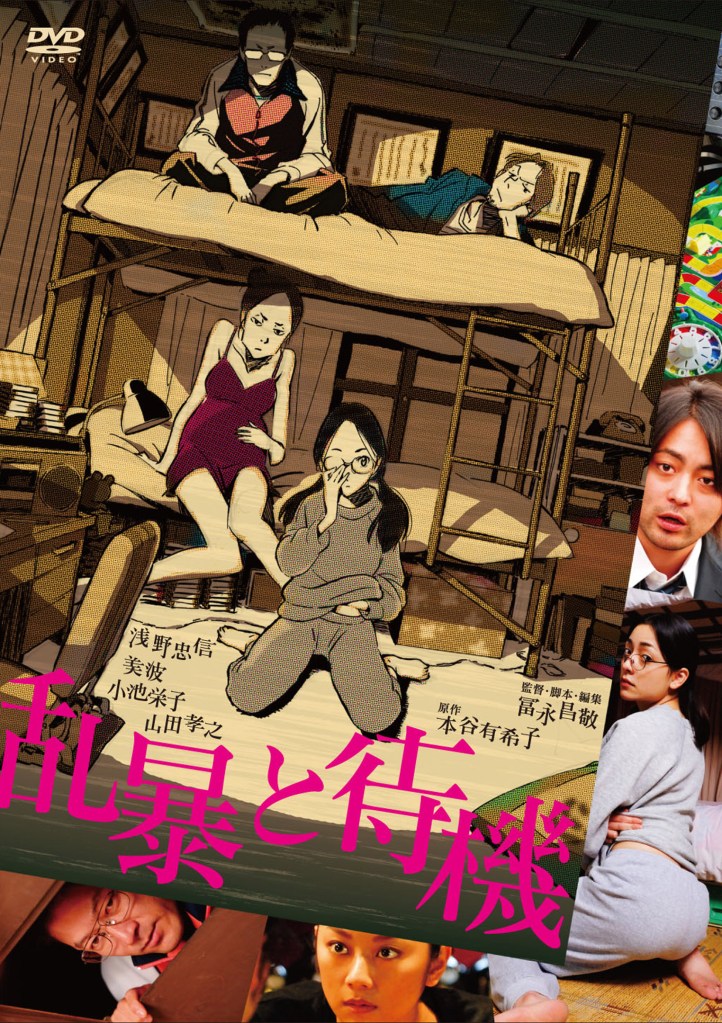
Vengeance Can Wait (乱暴と待機, Masanori Tominaga, 2010)

MFBDm_Tallcase_sell_CS3Vengeance is a dish best served cold, but then if you’re going to wait a while perhaps you should make sure to add plenty of salt and spice to the mix to disguise its rather rancid odour. Adapted from a play by Yukiko Motoya, Masanori Tominaga’s Vengeance Can Wait (乱暴と待機, Ranbou to Taiki) is the strange tale of four interconnected people who each become ensnared in a bizarre circle of violent revenge!

Asuka (Eiko Koike) and Banjo (Takayuki Yamada) are currently expecting a baby and have moved back to Azusa’s hometown where she is working in a bar and he is currently seeking employment (somewhat half heartedly). Whilst Azusa heads off to work, Banjo goes to introduce himself to the neighbours and surprises Nanase (Minami) during a lengthy sutra reading session. Nanase is a very strange woman indeed – dressed in a grey tracksuit, glasses, and generally looking odd, she immediately jumps to the conclusion that she’s annoyed Banjo with her weirdness and tries to give him money to make up for it, such is her intense fear of being disliked. Things get even weirder when Azusa realises Nanase is an old high school classmate towards whom she’s still nursing an ancient grudge. This also means that Azusa knows the man Nanase is living with and addresses as “big brother” is not her actual brother at all…..

Nanase becomes the plot’s essential “object” in a sense with Azusa acting as its subject and the two men more or less relegated to the status of adverbs. Azusa’s personality changes dramatically in the presence of Nanase – seemingly perfectly pleasant and ordinary in other circumstances, her tone takes on an extremely harsh quality, almost yanki-ish in its coarseness. However, Nanase’s need to be liked, or at least not disliked, has her immediately acquiesce to whatever it is she thinks other people want of her. She’s completely incapable of saying what she might actually think or doing what she would like to do but only thinks about how others are viewing her which is both extraordinarily masochistic and actually a little bit selfish.

The relationship between Nanase and her “big brother” Mr. Yamane (Tadanobu Asano) is the perfect culmination of this strange dynamic. Nanase philosophises at one point about the certainty of hate and the mysterious quality of love – that it’s impossible to say exactly why you love someone but you can usually point to a concrete reason for hating them. She and Yamane are bound by a common event in their pasts and, she reasons, perhaps this is enough of a reason for fate to keep them together. Yamane keeps her around because he’s plotting an elaborate revenge plot for a grudge he holds against her but at five years and counting he still hasn’t figured it out yet. During this time, he’s also started pretending to go out “marathon running” but has really been crawling into the attic space to spy on Nanase while she gets on with normal household tasks throughout the day.

Things come to a head when the feckless Banjo develops an attraction for Nanase despite her deliberately slovenly appearance which she affects for the express purpose of avoiding male interest. Using her inability to say no against her, he convinces her to start an affair with him whilst also blackmailing her that if she doesn’t he’ll mistreat his wife, Azusa, whom Nananse is still keen on making up with despite the long held high school era hurt which continues to come between them.

It’s a fairly light and absurd if darkly comic set up which is more about the pointlessness of grudges, violence, and lying about yourself to please others, than it is about a grander mediation on the fruitlessness of revenge – the desire for which, strangely, does end up building an otherwise elusive connection between two people who seem to have been unable to form one in any other way. Tominaga opts for a fairly simple and straightforward approach but does a great job of avoiding the often overly theatrical feeling of many stage to screen adaptations. However, it has to be said that perhaps some of the more unusual elements play better in the enclosed, less “realistic” theatre environment than they do on screen.

That is to say, Vengeance Can Wait has the feeling of slightly throwaway fringe theatre which is partly based on the frisson of mocking supposedly bourgeois values with a series of comically absurd episodes. This approach feels much more fun over a claustrophobic 90 minutes trapped in a tiny performance space which ends up covered in the physical manifestation of a deteriorating situation, but fares a little less well when you open it up into a larger filmic world. However, the film’s odd comments on accidentally sado-masochistic relationships and its absurd black comedy provide enough quirky diversion to build an appropriately amusing atmosphere.


Interestingly enough, Vengeance Can Wait is one of the few Japanese plays which has been translated and performed in English (it’s also unusual because it seems to be a direct translation whereas most English adaptations of foreign plays are “rewritten” by an established playwright from a literal translation) – performance rights with Samuel French. There’s also a review of the run of the play in New York in 2008 from Village Voice.

unsubtitled trailer:

Cesium and a Tokyo Girl (セシウムと少女, Ryo Saitani, 2015)

CesiumCaesium is a chemical element which has the distinction of being one of the very few metals which remains liquid at room temperature. These days you’re most likely to hear about one of its isotopes which is produced as a result of nuclear fission and can pose a serious environmental problem following a nuclear related disaster. Caesium comes to be something of an obsessive concern for the 17 year old heroine of Ryo Saitani’s debut film, Cesium and a Tokyo Girl (セシウムと少女, Cesium to Shojo), as Mimi comes to connect the presence of caesium in the water with the constant soreness she’s been experiencing with her tongue since the disaster hit.

A fairly normal teenager, Mimi is a precocious student, obviously bright but undoubtedly forthright and unafraid to correct her teachers should they make a mistake (she is also entirely unaware of the way her direct manner may make other people feel). She lives a comfortable life with her successful father and cheerful nursery school teacher mother and even makes sure to visit her grandmother who is ill in the hospital.

One day, she runs into a strange man during a thunderstorm who claims to be the god of thunder and also knows lots of other supposed deities currently living out their immortal existences in the modern Japan. When grandma’s beloved mynah bird, named Hakushu after the famous poet Hakushu Kitahara, suddenly ups and flies away, Mimi hits on the idea of trying to get some of her new found omnipotent friends to help her though the quest to track down one missing bird ends up leading her on a strange odyssey through time and geography as she follows a meandering path through Japan’s modern history.

Like many people following the Great East Japan Earthquake and the accompanying tsunami, Mimi has been left with deep seated existential doubts which prompt her into a deliberate consideration of the way she’s living her life and what might happen to her in the future. Using the unique powers of the gods, she travels back in time to 1940 and experiences the life her grandmother led at her own age but in very different circumstances. These wartime episodes don’t shy away from uncomfortable historical truths as her grandmother loudly and proudly extols the virtue of the nation’s “ally” Adolf Hitler whilst singing a patriotic song penned by her favourite poet, Hakushu Kitahara, who, at this point has lost his sight due to complications from diabetes and will eventually pass away in 1942 never knowing the outcome of the war.

Joining the seven gods as a kind of Snow White figure, Mimi’s life takes a surreal turn filled with cheerful musical sequences which run the gamut from a cute kids song to an oddly ‘80s inspired dance sequence as her grandmother meets sailor granddad to be. Saitani also ropes in another few top animators to come up with some impressively designed scroll painting inspired set pieces to give us a suitably ancient backstory on our gods as well as adding some humorous stop motion and brief pop-art inspired moments to make what could be a fairly heavy condemnation of recent history and the rise of nuclear technology into a fun and quirky comedy.

That said, there is a tendency at certain points to fall into an educationalist mood leaving things feeling like an entertaining for schools programme rather than a comedy with an ingrained streak of social commentary. Saitani began his career working with the similarly ironic Kihachi Okamoto and you can definitely see a lot of Okamoto influence in Saitani’s approach to his material as he adds in layer upon layer of surreal playfulness but always anchors his flights of fancy in a serious concern. Bright and cheerful it may be, but the ideas are anything but trivial.

The gods are not angry, exactly, just disappointed. We’ve been given this beautiful gift of bountiful green forests and flowing rivers and yet we’ve shown so little interest in taking care of it that much of it is withering before us like a forgotten houseplant after an extended holiday. However, the final piece of advice given to Mimi is that perhaps we need to stop harping on the past and concentrate on making the most of what we have right now, only that way can we begin to undo some of the damage that we’ve done in our relatively brief time as the dominant species and finally face up to our responsibilities as caretakers of our planet.


Reviewed as part of the SCI-FI London Film Festival 2016.

Unsubbed trailer:

Dual City (デュアル・シティ, Yokna Hasegawa, 2015)

dual cityCyberpunk and Japan are a match made in heaven though, it has to be said, it’s often been much more an inherited influence in international pop culture than something which has originated directly in Japan. Yokna Hasegawa’s Dual City (デュアル・シティ) puts this to rights a little with a politically infused tale of Japan in 2034 – a nation divided and engaged in a wider information war with the little guy at the mercy of evil corporate giants.
The year is 2034, following a civil war Japan has been divided in two with a north/south border located at the feet of Mount Fuji. Our protagonist, Yoriko, is a nurse and mother working in the North sector which is definitely thought of as the least advantageous place to be. When her hospital is raided by guerrilla soldiers, Yoriko finds herself in the relatively lucky position of last survivor but is then charged with assisting this “resistance movement” by taking over from the soon to be dead insurgent, Gou, and completing his mission of carting a mysterious suitcase across the border.

Once in the south, we’re introduced to the rest of the band including the dynamic Ayumi who can’t seem to forgive Yoriko for the loss of Gou. The gang’s ultimate goal is to expose the shady Nephe corporation who, aside from their business interests of arms dealing and android production, have begun building a virtual world known as “information life” which is constructed through harvesting the memories of Northern corpses. Yoriko lost her daughter to terrorist aggression and the idea that she might be able to see her again, albeit in virtual form, is one which she is unable to pass up.

Adding to the intrigue is the love story between a resistance member and an android which may or may not come to be a liability and the hacker group’s involvement with the steady stream of illegal migrants somehow making the dangerous cross border journey into the relative safe haven of the South. Many of these people have injuries or ailments that would be best served by a doctor, but having no proper papers they can’t risk a hospital and so the care that Yoriko can provide becomes another useful asset for the group.

Drawing parallels with other “divided” nations, Dual City looks at a multitude of contemporary social and philosophical problems from dealing with refugees fleeing an oppressive regime to the power of multinational corporations and the eternal quality of a mother’s love. Nephe (represented in a futuristic ad campaign starring Third Window Films’ Adam Torel as its heinous CEO) commits the very worst kind of identity theft as it steals and repurposes the very soul of those that it has killed by sucking out their memories and using them to create artificial counterparts in their online world. Are these ghosts in the machine any less “real” than their flesh counterparts were? A standard question of the cyberpunk world and one which still has no clear answer, but Dual City continues to explore it in a mature and nuanced manner.

Though an undoubtedly low budget, indie movie Dual City makes a decent job of creating its realistically grimy cyberpunk world with its interactive video screens and invisible techno warfare. Special effects, though sparse, are effectively achieved and never call attention to themselves. Dual City is actually the second part of a projected trilogy with the overarching title of Japan Year Zero (following the 2014 short Illuminations) but is perfectly intelligible even without knowledge of the previous film and manages to create a sense of a bleak, oppressive society which travels along with Yoriko from the totalitarian North to the supposedly freer South. Eventually Yoriko’s love for her daughter transforms and becomes something larger, an eternal and infinite love for all mankind that represents our last, best hope for peace. It only remains to be seen if the troubled society of 2034 can can learn to follow a similar road.


Reviewed as part of the SCI-FI London Film Festival 2016.

On a side note, Illuminations seems to be the film Hoshi Ishida was talking about when I interviewed him (for UK Anime Network) a couple of years ago. Small world! I would like to see the movie but it doesn’t seem to be available anywhere, maybe one day. Here is a trailer for Illuminations:

You can also keep up with director Yonka Hasegawa’s work via her website and twitter feed!

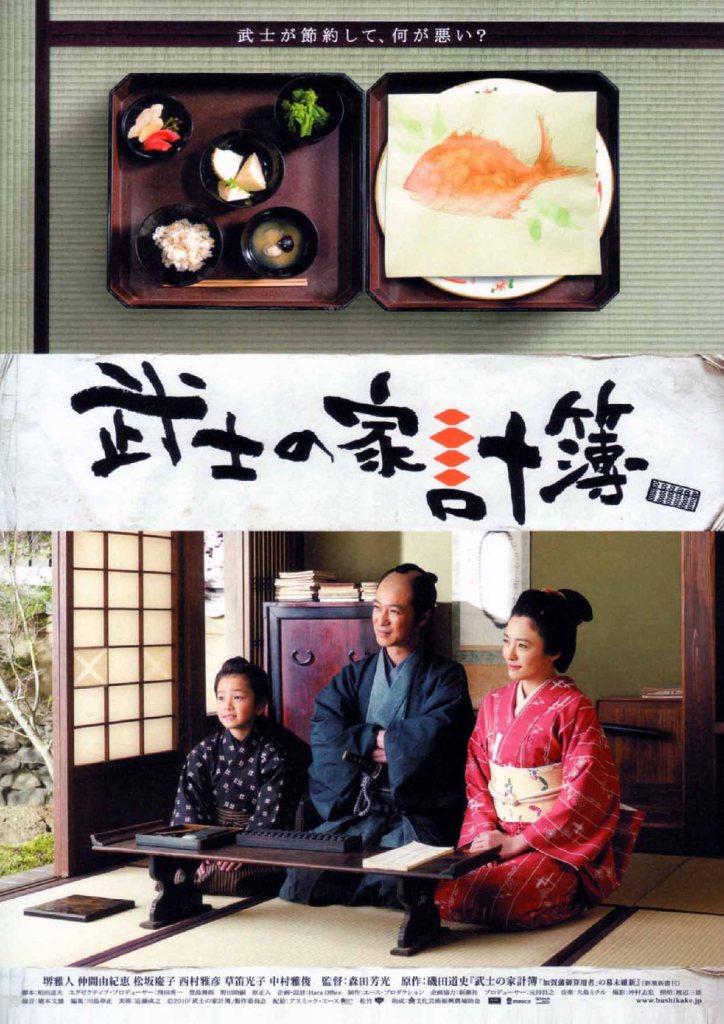
Abacus and Sword (武士の家計簿, Yoshimitsu Morita, 2010)

•Žm‚̉ƌv•ë•The stories of samurai whose soul is placed not in the sword but in another tool are quickly becoming a genre all of their own. Coming from the same screen writer as A Tale of Samurai Cooking: A True Love Story, Abacus and Sword is a similarly structured tale of penny pinching samurai accountants and a pean to the undersung heroes of the admin department without whom everything would fall apart.
Abacus and Sword (武士の家計簿, Bushi no Kakeibo) could almost be titled “a story of my father” as it begins with a voice over by the youngest adult generation seen in the film, Nariyuki Inoyama, who is at the time of speaking a naval accountant in the new post restoration world. As good an account as he is (and he must be, given his position), he feels he pales in comparison to his father, Naoyuki, whose skills with the abacus were somewhat legendary even if his people skills were often not on the same level.

Dubbed an abacus fanatic by his colleagues, Naoyuki’s top maths abilities get him into trouble right away when he notices an extreme discrepancy in the accounts details for the imperial rice dole. Around this time there are riots from farmers who are being squeezed to deliver more grain to the authorities during a time of famine but not seeing enough returned to them as well as starving people petitioning for food in the streets, so when Naoyuki asks why around a third of the rice is disappearing from the accounts or listed as “reserved” his superiors start getting nervous. As a mini underling, Naoyuki is not in a position to stop his bosses from exploiting their authority in the most devious of ways – creating a food panic and then profiting on the side through black market trading, and is simply instructed to “ensure the final accounts balance”. Unwilling to falsify his precious calculations, Naoyuki finds himself facing the possibility of exile from the imperial centre but eventually finds his persistence rewarded when the scam is finally uncovered by a higher level.

Accountants are often not respected in this era of samurai warriors who place an almost religious faith in the power of the sword. Their pay is low, hours long and taxing, and they have little prospects of advancement. After hearing the story of Naoyuki’s career Nariyuki returns to the subject of himself a little more as the conflict between austere father and wayward son takes centre stage. Naoyuki is a pragmatic man, he sees their family debts are unsustainable and embarks of prolonged plan of austerity in which he forces the entire extended family to sell all their non essential possessions and live as cheaply as possible until the debts reach a more manageable level so they can at least keep the social position their larger family home affords them rather than being moved to something less prestigious. This is an unusual move in status driven samurai circles and proves embarrassing for the rest of the family such as in one episode where Naoyuki can’t afford to buy fish for his son’s coming of age ceremony so simply puts a painting of a fish at each place setting. Creative accounting at its finest!

Nariyuki, however, can’t quite give up on the idea of the sword and goes off to fight in the various civil wars which erupt during the Meiji Restoration causing great worry to his parents, wife and children. He too becomes an accountant and is at first disappointed that it’s his skills with an abacus that can best serve the country rather than those needed on the frontlines but later comes to understand the tactical importance of maintaining the smooth financial functioning of an army.

A late career effort from the prolific Yoshimitsu Morita, Abacus and Sword is an uneven experience which is more or less devoid of the director’s usual attempts at experimentation pushing for a more general, sometimes even televisual approach to storytelling. At heart the film praises the virtues of living a thrifty, honest, and balanced life in which hard work is always fairly rewarded in the end and even when not provides its own set of rewards. However, virtuous as it is to live honestly and simply in tune with the clack of an abacus, it can prove fairly dull which is unfortunately also true of Abacus and Sword which despite brief episodes of light humour never quite engages with its twin dynamics of father son conflict which echoes that of the changing world as it emerges into the new Meiji era, and of shining a light on the forgotten admin workers who keep the world turning when everything else is falling apart. Morita’s anti-consumerist, transparency in government sympathies come to the fore and are once again timely, but like Naoyuki he fails to make his complaints sufficiently engaging to ensure his messages are received by those with the ability to take action.


English subtitled trailer:

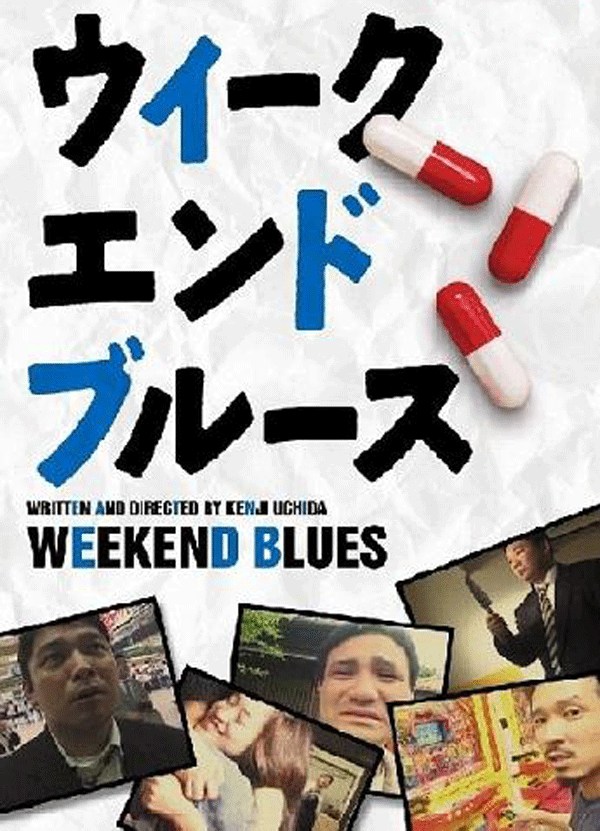
Weekend Blues (ウィーク エンド ブルース, Kenji Uchida, 2001)

weekend bluesKenji Uchida travelled to America’s San Fransisco State University to study filmmaking before returning to Japan and making this, his debut film, Weekend Blues (ウィーク エンド ブルース) which later went on to claim two awards at the prestigious Pia Film Festival for independent films earning him the scholarship which enabled his next film, A Stranger of Mine. However, Uchida’s film, though resolutely his own, individual creation, plays much more like the Japanese indie movies of the time and particularly those of the similarly considered, if drier, Nobuhiro Yamashita than it does to late 20th century American indie or the mumble core movement.
As in his later work, Uchida builds around a finely constructed farce only this time the central conceit is a bout of amnesia suffered by the central character, Kensuke, who is a depressed salaryman still reeling from his ex-fiancé’s sudden exit from his life. He takes solace in his one solid relationship – that with his committed slacker friend, the similarly named Kenji. However, on visiting Kenji’s apartment one Friday night he discovers Kenji has gone and got himself a girlfriend. Kensuke gets extremely drunk and also tries some of the weird drugs that Kenji has got from somewhere or other before accompanying Kenji’s new squeeze, Ayumi, on her way home.

That’s the last thing Kensuke remembers before waking up in a faraway town. On returning to Kenji’s flat he’s shocked to learn it’s actually Sunday already and he has absolutely no idea what’s been going on for the past 48 hours.

Jumping to the natural conclusion that the drugs are to blame, the two Kens descend on the dealer who seems to be some kind of man scientist researching a formula to give the “wimpy” men of today some of their caveman swagger back. Ironically named “samurai” the drugs themselves are more of a Mcguffin but provide a key into this world of nervous, unambitious, soon to be middle-aged men who’ve each had their girlfriends poached from under their noses by the more socially successful. A parade of jilted lovers passes by until we reach the more psychotic set who’ve decided to embrace some decidedly dodgy methods in order to ensure they won’t be humiliated and run out on ever again.

Uchida also adds another level to the amnesia based shenanigans with a sideline in internet dating where everybody is lying to everyone and presenting version of themselves that’s very much idealised. Kenji has told his prospective girlfriend that he’s a successful high earner despite the fact he doesn’t actually have a job at all, but at least his interest in the new woman has persuaded him to try and get back into the employment market so his full scale frauds can be demoted to gentle half-truths before things (hopefully) start to get more serious. In turn, his new lady love, Ayumi, may not be all she seems either.

Kensuke’s larger philosophy lies in a need to be needed. Now that his fiancée has left him, discovers he was no longer necessary to her anymore, Kenji feels himself a man without purpose and the prospect of simply continuing like this for another fifty years is beginning to frighten him. Again there’s a wider question here about interconnectedness (which is also the heart of any farce) in the supposedly “connected” world in which you can pick up a true love fantasy by lying about yourself on the internet – even if the mutual misrepresentations end up spinning their own pretty web of deceit in their own sweet time

Uchida’s first film is a necessarily low budget, indie effort but makes no apologies for itself or claims of being anything more than it is. That said, the performances are universally strong and the direction often interesting even given the obvious budgetary constraints. A very modern kind of farce which also looks back the salaryman comedies of the ‘60s, Weekend Blues is a good indication of Uchida’s future direction whilst also succeeding as an enjoyably off the wall comedy in its own right.


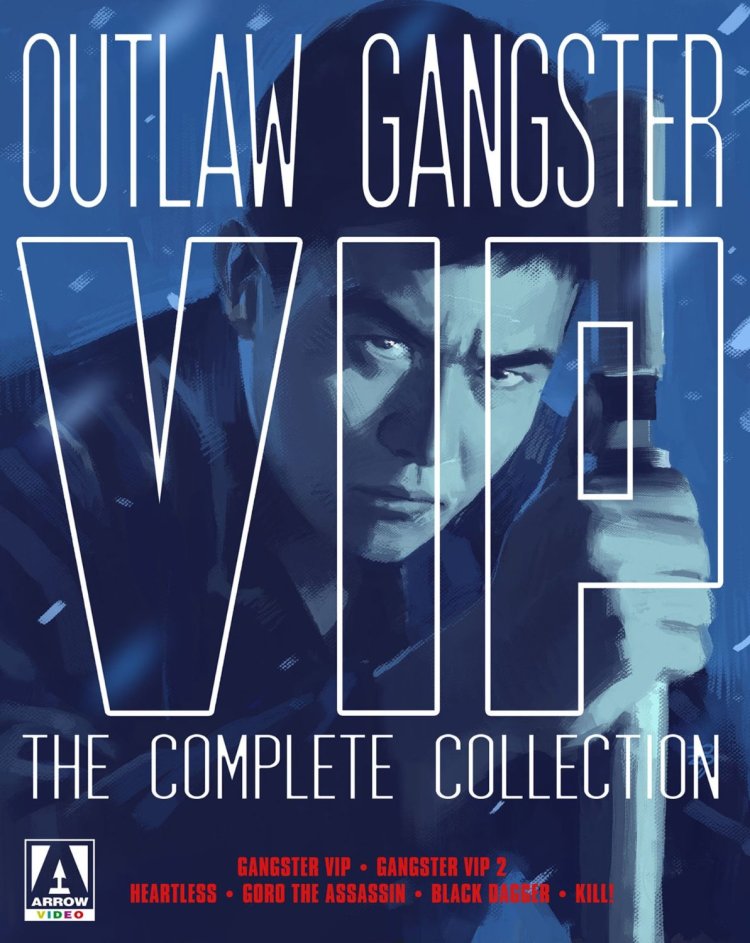
Outlaw: Gangster VIP the Complete Collection

outlaw gangster collectionReview of the Outlaw: Gangster VIP the Complete Collection dual format box set from Arrow Films first published by UK Anime Network.

There are two distinct eras of yakuza movies in Japan – the “ninkyo eiga” strand of traditional, noble gangsters acting out of a sense of loyalty and honour and the “jitsuroku” approach exemplified by Kinji Fukasaku’s Battles Without Honour and Humanity series which sought to show yakuza life for what it was – short, bloody and ultimately pointless. The Outlaw series provides a perfect bridge between the two as it’s based on the true life memoirs of former yakuza Goro Fujita but opts for a genre hybrid by essentially reframing the popular youth movies of the day as gangster noir rather than the down and dirty naturalism of Fukasaku’s magnum opus.

The Outlaw series consists of six films though only the first two are in direct continuity with each other. Gangster VIP 1 & 2 begin the saga of noble hearted gangster Goro who was orphaned when his mother died of illness during the war leaving him to look after his younger sister who also later dies either of illness or of malnutrition becoming the first of the women Goro is unable to save. He ends up a street kid and is eventually sent to reform school from where he escapes with an older boy, Sugiyama, who later resurfaces as a member of a rival gang in Part 1. These two films also chronicle Goro’s ongoing romance with the innocent Yukiko who falls in love with him after he saves her from a gang of thugs.

However, after Gangster VIP 2, the series has little internal continuity and the saga of Goro and Yukiko falls silent. This is actually a little confusing as many of the actors from the other films in the series frequently turn up playing entirely different characters, not least Chieko Matsubara who plays Goro’s love interest in every film but is actually a similarly named yet entirely different woman each time even if she also has a very similar backstory to that of Yukiko in the very first film.

Each chapter follows the same basic pattern – Goro gets out of prison/moves/goes looking for someone and ends up getting into trouble with the local gangsters despite his intense desire to leave the yakuza world behind. The chance of salvation is always offered in the form of Chieko Matsubara who plays exactly the same character each time even though she has different names and falls in love with Goro a little quicker with each passing frame. Goro is the noble hearted wanderer so he always opts to sacrifice his own potential happiness rather than get other people mixed up in his bloody and unpredictable gangster world.

The first few films in the series are more deeply rooted in the post-war past with the major theme being the loss of family and the yakuza providing a home for those otherwise without hope. Having been orphaned and left to starve on the streets, cruelly ignored by passersby and the society at large, men like Goro were forced to form associations with each other for survival and to turn to crime through lack of other options. Given the perilousness of their times, even the yakuza brotherhood is uncertain and these relationships are hollow and ever changing – a far cry from the unconditional love and support supposedly offered by the traditional family unit.

Moving on slightly, the series grows up with Goro as he moves form lamenting his rootless nature to an inability to put down roots for himself as he knows that his dangerous lifestyle is not something he wants to bring a wife, and particularly children, into. Things never end well for the married yakuza in these films who often see their wives or girlfriends kidnapped, raped or used against them in some other way and the overriding message is that love is both a weakness and an irresponsible indulgence for those who live or die by the sword.

The series features three different directors with Red Pier director Toshio Masuda helming the first which is perhaps the most accomplished even if Masuda is often criticised for not having a distinctive style of his own. Keiichi Ozawa picks up for parts 2, 4, 5, and 6 which each more or less follow the style laid out by Masuda though he does add in a few flourishes of his own including a very groovy showdown in a contemporary nightclub in the final film. Part three, Heartless, is directed by Mio Ezaki and is perhaps the weakest in the series though does at least break with the style and direction a little more than might be expected whilst adding a few thrills along the way.

The Outlaw series has perhaps not been fully appreciated outside Japan but now hopefully will be thanks to this excellently put together set from Arrow. The series as a whole feels a little safe at times and often pulls its punches where it had the opportunity to push for something with more bite but its doom laded tale of a noble gangster with a ruined heart is the kind of effortless, nihilistic cool that is hard to beat. Another excellent offering of Nikkatsu Noir mixed with existential youth movie and yakuza trappings, the Outlaw series is a long overdue addition to the world of Japanese action movies and one that every genre enthusiast will be eager to explore.


Outlaw: Gangster VIP the Complete Collection is currently available in a region free dual format Blu-ray/DVD box set in both the US and UK.

Trailer for the series as a whole:

Links to reviews of all six films:

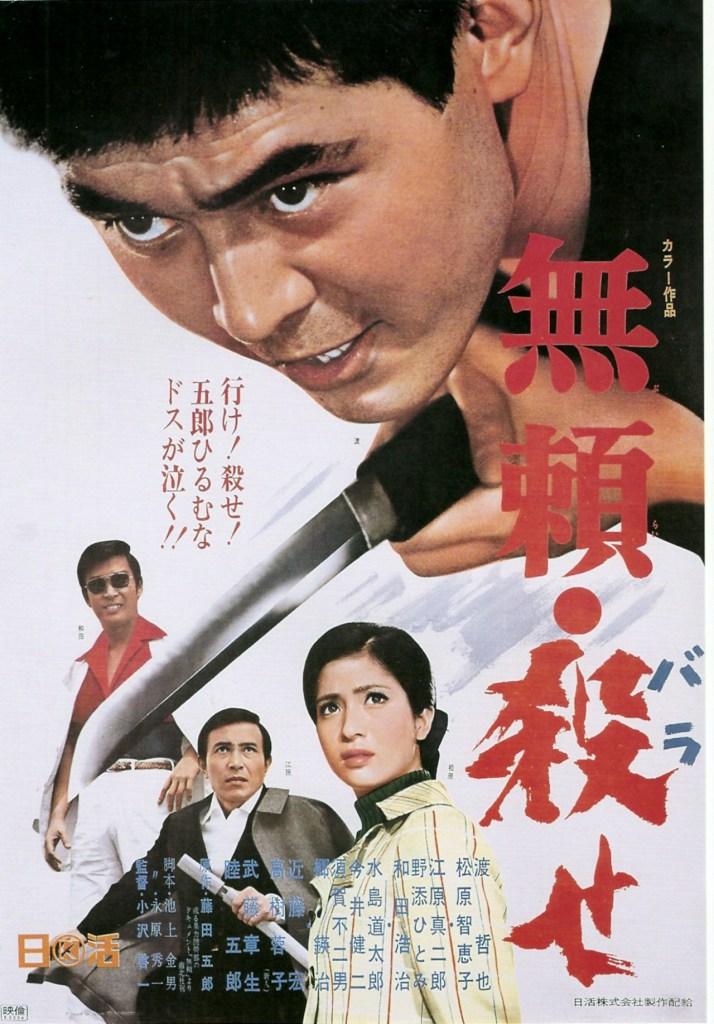
Outlaw: Kill! (無頼 殺せ, Keiichi Ozawa, 1969)

outlaw killGoro, Goro, Goro – will you never learn? Maybe he will because this is the last film in the series! Appropriately titled Outlaw: Kill! (無頼 殺せ, Burai Barase), this sixth and final film in the Outlaw series sees Goro once again moving to a new town and trying to lead a more honest life but unfortunately he’s wandered in at just the wrong time because a local gang boss has just been sent to prison after defeating a group of assassins leaving a dangerous vacuum and leading, therefore, to the outbreak of a turf war.
Goro’s first fight is with a gang of thugs who were hassling an elevator girl in a department store – the girl being Yumiko, played by Chieko Matsubara, becoming Goro’s love interest once again. Luckily or unluckily, Goro runs into an old friend from his prison days who is also one of the gang bosses involved in the turf war. After his friend promises him that he will incur no debt from him and he won’t get in the way of Goro finding a proper job, Goro agrees to move in with him and his wife – who only turns out to be the sister of elevator girl Yumiko which is not even the most predictable coincidence in this whole saga.

Despite his protestations about not getting involved in local gang politics, Goro’s attachment to his friend and his growing family means he can’t altogether avoid getting pulled back into the messy gangster world of violence and betrayal. Things end up going just about as well as they ever do and Goro is only able to clean up some of the chaos in this disputed area by creating even more counter chaos.

The format is becoming tired by the time we reach Outlaw: Kill! and it’s true that the film revisits exactly the same narrative beats as all of the other films, though it does so in a fairly exciting fashion. That said, there’s much less nuance here – we get that Goro sees himself as a lonely drifter who doesn’t deserve happiness, a self hating yakuza who is engaged on a long and hopeless walk to the grave. Perhaps it’s just because everyone’s getting older, but now it’s less about never having had a home or a proper place to belong than it is about the (im)possibility of building your own family. Goro’s friend, Moriyama, is married and going to be a father which Goro thinks is a nice thing, broadly, but also worries about what is means for a yakuza who may be killed at any second to have a wife and a child dependent upon him. Goro, being the noble sort of fellow he is, has decided that romance is irresponsible if you’ve already pledged your heart to the outlaw’s creed.

Once again directed by Keiichi Ozawa, Kill! sticks to the formula of his other offerings in the Outlaw series but opens with stylish series of colour filter stills rather than the action filled title sequences of the previous films. The fight scenes are exciting and actually quite bloody but perhaps not as innovative as some of those seen earlier in the series. In an interesting mix of old and new, Ozawa stages his final fight in a club but this time it’s a very contemporary night spot filled with guys and girls dressed in stylish, colourful outfits whilst a hippyish rock band play a cover of a famous pre-war ballad. Swooping around, notably shooting one sequence through a transparent floor/ceiling, Ozawa seems to be pushing forward more, breaking with the traditional ‘50s aesthetic for a new and crazy, youth counter-culture inspired moment which looks forward to the Stray Cat Rock series much more than back to the now ancient ninkyo eiga or sun tribe films.

Maybe Goro’s had his day too as Kill! ends in pretty much the same way as all but one of the previous films with Goro staggering away from the destruction he has wrought into a barren and snow filled landscape. Doomed to be a wanderer forevermore, Goro is a relic of the cruel post-war world which never gave him a break but his story’s now old hat. A man without a home is left forever alone, marching onward to the next confrontation or the final relief of a lonely grave.


Outlaw: Kill! is the six and final ( 😦 ) film included in Arrow Films’ Outlaw: Gangster VIP The Complete Collection box set (which is region free on DVD and blu-ray and available from both US and UK).

English subtitled original theatrical trailer:

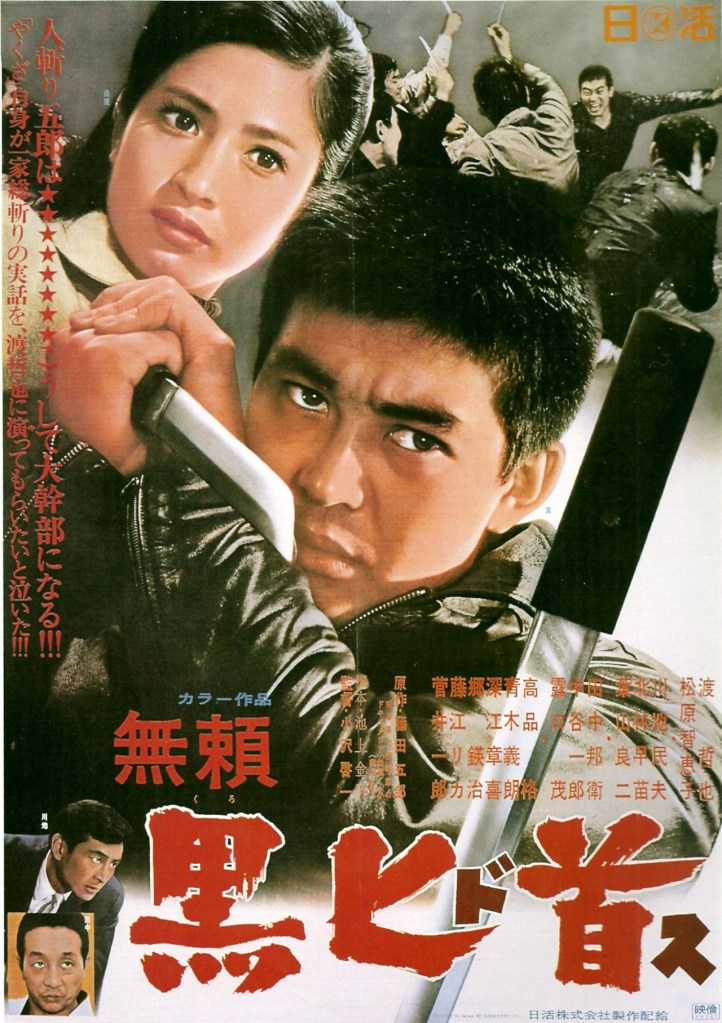
Outlaw: Black Dagger (無頼 黒ヒ首, Keiichi Ozawa, 1968)

outlaw black daggerGoro (Tetsuya Watari) just can’t catch a break. He sends his one true love off on a train to safety only to see her dramatically return because she can’t bear to leave his side. Her devotion costs her her life as she places herself between Goro’s manly chest and an assassin’s knife. Heartbroken, Goro gets out of town only to run into another old flame who is now a mama-san and has apparently married another yakuza (despite the fact that Goro parted with her because of his chaotic yakuza lifestyle). As usual, the past won’t let him go – this time in a more literal sense as Goro encounters another woman who looks exactly like the girlfriend who died in his arms….
This time for the fifth instalment in the Outlaw series, Black Dagger (無頼 黒ヒ首, Burai Kurodosu), it’s not so much family as romance which takes centre stage as we witness just how dangerous it can be to fall in love with a yakuza. Yuri (Chieko Matsubara), the girlfriend Goro couldn’t save, died because she loved him too much.  Saeko loved him too – he succeeded in getting rid of her but she ended up rebound married to another guy who kind of looks like him but isn’t as good, and now there’s Shizuko (Chieko Matsubara again) – a warmhearted nurse who’s once again fallen for Goro’s noble tough guy act. Goro knows the price of love and he thinks he’s no good so he tries to avoid letting himself fall, both for his own safety and for his prospective love, but in the end the one fight he can never win is the one against his own heart.

Oddly Goro gets on quite well with Saeko’s husband, though he’s not keen to get involved with his troubles. He warns him that it might be better to let Saeko go as in the end yakuza only cause suffering for their women and soon enough Goro is proved right when the local gang become intent on pimping Saeko out leaving her husband pretty much powerless to resist.

Apparently this cuts both ways as a sad song from a band of street musicians recounts that a good wife can be a man’s weakness. Again it isn’t really clear how this instalment fits with the others but Yuri’s story is certainly very similar to Yukiko’s as seen in the first two movies and Goro’s guilt over not being able to protect her comes to colour the rest of his life. Once again Goro tries to say goodbye to love, advising Shizuko of the folly of falling for a man like him – she should just find someone nice and be happy. Full of nobleness and conviction, Goro strides out to clean up the town for good, knowing he may not return to see the fruits of his labours.

Black Dagger is once again directed by Keiichi Ozawa and is more or less in keeping with his other efforts in the series, mixing studio bound action with occasional forays into wider outdoor expanses. The film opens with an impressive montage title sequence and fight scene, but other than that the only set piece we get is the street singer sequence towards the end though the final fight is once again action packed and impressively filmed. Black Dagger perhaps doesn’t bring anything too new to the franchise, but it does improve on its already familiar narrative with another doomed love story and a series of shattered dreams for poor old Goro. Unlike the more hopeful ending of the last film, Black Dagger ends on exactly the same note as the other Outlaw movies as Goro staggers away from the crime scene, knife in hand and ready for the next crisis to come his way.


Outlaw: Black Dagger is the fifth of six films included in Arrow films’ Outlaw: Gangster VIP The Complete Collection box set (which is region free on DVD and blu-ray and available from both US and UK).

English subtitled original theatrical trailer:

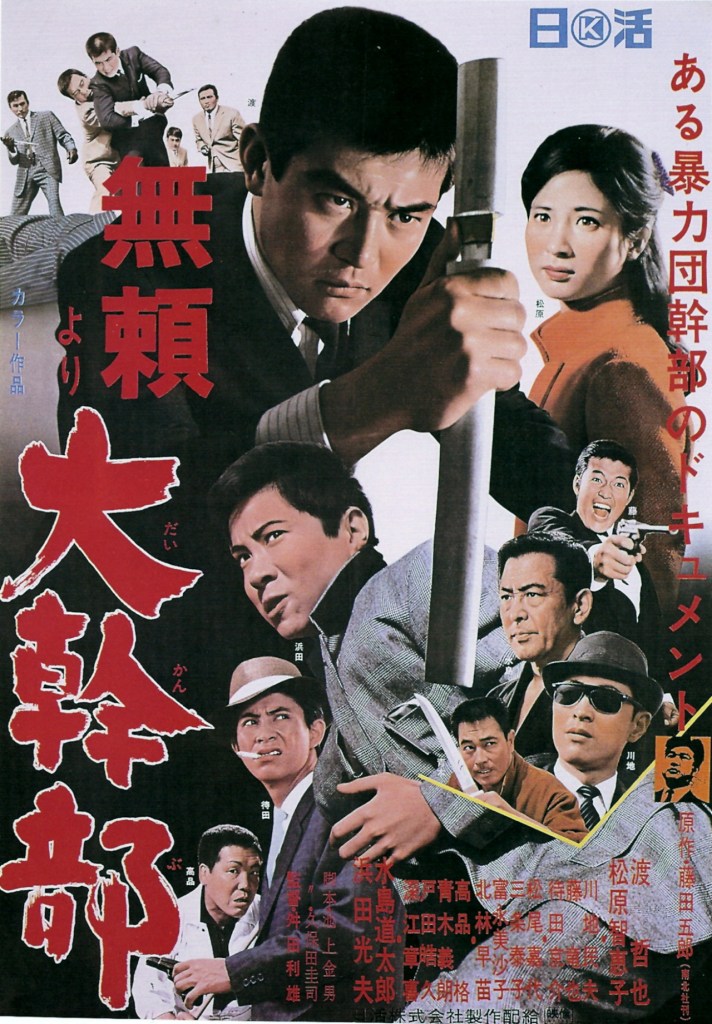
Outlaw: Gangster VIP (「無頼」より大幹部, Toshio Masuda, 1968)

outlaw gangster VIP 1 posterBy 1968 the fate of the gangster movie was somewhat in flux as the old ninkyo style was on its way out yet the jitsuroku approach, later to find its zenith in the Battles Without Honour and Humanity series, hadn’t quite taken hold. Outlaw: Gangster VIP provides an essential bridge as it takes its inspiration from the writings of one time yakuza Goro Fujita but at the same time brings together many of the themes that were dominating Nikkatsu’s output at the time from their star led, youth appeal billboard cool to their noir inflicted, nihilistic crime thrillers as a kind of culmination of everything they had been producing up to that point.

The first film in the series, Outlaw: Gangster VIP (無頼」より大幹部, Burai yori Daikanbu) begins with a black and white prologue seemingly set around the end of the war in which a young boy endures firstly the death of his mother and then the younger sister who has been left in his care – presumably through hunger or at least ill heath exacerbated by malnutrition. Eventually he himself is arrested after being caught trying to steal food and is sent to a reform school from which he escapes alongside another boy, Sugiyama.

Flash forward to a grown up version of Goro (Tetsuya Watari) lounging around in a dingy apartment and the film expands into glorious, if garish color. Goro is summoned to a local drinking establishment where his yakuza boss is under attack. On getting to the bar and coming to his boss’ defence he finds that the aggressor is none other than Sugiyama. Saving his boss by stabbing his friend he nevertheless ensures Sugiyama’s survival with a carefully placed blow though both are sent back to prison. Goro gets out three years later to discover his girlfriend has married someone else and the yakuza world is just as dog eat dog as it was when he left it.

As in many other films of this burgeoning genre, the yakuza is more or less a surrogate family of grown up orphaned street kids who’ve bound together for increased odds of survival. There maybe strong bonds between brothers, but the old ways of samurai style honourable conduct are long gone (if they ever really existed at all). Suigyama’s gang have failed to protect his girlfriend who has been reduced to prostitution despite his sacrifices for them – an unthinkable act in traditional terms, but Sugiyama’s boss is the new kind of uncaring, ambitious yakuza who cares nothing for traditional ethics.

The yakuza as a home for waifs and strays is a theme which continues throughout the series with the constant references to “hometowns” and a desire to get out of the city for a simpler, more honest life. People keep telling Goro that he’s not a real yakuza, that deep down he doesn’t have a gangster’s heart. This is true, to an extent, as Goro is the kind of noble criminal seen in the ninkyo genre who clings fast to the old ways – loyal to his friends and his clan, seeking to protect those who need it over choosing to further exploit the already vulnerable. He’s a gangster because life left him with no other options. For a street kid and reform school escapee, what possible other place could there be for him to survive than in the arms of his yakuza brothers?

An exile from the world of conventional society, Goro cuts a lonely path which ties into the nihilistic noir themes of the genre as he wanders around in very cool looking leather jacket. Mostly still studio bound, Masuda opts for a fairly straightforward approach yet with some noir-esque canted angles and a few interesting set pieces. The unusual finale in which Goro faces the treacherous yakuza kingpins against the background of a cabaret act serves as impressive highlight of the film, perfectly contrasting its garish technicolor world with the darkness underneath as Goro staggers off along a street dark with something more night and towards an eventual salvation of one kind or another.


Outlaw: Gangster VIP is the first of six films available as part of Arrow’s amazing new blu-ray and DVD box set which is released in UK and USA and is completely region free (hurrah!).

I’ve also written a full writeup of the box set as a whole over at UK Anime Network which you can read right now if you’re the sort of person who likes to skip to the end. Otherwise, get ready for five more tales of broken hearted tough guys….

English subbed version of the original theatrical trailer:

Temptation (誘惑, Kozaburo Yoshimura, 1948)

TemptationFeelings can creep up just like that, to quote another movie. Like Wong Kar-Wai’s In the Mood for Love, Temptation (誘惑, Yuwaku) also echoes Lean’s Brief Encounter with its strains of accidental romance between unavailable people even if only one of the pair is already married. However, this time there’s much less deliberate moralising though the environment itself is a fertile breeding ground for the judgemental.

The film begins with Takako (Setsuko Hara) paying her respects at the grave of her recently deceased father only to run into an old pupil of  his arriving for the same reason. Takako and Ryukichi (Shin Saburi) are both making the arduous trip back to the city and decide to travel together. Stopping over in Gifu, they find difficulty in getting a hotel room because of a big horse race due to take place the next day and rather awkwardly end up sharing a bed. After Takako becomes upset and ponders what she’s going to do now her father is gone, Ryukichi offers to let her move in with him and the children. Discussing this with his wife who is an invalid living away from the family, he talks paternally of Takako and of a wish to look after her as a way of honouring the memory of his former teacher. However, it isn’t long before the inevitable happens and the pair begin to fall in love.

Ryukichi first met Takako as a little girl when he was her father’s student but she’s 21 years old now – a grown woman by any standard, and plenty old enough to know what she’s doing. He describes her as still “silly”, like a child, and indeed Setsuko Hara breaks out some of her most radiant (if occasionally pained) smiles and almost mocking laughter to play a complex mix of putting a brave face on grief and genuine happiness at being back in a family home. Though feeling the crippling loss of her only family member has left her feeling devoid of a purpose in life, Takako is an essentially good and kind person who sees the best in people and is only too happy to help Ryukichi with the children while his wife is ill as well as continuing with her medical studies.

After leaving academia, Ryukichi has become left leaning politician committed to creating a better, fairer nation. Like Takako he is also an honest and decent person with a high sense of personal integrity. His motives for bringing Takako into the house were innocent, yet gradually his feelings for her begin to shift from the paternal to the romantic causing him a considerable amount of stress as he battles the need to remain faithful to his wife even in her absence while his attraction to Takako continues to grow.

The impending threat of illicit action stalks the screen almost like the stealthy figure of the killer in a slasher movie. At one point where the feelings threaten to overwhelm the couple despite their best efforts to suppress them, Tokie (Haruko Sugimura) – the sickly wife, unexpectedly turns up in true melodrama fashion as if summoned by the lovers’ guilty consciences and accompanied a chorus of stinging strings.

Tokie herself played by veteran actress Hariko Sugimura, is every inch the wounded wife though her plight is played with a little less vindictiveness than in a similarly themed gothic novel where the bedridden spouse suddenly rises as if from the grave itself to haunt the new lovers while still alive. Originally approving of Ryukichi’s desire to help Takako, Tokie’s fears are awaked when seeing her playing with the children on the beach – all long legs and youthful skin, moving in a way she fears she never will again. “Everything inside my chest is ruined” she tells Ryukichi before returning sadly inside, alone, prematurely exiling herself from her own family.

That said, Temptation refuses to follow the established pattern in that it suddenly reverts to a standard romance with no feeling of judgement inflicted on the couple whose love story has occurred in an illicit fashion. Tokie has a late in the game change of heart and the guilty spectre that haunts the couples of European melodrama fails to arise meaning that neither party is left feeling a need to reject their true feelings out of a desire to atone in some way for their inappropriate emotions and putative (if not actualised) betrayal.

This is surprising in some ways as the films also wants to offer a mildly left wing narrative represented by the poor boy fellow student of Takako who is arrested near the beginning of the film for selling flour masquerading as sweetener. He is of peasant stock and ultimately opts to return to simple and honest country life. Offering to take Takako with him, he gives her an opportunity to escape the temptation which is plaguing her and live quietly and naturally in an honest and humble way. In another film, this would be the solution – an abandonment of bourgeois emotion by giving up on her married, middle class politician who, for all his fine talk of open plan houses and rejection of “feudal” ideas, is still a reactionary and part of the system. However, strangely, emotion wins out and the audience gets a “happy ending” (of sorts) which feels a little bit out of place.

Temptation plays with many forms during its running time most notably romantic melodrama but often feels more like a thriller with its various twists and turns which always threaten to disrupt the narrative in unexpected ways. Consequently the film has something of an uneven tone and begins to drag a little even given its fairly short running time. This becomes a particular problem approaching the finale which lacks weight despite its obvious potential for melodrama. Still, even if Temptation is often more interesting than it is engaging it does offer a series of striking visual motifs as well at the superb performances of its leading players.


No trailer for this one, but here’s a picture of Setsuko Hara on the cover of Shin Eiga magazine in 1949 (which is a publication I can’t seem to find out much about). Btw, this is another one with a Kaneto Shindo script!

setsuko hara