Good Stripes (グッド・ストライプス, Yukiko Sode, 2015)

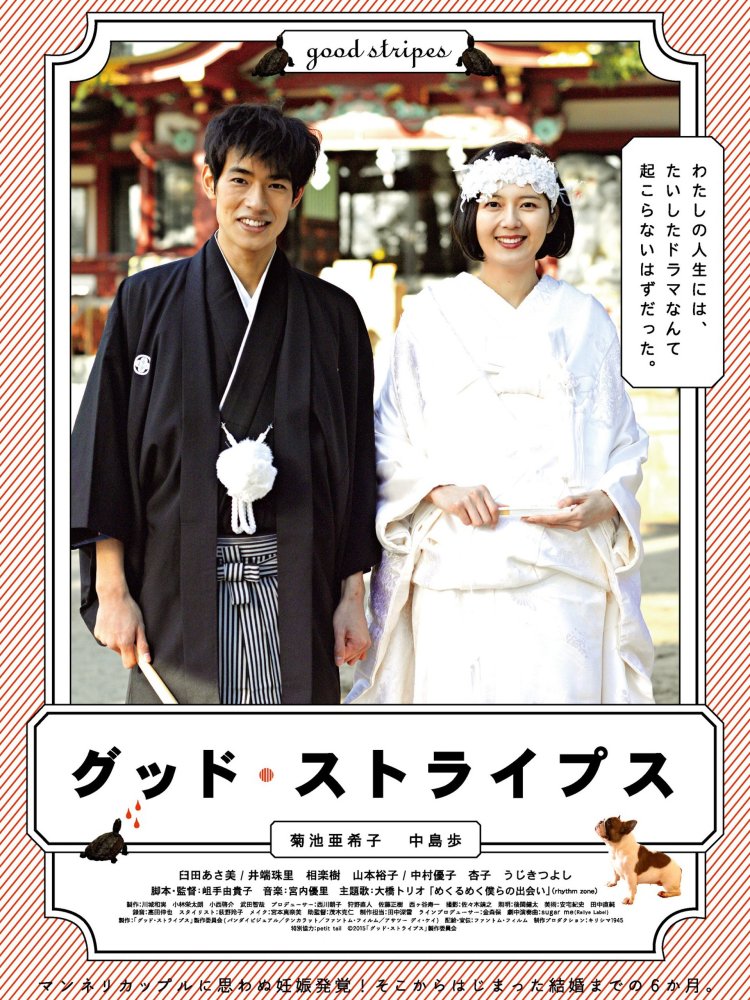
Good stripes posterThe international media has become somewhat obsessed with the idea of Japan as a land of wilfully lonely singletons who’ve rejected the idea of home and family either in favour of the easier pleasures of one way virtual romance, or simply because a series of economic and social problems have made married life an unaffordable luxury. This is of course an exaggeration, but it is true enough that younger people have more choices which can, in some cases, lead to more worries and confusion. The young couple at the centre of Yukiko Sode’s Good Stripes (グッド・ストライプス) are in this sense a perfect encapsulation of their generation as they find themselves vacillating in the face of an unexpected crisis.

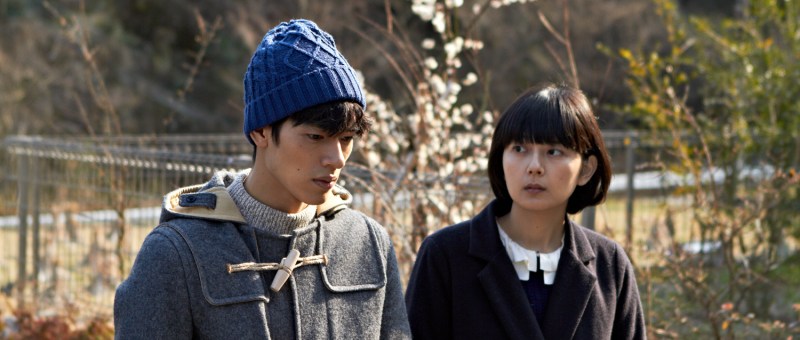
Midori (Akiko Kikuchi) and Masao (Ayumu Nakajima) have been together four years and truth be told the relationship seems to have run its course. Masao is about to jet off to India for three whole months yet Midori hardly seems bothered. While he’s away she stops responding to his messages, leaving him feeling even more isolated and alone so far away from home. Just when it seems the time has come to part, Midori realises she is pregnant, and as she’s already five months gone the most important decision has already been made for them. Wanting to do the “right” thing, Midori and Masao decide to marry and raise their baby in the conventional fashion yet they do so rather reluctantly and with a degree of mutual resentment.

The more we see of Midori and Masao, the more difficult it becomes to figure out how they got together in the first place. He is a typical middle class boy from a professional home (albeit a somewhat atypical one) and she a free spirit who grew up in the countryside. Midori doesn’t fit with Masao’s supercilious friends, one of whom is extremely rude and often makes a point of making fun of her while Masao eventually joins in rather than defend his girlfriend from what is really a little bit more than good natured banter. Reaching their late twenties they’re at the age where most of their friends are settling down, but they remain somewhat diffident, apparently not planning to stay together forever but not quite getting round to breaking up.

Things being the way they are, it’s all a little unplanned which is perhaps why Masao bristles when Midori finally moves into his well appointed apartment. He doesn’t have anywhere to put her things and is unwilling to shift any of his own, claiming putting up additional shelving would disrupt the balance of the room. Inviting someone else into your life must necessarily unbalance it, requiring at least a period of recalibration until a new equilibrium is reached, but Masao’s brief moment of resentment is perhaps understandable as he wrestles with being railroaded into a decision he isn’t sure he wanted to make.

Nevertheless, he tries to make the best of things by keeping quiet to keep the peace. Later when we meet Masao’s strangely “cute” doctor mother, she wonders if she made a mistake in the way that she chose to raise him. Having left Masao’s father when he was only five, she vowed to raise her son to be chivalrous – always carry the bags, be the first to apologise after a fight etc, but now wonders if she taught him to be superficially polite while inwardly seething with repressed anger and terrified of confrontation. Supportive to a point, Masao’s mother is also perhaps a little exasperated by the youngsters’ halfhearted attempt to embrace responsibility while quietly doubtful if they can really stay the course.

A meeting with Midori’s rowdy country family including her “difficult” spinster older sister and the equally free spirited younger one who makes fireworks for a living, proves eye opening for Masao as the only child of a sophisticated home but it’s an unexpected reunion with his own long absent father which eventually sets him on a course towards addressing his feelings of rootlessness and issues with intimacy. Resentful of his circumstances he begins having an affair with a pretty college friend only to come to hate himself during a torrid night in a hotel in which he suddenly realises what he’s getting up to is “all a bit animalistic”. Reconnecting with his father and realising that while they share certain similarities with each other they are all but strangers perhaps allows him to let go of his longstanding issues of abandonment and pursue his own desires which he’s fond of claiming to have abandoned altogether after discovering in childhood that nothing turned out the way he expected.

Midori and Masao may be two people railroaded into a future neither of them is quite sure they wanted, but in the end being forced to deal with a shared crisis does eventually bring them closer together if only in being forced to address their very separate issues both independently and as a couple. “Why take it out on me?” Midori snaps by accident, sensing Masao’s discomfort in dealing with some surprising revelations from his father, before thinking better of it and reverting to a more supportive position but her words do perhaps get through to her conflicted boyfriend even if he only really comes to accept his responsibility when forced to fish her out of a drainage ditch, reassured by her claims that there’s no need to worry because she’s the 100% boring sort of person that nothing ever really happens to. Giggling at the strangeness of it all, the pair vow their commitment to each other in the presence of the god of overcoming obstacles, together at last just as they prepare for their lives to be “unbalanced” all over again.


Good Stripes was screened as part of the 2019 Japan Foundation Touring Film Programme.

Original trailer (no subtitles)
Three Stories of Love (恋人たち, Ryosuke Hashiguchi, 2015)

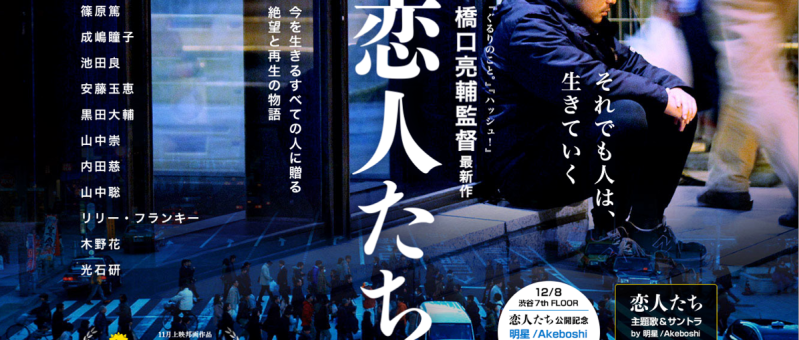
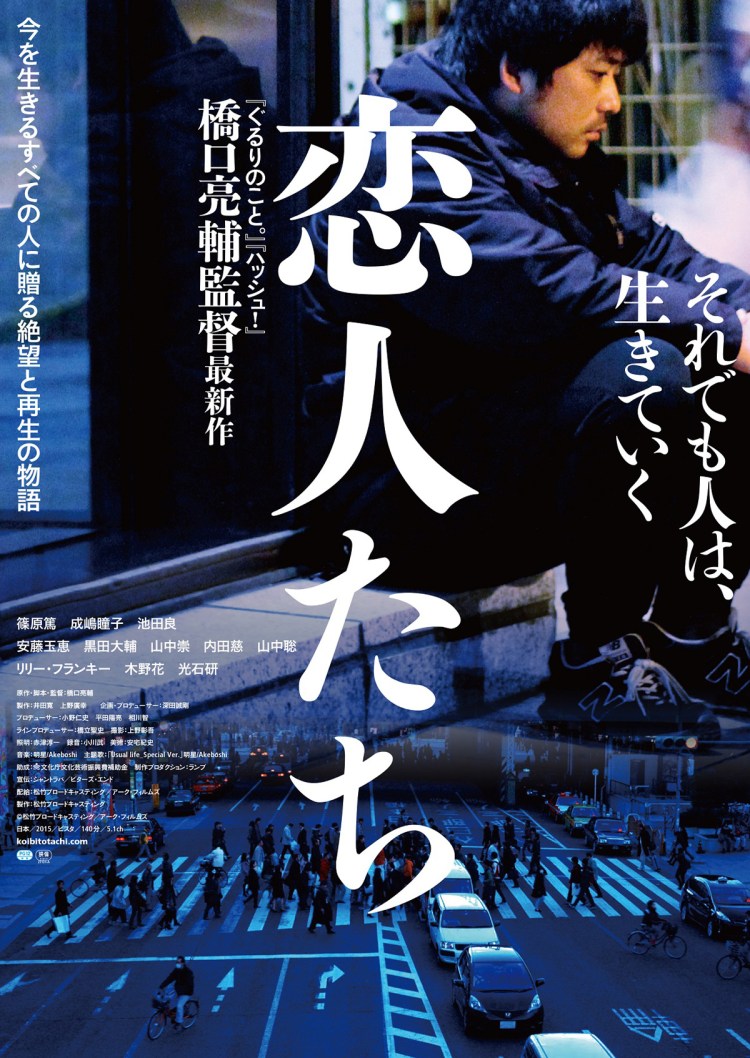
Three Stories of Love posterRyosuke Hashiguchi began his career with a collection of sometimes melancholy but ultimately hopeful tales of gay life in contemporary Japan. In 2008 he branched out with the finely tuned emotional drama All Around Us which followed an ordinary couple’s attempt to come to terms with the loss of a child. Three Stories of Love (恋人たち, Koibitotachi) finds him in much the same territory as he takes three very different yet equally burdened romantics and sets them on a path towards a kind of acceptance while suffering inside a system where everyone seems to be intent on exploiting other people’s unhappiness.

The first of our heroes, Atsushi (Atsushi Shinohara), is a bridge inspector whose wife was murdered in a random street attack three years previously. Ever since then he’s suffered with depression and found it difficult to hold down a job or a life and has become obsessed with getting personal revenge on the killer who pleaded the insanity defence and was committed to psychiatric care rather than to prison. Meanwhile, across town, listless housewife Toko (Toko Narushima) is trapped in a loveless marriage to a domineering husband and living with her snooty mother-in-law. Toko’s only outlet is compulsively rewatching a shaky video of the time she and her friends witnessed Princess Masako briefly exit a building. The third of our heroes, Shinomiya (Ryo Ikeda), is a self involved lawyer with a longstanding crush on his straight best friend from college who has since married and had a young son.

The three strands are only loosely interconnected, occurring as they do in the same city at the same time, though they do each share a sense of defeat and impossibility as each of our heroes struggles either to escape from or come to terms with their difficult circumstances. Atsushi’s case is perhaps the most extreme as he deals not only with his grief and anger but with the persistent stigma of being involved with violent crime. Visited by his bubbly sister-in-law he idly remembers to ask after the man she was about to marry last time they met only to be told that he abruptly dumped her after her sister’s death and not only that, all her friends abandoned her too. Getting revenge has become Atsushi’s only reason for living – he stopped paying his health insurance to get money together for fancy lawyers like Shinomiya who convinced him he could lodge a civil case but were only ever stringing him along to fleece him of money he never really had.

Shinomiya is, in a sense, our villain. He listens dispassionately to his wealthy clients – including one woman seeking a divorce (Chika Uchida) because her husband forgot to tell her he was burakumin until after they were married, but privately mocks them and is so unpleasant to his colleagues that someone eventually pushes him down a flight of stairs, breaking his leg. Intensely self-involved, he cares little for other people’s feelings save for those of his forlorn love Satoshi (So Yamanaka). Satoshi’s wife Etsuko, originally friendly and understanding, eventually takes against Shinomiya either because she doesn’t like the way he fiddled with her son’s ears or resents the two men cooing over the child and accidentally making her feel like an unwelcome outsider. Introducing his much younger boyfriend only seems to make matters worse, though the relationship does seem to have its problematic dimensions even if not in the way Etsuko decides to interpret them as Shinomiya takes pains to run down his partner in public and berate him at home. It’s difficult to resist the interpretation that Shinomiya prefers younger lovers because he can boss them around and, in truth, he doesn’t even seem very attached to this one, but he’s about to get a very rude awakening when it comes to learning that he’s not as permanent a part of everyone else’s lives as he seems to think.

Atsushi is fleeced by the Shinomiyas of the world and his heartless health insurers, but he’s wily enough to spot the obvious scam in the lovelorn office boy’s sudden enthusiasm for magical beautifying water which turns out to be part of a bar lady’s (Tamae Ando) nefarious scheme to resell the tapped variety with some of her own glamour shots attached to the front. Toko is wily enough to see it too, though she eventually succumbs when would-be-chicken-farmer Fujita (Ken Mitsuishi), whom she met at work during a difficult moment with her boss, delivers her some on spec. Lonely and insecure, Toko appreciates the unexpected interest but Fujita is not the white knight she first assumes him to be and is eventually exposed as yet another scam artist gunning for the little money she might have been able to hide away in her rabidly penny pinching home.

Shinomiya might feel himself proud to be among the fleecers rather than the fleeced, but he soon gets a comeuppance in realising he has wilfully pulled the wool over his own eyes, blinded in a sense by love. Toko, meanwhile, has learned to accept the latent feudalism of the modern society in her obsession with royalty though a brief attempt to transcend her feelings of innate inferiority seems destined to end in failure if perhaps engineering a mild improvement in her familial circumstances. Atsushi alone, a man whose job it is to assess the foundations, begins to find a degree of equilibrium thanks largely to nothing more than a good friend willing to listen and share his own suffering. Exploitation of others’ misfortunes and a series of social prejudices conspire against our three lovers but perhaps there is something to be said for learning to find the blue sky from whichever vantage point you happen to be occupying no matter how small and distant it may be.


Three Stories of Love was screened as part of the 2019 Japan Foundation Touring Film Programme.

Original trailer (no subtitles)
Shoplifters Tops 92nd Kinema Junpo Best 10

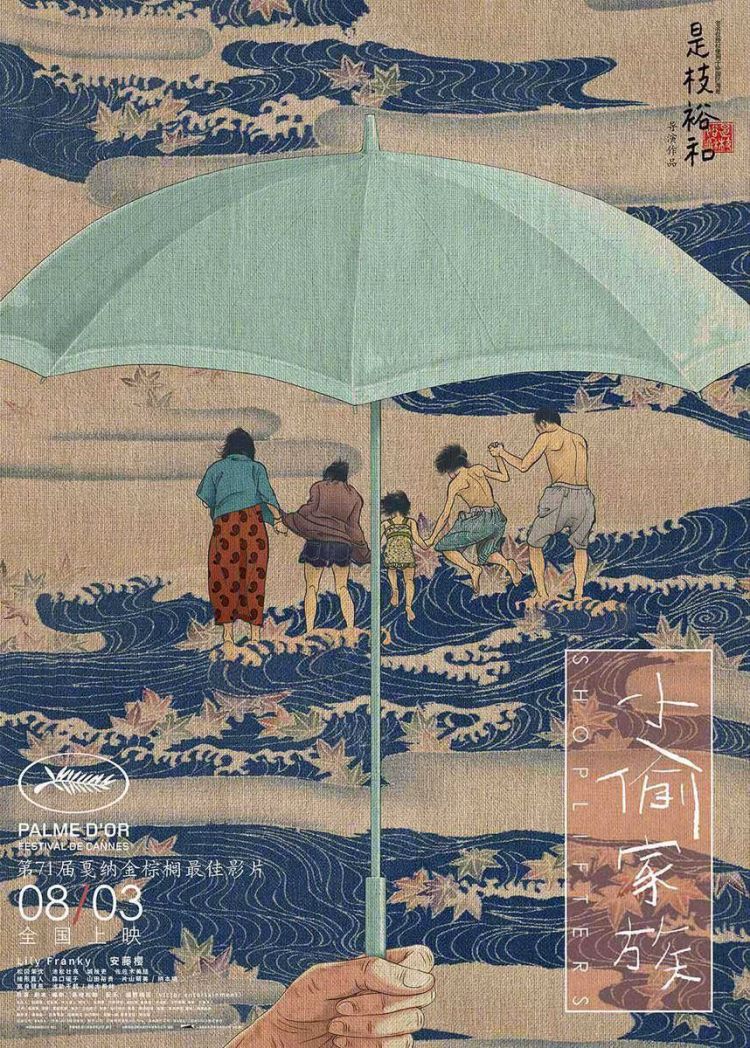
Shoplifters poster 2Prestigious Japanese cinema magazine Kinema Junpo has named its “best 10” movies released in 2018. This year’s list is tinged with sadness as it includes the final screen performances of two much loved Japanese actors – Koreeda stalwart Kirin Kiki and Ren Osugi who sadly passed away in February of last year.

1. Shoplifters (万引き家族)

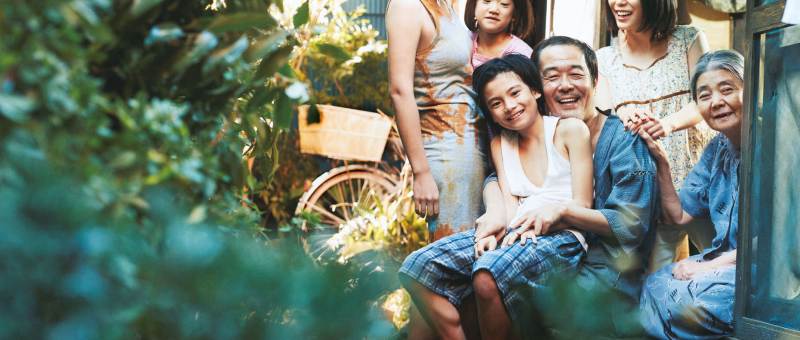
Shoplifters still 2Hirokazu Koreeda’s Palme d’Or winner picks up another award in being officially named the best movie of 2018 by the prestigious Kinema Junpo magazine. This hard hitting tale of modern lives on the margin may have irritated all the right people, but it also arrived at a pertinent moment in coinciding with a very real series of societal failures leading to the deaths of at risk children and contributing to a much needed debate as to society’s responsibility towards its most vulnerable citizens. Shoplifters also marks one of the last performances from the late Kirin Kiki who is also the recipient of the first Kinema Junpo special award. Review.

2. The Chrysanthemum and the Guillotine (菊とギロチン)

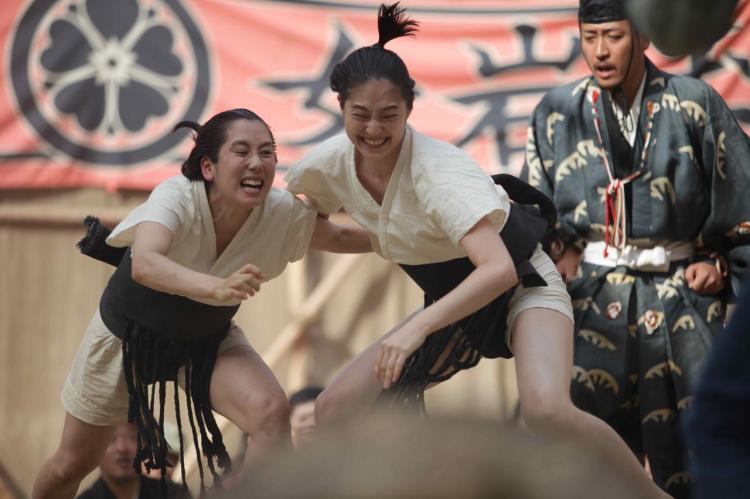
chysanthemum and the guillotine still 1The first of two films making the top 10 directed by Takahisa Zeze, The Chrysanthemum and the Guillotine is a Taisho era tale of sumo and revolution in which a band of anarchists known as the Guillotine Society find themselves fascinated by an itinerant troupe of female sumo wrestlers shortly after the Great Kanto Earthquake of 1923.

3. And Your Bird Can Sing (きみの鳥はうたえる)

And your bird can sing bannerSho Miyake adapts the novel by Yasushi Sato but shifts the setting from 1982 to the present day and from Tokyo to the author’s native Hakodate (the setting for a series of his novels recently adapted for the screen which includes The Light Shines Only There, Over the Fence, and Sketches of Kaitan City). Recipient of the best actor award Tasuku Emoto stars alongside Shota Sometani and Shizuka Ishibashi as a trio of slackers become embroiled in an awkward ménage à trois.

4. Asako I & II (寝ても覚めても)

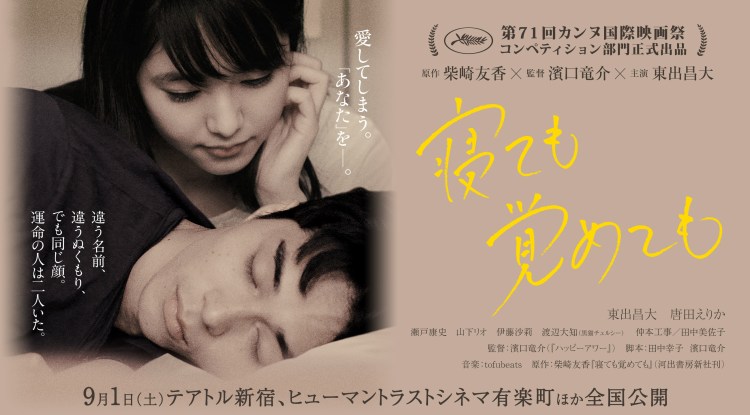
Aasako 1 & IIA conflicted young woman struggling to move on from lost love falls for a guy who looks just like her ex but can’t decide whether to embrace the fantasy of unresolved romance or the security of a steady relationship in Hamaguchi’s complex yet playful comedy drama adapted from the novel by Tomoka Shibasaki. Review.

5.  The Blood of Wolves (孤狼の血)

blood of wolves still 1Kazuya Shirashi, winner of this year’s best director award, pays tribute to the world of Battles Without Honour in an ’80-style neo-noir in which a straight-laced rookie is partnered with a veteran rogue cop who leads him straight into the heart of darkness. Review.

6. Lying To Mom (鈴木家の嘘)

lying to mom still 1Mrs. Suzuki attempts to save her reclusive son who has tried to hang himself but injures herself in the process. Unfortunately, her son didn’t make it but when Mrs. Suzuki wakes up in hospital she’s lost her memory of the traumatic incident which put her there. Her family not having the heart to tell her the truth, pretend that their son is alive and well and living in Argentina…

7. Killing (斬、)

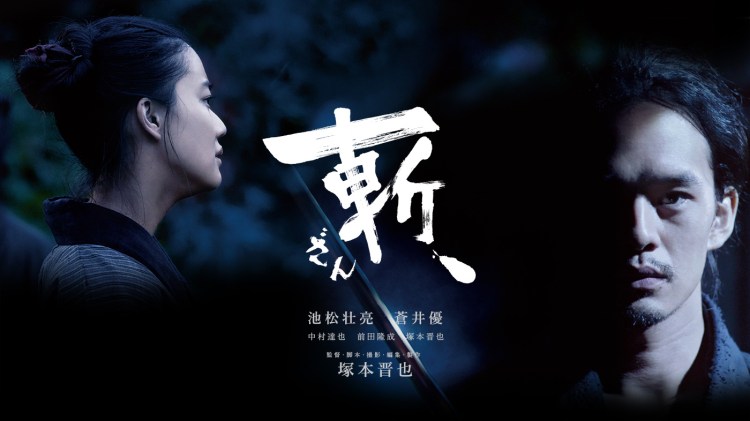
Killing bannerThe latest from Shinya Tsukamoto and his first foray into the jidaigeki, Killing follows a young samurai who prefers not to raise his sword but is swept into the violence of the Bakumatsu era anyway.

8. My Friend “A” (友罪)

My Friend A still 1A second entry for director Takahisa Zeze, My Friend “A” is a story of the legacy of guilt and (im)possibility of redemption as an embittered former journalist befriends a strange young man he believes may have been responsible for a brutal series of child killings 17 years previously. Review.

9. Every Day A Good Day (日日是好日)

every day a good day still 1Starring the legendary Kirin Kiki in one of her final performances, Every Day a Good Day is inspired by the writings of Noriko Morishita and revolves around the serene elegance of the traditional tea ceremony.

10. Kyoukaishi (教誨師)

Kyoukaishi bannerRen Osugi stars as a prison chaplain ministering to prisoners on death on row in what would be his final screen appearance before he sadly passed away in February 2018.

Individual Awards:

Best Actress: Sakura Ando (Shoplifters)

Best Actor: Tasuku Emoto (And Your Bird Can Sing, Dynamite Graffiti, Lovers on Borders)

Best Supporting Actress: Hana Kino (Come On Irene)

Best Supporting Actor: Tori Matsuzaka (The Blood of Wolves)

Best Newcomer (female): Mai Kiryu (The Chrysanthemum and the Guillotine, Lying To Mom)

Best Newcomer (male): Kanichiro (The Chrysanthemum and the Guillotine)

Best Director: Takahisa Zeze (The Chrysanthemum and the Guillotine, My Friend “A”)

Best Screenplay: Toranosuke Aizawa & Takahisa Zeze (The Chrysanthemum and the Guillotine)

Reader’s Choice Award for Best Director (Japanese): Hirokazu Koreeda (Shoplifters)

Reader’s Choice Award: Shiraku Tatekawa (Shiraku Tatekawa’s Cinema Tsurezuregusa)

Special Award: Kirin Kiki

Source: Kinema Junpo official website.

Tonight, at the Movies (今夜、ロマンス劇場で, Hideki Takeuchi, 2018)

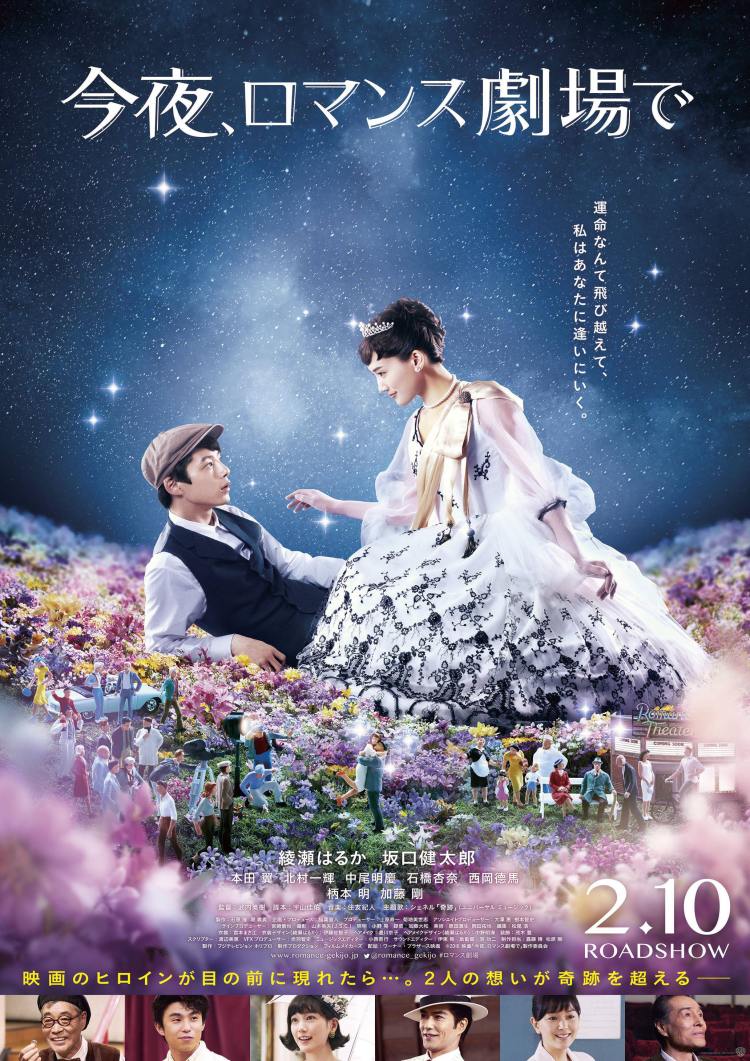
Tonight, at the Movies posterThe romance of the silver screen is one that never fades. Cinema has long been in love with itself, wilfully trapped inside the nostalgia of its own origins and youthful glory days. Nevertheless, we love it too and it’s a rare film fan who can resist the allure of the golden age backlot. With Tonight, at the Movies (今夜、ロマンス劇場で, Konya, Romansu Gekijo de, AKA Color Me True) Hideki Takeuchi becomes the latest in a long line of directors including Koki Mitani and Yoji Yamada to pay homage to world of classic Japanese cinema only this time he opts for a double rainbow as his eternal dreamer hero laments the loss of ‘30s glamour in the declining movie world of 1960 while his older self looks back on the bygone pleasures of his youth.

In 1960, Kenji (Kentaro Sakaguchi) is an assistant director at Kyoei film studios. Well, AD is what it says on his payslip, but Kenji is a mild mannered sort who mostly ends up doing odd jobs like ferrying props around and painting backdrops, mostly because he’s too much of a soft touch to push for anything else. The shy and beautiful daughter of the studio chief, Toko Naruse (Tsubasa Honda) – note the name, has fallen for him, but Kenji only has eyes for the silver screen. He spends his evenings at the local rep cinema “Romance Theatre” where he watches the daily programme and then bribes the owner (Akira Emoto) to make use of the projection booth after hours to watch his favourite forgotten classic, “The Tomboy Princess and the Jolly Beasts”. After a freak lightning strike and power outage, Kenji is shocked to discover that Miyuki (Haruka Ayase), the Tomboy Princess herself, has escaped from the silver screen and ventured into the Technicolor world.

After opening within the world of the film within the film, Takeuchi hops us forward to the contemporary era of cellphones and an ageing society as a kindly nurse laments that no one ever seems to come and see her favourite patient, Mr. Makino (Go Kato), except his granddaughter who everyone agrees is unnecessarily cold towards him. Makino is something of a key name in Japanese movie history having belonged to Shozo Makino who is often regarded as the father of Japanese cinema, and to his son Masahiro who was best known for his jidaigeki but also for his love of song and dance as seen in such cheerful hits as Singing Lovebirds which seems to have in part inspired the brief musical number in The Tomboy Princess sung by her Jolly Beasts in true ‘30s style. As we assume, Mr. Makino is Kenji 50 years later though we quickly realise that he was not able to live up to the promise of his name and never became the top film director of his dreams.

This is (partly) because we meet Kenji at what is really the beginning of an end. By 1960, the golden age was drawing to a close and studios were beginning to feel the heat from the growing popularity of television. In 10 years time, Kenji’s studio will no longer exist and the industry will have undergone a series of seismic shifts that will forever change the cinematic landscape. Yet even now Kenji is looking back rather than forwards – he worships the world of twenty years previously with its cheerful if nonsensical musical adventures and most particularly that of the Tomboy Princess who dares to rebel against her destiny by leaving her life of comfort behind to seek adventure in a foreign land, ours.

As the voice over from the melancholy rep cinema manager reminds us, film is fleeting but even forgotten films have the magical power to bring colour to someone’s heart. Both Kenji and the cinema manager have a deep seated reverence for movie making and feel almost sorry for the myriad films lying dormant in rusty cans waiting for someone to find them. The heroine of just such a film, Miyuki in turn is a lonely cinema ghost whose era has long since passed.

In Kenji she has finally found an adoring audience though the pair remain separated by an invisible screen even as their fated romance proceeds along the expected lines. Taken as metaphor, Kenji’s all encompassing obsession with a character from an old movie is not especially healthy and later leads him to reject the possibility of a full and conventional romance with a woman who loves him as well as give up on his dreams of movie making. He has, in a sense, decided to marry “cinema” with all the questionable aspects of that decision. In this case, however, “cinema” has taken real physical form even if that form is not available to him physically. Kenji and Miyuki remain on two sides of an invisible screen, but it is clear that the love flows both ways and, perhaps crucially, causes them both pain in their inability to exist fully within the same physical space. 

Filled with a wealth of references to cinema classics from Japan and beyond, Tonight, at the Movies is a beautiful fairytale romance well worthy of its cinematic pedigree. Cinema is a theoretical paradox where permanence and impermanence meet thanks to the magic of the movies. Nostalgia may be a trap, but it’s a beautiful one to fall into.


Tonight, at the Movies was screened as part of the 2019 Japan Foundation Touring Film Programme.

Original trailer (no subtitles)
Thicker than Water (犬猿, Keisuke Yoshida, 2018)

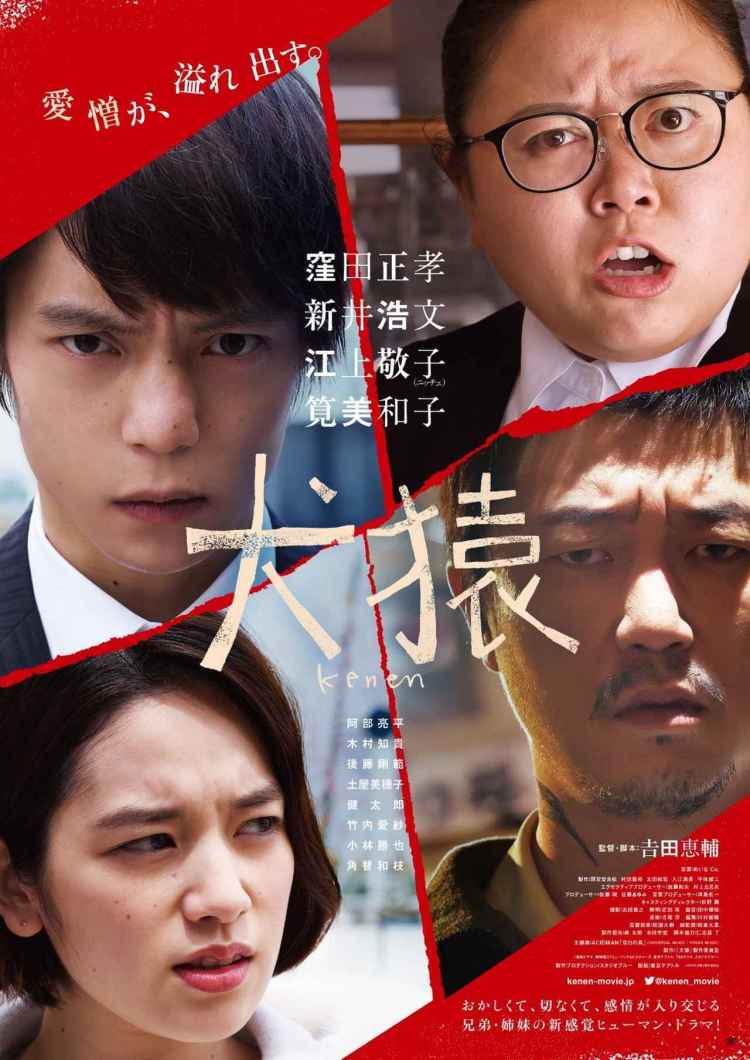
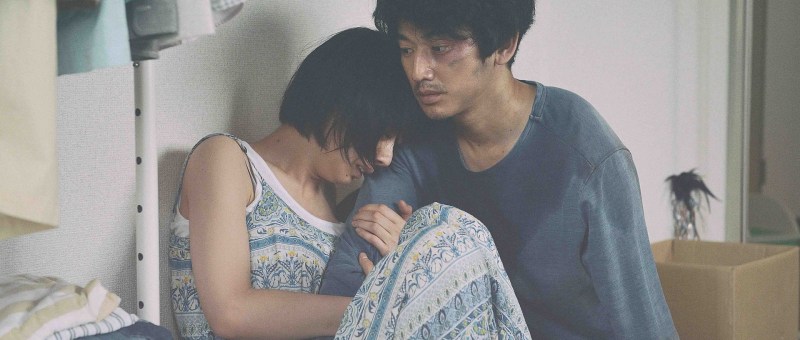
Thicker than Water posterIn the long history of the Japanese family drama, the tensions are generally vertical rather than horizontal. Siblings are often engaged in trying to broker the peace or snatch a little bit of independent living away from an all consuming family environment. Then again, we meet most families when the kids are gown up and struggling with their approaching transition into other families or other lives. Kids fight, but grown up brothers and sisters are supposed to find a degree of civility at least even if the petty resentments of childhood never quite go away. For the parallel pairs of mismatched siblings at the centre of Thicker than Water (犬猿, Kenen), however, the reverse is true.

Older sister Yuria (Keiko Enoue) has taken over the family print shop now that her father is bedridden while her younger, prettier sister Mako (Miwako Kakei) is struggling to make it as an actress. Often resentful of her sister’s domineering, business-like attitude, Mako wilfully targets her weaknesses by making barbed comments about her weight and appearance of which she knows Yuria is insecure. Yuria, meanwhile, treats her sister as a foolish child, immediately taking over rather than let Mako do something “wrong” and thereby chipping into her insecurities about a lack of intelligence.

The spiky dynamic between the two sisters intensifies when Yuria develops a crush on a handsome young salaryman who makes regular visits to the shop to get his posters printed. Kazunari (Masataka Kubota), however, predictably falls for Mako (who is only interested in him as a way of annoying her sister). Meanwhile, he has sibling drama of his own in that his no good, thuggish older brother Takuji (Hirofumi Arai) has just been released from prison and made an unwelcome reappearance in his life.

What exists between the siblings isn’t quite “rivalry”, mostly they aren’t fighting over parental affection or esteem so much reacting against their obviously complimentary characteristics. Yuria envies Mako’s beauty, while Mako secretly envies her sister’s intellectual confidence even if she also resents her bossiness and affectation of superiority in order to mask her insecurity. Kazunari makes a show of his earnestness, that he’s doing everything “properly” – working hard, living within his means, paying off his parents’ debts and saving for his retirement, while underneath it all he envies his brother’s non-conformity even if its risks terrify him. Thus they snipe at each other. The thing about family is they know where all the buttons are and find pressing them extremely hard to resist.

That said, the familial bond is a strong one and perhaps they can snipe cruelly at each other precisely because it is unlikely to break. Nevertheless, when pettiness and cruelty intensify there can hardly be a positive outcome save perhaps to hit the reset button and send our warring siblings back to their idyllic childhoods in which they played together happily free from their adult resentments. Like children fighting over toys, each wants what the other has and seethes over the injustice of not being the one to have it. An extreme situation might seem to clear the air, repair the relationships and restore them to their original condition with each reaching an understanding of themselves and their opposite number, but old habits are hard to break and any thaw in relations is likely to be extremely temporary.

No stranger to extremes, Yoshida opens with a humorous sequence spoofing a trailer for a cheesy Japanese teen romance which is enthusiastically recommended by a series of vox pop champions, not least among them Mako who who somewhat unethically plays the part of a lovestruck young woman who over identifies with the movie’s themes. The trailer promises a “parallel love story” which, in truly Yoshida-esque irony, is more or less what we get as we witness the symmetrical tales of our two sets of warring siblings whose animosity almost tips over into co-dependency. Mirrors of each other, they love and loathe but remain unable to reconcile themselves to the various faults they see reflected in their opposing number and therefore unable to break free from the petty jealousies and resentments which define family life. There may be no escape from the intense self loathing unfairly projected onto an equally burdened sibling, but perhaps there is faint hope in the enduring continuity of their quietly simmering warfare even as it binds them in mutual misery.


Thicker than Water was screened as part of the 2019 Japan Foundation Touring Film Programme.

Original trailer (English subtitles)

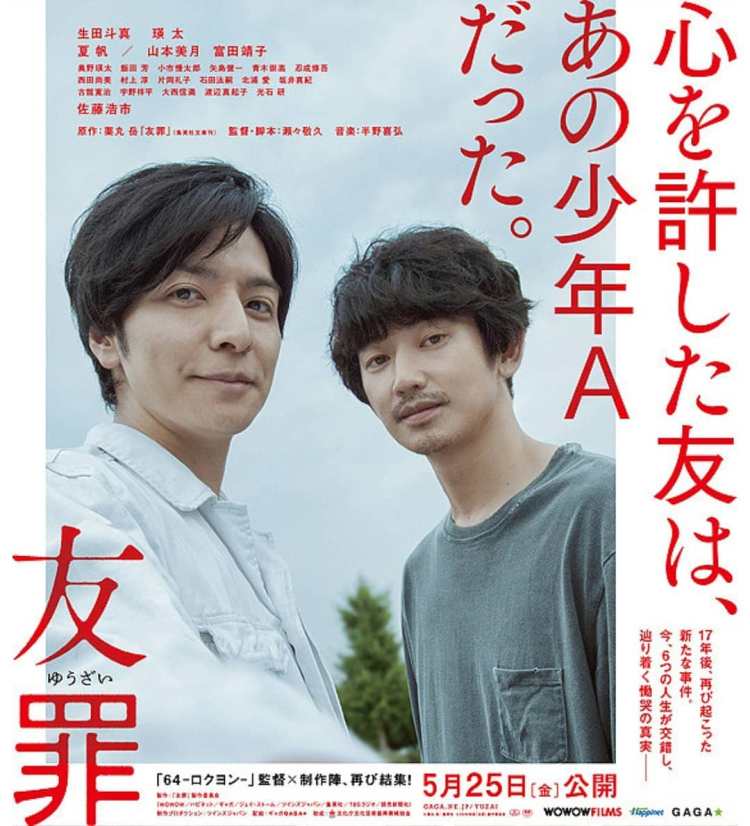
My Friend “A” (友罪, Takahisa Zeze, 2018)

My Friend A posterThe Japanese justice system is founded on the idea of confession and atonement, that if you admit your crime and show remorse you will be forgiven. The truth, however, is much more complex and those whose lives have been tainted by transgression are often rejected by a still unforgiving society. Director Takahisa Zeze describes his adaptation of Gaku Yakumaru’s novel My Friend “A” (友罪, Yuzai) as a picture of the world he longs to see at the end of the Heisei era, one which is less judgemental and more compassionate where the bonds between people can perhaps overcome the traumatic past.

In the present day, two very different men – failed journalist Masuda (Toma Ikuta) and the sullen and mysterious Suzuki (Eita), are inducted as probationary workers at a small factory. Suzuki’s determination to keep himself to himself does not endear him to the other workers who become convinced that he is hiding something from them. Suzuki is indeed hiding something, though his reasons for avoiding human contact are various and complex. When a young child is found murdered nearby in a method which echoes a notorious killing from 17 years previously, Masuda is contacted by an old colleague (Mizuki Yamamoto) investigating the case and begins to wonder if the secret Suzuki seems to be burdened by might have something to do with one crime or both.

In actuality, Masuda does not seem to believe that Suzuki is involved with the recent killing even if he comes to the conclusion that he is almost certainly the teenager convicted of the earlier crime. Nevertheless, he develops an awkward “friendship” with him which is partly exploitative as he ponders writing an exposé on the injustice that allows someone who committed such heinous acts, even in childhood, to start again with a new identity. “Injustice” becomes a persistent theme as seen in the melancholy tale of taxi driver Yamauchi (Koichi Sato) who is carrying the heavy burden of being the father of a son (Hoshi Ishida) who killed three children as a joy riding delinquent. Hounded by one parent, and accidentally harassing the others through his relentless attempts to apologise for his son’s transgression, Yamauchi has ruined his family through his own need for personal atonement. Having divorced his wife and lost touch with his son, he is enraged to learn that he plans to marry and will soon be a father. Even if his wife-to-be knows of his past and accepts it, Yamauchi believes his son has lost the right to live as other people live and finds it extraordinarily offensive that a man who took the lives of children would have a child of his own.

Yamauchi seems to want to put his family back together but only succeeds in tearing it apart. Corrupted families loom large from the mysterious photograph of the smiling boy surrounded by the scratched out faces of his parents and sibling found among Suzuki’s belongings, to the reform school boy taunted with the accusation that he might not have turned to drugs if only his parents had loved him more. Suzuki fixates on his reform school teacher Shiraishi (Yasuko Tomita), but she in turn has neglected her own daughter in her fierce desire to save the souls of these violent young men many of whom have become the way they are because they believe that they are worthless and no one cares about them. Meanwhile, Miyoko (Kaho) – a young woman drawn to Suzuki’s silent solidarity, struggles to escape her own traumatic past partly because she was shamed in front of her family who then were also shamed by her inescapable transgression.

Unlike Suzuki, Miyoko has committed no crime but is haunted just the same. As is Masuda though his guilt is real enough if of a more spiritual kind as he struggles to accept his role in the death of a friend who committed suicide when they were just children. Then again, Masuda’s struggle, like Yamauchi’s, is perhaps a solipsistic one in which what he is really mourning is not his friend but the vision of his idealised self. On visiting his late friend’s mother, Masuda bristles when she talks about his journalistic career and her hope that he is still “strong and just” like the teenage boy she believes stood alongside her lonely son when the truth is that he abandoned his friend when he needed him most because he was too cowardly to risk becoming a target himself. Despite his high ideals, Masuda had been working at a scandal rag and his only real piece of ethical journalism was a confessional about the destructive effects of high school bullying. He remains conflicted in his friendship with Suzuki not quite because he fears his dark past but because he fears his own moral cowardice – something he is reminded of when a housemate points out that no-one likes Suzuki and that if Masuda sides with him, no one will like him either. 

The question that is asked is whether discovering someone’s dark secret necessarily changes who they are now and if it is ever really possible for those who have in some way transgressed to return to society. As Suzuki puts it to Masuda in reflecting on their unavoidable commonality, they’re each men who rarely unpack their suitcases, always on the run from an unforgiving present. Yet there is perhaps hope despite Masuda’s ongoing diffidence in his eventual (self) confession and belated solidarity with a man he later recognises as a “friend” in acknowledgement of the unconditional bonds of genuine friendship.


My Friend “A” was screened as part of the 2019 Japan Foundation Touring Film Programme.

International trailer (English subtitles)

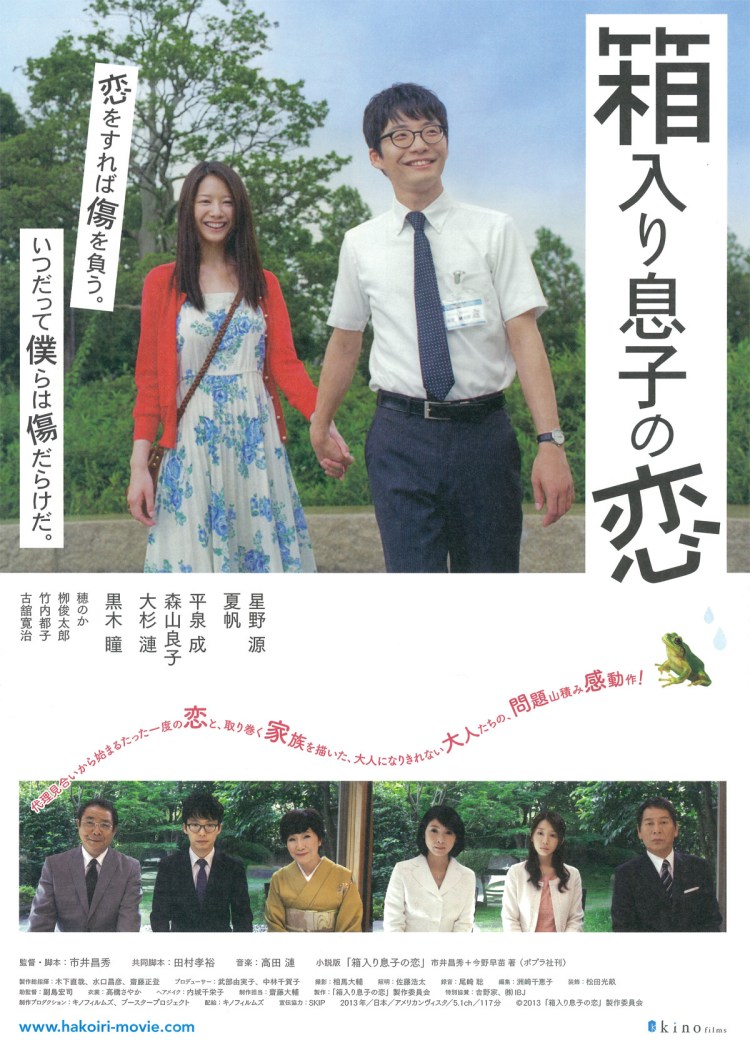
Blindly in Love (箱入り息子の恋, Masahide Ichii, 2013)

Blindly in love posterPost-war Japanese cinema was intent on investigating whether father really did know best while his children strived to find their place in a changing society. Contemporary Japanese cinema may feel as if the question has been more than well enough answered already but then again Japanese society remains conformist in the extreme and arranged marriage still an option for those who find it difficult to find a match on their own (remaining single, it seems, is still an option requiring intense justification). The protagonists of Blindly in Love (箱入り息子の恋, Hakoiri Musuko no Koi) find themselves in just this position as their well meaning (to a point) parents attempt to railroad them into the futures they feel are most appropriate while perhaps failing to deal with the various ways their own behaviour has adversely affected their children’s ability to function independently.

Kentaro (Gen Hoshino) is 35. He has a steady job as a civil servant and still lives at home with his parents which is hardly an unusual situation in contemporary Japan save for the fact he is not married and seems to have no interest in dating. Rather than eat with his colleagues, Kentaro comes home for lunch every day and returns straight after work, retreating into his bedroom to spend quality time with his pet frog and play video games. His parents, worrying that he may be lonely when they are gone, decide to find him a wife by effectively going speed dating on his behalf with a host of other parents in a similar position.

There they meet the Imais who are keen to marry off their 23-year-old daughter Naoko (Kaho). The elephant in the room is that everyone at this meeting is there because they believe there is something “wrong” with their children that makes them difficult prospects for marriage. Consequently, the Imais have decided not to disclose the fact that Naoko is blind until later in the negotiations.

The Imais’ ambivalent feelings towards their daughter’s disability speak to a persistent social prejudice which views those who have different needs as somehow less. Mr. Imai is a high flying company CEO who puts on a show of only wanting the best for his little girl, but he’s also a snob and a bully. He keeps trying to set Naoko up with “elites” like him, but those elites will also share his own prejudices in feeling that his daughter is “imperfect” and therefore not a prime match in the arranged marriage stakes. Kentaro, who unbeknownst to everyone except Mrs. Imai has already enjoyed a love at first sight meet cute with Naoko, is the only one brave enough to call Mr. Imai out on his hypocrisy when he accuses him of neglecting his daughter’s feelings in favour of asserting his own paternal authority. As you can imagine, Mr. Imai is not happy to have his faults read back to him.

Making the accusation at all is extremely hard for Kentaro who has just spent the last ten minutes getting a dressing down from Mr. Imai who has read out a list of his perceived imperfections from his unbreakable introversion to his lack of career success. Mr. Imai wants to know if a man like Kentaro who has basically been the office coffee boy for the last 13 years can keep his daughter in the manner to which she’s been accustomed. Kentaro has to admit that he probably can’t and that Imai has a point, but unlike Imai he is thinking of Naoko’s happiness. He sees her disability but only as a part of her personality and respects her right to a fully independent life which is something her father seems to want to deny her, not out of a paternalistic (or patronising) worry for her safety but simply as a means of control.

Conversely, Kentaro is attracted to Naoko precisely because he feels as if she might be able to see him in greater clarity in being unable to judge him solely on appearance. In a rare moment of opening up as part of his defence against Mr. Imai, Kentaro reveals the pain and suffering that have led him to withdraw from the world, admitting that after years of being taunted or ignored, branded an oddball and mocked for his rather robotic physicality he simply decided it was easier to be alone. It might be safe to say that Kentaro’s parents are being overly intrusive, that they are trying to impose their idea of a “normal” life on their son who may be perfectly happy playing video games alone for the rest of his days. Kentaro, however, is not quite happy and as is later pointed out to him had merely given up on the idea of any other kind of existence as an unattainable dream.

Giving up has been Kentaro’s problem and one that recurs throughout his awkward courtship. Like his pet frog, Kentaro has been perfectly contained within his own tank and somewhat fearful to crawl outside but is slowly finding the strength thanks to his bond with Naoko who struggles to overcome her conservative patriarchal upbringing and escape her father’s control. Yet it isn’t only the youngsters who have to learn to leave the nest but the parents who have to learn to let them go. Kentaro’s mum and dad have perhaps enabled his sense of disconnectedness by keeping him at home with them as a treasured only son, while the Imais’ problems run deeper and hint at a deeply dysfunctional household with a father who is controlling and eventually violent while Mrs. Imai tries to effect her daughter’s escape from the same patriarchal conservatism which has succeeded in trapping her. Blindly in Love refuses either of the conventional endings to its unconventional romance but edges towards something positive in affirming its protagonists’ continued determination to fight for their own happiness even if opposed at every turn.


Blindly in Love was screened as part of the 2019 Japan Foundation Touring Film Programme.

Original trailer (English subtitles)

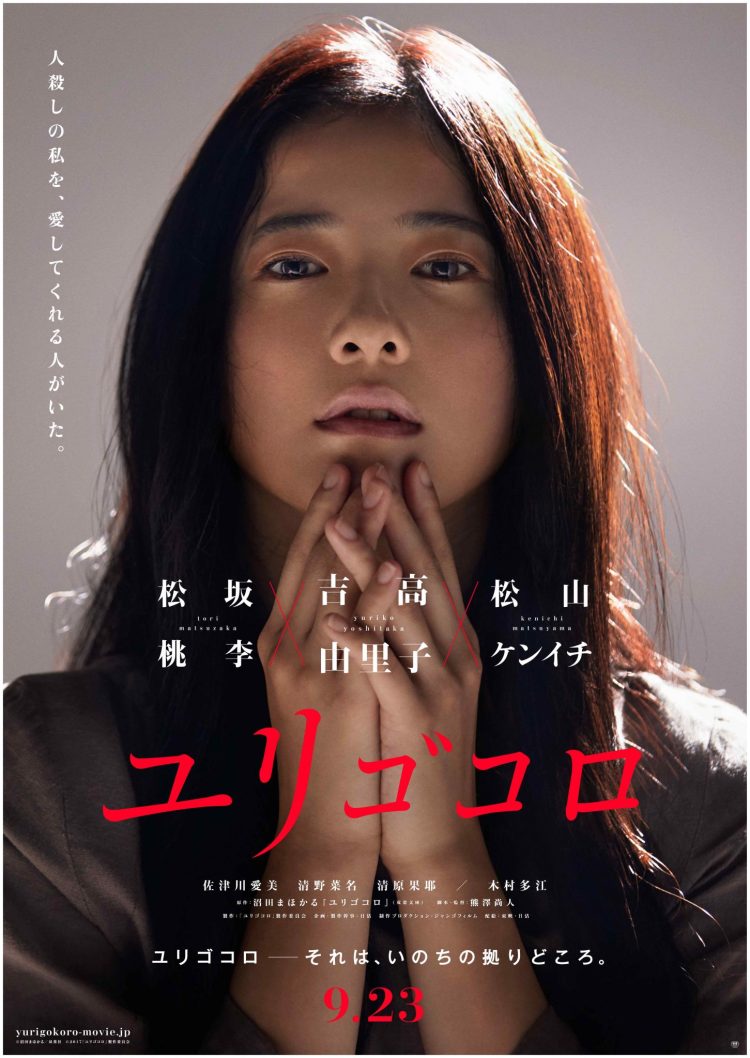
Yurigokoro (ユリゴコロ, Naoto Kumazawa, 2017)

Yurigokoro posterThose who cannot remember the past are doomed to repeat it, as they say, but is it better to acknowledge the dark parts of yourself as part of an inherited legacy or ignore a nagging sense of incompleteness in favour of a harmonious existence? The hero at the centre of Naoto Kumazawa’s Yurigokoro (ユリゴコロ), adapted from the mystery novel by Mahokaru Numata, is about to discover a side of himself he might not like just as storm clouds seem to gather over his previously idyllic childhood home.

For Ryosuke (Tori Matsuzaka), everything had been looking up. He’d set up his own business – a charming cafe and summer lodge, with the woman he intended to marry, Chie (Nana Seino). However, no sooner has he introduced his fiancée to his father than she disappears, gone without trace. Meanwhile, his father informs him that he has stage four pancreatic cancer. Suddenly everything is falling apart and the braver the face he tries to put on it, the worse he seems to feel. Perhaps that’s why he can’t resist opening up a mysterious old box hidden in a cupboard in his father’s study that almost calls out to him to be opened. Inside the box is an old exercise book with the title “Yurigokoro” pencilled on the front. Ryosuke only reads the first few pages but they’re enough to disturb and fascinate him. The book, written in the first person, recounts the dark history of a murderess (Yuriko Yoshitaka) from silent, disconnected child to vengeful spirit.

“Yurigokoro” as the diary’s protagonist later explains is a made-up word, one she childishly misheard from the mouth of a well meaning doctor (who probably meant “yoridokoro” which means something like grounding). It could, however, almost translate as a shaking heart – something the doctor seems to imply the child does not quite have which is why she feels disconnected from the world around her and unable, or unwilling, to speak. The girl in the book travels through life looking for something that makes her heart beat and originally finds it only in the strange pleasure of watching something die, at first by accident and later by design. She drifts into an intense relationship with a damaged young woman (Aimi Satsukawa) who, like her in a fashion at least, resorts to self harm in order to feel alive. She thinks she finds her home, but it slips away from her or perhaps changes in form as it succumbs to inevitable disappointment.

Yet, in the grownup crimes at least, there is a kind of love in amongst grudging resentment. Ryosuke reads the diary and declares he does not relate to it at all but something about it gets under his skin and he can’t let it rest. He hears from an older woman (Tae Kimura) that Chie may have a past he knew nothing about, largely because he failed to ask, and that she may be in danger. He begins to feel rage surfacing within him like the dark violence of the diary’s protagonist and it both frightens and enthrals him.

The owner of the diary likens her experience of existing in the world to being prickled by hundreds of tiny thorns. She seeks relief through bloodletting and violence, as if she could shake herself free of the tiny stings that remind her of nothing other than her sense of emptiness. Later she discovers that love too can shake the heart, but the old darkness remains and even the most positive of emotions may require an act of violence in order to sustain it. The diarist remains ambivalent, knowing that there is no salvation for her except death and that any attempt to stave off the darkness with light will eventually fail, but determined to cling on to her brief moment of wholeness however inauthentic for as long as it lasts.

Ryosuke, meanwhile, who’d apparently never sensed in himself the kind of gaping emptiness that the diary’s owner describes, is forced to wonder if the diary is legacy and destiny, if he too is destined to commit random acts of inescapable violence as someone unfit for living as a human being among other human beings. Love might not have “cured” the darkness inside the diarist, but it did change it in quite a fundamental way, a way that eventually provided him with the means of his “salvation” perhaps at the cost of her own if only he is willing to accept it. Ryosuke might wish he’d never opened that particular box, but in doing so he discovers not only the path towards a fully integrated self but that his own darkness can be tempered precisely because of the sacrifice that was made on his behalf.


Yurigokoro was screened as part of the 2019 Japan Foundation Touring Film Programme.

Original trailer (no subtitles)
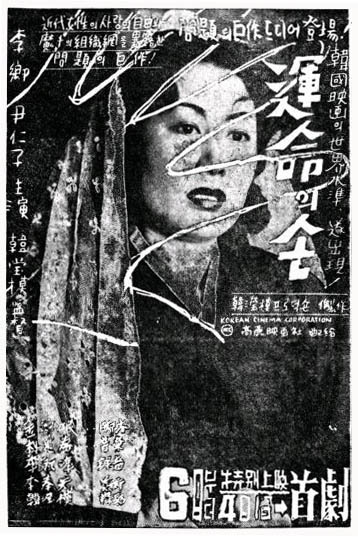
The Hand of Fate (運命의 손 / 운명의 손, Han Hyung-mo, 1954)

Hand of fate poster 2

The kinds of directors who tend to garner retrospectives and reappraisals are perhaps those who lean closer to our own ideological biases. Even in the tightening censorship of the 1960s, Korean directors like Kim Soo-yong and Lee Man-hee were able to subtly undercut the prevailing conservatism of their times. Director Han Hyung-mo, by contrast, was a committed rightist whose films express a distinct intolerance towards liberalism, women’s rights, and the Communist North. Han, like many directors of his generation, studied filmmaking in Japan near the end of the Colonial era and began his career as a cinematographer. His first film, Breaking the Wall released in 1949, is sometimes described as the first Korean anti-communist film. Returning to narrative filmmaking after serving as a documentarian during the Korean War, Han’s Hand of Fate (運命의 손 / 운명의 손, Unmyeong-ui Son, AKA Hand of Destiny) released in 1954 is not perhaps as rabidly anti-communist as might be expected but makes clear that there can be no redemption for an ideologically compromised woman.

Jung-ae (Yu In-ja), a North Korean spy posing as a bar girl in the South, enjoys a life of comparative freedom and luxury but remains committed to her mission. When the police bring a wounded student, Yong-chul (Lee Hyang), to her door one day as a possible suspect in a robbery she’d previously reported to them, she takes pity on the man and tells the police to let him go. She brings him into her apartment, treats his wounds, and feeds him. For some reason she develops an attraction for the melancholy student and so when she spots Yong-chul working on a construction site, Jung-ae takes him out on the town, buys him a new suit and shoes, and eventually begins a relationship with him. Professional habits die hard, however, and so when she rifles through his wallet she is disturbed to find his military intelligence ID card and discover he is really a spy catcher.

Released in 1954, Hand of Fate is a product of the immediate post-war era and is in fact one of the very few surviving films from that year. Nevertheless, it takes its cues very much from international cinema and particularly from American and European noir and spy films in its fatalistic trajectories and uncharacteristically murky worldview. Though Han includes mild anti-communist sentiment in Jung-ae’s eventual disillusionment with the “Communist Party’s hackneyed methods”, the fact that she is a spy for the North is almost incidental for much of the film, the conflict being not that she is a Communist and therefore evil but on a much simpler level that she is required to straddle a difficult ideological divide. Of course, the force that shakes her loyalty is love and in this Han reaffirms her womanliness in simultaneously making emotion both her weakness and the best weapon against the rigidity of Communism. Then again, rightists aren’t so keen on emotion either and so romance must fail.

Both Jung-ae and Yong-chul come to the conclusion that their only mistake was falling in love – not so much with an “enemy” but across an impossible border presented by the 38th Parallel. The futility of the love is laid firmly at the feet of a destructive division imposed by outside powers which painfully separates two parts of one whole. “We love each other, why can’t we be together?” Yong-chul asks, still unaware that Jung-ae is the female spy he’s been looking for. “You’re so close to me now”, Jung-ae adds later, “Why have we been so far apart?”, lamenting that the wall which has kept them at a distance from one another has been largely illusionary and has now been destroyed if only in terms of personal ideology. Rather than the demonisation of the North which would define the anti-communist film, it is the pain of the division which is the real enemy though in contrast to other similarly themed films, Han suggests a clean break might be the best solution rather than holding out hope for reunification.

Meanwhile, the pair work at cross purposes in misattributing the suffering of the other to culturally defined, gender-specific stigmas. Yong-chul assumes Jung-ae’s misery is down to being a “fallen woman”, that as a sex worker she worries she has lost the right to love him (he is keen to assure her that she hasn’t and there’s nothing wrong her life choices – a liberality that stands in contrast to the film’s subtle condemnation of Jung-ae on just this fact as a woman who uses her body as a tool of war), when really she is caught in an impossible position in having fallen in love with a man she will probably have to kill. Before discovering his real occupation, Jung-ae assumed Yong-chul’s misery was down to his poverty. She feels the manual job he takes to support himself through college is beneath him, indulging in a stigma towards blue collar workers which seems odd for a committed communist, and wants to “save” him by restoring him to his rightful social class with her money which she earned in a way she fears he may think immoral.

Despite Han’s fierce conservatism, Hand of Fate features the first on screen kiss in Korean cinema history but where it is undoubtedly romantic, it is also dark and fatalist. In keeping with the title and the noirish atmosphere, the narrative trajectory leads only to tragedy in which the division will be maintained with the South in the ascendent. Jung-ae’s ideological fracturing leaves her with nowhere to turn, while Han’s overly conservative viewpoint will not allow her to find peace or resolution not only because of her Communist roots but because of being an “immoral” and “vulgar” woman as she describes herself early on. Described as “An epoch-marking, ambitious work in the history of Korean Cinema”, Hand of Fate is indeed a bold experiment, opening with a tense, dialogue free sequence of spy craft and danger even if it later overdoes the expressionism with climactic thunderstorms and overly literal bombs (not to mention the constant hand imagery), offering a dark and noirish vision of a divided future in which the pain and suffering caused by the division will continue with the only “hope” that the wall will eventually become a fading scar.


The Hand of Fate is available on English subtitled DVD courtesy of the Korean Film Archive which also includes a special documentary, a video essay by film scholar Kim Jong-won, and an interview with art director Non In-taek, as well as a bilingual booklet featuring a brief commentary on the film and an essay by the Korean Film Archive’s Jo Jun-hyung. Also available to view via the Korean Film Archive’s YouTube Channel.

Brief clip (dialogue free)

Dad’s Lunch Box (パパのお弁当は世界一, Masakazu Fukatsu, 2017)

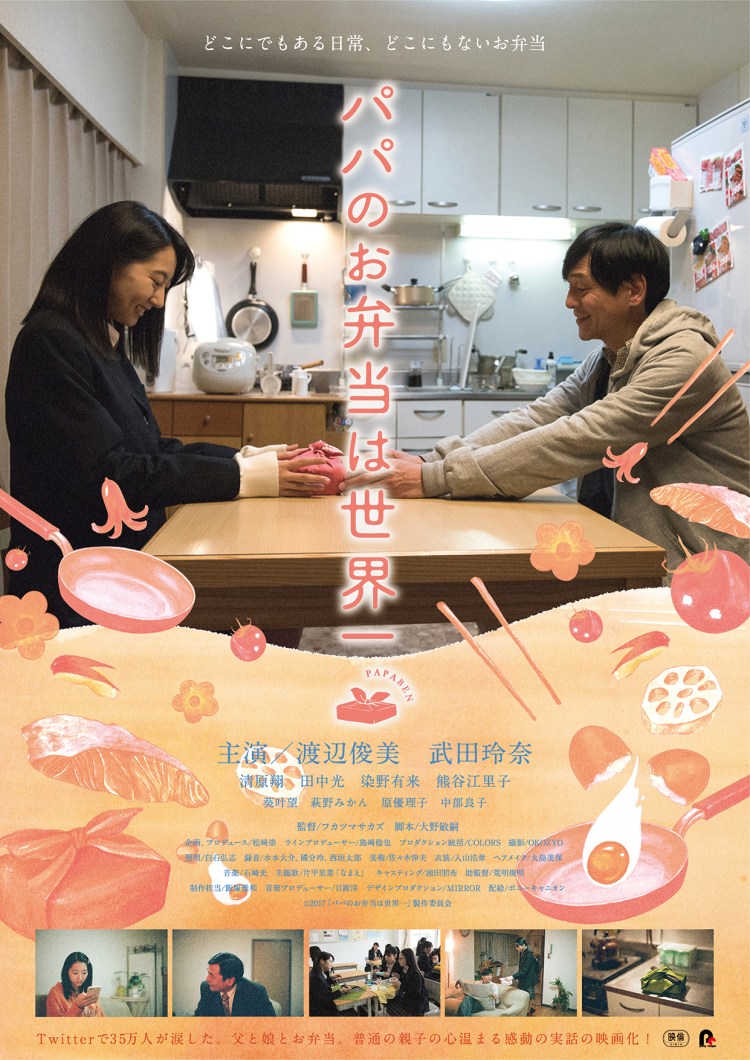
Dad's Lunchbox posterLunch is serious business in Japan, but perhaps those adorable character bento have a dark side, forcing already frazzled mothers to get up before dawn in order to ensure their child’s lunch box will be sufficiently “cute” or risk being made to feel like a cold and unloving parent. It goes without saying that it’s usually mums who are expected to take care of food preparation, salaryman dads are a rare sight in a kitchen, but then a recent phenomenon known as “papaben” has been taking the internet by storm and somewhat normalising the idea that fathers too can channel their love for their kids into visually appealing, nutritionally balanced meals.

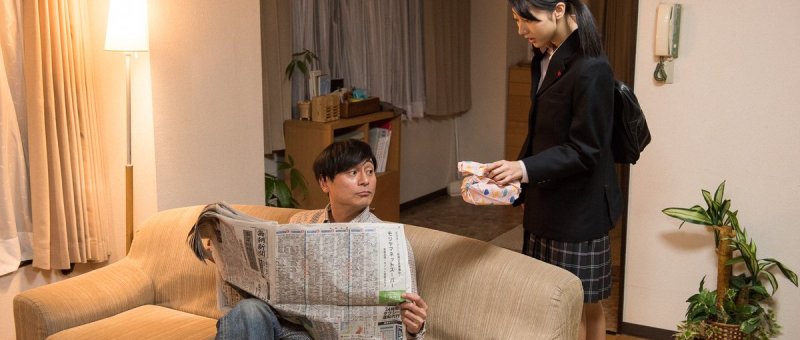
Dad’s Lunch Box (パパのお弁当は世界一, Papa no Obento wa Sekai Ichi), the debut feature from Masakazu Fukatsu, is inspired by a viral Tweet posted by a high school girl on her graduation which thanked her father for taking the trouble of making a handmade bento for her every day of her high school life. The Tweet also included a photo of his risible first effort and his final high school lunch box crafted after three years of trial and error. Fukatsu’s film version follows a recently single salaryman known only as “Father” (Toshimi Watanabe) who decides to make the creation of bento his primary method of demonstrating that he is perfectly fine bringing up his teenage daughter Midori (Rena Takeda) all alone.

The film does not dwell on the circumstances which led to Father’s wife leaving and there does not appear to be any animosity between himself and his daughter on account of it, nor does Midori suffer any particular stigma at school because of having a single dad save for the unfortunate quality of her daily bento. Father, having lived a regular salaryman life, is not exactly a great cook and has an uphill journey ahead of him when it comes to mastering the basics let alone creating the Instagrammable lunches of his daughter’s dreams. Taking a few tips from a friendly lady at work, Father eventually realises that for a teenage girl bento are an important social signifier and must, in all cases, be cute. Nevertheless, he struggles with fundamental hygiene concerns that leave him unaware of why you shouldn’t put sashimi in a lunch box which is going to be sitting around at room temperature all day.

The most important component in a bento is, however, love which is why Father started making them in the first place. It’s not so much that he eventually masters the art of cooking, nor that of learning how to make his dishes aesthetically pleasing, but that he is able to connect with his increasingly distant teenage daughter as he does so. Midori, having grown to like her dad’s previously embarrassing lunchtime fare, tricks him into making two bento lunches passing one off as her own work in order to give to a boy she likes and sort of (though incorrectly) assumes is her boyfriend. The boyfriend is, it has to be said, quite cheeky and extremely ungrateful when one considers he’s getting a 100% free lunch every day, but in any case his decision to rudely criticise Father’s by now beautiful bento is the one which finally sets alarm bells ringing in the mind of the romantically naive Midori and her supportive friends. Father remains oblivious until the lady at work helps him out again by keying him in to Midori’s likely source of teenage angst. When giving her a gentle opportunity to open up doesn’t yield results, Father realises he needs to give his daughter space to figure things out, leaving tiny notes of encouragement along with the food to make sure she knows he’s there if she needs him.

In a strange turn of events, actor Toshimi Watanabe who plays the father (previously known as a ‘90s hip hop star) himself made quite a splash in the papaben world when he released a book of his own bento recipes in 2014 crafted for his teenage son through his high school years. Dad’s Lunchbox may be low on plot detail, but it’s high on heart in its earnest tale of a doting dad just so happy to be making headway in conquering the most of domestic of tasks while finding the way to his daughter’s heart through her stomach.


Dad’s Lunchbox was screened as part of the 2019 Japan Foundation Touring Film Programme.

Original trailer (no subtitles)