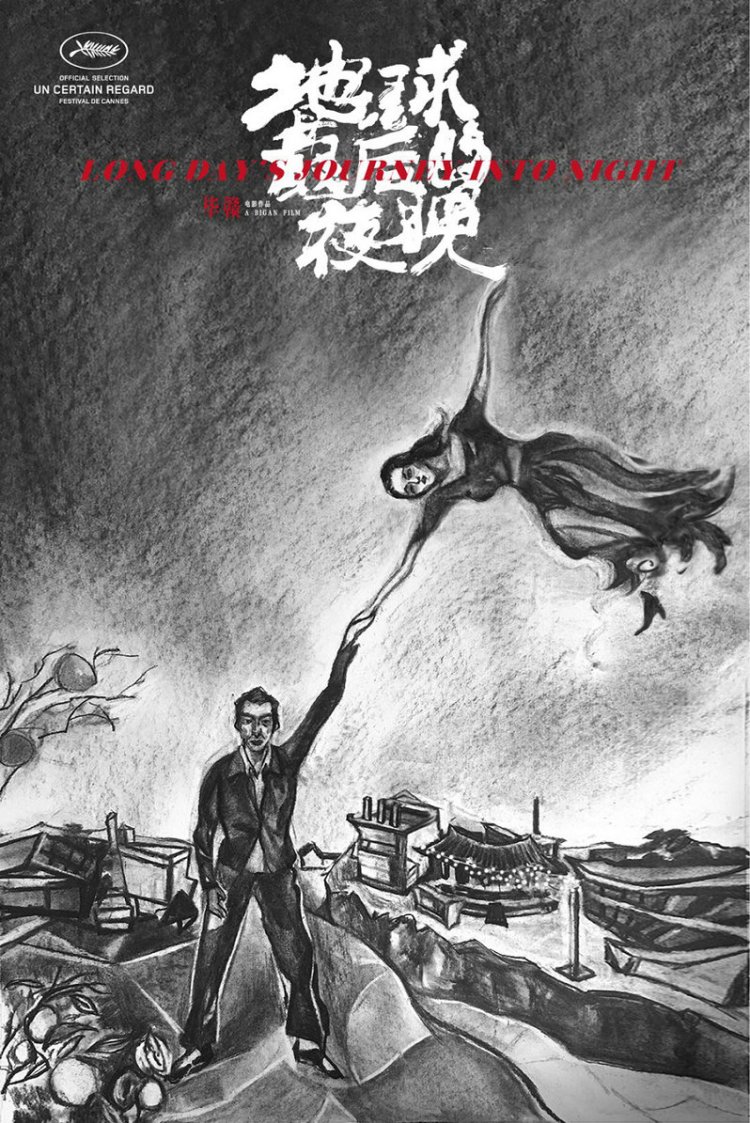
Long Day’s Journey into Night (地球最后的夜晚, Bi Gan, 2018)

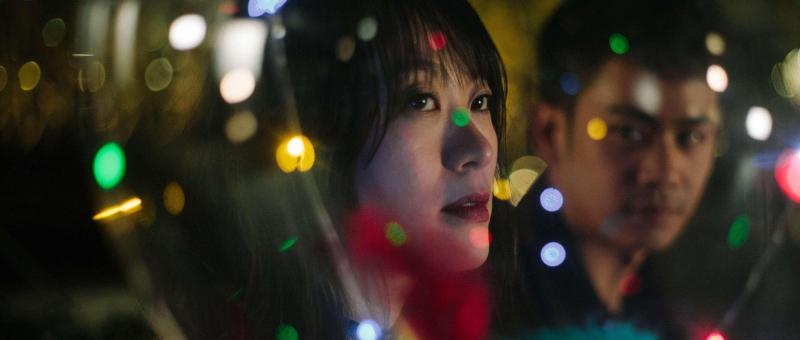
Long Day's Journey into Night poster“It’s living in the past that’s scary” an old friend advises the hero of Bi Gan’s Long Day’s Journey into Night (地球最后的夜晚, Dìqiú Zhòu de Yèwǎn). He knows she’s right, but like the best film noir heroes, the past is the place he can’t bear to visit or to leave. Stealing a title from a Eugene O’Neill play about a dysfunctional family individually lost in the fog of self-delusion and unable to escape the legacies of past trauma, Long Day’s Journey into Night is the story of a man looking for lost love but finding it only within the confines of his own memory, transient yet also eternal.

Luo Hongwu (Huang Jue) returns to his hometown of Kaili on the death of his father. As becomes apparent, there is nothing much of interest for him in a home he has avoided for years though an unexpected inheritance – a stopped clock his father could not stop looking at in the days before his death, yields unexpected treasure in the form of a black and white photograph of a young woman whose face has been burned out by a cigarette. Meanwhile, Luo walks us back through his own sad life story beginning at the turn of the Millennium when a recent divorce led to him letting down a friend, Wildcat (Lee Hong-Chi) – a roguish gambler, who was later murdered by gangster Zuo (Chen Yongzhong). Chasing the man who killed his friend, Luo tracks down his lover who bears a striking resemblance to the woman in the photograph. She tells him her name is “Wan Qiwen” (Tang Wei), and fascination soon turns into romance. As Luo has already hinted to us, Qiwen is the woman who defines his dreams – another of the disappeared, a ghost of memory which won’t let him rest.

Like the hero of Kaili Blues, Luo spends the rest of the picture looking for the missing – the mother who abandoned him in childhood, the man who killed Wildcat, and of course Qiwen. A haunted man, Luo chases ghosts and spectres of memory, attempting to repair his damaged world but perhaps half hoping not to find what it is he’s looking for and risk losing the beauty of its absence. Qiwen spins him a tale a worthy of any film noir femme fatale – of a jealous boyfriend and an impossible future. We can only be together if we live in the stars, she tells him, contributing to a noirish sense of futility which seals Luo inside a looping bubble of perpetual heartbreak and unresolvable longing.

For Luo all women and none are Qiwen whose emerald clad image echoes in every female face he sees. Memories of Qiwen and of his mother mingle uncomfortably, overlap and become one as he looks for explanations behind his twin abandonments and the heavy wound he carries in his heart. In his opening voice over, Luo tells us that dreams rise up within him and he rises with them as if his body were made of hydrogen, but that his memories are made of stone – heavy, immutable, and impossible to escape. Yet the dreamland is precious to him, because it’s the only place he can see Qiwen and where she is all he sees. Luo’s answers, if they come at all come only in dreams where the jumbled elements of his ongoing investigation reorder themselves, come together, and present a new truth holding its own transitory revelations.

In a dream Luo meets another woman who looks just like Qiwen only this time called Kaizhen with whom he trades eternity for transience and to whom he eventually gifts both. Luo’s wandering dream takes place on the winter solstice – literally the longest night on Earth, but is still too short. Drenched in perpetual rainfall, this Kaili is a lonely place of darkness and neon – a perfect encapsulation of Luo’s interior world, shaped by film noir and tragic romance which nevertheless gives way to a 3D dreamscape free of the selective editing which makes memory an unreliable narrator. Luo says that the difference between film and memory is that films are all false while memory holds both truth and lies, but in dreams dualities coalesce and absolutes disappear in a union of truth and fiction, transience and eternity. Bi Gan builds on the aching poetry of Kaili Blues for beautifully composed exploration of memory and desire mediated through frozen time and a single endless night.


Screened as part of the 2018 BFI London Film Festival.

Short clip (no subtitles)
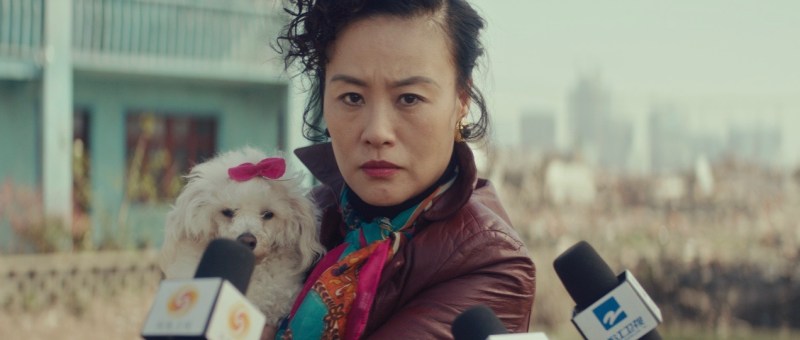
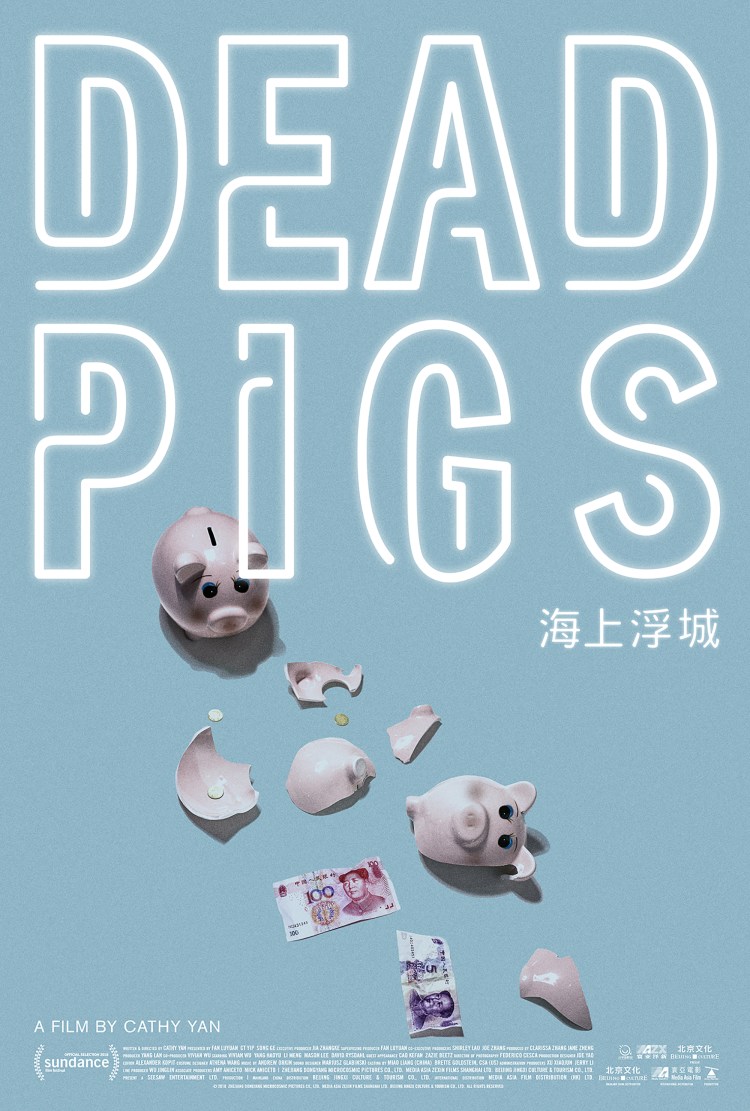
Dead Pigs (海上浮城, Cathy Yan, 2018)

Dead Pigs posterPigs – they have the best life, according to pig farmer Old Wang (Yang Haoyu). All they do is sleep and eat while hard working folks like him go out of their way to keep them comfortable. To Old Wang, it doesn’t seem fair but, ironically enough, he seems to have forgotten the heavy price a prize pig pays for its short life of “luxury”. Nevertheless, all his hard work is about to go down the drain in the debut film from Cathy Yan, Dead Pigs (海上浮城, Hǎi Chàng Fú Chéng). Loosely inspired by the infamous Huangpu River incident, Dead Pigs is a decidedly cheerful satire of modern China’s capitalist revolution and the many changes, good and bad, it has wrought.

When all the pigs in China suddenly start dropping dead, it presents a series of problems for your average pig farmer like Old Wang. With everyone on high alert and no clear indication of what is causing the strange phenomenon, no one is buying pork and getting rid of the carcasses in the “official” way is costly, bothersome, and will alert the attention of the authorities. Therefore, pretty much everyone starts tipping their dead pigs in the river which, besides being unsightly, is also a significant risk to public health.

Old Wang, however, has other problems. When we first meet him, he’s become obsessed with the cutting edge art of VR technology because it feels just like the real thing, delighting in pretending to go swimming when he could actually just go swimming outside if only he hadn’t been polluting the river with pig carcasses. Not content with virtual delusions, he’s also got himself into debt by “investing” in a scheme which turned out to be a scam and lost him all his savings. In debt to loan sharks, Old Wang decides to ask his sister, Candy (Vivian Wu) – a beautician with an upbeat, inspirational marketing campaign, for help. Candy, however, is in the middle of a nasty dispute with a local property developer which has bought up all the other properties in the area to build a brand new housing complex bizarrely inspired by classic Spanish cathedral Sagrada Família and designed by American architect Sean (David Rysdahl) who has ended up in China in flight from failure at home. Old Wang considers asking his son, Zhen (Mason Lee), whom he thinks has a good job in the city, for the money to pay the gangsters, but Zhen is just a waiter (in an upscale bar/restaurant specialising in pork) and is too ashamed to tell his dad he can’t help. Meanwhile, Zhen has also fallen for disillusioned rich girl Xia Xia (Li Meng) who is currently rethinking her elitist lifestyle.

Snapping at the property developers, Candy laments that it’s all “money, money, money” and resents that they can’t see the various practical and sentimental reasons she might not want to move, assuming she’s just an old battle-axe out for more money. In the world of rich kids like Xia Xia, money is indeed all that matters – having the flashiest outfits, jewellery, cars and accessories while being seen at the trendiest bars and restaurants on the arm of the handsomest companions the elite has to offer. No one seems to care very much about how they treat others because every offence can be paid for. Xia Xia, though she perhaps suspected it before, learns the hard way when she winds up in hospital and none of her many “friends” bother to visit her, preferring to send expensive gifts instead.

Meanwhile, Wang Zhen and his dad are two guys left behind by rapid modernisation. Too ashamed to tell his father he couldn’t cut it in the city, Zhen eventually takes to deliberately crashing into oncoming vehicles with his bicycle in the hope of extracting compensation – willingly submitting himself to a system in which money has become a license to do wrong for those who can afford it. American architect Sean feels much the same as he makes plain in an impassioned speech to Old Wang in which he insists that no one has the right to call him stupid or to make out he isn’t good enough for the brave new world they are making. Sean, having ended up in China in an attempt to escape these same feelings of inadequacy and failure in his home country, finds a new niche for himself, uncomfortable as it is, as a professional Westerner for hire in series of bizarre publicity stunts managed by a talent agency specialising in such rarefied fare. 

Yet more than the greed, selfishness, and inhumanity the cruelty of capitalism has engendered, it’s the loss of community that seems to really sting. Candy wants to hold on to her childhood home as a physical expression of a long lost neighbourhood and now absent family. Tellingly, the song she’s always singing, which is later reprised as a community wide karaoke number, is a classic track by Teresa Teng known as “I Only Care About You” in its Mandarin version but originally released in Japanese as “Toki no Nagare ni Mi wo Makase” which literally means “surrender yourself to the flow of time”. You can’t stop progress – perhaps it’s a mistake to cling on to the tangible in a world constantly in flux when what really matters has always been close at hand. The message seems to be, salvage what you can but get out of the way of the bulldozer before it buries you too. Sparkling with whimsy and filled with impromptu song and dance, Dead Pigs is a delightfully surreal examination of a changing nation in which goodness and empathy eventually win out (to a point at least) against the overwhelming forces of rampant capitalist expansion.


Screened at the 2018 BFI London Film Festival.

Original trailer (English subtitles)

Teresa Teng’s I Only Care About You

Original Japanese version (Toki no Nagare ni Mi wo Makase)

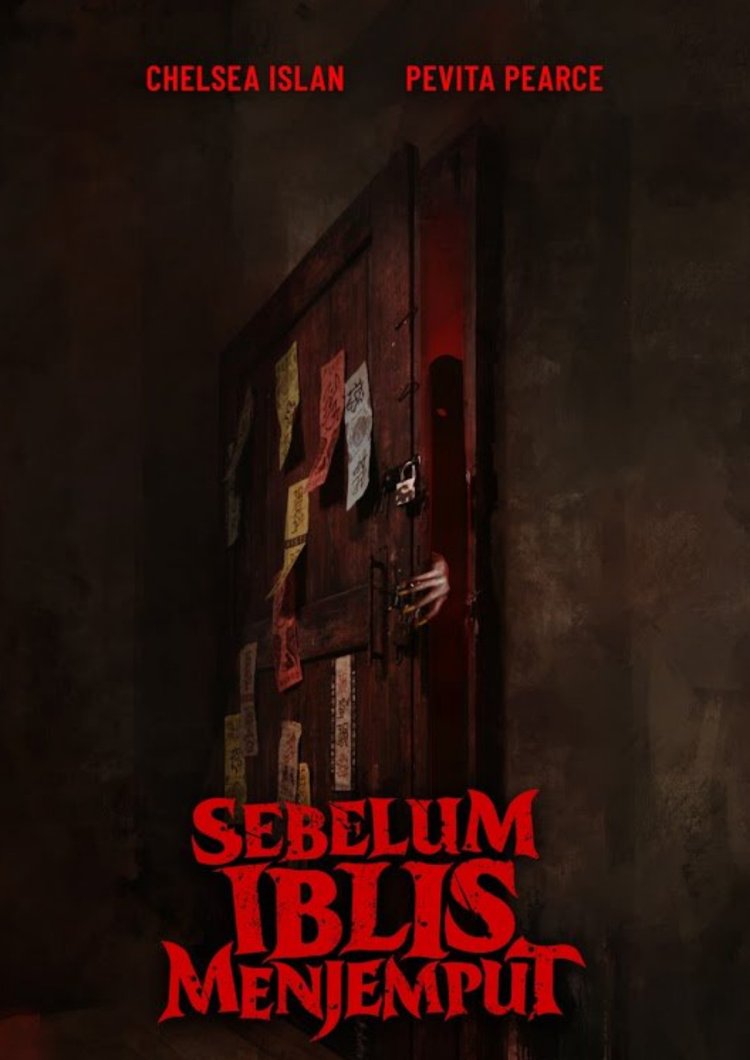
May the Devil Take You (Sebelum Iblis Menjemput, Timo Tjahjanto, 2018)

may the devil take you posterTop travel tip – if you encounter a door which is plastered with Buddhist sutras, it’s generally a very bad idea to open it. In this case, just not opening the door is a valid and very sensible option. Sadly, it’s one the protagonists of Timo Tjahjanto’s May the Devil Take You (Sebelum Iblis Menjemput) decided not to take. Following Joko Anwar’s Satan’s Slaves, May the Devil Take You also has a few hard questions to ask about the nature of “family” and how strong those bonds really are when the supernatural presses on already exposed nerves.

The film opens with formerly successful property entrepreneur Lesmana (Ray Sahetapy) entering some kind of agreement with a demonic shamaness whom he later kills and hides in the basement of his remote country villa. An undisclosed amount of time later, Lesmana is struck down with a mystery illness which forces his fractured family back together. Alfie (Chelsea Islan), Lesman’s estranged daughter from his first marriage, is called back to the bedside along with her step-siblings Ruben (Samo Rafael) and Maya (Pevita Pearce), famous actress step-mother Laksmi (Karina Suwandhi), and half-sister Nara (Hadijah Shahab). Forced politeness eventually gives way to resentment, especially when Laksmi begins to ponder selling the villa which is technically in Alfie’s name even if still thought of as a “family” property. When everybody unexpectedly turns up at the same time in search of things of value, they have very little idea of what it is that awaits them there.

Once again the threat is a bad inheritance in which the children are forced to pay for the crimes of their “father” who has let greed get the better of him and allied with dark supernatural forces in order to make himself fabulously wealthy. Lesmana’s sensational success is less due to his business acumen than to selling his soul, well not actually “his” but those belonging to his loved ones, to the Devil. His business empire apparently in tatters, Lesmana has both a problem and a solution, but the Devil is always wanting more and there may lines Lesmana won’t cross even when he is apparently willing to sacrifice the lives his wife and children just to be accounted a “success”.

There may be horrors lurking in the cellar of every home, but in this one they are quite literal and very, very angry. Family, as a concept, is the weapon the Devil chooses to wield, poking into all the dark and uncomfortable corners that basic civility usually leads most to avoid. Alfie, angry and carrying the trauma of her mother’s death, is resentful of her father’s new family and most particularly of her imperious step-mother whom even Maya later describes as “not a good person”. Yet for all that she can’t quite bring herself to “hate” her step-siblings, especially the kindly Ruben who seems to have embraced his role as a natural peacemaker. Their bonds will be tested by insidious evil which presses hard on their insecurities of their awkward family set-up in which no-one quite feels accepted, or wanted, or loved by almost anyone else.

Then again, family itself becomes a source of salvation when the buried past is unearthed and then reburied having been properly dealt with. Rather than a comment of Lesmana’s rejection of traditional religion and misuse of black magic, May the Devil Take You is an exploration in the desperation of a greedy man whose desire for infinite instant gratification is matched only by the Devil himself. Lesmana was willing to sell his family for gold only to change his mind and lose them anyway. The supernatural horror is all too real, but rooted in the sins of the father and in the broken familial connections which continue trap each of the protagonists in the stereotypically creepy remote rural mansion complete with creaking floorboards and leaky ceilings. Tjahjanto’s awkward tone, over-reliant on genre norms to degree of parody but distinctly serious, makes for a strangely uneven experience but there is certainly enough hellish imagery to fuel the nightmares of many a susceptible viewer.


Screened at the 2018 BFI London Film Festival.

Original trailer (no subtitles)

Believer (독전, Lee Hae-young, 2018)

Believer posterJohnnie To’s darkly comical tale of a weaselly meth cook with an extremely strong survival instinct and the austere policeman who can’t resist taking his bait might seem perfectly primed for a Korean remake in its innate pessimism and awkward bromance. Lee Hae-young’s Believer (독전, Dokjeon), however, merely borrows the bones of To’s Drug War while doubling down on its central conceit as reckless obsession leads to the undoing of both our heroes, each forced to confront the futility of their respective, mutually dependent quests.

Obsessed with tracking down a mysterious drug lord known only as “Mr. Lee”, narcotics cop Won-ho (Cho Jin-woong) asks a favour from an old informant only to see her murdered, leaving him only a vague clue by tracing an infinity symbol on a crumpled receipt moments before passing away. Warned off the Mr. Lee case, Won-ho finally gets a lead when an explosion at a drug lab brings scorned righthand woman Oh (Kim Sung-ryung) into his office promising to spill the beans in return for protection and immunity. Sadly, Won-ho couldn’t protect her either, but there was another unexpected survivor in the form of low level middleman Rak (Ryu Jun-yeol).

Traumatised by the death of his mother in the same explosion, Rak initially says nothing under interrogation but suddenly wakes up on learning that the lab’s dog also survived and has been rescued by the police. Unlike the “hero” of To’s film, Rak is small fry (if well connected) and is not looking at anything more than significant prison time. Rak may not be fighting for his life but he has a number of reasons for switching sides, especially once Won-ho fills him in on Mr. Lee’s backstory and long history of abrupt purges.

Despite working for the organisation, neither Oh nor Rak had ever met “Mr. Lee”. No one knows anything about them – gender, nationality, name, or location. In fact, there may not even be a Mr. Lee. Perhaps “Mr. Lee” is merely the “god” of drug dealers – an abstract idea almost given flesh but existing in a spiritual sense alone. Nevertheless, the idea of a Mr. Lee has completely captured the heart of compassionate police detective Won-ho whose all encompassing need to find him has already severely destabilised his life. After failing to protect his informant, Won-ho’s complaint against Mr. Lee is now a personal as well as professional one. Not so much out of vengeance (though there is that too), but a need to make the deaths count and his mounting losses meaningful.

Yet as another Mr. Lee contender later puts it, salvation may not be a matter of faith and if your faith has been misplaced, death may be a healing. In believing so deeply in the idea of “Mr. Lee”, Won-ho has given him form and created an idol to be worshipped through devotion. “Brian” (Cha Seung-won), a higher ranking gangster and former preacher chased out of the US for getting his congregation hooked on cocaine, has his own particular brand of faith based problems but subscribes to much the same philosophy. He may really be Mr. Lee (as may anyone), but if he isn’t he’s determined to convince himself he is in order to see himself as something more than the failed son of a chaebol dad who couldn’t hack it in the family business or in the pulpit. Brian would be happy to die as Mr. Lee rather than going on living as “himself”. Won-ho, unable to understand why kids do drugs asks his informant who explains it’s mostly because life is rubbish. Later someone says something similar to Brian, that he’d rather delude himself with the belief that he’s “someone” rather than face the emptiness.

Despite himself, and as Rak is eager to remind him, Won-ho is dependent on his informant for the pursuit of his case. Won-ho is reluctant to trust him even though Rak seems to be actively working to protect him in this extremely dangerous and largely unfamiliar world. Rak, by contrast, is aware he hasn’t won Won-ho’s faith, but assures him that’s OK because Rak trusts him. Rak does indeed seem to have the upper hand along with mysterious motivations and a fishy backstory, but Won-ho’s desperation to get close to Mr. Lee leaves him wide-open, unwilling to trust his guide but too invested to consider cutting him loose. “Belief” becomes its own drug, a transformative ritual act which gradually erodes all other needs and leaves only emptiness in their place. Won-ho can’t even remember why he started chasing Mr. Lee, but all that remains of him is the chase – a true believer suddenly bereft of a cause. Lee Hae-young takes To’s nihilistic cynicism and subverts it with a focus on the personal as both men fight self created images of their individual demons but find themselves unable to escape from their mutually assured identities.


Believer was screened as part of the 2018 BFI London Film Festival.

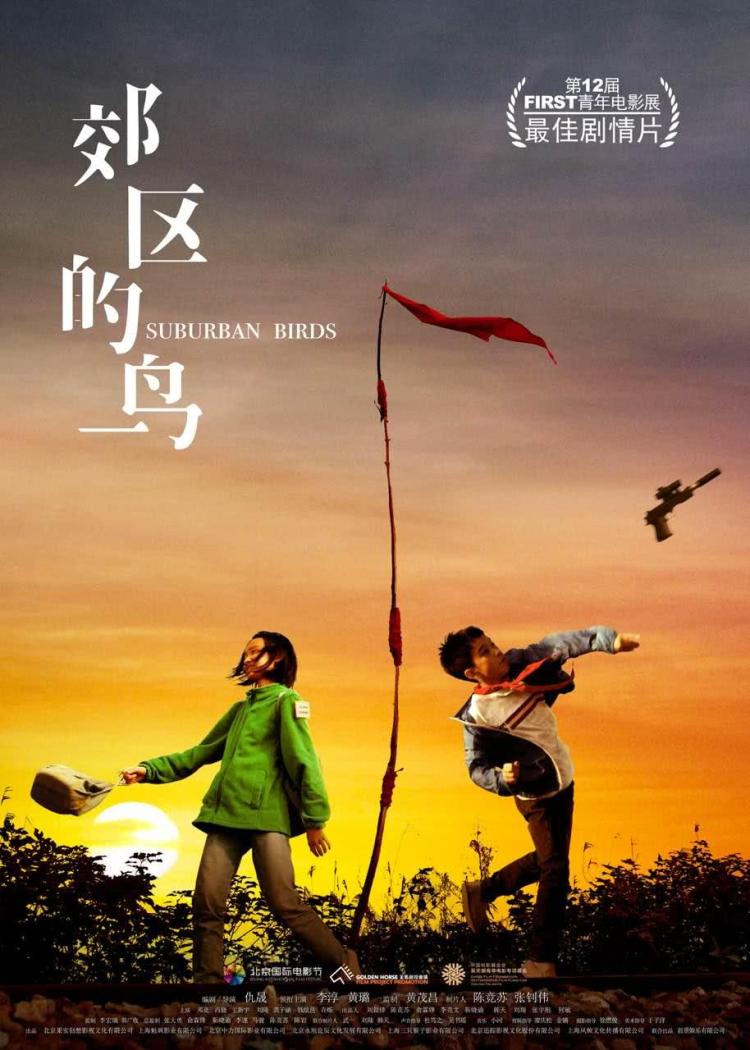
Suburban Birds (郊区的鸟, Qiu Sheng, 2018)

Suburban Birds poster 1Everything is collapsing in the strangely entropic world of Qiu Sheng’s Suburban Birds (郊区的鸟, Jiāo de Niǎo). Time and memory conspire to confuse and confound as man-made structures devour the natural pleasures of human existence, stepping in time with China’s rapid urban development in a hasty march towards a fractured future. Our hero dreams of finding rare avian life, but remains shackled to the earth as an agent of both destruction and creation – literally “engineering” the future while attempting to repair the mistakes of the past.

Xiahao (Mason Lee) is currently working for a government-backed team of surveyors trying to solve a massive subsidence problem which has rendered a brand new estate unfit for habitation. The subsidence problem, besides being dangerous and apparently unpredictable, is also expensive – the city is footing the bill for putting an entire neighbourhood up in a hotel while essential works on a new subway line needed to serve it are also on hold. The engineers are doing their best, but they seem ill equipped to investigate and feel both under resourced and under appreciated. The youngest member of the team, Ant (Deng Jing), is even thinking of quitting because he gets all the rubbish jobs and his girlfriend thinks there’s no future in his career seeing as there’s relatively little scope for advancement save becoming the “boss” which doesn’t actually pay very much. In between drinking, arguing, and investigating, Xiahao strikes up a relationship with one of the evictees – the pretty hairdresser “Swallow” (Huang Lu), to whom he eventually offers to show the elusive birds.

Meanwhile, a second tale takes over when Xiahao investigates an abandoned school and discovers a diary written by another Xiahao (Gong Zihan) which details the various adventures of a group of adolescent friends. Whether in reality or just in the older Xiahao’s imagination, the kids from the book echo people in his adult life from the members of his engineering team to the two female evictees he encounters at the hotel. The younger Xiahao could perhaps even be an echo of the older one’s real or imagined childhood – the aesthetics are distinctly ‘90s but the adventures are infinitely timeless. Little Xiahao and his friends communicate in person and go outside to play, fully existing in tune with their surroundings and as much part of the natural world as the “suburban birds” looking for a perch in a land under permanent construction.

Yet modern China somehow works its way into their idyllic world. The kids play in the ruins of broken broken buildings, are literally injured by the ruptured landscape, and finally begin to disappear one by one. Eventually the streams cross – the young Xiahao and the other boys come across the older Xiahao and his team dreaming away under greying skies while their optical level looks silently on at nothing. The kids stick a piece of chewing gum on the lens – an act which is both intensely irritating for the slumbering adults and a literal proof of their material existence within the same plane if not definitively the same time.

Xiahao’s dreams, as he recounts them to his bored coworkers, revolve around a terrible gushing of water as a powerful drill inexplicably turns to liquid. The loudmouth party man tagging along to chivvy the crew towards a completion of the paperwork even in the absence of a safe and workable solution, has an appropriately bawdy theory but the dream itself is later echoed by the boys who find themselves charged with carrying a large butt of water through their school until its weight gets the better of them. Xiahao is convinced that leakage lies at the heart of the subsidence problem, that shoddy workmanship and bad weather have conspired to ruin the ambitions of human engineering. Public safety is not such a concern as faith in local government. Not only has an all encompassing hunger for progress robbed the land of its beauty but has begun to erode itself from the underneath leaving only a perilous fall to the chasms below.

Xiahao dreams of a more innocent time. His ringtone alarm features bird song which is either so real you can’t tell the difference, or the ironically named Swallow has never actually heard it before outside of the movies. He wants to find the elusive “suburban birds” but turns to the internet to do so, eventually wading back into into a dream in which children play freely among the greenery while singing semi-ominous communist songs about how the future belongs to the young. A riddle besets them all – what is both long and short, fast and slow, and whole yet may be divided into many parts? The answer seems to be time, or perhaps memory, hinting at the way past haunts the future as a squatting tenant of the present which can neither speak nor stay silent. Forgetting, like the water pouring in through the inexpertly poured concrete of a half constructed subway tunnel, erodes the foundations of conscious thought. You can’t build a future on emptiness, and if there’s nowhere for the birds to sit what sort of future is it anyway?


Screened at the 2018 BFI London Film Festival.

Original trailer (English subtitles)

Interview with director Qiu Sheng from Locarno

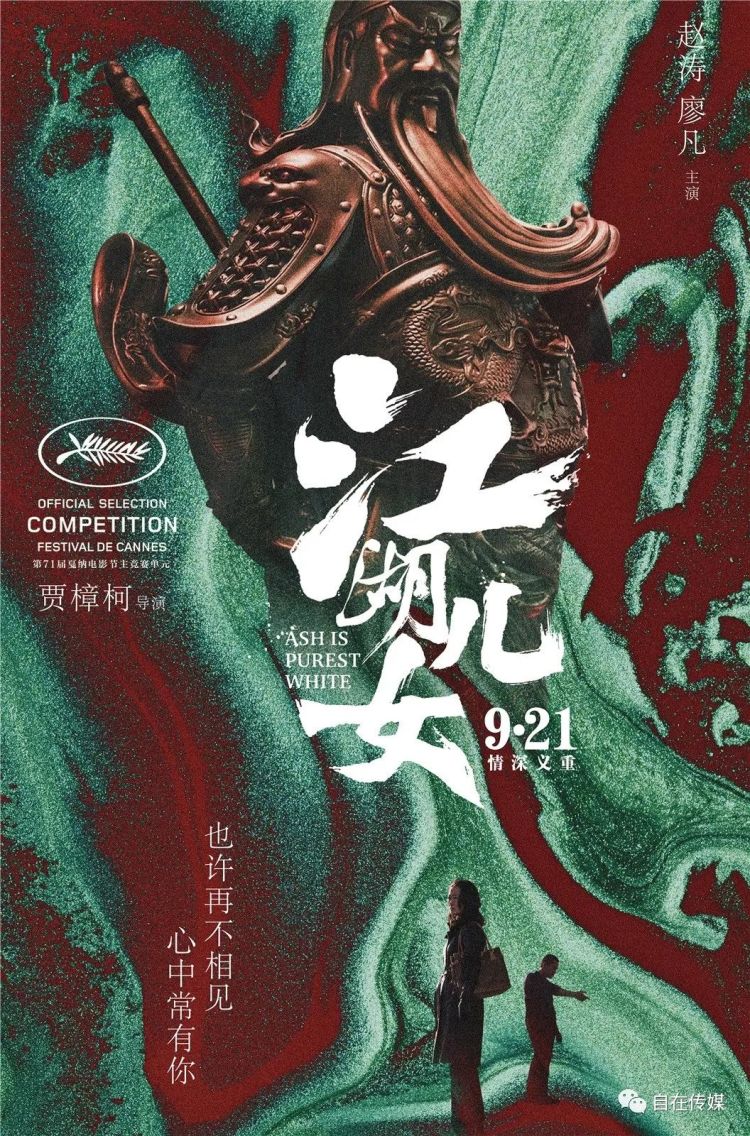
Ash is Purest White (江湖儿女, Jia Zhangke, 2018)

Ash is purest white poster 1Jia Zhangke returns to the world of crime for a slice of jianghu blues in his latest chronicle of modern China through the eyes of its ordinary, downtrodden citizens. Self referential in the extreme, Ash is Purest White (江湖儿女, Jiānghú Érnǚ) is a sad story of conflicting values and missed connection as a lovelorn woman proves herself too good, too pure, and ultimately too strong for the weak willed man she can neither love nor abandon. Times change and feelings change with them. To survive is not enough but integrity comes at a heavy price in a land where everything is for sale.

Echoing the time jumping narrative of Mountains May Depart, Jia opens in 4:3 and in 2001 as Qiao (Zhao Tao), sporting a black Cleopatra-esque haircut (the same as that worn by the identically named heroine of Jia’s own Unknown Pleasures from 2002) takes the bus into town. The first lady of the local “jianghu” underworld, Qiao is the devoted righthand woman of petty gang boss Bin (Liao Fan), enjoying the loyalty, honour, and respect of all in the slightly depressing environs of a small corner of dusty Datong. Bin is a walking monument to the idea of “jianghu” as mediated through Hong Kong action movies, swaggering around with a gun in his belt to prove that he’s the top dog in this tiny town. To live by jianghu is know that someone is always coming and when another prominent gangster is offed by young thugs, it’s not long before they come knocking on Bin’s door. Humiliatingly thrashed in the main square, Bin is only saved by a heroic intervention from Qiao who takes up his gun and fires into the air, a look of imperious authority on her face even as her eyes flicker with fear and excitement.

Qiao didn’t shoot anyone, but as the gun was illegal and she brought its presence to the notice of the police she gets into trouble anyway. A fierce devotee of the jianghu way, she refuses to give up Bin and insists the gun is hers and always has been. The gun was not hers in a real sense, and though she intends to lie in order to protect the man she loves from her mistake in firing it, spiritually speaking she and the gun are one. Having admired Bin’s skilful defusing of a petty gangster dispute without needing to use it, Qiao picks up the pistol and turns it over in her hands. The irony is, Qiao doesn’t need the gun but it completes her all the same, or at least completes the image she has of herself as an action movie heroine. Bin, however, has the gun because he doesn’t believe in himself in the same way Qiao does. He knows he’s weak and that his time is limited.

When Qiao is sent to prison for five years, she fully expects to find Bin waiting for her on the other side when she gets out. In the meantime Bin has proved true to form – he’s found himself another powerful woman to hide behind, though this time he’s chosen (or, in reality, is chosen by) one with good connections rather than fighting spirit. Bin has left the world of jianghu behind to try and make it in the rapidly developing capitalist economy, but as Qiao tells him when they finally reunite she had to live as a jianghu just to find him. Alone and friendless, betrayed by her love and disrespected by her new environment, Qiao turns to a cheeky strain of petty crime to get by – taking social revenge by attempting to blackmail random men over secret affairs, gatecrashing wedding parties for food, living by her wits on the streets and, if she’s honest, enjoying it.

Qiao is, in a sense, living in an imagined past. The frequent strains of Sally Yeh’s theme from John Woo’s seminal noir-tinged hitman drama The Killer underscore the yearning for an era of heroic bloodshed, brotherhood, and honour which never really existed outside of the movies. While Qiao grips her gun and fires in the air, Bin lights a melancholy cigarette watching Taylor Wong’s Tragic Hero, grumpily passive as always. Qiao saves Bin, more than once, but he can’t forgive her for it or reconcile himself to his own lack of resolve.

The film’s Chinese title, loosely translated as “the sons and daughters of jianghu” hints at the power of this double edged inheritance in which the archaic social codes of brotherly honour and loyalty are both barrier and bridge in an increasingly amoral society. Jia shows us a world of mine closures and forced migration, revisits the Three Gorges damn in which the past is sunk to pave way for the future, and introduces us to a modern day prospector with a big idea about UFOs. Bin, weak and opportunistic, doesn’t have the ability to ride the waves of China’s changing tides, but Qiao doesn’t have the will. Burned right through to her jianghu core, she sticks steadfastly to her code as she retreats to her spiritual home but owns her place within it even as the modern world rises up all around her. Qiao’s independence is both victory and defeat, an echo of the failed ideologies of a nation drunk on capitalism in which newfound freedom confuses and corrupts in equal measure. Nevertheless, there is something tragically romantic in Qiao’s lovelorn longing for a more passionate era in which the bonds between people still counted for something even if their demands were not always fair.


Screened as part of the 2018 BFI London Film Festival.

Short clip (English subtitles)

Full version of Sally Yeh’s theme from John Woo’s 1989 existential hitman noir The Killer

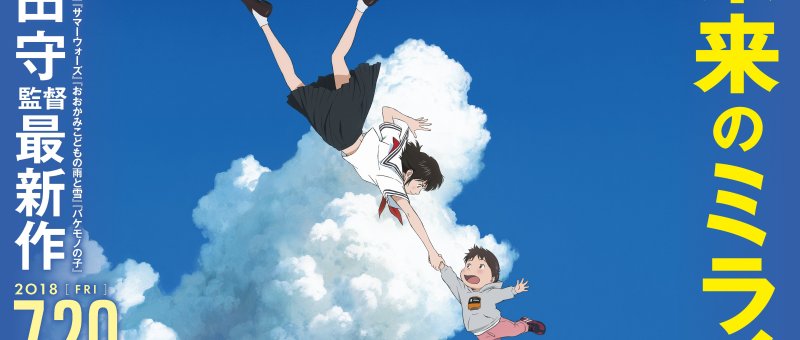
Mirai (未来のミライ, Mamoru Hosoda, 2018)

Mirai posterIn Mamoru Hosoda’s Wolf Children, a young woman experiences heartbreak when the love of her life is cruelly cut down, leaving her alone with two small children whose particular needs send her off in search of a new way of living. Hosoda’s filmography is filled with family drama, of how difficult and painful the relationships between parents and children can be. Wolf Children was the story of a mother’s tragedy in that she has to set her children free in order to see them grow. The Boy and the Beast was a young man’s struggle to make peace with his father. Mirai (未来のミライ, Mirai no Mirai) presents an altogether less “complicated” vision of family life, steeped in authentic detail and gentle warmth.

The hero of the tale is Kun (Moka Kamishiraishi) – a train obsessed four year old suddenly presented with a new baby sister later named “Mirai” (Haru Kuroki). Having been an only child used to receiving all of his parents’ attention, Kun is intensely resentful of the various ways his life has changed. Feeling pushed out, he begins to throw tantrums, become argumentative, even threaten to run away from home. Meanwhile the family dog, Yukko, looks on with thinly veiled contempt as Kun gets a little of his own medicine in no longer being the centre of attention.

Taking refuge in the front garden which is a major feature of the family home designed by his architect father, Kun begins to receive a series of visitations – firstly from an anthropomorphised Yukko and then by the teenage incarnation of his little sister on an urgent mission to the past to ensure her absent minded father packs the Hina Matsuri dolls away on time lest she end up an old maid, prevented from marrying her one true love because of ancient superstition (and her father’s forgetfulness). After interacting with the older Mirai, Kun travels off on further flights of fancy to observe his mother at his age and even his late great grandfather – a dashing, motorcycle riding hero who walked with a limp thanks to a lucky wartime escape.

Snatched from vague comments overheard from his parents and grandmother, Kun’s adventures teach him new and valuable ideas about the world. He learns that it’s alright not to understand everything right away because that’s what life is for. As someone later puts it, there’s a first time for everything and once you’ve learned one thing you’re halfway way to knowing everything else. Meeting his mother as a youngster shows him that she was once a messy toddler too and that all things come in time.

Kun still doesn’t quite understand, but comes to a new appreciation of his home and his family as a part of something far larger of which he is merely a mid-point on an ever expanding scale. Mirai shows him his “family tree” as manifested literally in the one in the family garden. Somewhat oddly for a girl from the future, Mirai likens it to a card index like the ones at the library (perhaps one of her old fashioned preoccupations like the Hina Matsuri superstitions) filled with personal stories in which no one is ever really forgotten. Having gotten himself into quite a fix and wound up at a very futuristic looking Tokyo train station, it’s family which eventually sets Kun on his way back home, having remembered who he is in relation to others.

Yet Kun’s family is also intensely modern and going through changes of its own. Kun’s mother will be going back to work soon after Mirai’s birth – something still somewhat unusual in traditional Japan while in an even more seismic leap towards equality Kun’s father, who will be working from home, has committed to sharing responsibility for the domestic realm in looking after the children during the day as well as taking care of the cooking and the cleaning while Kun’s mum works. Kun’s mother might bristle at her husband’s eagerness to accept praise for only doing his fair share while struggling with ordinary day to day tasks, but the couple have soon found a happy equilibrium in embracing the joys and anxieties of building a family. Another beautifully profound tale from Hosoda, Mirai is a lovingly rendered exploration of what it is to live a life among lives with all the rewards and responsibilities that entails.


Screened as part of the 2018 BFI London Film Festival.

International trailer (English subtitles)

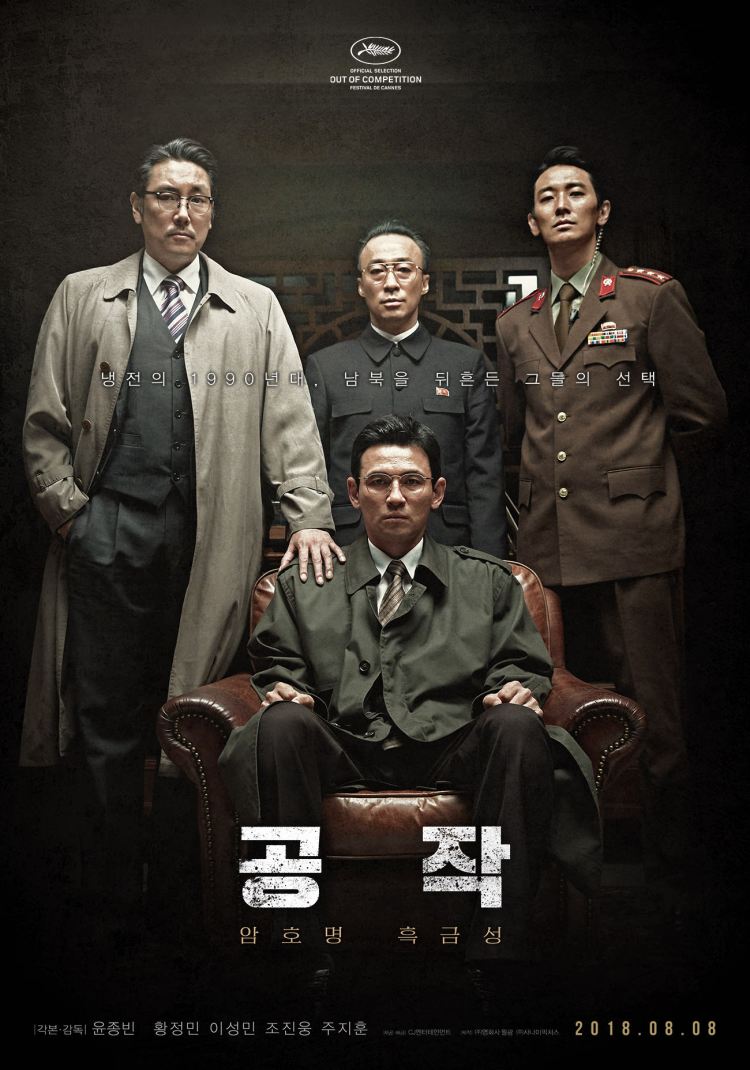
The Spy Gone North (공작, Yoon Jong-bin, 2018)

Spy gone north posterSome might say the first lesson of spying is not too ask too many questions. The hero of Yoon Jong-bin’s Spy Gone North (공작, Gongjak) may wish he’d heeded this advice as his ongoing mission to gain access to North Korea’s nuclear secrets by way of an unlikely advertising scheme sets him on a dark path towards the realisation that he might not be working for the good guys after all. In geopolitical terms, an enemy is sometimes more helpful than a friend – especially if your “enemy” is working on the same system and can be relied upon to play along when the occasion calls.

By the early ‘90s, South Korea has emerged from a lengthy period of military dictatorships into a fledgling democracy. Tensions with the North are running high as the nation has announced an intention to withdraw with from the Nuclear Proliferation Treaty on grounds of national security. Fearing that the North has already successfully developed nuclear weapons, the South decides to ramp up intelligence gathering activity which is where “Black Venus” comes in. Shedding his old identity by appearing to lose himself in drink and gambling, intelligence officer Park Suk-young (Hwang Jung-min) poses as a sleazy businessman with the intention of gaining access to the North Korean elite through their external trade commission operating out of Beijing.

Improbable though it seems, Park manages to engineer a genuine friendship with the cold and austere North Korean trade official Ri Myong-un (Lee Sung-min) with whom he eventually shares unexpected common ground. Strapped for cash after the South sets them up by getting them in hock to China over a mislabelled walnut scandal, the North needs money fast, which is why they’re prepared to talk to someone as shady as Park’s cover. Park sells them an unlikely solution which runs contrary to their core philosophies in exploiting the exoticism of the forgotten North to sell capitalistic decadence in the South through selling licenses to shoot commercials on North Korean soil (which also allows him to travel about the country with a camera), but he doesn’t quite see the added value of his mission even while almost forgetting about the need to get close to the site of the supposed nuclear research facility.

While Park finds himself an “honoured guest” of the Dear Leader (Gi Ju-bong) whose presence evokes both fear and awe, he is also faced with a pressing political crisis at home as the nation prepares for an upcoming presidential collection. Despite the democratic revolution, the same party has been in power for the last 30 years and the recent swing towards the liberal opposition party has many running scared, especially as taking a softer line towards the North is a prominent manifesto pledge – alongside a reform of the security services, which is obviously distressing news for Park’s bosses. In order to maintain the sense of fear which keeps the right-wingers in power, the security services have been secretly communicating with the North and bribing them to create disturbances at politically advantageous times to manipulate the outcome of elections. Park is not exactly a liberal, but he has to admit this is not a good look and if you’re just going to parrot the “for the people” line perhaps you’re not much better than the thing you claim to hate.

Meanwhile, Park is also witness to a side of North Korea outsiders don’t generally see filled with the starving and the destitute. Loyalists all, there are those among the North Korean elite who want to see conditions improve and worry that thanks to the intense stranglehold of the ruling regime they never will. As in everything, business interests trump all. Park and Ri are fighting for the same thing, aware their fledging enterprise is a subterfuge but also that it’s a huge and dangerous first step towards a happier future. After 40 years of mutual manipulations, however, not everyone is keen on abandoning the status quo especially as the two nations have developed an intensely symbiotic relationship founded on mutual demonisation and a friendly willingness to conspire in ensuring the survival of a useful evil. Still, the strangely fraternal relationship between Park and Ri – two fiercely patriotic men from opposing sides who each identify goodness in the other becomes the heart of the film, holding out hope for empathy and compromise when most prefer enmity and chaos.


Screened as part of the 2018 BFI London Film Festival.

International trailer (English subtitles)

Drug War (毒戰, Johnnie To, 2012)

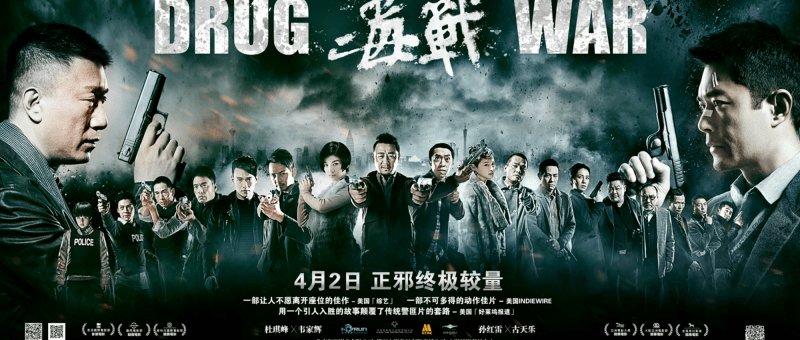
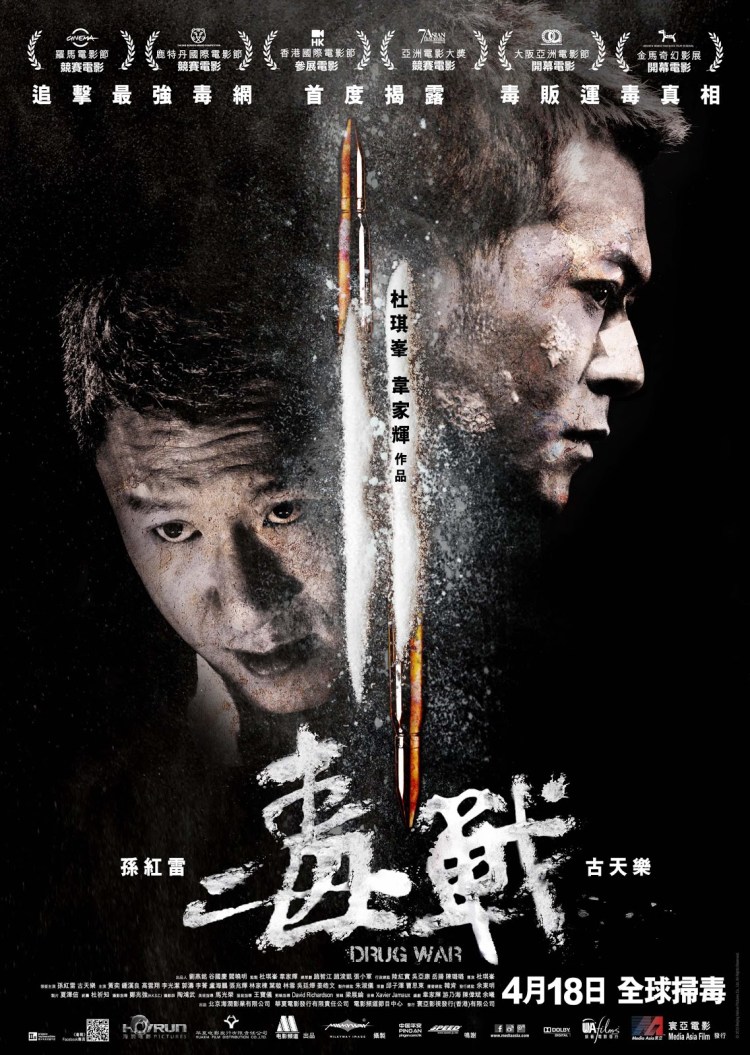
Drug War posterIn the world of the Hong Kong action flick, the bad guys are often the good guys, and the “good guys” not so good after all. Even crooks have their code and there are rules which cannot be broken ensuring the heroes, even when they’re forced into morally dubious acts, emerge with a degree of nobility in having made a free choice to preserve their honour over their life. In Mainland China, however, things are a little different. The bad guys have to be thoroughly bad and the good guys squeaky clean. You won’t find any dodgy cops or dashing villains in a thriller from the PRC where crime can never, ever, pay. And then, enter Johnnie To who manages to exactly what the censors board asks of him while at the same painting law and chaos as two sides of the same coin, each deluded and obsessed, engaged in an internecine war in which the idea of public safety has been all but forgotten.

The film begins with the conclusion of an undercover operation run by Captain Zhang (Sun Honglei) in which he successfully disrupts a large scale smuggling operation. Meanwhile, meth cook Timmy Choi (Louis Koo) attempts to escape after an explosion kills his wife and her brothers but drives directly into a restaurant and is picked up by the police. Timmy soon wakes up and tries to escape but is eventually recaptured – from inside the chiller cabinet in the morgue in a particularly grim slice of poetic irony. Seeing as drug manufacture carries the death penalty in the PRC, Timmy turns on the charm. He’ll talk, say anything he needs to say, to save his own life. Including giving up his buddies.

Timmy is, however, a cypher. His true intentions are never quite clear – is he really just an opportunist doing whatever it takes to survive, or does he still think he can escape and is engaged in a series of clever schemes designed outsmart the ice cool Zhang? Zhang takes the bait. Eyeing a bigger prize, he lets Timmy take him into the heart of a finely tuned operation even playing the part of loudmouth gangster Haha in a studied performance which reinforces the blankness of his officialdom. Zhang is certain he is in control. He is the law, he is the state, he is the good.

Could he have misread Timmy? Zhang doesn’t think so. Timmy remains calm, watchful. Eventually he leads Zhang to a bigger drug factory staffed by a pair of mute brothers who have immense respect for their boss. Suddenly Timmy’s impassive facade begins to crack as he tells his guys about his wife’s passing but it’s impossible to know if his momentary distress is genuine, a result of mounting adrenaline, or simply part of his plan – he does, after all, need to get the brothers to give themselves away. Unbeknownst to Timmy, however, the brothers are pretty smart and might even be playing their own game.

To pits Hong Konger Timmy against Captain Zhang of the PRC in a game of cat and mouse fuelled by conflicting loyalties and mutual doubts. Whatever he’s up to, Timmy is a no good weasel who is either selling out his guys or merely pretending to so that he can save them (or maybe just save himself and what’s left of his business). Zhang, meanwhile, is a singleminded “justice” machine who absolutely will not stop, ever, until all the drug dealers in China have been eradicated. Yet isn’t all of this destruction a little bit much? Zhang doesn’t really care about the drugs because drug abuse wrecks people’s lives, maybe he doesn’t really care about the law but only about order and control, and what men like Timmy represent is a dangerous anarchy which exists in direct opposition to his conception of the way the world ought to work.

There is a degree of subversive implication in the seemingly overwhelming power of the PRC coupled with its uncompromising rigidity which paradoxically makes it appear weak rather than strong, desperate to maintain an image of control if not the control itself. The final fight takes place in front of a school with a couple of completely non-fazed and very cute little children trapped inside a school bus – Timmy does at least try to keep them calm even while using them as part of his plan, but Zhang and his guys seem to care little for the direction of the stray bullets they are spraying in order to win the internecine battle with the drug dealers and stop Timmy in his tracks once and for all. A pared down, non-stop action juggernaut, Drug War (毒戰, Dú Zhàn) is another beautifully constructed, infinitely wry action farce from To which takes its rather grim sense of humour all the way to the tragically ironic conclusion.


International trailer (English subtitles)

Asako I & II (寝ても覚めても, Ryusuke Hamaguchi, 2018)

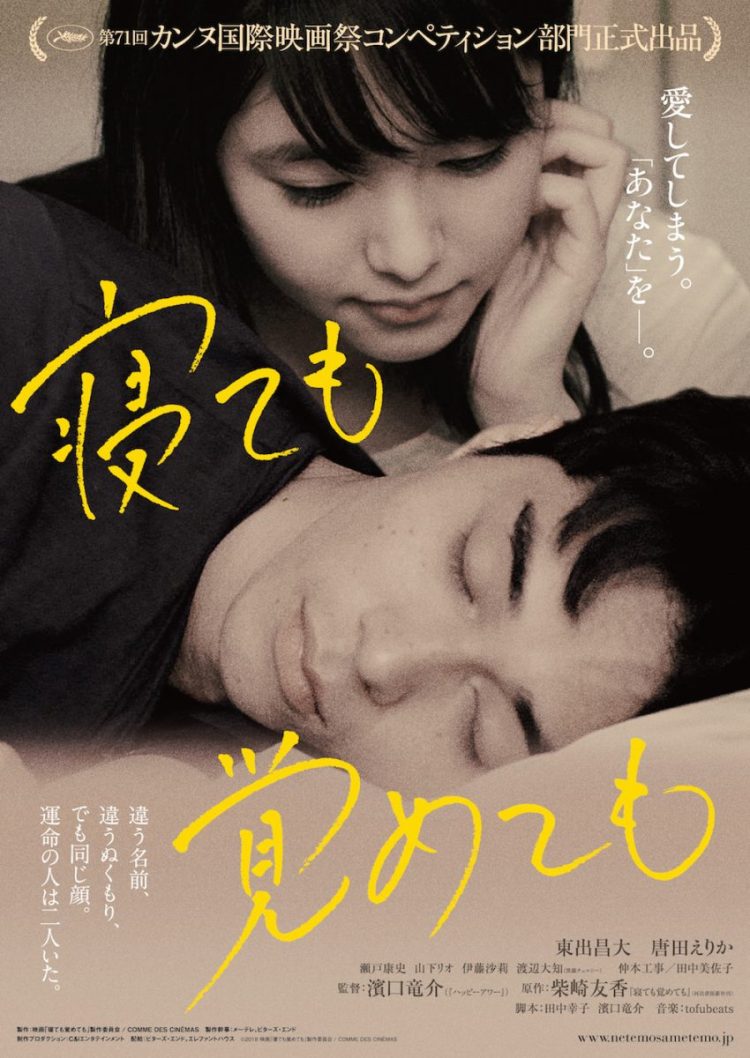
asako I & 2 posterDualities define the perpetually submerged worlds of Ryusuke Hamaguchi’s Happy Hour followup Asako I & II (寝ても覚めても, Netemo Sametemo). Waking and sleeping, fantasy and reality, past and present, presence and absence, love and sadness. Asako (Erika Karata), an ordinary young woman of the contemporary era, finds herself in a similar position to many of the heroines of contemporary Japanese literature in that she has no idea what she really wants out of life and is essentially torn between a series of idealised lives snatched from movies and magazines. Yet she is also haunted by a broken heart, arrested in a state of perpetual adolescence thanks to an early disappointment in love in which remains horribly unresolved.

As a university student in Osaka, Asako attends a photo exhibition dedicated to one of the few books put out by legendary Japanese photographer Shigeo Gocho titled “Self and Others”. Fascinated by an eerie picture of two little girls dressed identically, one slightly taller than the other, Asako’s attention is eventually caught by a striking young man. She leaves the exhibition and follows him until he eventually turns and faces her. Firecrackers some teenagers had been struggling to light suddenly explode around his feet. He strides over to her, asks for her name, and then leans in for a kiss – at least, that’s the way he later tells it to a disbelieving friend who points out that “no one meets like that”. An arty type in dungarees and shaggy hair, the young man’s name is “Baku” (Masahiro Higashide) – he uses the character for wheat (his dad was big into grains) but it’s also a homonym for explosion which a is key indication of the unpredictable excitement he comes to represent for Asako as her uni best friend Haruyo (Sairi Ito) attempts to warn her by insisting that Baku is the heartbreaking type and whatever she has with him is destined to end in tears.

Haruyo’s prediction comes to pass when Baku steps out one day to buy some shoes and never returns. A brokenhearted Asako makes her way to Tokyo and begins working a cafe but two and a bit years later, she is stunned to find “Baku” wearing a suit and working in an office. He doesn’t remember her and says his name’s Ryohei, but Asako can’t shake the association which is both attractive and repellent in equal measure. Ryohei is smitten, he felt the connection too, but Asako doesn’t quite know what to do with this unfortunate coincidence.

Events repeat themselves with only mild distortions – Asako and Ryohei attend another Gocho photo exhibition though this time with Asako’s Tokyo best friend, Maya (Rio Yamashita). Rather than a motorcycle accident, Ryohei and Asako find and comfort each other after the 2011 earthquake and eventually become a couple, move in together, and even get a cat. Asako begins to fall for Ryohei, but can’t be sure her love for him isn’t really love for Baku refracted through a different lens. Baku, a man with a wandering heart, once told her he would always return no matter how long it might take. There’s a part of Asako that’s always waiting, held back, afraid to move and unwilling to acknowledge the death of her younger self as immortalised in the image of herself with Baku.

When Haruyo runs into Asako and Ryohei unexpectedly in Tokyo, she gives us our first indication that Ryohei really does look like Baku and the association isn’t just a projection of Asako’s romantic anxieties. Haruyo’s first words to Asako are that she hasn’t changed – they’re intended as a compliment, but Asako bristles. She feels as if she’s moved forward, matured, is preparing to enter a comfortable middle age with Ryohei at her side but deep down she knows she hasn’t. She’s still the naive student pining for a lost love that never cared enough about her to resolve itself. She worries she’s been playacting and that her relationship with Ryohei isn’t “real” even if she cares about him enough to have her feeling guilty for this mild form of betrayal.

Later, offered another possibility, Asako feels as if her life with Ryohei has been like a dream, or perhaps the only waking moment of her life. When Ryohei introduces a work friend to Maya as an excuse to get close to Asako, they watch a video of her performing a scene from Chekhov’s Three Sisters – a play famously about self delusion in which the fierce belief in an impossible future becomes the only thing which makes life possible. The climactic earthquake hits just as Ryohei is preparing to watch Maya perform in Ibsen’s The Wild Duck – the play which lays bare the playwright’s key tenet, that if you take away a man’s life lie you take away his happiness. Ryohei’s friend Kushihashi (Koji Seto) might rip into Maya’s “narcissistic” acting, denigrating her for attention seeking rather than baring her soul on stage, but Asako admires her determination and absolute certainty in her chosen goal, things she herself lacks.

Talked down by the soothing tones of practiced de-escalator Ryohei, Kushihashi is prompted to confess that his outburst was mostly out of jealously, that having given up his dreams of the stage for a conventional salaryman life he resented seeing someone else embrace theirs. Asako can’t decide which “dream” she wants – a life of fireworks and unpredictability with Baku for all the heartbreak it might bring, or one of gentle happiness with the good and kind Ryohei. A series of crises prompt her into making a clear choice – seemingly her first, though it may be too late. Real love is messy, painful, and ugly, but it’s beautiful too once you learn to see through the miasma of self delusion and romantic fantasy.


Screened as part of the 2018 BFI London Film Festival.

Original trailer (no subtitles)