The Ballad of Narayama (楢山節考, Keisuke Kinoshita, 1958)

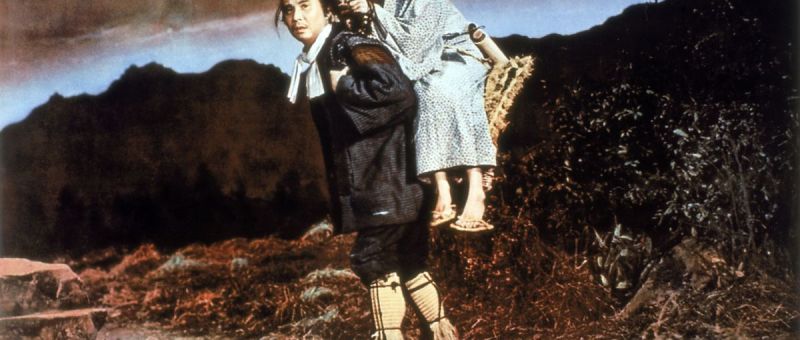
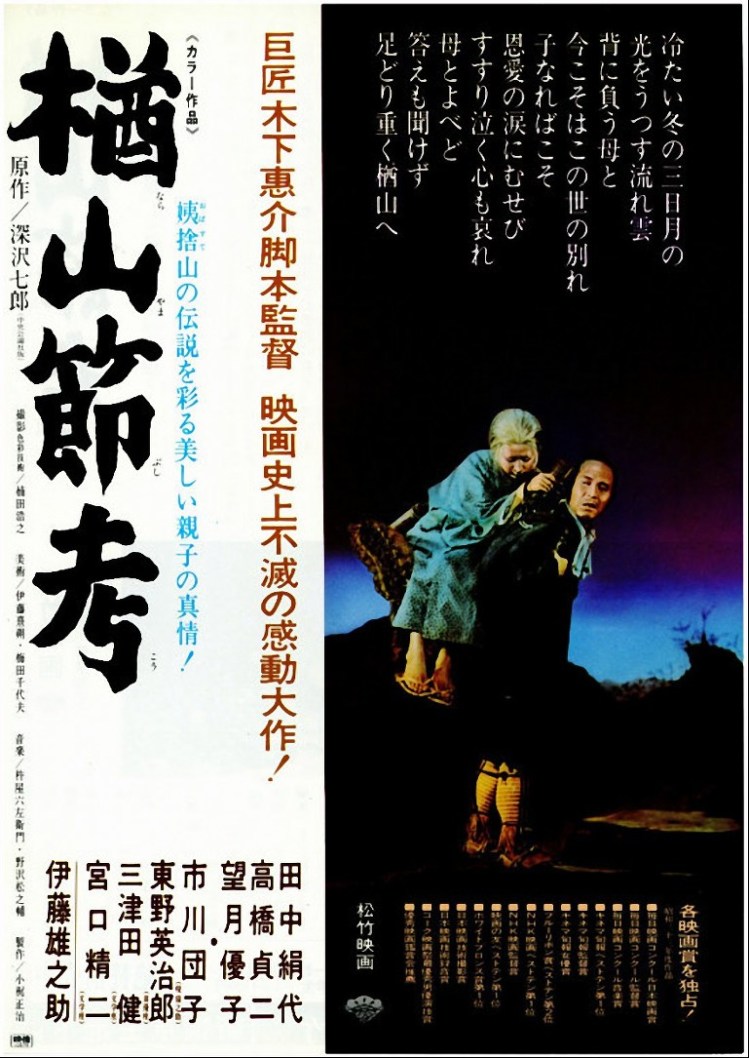
ballad of narayama kinoshita 1958 posterMany naughty children running low on filial piety have probably been told the folktale about a man who took his son along when he abandoned his senile father on a mountain to die only to have his son later do the same thing to him. In Japan, the mythical practice of “obasute” or “ubasute” is a kind of Logan’s Run equivalent in which elderly people elect to remove themselves from society in order to reduce the burden on the young. The Ballad of Narayama (楢山節考, Narayama-bushi Ko) has, perhaps, taken on an additional degree of pathos in ageing Japan in which many elderly people find themselves metaphorically cast out from a society in which they have become the majority, but the idea of “obasute” is intended to be a lesson to the young to treasure their elders and accept the responsibility to care for those who can no longer care for themselves in the knowledge that they too will one day be old.

Keisuke Kinoshita is sometimes criticised for his supposed sentimentalism but his central concern was always in the redemptive power of the relationships between people, that there is always kindness even in the worst of circumstances and that this is enough for hope to survive. In telling the sorry tale of Narayama in which those of over 70-years-of-age are forced into a ritual suicide by social convention, Kinoshita opts for alienation in deliberately shifting into a theatrical register inspired by kabuki featuring obvious studio sets, stylised action, and traditional narration, but his decision to pull back makes the message all the more painful, as does the insistence on the timelessness of his tale.

Long ago in the distant feudal past, 69-year-old Orin (Kinuyo Tanaka) knows that it will soon be time for her widowed son, Tatsuhei (Teiji Takahashi), to carry her to Narayama where she hopes to die of exposure in the New Year snows. She has made her peace with this, it is the will of the gods and she has no call to disobey. Her son, however, is distraught to think of the time he will be expected to carry his elderly mother to a remote spot in the mountains and leave her there, alone, to die of cold and starvation. When a messenger arrives from Orin’s home village to propose a match for Tatsuhei, a recently widowed woman of exactly the same age – Tama (Yuko Mochizuki), Orin is overjoyed – she can go to Narayama without fear or worry, her son and grandsons will be looked after even after she is gone.

The tradition began because the villages in this region are extremely poor. Tatsuhei and Orin will be enjoying their one and only bowl of white rice for the year in celebration of Bon. Orin’s self-centred grandson Kesakichi (Danko Ichikawa) has made up a horrible song about his grandma in which he criticises her for still having all her own teeth at 70 – implying that, as she is not malnourished enough to have lost them, she must have been greedy and taken more than her fair share of food. Unable to bear such reproach, Orin smashes out her own front teeth to better conform to the conventions of her society and make herself a more acceptable sacrifice to the gods as a good and pious woman.

This early horrific act is perhaps the key in illuminating Kinoshita’s gentle critique of social conformity as a tool of social control – something which had become increasingly apparent during the militarist era. Orin, a kind and decent woman, is herself complicit in this abhorrent custom – her acceptance of it is part of her goodness, a sign of her altruistic self-sacrificing nature, but her own unwillingness to challenge the darker aspects of the society in which she lives leads only to their perpetuation and an ongoing descent into unkindness and cruelty.

Tatsuhei, a good and pious son, cannot reconcile himself to his mother’s fate, while his own son, Kesakichi, openly mocks his grandmother for not going sooner and Kesakichi’s pregnant girlfriend (Keiko Ogasawara) looks on enviously at the extra beans on offer if there were one less mouth to feed. Old and bent, Orin still plays a vital part in her community – she harvests the rice while Kesakichi lounges in trees, and she alone knows the best place to catch trout, a valuable skill in a village where food is scarce. Despite the possibility for disaster, Orin and Tama bond instantly as kindred spirits, both kind people in an often unkind world. It’s to Tama that Orin finally divulges her knowledge – something the village will be poorer for when she is gone, having passed her familial responsibilities to another woman and seen her son happily settled with a perfectly suited second wife.

When Tatsuhei returns, broken, after having performed the dreaded ritual he watches his own cruel son laughing and joking from within their shared home, caring only for himself and his easy pleasures. Tama, equally upset over the loss of Orin with whom she had bonded as mother, tries to comfort her husband but is eventually overcome by the tragedy of life, taking comfort only in the fact that, when they are 70, she and Tatsuhei will climb Narayama together.

Hardship, far from bringing people together in the famous harmony that Japanese society praises itself for, has forced them apart, infected them with a sense of mutual distrust and a them or us mentality. Orin feeds the senile old man cast out from his own unfeeling family, but she also urges him towards making a sacrifice of himself on Narayama, genuinely believing that both of their existences have become inappropriate, a greedy usurpation of time which rightfully now belongs to others. Kinoshita respects Orin for her stoicism and righteousness, but pities her for the cruelty of the world in which she lived and was so powerless to resist that it never occurred to her that she should. There is a painful sensitivity around those who willingly went to their deaths in service of something they believed to be right because their society said it must be so, never daring to consider the ways in which their society may be mistaken.

Heavily stylised and markedly experimental for a mainstream Shochiku melodrama of the late 1950s, Kinoshita’s The Ballad of Narayama is a heartrending tale of transience and inevitability, but it’s also one of the various ways a stringent society erodes the bonds between people. The intense love of Tatsuhei for his mother is destroyed by a terrible custom that no one is brave enough to defy, leaving the family rudderless and the village poorer for having been robbed not only of Orin’s wealth of experience but of her warmth and kindness. Kinoshita ends on an ambiguous image showing us the modern train station which stands on the former village of “Obasute”, demonstrating the passage of time and arrival of “modernity” but also that ancient customs are never quite as “ancient” as they seem.


Scene from near the end of the film (English subtitles)
Noh Mask Murders (天河伝説殺人事件, Kon Ichikawa, 1991)

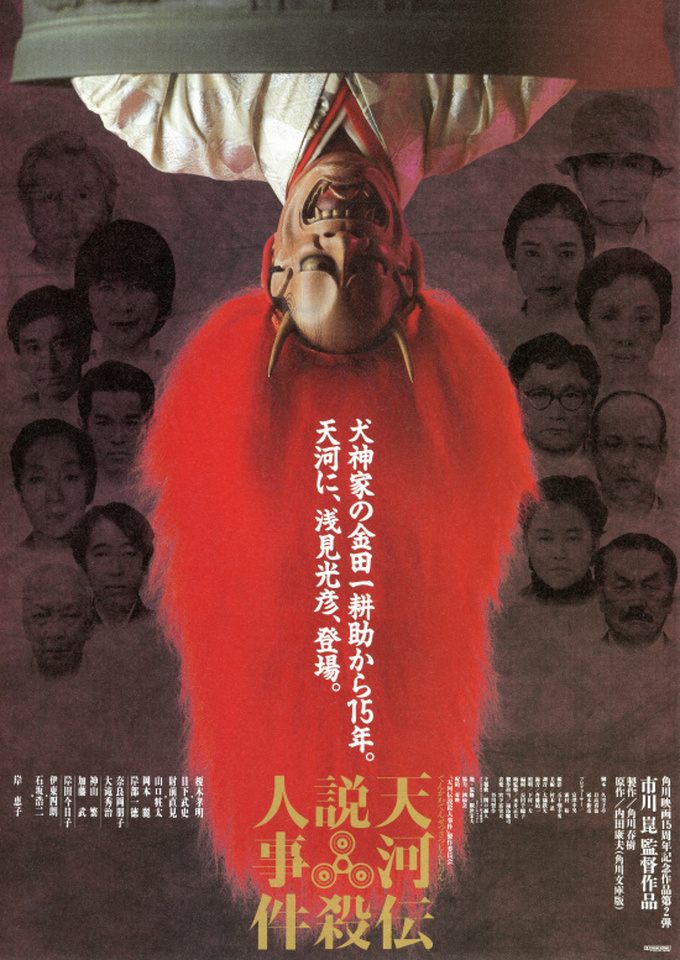
noh mask murders posterFor one reason or another, Japanese mystery novels have yet to achieve the impact recently afforded to their Scandinavian brethren. Japan does however have a long and distinguished history of detective fiction and a number of distinctive, eccentric sleuths echoing the European classics. Mitsuhiko Asami is just one among many of Japan’s not quite normal investigators, and though Noh Mask Murders (天河伝説殺人事件, Tenkawa Densetsu Satsujin Jiken) is technically the 23rd in the Asami series, Kon Ichikawa’s adaptation sets itself up as the very first Asami case file and as something close to an origin story.

Ichikawa, though he may be best remembered for his ‘60s arthouse masterpieces, was able to go on filmmaking where others perhaps were not precisely because of his forays into the populist with a series of mystery thrillers including several featuring top Japanese detective Kindaichi (who receives brief name check in Noh Mask Murders). Published by Kadokawa, Noh Mask Murders is produced by Haruki Kadokawa towards the end of his populist heyday and features many of the hallmarks of a “Kadokawa” film but Ichikawa also takes the opportunity for a little formal experimentation to supplement what is perhaps a weaker locked room mystery.

Asami (Takaaki Enoki) begins with a voice over as four plot strands occur at the same temporal moment at different spaces across the city. In Shinjuku, a salaryman drops dead on the street, while a young couple enjoy a secret tryst in a secluded forest, a troupe of actors rehearse a noh play, and Asami himself is arrested by an officious policeman who notices him walking around with a dead bird in his hand and accuses him of poaching. As he will later prove, all of these moments are connected either by fate or coincidence but setting in motion a series of events which will eventually claim a few more lives before its sorry conclusion.

To begin with Asami, he is a slightly strange and ethereal man from an elite background who has been content to drift aimlessly through life to the consternation of his conservative family which includes a police chief brother. He harbours no particular desire to become a detective and is originally irritated by a family friend’s attempts to foist a job on him but gives in when he learns he will have the opportunity to visit Tenkawa which is where, he’s been told, the mysterious woman who helped him out with the policeman in the opening sequence keeps an inn. Hoping to learn more about her, he agrees to write a book about the history of Noh and then becomes embroiled in a second murder which links back to the Mizugami Noh Family which is currently facing a succession crisis as the grandfather finds himself torn over choosing his heir – he wants to choose his granddaughter Hidemi (Naomi Zaizen) who is the better performer but the troupe has never had a female leader and there are other reasons which push him towards picking his grandson, Kazutaka (Shota Yamaguchi).

As with almost all Japanese mysteries, the solution depends on a secret and the possibilities of blackmail and/or potential scandal. The mechanics of murders themselves (save perhaps the first one) are not particularly difficult to figure out and the identity of the killer almost certainly obvious to those who count themselves mystery fans though there are a few red herrings thrown in including a very “obvious” suspect presented early on who turns out to be entirely incidental.

Ichikawa attempts to reinforce the everything is connected moral of the story through an innovative and deliberately disorientating cross cutting technique which begins in the prologue as Ichikawa allows the conversations between the grandchildren to bleed into those of Asami and his friend as if they were in direct dialogue with each other. He foregrounds a sad story of persistent female subjugation and undue reliance on superstition and tradition which is indirectly to blame for the events which come to pass. Everyone regrets the past, and after a little murder begins to see things more clearly in acknowledging the wickedness of their own actions as well as their own sense of guilt and complicity. Noh is, apparently, like a marriage, a matter of mutual responsibility, fostering understanding between people and so, apparently is murder, and one way or another Asami seems to have found his calling.


The Third Murder (三度目の殺人, Hirokazu Koreeda, 2017)

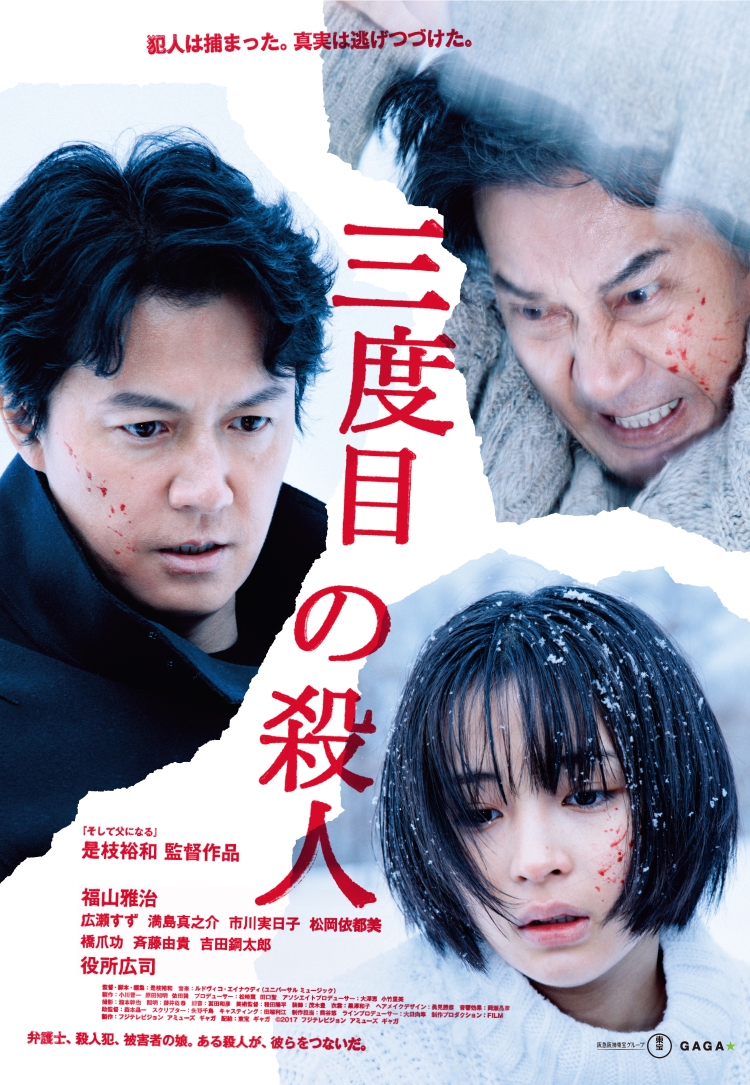
Third Murder posterJapanese cinema has often put the justice and legal system on trial and found it wanting. From Yoji Yamada’s Flag in the Mist in which a “selfish” lawyer contributes to the death of an innocent man, to Yoshitaro Nomura’s spiralling, feverish The Incident, Yoshimitsu Morita’s Kafka-esque Keiho, Gen Takahashi’s pointed Court of Zeus, and Masayuki Suo’s comparatively more straightforward I Just Didn’t Do It, the entire justice system takes on an almost spiritual quality of absurdity, tormenting the accused for the sake of a pantomime of justice, little caring for his or her guilt or innocence and intent only on propping up its own sense of absolute authority.

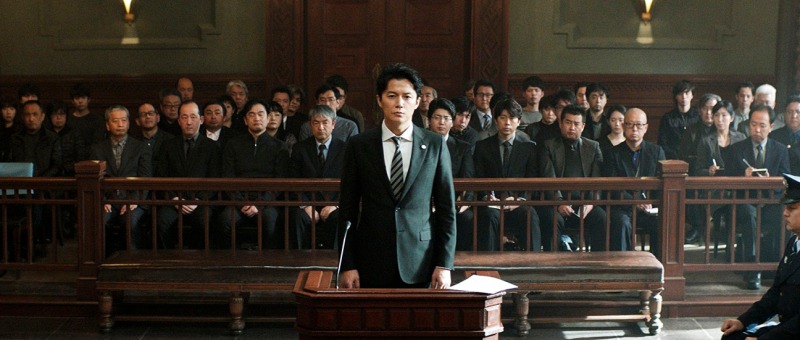
Like Yoji Yamada in Flag in the Mist, The Third Murder (三度目の殺人, Sandome no Satsujin) finds director Hirokazu Koreeda in unfamiliar territory though, at heart, it all comes back to family. A top lawyer, Shigemori (Masaharu Fukuyama), currently in the middle of a divorce, is asked to represent a man who has freely confessed to murder. As the son of the original judge who sentenced the accused, Misumi (Koji Yakusho), to the 30 year sentence he had not long been released from before (allegedly) committing the crime, Shigemori feels a responsibility to act but is frustrated by his client’s constantly shifting story. Nothing he says adds up, and every new angle Shigemori uncovers provokes only more doubt as to the true nature of the case at hand.

Shigemori, somewhat condescendingly, criticises the junior lawyer in the office for his naivety in wanting to to investigate the crime. Understanding and empathy are “unnecessary” in defending a client. The business of a lawyer, on either side, is to assess the evidence at hand, create an argument that withstands scrutiny, and eventually triumph in debating one’s opponent. In the face of the law, the “truth” is an irrelevance.

Shigemori’s cynicism is however rocked by the eerie presence of Misumi who seems to carry with him a kind of deepening emptiness. Misumi has already served 30 years in prison for the murder of two loansharks, the theft of their money, and an act of arson committed on their property to disguise the crime. Shigemori’s father, now a much older man, laments his youthful naivety in handing down a compassionate judgement which took into account the mitigating circumstances – Misumi’s troubled childhood, his poverty, the dire economic situation in which the closure of the local mines had led to mass unemployment and provided fertile ground for unscrupulous money lenders, and a series of personal tragedies which may have unbalanced his mind, but now he thinks some people are just bad and Misumi’s third murder is, in a sense, also his responsibility in allowing him the freedom to commit it.

Yet, there is also a doubt that Misumi’s first crimes are even his. We are told that, like the current case, Misumi couldn’t stick to one story – a common phenomenon with those who confess under duress, saying yes to everything in order to make the questioning stop but later forgetting what exactly they confessed to. Misumi later says he confessed only because he was told that confessing was the only way to avoid the death penalty which, ironically enough, is what he now faces. He also claims he was intimidated by the (admittedly stern) prosecutors, and when it looks as if a new trial may be necessary, the judge opts for the most “judicially economical” solution to incorporate the new demands into the current trial for reasons which the lawyers attribute to his personal need to get the case off his docket in good time so as not to muddy his own reputation. Japan’s 99% conviction rate is less an endorsement of judicial efficiency than a worrying indictment of the legal process in which trials are mere formalities held for show, a pantomime intended to reinforce an idea of “justice” which does not quite exist.

The weight of justice itself is called into question. We learn that the victim was guilty of several crimes, some of them more forgivable than others. Yet is his death “justice” or “murder”, was he “killed” or was the act one of “salvation” for his victims? There are no easy answers and the uncomfortable fact remains that one kind of justice may not necessarily be any different from another. Misumi remains a cypher, his motives for committing the crime(s) (if he even did commit them at all) unclear yet there is also something in him that suggests he is merely a reflection of ourselves, a projection of our own primal need to see justice done that our civil selves have tried and failed to codify into a universally recognised system of fairness known as law. Then again perhaps all we really want is a story we can understand and empathise with, perhaps we don’t want justice at all – we want narrative, a strategy for defence against the cruel and arbitrary charges of an unforgiving world. Shigemori stands at a crossroads, cleansed of his cynicism but unsure what to replace it with, as, perhaps, as we.


Currently on limited release in UK cinemas courtesy of Arrow Academy.

International trailer (English subtitles)

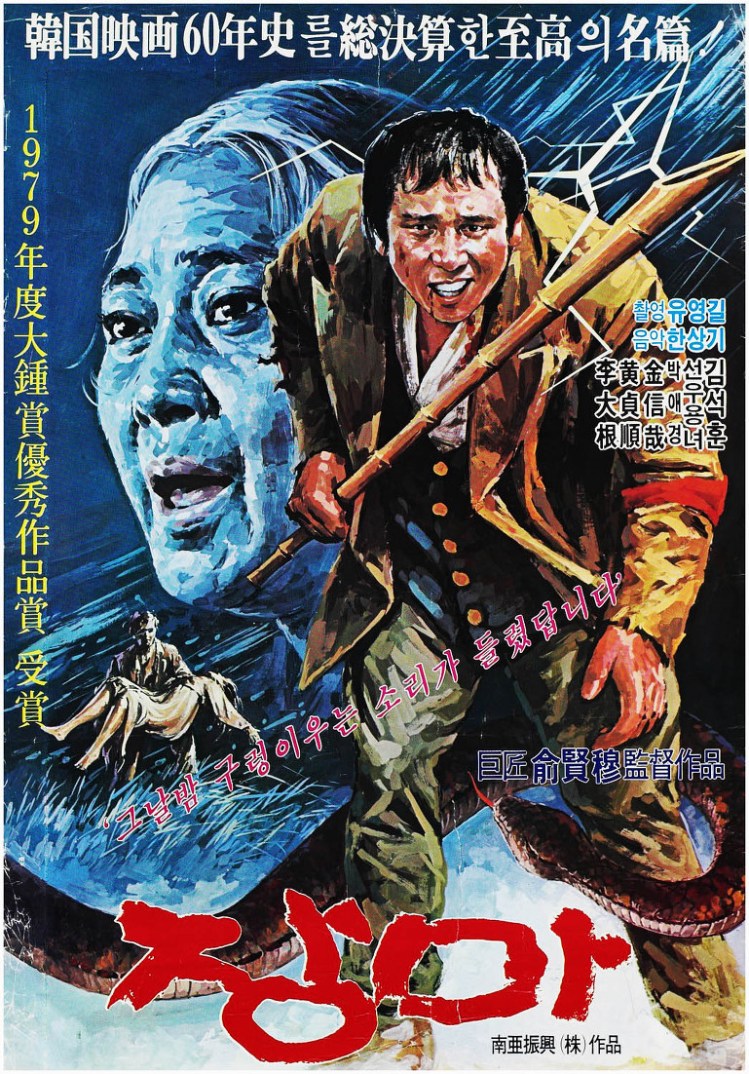
Rainy Days (장마, Yu Hyun-mok, 1979)

Rainy Season posterOften regarded as an “intellectual” filmmaker, Aimless Bullet’s Yu Hyun-mok returns to one of his central preoccupations in 1979’s Rainy Days (장마, Jangma). Released close to what would be an abrupt end to the oppressive and authoritarian rule of Park Chung-hee (which would be followed by another repressive military regime), Yu’s literary film falls into the anti-communist subgenre though Yu is careful to reframe his tale not as one of left versus right but of right versus wrong and of the dangerous gulf in-between. As it would in 1979, the political wind shifts without warning and then reverses itself leaving few untouched by the chaos and confusion of a government in flux. Rainy Days is a season of silence and tension, waiting for the sun but weathering a storm which may never end.

In the early 1950s, a family moves from Seoul to stay with relatives including Dongman (Choi Yong-weon) – the grandson of the older woman who is coming to live with her daughter’s family along with her university educated son Giljun (Kang Seuk-woo) and student daughter Gilja (Ju Hae-kyeong). Towards the end of the war, Maternal Grandmother (Hwang Jung-seun) has a prophetic and traumatic dream of trying to pull her own tooth which she interprets as a warning that Giljun, a serving soldier fighting for the South, has been killed in action. Sure enough, the next day a telegram arrives carrying the dreadful news back to the family. Maternal Grandmother tries to comfort herself as best she can, pretending to have grown used to the news thanks to her dream but in reality heartbroken and distraught by the loss of her only son.

Meanwhile, Dongman’s other uncle, the son of Paternal Grandmother (Kim Shin-jae), is off fighting for the North as a communist partisan hiding in the mountains. Suncheol (Lee Dae-geun) was once so kind hearted that as a boy he released the fish he caught in the local river, but when the communists took his village he was quickly seduced by their recently acquired power. While Giljun was forced to hide in a makeshift hollow covered by leaves in the woods, Suncheol was busy getting in with communists and though he claims to want to protect his family eventually informs on his brother-in-law only to find it blowing back on him when they doubt his commitment to the cause in not having turned the “Southern Sympathiser” in sooner. A simple man, Suncheol joins the communists and turns on Giljun as a reaction against his feelings of inferiority in the face of urban sophistication. Suncheol is cheerful and goodhearted, broadly liked by those around him, but he is also like a child who acts on impulse and takes things too far without considering the consequences of his actions just as he does when instigating a little “mob justice” against a villager who had tried to crack down on the trafficking of illegal moonshine much to the consternation of his neighbours.

The central conflict is dramatised by the sparky relationship between the two grandmas who have each passed into the age in which it becomes appropriate to voice one’s concerns openly without particularly caring how those views will be received. Paternal Grandmother, having opened her house to Maternal Grandmother and her children, feels herself to be in a position of superiority and is often wilfully unkind to her guests, offering a series of truly unforgivable words to the bereaved Maternal Grandmother who has, quite reasonably, cursed all the communists who are responsible for the death of her son. Seeing as Paternal Grandmother’s son Suncheol is a communist partisan she takes exception to this which provokes a fierce, accidentally political family row which may be eternally irreparable.

The North is, however, beaten back and the village retaken by the South. Suncheol is now a fugitive hiding in the mountains who has killed many men and fears he will not be forgiven even if he gives himself up to the authorities in the hope of rejoining his family. Proud Paternal Grandmother remains proud of her brave son, refusing to believe what they say about the partisans and secretly hoping for a resurgence of the North though like Maternal Grandmother before her she cannot say these words plainly for fear of getting into trouble with the authorities. When Suncheol makes a brief visit back to the family home, broken and desperate, to float the idea of turning himself in, it has grave consequences for little Dongman who is tricked into to informing on his uncle and earns the wrath of Paternal Grandmother in the process. Maternal Grandmother, however, has had more time to come to terms with her grief and is sympathetic to her grandson’s plight, knowing that he is just a child and did not understand the consequences of his actions.

Played by the wonderful Hwang Jung-seun, Maternal Grandmother becomes the heart of the drama. Having lost everything – her only son, her life in Seoul, her hopes for the future, she remains stoic, repeating the mantra that everything is fine because she knew all along how it would be. Following her painful outpouring of grief and war of words with Paternal Grandmother she comes to terms with her situation and tries to carry on as best she can with warmth in her heart. She even tries to forgive Paternal Grandmother and expresses sympathy for her as another mother losing a son in a stupid and senseless war. Paternal Grandmother cruelly pointed out that Maternal Grandmother would have no son to perform her funeral rites, but it is Maternal Grandmother who eventually performs the shamanistic ritual at the film’s conclusion in place of Paternal Grandmother, provoking a reconciliation of the two women and a banishment of the rancour which had existed between them.

Focussing tightly on the realistic emotions of the contemporary villagers who hold no particular political views but are caught in the middle of a war and simply trying to survive, Yu dramatises the tragedy of division not in a question of “good” Southerners, and bad “Communists”, but of bereaved grandmothers and broken families, ruined futures and fractured pasts. Yet once again he departs from the tragic ending of the novel for one which allows hope for the future. Little Dongman, put on house arrest by his irritated father, is finally allowed to go out to play with the other village children, rejoicing in the sunny skies and beautiful forrest scenery, returning to a childhood idyll now free of wartime confusion.


Available on DVD as part of the Korean Film Archive’s Yu Hyun-mok boxset. Also available to stream via the Korean Film Archive’s official YouTube Channel.

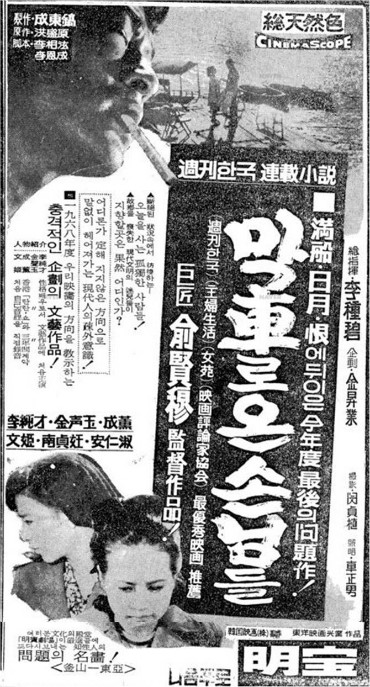
The Guests of the Last Train (막차로 온 손님들 / 막車로 온 손님들, Yu Hyun-mok, 1967)

guests who came by train 2Despite ongoing social and political oppression, the Korea of the 1960s was an upwardly mobile world in which increasing economic prosperity and global ambition was beginning to offer the promise of financial stability and a life of comfort to millions of young men and women, albeit at a price. Yu Hyun-mok, often thought of as among the most intellectual of “golden age” film directors, was a relatively infrequent visitor to the “literary film” but Guests of the Last Train (막차로 온 손님들 / 막車로 온 손님들, Makcharo on Sonnimdeul, AKA Guests Who Arrived on the Last Train), adapted from a novel by Hong Seong-won, is perhaps comfortably in line with his career long concerns in its focus on those who for one reason or another have been running to catch the rapidly departing train of modernity, pulling themselves on board just it prepares to pull away. A disparate tale of three men and their respective love interests, Yu’s film once again rejects the consumerism of the modern society in its cold and lonely search for soulless acquisition and finds comfort only in the fragile connections between the lost and hopeless.

The film opens behind a train station where a young woman, Bo-yong (Bo-yong), staggers and stumbles, grasping for something to hold on to but hardly able to stand. Eventually a man, Dong-min (Lee Soon-jae), turns up and tries to hail a taxi. Noticing the distressed woman, he manages to get her into a car and when she tells him she has nowhere to go, takes her home with him. Dong-min is currently off work with an illness which turns out to be terminal lung cancer and has only a few months left to live as a second opinion from his doctor friend, Kyeong-Seok (Seong Hoon), makes clear. Kyeong-seok is also facing a problem with a female patient, Se-jeong (Nam Jeong-im), suffering a nervous complaint after losing her wealthy husband and subsequently being hounded by her relatives over the inheritance. When Se-jeong leaves the hospital the pair end up having an affair but the money continues to present a problem – neither of them want the hassle of dealing with it. Meanwhile, Dong-min and Kyeong-seok reunite with another old friend, Choong-hyeon (Kim Seong-ok), who has just returned from Japan apparently having become fabulously wealthy. Choong-hyeon has pretensions of becoming an avant-garde artist, but is unable to get over his ex-wife who has left him to become a famous actress.

Each of the three men is in someway arrested, unable to move past something towards the future rapidly rolling away from them like a train leaving the station. Dong-min’s depression and listlessness is understandable given that he’s facing a terminal illness and knows that he has already reached the end of the line. Yet his ennui began long before. Kyeong-seok, describing his friend to a colleague, disapprovingly remarks that he used to be a mild-mannered bank teller but left to become a freelance translator and journalist. Unable to put up with the stringent, high pressure world of work Dong-min removed himself from it to try and grasp his freedom only to remain dissatisfied and eventually defeated by a cruel and arbitrary illness. Even so he retains his human feeling as demonstrated by his decision to help Bo-yong rather than leave a vulnerable woman alone to suffer on the streets. Staring blankly at the calendar on his wall, avoiding tearing off the sheets which serve as an all too obvious symbol of his limited time, he falls slowly in love with the woman who remains at his side whilst knowing that his existence is futile and doomed only to tragedy.

Kyeong-seok, by contrast, is merely disaffected. Dragged into a relationship with Se-jeong originally unwillingly, what he resists is responsibility. He wants to help her, but he does not want to get involved with her complicated familial and financial problems. As so often in Yu’s films, money is the root of all evil, presenting barriers between people where there should be none. Neither Kyeong-seok or Se-jeong are very interested in the money for its own sake, they want only simple lives of adequate comfort and emotional fulfilment – something which the hassle of dealing with other people’s money hungry machinations will actively destroy.

Money has also, in a sense, destroyed Choong-hyeon’s hopes though more through his misplaced faith in its ability to buy him back what he’s lost. His relationship with his wife is clearly over, she has chosen something else which is her right and privilege, but Choong-hyeon can not accept it and continues to look for her in all he does. Attempting to become an “artist” himself, he uses his money to get himself a show featuring his avant-garde pop art creations but neither of his friends rate his work or is careful enough about his feelings to avoid criticising it. Choong-hyeon spirals out of control, becoming dangerously obsessed with a schoolgirl he somehow wants to imagine as his wife. Dong-min and Kyeong-seok suspect that he will kill himself, but by this point they aren’t sure if they should care. What would they be saving him for? There is no possible salvation – no one can save anyone else, and no one can save themselves. Each is an individual and can offer no excuses. Love and friendship are but scant comfort in a cold and lonely world.

Meanwhile, the women continue to suffer in silence. Yu chooses to focus on his trio of male misfits rather than the pair of unlucky women whose story lies at the centre of the narrative. Se-jeong married an older man for apparently legitimate reasons but the marriage was unsuccessful and also ruined her friendship with her husband’s daughter who, unsurprisingly, turns out to be Bo-yong. Looking for love and not money, Se-jeong is only holding on to her inheritance in the hope of someday reconciling with Bo-yong and handing it all to her. Meanwhile, Bo-yong has been on the run from her former life. Once an air stewardess, Bo-yong dropped off the radar when a former fiancé planted drugs in her suitcase and got her sent to prison. Like Se-jeong she is looking for support and companionship and finds it in the kind if melancholy Dong-min, vowing to stay by his side even if she knows their time it limited. The two women are eventually “reunited” at a wedding, but the crowd keeps them apart, breaking into factions fighting over the inheritance that neither Se-jeon or Bo-yong actually want.

Yu declines to tell us whether the women are eventually able to meet and repair their friendship, but he does make clear that both have rejected the superficial comforts of wealth in asking for a small and simple life with their respective partners. In this he offers both hope and despair. The couples are rejecting the new future their nation has planned for them, yearning for small comforts and an end to their loneliness and struggling to find it in an increasingly alienated world. Bo-yong, at least, steps forward to grasp her chance at happiness however small it maybe, waiting for the train and seeing red lights change to green only when her gesture of sincerity is finally accepted.


Available on DVD as part of the Korean Film Archive’s Yu Hyun-mok boxset. Not currently available to stream online.

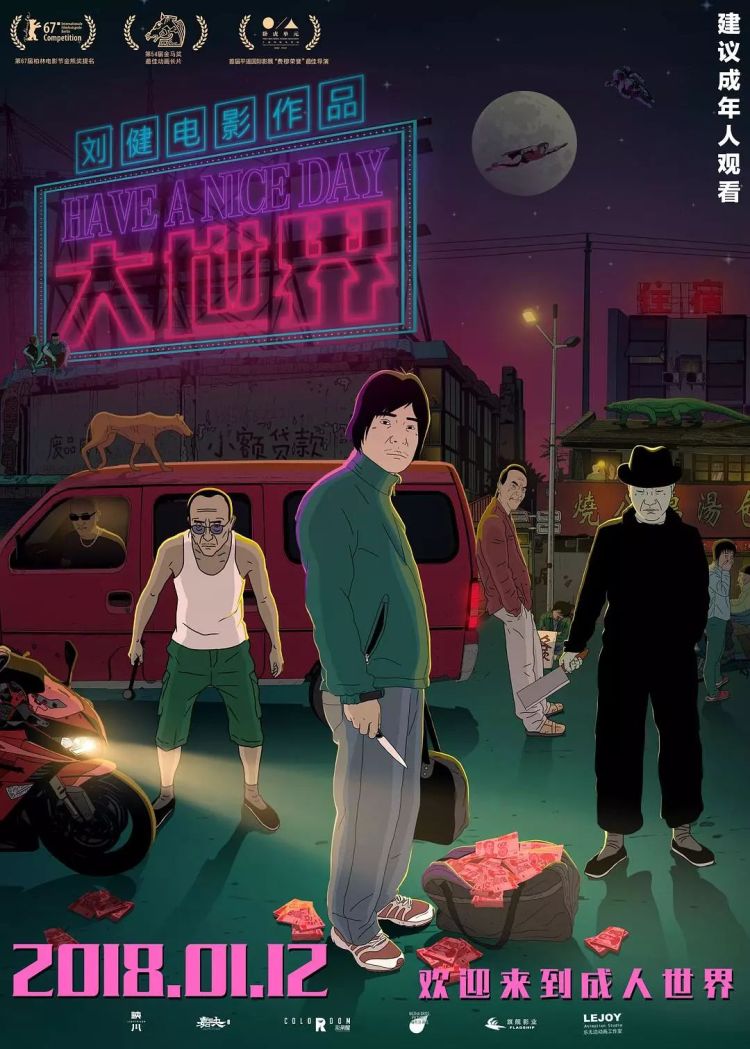
Have a Nice Day (大世界 / 好极了, Liu Jian, 2017)

Have a Nice Day poster 1Even when everything is pointless, still you have to try to live. “Spring is spring”, as the opening quote by Leo Tolstoy proclaims and so there is life even among the ruins which, in this case, exist in the mysterious “development zone” somewhere in the modern China. This backstreet noir takes place in a world of near apocalyptic dilapidation though the effect is more one of incompleteness than destruction, as if an over excited city planner had randomly started projects one after another but suddenly tired of each of them. Jack Ma may have affirmed that everyone has a dream in his heart, but the dreams here are small and mostly unattainable, locked into a claustrophobic atmosphere of inescapable despair.

Xiao Zhang (Zhu Changlong), a lowly construction driver, decides to seize his chance of happiness with both hands in lifting a vast sum of cash which belongs to mob boss Uncle Liu (Yang Siming). Uncle Liu, however, is busy torturing his childhood friend for supposedly sleeping with his wife. He sends his best guy, enigmatic hitman Skinny (Ma Xiaofeng), after Zhang but before Skinny can get to him, Xiao Zhang is is picked up by “inventor” Yellow Eyes (Cao Kou) whose X-ray specs have spotted the money and decided it’s too good an opportunity to miss. He takes off with his kind-of-girlfriend (Zheng Yi) who is also the sister-in-law of a guy who works with petty gangster Lao Zhao (Cao Kai) who is the guy Xiao Zhang took the money from in the first place. Meanwhile, the mother of Xiao Zhang’s girlfriend has asked her niece, Ann Ann (Zhu Hong), to have a look into what’s going on with Xiao Zhang because he’s been sending some very suspicious messages.

Everything here is in transit. Hitman Skinny is fond of telling people that he’s “just passing through” but so is everyone else, there is nothing here to stop for, except that it’s impossible to escape. All the significant places are also points of transit or hope for connection – the “Integrity” internet cafe, a “business” hotel, a road which leads nowhere through a landscape permanently “under construction”. Everything is half formed or falling down, the world is indistinct as if it hasn’t discovered its own identity and has tried to cobble something together from the back streets of other cities glanced in violent movies from somewhere far away.

Xiao Zhang, (almost) our hero, is almost the same – he tells Skinny that his dream was to be a man like him rather than the spineless coward he feels himself to be because guys like him always seem so cool in the movies. Doubtless Skinny doesn’t seem so “cool” with his foot on Xiao Zhang’s chest, but Xiao Zhang’s need is as much about escape as it is a matter of practicality. Though the practicality is ironic enough – he wants the money to pay for more plastic surgery for his fiancée whose face has apparently been ruined by a botched operation. Xiao Zhang hopes they can escape to South Korea, world capital of cosmetic procedures, where they can repair what the modern China has destroyed.

It isn’t difficult to see why Have a Nice Day (大世界, Dàshìjiè, previously titled 好极了, Hǎojíle) rubbed the censors the wrong way. Liu’s vision of the China of today is a lawless wasteland in which despair and inertia reign while those of the post ‘80s generation flail wildly in the wind, drinking in overseas culture from Hong Kong and the West and wanting more than their society can give them. In a running joke everyone has a startup idea they’re sure will be the next big thing but when it comes right down to it, even with the money they’ve no idea what they’re doing. Two boys chatting idly about the future find only futility with one lamenting that if he wanted to make it he’d have gone to England to study, only for the other to ask what the point would be now the UK has left Europe. He has a radical startup idea of his own – a restaurant! After all, people will always need to eat. You have to admire his practicality, even if bemoaning his lack of imagination.

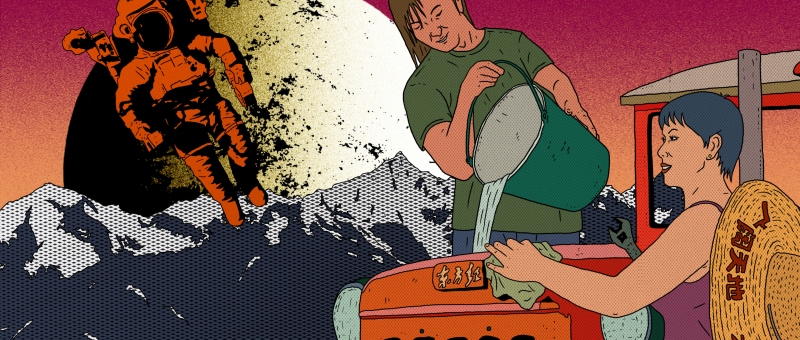
Meanwhile, the cousin of Xiao Zhang’s fiancée and her boyfriend, having figured out that Xiao Zhang really does have the money and intending to take it from him, fantasise about finding their own “Shangri-La”. Breaking into a lengthy karaoke-style video sequence, Liu paints a jagged picture of Ann Ann’s visual ideology which quickly descends into a mish-mash of Mao-era socialist propaganda posters and their collections of cheerful country women enthusiastically driving tractors and juggling sheep while posing in traditional Chinese dress with children in neckerchiefs reading improving literature. Everything is for sale, even apparently the innocence of the past. A friend of Lao Zhao’s expounding on the nature of freedom describes it as a three tiered system – the farmer’s market, supermarket, and online, your degree of personal autonomy and happiness reduced to a question of how the place you buy your groceries informs your sense of self worth.

Rampant capitalism has led to moral as well as physical decay as the half-finished buildings collapse under the weight of national hubris, a weathered statue standing in for a real life policeman as the hollow representation of the authority of an absent regime. Animated with an oddly naturalistic minimalism and filled with whimsical absurdity, Have a Nice Day serves as a condemnation of the last 30 years of Chinese history but it does so with a wistful irony. After all, it’s not as if things are much better anywhere else.


Have a Nice Day is released in UK Cinemas on 23rd March courtesy of Mubi. Check the official website to find out where it’s screening near you.

International trailer (English subtitles)

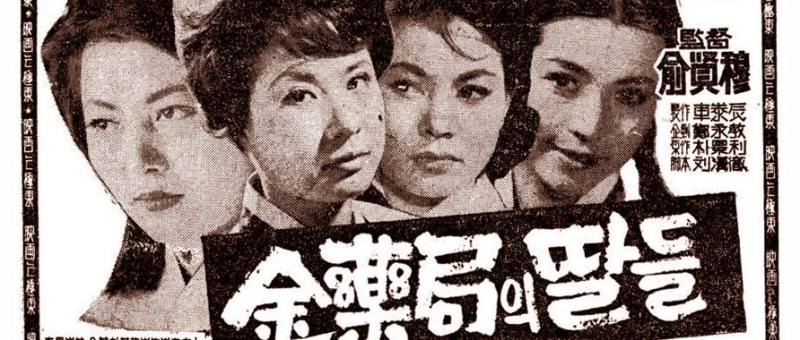
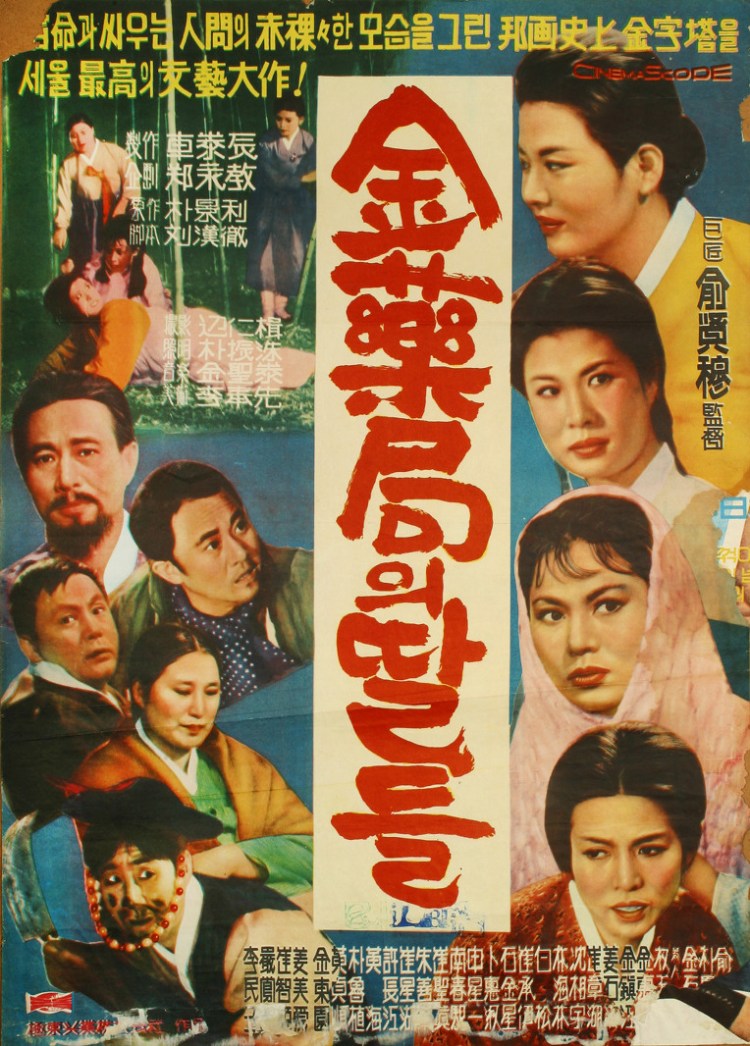
The Daughters of Kim’s Pharmacy (김약국의 딸들 / 金薬局의딸들, Yu Hyun-mok, 1963)

Daughters of Kim's Pharmacy poster“Literary Film” had become a kind of genre of its own in Korean cinema, both embracing and rejecting the nation’s taste for melodrama with differing degrees of artiness. Director Yu Hyun-mok, however, was not generally associated with the kind of affectation coupled intense sentimentality that sometimes marked the worst examples of the genre but with a unique brand of cinematic realism which attempted to address the social issues of the day whilst still getting past the censors who were hot on politics but increasingly lax on sex and violence. Nevertheless, The Daughters of Kim’s Pharmacy (김약국의 딸들, Kim yakgukjib daldeul) is a “literary film” adapted from a novel by Park Gyoung-li and set firmly in the recent past. Yu eventually gives in to the inherent melodrama of a small family battling a legacy of pain and destruction, but tellingly subverts it by discarding the tragic ending of the original novel for something that offers a degree of hope albeit in an all but hopeless world.

The film begins at the close of the Joseon Dynasty as a young man runs into another man’s house and desperately reaffirms his love for a woman who is now married to someone else while he is also married to woman from his village. The woman refuses to see him while he pleads with her, sobbing, but when her husband returns home unexpectedly he doubts his wife’s virtue. Threatening her and then chasing off the lover, the husband kills him by accident and is forced to flee while the woman takes poison and kills herself in her misery leaving her son, who will later become Kim the pharmacist, orphaned and alone, and the family forever “cursed” by her unquiet spirit.

18 years later Kim himself is forced into an arranged marriage which he wanders away from on the wedding day, leaving his aunts to wonder if he hasn’t been “possessed” by the vengeful spirit of his late mother. Despite the “curse” the marriage is successful in that it is not particularly unhappy and produces four daughters who are each of age when the story begins thirty years after Kim’s wedding.

The central heroine, Yong-bin (Um Aing-ran), is a “modern woman” of the colonial era, taking advantage of a shift forward into a progressive new world by leaving her tiny home village for university in Seoul. Though she longs to be free of the primitivism of her origins with its shamanistic rituals and patriarchal traditions, she is also of an elegant, conservative disposition and loves her parents deeply – something that provokes conflict in her desire for the comforts of home and the promise of away.

Of the other three daughters, each represents a particular kind of trap of the age. The oldest, Yong-sook (Lee Min-ja), has given birth to a child out of wedlock and lives alone independently raising her son in penury. Meanwhile third sister Yong-ran (Choi Ji-hee) is no longer a child but continues to loll around the house showing off her legs and posing provocatively. Her father is thinking of marrying her off to a local fisherman who has taken a liking to her, but the plan is scuppered when it is revealed that Yong-ran has been taking frequent nighttime excursions to the graveyard in the forest for secret trysts with one of the servants. When they are discovered, Kim chases the man away leaving Yong-ran publicly shamed and heartbroken. Eventually she is married off to someone befitting her social class only to discover that her new husband is impotent thanks to an opium addiction. She is routinely beaten and abused but can do nothing to escape her life of violence and terror. Yong-oak (Kang Mi-ae), the youngest sister, will eventually suffer a similar fate if one more usual, when she marries Yong-ran’s fisherman suitor only to find him rough and resentful as the fishing industry continues to fluctuate.

When Yong-bin’s mother (Hwang Jung-seun) meets her at the harbour on her return from Seoul she mentions the family curse by way of bemoaning their increasing ill fortunes. Yong-bin dismisses her mother’s concerns, preferring to think that its one’s own deeds that determine one’s future, but her mother sadly shakes her head and repeats that it’s all fated. Yong-bin’s modern way of thinking will increasingly come into conflict with her superstitious upbringing, but there’s no denying her family has had a run of bad luck – one which is only set to intensify as time moves on.

This is the central tragedy – the Kim family, trapped in the past, is unable to move beyond its “curse” and whether fated or not is set to destroy itself through outdated thinking. Though it is undoubtedly not the message the film is intended to convey, it’s impossible to ignore the degree of unhappiness which has been caused by the system of arranged marriages and the convention that true feelings must be suppressed in order to maintain ancient social codes. The Kims’ “curse” comes from the death of a woman scorned in love and betrayed by a prideful husband. If only she had been allowed to marry the man she chose, there would be no curse, no violence, no fear. As long as personal happiness is undervalued, there will be only suffering and misery for all but most particularly for the young women of Korea.

Yong-bin, an urban sophisticate, knows this more than most. Her father thinks he ought to marry her off first so he can marry off Yong-ran whose precociousness is beginning to alarm him. Yong-bin, however, wants to finish her education before submitting herself to a lifetime of servitude as someone’s wife and later mother. Her father has his eye on a match – the son of a usurious loanshark who is also a Japanese collaborator. Luckily, Yong-bin likes the man her father has chosen and sees only a romantic fantasy in marrying a childhood friend despite a warning from another mutual acquaintance that Hong-sub is a timid yet ambitious man – a dangerous combination which is unlikely to yield much happiness. She is going to get her heartbroken in more ways than one, her illusions of innocent romantic destiny shattered and her heart wounded by a spiritual as well as physical betrayal by the feckless Hong-sub who turns out to be not the man she thought he was but the one she was warned about.

Yet there is something in Yong-bin’s modernism that cannot be denied. This being the colonial era, the influence of the Japanese is felt even in this tiny village. Kim has sold the family pharmacy because of the influx of Western medicine coming in through Japan. He invested heavily in fishing, but the Japanese are ruining that too through invading local waters and overfishing them. Yet Kim still thinks of himself as a feudal lord with a real duty towards the people of his village. When his boat is ruined in a shipwreck and many sailors killed, he feels he must compensate the victims’ families who are now without the means to support themselves. This leaves him open to exploitation by Hong-sub’s usurious father who is in big with the Japanese who are, to an extent, the route cause of all these problems. Hong-sub’s father laughs when Kim declares his need of extra cash to support those who’ve suffered because of his failed fishing venture, thinking his sense of duty merely stupid but also seeing that it’s another hook for him to exploit that brings him closer to his goal of harnessing Kim’s ancestral estate with its large amount of farmland and property.

The Japanese play into a small sub-plot in which Yong-bin’s cousin (Shin Seong-il) is engaged in the resistance movement and eventually leaves for a covert mission in Japan. Before he leaves he introduces Yong-bin to a friend, Kang-geuk, who has been arrested and is being carted off to Japan for trial but has apparently fallen in love with her based only on his friend’s stories and a photograph. She’s back to a romantic fantasy once again and gravitating towards the spectre of arranged marriage which the film has already done such a great job of discrediting. It is, however, the perfect symbiosis of the film’s themes allowing Yong-bin to embrace both sides of herself. Meeting again after the liberation and a succession of terrible tragedies for the Kim family, Kang-geuk responds to Yong-bin’s intention to leave her hometown forever by asking her to name a place which is not tinged by loss and tragedy, and of course she can’t. Suddenly, her village doesn’t seem so bad anymore.

The “curse” is broken in being acknowledged and Yong-bin exercises her freedom to choose, consenting to a marriage, and making a decision to stay rather than being forced to leave. Yu’s comparatively hopeful ending in which Yong-bin nevertheless places herself back within a patriarchal value system stands in sharp contrast to that of the novel in which the Kim family’s failure to reconcile themselves to modernity provokes their downfall, but there is only so much hope in this hopeless world and Yong-bin, like her surviving sisters, will continue to suffer in an existence which offers little else to Korea’s oppressed women, remaining complicit in her own misery.   


Available on DVD as part of the Korean Film Archive’s Yu Hyun-mok boxset. Also available to stream via the Korean Film Archive’s official YouTube Channel.

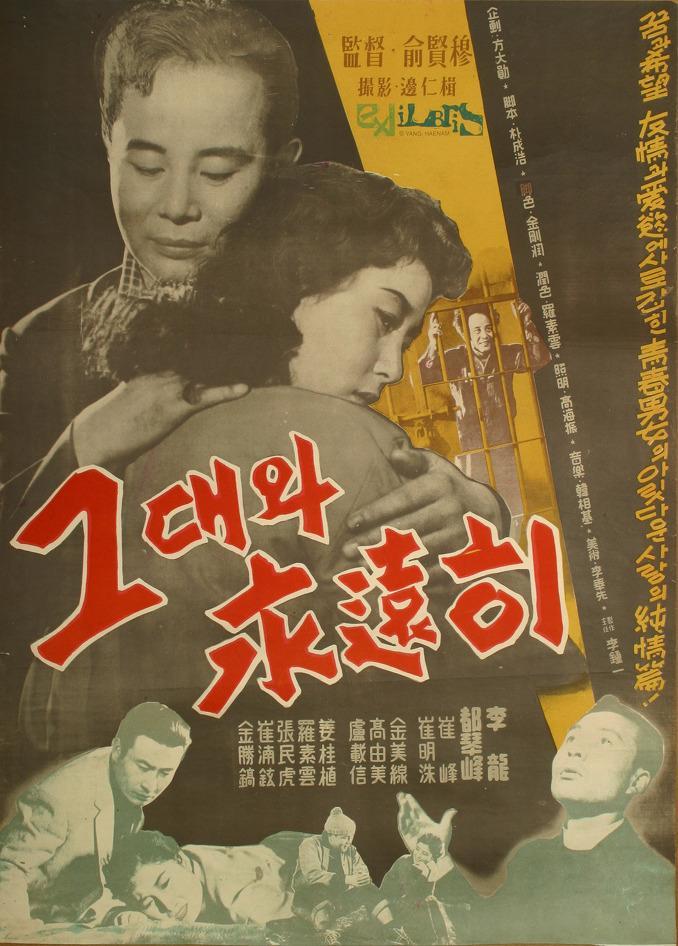
Forever With You (그대와 영원히 / 그대와永遠히, Yu Hyun-mok,1958)

Forever with you posterBest remembered for his 1961 feat of neorealist social drama Aimless Bullet, Yu Hyun-mok was one of the early masters of Korea’s golden age who sought to bring a degree of intellectual rigour and formal experimentation to a medium which often favoured the populist or propagandist. He did, however, have to start somewhere and the earliest surviving film in Yu’s filmography is indeed a melodrama though one perhaps a little to the side of the norm and with an axe to grind as regarding economic equalities and the demands of spiritual morality, even if he is forced to retreat to entrenched social codes in the closing moments.

The camera pans over a city filled with rooftops and eventually lingers on a group of children playing quietly by a wall. Panning over the wall which is exceedingly high, Yu reveals the children to have been playing on the other side of a prison where Gwang-pil (Lee Ryong), an inmate, is about to be released after 10 years inside. All things considered, Gwang-pil does not seem to be a hardened criminal and is optimistic for the future, intending to go straight and hoping to reconnect with the childhood sweetheart he believes is still waiting for him in the outside world though they have not seen each other since Gwang-pil made an ill-advised escape attempt and got his sentence increased a number of years. He recounts all of this to another inmate who is happy for him, broadly, but not quite convinced Gwang-pil is going to make it in the regular world.

Switching to a lengthily flashback, Yu allows Gwang-pil to recount the circumstances which landed him in jail, which also gives the director a chance to engage with his socio-political concerns. 10 years previously, Gwang-pil was a happy young man from an exceptionally poor village who was best friends with Ae-ran (Do Kum-bong). Ae-ran works in a bakery to help support her family, and often walks home with Gwang-pil which is one of the few times they have to be together. A happy day at the beach sees them building sandcastles and dreaming of the life they will one day live with a house and children of their own, only to see all their dreams washed away by a sudden outbreak of rain. In desperate need of money both to support himself and his bedridden mother and to impress Ae-ran, Gwang-pil starts hanging round with delinquents and picking pockets. Though Gwang-pil wants to give back some of the money they stole fearing the woman they took it from is also poor and cannot spare it, he goes along with the delinquents’ plan to rob a nearby US army depot. The others get away but Gwang-pil is arrested and sent to prison.

The first and foremost motivator for Gwang-pil’s descent into criminality is poverty and familial breakdown. His father was a gambler who left his mother flat, while she has become bedridden and is dependent on her teenage son for financial support. With no real jobs available in the town and no prospect of a way out through education, Gwang-pil is seduced by crime despite having no real aptitude for it. The other motivator, if indirectly is Ae-ran or, more specifically, jealous insecurity related to the harmonica playing delinquent Dal-soo (Choi Nam-hyun). Too poor to afford a harmonica of his own, Gwang-pil fears losing Ae-ran to a flashier guy and so he picks pockets to buy her fancy treats little realising all she wants is his time – something he will rob her of by getting himself sent to prison.

The war between Gwang-pil and Dal-soo over possession of Ae-ran will occupy the rest of the film though Ae-ran, like many women in the golden age of Korean cinema, is left with little choice of her own other than to continue suffering. When Gwang-pil gets out of jail it’s one of the other delinquents who meets him – Sang-moon (Choi Myung-soo) has become a priest, in part out of remorse for what happened to Gwang-pil and regret over his criminal past. Sang-moon is determined to help Gwang-pil repair his life but knows finding out what happened to Ae-ran is going to break his heart and send him spiralling into a nihilistic whirlpool of despair. Ae-ran has married Dal-soo who chose the path of crime and still operates a dodgy hostess bar as a front for his gangster activities.

Gwang-pil is just as upset and angry as Sang-moon feared. So much so that he completely misses how miserable Ae-ran is in her marriage and that her daughter, Eun-joo, is nine years old meaning she was conceived before he went to prison. Obsessed with his own pain, anger, and self loathing he fails to see anything other than his ruined hopes and commits himself only to further ruination through drink and the attentions of the manager at Dal-soo’s bar which are not altogether as one might assume them to be.  Only too late does he begin to grasp the real situation but is still too wounded to process it fully. Dal-soo, knowing Ae-ran has never loved him and wondering if her decision to become his wife has been a long form act of revenge, sets a plan in motion to remove his rival from the scene while Gwang-pil also longs for revenge against the man who has stolen everything from him.

Dal-soo and Gwang-pil square off, leaving Ae-ran whose health is so poor and nerves so fragile that she has virtually lived in hospital for the last few years, to suffer alone with only the austere comfort of Sang-moon’s priestly ministrations. Wanting to be “a good wife” she stands by Dal-soo but fears for Gwang-pil, not only for his life but also for his soul lest he fall back into criminality in the shock and hopelessness of her betrayal. Her situation is impossible and the strain of it difficult to bear. She hates her husband and blames herself for the fate of her one true love but has no recourse other than to continue suffering or die. In keeping with the story’s melodrama origins, Ae-ran pays a heavy price for her “weakness”, as does Dal-soo, leaving only the priest and the wronged man behind, strengthened by the need to care for the daughter he never knew he had.

Far from the rigour and furious intent of Aimless Bullet, Forever with You (그대와 영원히 / 그대와永遠히, Geudaewa yeongwonhi) is a much more modest effort even among studio pictures from 1950s. Largely filmed on set with low production values, Forever With You does allow Yu a degree of formal experimentation as he makes frequent use of pans and zooms more commonly seen in the films of 20 years later and occasionally gives in to ostentation as in his expressionist spinning shot of Gwang-pil and a bar girl dancing as he attempts to lose himself in abandon, or an overhead view of a gangster meeting. In the end Gwang-pil comes to himself too late, only realising his foolishness just as he loses everything that mattered to him but Yu changes track, gives him hope again in the prospect of a new beginning, learning to live for others in purehearted sincerity whilst walking away proudly into the harshness of the post-war world.


Available on DVD as part of the Korean Film Archive’s Yu Hyun-mok boxset. Also available to stream via the Korean Film Archive’s official YouTube Channel.

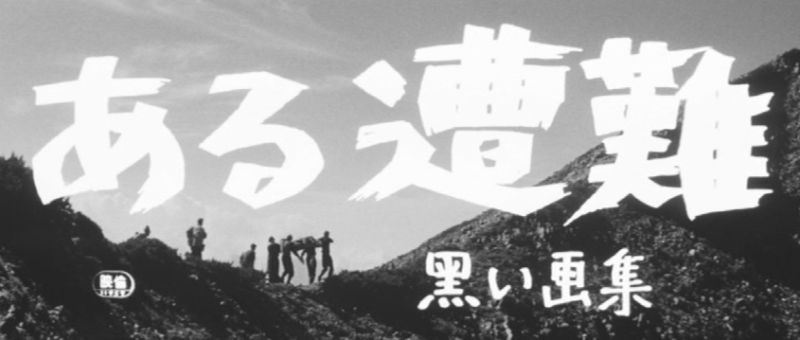
Death on the Mountain (黒い画集 ある遭難, Toshio Sugie, 1961)

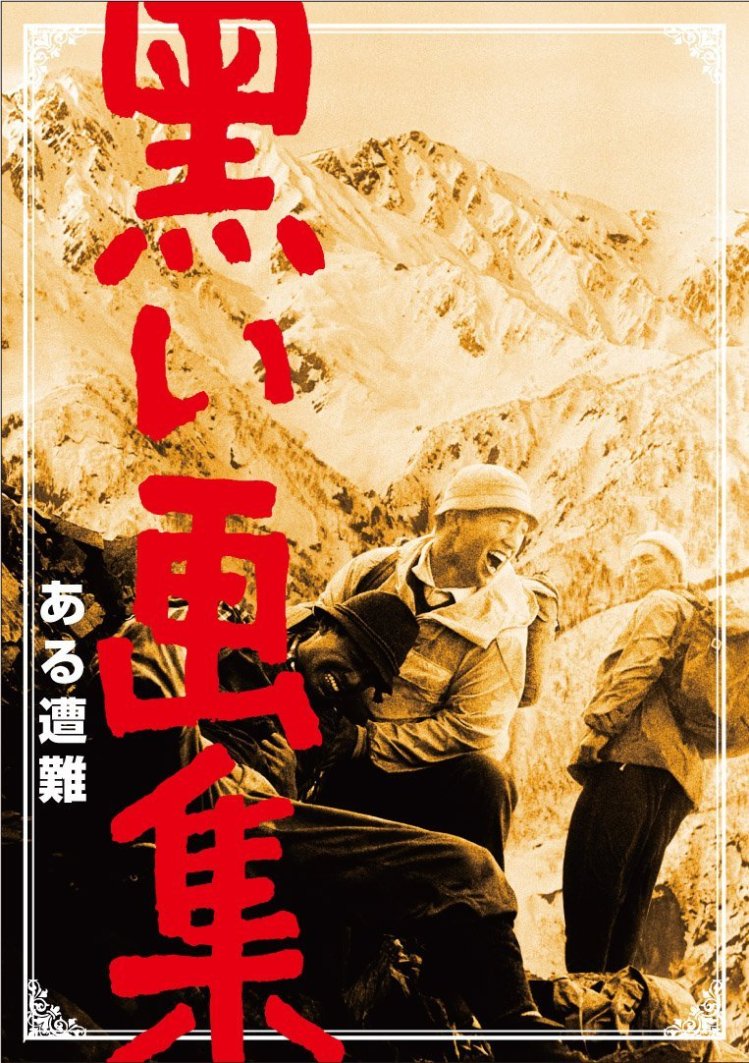
Death on the Mountain DVD coverThere can be few films with as accurate a title as Death on the Mountain (黒い画集 ある遭難, Kuroi Gashu: Aru Sonan) , but Toshio Sugie’s 1961 psychological melodrama certainly makes good on its promise. The Japanese title of the film is prefaced by “The Black Album” which is a title given to a series of novellas penned by one of Japan’s most prominent mystery writers, Seicho Matsumoto, whose work was frequently adapted for the screen including eight collaborations with director Yoshitaro Nomura of such well known mysteries as Zero Focus and Castle of Sand. Death on the Mountain was, like the others in the Black Album series, serialised in Shukan Asahi, in this case between 5th October and 14th December 1958 under the title “Sonan”. “Sonan” literally means “distress” or “disaster”, but it has another telling association – “Sonanshi”, meaning “accidental death” such as might occur while mountain climbing, sailing, or engaged in some other dangerous yet normalised activity. The death at the centre of Death on the Mountain is accidental in once sense, but very much not in another.

The film begins with a body being winched from a lower platform back up to a snowy ridge. Iwase (Kiyoshi Kodama), an experienced mountain climber, has perished in a freak accident. Packed inside his backpack, Iwase’s body is burned at the foot of his beloved mountains while his mother looks on sadly, his sister Masako (Kyoko Kagawa) angrily wondering how her brother, a true mountain man, could have died in such a bizarre way while a much less experienced climber, Urahashi (Takashi Wada), survived. The secret may lie with the leader of the expedition, Eda (Hisaya Ito), who has been looking sheepish ever since the incident but otherwise comports himself in a cool, detached manner.

Like many of Matsumoto’s mysteries, Death on the Mountain turns on a secret but Sugie’s adaptation never seriously considers that Eda is not in someway at fault or questions that Urahashi’s recollection of events, published in a popular mountaineering journal, is anything other than accurate. The facts, as laid out firstly by Urahashi’s article, state that Iwase had not been himself on the day of the climb. Eda had treated them all to first class sleeper cabins but Iwase spent the night drinking, chain-smoking and brooding, meaning he was tired before they even arrived at the mountain. He didn’t sleep at the inn either because of someone whispering all night long and needed to take frequent rests during the early part of the climb. Resting is, however, dangerous – as is excessive thirst, and Iwase spent a lot of time guzzling water and sitting down all of which made him even more exhausted. Coupled with a turn in the weather which left him cold and wet, Iwase’s exhaustion got the better of him and he finally lost his mind. At least, that’s the way Urahashi described it, and Eda seems not to dispute his version of events even if the failures – not bringing a map for both mountains they intended to climb but only one, pressing on despite the weather, and mistaking the trail back to the standard path, all rest squarely with him.

Japanese mysteries by and large are much more concerned with the how rather than the why, though in Death on the Mountain the how is a much greyer area than one might assume. As Masako’s cousin, an experienced mountaineer himself, points out, Iwase’s death was caused by a series of unfortunate circumstances but that doesn’t necessarily preclude that there was ill will or that someone didn’t help the “unfortunate circumstances” along in the hope that they would lead to the “accidental death” of the title. There was, therefore, not quite a murder but definitely a lot of ill will and gentle coaxing towards an act of guilty self destruction. As for the why, well that turns out to be far less interesting and suitably petty. Morally speaking, the act of “murder” becomes moot, though the “murderer” finally meets justice head on, only for the tale to end on a note of ambiguity as Masako, whose investigations have resulted only in further deaths, blames herself for daring to disturb the peace. If she’d only have let the “murder” of her brother lie, no one else would have died. Is Masako now an accidental “murderess” or a frustrated seeker of justice? Whatever the answer, all her efforts have been in vein.

Death on the Mountain was previously adapted as a TV drama shortly after the novel’s release, broadcast between 31st August and 7th September 1959, though presumably with lesser production values than Sugie’s admittedly minimal yet authentically detailed exploration of modern mountaineering. Shooting on location and making much of crunching snow, swirling fog, and pelting rain, Sugie runs high on atmosphere but fails to capitalise on the noirish sense of malevolence that lies at the centre of Matsumoto’s mystery, that evil can come dressed as kindness and the line between murder and accident is much thinner than might otherwise be presumed. Matsumoto seems to want to ask a few questions about causality and personal responsibility, the degree to which a man’s death is his own failing, how much the fault of “unfortunate circumstance”, and how much ill intentions from the world around him. Sugie, however, is content to let the suspense peter out with the solution offered in true detective style through a suppositional monologue delivered in front of the presumed murderer but for the audience’s benefit. Nevertheless, even if the mystery falls flat the mountain air rings true and Sugie has, at least, captured something of nature’s awesome power and terrifying beauty.


Aperture: Asia & Pacific Film Festival Launches 2018 UK Tour

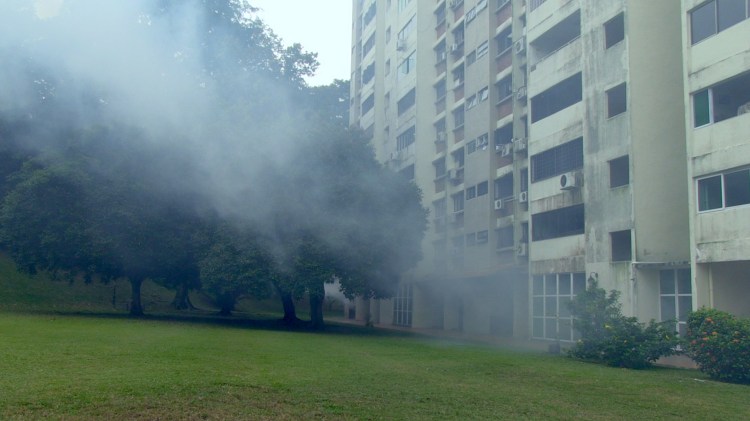
in time to come still 2Following its announcement last October, Aperture: Asia & Pacific Film Festival – a brand new UK festival dedicated to Asian cinemas, is set to launch its inaugural screening series with three events at Glasgow’s Centre for Contemporary Arts in late March.

In Time To Come 

25th March, 1pm

in time to come still 1Tan Pin Pin’s Singaporean documentary unearths a time capsule of national history through videographic recordings to probe the connections between time and memory.

The Island Funeral

29th March, 6pm

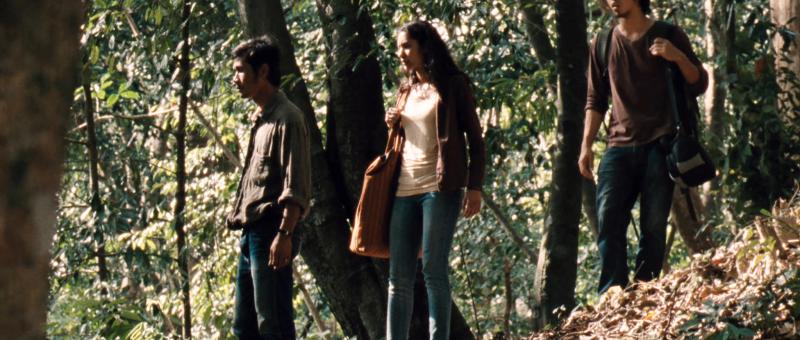
Island Funeral posterLaila, a Muslim in predominantly Buddhist Bangkok, travels south along with her brother Zugood and friend Toy just as political turmoil engulfs the city. Yet being from the city they are each mostly ignorant of the ongoing political strife which has plagued the southern regions for quite some time. Meeting a conflicted soldier who also feels like an outsider being from the North the four continue on their journey through a strange landscape.
People Power Bombshell: The Diary Of Vietnam Rose

31st March, 1pm

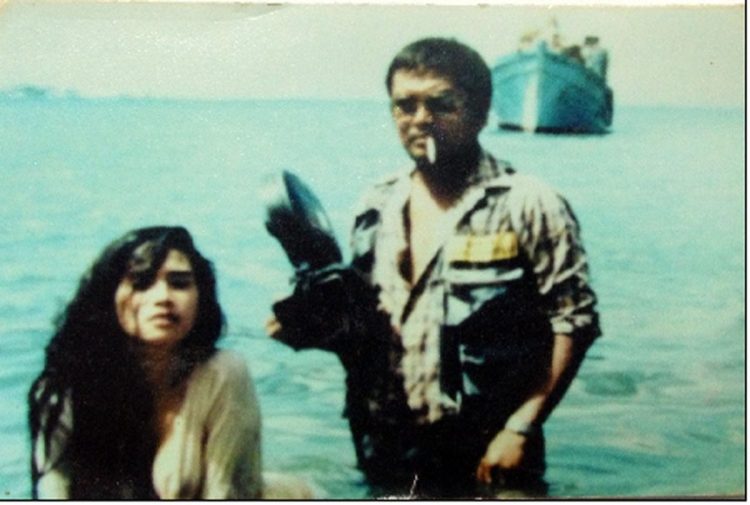
People Power Bombshell- The Diary of Vietnam RoseJohn Torres repurposes footage from an uncompleted film by Celso Advento Castillo to lay bare the various oppressions of the Marcos regime at the time of the People Power Revolution through the story of Liz Alindogan whose dreams of becoming an actress were frustrated by the world in which she lived.

All three screenings take place at Glasgow’s Centre for Contemporary Arts and tickets are already available via the links above. Further details are available on the official website and you can keep up with all the latest news via the festival’s Facebook Page and Twitter account.

Aperture: Asia & Pacific Film Festival will tour across the UK throughout the spring and summer of 2018.