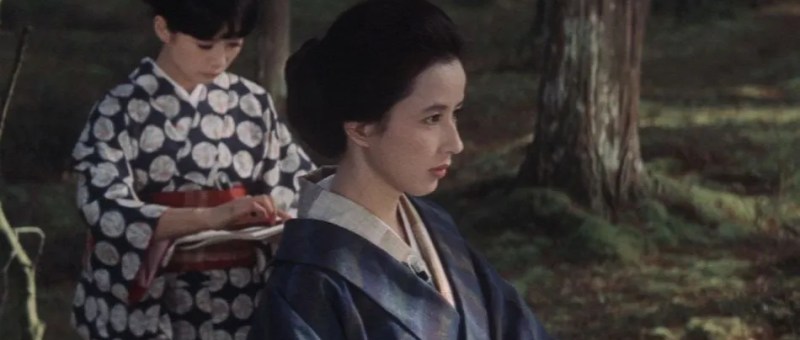

Masahiro Shinoda, a consumate stylist, allies himself to Japan’s premier literary impressionist Yasunari Kawabata in an adaptation that the author felt among the best of his works. With Beauty and Sorrow (美しさと哀しみと, Utsukushisa to Kanashimi to), as its title perhaps implies, examines painful stories of love as they become ever more complicated and intertwined throughout the course of a life. The sins of the father are eventually visited on his son, but the interest here is less the fatalism of retribution as the author protagonist might frame it than the power of jealousy and its fiery determination to destroy all in a quest for self possession.
Middle-aged author Oki (So Yamamura) is making a trip to Kyoto in order to hear the New Year bells but whilst there he wants to reconnect with someone very dear to him whom he has not seen for a long time. 15 years previously, Oki, already around 40 and married with a young son, had an ill advised affair with 16 year old Otoko (Kaoru Yachigusa). Oki’s indiscretion was discovered after Otoko fell pregnant and gave birth to an infant who sadly died after just a few months provoking Otoko’s own suicide attempt. Oki turned the traumatic events into a best selling novel which made his name and has not seen Otoko during the intervening years. Now a successful painter, Otoko has remained unmarried, still traumatised by her youthful experiences, and is currently in a relationship with a female student, Keiko (Mariko Kaga).
Keiko, a beautiful though strange young woman, will be the cause of much of the sorrow resulting from Oki’s decision to visit Otoko after all these years. Angry on her lover’s behalf, Keiko takes it upon herself to exact revenge for the wrong which was done to Otoko at such a young age, ignoring her lover’s pleas to leave the situation well alone.
Perhaps surprisingly, Shinoda avoids the temptation to retain Oki’s central viewpoint by attempting to survey the various threads which bind and constrain each of the protagonists, locked into a complex system of love, jealously, pain and obsession. Oki sows the seeds of his own downfall in his improper relationship with a teenager over twenty years younger than himself whom he has no intention of marrying seeing as he is already married and even has a child. Little is said about the original affair save for the effect it had both on Otoko and on Oki’s marriage which endures to the present time even though it appears Oki continues to pursue other women outside of the home. Not only does Oki turn his scandalous love life into a best selling novel, but he makes his wife, Fumiko (Misako Watanabe), type it up for him, forcing her to read each and every painful detail of his relations with another woman.
During the writing of the novel, Fumiko begins to become ill, depressed and listless, but not out of suffering or disgust – what she feels is jealousy but of a literary kind. Fumiko laments that Oki has written an entire book about Otoko, but never thought to write one for her. Even if depicted as some kind of harridan or vengeful, shrewish woman, Fumiko wanted to be Oki’s muse and was denied. Otoko, by contrast never wanted anything of the sort and has lived quietly and independently ever since her traumatic teenage love affair with a married, older, artist. Her feelings, complicated as they may be, are the motivation for the actions of her obsessive lover, Keiko, determined on taking “revenge” for pain Otoko is not entirely certain she feels. Keiko’s jealously has been roused by Oki’s return and the possibility that it may reawaken Otoko’s youthful romantic yearnings. Unwilling to surrender her beloved to another, she sets about destroying that which may come between them, perfectly willing to destroy both herself and the woman she claims to love in the process.
Oki is, after all, a novelist and therefore apt to ascribe a kind of narrative to his life which may ignore its more ordinary baseness. His equally sensitive son, Taichiro (Kei Yamamoto), brings up the subject of Princess Kazu and the glass panel and lock of hair which were discovered with her body and muses on whether these belonged to her husband, as is said, or her “true love” as seems to be suggested by the evidence at hand. Loves true and false are played off against each other but the forces at play are less grand romances than petty lusts and obsessions. Keiko wants to own her lover absolutely but her games of revenge cause Otoko only more pain and take her further away from that which she most loves towards the film’s dark and ambiguous conclusion in which the innocent are made to suffer for other people’s transgressions.
Otoko’s suffering is largely ignored by all concerned though it’s clear that the loss of her child is a deep wellspring of pain which has become the dominant force in her life. Misused and abandoned, Otoko has sought only quietness and solitude living independently and without the need for male contact. Keiko, whilst crying out that she hates men and is going to destroy the family of the man who has destroyed her lover, acts only out of selfishness, refusing to see how far her actions are wounding the woman she loves even as she sets out to make a weapon of her beauty and turn it on the male sex.
Shinoda films with his characteristic aesthetics adopting a position of slight distance as his protagonists gaze at reflections of themselves and talk through mirrors yet refuse the kind of introspection which a novelist like Oki would be expected to project. A final moment of high drama is offered in a series of freeze frames, as if the emotions are too big and complex to be understood as a whole but can only be grasped in painful fragments snatched from among the resultant chaos. With Beauty and Sorrow conjures the idea of nobility in romance, enhanced by the inevitability of its failure, but for all of its aesthetic pleasures and enduring sadness this is not the elegant coolness of romantic tragedy but the painful heat of love scorned as it festers and corrupts, spreading nothing other than pollution and decay.
Original trailer (no subtitles)
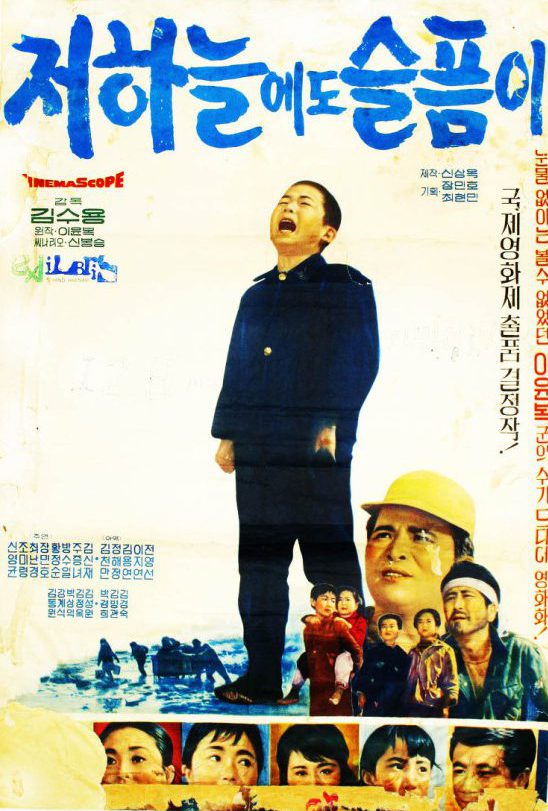 It’s a sorry enough tale to hear that many silent classics no longer exist, regarded only as disposable entertainment and only latterly collected into archives and preserved as valuable film history, but in the case of South Korea even mid and late 20th century films are unavailable thanks to the country’s turbulent political history. Though often listed among the greats of 1960s Korean cinema, Sorrow Even Up in Heaven (저 하늘에도 슬픔이, Jeo Haneuledo Seulpeumi) was presumed lost until a Mandarin subtitled print was discovered in an archive in Taiwan. Now given a full restoration by the Korean Film Archive, Kim’s tale of societal indifference to childhood poverty has finally been returned to its rightful place in cinema history but, as Kim’s own attempt to remake the film 20 years later bears out, how much has really changed?
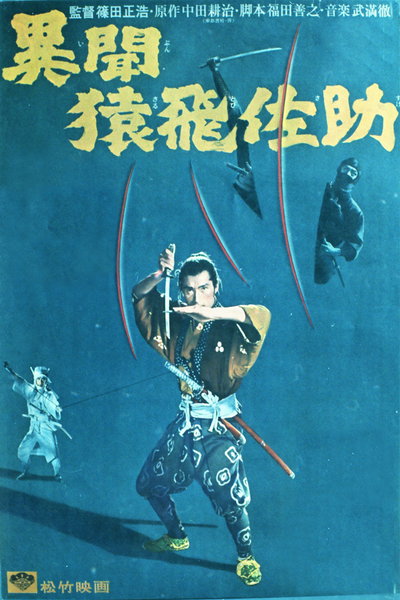 Nothing is certain these days, so say the protagonists at the centre of Masahiro Shinoda’s whirlwind of intrigue, Samurai Spy (異聞猿飛佐助, Ibun Sarutobi Sasuke). Set 14 years after the battle of Sekigahara which ushered in a long period of peace under the banner of the Tokugawa Shogunate, Samurai Spy effectively imports its contemporary cold war atmosphere to feudal Japan in which warring states continue to vie for power through the use of covert spy networks run from Edo and Osaka respectively. Sides are switched, friends are betrayed, innocents are murdered. The peace is fragile, but is it worth preserving even at such mounting cost?
 “If you don’t laugh when you see this movie, I’m going to execute you” abacus wielding hitman Komatsu warns us at the beginning of Haryasu Noguchi’s Murder Unincorporated (大日本殺し屋伝, Dai Nihon Koroshiya-den). Luckily for us, it’s unlikely he’ll be forced to perform any “calculations”, and the only risk we currently run is that of accidentally laughing ourselves to death as we witness the absurd slapstick adventures of Japan’s craziest hitman convention when the nation’s “best” (for best read “most unusual”) contract killers descend on a small town looking for “Joe of Spades” – a mysterious assassin known only by the mole on the sole of his foot.
 Windows on Worlds