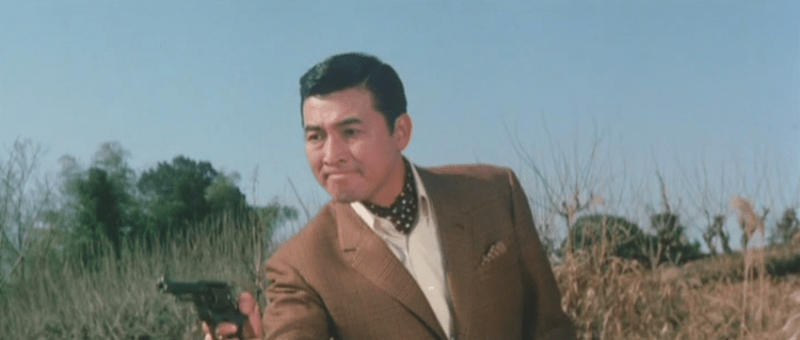
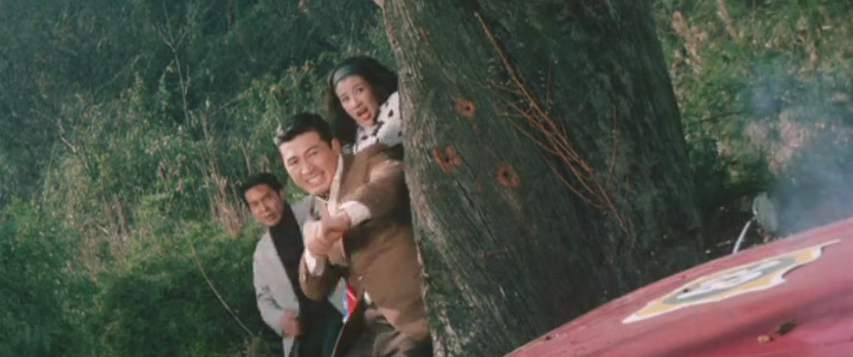
The Man Without a Map (燃えつきた地図, Hiroshi Teshigahara, 1968)

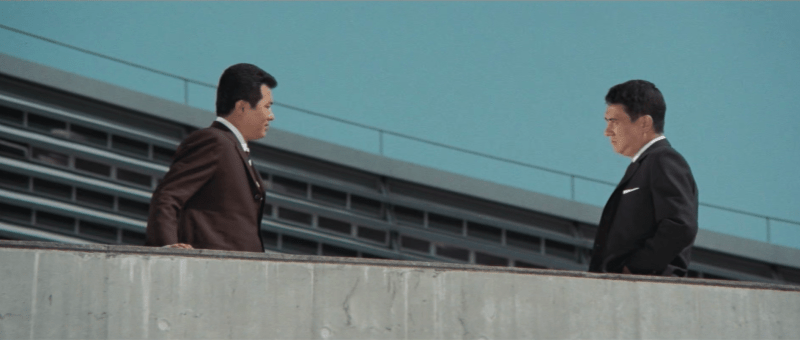
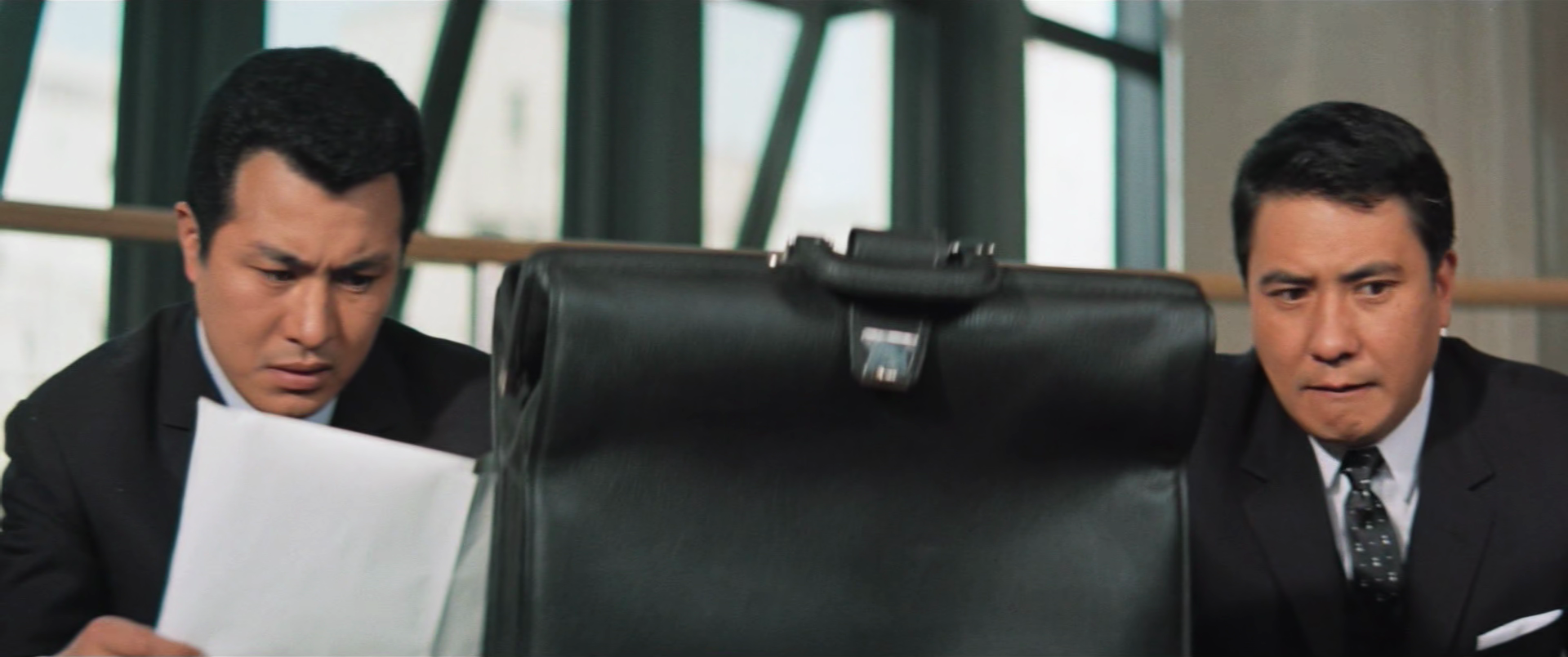
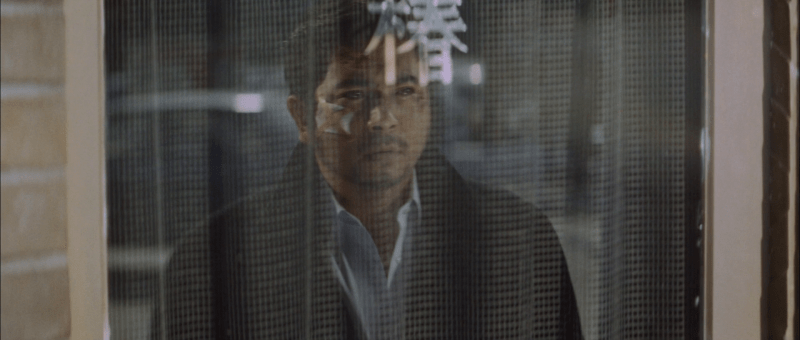
Hired to find a missing person no one really wants found, a detective begins to chase his own tail amid the impersonal vistas of the contemporary city in Hiroshi Teshigahara’s The Man Without a Map (燃えつきた地図, Moetsukita chizu). The fourth and final in his series of Kobo Abe adaptations and the only one in colour, the film’s Japanese title “burned-up map” may also, in its way, refer to the city of Tokyo which appears blurred out and indistinct in the sepia-tinted opening and is thereafter frequently shot from above as a depersonalised space where anonymous cars shuttle along highways like so many ants moving in rhythm with the momentum of the metropolis.

We follow a nameless detective (Shintaro Katsu) as he’s charged with investigating the disappearance of a 43-year-old salaryman, Hiroshi Nemuro, who turns out to have myriad other personalities and hasn’t been seen for six months. The man’s wife, Mrs Nemuro (Etsuko Ichihara), is not terribly helpful and the detective comes to wonder if the investigation itself is intended to further disguise the man’s whereabouts and prove that he really is a “missing person”. Yet this Tokyo is full of “missing people” including the detective who, we later learn, is a kind of fugitive himself. He apparently walked out on his wife (Tamao Nakamura), the owner of a successful boutique, because he couldn’t find his place there any more. He was once a salaryman too, and became a detective because it was the furthest thing he could think of from a regular job. 

It confuses him that no one really seems to be interested in where Nemuro is or if he’s alright, only in the reason behind his disappearance. The more he chases him, the more he begins to take on Nemuro’s characteristics as if he were intended to slide into the space Nemuro has vacated. Toru Takemitsu’s eerie harpsichord score only seems to add to the hauntingly gothic quality of this quest. The question is whether such a thing as identity even exists any more. The detective puts on Nemuro’’s jacket, though it’s too small, and is mistaken for him, while a colleague of Nemuro’s insists that he’s seen him in the street and is sure it was Nemuro simply because of the unusual colour of his suit without ever seeing his face. Tashiro (Kiyoshi Atsumi) tells the detective that Nemuro had a secret hobby taking nude photos at a specialist club that caters to such things. The two of them are confident they’ve identified the woman in the picture based on her haircut, but the girl they speaks laughs and takes off her wig explaining that she was merely asked to wear it, so the woman in the photo could be anyone, including Nemuro’s own wife.

Nemuro apparently had a series of hobbies for which he’d obtained certificates because he said that having them helped him to feel anchored in his life, though he’s apparently unmoored now. Like the detective, he may have been trying on different personalities from car mechanic to school teacher looking for the right fit and a place he felt he belonged in rebellion against the depersonalisation of the salaryman society in which one man in a suit is as good as another. The detective finds an opposite number in the missing man’s brother-in-law (Osamu Okawa), a very modern, apparently gay gangster connected with a network of male sex workers sold on to influential elites, and a commune of similarly displaced people working as casual labourers that is overcome with corporate thugs and eventually trashed.

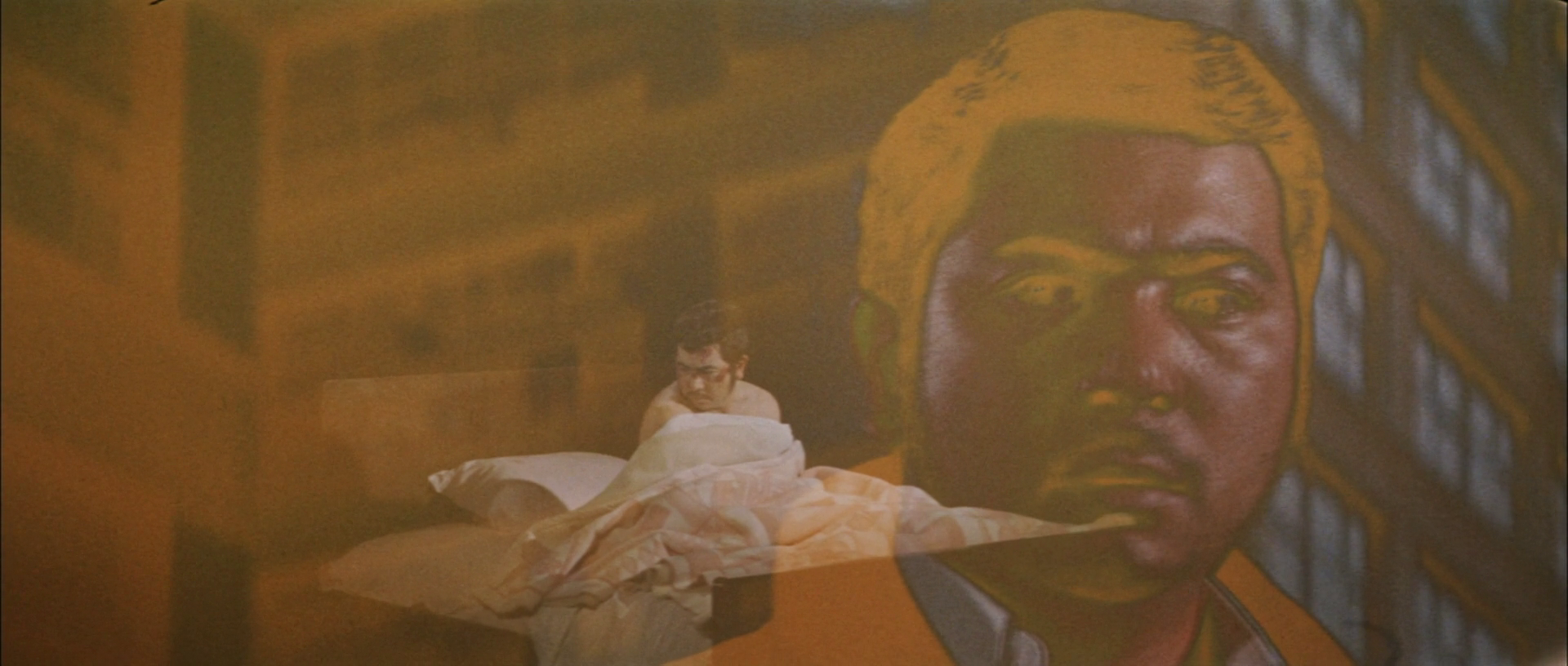
The trashing of the commune may have something to do with a man named Maeda who is a councillor in a town no one’s heard of, but was possibly involved in some shady business over which Nemuro may have been intending to blackmail him or blow a whistle with the assistance of his brother-in-law who helped him land a big contract at work. The more the detective investigates, the more confused he becomes. It’s impossible to follow the case as we might expect in a conventional noir thriller, but we’re not supposed to be looking at Nemuro’s disappearance so much as the detective’s gradually fracturing sense of self as he becomes lost in the anonymous city. He sees himself bury Mrs Nemuro in leaves only for her body somehow reduce itself to its component parts and sink into the street. Later her face is superimposed on the buildings as if she were looking down on him while he is lost and alone. Nemuro’s face also appears on buildings, though more as a metaphor as if the salaryman and the office building were one and the same and the reason the detective can’t find him is because he doesn’t really exist as a concrete identity. The detective spots a dead cat in the road and laments that he never thought to ask its name, but will try to think up a good one later. He might as well be talking about himself, now displaced, unmoored, and pursued among the city streets, a man without a map lost amid the simulacrum of an imaginary city.


Big Time Gambling Boss (博奕打ち 総長賭博, Kosaku Yamashita, 1968)

A Shakespearean tragedy of blood and honour, Kosaku Yamashita’s Big Time Gambling Boss (博奕打ち 総長賭博, Bakuchiuci: Socho Tobaku) discovers only fatalism and futility in the nobility of the yakuza code. The tragedy is that at any moment anyone could make a free choice to walk away, to abandon these arbitrary notions that convince them they must kill their friends and let their enemies go free, but they don’t because spiritually they cannot. Abandoning the yakuza code would in its own way a kind of death and mentally unsurvivable. 

There is however a greater tragedy in play. The film opens in the spring of 1934 with a villain remarking that it’s absurd to restrict oneself to one’s home terrified while a sword and the Japanese flag appear behind him. The catalyst for all this drama is Japan’s imperialist expansion. Yakuza fixer Senba (Nobuo Kaneko) and the shady Kawashima have hatched a plan to get all the yakuza clans to unite in a “patriotic” mission to traffic drugs to the frontlines looting as they go. Noble boss of the Tenryu Awakawa refuses, reminding them he’s just a simple gambling man and has no desire to get involved with politics before collapsing with a stroke. With Awakara alive but bedridden and no longer able to communicate effectively, the Tenryu decide to nominate a successor. The ideal candidate, Nakai (Koji Tsuruta), declines the offer on the grounds that he is a transplant from another gang in Osaka and thinks it would be inappropriate for an outsider to lead the clan. He proposes that his sworn brother, Matsuda (Tomisaburo Wakayama), should be appointed, though he is currently surviving a prison sentence so a caretaker should serve in his stead until his release. Most think this sensible though the proposed caretaker, Ishido (Hiroshi Nawa), also declines given the rules of seniority despite the fact that he is Awakawa’s son-in-law and so dynastic succession would also seem permissible. 

It’s during all of this finagling that Senba begins manipulating events to his advantage, gently manoeuvring the other lieutenants towards accepting Ishido as the new boss while he has no idea he’s being used as a pawn in Senba’s nefarious nationalist plotting. When Matsuda is released early, the entire situation kicks into overdrive in his outrage that the codes of rank have not been respected and that a man who is his inferior now sits at the head of the clan in a place he think’s rightfully Nakai’s but in light of his honourable refusal no one’s but his own. Even Matsuda later recognises his hot-headed recklessness in directly challenging Ishido over his decision to accept, insisting that the proper thing to do in his position would have been to persuade Nakai to take the job. Meanwhile, his own righthand man who’d been slumming it as a mere labourer in his absence, is dragged into intrigue in foolishly defending his honour by recklessly attacking Ishido’s men incorrectly believing they had provoked another gang’s attack on Matsuda little knowing it was all part of Senba’s plot. 

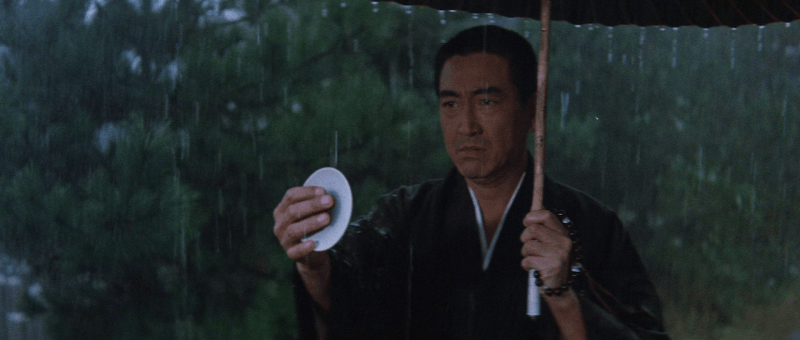
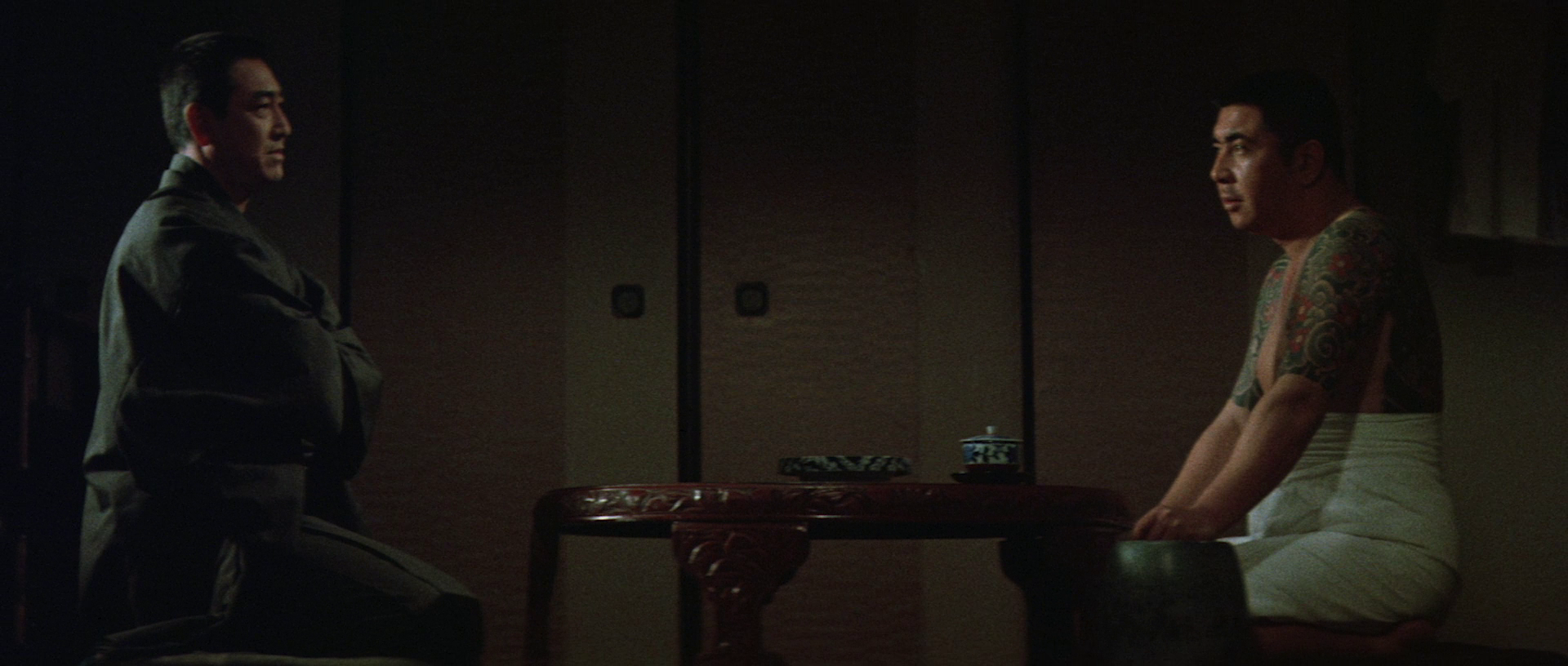
Nationalist trappings aside, Senba’s villainy is obvious from the moment he tells Nakai he thinks Matsuda was foolish for going to prison on the clan’s behalf and that he should have just found a scapegoat and put the blame on them, signalling himself a member of the new amoral yakuza who does not believe in giri and has no ninjo. Nakai rather is the opposite, as his old boss confirms in praising him for his correct decision to turn down the succession as it would not be right for him to accept as one who did not originate in their gang. Matsuda meanwhile pays too much attention to the letter of the code and not its spirit, obsessed with Ishido’s transgression and unable to let the matter drop to live a quiet life even as Nakai tries to convince him that the decision has been ratified by the lieutenants and the boss and so he must obey it. In a poignant moment, Nakai brings out the cup they used to seal their friendship and tells him that he will choose the clan, breaking the cup if Matsuda does not agree to accept a minimal degree of humiliation in returning with the intention of lying low and subtly reminding him that if he does not Matsuda will be placing a heavy burden on him that he may be forced to inflict lethal violence on his best friend and in fact brother-in-law. Realising the gravity of the situation, Matsuda immediately backs down, but events are now in motion that neither of them are capable of stopping. 

Of course, they could walk away but they don’t. Nakai offers the opportunity to Matsuda’s remorseful foot soldier Oto, telling him to leave the clan and take the woman he loves far away to live a peaceful life but of course he can’t because of his debt of loyalty to Matsuda. They are all trapped by the code which they follow and the villains ignore, laughing at them all the way. Then again, that’s what men like Nakai are for, born to set things right even if it comes at great personal cost. Even he finally snarls that he’s merely a murderer, rejecting any sense of honour in his actions while throwing a sword at the symbol of the system which has defined his life and submitting himself to the automatic operation of law of the state as a kind of martyr for system in which he may no longer believe. 


Trailer (English subtitles)

Ninja’s Mark (忍びの卍, Norifumi Suzuki, 1968)

Many have tried to end the Tokugawa line. Few have done so by covering a courtesan’s legs in fish scales to put the Shogun off his stride. Based on a book by Futaro Yamada, Norifumi Suzuki’s Ninja’s Mark (忍びの卍, Shinobi no Manji) is at heart a romantic tale in which love is “part of the game” but also apparently the one trick a ninja can’t escape. Perhaps that’s why Shogun Iemitsu at the comparatively late age of 30 has failed to produce an heir with any of the beautiful yet emotionally distant courtesans of the inner palace many of whom also seem to be ninjas, therefore provoking a constitutional crisis.

Aside from that, it seems the ninja plot is a kind of revenge against the Tokugawa carried out by the last remnants of a house that was dissolved by the Toyotomi. There are in fact three ninja clans all clustering around the palace, Iga, Koga, and Negoro, each of whom have different kinds of skills. Technically, some of them are in the employ of the Shogun’s disinherited younger brother Tadanaga (Shingo Yamashiro), but others of them are working strictly for themselves and their revenge. In any case, their plan is to prevent Iemitsu from fathering an heir by putting him off sex essentially by making it freaky (in a bad way). Thus one of the ninjas uses his ability to transform objects so that the courtesan’s legs are covered in fish scales. Another plan sees a ninja body swap with one of the women so that Iemitsu’s sperm ends up inside him where it obviously has nowhere to go. Meanwhile others hatch a plan to steal some of Tadanaga’s seed to use on the women in the inner palace to cover up Iemitsu’s potential infertility seeing as it is after just as good being of the Tokugawa line. 

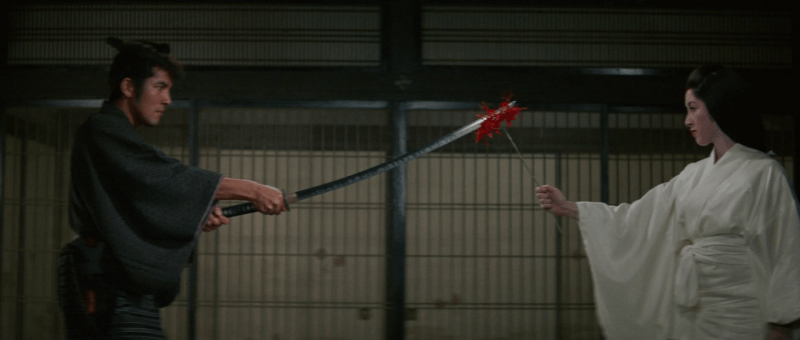
This particular ruse is suggested by Toma (Isao Natsuyagi), the disenfranchised former member of the Yagyu school turned ninja ronin they bring in to solve the problem. He quickly homes in on Kageroi (Hiroko Sakuramachi), a female ninja, as the villainess whose special power is poisoning men with love and desire by means of the spider lily plant. But as Toma points out to her, she is also a prisoner of her skill in that if she were to fall in love she would inevitably kill her lover. Of course, he survives her first attempt to kill him, leading her to fall in love with Toma and become conflicted in her mission while he plays on her emotions to escape but eventually realises they may be more genuine than he first realised. 

In this, Suzuki brings some of his trademark romanticism particularly in the colourful art nouveau aesthetics and frequent use of rose imagery. Though the film is clearly designed to lean into the erotic with frequent use of nudity and salacious scenes including a brief moment of lesbian seduction, it eventually heads towards romantic tragedy in which the debauched and nihilistic Toma and the wronged Kageroi discover a love made impossible by their ninja code and the times in which they live. Having been ordered to kill her, Toma declares that he will marry Kageroi in the next life and returns to her the Buddhist Manji that is the “ninja mark” of the title. 

Nevertheless, the dialogue is often suggestive as in Kageroi’s curse that Toma’s “sword” will rot, while it’s also Toma’s “sword” that alerts him to the danger she presents. Toma too claims to derive his ninja powers from his “sword” having apparently concentrated them by repressing his sexual desire and swearing off women. He says that he seals all his “distracting” thoughts into a virgin, closing off all her senses and placing her into a coma until he breaks the spell. Even so, he admits that without his “sword” he is just a man, and as a man claims to love Kageroi, but as long as he has his “sword”, and she her “lily”, their love is impossible. 

But this repressed love seems to pose less threat to the social order than the lack of it in Iemitsu who is bored with his courtesans and cannot conceive an heir. Constitutional crisis is averted only through a little ninja trickery and a convenient ruse to overcome Iemitsu’s infertility so that in time he produces five sons and a daughter, which honestly seems like it might just present another set of problems in about 30 years’ time. Like similarly themed ninja pictures, Suzuki makes good use of surrealist imagery and colour play alongside the kind of onscreen text later used in jitsuroku yakuza films to name each of the ninja’s key skills and which clan they belong to. What he always returns to, however, is the sense of romantic tragedy in a world seemingly poisoned by ambition in which love itself is rendered an impossibility. 


*Norifumi Suzuki’s name is actually “Noribumi” but he has become known as “Norifumi” to English-speaking audiences.

Sunset Over the Horizon (夕陽西下, Lin Fu-Ti, 1968)

Shot at the same time as The Love in Okinawa, Sunset Over the Horizon (夕陽西下) is another Okinawan and Taiwanese co-production directed by Lin Fu-ti assumed lost until its discovery in San Francisco’s Chinatown in a Mandarin-dubbed print. Unsurprisingly, it features many of the same cast members and locations and even has a similar theme of impossible love but is more ambitious in scope incorporating both dream sequences and flashbacks to explore the changing relationship between Japan and Taiwan.

Lin opens the film with its conclusion as Shizuko watches a boat silently depart carrying away her love, the much older pastor/penniless painter Ching-wen who has made the decision to return to Taiwan having finally faced, if not quite come to terms with, his traumatic past at the end of the war and Taiwan’s “liberation” from Japanese colonisation. Japan had conquered Taiwan by force in 1895, but otherwise ruled with much less of an iron fist than it did in other areas of its empire. Lin seems to be making a minor point in dramatising the moment of “liberation” as one of conflicting emotions as the Japanese flag is slowly lowered and that of the KMT, another colonising force, rises in its place meaning that the island is not really “liberated” at all, merely changing hands and to a regime that became more oppressive than that which preceded it had been. 

The irony is that it’s this “liberation” that disrupted his romantic future as a young Taiwanese student in love with the daughter of a Japanese general. With the end of the war, the Japanese must leave Taiwan and so his love must go with them and return to the mainland. She asks Ching-wen to come with her, but he refuses. He is unwilling to leave his nation and his family, though we can see he did so years later and traveled to her hometown of Okinawa though she ultimately chose to take her own life out of a sense of despair and futility. She could not return to Japan with Ching-wen nor stay with him in Taiwan either and so to her the only answer, the only real “liberation,” lay in death.

Shizuko later posits something similar even if her dilemma is different. Her businessman father wants her to marry the son of a local factory owner so that he will support his business but Shizuko refuses because she wants to fall in love and does not seem to like her father’s chosen suitor. The situation is somewhat complicated by the fact that Shizuko is a child of her father’s first marriage and is therefore resented by her stepmother who wants her to leave the family as quickly as possible. In some ways this dynastic union represents a decision to embrace the more consumerist future that Japan in the later 1960s represents. Ching-wen on the other hand despite his ruination represents something purer and more spiritual that is less materialistic and rooted in sincere emotion. Shizuko insists that the businessman may buy her body but never her heart, but that seems perfectly fine to him because it seems he’s not all that bothered about her heart and just wants to possess her like a trophy. Frustrated by her objections, he continues to offer greater sums of money and later tells his underling, who looks horrified, that he plans to keep her locked up at home.

But there are other forces which stand in the couple’s way such as the inappropriate 18-year age gap considering that Shizuko is only 19 years old meaning she was born around the time Ching-wen’s first love died (probably at around the same age). It appears that Ching-wen is protestant preacher and so there’s no religious reason why he should not be married, but it’s clear that he has a serious alcohol problem and is a broken, ruined shell of a man unable to bear the romantic heartbreak he endured as a student and has presumably been atoning for ever since. Given all of this, there is no real explanation for the love that exists between them in the first place save for physical attraction (which is less likely given Ching-wen’s unkempt appearance) or a meeting of souls. In the end the theme seems to be moving on from the past and we realise that the lovers cannot be together because Japan and Taiwan must in effect go their separate ways. Though Shizuko too says she longs to return to Taiwan (when she lived there is not explained), she must fulfil her duty to her father by marrying the Japanese businessman. Over the horizon, there is only ever a sunset with no real indication of a happier future in the distance only futility and endurance if also a new beginning in moving on from the traumatic past.


Sunset Over the Horizon screened as part of this year’s Cinema at Sea.

Trailer (English subtitles)

The Love in Okinawa (琉球之戀, Lin Fu-Ti, 1968)

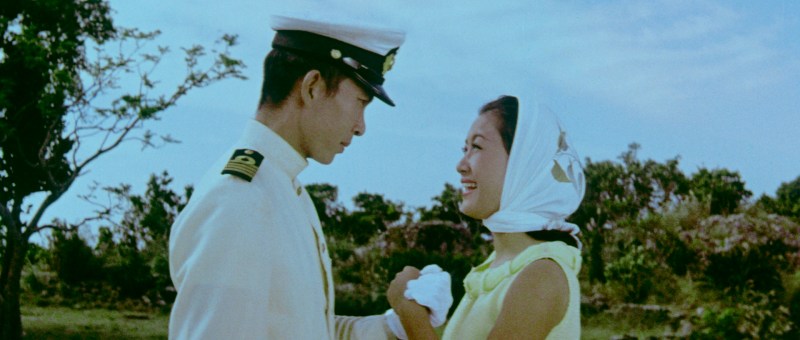
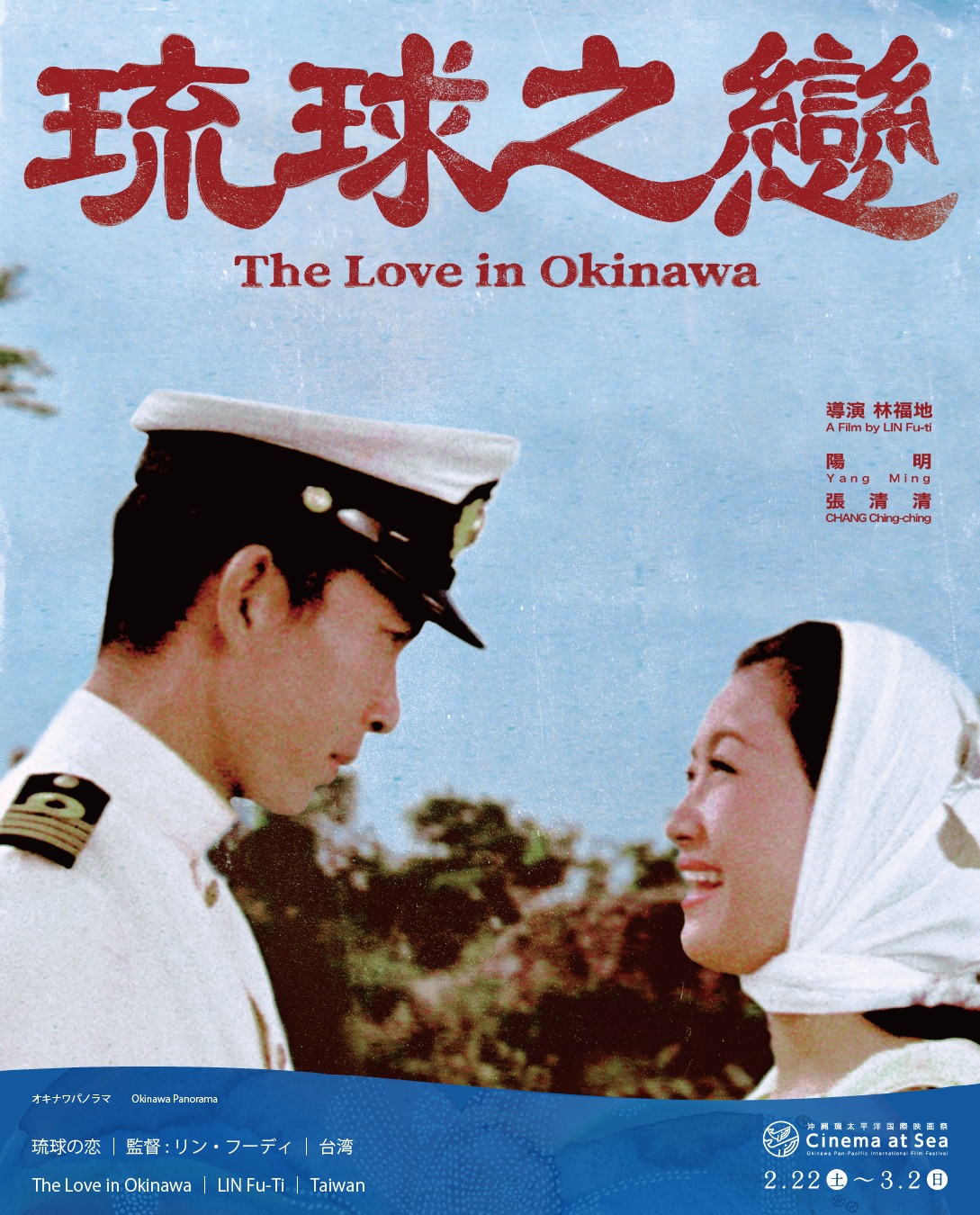
Though he may be captain of his own boat, a young man finds himself powerless in the matters of love in Lin Fu-Ti’s Taiyupian romance, The Love in Okinawa (琉球之戀). Long thought lost and recently restored from a Mandarin-dubbed print discovered in San Francisco’s Chinatown, the film was a collaboration between Taiwan and locally based film companies completed shortly before the islands’ return to Japanese sovereignty after an extended period of American occupation. Though the two nations share a degree of common ground in their experience of Japanese colonialism, the film seems to suggest that nothing really good comes of trying to do business here and events might have progressed differently if the family had not delayed its return to Taiwan.

Nevertheless, the real problem is that Hung-hai is a boat captain who in theory possesses the total freedom of the wide open seas yet he is unable to defy his father and marry the woman he loves out of a sense of filial piety. Hung-hai and Hsui-ling were childhood friends and their fathers were once like brothers only to be forced apart by a business dispute ending in a court case which Hung-hai’s father lost. Hsiu-ling’s father’s business later went bust anyway and he has been dead for several years but Hung-hai’s father still harbours fierce resentment towards him. The family went through a period of financial hardship following the court case during which Hung-hai’s mother worked herself to the bone gathering money for their new start. Hung-hai’s father blames his former friend for hastening his wife’s early death which is why he can’t accept Hsiu-ling, to whom he was once like an uncle, as his daughter-in-law.

But on the other hand he also has his own plans for his son’s life which include marrying Yoshiko. Yoshiko is the current “Miss Okinawa” and a minor celebrity who appears on television singing Japanese songs such as Mari Sono’s 1966 hit Yume wa Yoru Hiraku. She is always dressed in kimono, while Hsui-ling wears more westernised contemporary fashions but is later seen in more recognisably Chinese-style after her return to Taiwan. To that extent, Yoshiko represents a closer union with the growing economic powerhouse of Japan as mediated through Okinawa, while Hsui-ling represents an unsullied Taiwan yet one still restrained by increasingly outdated notions of filiality.

Eventually, after a series of ironies, Hung-hai’s father is forced to admit that his authoritarianism and refusal to allow his son to chart his own destiny has destroyed his family’s future. Unable to marry Hsui-ling who thinks that he has married Yoshiko after seeing her announce their engangement on television while he was away on his boat, Hung-hai falls into depression and takes to drink. Though he had long favoured Hung-hai to take over the business over his older son Ah-qin who has a physical disability and was therefore left behind in Taiwan to babysit the domestic business, Hung-hai’s father begins to realise the mistakes he has made and that in this ruined state Hung-hai will never amount to anything nor prove a worthy heir for his business empire.

Ah-qin, meanwhile, is oblivious to all this and the soul of kindness and decency. In some ways, he might play into a stereotypical vision of disabled people as saintly and innocent, yet is unwittingly drawn into his brother’s romantic drama knowing nothing of his father’s animosity towards Hsui-ling and her family nor of his brother’s love for her which is the cause of his depression. He wants only for everyone in his family to be happy, and in the end is willing to sacrifice his own happiness to facilitate it (which is a paradoxical expression of “positive” filiality). Hung-hai had suggested simply running away and eloping to Taiwan but Hsui-ling’s mother was on her deathbed and neither of them really had the stomach to abandon their parents in a “foreign” land. Thus this kind of filiality that divides the lovers is nothing but destructive. Not only does it ruin the family entirely, disrupting the relationship between the brothers as well as between father and sons, but leads only to futility and heartbreak in which true freedom is found only in death.


The Love in Okinawa screens as part of this year’s Cinema at Sea.

Trailer (Traditional Chinese / English subtitles)

Genocide (昆虫大戦争, Kazui Nihonmatsu, 1968)

In the early 1960s, tokusatsu movies had begun to slide towards something which was much less serious than the early days of the genre, but as the decade went on others edged in the direction of the ‘70s paranoia thriller expressing a nihilistic view of contemporary Cold War geopoliticking. Given the rather provocative English title Genocide (昆虫大戦争, Konchu daisenso), as opposed to the more recognisably genre-inflected “great insect war”, Kazui Nihonmatsu’s wasp-themed disaster film is part anti-nuclear eco-treatise and part anti-US spy movie.

Then again, the film’s secondary hero, Joji (Yusuke Kawazu), a Japanese man obsessed with collecting rare insects he sends alternately to a researcher in Tokyo and a foreign woman living locally, cannot exactly claim the moral high ground. When he spots a US bomber falling out of the sky and runs to investigate the descending parachutes, he’s in the middle of tryst with Annabelle (Kathy Horan) while his wife waits for him patiently at home. Not only that, he picks up an expensive watch dropped by one of the airmen and attempts to sell it, he later claims to buy something nice for his wife, Yukari (Emi Shindo). Meanwhile, the voice of reason Dr. Nagumo (Keisuke Sonoi) is also seen conducting experiments on animals, injecting insect venom into a squirming guinea pig while explaining that the toxin affects the nervous system and causes madness and death. 

For all his own moralising, it’s this callous and selfish disregard for life which caused so many problems. The insects have apparently become fed up with human volatility and have decided that they don’t care what humans do to each other but they won’t go down with us in a nuclear war so the only solution is total eradication. The film’s true moral centre, the innocent Yukari, had tried to stop Joji capturing insects, reminding him that “insects have babies too,” while unbeknownst to him the insects he’d been capturing for Annabelle had been used for her sinister experiments to “breed vast numbers of insects that drive people mad and scatter them across the world.”

Annabelle’s quest is one of revenge, claiming that she doesn’t trust humans and likes insects because they don’t lie. She’s currently working with Communist spies supposedly researching deadly nerve toxins but with no loyalty to the regime, only the desire for the eradication of humanity in revenge for the murder of her parents in the holocaust. The Americans, meanwhile, only care about getting the H-bomb that the downed bomber had been carrying, eventually admitting that they’re considering simply detonating it to wipe out the insect threat in total indifference to the lives of those who live on the islands. When Nagumo challenges him, the American officer pulls a gun. One of the soldiers refuses the command to detonate, but is then killed. 

The Americans reject the idea that it was “insects” that brought the plane down, but tell on themselves on insisting that the airman onboard was hallucinating having become addicted to drugs to help him overcome his fear of combat situations. The insects do indeed cause him to hallucinate but with flashbacks back to his time in Vietnam, loudly exclaiming that he won’t go back there before asking for more drugs and being injected by a medic. The American officers claim they’re fighting for “freedom and independence,” but it rings somewhat hollow and is immediately challenged by Nagumo. “Sacrifices must be made in war,” they retort when he points out that detonating the bomb will not only kill everyone on the islands but irradiate the rest of Japan, wiping out the Japanese as if they too were merely insects. 

Even so, Nagumo too wants to wipe out the insects rather than consider the implications of their concern or find a way to live with them. Annabelle might have had a point when she said that human beings only knew hate despite her entirely twisted and exploitative plan to use the insects to complete her mission of eradicating humanity. In any case, in contrast to other similarly themed films, Nihonmatsu keeps things fairly realistic despite the outlandishness of the narrative, frequently cutting back to closeup footage of an insect biting into human flesh with its pincers before ending on an image of a nihilistic and internecine destruction that suggests there may be no real hope for us after all.


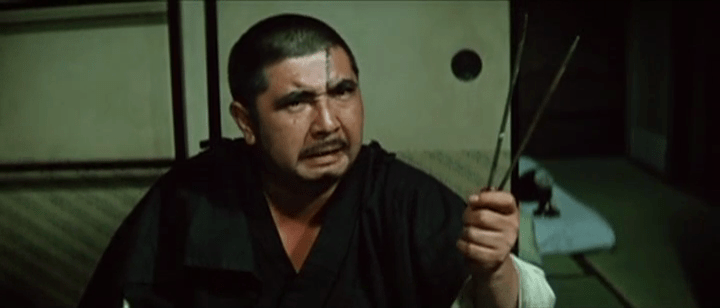
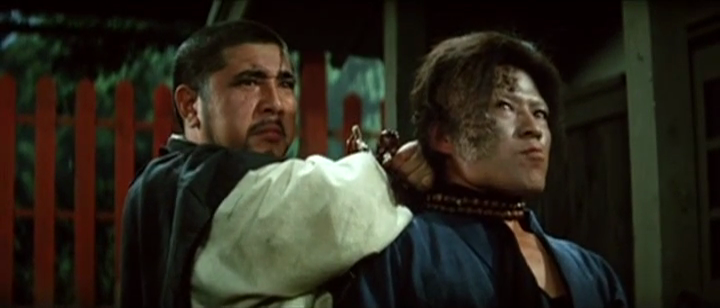
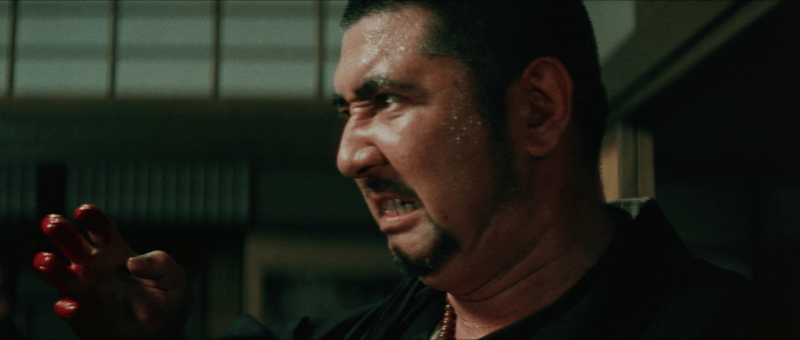
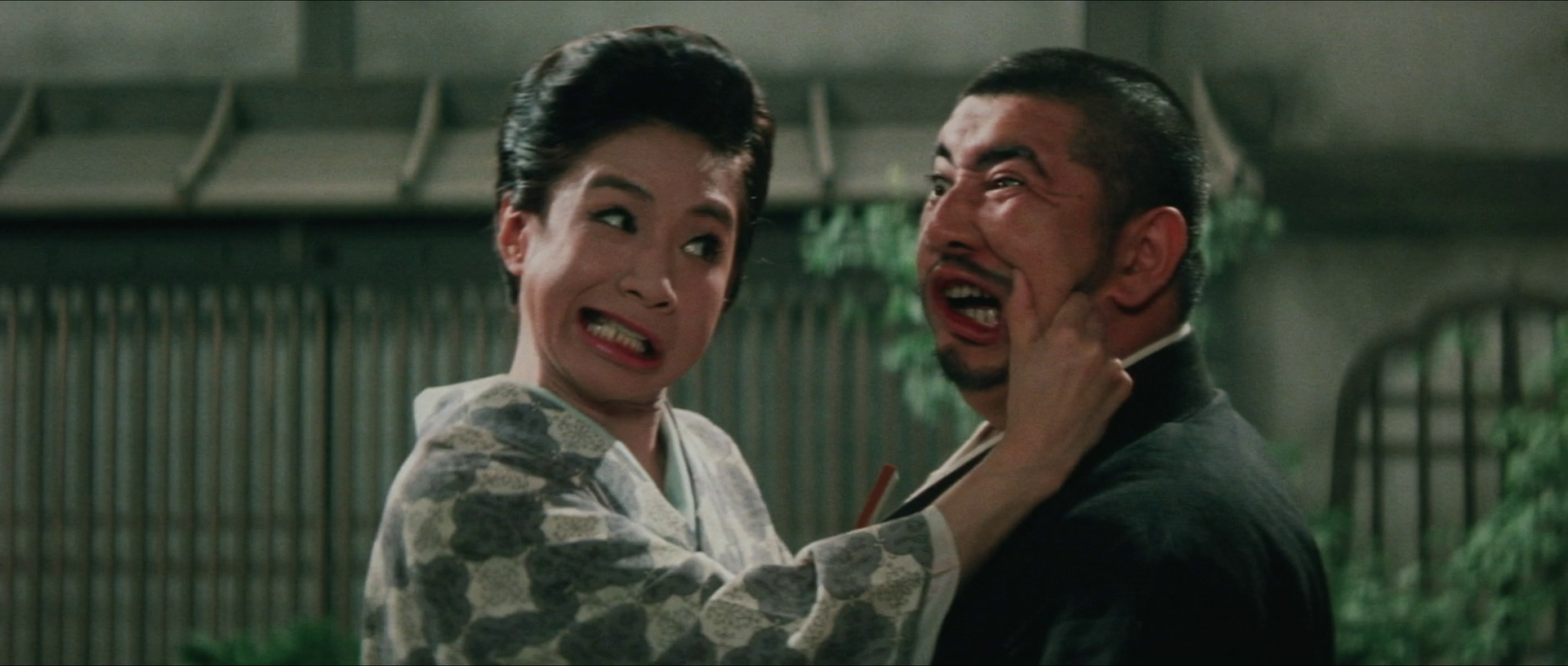
Wicked Priest 2: Ballad of Murder (極悪坊主 人斬り数え唄, Takashi Harada, 1968)

The Wicked Priest returns for a second instalment but once again finds himself confronted with imperfect paternity in The Wicked Priest 2: Ballad of Murder (極悪坊主 人斬り数え唄, Gokuaku Bozu: Hitokiri Kazoe Uta). This time directed by Takashi Harada, the series begins to embrace its anarchic nature in the sometimes cartoonish exploits of its hero who largely just wants to have a good time but is inconveniently called to missions of justice while silently stalked by ghosts of the past in the form of spooky monk Ryutatsu (Bunta Sugawara) whom he blinded in a fight at the end of the previous film. 

Now a lonely wanderer, Shinkai (Tomisaburo Wakayama) comes across a fleeing yakuza with a small boy in tow and steps in to help. As he discovers, the man, Rentaro (Asao Koike), is a former gangster whose wife has passed away leaving him the sole parent to Seiichi, a little boy of around six. Rentaro wants to turn himself in to the police so he can fully sever his ties to the underworld and start again along a more honest path to raise his son right, but needs to deliver him to his father, a jujitsu instructor, before he can. Somewhat surprisingly, Rentaro suddenly asks Shinkai, a man he’s never met before, to take Seiichi to his grandfather before rushing off supposedly to give himself over to justice. When Shinkai arrives, however, Iwai (Hideto Kagawa), the grandfather, refuses to let them in having disowned his son over a local scandal some years previously. 


As in the first film the major theme is paternal disconnection, Rentaro caught between wanting to be a good father to his son and seeking his own father’s approval. Fatherless himself, Shinkai cannot understand nor condone Iwai’s stubbornness in refusing even to look at his small grandson but resolves to care for him himself until his grandfather changes his mind or for as long as he is needed. Meanwhile it turns out that Rentaro was once involved with the evil gang, Godo, who have been causing trouble in the town by trying to muscle on the local cockfighting scene. 

Godo have also been force recruiting some of the local men to increase their dominance while schmoozing with a corrupt politician, Kadowaki (Hosei Komatsu), hoping to make cockfighting a local speciality, even going so far as to kidnap a young woman known to Shinkai and gift her to him. Shinkai manages to rescue her after dressing up as a head priest and subtly suggesting to Kadowaki that his election prospects might suffer if any rumours were to get out about untoward goings on in his household. Iwai explains that jujitsu is not meant to be a violent art used to tackle evil gangsters but is anyway posited as a kind of local resistance leader standing up to Godo but with little effect other than making himself a target for their ire while left vulnerable in their ability to use Rentaro against him. 

While getting mixed up in a local dispute trying to stand on the side of the little guy while looking after Seiichi, Shinkai’s exploits are often comedic in nature as he continues to play the part of the ironic monk though with real sincerity. Sneaking into a temple and belatedly discovering it to be a convent he becomes captivated by a Buddhist nun who appears to experience some kind of sexual awakening but then becomes fixated on him, insisting on becoming his wife and causing him to hide in a chicken coop to avoid her. On the other hand, his stalking by Ryutatsu takes on an almost spiritual quality as the near silent monk, now even more gaunt than before, shuffles his way towards him. Yet this Ryutatsu is a little more spiritual than before, agreeing to postpone his quest for vengeance unwilling to fight Shinkai with little Seiichi looking on and even at one point stepping in to protect him himself because all children are Buddha. Nevertheless, the film ends with another bloody battle surprising in its intensity with severed limbs and sudden violence as Shinkai ensures that those in the wrong get what’s coming to them, speeding up the wheel of karma by a turn or two to make sure they face justice, of one sort of another, in this world if not the next.  


Wicked Priest (極悪坊主, Kiyoshi Saeki, 1968)

A bunch of corrupt monks get a lesson in business ethics from one of their own in the aptly titled Wicked Priest (極悪坊主, Gokuaku Bozu). The first in a series of five films starring Tomisaburo Wakayama as a rogue Buddhist monk who enjoys fighting, drinking, and women but deep down has a powerful sense of moral righteousness, Wicked Priest is in its own way another take on classic ninkyo only this time it’s temples acting like yakuza clans rather than actual gangsters with “wicked priest” Shinkai the ironic symbol of nobility. 

Set in early Taisho, the film opens with a prologue set five years before the main action in which Shinkai breaks up a fight between another violent monk, Ryotatsu (an incredibly gaunt Bunta Sugawara), and some yakuza he challenged while they were hassling a young man for supposedly messing with the wrong girl. Predictably, it’s Shinkai who ends up in trouble. Relieved of his duties, he’s exiled to another temple and sentenced to spend a whole year in isolation thinking about what he’s done. Five years later we can see that the conclusion he’s mostly come to is that the religious world is full of hypocrisy anyway and he might as well live his life to the full while he can.

Indeed, the opening scene sees him ironically reciting a sutra with his head between a woman’s legs and preparing to drink holy water from her belly button. The problem here seems to be one of inter-temple politics that sees Shinkai hassled by officious monk Gyotoku (Hosei Komatsu) who objects to Shinkai’s behaviour and to the leniency which is shown to him by head priest Donen (Kenjiro Ishiyama). Of course Gyotoku is later discovered to be the source of corruption, wanting to depose Donen and take control of the temple in part to facilitate a sex ring he’s running that involves live peep shows literally on temple grounds. Shinkai, meanwhile, has a particular dislike for abusers of women and especially for pimps eventually rescuing some of the women indentured by a local brothel and unfairly kept on after redeeming their contracts with bogus loans, and starting a women’s refuge in the temple where they can find “honest” work and eventually lead “normal lives” as farmers or waitresses free of the abuse and oppression they faced in the “hell” of indentured sex work.

Wandering around the town, he saves one young woman newly arrived in Tokyo from falling victim to a scam and being forced into sex work by getting her a waitressing job at a local restaurant. To keep her safe, he jokes with the cafe owner that he’s already slept with her which in the bro codes of the time makes her his woman and owing to his famously violent nature no one else is going to bother her. For what it’s worth, women young and old come to admire him greatly for his gallantry though he never abuses his position. All of his sex partners are at least of his own age and fully consenting even if he is not exactly faithful in love. 

Meanwhile there’s some minor commentary more familiar from post-war gangster films that sees the temple as a refuge for orphaned men. The fatherless Shinkai finds a beneficent paternal authority in Donen and is, he says, “reformed”, if living to a code that seems to be mostly his own but informed by a kind of moral righteousness not found in others at the temple. Having discovered that a wayward young man Shinkai is attempting to save from his life of petty crime exploiting women for his own gain is a son he never knew existed, Donen would have left the temple to fulfil his familial role but is prevented from doing so by the intrusion of temple politics. Unless undertaking specific vows, Buddhist priests are not necessarily expected to practice celibacy and are permitted to marry yet Donen’s father objected to his choice of bride and she left not wanting to disrupt his temple career. Shinkai entrusts the boy to Donen, talking him into accepting a new paternal authority as a means of returning him to the “proper” path while himself swearing that he will leave the temple in order to ensure justice is served against the true “wicked priest” Gyotoku. Directed by ninkyo specialist Kiyoshi Saeki, the film ends in an outburst of bloody violence as Shinkai takes revenge on institutional corruption but once again leaves its hero a lonely wanderer in an unjust world.


Original trailer (no subtitles)

Curse of the Blood (怪談残酷物語, Kazuo Hase, 1968)

Vengeful ghosts in Japanese cinema usually originate from some kind of injustice. Generally, they’ve met a bad end through no real fault of their own while the person who killed them continues to prosper, though it’s also true that becoming a vengeful ghost means becoming an embodiment of vengeance which is itself indiscriminate and directed towards an unjust society more than one particular transgressor. In The Ghost of Kasane, for example, the curse extends to target the murdered man’s own daughter rather than just the descents of the man who murdered him.

Loosely based on the same tale, Curse of the Blood (怪談残酷物語, Kaidan Zankoku Monogatari) is indeed rooted in an injustice, but the emotions that create the ghost are greed and pettiness much more than a desire for retribution. A hatamoto lord has borrowed a large sum of money from a blind masseur evidently running a sideline as a loan shark. The monk, Sojun (Nobuo Kaneko), points out the term is coming to a close and the money should be repaid but Shinzaemon (Rokko Toura) doesn’t want to pay. Having just watched Sojun give his wife Toyo a sexually charged acupuncture session, he coldly remarks that he’ll be paying with his wife’s body. Toyo is obviously not really onboard with this plan, while Sojun at first declines only for Shinzaemon to state that he has the husband’s permission so it’s all fine. But Sojun then attempts to pay Shinzaemon with the improbably large sum of money he’s currently carrying, agreeing to sleep with Toyo but stating that the debt and interest will remain unchanged.

In any case, as soon as Sojun begins caressing his wife’s body Shinzaemon brutally cuts him down. He asks his recently returned grown up son Shinichiro (Masakazu Tamura) to help him dump the body in a nearby lake. Shinichiro complies, but it soon becomes evident that he disapproves of his father’s debauched ways and treatment of his mother. Despite being in debt to Sojun, Shinzaemon has a mistress and an illegitimate child with another woman he is also raising in his house. Shinichiro is painted as the good samurai son, one who behaves with the proper decorum and is unlike his father in his sense of righteousness. Shinzaemon even says as much, urging him to study Confucius and martial arts to one day restore the family he has ruined through his moral transgressions. 

But in taking a sword to the mistress, Shinichiro is himself corrupted. She merely seduces him and it seems to be this that pulls him over to the dark side. Some years later, Shinichiro becomes a bandit, conman, and murderer accidentally killing a woman during rough sex and then running off with the stash of gold from the home of the man who had taken him and promised him a respectable future. Then again, the man had run a pawn shop so perhaps he was’t as morally upright as he might seem despite his kindness to Shinichiro while it also transpires that he was extracting sexual favours from the maid, Ohana (Yukie Kagawa), who turns out to be one of Sojun’s two daughters. 

In another strange twist it was Ohana and her sister Suga (Saeda Kawaguchi) that Sojun had cursed when he died. He blamed them for somehow orchestrating his death and was insistent he was taking his money to hell with him, so they couldn’t have any of it. Suga takes him to task, decrying that he wasn’t fit to be a father and tormented their mother to death while otherwise complaining that he’s a sleazy old miser who doesn’t share his wealth with them so she’s taking it and running away. Suga’s determination to take the money is an attempt to seize autonomy, but she ends up using it in much the same way as her father, essentially as means of buying sexual companionship. Unbeknownst to her, she becomes besotted by Shinzo (Yusuke Kawazu), Shizaemon’s now grown-up illegitimate son, and binds him to her through her wealth.

Just like Shinichiro, Shinzo has been corrupted by the world around him and has little sense of humanity or morality. As he says, you’d have to be a fool to be honest in this world. Like his brother he has a caustic voiceover stating what he really thinks in contrast to his meek and obedient exterior, decrying Suga as an ugly old hag and expressing disgust at the idea of sleeping with her but also a willingness to put up with it in order to get his hands on her gold. Money lies at the root of all problems, but less so the need for it than simple greed. Shinzo has unwittingly entered a more romantic sexual relationship with Ohisa (Hiroko Sakurai), who turns out to be his half-sister, but her material desires outweigh his own and they are unable to move forward with their lives because they lack the economic stability to set up home. 

To that extent, money is a means of overcoming the barriers of social class or gender to pursue greater freedom that inevitably becomes a means in itself. Sojun does not appear often as a ghost but haunts all the same, an evil smile on his face each time he manifests and takes pleasure in the sight of those who robbed him of his wealth paying the price. Simply put, he remains jealous of his money and can’t bear the thought of anyone else having it so is determined to drag it all the way to hell. Shinzaemon may have cursed his family through his immoral behaviour, but Sojun is simply annoyed about the money. Then again, perhaps he’s just a product of the world in which he lives in which money is the only way to overcome the oppressive barriers of disability, social class, and gender for to be without it is to be a lonely ghost with no currency or agency in society ruled by a fiercely patriarchal hierarchy. Hase conjures some haunting ghost imagery and uses bouts of solarisation as if the world itself were being bleached by all this cruelty and cynicism, occasionally isolating each of the protagonists in a theatrical spotlight which doubles as a personal hell yet in the end suggesting that there really is no escape from the vengeful haunting of an unjust society.  


The Pit of Death (怪談おとし穴, Koji Shima, 1968)

The building at the centre of Koji Shima’s dread-fuelled horror noir Pit of Death (怪談おとし穴, Kaidan Otoshi Ana) is said to be haunted by the spirits of the many people who died during its construction. In his opening voiceover, anti-hero Kuramoto (Mikio Narita) likens the city to a hornet’s nest, the salaryman drones mindlessly buzzing around the business district as if driven by some supernatural force. In that sense, the office building itself becomes an eerie place, the nexus of the salaryman dream which in the end drags all to hell. 

Largely a retelling of Yotsuya Kaidan for the mid-20th century with a little A Place in the Sun thrown in, the film finds Kuramoto an ambitious man deluded by consumerism and resentful of the classism and snobbishness which limit his prospects as a man who has otherwise been able to pull himself out of poverty. His boss pointedly speaks of his talents which include the ability to speak several languages despite only having attended night school rather than university while it’s unusual for a man of his background to hold this kind of position even if he’s only a secretary and not yet an executive. Nevertheless, his boss clearly sees him as a potential successor and plans to marry him to his daughter (Mako Sanjo) who has in some ways inexplicably developed a crush on him.

But Kuramoto is already in a relationship with typist Etsuko (Mayumi Nagisa). In fact, the reason the boss is so pleased with him is largely down to her in that he asked Etsuko to sleep with their foreign client, Mr Hancock, to seal the deal which she duly did. Kuramoto plans to throw her over in order to pursue his dream of taking over the company so he can look down on those who once looked down on him. He tells Etsuko that the marriage will be in name only, that he isn’t attracted to the boss’ daughter Midori, and their relationship will continue as before only to be confused when Etsuko is not totally on board with the plan. She tells him she’s pregnant with his child though he callously points out it could be Hancock’s and insists on an abortion thereafter determining he must kill her so that he can fulfil his destiny by joining the executive class. 

His desires are obvious when he steps into Midori’s home and gazes at a painting crassly asking how much it’s worth, admitting that he’s the kind of poor person who has a fascination with luxury. His forward propulsion is driven by a fear of poverty, the trauma of the hard life he’s had and the futility he felt in his inability to escape it. Yet it’s also a kind of class rebellion motivated by resentment for the prejudice held against him as a man without means in a highly stratified society. Paradoxically, he will do anything and everything to be accepted as a member of the elite class including murdering Etsuko, the symbol of the working class past he fears will drag him down.

Etsuko does indeed drag him down eventually in her own revenge against his callousness and the double standards of a patriarchal society. Her relationship with Kuramoto seems to be a secret in the office while he uses and discards her when no longer useful to him. She too is trapped within this building of a newly corporatised society but can rise no further alone and is in a fairly bleak position without Kuramoto for she has already thrown away her only bargaining chip by entering a sexual relationship with him. Should she attempt to raise his child alone as a never married single mother, her life would be very difficult indeed if not actually impossible. Nevertheless, she does have real power over Kuramoto in her ability to expose the affair and ruin his chances of career advancement through dynastic marriage destroying any possibility of his future success. 

In Kuramoto’s mind, Etsuko cackles like a witch or evil spirit. Her hair billows out into the wind like a vengeful ghost, though the first few times Kuramoto only imagines her death. He sees himself push her off a roof, only to be surprised to see her still standing over him. Etsuko haunts Kuramoto while alive as an image of his destruction all while he silently plots hers. He plans to use the building against her, hiding her body inside it where he assumes no one will see. In the end, it’s as if this building, an edifice of soulless corporatising capitalism, consumes them both, drawing them in with their unfulfilled desires until they fall into the bottomless pit of post-war ambition. Shima makes frequent use of solarisation and film noir lighting to destabilise Kuramoto’s world as his mental state starts to fracture along with innovative use of split screens to lend the space a sense of eerie continuity but ultimately posits the salaryman society as a kind of death trap beckoning greedy souls towards their demise with an inexorable fatalism.