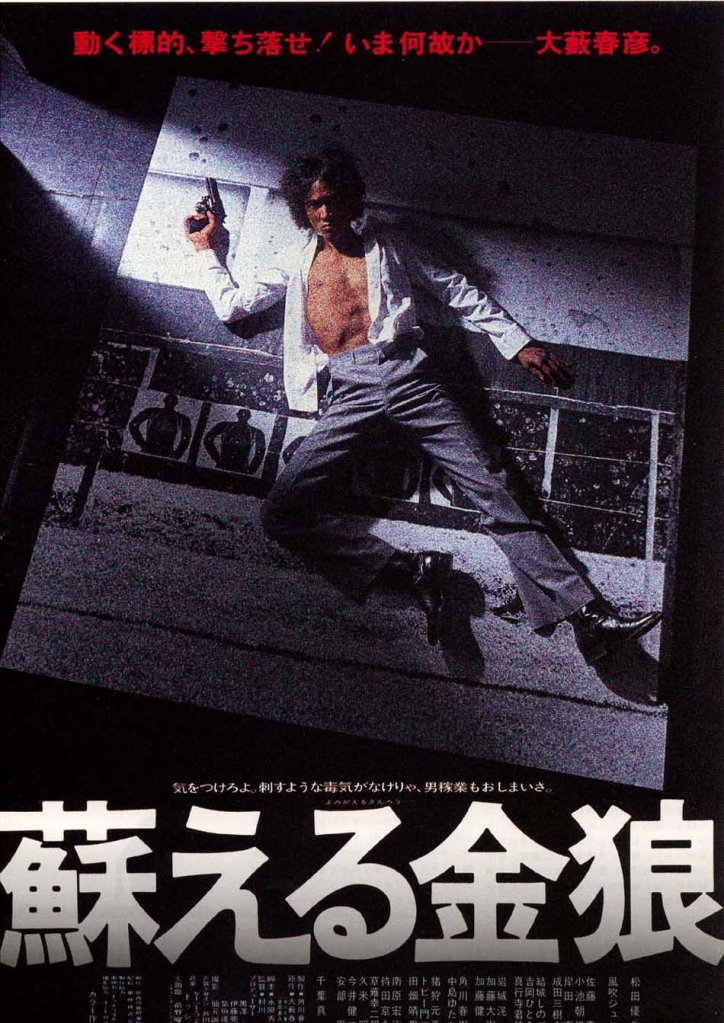
Resurrection of Golden Wolf (蘇る金狼, Toru Murakawa, 1979)

resurrection-golden-wolfYou know how it is. You work hard, make sacrifices and expect the system to reward you with advancement. The system, however, has its biases and none of them are in your favour. Watching the less well equipped leapfrog ahead by virtue of their privileges, it’s difficult not to lose heart. Asakura (Yusaku Matsuda), the (anti) hero of Toru Murakawa’s Resurrection of Golden Wolf (蘇る金狼, Yomigaeru Kinro), has had about all he can take of the dead end accountancy job he’s supposedly lucky to have despite his high school level education (even if it is topped up with night school qualifications). Resentful at the way the odds are always stacked against him, Asakura decides to take his revenge but quickly finds himself becoming embroiled in a series of ongoing corporate scandals.

Orchestrating a perfectly planned robbery on his own firm in which Asakura deprives his employers of a large amount money, he’s feeling kind of smug only to realise that the bank had a backup plan. The serial numbers of all of the missing money have been recorded meaning he can’t risk spending any of it. Accordingly he decides the “safest” thing to do is exchange the problematic currency for the equivalent in heroine. His plan doesn’t stop there, however. He also knows the big wigs at the top are engaged in a high level embezzlement scam and seduces his boss’ mistress, Kyoko (Jun Fubuki), for the inside track. Asakura is not the only game in town as another detective, Sakurai (Sonny Chiba), is blackmailing some of the other bosses over their extra-marital activities. Playing both sides off against each other, Asakura thinks he has the upper hand but just as he thinks he’s got what he wanted, he discovers perhaps there was something else he wanted more and it won’t wait for him any longer.

Based on a novel by hardboiled author Haruhiko Oyabu, Resurrection of Golden Wolf is another action vehicle for Matsuda at the height of his stardom. Re-teaming with Murakawa with whom he’d worked on some of his most famous roles including The Most Dangerous Game series, Matsuda begins to look beyond the tough guy in this socially conscious noir in which an angry young man rails against the system intent on penning him in. A mastermind genius, Asakura is leading a double life as a mild mannered accountancy clerk by day and violent punk by night, but he has every right to be angry. If his early speech to a colleague is to be believed, Asakura worked hard to get this job. A high school graduate with night school accreditation, he’s done well for himself, but despite his friend’s assurance that Asaukura is ahead in the promotion stakes he knows there’s a ceiling for someone with his background no matter how hard he works or how bright he is.

Under the terrible wig and unfashionable glasses he adopts for his work persona, Asakura has a mass of unruly, rebellious hair and a steely gaze hellbent on revenge against the hierarchical class system. He is not a good guy. Asakura’s tactics range from fisticuffs with street punks to molesting bar hostesses, date rape, and getting his (almost) girlfriend hooked on drugs as a means of control, not to mention the original cold blooded murder of the courier he stole the company’s money from in the first place. The fact he emerges as “hero” at all is only down to his refusal to accept the status quo and by his constant ability to stay one step ahead of everyone else. When the system itself is this corrupt, Asakura’s punkish rebellion begins to look attractive despite the unpleasantness of his actions.

Adding in surreal sequences where Asakura dances around his lair-like apartment in a quasi-religious ritual with his silver mask, plus bizarre editing choices, eerie music and incongruous flamenco, Murakawa’s neo-noir world is an increasingly odd one, even if not quite on the level of his next film, The Beast Must Die. Very much of its time and remaining within the upscale exploitation world, Resurrection of Golden Wolf is necessarily misogynistic as its female cast become merely pawns exchanged between men to express their own status. The tone remains hopelessly nihilistic as Asakura nears his goal of the appearance of a stereotypically successful life with an executive job and possible marriage to the boss’ daughter only to find his conviction wavering. Hopelessly bleak, dark, and sleazy, Resurrection of Golden Wolf is, nevertheless, a supreme exercise in style marrying Matsuda’s iconic image with innovative direction which is hard to beat even whilst swimming in some very murky waters.


Again, many variations on the English title but I’ve gone with Resurrection of Golden Wolf as that’s the one that appears on Kadokawa’s release of the 4K remaster blu-ray (Japanese subs only).

Original trailer (English subtitles)

The Man Who Left His Will on Film (東京戰争戦後秘話, Nagisa Oshima, 1970)

man-who-left-his-will-on-filmEvery story is a ghost story in a sense. In every photograph there’s a presence which cannot be seen but is always felt. The filmmaker is a phantom and an enigma, but can we understand the spirit from what we see? Whose viewpoint are seeing, and can we ever separate that subjective vision from the one we create for ourselves within our own minds? The Man Who Left his Will on Film (東京戰争戦後秘話, Tokyo Senso Sengo Hiwa) is an oblique examination of identity but more specifically how that identity is repurposed through cinema as cinema is repurposed as a political weapon.
The film begins with an anarchic scene in which two men argue over use of an 8mm Bolex camera. The man whose voice we can hear is angry with the cameraman who he claims has stolen his camera only to use it for “trivial” street scenes and landscapes whereas he needs it to “capture the struggle” by filming a nearby student protest. Eventually we can verify that there are two men as the protagonist, Motoki (Kazuo Goto), briefly moves in front of the camera in order to try and snatch it away from the filmmaker. The man holding the camera then runs off as breathless, handheld camera takes over. Motoki follows him and we follow Motoki as the scene takes on an ominous quality. The cameraman reappears atop a nearby building before plunging to his death camera in hand. Stunned, Motoki approaches the bloody scene and, noticing the camera is still intact, tries to retrieve it only to be picked up by the police who confiscate the camera as evidence.

Motoki then wakes up back at his left wing commune with his friends eager to know what happened. Strangely, they do not seem to be aware that one of their number has died and are more worried about the police being in control of one of their “means of production”. Even the dead man’s girlfriend, Yasuko (Emiko Iwasaki), begins to doubt the fact that he ever existed at all. Motoki and Yasuko begin investigating the mysterious presence together, chasing their elusive filmmaker and each taking possession of his form on more than one occasion but the question who owns these images, whose identity defines the narrative, proves an elliptical and ethical dilemma.

Oshima, evidently, was no right wing stooge but even if The Man who left His Will on Film takes the world of the student protests as its milieu, it does so to undermine them. Motoki’s comrades view filmmaking as a revolutionary act. They claim to turn the camera into a weapon by using it confront reality, but as Yasuko later admits much of this is a rationalisation which allows them to continue a “bourgeois” art form without abandoning their left wing principles. The cadre members spout marxist dogma and argue about who has the highest political consciousness, but all they ever do is film the ongoing struggle. Their fight is empty, their vision blank.

Notably, the first of several arguments over dogma relates to “ownership” of the camera itself and whether Motoki and another comrade fought hard enough to retrieve it from the oppressive state. Did Motoki chase after “his” camera, meaning he condones the idea of “private” property which is contrary to the communal nature of the group, or “their” camera which is a revolutionary tool? The camera itself is singular, but the group is plural. This commune is intended to work as a hive mind, the people as one with one vision and one identity but Oshima exposes this as an impossibility. The group is a collective of individuals with different ideas and opinions which do not necessarily conform to a common point of view.

This is further brought out when the camera is retrieved and revealed to contain a collection of seemingly apolitical landscapes and street scenes. The group members are quickly bored with the static shots of everyday subjects, some berating the filmmaker for his “bankrupt” politics and lack of artistry while others vow they must honour their comrade’s struggle by watching the film to its conclusion in order to derive the meaning. The unseen filmmaker has indeed left his “will” on film, not as a testament or embodiment of future policy, but his literal “will”. His individual spirit and vision are contained within the seemingly innocuous shots in a political act of revolutionary individualism. He is the film, the film is him.  His vision dominates, we must accept it or remake it as our own.

Motoki, constantly chasing shadows, attempts to remake the film in the mould of the original filmmaker but unexpectedly encounters aspects of his own life already existing within it. Yasuko’s approach is more proactive. She inserts herself into the film, makes her presence known and refuses to be invisible. She picks up the camera and fights for her place within the frame. Hers is the struggle of the true revolutionary filmmaker, imprinting herself and her vision onto the film.

Where does this leave us? We’re in the film too. We see the film and, in a sense, recreate it in our own minds, recasting ourselves as director and protagonist. We see the film subjectively yet we cannot divorce ourselves from the original vision. Motoki’s venture fails because he only sees the landscapes, whereas Yasuko takes the same images but repossesses them, remaking them in her own image in a true act of cinematic revolution. Yasuko has seized the means of production and overthrown the tyranny of anonymous images in refusing to be constrained by someone else’s will. The camera is a weapon, but it is we who choose what it sees, and in turn what it sees in us.


Original trailer (English subtitles, NSFW)

Belladonna of Sadness (哀しみのベラドンナ, Eiichi Yamamoto, 1973)

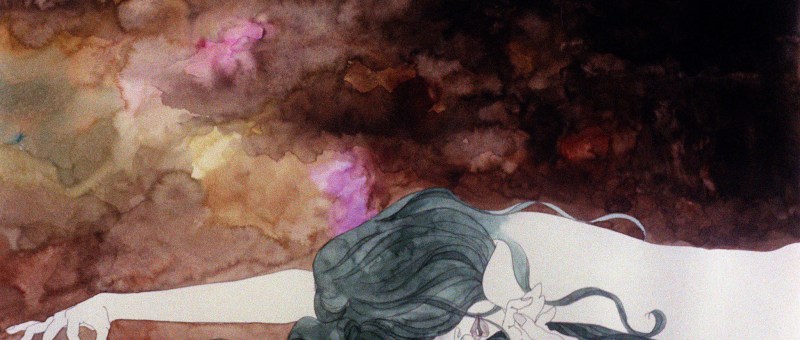
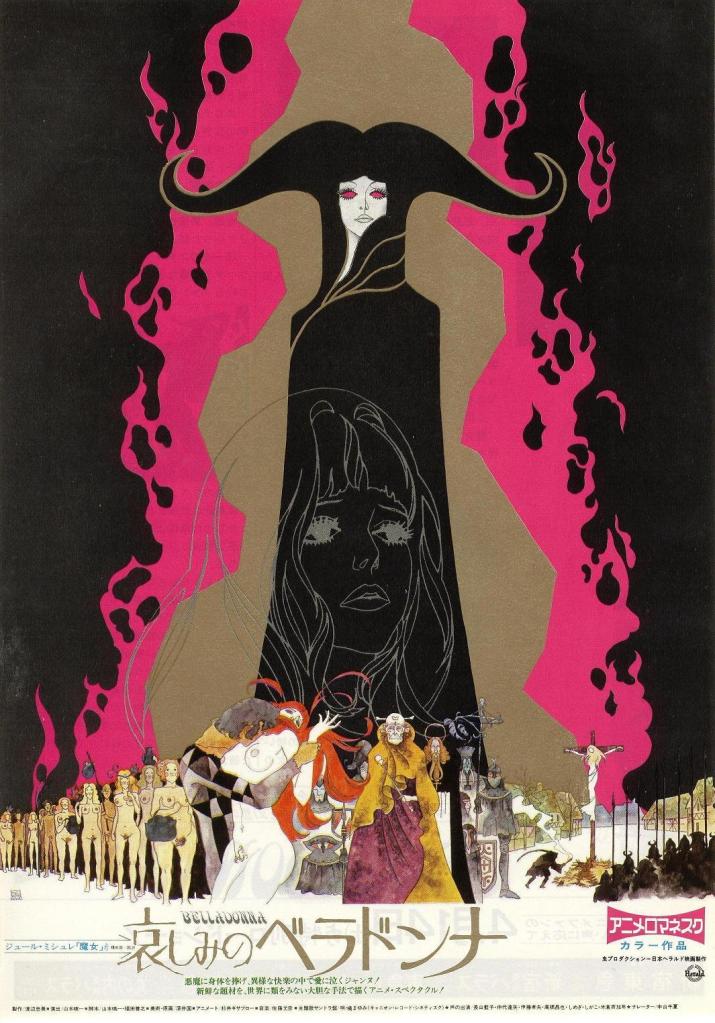
belladonnaLoosely based on Jules Michelet’s La Sorcière (Satanism and Witchcraft) which reframed the idea of the witch as a revolutionary opposition to the oppression of the feudalistic system and the intense religiosity of the Catholic church, Belladonna of Sadness (哀しみのベラドンナ, Kanashimi no Belladonna) was, shall we say, under appreciated at the time of its original release even being credited with the eventual bankruptcy of its production studio. Begun as the third in the Animerama trilogy of adult orientated animations produced by legendary manga artist Osamu Tezuka’s Mushi Productions, Belladonna of Sadness is the only one of the three with which Tezuka was not directly involved owing to having left the company to return to manga. Consequently the animation sheds his characteristic character designs for something more akin to Art Nouveau elegance mixed with countercultural psychedelia and pink film compositions. Feminist rape revenge fairytale or an exploitative exploration of the “demonic” nature of female sexuality and empowerment, Belladonna of Sadness is not an easily forgettable experience.

Beginning in true fairytale fashion with a gentle voiceover, the tale introduces us to Jean (Katsutaka Ito) and Jeanne (Aiko Nagayama), two ordinary medieval French peasants blissfully in love. Being the good, honest, Christian kids they are, they want to get married but as we’re told, this is the beginning of the story, not its end. Following tradition to the letter the pair turn up at the castle with their families to inform the Baron of their union and pay the marriage tax but the Baron takes a fancy to Jeanne and whacks up the price to a level Jean could never pay even if the entire village sold everything they had to help him, so that the Baron may exercise his droit du seigneur by claiming Jeanne’s maidenhead. After kicking everyone else out the Baron brutally rapes Jeanne before letting all of his cronies have a go too.

Finally crawling home bruised, broken, and violated Jeanne seeks comfort from her gentle husband Jean but despite his fine words, he is unable to accept what has happened and eventually retreats from her. At this point the weirdness begins as Jeanne’s intense inner rage and sadness summons forth a tiny demon friend who looks just like an overly friendly penis and also grows in size a little bit when you stroke him in just the right way. This starts Jeanne on her ultimate path towards becoming a master sorceress and eventual mistress of the devil himself. Jeanne’s fortunes rise in line with her sexual empowerment but an empowered female is not always popular with the ruling elite.

Jeanne’s empowerment and the subsequent threat it poses to the accepted political fabric is the main thrust of the narrative but it’s also important to remember that the process began with a brutal act of rape. Jeanne continues to be raped by her ever growing demon friend until achieving a kind of oneness with the Devil himself but the unwanted acts of Jeanne’s “demon”, who describes himself simply as a part of Jeanne, are mitigated because she is depicted as enjoying them (only guilt makes her say otherwise) and, after all, they form part of her sexual education. Jeanne’s power stems from the intense resentment she feels at her continued lack of agency, eventually buying her power and status enough to threaten the Baron and all he stands for.

Even if Jeanne’s power comes from the darkest of places, everything she uses it for is morally good (at least from a “modern” standpoint). When the Baron returns from a war to find Jeanne ruling the roost, he attempts to canvass some of his subjects hoping to hear tales of her cruelty or ineptitude but finds only praise. Jeanne heals the sick, helps a couple with too many children find a solution to maintain their married harmony without the risk of bearing any more, and even helps an elderly woman make contact with the depths of hell (wasn’t exactly what she had in mind, but she was thrilled to bits anyway).

The worst thing Jeanne’s power provokes is the large scale and extremely strange orgy which takes place in her hair, sees her copulating with the entire village, and even transforms genitals into bizarre creatures. This purely pleasurable exercise, even if against the prevailing moral code, has no real world consequences such as a failed harvest or ruined city brought about by the villager’s abandonment of duty for physical pleasure.

However filled with “goodness” her actions are, Jeanne herself is branded a witch and the only reason she is not burned at the stake immediately is that the Baron and his advisors fear that if Jeanne is burned whilst still bound to the devil, the demonic elements inside her will be set free and could “pollute” the other women in the village with a nasty desire to be taken seriously as people. This fear is later borne out as each of the village women emerges with Jeanne’s impassive face before time jumps on a few hundred years to the French Revolution and its vanguard of valiant women seeking social justice as evidenced by Eugène Delacroix’s 1830 painting Victory Leading the People which forms the final image of the film.

Belladonna of Sadness seems conflicted over whether this kind of empowerment is a good thing or not. Jeanne’s journey begins with violence which gives birth to rage and an eventual “succumbing” to the dark arts which facilitates her revenge. Everything about Jeanne becomes satanic and her sexuality is the weapon which she wields against male subjugation. The empowered Jeanne is independently monstrous, rather than just monstrous to the Baron and the true forces of evil, thanks to her involvement with illicit supernatural entities. Her independent spirit does indeed pollinate as the Baron feared it might, but whether these women are to be read as having been “freed” or as vengeful harpies robbing men of their rightful place whilst intent on upending the social order, might be a matter for debate.

Yamamoto opts for a mix of styles making great use of still paintings and more primitive animation to enhance the effect. Combined with the very contemporary sounding folk music, the later ventures into the realm of psychedelia lend the film a new age fable quality to present a broadly feminist rape revenge fairytale. However, this particular story offers no happy ending for its heroine even if it does retroactively add one in the form of the ongoing social change her various transgressions engender. Wildly experimental, often extremely beautiful, and necessarily explicit, Belladonna of Sadness is, as its name suggests, a melancholy tale but one just as passionately free as its tragic heroine.


Cinelicious Pics restoration trailer (English subtitles, NSFW)

Female Prisoner Scorpion: #701’s Grudge Song (女囚さそり 701号怨み節, Yasuharu Hasebe, 1973)

The saga seemed complete with the end of Beast Stable but inevitably Matsu returns in the bonus instalment, Female Prisoner Scorpion: #701’s Grudge Song (女囚さそり 701号怨み節, Joshu Sasori – 701 Go Urami Bushi). Original director of the series Shunya Ito agreed that the ballad of Matsu was sung through, and so Yasuharu Hasebe reteams with star Meiko Kaji after their previous collaborations on Retaliation and the Stray Cat Rock series during their time at Nikkatsu. Hasebe’s style is the polar opposite of Ito’s arthouse inspired painterly majesty and heavily favours the groovy, ‘70s youth inspired aesthetic he employed in the Stray Cat Rock series. Coming as it does after Ito’s genre rocking visual tour-de-force, Grudge Song can’t help feeling a little regressive and a reminder of what a considered cash grab this fourth instalment really is but that isn’t to deny the fact that it can prove an enjoyable, genre skewing, effort when considered in isolation.

The end of Beast Song told us that Female Prisoner Scorpion served her sentence, was released and disappeared into the ether like the legendary creature she was. However, Grudge Song provides another episode to her history and begins with Matsu (Meiko Kaji) being re-arrested by police during someone else’s wedding (you have to feel sorry for the happy couple – could the police not have done this outside at least?). She fights them off in grand fashion and manages to escape though is gravely injured and not able to run very far. Luckily she is found by a damaged former protester working at a cabaret club who helps her hide out from the police. Soon the pair enter into a kind of romance but it’s not long before Matsu has some names to add to that ever increasing grudge list.

Along with the change of director comes a slight refocusing. Both the original trilogy and this fourth instalment have definite political undercurrents but Grudge Song allows these to be more overt with its constant references to the student protests of the late ‘60s and ’70s as well as to police corruption and brutality. Matsu’s ally and sometime lover, Kudo (Masakazu Tamura), had been a prominent protester picked up and repeatedly tortured by police leaving him with both physical and mental scarring. Obviously distrustful of authority but also made fearful, Kudo has been keeping his head down until he finds a kindred spirit in Matsu and decides to fight back.

The enemy here is the police – as it was to a degree in some of the other films, but Matsu’s concerns are playing second fiddle to her male saviour’s psychological traumas. This is the first film where Matsu has any kind of male help, and she’s essentially in an assisting role as Kudo attempts to defend her from the police (her injuries meaning she can’t exert the same kind of preternatural power as in the other instalments). There may be a kind of spiritual connection between Matsu and Kudo but the fact that she trusts him so quickly is strange given her behaviour throughout the series, though perhaps she has little choice given her physical condition. This is also the first time where Matsu allows an innocent woman to be killed in front of her – ironically another victim of male violence whose life is lost through no fault of her own. The other Matsu would at least find this upsetting, but this new Matsu who’s now more of an accomplice to a borderline terrorist protest cell consisting of one male member, is entirely indifferent.

Though Hasebe mimics some of Ito’s cinematography notably in the opening and his iconography of “Scorpion”, he abandons his stylistic concerns in favour of something very much more directly contemporary. In keeping with his work on the very groovy, youth orientated Stray Cat Rock movies, Hasebe turns Female Prisoner Scorpion into a standard ‘70s exploitation pic complete with gratuitous lesbianism, nudity, and random violence. Zooms, whip pans, and anarchic camera action are accompanied by jazzy electric guitar and a stoner vibe that is designed to appeal to the youth of the day but appears hopelessly dated now unlike Ito’s approach which is still of its era but manages to take on a timeless quality. As an example of ‘70s exploration cinema, Grudge Song pays its dues but as a Female Prisoner Scorpion movie, it falls far short of its predecessors.

Grudge Song marked the last outing for Kaji as the titular Scorpion, though this Matsu is not the Matsu of the rest of the series. Hasebe doesn’t seem so attached to the cult of Scorpion and more or less reboots her for a fairly straightforward genre affair which lacks the subtle intelligence of Ito’s vision. Still, taken alone Grudge Song is not without its charms though it loses the feminist edge of the rest of the series and recasts its heroine as a bit player in a game of revenge against the authorities in the name of vengeance for the death of the student movement.


Original trailer (English subtitles, NSFW)

Female Prisoner Scorpion: Beast Stable (女囚さそり けもの部屋, Shunya Ito, 1973)

beast-stableAt the end of Female Prisoner Scorpion: Jailhouse 41, Matsu – the “Scorpion” of the title, had enacted parts of her revenge but lost even more friends and allies along the way. Still filled with an intense rage, she wandered away from her imprisonment towards the dawn and a free, if uncertain, future. It’s here we find her at the beginning of Beast Stable (女囚さそり けもの部屋, Joshu Sasori – Kemono Beya) – a fugitive from justice, but a seemingly calm one. Until, that is, she is cornered.

Beginning in an extremely memorable opening sequence, the film zooms in on Matsu riding a subway train like any other young woman when she gets spotted by a couple of policemen who decide to try and take her in. Whipping out her knife from under her coat, Matsu slashes away but is almost caught when one of the policeman handcuffs her. She reacts to this situation in a typically direct way by simply hacking the policeman’s arm off and running away with it.

Hiding out in a graveyard and gnawing at her macabre bracelet in an attempt to get it off, Matsu strikes up an improbable friendship with prostitute Yuki (Yayoi Watanabe). Yuki is harbouring a dark secret in that she keeps her brain damaged brother locked up in a back room where she is forced to satisfy his sexual urges lest he attack other women.

While working as a seamstress, Matsu becomes more and more involved with the underworld and its collection of pimps and madams, each eager to profit from the weakness and misfortune of others. Eventually, after becoming too much of a problem, Matsu is locked up again – but this time inside the birdcage of a dangerous and eccentric yakuza mama-san, Katsu (Reisen Lee), with the corpse of a less fortunate victim on the other side of the bars. New names are about to appear on Matsu’s ever growing grudge list as the wrongs done to others begin to outweigh the pain of those enacted on herself.

Beast Stable differs from the first two films in the series as it mostly takes place in the “free” world until it reenters the prison environment for the final stretch. Matsu may be out of jail but she’ll never be truly free and her intense inner rage might give her away if it weren’t for her the fact her face is plastered all over the city adorning wanted posters in every conceivable location. With no particular target for her vengeful spirit, Matsu is in survival mode but her growing alliance with Yuki and the cruelty of the underground sex industry quickly awaken her old fire.

This time the big bad is another woman – a cruel madam, willing to protect her investment to the max. When she finds out one of her girls has been hiding a pregnancy, she insists on an abortion even though the baby is six months or so along. Kicking and screaming, the pregnant woman is subjected to a horrific procedure conducted by a drunken doctor which is neatly contrasted with another abortion which is carried out with a much higher level of medical care. Needless to say, Matsu cannot let this one go and makes another of her daring and mysterious escapes to enact her revenge. As she leaves, she’s become a fury of vengeance once again – her face pixelated by the surgery window, shaving her of her identity.

Though more grounded in reality than Jailhouse 41, Beast Stable is still selling the ballad of Matsu as she continues her trajectory into legendary heroine status. Always playing a long game, Matsu has the uncanny ability to escape from any holding pen save the one that burns inside her mind. Having satisfied her personal desire for revenge, Matsu moves on to the cruelties of the wider world and those that bully and misuse already vulnerable people. Her sense of greater responsibility grows as her humanity begins to return through her friendship with Yuki which eventually becomes a deep alliance between two equally trapped women.

At the end of the film we’re told that Matsu served her prison sentence and was released, but no one knows what happened to her after that. Her apotheosis is complete as she becomes the legend – a wandering heroine, meeting out justice in a cruel and indifferent world. Kaji continues to excel in her performance of the near silent Matsu, burning with rage and resentment in every scene. Beast Stable would be Ito’s final contribution to the series and acts as a suitable conclusion to the trilogy as Matsu finally becomes Scorpion in our imaginations and, strangely, our hearts.


Original trailer (English subtitles)

Female Prisoner Scorpion: Jailhouse 41 (女囚さそり第41雑居房, Shunya Ito, 1972)

scorpion-2Female Prisoner Scorpion: Jailhouse 41 (女囚さそり第41雑居房, Joshu Sasori – Dai 41 Zakkyobo) picks up around a year after the end of Female Prisoner #701: Scorpion and finds Matsu (Meiko Kaji) tied up in a dingy prison basement, apparently left bound and in solitary confinement for the entire interval. Once again directed by Shunya Ito, the second instalment in the Female Prisoner Scorpion series is another foray into the women in prison field but Ito resolutely refuses to give in to the exploitative genre norms, overlaying his tale of individualistic rebellion with an arthouse sensibility that has a much wider scope than its ordinary vengeance driven narrative may suggest.

Matsu may have been lying bound and gagged in a dingy underground hole for the best part of a year but today is a special day and sadistic prison warden Goda (Fumio Watanabe) is going to let her out to be shown off in front of a visiting inspector who’s paying a final visit before Goda is promoted to a top job in Tokyo. When Matsu makes a lunge for Goda, the inspector is so afraid that he wets himself, sending the other woman into a frenzy and resulting in a riot. Once again the entirety of the prison is punished, but this time Matsu is singled out for a public punishment gang rape by Goda’s goons. This kind of humiliation is too much for her fellow prisoners who instantly turn on her, but their violence provides an opportunity for escape and before long Matsu is on the run, again.

At the end of the first film, Matsu had accomplished her first round of vengeance – against the man who orchestrated her downfall and the men who secured it, but ultimately she wound up a female prisoner once again. Though Goda may have had her hidden away because of her habitual escapism, Matsu had not given up as we see from her attempts to scrape the floor away with her spoon held tight in her mouth. Barely speaking, Matsu is an unstoppable column of pure rage but an elegant one, supported by her self contained restraint.

Her anger this time is directed towards Goda himself, especially after his despicable organised punishment rape that was designed both to break her own spirit once and for all and also to damage her in the eyes of her fellow inmates who are intended to see her defeated and destroyed. The guards are a stand in for society at large, using sexual dominance and social position to keep their women in line. The visiting prison inspector makes a point of telling Matsu that “they” don’t hate her personally – they’re there for her, to help her “recover” and become a functioning member of society. Which is ironic because Goda does hate her personally as he holds her responsible for the damage to his eye sustained in the previous film. His last act before moving on is one against Mastu – an attempt by the forces of authority to crush her individual rebellion and use their victory as a coercive tool to force others to conform.

In this way, Matsu’s position as a member of a subjugated class is less important than her status as an agitator but these are women who have each suffered at the hands of men. As an extremely theatrical sequence sung in the traditional form informs us, the women who escaped with Matsu committed their crimes out of love or jealousy. Poisoned rivals, dead lovers, even children murdered to get back at their philandering father in some Medea level psychotic rage which ruins the perpetrator even more than the intended victim.

Later while the women are enjoying their brief taste of freedom, one of them is brutally raped and murdered by a troupe of feral men who boast about the wartime atrocities they committed before descending on a lone woman like a pack of rabid dogs. The others take their revenge for their friend, but also for all the women who have met a similar fate inflicted by a male dominated society which sees them as something to be controlled and then made use of, little more that cattle hemmed in and milked until dry.

As in the first film Ito makes use of expressionist techniques and strange angles to give his film a more elevated feeling that might be expected but this time he adds in a surrealist, spiritual dimension as with the old woman who sings the stories of our heroines and then dies only to bury herself in leaves and disappear into the ether, like some forgotten deity of misused women. Likewise, when one of the prisoners is raped and murdered, the men throw her body into a nearby river like an empty beer can but the waterfall behind her suddenly runs with blood as an expression of the violence which pollutes the natural world. A bus suddenly splits in two, separating our subjugated women from the violent men who mentally sentence them, given free reign simply because of their sex. Ironically enough, our last glimpse of of Matsu takes place in the reflection of Goda’s glasses and then in his false eye when she is suddenly rejoined by her compatriots for a triumphant dance of freedom on a city rooftop.

Even stronger than in the original Female Prisoner #701 Scorpion, Jailhouse 41 further advances its ideology of free individuals battling the conformist authority of the state all filtered through the prism of the patriarchy. Matsu’s vengeance is personal, she keeps her distance from the other women who do not seem inclined to band together to oppose the forces which oppress them so much as seek a wary, temporary alliance of necessity, but seeing them all reassembled in spirit at the end brings a larger dimension to Matsu’s victory which now seems much less like solving a practical problem than a deliberate strike at a wall which was solely designed to keep a certain group of people in their place. The jail is broken, all that remains is to choose to escape its restraints.


Original trailer (English subtitles, NSFW/gore)

Female Prisoner #701: Scorpion (女囚701号/さそり, Shunya Ito, 1972)

scorpion-701

Meiko Kaji had already become a familiar face in Nikkatsu’s genre output when she took on the role that would come to define her career at only 25 years of age. Toei’s Female Prisoner #701: Scorpion (女囚701号/さそり, Joshu Nana-maru-ichi Go / Sasori) would launch a series of similarly themed films and create a national pop culture icon in its central character. Based on a manga by Toru Shinohara, Female Prisoner #701 Scorpion is, at heart, a women in prison film and a cornerstone of the pinky violence genre but first time director Shunya Ito has more on his mind than salacious thrills and offers up a noticeably nuanced approach to his material filled with impressive art house flourishes.

701 is the number printed on the back of the prison uniform worn by inmate Nami Matsushima (Meiko Kaji). She makes a valiant escape attempt with a fellow prisoner, Yuki (Yayoi Watanabe), but the pair are caught and put into solitary confinement where they experience torturous treatment both at the hands of the guards and their fellow prisoners. Mostly known as Matsu but also given the nickname of “Scorpion”, Prisoner #701 is not exactly popular with the other ladies in the joint who seem to resent her escape attempts and quiet dignity, annoyed by her above it all demeanour.

Matsu has just one mission in life – vengeance, on the man who wronged her, on the society that allowed her to be wronged, and on the prison system with its sadistic guards and turncoat inmates. Once an ordinary, law abiding woman, Matsu had the misfortune to fall in love with a vice cop who convinced her to go undercover in a yakuza club to get some vital info he needs to bust it. However, Sugima (Isao Natsuyagi) turns out to be the biggest crook of them all and was merely using her to try and take out the local yakuza to get in with a bigger yakuza boss and key into a slice of the drugs trade. Matsu is brutally gang raped after her cover is blown and ends up being sent to prison after making an attempt to ice her former lover with the desire to get out and complete her mission the only thing that’s keeping her going.

Ito begins with an ironic scene in which one of the prison guards is receiving a commendation for his honourable service, Japanese flag flying proudly behind above, until the occasion is interrupted by the escaped prisoner alarm. Later Ito puts the yakuza boss in a building bearing the large banner “Beautiful Soul and Harmony of Japan” and he even adds in an expressive moment as Matsu surrenders her virginity to Sugima, staining her white sheets with a large red circle. Society is corrupt everywhere from Sugima’s bent copper to gang raping yakuza and the prison system itself.

The guards are effectively running their own little empire, cut off from mainstream law enforcement and left to their own “corrective” impulses. Ito gives us salacious shower scenes and women being marched around in the nude but he places us in the place of a voyeur, making it plain that the prison guards are sating their lust for power through humiliating their charges in sexual dominance and violence. Divide and rule is the name of the game as a top tier of prisoners are “employed” in various prison tasks earning them a different colour uniform and a status bump. These ladies are even worse than some of the male guards and are responsible for much of the cruelty inflicted on Matsu and Yuki during their time in solitary.

Inter-prisoner conflict is not the central theme of the film as Matsu continues to plan for her eventual escape and revenge on the man who has ruined her life. A slight spanner is thrown in the works when an inside woman is recruited to take Matsu out, but Matsu is painted as a the ultimate vengeful warrior. Barely speaking (the bulk of her dialogue is actually voice over for her flashback scene), Matsu waits silently, observing and plotting. Biding her time she manages to take an extremely skilful and poetic revenge against her solitary abuser despite her hands and feet being bound, and when a police mole is placed in a cell with her Matsu sees through the ruse straight away. Seducing her new cellmate, Matsu neutralises the threat with ease maintaining her trademark intense elegance all the way through.

Though the synopsis smacks of cheap and nasty exploitation Ito doesn’t see it that way and films with an art house aesthetic rather than a salacious eye. Matsu’s flashback takes a very theatrical form with a rotating set and Matsu remaining present in the corner as she narrates. Her rape scene is grotesque and nightmarish, shot through a see-through floor as her attackers grin and gurn away at her like fairytale monsters. Likewise, when Matsu traps another prisoner in her own scheme, the woman turns into a classic ghost creature, face white and staring, broken glass firmly gripped manically in front. The acting style is broad and absurd. Policeman laugh loudly and for too long, blood is an artificial kind of red, gloopy like paint, and pantomimeish grotesquery is everywhere. Ito’s backgrounds are expressionist rather than realist but always perfectly pitched.

You can tell a lot about a place from the way it treats its prisoners and when its as bad as this, you start to wonder which side of the bars you’re really on. The guards are only a representation of a consistently exploitative society, but they can at least be outsmarted. “To be deceived is a woman’s crime”, says Matsu, but it’s one she fully intends to atone for – in blood, settling not just her own score but those of all her fellow prisoners caught in the patriarchal trap of hollow promises and abused honour.


Original trailer (English subtitles)

Oh Seagull, Have You Seen the Sparkling Ocean? : An Encounter (鴎よ、きらめく海を見たか めぐり逢い, Kenji Yoshida, 1975)

seagullSparkling seas sound like hopeful things, especially if you’re a majestic seagull flying far above, bathed in perpetual sunshine. But then, perhaps the water below is shining with the shards of broken hopes which float on its surface, is its beauty treacherous or in earnest? So asks the singer of the title song which recurs throughout the film as if to undercut even its brief moments of happiness. There is precious little joy to be found in the lives of the two protagonists of Oh Seagull, Have You Seen the Sparkling Ocean? : An Encounter (鴎よ、きらめく海を見たか めぐり逢い, Kamome yo, Kirameku Umi wo Mitaka: Meguriai), only pain and confusion as they try to rebuild their ruined lives in an uncaring city.

Katsuo is a drifting young man, one of the many to have escaped the mining industry after the pits began to close down but now finds only temporary manual work available to him. In Tokyo, he works as part of a window washing team, gazing into high rise office buildings which are a world away from his precarious hand to mouth existence. In one particular window he spots an office lady attempting to straighten her stockings in an otherwise empty room. Smitten he decides to pursue the woman though she is far from interested in a peeping tom of a window guy who’s coming on far too strong.

Kumi has her own problems. Like Katsuo she’s found herself in the city after escaping a life of poverty and the unwanted attentions of a relative in a fishing village. Her sights are set a little higher in the increasingly consumerist environment of ‘70s Tokyo, hence her high rise career and desire to find the right kind of husband. However, even here, she doesn’t seem able to get away from possessive men and is stalked by an ex-boyfriend who just won’t take no for an answer.

Eventually Kumi and Katsuo grow closer but on a visit to the beach come across an injured seagull which Kumi immediately tries to bury despite the fact it isn’t actually dead yet – better to die than live on in shame, says Kumi. Katsuo disagrees and decides to take it home and nurse it back to health though Kumi breaks up with him because of it. After a chance encounter the pair get back together but their fragile love story is under attack from every possible direction.

Katsuo and Kumi have each led difficult lives though they have very different ways of coping with trauma. Katuso has retreated into a fantasy world inspired by Gaugin’s famous painting Where do we come from? What are we? Where are we going?. When he first meets Kumi, all Katsuo can talk about is Resipuruko and how wonderful everything will be when he gets there. The speech exasperates Kumi who at first feels stupid for not having heard of Resipuruko, but then cheated to discover its just a made up place of the kind that children create out of fun. Nevertheless, Resipuruko continues to become a symbol in their lives, a place of hope and peace in which they would be able to live together freely and in comfort, away from the difficulties of everyday city life.

Katsuo is cheerful and optimistic. Not exactly forward looking but proceeding in the name of hope. Kumi is driven more by fear and resentment, constantly looking behind her rather than ahead. Though Katsuo’s life has not been easy, Kumi has experienced more suffering with less agency which has left her with far less capacity for making the best of things. Like Nina in Chekov’s play, she is the seagull – something beautiful, destroyed, just because it could be. Katsuo’s efforts to heal the wounded bird run in parallel to his desire to save Kumi but then, the seagull wants to be free and Kumi is forced to feel as if she never will be.

At one point Kumi says she and Katsuo are on different sides of an invisible window and it’s true that they’re opposites in many ways – he thrives on fantasy, she is destroyed by reality, but they could be perfectly happy together if it weren’t for the vagaries of fate.  Oh Seagull, Have You Seen the Sparkling Ocean? : An Encounter, is a tale of tragedy as young lives are ruined by time and circumstance, leaving them with only broken hearts to face the unfair world before them. Resipuruko exists only in a spiritual sense, but it can be called forth if you believe in it enough. Dreams are fragile things, whether realistic or fantastical, but they, like the seagull, deserve their time to fly unfettered.


Original trailer (no subtitles)

Aesthetics of a Bullet (鉄砲玉の美学, Sadao Nakajima, 1973)

aesthetics of a bullet1973 is the year the ninkyo eiga died. Or that is to say, staggered off into an alleyway clutching its stomach and vowing revenge whilst simultaneously seeking forgiveness from its beloved oyabun after being cruelly betrayed by the changing times! You might think it was Kinji Fukasaku who turned traitor and hammered the final nail into the coffin of Toei’s most popular genre, but Sadao Nakajima helped ram it home with the riotous explosion of proto-punk youth movie and jitsuroku-style naturalistic look at the pettiness and squalor inherent in the yakuza life – Aesthetics of a Bullet (鉄砲玉の美学, Teppodama no Bigaku). This tale of a small time loser playing the supercool big shot with no clue that he’s a sacrificial pawn in a much larger power struggle is one that has universal resonance despite the unpleasantness of its “hero”.

Kiyoshi Koike is a former chef with a gambling problem and a living room full of rabbits that he bought hoping to sell as pets but his sales patter could use some work and the business is not exactly taking off. Getting violent with his girlfriend after borrowing money from her to play mahjong and then getting annoyed when she doesn’t seem keen to lend him more to change his rabbit business into a dog business, Kiyoshi is at an impasse. So, when the local gangsters are looking for a patsy they can send into enemy territory as a “bullet” Kiyoshi’s name is high on the list. They need someone “hotblooded, must have daredevil courage, when he flips he should make a huge racket” – Kiyoshi more than fits the bill, and more to the point he has no idea what he’s doing.

Given a large amount of money and a gun, Kiyoshi gets a haircut and buys some fancy suits to play his part as a super cool gangster who doesn’t take any shit from anyone. He goes around telling everyone his name and gang affiliation very loudly, waving his pistol and acting like a big shot despite the fact he obviously has no name and no reputation. The plan is he fires his gun, gets killed, his gang swoop in for a gang war and wipe out the opposition. Only, when Kiyoshi gets too invested in his part and beats up a rival gangster, the local boss apologises and offers him a knife to make things even with the guy who just disrespected him…

If he fires his gun, it’s game over but what exactly is keeping his finger off the trigger – fear, or self preservation? Either way, Kiyoshi is way over his head in a game he never understood in the first place.

This is no ninkyo eiga. There’s no nobility here, these men are animals with no humanity let alone a pretence of honour. Kiyoshi is a loser, through and through, but once the gun is in his hand he transforms into something else. The gun becomes an extension of himself, a symbol of his new found gangster hero status. A fancy suit and a fire arm are handy props for a method actor but the performance only runs so deep, what is Kiyoshi now, a man, or a bullet?

Whatever he is, he’s no hero. In his untransformed state he violently beat his girlfriend whom he also forced to work as a prostitute, and even after getting the gun he witnesses a woman being gang raped yet appears to be more amused than anything else. He ends up getting into a fight with the other two guys waiting for their go and seems to feel heroic after the woman gets away but his intention was never to rescue her. Indeed, bumping into her again he makes a clumsy attempt at subtle blackmail though she gets a kind of revenge on him in the end. Even his “romantic” encounter with the glamorous former photo model girlfriend of the rival gang boss ends with a bizarre sex game in which he makes her get on all fours and bark like a dog.

When the time comes, Kiyoshi can’t contemplate the idea of returning to his old loser self and is fixated on reaching the peak of Kirishima which is said to be the place where the gods descended to Earth. When the bullet finally emerges, it heads in the wrong direction. Self inflicted wounds are the name of the game as an aesthetically pleasing, poetic end to this tragic story follows the only trajectory available for a classic yakuza fable.

After beginning with a montage of people sloppily eating junk food set against a proto-punk rock song dedicated to the idea of living the way you please and not letting anyone get in your way, the film contrasts the independent, non-conformist yakuza ideal of total freedom with Kiyoshi’s lowly status in an increasingly consumerist environment. The yakuza life would indeed prove a passport for a man like Kiyoshi to jump into the mainstream, but this fantasy world is one that cannot last and one way or another the curtain must fall on this expensive piece of advanced performance art.

Aesthetics of a Bullet has, like its hero, been abandoned on the roadside. Whereas the Battles Without Honour series has become a landmark of the yakuza genre, Aesthetics of a Bullet has never even received a home video release in Japan and has received barely a mention even the histories of ATG movies. This is surprising as its noir style and art house approach ought to have made it one of ATG’s more commercially viable releases even with its sleazy, nihilistic tone. Opting for a more naturalistic approach, Nakajima nevertheless breaks the action with expressionistic sequences as Kiyoshi fantasises a glorious death for himself, climaxes through gunshot, or remembers the student riots through a blue tinted sequence of still photographs. A complex yet beautifully made, genre infused character piece, Aesthetics of a Bullet is a long lost classic and one in urgent need of reappraisal.


Title sequence and first scene (unsubtitled)

The Music (音楽, Yasuzo Masumura, 1972)

The MusicIf the under seen yet massively influential director Yasuzo Masumura had one recurrent concern throughout his career, passion, and particularly female passion, is the axis around which much of his later work turns. Masumura might have begun with the refreshingly innocent love story Kisses, but later he dived deep into the depths of depravity in Blind Beast and of manipulation in Manji before cycling back around the intense freudian character study which is The Music (音楽, Ongaku) in 1972. Based on a novel by Yukio Mishima (Mishima and Masumura – a match made in heaven), The Music is the story of one woman’s corrupted sexuality caused by a series of inappropriate sexual encounters during her childhood.

The film begins with a symbolic title sequence in which a large pair of scissors opens and closes rhythmically before being superimposed over the body of a woman – Reiko, our protagonist. She has made an appointment with a psychiatrist because, she claims, she has strange symptoms including constant nausea which led her to believe she was pregnant though medical doctors can’t find the cause of her sickness. The other thing is she can’t hear music, she can hear voices and sound effects but if music starts playing it’s like she goes deaf. Her psychiatrist isn’t quite convinced by Reiko and can tell she’s misleading him.

Sure enough he asks her to come back and she admits not hearing music was a symbolic way of explaining that she derives no pleasure from sex. Her boyfriend is a good man and she loves him, she doesn’t think the problem is with him, but she simply feels nothing when he touches her and it’s causing a rift in the relationship. This is the “music” she was talking about and which will become a recurrent motif throughout the film. Later, Reiko finds that she is able to derive a kind of satisfaction from sexual acts with men who are either dying or impotent, but should they simply get better she again loses all interest in them.

As might be expected, the reasons for Reiko’s strange behaviour lie in her childhood. Her fascination with scissors derives from a game of rock paper scissors she once played with the boy to whom she was betrothed to marry when they came of age. Reiko is the only girl in the group and when she loses the boys suddenly declare she’ll have to have her “thing” cut off – only she’s a girl and never had one in the first place. This leaves her feeling disturbed, humiliated, and in some way inherently deficient. From this point on she develops a masculine sensibility symbolised by one side of the closing scissors which becomes her own “thing”, leaving her with a desire for both cutting and being cut.

We also discover that Reiko was assaulted at a young age and that she also experienced early sexual contact with a family member as well as witnessing her aunt engage in an inappropriate relationship which greatly disturbed her. In all, it’s not surprising that Reiko is experiencing such a degree of confusion given all of the traumatic events that have followed her since her youth. Involved in an obsessive, incestuous sexual relationship Reiko is unable to move on with a “normal” life until she addresses the true cause of all her problems.

The psychiatrist is wiley guy, he can spot a lie a mile off and he has Reiko’s number pretty quickly. Amusingly, she does our job for us of trying to diagnose herself with the obvious solutions that seems to emerge from the latest story she’s told, only for the doctor to remind her it’s not so simple and untrained people shouldn’t try to analyse themselves. This is a little ironic in some respects as a trained psychologist would probably give much of Mishima’s cod Freudianism short shrift, but it works well enough in the context of the film. Reiko is about as unreliable a narrator as it’s possible to find but it does seem at last that the truth has been uncovered and Reiko set free from her improper sexual desires.

There’s a degree of campness involved in The Music with its heavy atmosphere and overtly theatrical melodrama. Masumura films with a perverse eye, animating Reiko’s recollections like dreams complete with bizarre perspectives and symbolic imagery to complete his Freudian approach to filmmaking. The Music may not be his most accomplished work, but it is nevertheless interesting and a late career return to his most pressing concerns.


Unsubtitled trailer (NSFW):