Queen Bee (女王蜂, Kon Ichikawa, 1978)

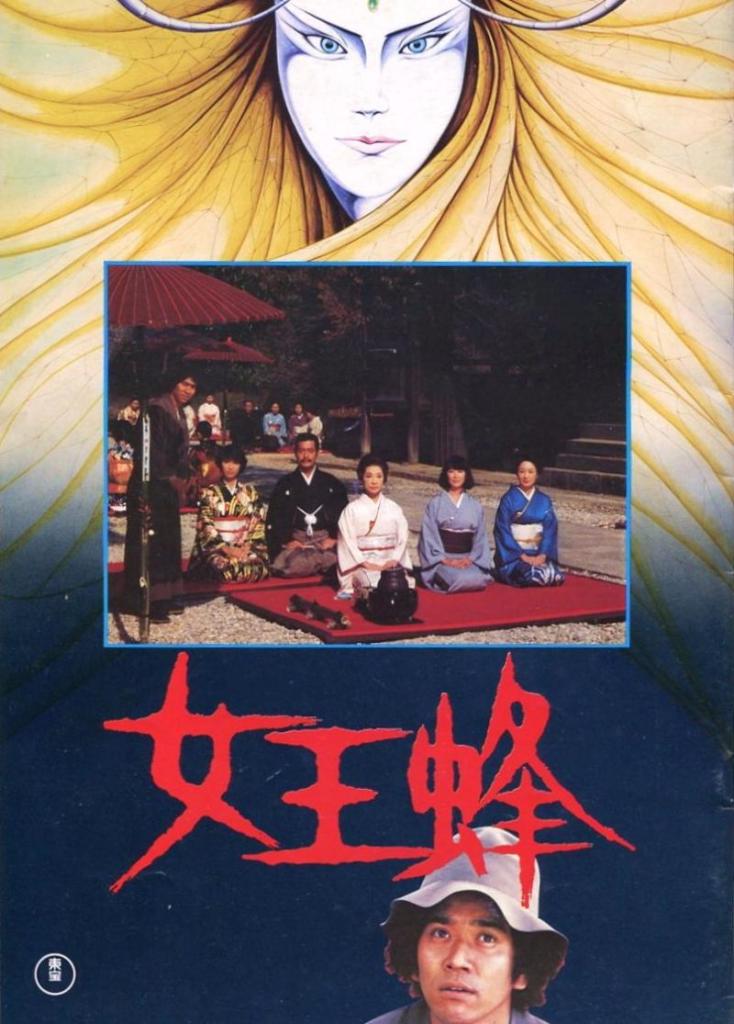
queen beeKon Ichikawa may be best remembered for his mid career work, particularly his war films The Burmese Harp and Fires on the Plain as well as his melodramas Ototo and Bonchi, but he was one of the few directors who was prepared to keep one foot in the commercial arena as well as making more personal, “artistic” efforts. For this reason he was able to go on working through the creatively dry ‘80s when other big name directors, in particular Akira Kurosawa, found themselves locked out of the cinematic arena in their native country. Ichikawa’s biggest box office success was in fact the literary adaptation of a popular mystery novel The Inugamis (which he actually remade in 1999 as his final feature film). 1978’s Queen Bee (女王蜂, Jooubachi) is one of five films that Ichikawa made based on the work of popular mystery writer Seishi Yokomizo which feature the eccentric detective Kousuke Kindaichi.

In many ways, Queen Bee is the perfect synthesis of European and Japanese mystery styles as it technically plays host to its strange detective but places him off centre, more as an onlooker to events than the protagonist. Though it follows something like a classical Agatha Christie approach, it also brings in the Japanese love of puzzles and the importance of long buried secrets bubbling to the surface and coming back to haunt everyone involved in the original incident. It’s also important to note that Ichikawa is deliberately playing up the camp comedy of the situation too as he makes his bumbling policeman a definite figure of fun as well as sending Kindaichi tumbling into a pond among other oddly comic elements for this multiple murder mystery.

The story itself begins in 1932 as two students, Hitoshi and Ginzo, leave a small town where they’ve been learning all about the local folklore. Hitoshi later returns under less than pleasant circumstances as he’s come to get his grandmother’s ring back after giving it to a local girl, Kotoe, whom he’d agreed to marry, only his mother objects so now he wants to hold off a bit. Unfortunately this is not a good idea as Kotoe is already pregnant with his child. Sometime later Hitoshi dies in mysterious circumstances and we flash forward to 1936 when the daughter, Tomoko, is three years old and Ginzo comes back to propose to Kotoe.

Now we fast forward to 1952 when Tomoko is about to turn 19. Kotoe has died, Tomoko has been adopted by Ginzo, and three folklore loving students have set their eyes on her as a bride. Unfortunately, one of these suitors also winds up getting killed with Tomoko the prime suspect and it looks like history may be about to repeat itself.

Queen Bee may be a more mainstream effort, but Ichikawa films in a noticeably anarchic fashion with extremely strange cuts and juxtapositions, not to mention the almost parodic tone of the film. He adopts a fairly perverse approach to the entire enterprise even allowing his veteran star Tatsuya Nakadai to play the 20 year old version of himself in the brief 1930s scenes which is, it has to be said, something of a mistake. As fine an actor as Nakadai is, playing a 20 year old at 50 is a stretch and one which serves as a point of alienation during the deepest historical layer of the film.

As is usual with Japanese mysteries, the plot relies on the solution of various puzzles, riddles and the mechanics of crime much more so than the human psychology and importance placed on motive that dominate Western detective tales. As well as the long buried secrets, Queen Bee brings in some commentary on the place of social class in the post-war world, the folly of misplaced love, and how the failure to act honestly and in the best interests of others by putting your own feelings aside can cause extreme repercussions not only in your own future but those of generations to come. Once again, only by exposing previously unexpressed emotions and lies both accidental and deliberate can the trauma be resolved and crises come to an end.

Queen Bee is a strange film which plays up its European detective novel atmosphere complete with the drawing room lecture that has become a hallmark of the genre but also adds in a layer of irony and an almost winking jokiness that make for an oddly amusing tone. The mystery element itself is satisfying enough to keep even the most seasoned crime fan guessing with plenty of red herrings and misinformation along the way. That said, Queen Bee is also very much of its time and perhaps fails to offer much more than an enjoyably old fashioned detective story, albeit one which is anchored by strong performances from its veteran cast.


Unsubtitled trailer:

The Iron Crown (鉄輪, Kaneto Shindo, 1972)

iron crownFemale sexuality often takes centre stage in the work of Kaneto Shindo but in the Iron Crown (鉄輪, Kanawa) it does so quite literally as he refracts a modern tale of marital infidelity through the mirror of ancient Noh theatre. Taking his queue from the Noh play of the same name, Shindo intercuts the story of a contemporary middle aged woman who finds herself betrayed and then abandoned by her selfish husband with the supernaturally tinged tale of a woman going mad in the Heian era.
The film begins in a theatrical sequence in which Shindo’s wife and muse Nobuko Otowa appears in traditional dress and declares that she going to pray at a shrine to request vengeance on the lying, cheating husband who’s ruined her life. As part of this, she asks to be turned into a vengeful demon so that she may properly enact her revenge. However, after a while Shindo interrupts the action to return to the contemporary era and a man and woman in bed who keep being disturbed nuisance phone calls which turn out to be from the man’s wife (also played by Otowa) standing in a phone box outside.

The husband and his mistress – a much younger, sexually liberated woman, are given no respite from the unsettling phone calls. Haunted by the unseen figure of the betrayed wife, the couple eventually attempt to move around to avoid her ending up in a strange, otherworldly hotel. They become convinced that the wife has followed them and is telephoning from within the hotel itself despite having been told that they are in fact the hotel’s only guests. In the final sequence of the Noh play, the wife, who is now a demon, finds herself unable to enact her revenge in the way that she would like but vows to await another chance though her demonic powers eventually desert her, leaving her as an invisible ghost with only her voice remaining.

Shindo operates on three interconnected layers each radiating from the original Noh play. First of all there’s the central contemporary story of the adulterous husband, his mistress and the betrayed wife which is intercut with scenes from the Noh play but this is divided too – into a “realistic” depiction as in the wife fleeing through the forest and of outwardly “theatrical” scenes in which the entire stage apparatus is visible with enclosed walls and the musicians seated to the side of the stage area.

In one sense, it’s true that the position of the Heian era wife in this instance in a much harder one to bear than that of her modern counterpart who faces less of the stigma of the divorced woman and probably does have much more possibility of rebuilding her life even if she has made large sacrifices and wasted her youth on an unworthy man. However, just in the Noh play the hurt and resentment born by the unnamed modern woman is enough to develop into a supernatural force in its own right which pursues the new couple not only through the direct means of her phone calls but even begins to haunt them causing a degree of hysterical paranoia in the quite cowardly husband who even starts to see the “ghost” of his wife standing accusingly before him.

The real and the dreamlike theatre of vengeance blur into each other becoming evermore indistinct. By the time the adulterous couple have arrived at the hotel they’ve already entered another realm. Though the real world pokes through occasionally, the hotel itself takes on an ethereal quality with its staff each wearing the white makeup of the Noh theatre and spouting strange, oddly straightforward dialogue. Yet the couple themselves don’t seem to be able to detect the oddness around them or even be able to tell it apart from that which is recognisably part of their world, so caught up are they in the guilt and torment brought about by the unseen presence of the abandoned wife.

Shindo adopts a complicated, experimental structure to explore what is at heart a simple idea – the timeless quality of a woman’s jealousy. Hell hath no fury like a woman scorned and even if not physically present, the spectre of the former wife becomes a disruptive force in the husband’s intentions of leaving her behind to pursue other opportunities with a younger woman. Fascinating yet elusive, The Iron Crown is perhaps best considered with a firm knowledge of the original Noh play in hand, yet its haunting imagery and experimental take on form make it an intriguing entry into Shindo’s diverse filmography.


Unsubtitled trailer:

The Assassination of Ryoma (竜馬暗殺, Kazuo Kuroki, 1974)

Ryoma AnsatsuSakamoto Ryoma is a legendary revolutionary of Japan’s Bakumatsu period which encompasses the chaos that ensued after Japan was forced open after centuries of self imposed isolation. Ryoma was a low level samurai from a small town who resented the unjust treated of the arrogant true samurai above him and skipped out on his clan without the proper permission to go study sword fighting in the city. After the arrival of the Americans and witnessing their far superior technologies, Ryoma was one of several men who became convinced that Japan needed to modernise quickly or become a slave to more advanced cultures. However, this was a turbulent era and there was general infighting among all factions and all sides and Ryoma was mysteriously assassinated in 1867 along with his friend and ally Nakaoka Shintaro.

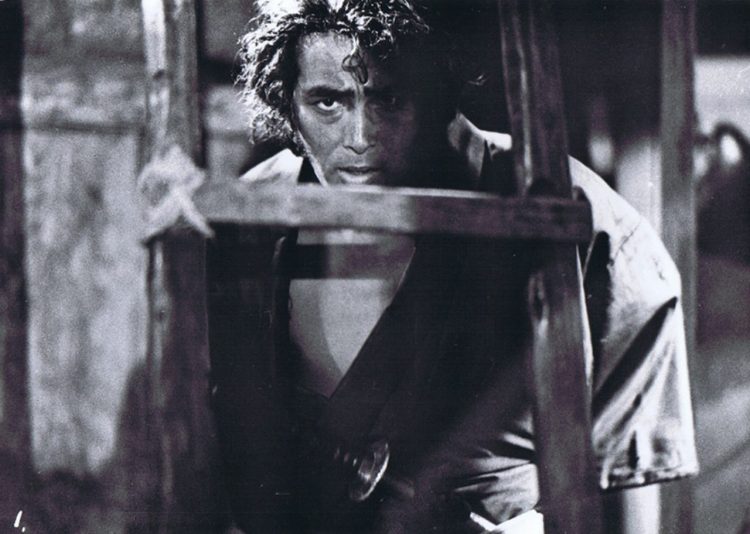
In thinking about the legacy of Sakamoto Ryoma, it’s important to try and separate the man from the legend. His legacy has become somewhat romanticised as his visionary ideas of a modernised Japan free of outside influence but also of outdated, feudalistic ideals have developed into an easily cop-opted set of talismans. Kuroki Kazuo’s 1974 film The Assassination of Ryoma (竜馬暗殺, Ryoma Ansatsu) attempts to place Ryoma firmly back within the mortal realm as it explores the events of his last days in late 1867 when he was brokering the new world from the shadows.

Played by Japan’s original ‘70s wild beast Harada Yoshio, this Ryoma is a slightly bumbling though thoughtful young man who likes to have a good time when he isn’t busy trying to overthrow the shogunate. An early scene sees him fiddling with a revolver which he claims is a better weapon to be in hiding with because it’s a little more portable and discreet than a traditional sword. However, he doesn’t quite know how to use it and can’t figure out how to make it fire in order to give his friend a demonstration. Later, having moved on slightly from his ideas of a peaceful revolution, his plan to buy a number of rifles backfires when he is sent a camera instead.

Ryoma is joined by two “allies” who both originally came in order to kill him but have apparently switched sides. The first is one of his oldest friends, Shintaro, who remained a member of a hard right revolutionary group in Ryoma’s home town which ran under the slogan “Revere the Emperor, Expel the Foreigners”. Understandably they haven’t taken too well to Ryoma’s change of heart regarding the modernisation of Japan and are committed to taking him out – hence dispatching Shintaro, though he proves reluctant to assassinate his friend. The other is a mysterious and largely silent assassin, Uta (played by Matsuda Yusaku), who also ends up forming an unlikely friendship with Ryoma which prevents him from carrying out his mission.

Kuroki shoots in black and white within a 4:3 frame and in gritty 16mm but also goes in handheld almost like newsreel footage shot by a frontline war correspondent. As well as using some silent cinema inspired compositional techniques, Kuroki also adds in a few intertitles either with historical information or to provide some additional commentary on the action such as when he tells us that violence from left wing samurai is a daily occurrence. Drawing a neat parallel between he chaos of the Bakumatsu era and its tussling between new and old, Kuroki leaves us with a sense of historical continuity by equating the left wing samurai rebellion of the 1860s with the left wing student moment of a whole century later.

However, Ryoma is just one man. In an enlightening metaphor about a cat who got stuck up a tree, Ryoma calls to it and tried to climb up to get the cat down but it just kept climbing higher and wouldn’t even take the mochi he tried to offer it on a stick. Eventually Ryoma wanted to cut the whole tree down in order to save the cat but everyone laughed at him – cut down a 10ft wide tree to save one skinny cat? At that time Ryoma laughed too but later it made him angry. He thought the idea of cutting down the tree should be allowed to be considered, that every option ought to be explored. The important thing is to see things from all angles and allow yourself the freedom to change your mind, reject all previous knowledge in the light of a new way of thinking. This kind of freedom is necessarily frightening and may lead others onto a path which you yourself do not wish to follow but all the same it is the very idea which gives birth to Ryoma’s entire philosophy.

Kuroki’s vision of this visionary hero is an unconventional one and one which was not universally accepted by the audience of the time. Just as radical as the man himself, Kuroki’s film portrays Ryoma as a modern revolutionary who lived a hundred years ago, yet wanted many of the same things that the youth of the day were still fighting for – personal freedom, equality for all, and a modern society which allowed his nation to stand independent, on an equal footing with its European counterparts. The assassination itself is brutal, bloody and efficient. It’s an uncinematic ending for a cinematic hero in which he’s violently cut down in a frenetic yet naturalistic fashion leaving a trail of polluting black blood spreading across the high contrast bright white background. His ideas were too radical for his era, and his tragic end a sadly predictable one but what does this say about the world of today and the would be revolutionaries whose voices appear to have been silenced?


(I’ve gone for surname first order here because that’s the most usual way of referring to historical figures – I accept that it’s confusing but it is at least consistant).

The life story of Sakamoto Ryoma has been dramatised many times, most recently as a Taiga drama, Ryomaden, directed by Rurouni Kenshin’s Ohtomo Keishi and starring Fukuyama Masaharu, which has apparently boosted Ryoma’s profile even more and created a raft of new tourist spots in various areas of Japan. (It’s obviously very long as it’s Taiga drama but is well worth the investment in time and effort.)

Unsubbed trailer:

The Classroom of Terror (暴力教室, Akihisa Okamoto, 1976)

classroom of terrorWhen the teachers are as corrupt as the students are disruptive, society is going to wind up with a complex set of problems. Classroom of Terror (暴力教室, Boryoku Kyoshitsu) is, in some ways exactly what it sounds like – delinquents! Sex, drugs, fighting! etc but also subverts these aspects of the bad teen movie by turning the camera right back on the adults who are perpetuating this world of unruly adolescents. An early entry for action star to be Yusaku Matsuda, Classroom of Terror sees him cast in a recognisably manly role though one with a greater degree of nobility.

Mizoguchi is a rookie teacher at an ordinary high school with a falling reputation. Behind his back, the established teachers are virtually taking bets on how long he’s going to last with this “difficult” class that’s giving everyone grief. However, Mizoguchi is a tough, generally cool kind of guy, and he’s able to stand up to this rambunctious group of teenage boys pretty well.

That said, there’s a subset of “bousouzoku” biker gang kids in the school which seems intent on dominating not just the other kids but the entire infrastructure of the academy too. Led by Kitajo, the “Sidewinders” wear identical leather jackets with a snake on the back and all have rockabilly hairstyles which match their Brando-esque The Wild One attitudes. Delinquent doesn’t quite cover their activities and Kitajo in particular is not above seducing the principle’s daughter as part of a blackmail plot or even revenge raping the younger sister of an opponent. However, the kids are not the bad guys here as there’s an even bigger scandal going on in the school’s administration department and the Sidewinders, with Mizoguchi’s help, might be the only way to stop it.

Classroom of Terror mixes a number of genres together and then buckles them onto a typical kids gone wild delinquent movie. In actuality it has more in common with a yakuza crime pic as it turns out Mizoguchi is more or less a stooge brought in by the powers at be to quell rebellion but then realises he’s been working for the “bad guys” and switches sides. The Sidewinders operate more like rival gang, the area’s underdogs who definitely aren’t “good guys” but might be better than the corrupt administration that’s currently in place.

Of course, these guys are just teenagers and this is a school, not the back streets of some shady part of town. Mizoguchi’s class is boys only and extremely disruptive – bombarding a female teacher with paper aeroplanes made out of their test papers, developing a zip wire system to pass each other porn and just generally refusing to conform to any kind of expected behaviour. Kitajo in particular is seen to be rebelling against all kinds of authority thanks to an oppressive home environment controlled by his strict and violent father. When the older generation is shown to be corrupt as in the plot to defraud the school of money at the expense of its pupils, it’s the duty of youth to rebel and their refusal to follow the path that has been set down for them is in no way surprising.

A typical ‘70s exploitation picture, Classroom of Terror displays all the genre’s hallmarks from the swooping handheld camera shots, whip pans and zooms to the funky soundtrack. However, it does also fall into the unpleasantness associated with the lower end of these kinds of films in its use of rape as a plot device which takes on an unsavoury and salacious quality though the scenes themselves are not particularly graphic. Likewise, there is a fair amount of explicit nudity in the first half of the film during the seduction plot of the teenage daughter of the principal which is played for all its worth. Though not as sleazy as other examples of films of this kind, Classroom of Terror has a necessarily male viewpoint which runs close to generalised misogyny.

Perhaps most notable for providing early leading roles for Matsuda and also for Hiroshi Tachi who plays the leader of the Sidewinders and was at that time the lead singer of a popular rock group, The Cools, Classroom of Terror is a fairly typical youth gone wild movie though one which attempts to justify youth rebellion by pointing out the oppressive and hypocritical actions of the older generation. That said, it’s never entirely on youth’s side and the boys are very definitely unpleasant and out of control. Though the use of rape as a tactic is not exactly supported, it isn’t condemned either, rather just accepted as something that happens – but happens to men, largely, who lose face when “their” women are “damaged” by their enemies. Unpleasant yet often exciting in execution, Classroom of Terror is an interesting mix of exploitation genres though one which perhaps leaves a sour taste in the mouth.


Unsubbed trailer:


Murder in the Doll House (乱れからくり, Susumu Kodama, 1979)

murder in the doll houseYusaku Matsuda was to adopt arguably his most famous role in 1979 – that of the unconventional private detective Shunsaku Kudo in the iconic television series Detective Story (unconnected with the film of the same name he made in 1983), but Murder in the Doll House (乱れからくり, Midare Karakuri) made the same year also sees him stepping into the shoes of a more conventional, literature inspired P.I.

Toshio Katsu has had a bad day at the bicycle races, almost losing his entire salary before thinking better of it and retuning his last betting slips to buy himself some ramen. Originally hoping to write detective thrillers, Toshio had studied literature at university but later dropped out fearing he had no real talent as a writer. Spotting an ad for jobs at a P.I. firm he thinks it’s worth a shot. When he arrives at the Udai detective agency he finds it’s just one tiny office led by former police woman Maiko Udai. Being short on help, she hires Toshio right away and puts him to work on her number one case – investigating some interfamilial conflict at a top toy company. However, when their target is killed during a car chase, Maiko and Toshio find themselves trapped inside a maze of complicated tricks and devious puzzles.

Matsuda plays it a little straighter here as an, admittedly laid back, master detective with a knack for always being in the right place at the right time. The case at hand concerns an elderly toy magnate and his factory which is run by his son Soji as the president and his nephew Tomohiro as the manager of production. As might be expected there’s a fair amount of conflict between the two men which is exacerbated by an incident in which a series of racing cars the company was due launch had to be pulled following safety concerns leading Soji and Tomohiro to hold each other responsible for the failure. The old man wants the detectives to keep an eye on Tomohiro in case he decides to launch some sort of coup but just about everyone is acting suspiciously in this weird mansion which was built as some kind of folly with hundreds of built in tricks like a lakeside woodland labyrinth and secret underground passages. Oh, and there might even be some hidden Edo era treasure too. Before long people start dropping dead in increasingly bizarre ways.

In the best traditions of Japanese mystery stories which place fiendishly elaborate plots at their centre, Murder at the Doll House more than succeeds as a classic detective story. We’re presented with a set of strange occurrences which our master sleuth will explain to us in a long lecture at the end and even if one or two twists are a little obvious, the satisfaction involved in having figured them out ahead of time outweighs any kind of disappointment. Toshio may say he wants to be like Philip Marlowe but in actuality his detective is a little more in the European mould – almost like a more active Poirot or a slightly less obtuse Sherlock Holmes. Still, donning a trench coat with a turned up collar yet eschewing the classic hat which would have obscured his giant ‘70s perm, Matsuda once again turns in a very “cool” performance as super smart private eye.

Welcome to the Doll House isn’t quite as action packed as some of Matsuda’s other roles from this era even if it does have a genuinely thrilling finale. Making up for physical excitement with a more cerebral approach which mixes in a few horror tropes with the creepiness of the old house and “murder by doll” scenario, Murder at the Doll House makes for an enjoyably strange mystery adventure which also adds in a little quirky humour along the way for good measure.


Based on the novel by Tsumao Awasaka (not currently available in English).

Matsuda does some detecting (unsubtitled)


The Teahouse (成記茶樓, Kuei Chih-Hung, 1974)

TheTeaHouse+1974-248-bWhere oh where are the put upon citizens of martial arts movies supposed to grab a quiet cup of tea and some dim sum? Definitely not at Boss Cheng’s teahouse as all hell is about to break loose in there when it becomes the centre of a turf war in gloomy director Kuei Chih-Hung’s social minded modern day kung-fu movie The Teahouse (成記茶樓, Cheng Ji Cha Lou).

Wang Cheng runs a small teahouse which prides itself on being the kind of progressive environment where everyone looks after each other as long as they play by the rules. Unfortunately, one of his young guys – Blackie, fresh off the boat from the mainland, has got himself into bad company and into trouble with the law. However, as he’s a minor, he gets off with barely any punishment at all. Cheng tells him he can stay at the teahouse only if he pays properly for his crime leading him to try and get himself arrested all over again so he can go to jail (which actually proves very difficult).

Another unfortunate side effect of Blackie’s adventure is that it brings some unwanted gangster attention and when two young thugs come looking for one of the waitresses, Boss Cheng is not going to stand for any nonsense. However, after his attempts to help the girl have failed, he finds himself in trouble with two different sets of gangsters and also a meddling police inspector who seems intent on using the teahouse to trap the triads.

Boss Cheng is a good and decent man but also someone with his own opinions on justice who is not afraid to take matters into his own hands. His rules for workers at the teahouse emphasise obeying the law and behaving like responsible citizens, but he’s not above carrying out a little corrective action of his own if the need arises.

The biggest theme of the film is the rising inequality and place of migrants from the mainland in contemporary Hong Kong society but the first target Kuei has his sights set on is out of control youth. Because of the lenient laws regarding child criminality, the young men of Hong Kong run rampant, safe in the knowledge that nothing is going to happen to them while they remain under the age of responsibility. The two gangsters accused of raping and attempting to force the teenage waitress at the teahouse into prostitution give their ages as 14 and 15 respectively to the trial judge and are released without charge to go back to their life of crime with impunity and no respect for the law or conventional morality. Sadly, this system just creates another child criminal but one who will receive a jail sentence even if a lighter one to be served in a reform school rather than a prison.

Blackie was seduced into crime by a lack of funds – having managed to make it over from the mainland he has nothing other than his job at the teahouse and the support of Boss Cheng. One day a ragged looking little boy leading his sister by the hand wanders into the teahouse to beg for food. It turns out his small family escaped from the mainland too but his father never made it to Hong Kong and his mother is ill, leaving the children to try and fend for themselves. Boss Cheng takes pity on them and gives the boy a job plus paying for his school fees but he still finds himself beaten up by thugs not much older than himself in the street.

All the while, corrupt fat cats are messing with the system to keep the poor in their place while the rich get richer. Cheng takes great pleasure in playing off a corrupt industrialist who tried to use him as a sacrificial pawn in his own war against the triads (well, the triads he doesn’t like, anyway). Amusingly, one of the triad bosses seems to think Cheng is also a brother forcing him to pretend to know all about triad rituals to attempt to make a truce with them. The teahouse is situated right between the territories of two rival gangs making it a prime spot for conflict. However, the real problem comes when the police start muscling in, giving off the impression that Cheng has turned traitor on the triads. Soon, Cheng becomes the single biggest threat to his own teahouse and the progressive environment he hoped it would foster.

The Teahouse is actually a little ahead of its time concentrating not on kung fu or street fighting but mixing in a little gun play and some bloody knife crime. The shooting style is impressive throughout with a realistic, gritty atmosphere which aims to put the real streets on screen. The film does, however, have a tendency to fall into an episodic rhythm and suffers from its abrupt and slightly odd, downbeat ending which finishes things on an unsatisfying note. That said, The Teahouse is a stylishly shot and socially engaged action extravaganza that makes up for its minor shortcomings with a degree of chutzpah which looks forward to the classic heroic bloodshed movies of the ‘80s.


Seen as part of HOME’s CRIME: Hong Kong Style touring season.

Unsubtitled trailer (Mandarin):


No Grave for Us (俺達に墓はない, Yukihiro Sawada, 1979)

No Grave for Us posterThough he might not exactly be a household name outside of Japan, the late Yusaku Matsuda was one of the most important mainstream stars of the ‘70s and ‘80s. Had he not died at the tragically young age of 40 after refusing chemotherapy for bladder cancer to star in what would become his final film, Ridley Scott’s Black Rain, he’d undoubtedly have continued to move on from the action genre in which he’d made his name. No Grave For Us (俺達に墓はない, Oretachi ni Haka wa Nai) is fairly typical of the kinds of films he was making in the late ‘70s as he once again plays a cool, streetwise hoodlum mixed up in a crazy crime world where no one can be trusted.

The film begins with a humorous incident in which a man sets fire to a small parcel in the ladies’ area of a department store and loudly starts shouting about a bomb before using the resulting panic and chaos to calmly extract the money from the nearby tills. His plan is going perfectly except for one cashier who’s rooted to the spot, confused by the rat who lives under the counter who isn’t perturbed by the presence of a “bomb”. Shima makes off with his money and starts planning a new job which he plans to carry out with his longtime friend and brother in arms Ishikawa. The pair carry out a robbery on a rival gang but an ex-yakuza, Takita, tries to make off with the loot. Shima and Takita bond and agree to split the money but Ishikawa gets captured and subjected to humiliating treatment by the gangsters. The intrusion of Takita and of the resurfacing problematic shopgirl, Michi, slowly drive a wedge between the previously inseparable Shima and Ishikawa.

No Grave for Us is, as the title suggests, a noir inflected B-movie in which the lowlife punk Shima contends with the various trials and tribulations associated with a life of petty crime. Child of an uncaring society, he’s been in and out of trouble since adolescence. He met Ishikawa when the pair were both in reform school together, Shima for assault and Ishikawa for drug related offences. Shima is not a drug user and seems to disapprove of his friend’s habit but makes no great protest against it. When Michi turns up at Ishikawa’s bar (just by coincidence) she’s lost her job at the department store after being accused of taking the money that Shima stole. It turns out that she too is a junkie and has been living a life of dissipation since being picked up for prostitution during middle school. She fits right in with Shima and Ishikawa but, predictably, begins to prefer the more assured Shima to the loose cannon Ishikawa which begins to present something of a problem for the pair.

Shima and Takita originally reach an understanding based on a gangster code of honour which they both understand. Ishikawa aside, the pair would make a good team but their growing comradeship only adds to Ishikawa’s sense of insecurity causing him to take matters into his own hands with fairly disastrous consequences. A misunderstanding makes Takita and Shima mortal enemies putting an end to any kind of alliance that might have been possible. There’s no comradeship here, no true friendship. Every relationship is a possible betrayal waiting to take place, every warmth a weakness.

Director Yukihiro Sawada had mostly worked in Nikkatsu’s Roman Porno line other than co-helming Sogo Ishii’s first feature, Panic High School, the previous year but No Grave for Us is refreshingly light on exploitative content. There is some brief nudity but nothing particularly out of keeping for a regular studio picture of the time. Likewise, the fights are of a more realistic nature and bloodshed kept to a minimum. The look of the film is also very typical of its era though Sawada only rarely uses the extreme zooms which are the hallmark of ‘70s cinema opting for a more straightforward, often static, approach. The film’s jazz inspired score also helps to bring out its noir undertones as these three guys who could have been allies find themselves turning on each other for the most trivial of reasons.

In many ways there’s nothing particularly special about No Grave for Us save for being an excellent example of mainstream action cinema in the late ‘70s. The film is full of knowing references to other recent genre hits as well as popular culture of the time including a lengthy tribute to top idol group Pink Lady whose song Zipangu also features on the soundtrack, and has an all round “cool” sensibility to it that was no doubt very popular at the time of its original release. An enjoyable enough genre effort, No Grave for Us is an impressively handled slice of late ‘70s noir inspired B-movie action but perhaps has little else to recommend it.


Unsubtitled trailer:

and a clip of Pink Lady performing Zipangu, just because


The Pilferer’s Progress (发钱寒, John Woo, 1977)

Money CrazyJohn Woo is best known in the West for his “heroic bloodshed” movies from the ‘80s in which melancholy tough guys shoot bullets at each other in beautiful ways. However, he had a long and varied career even before which began with Shaw Brothers and a stint in traditional martial arts movies. What often gets over looked outside of Woo’s native Hong Kong is his many comedies, of which The Pilferer’s Progress (AKA Money Crazy, 发钱寒, Fa Qian Han) is one of his most successful.

The plot follows the comic adventures of two down on their luck hoodlums – would be bodyguard Poison (Ricky Hui) and “private detective” Dragon (Richard Ng Yiu hon), who keep running into each other so many times that they eventually end up having to become a team. After each becoming involved with the greedy business man Rich Chan (Cheung Ying), the two find themselves lusting after a set of three diamonds which he has in his possession. Their desire only grows after meeting Mary (Angie Chiu) and her godfather to whom the diamonds originally belonged before Chan cheated him out of them.

Love trumps money, at least for a while, as Poison and Dragon team up to get revenge on Chan and get the diamonds back for Mary. Of course, more personal concerns end up raising their heads towards the end as the duo realise that if they just give the diamonds back to Mary it might buy them some brownie points but they’ll be quite massively out of pocket. They come up with a suitably anarchic solution that involves dummies holding guns and a motorbike cleverly concealed inside a haystack not to mention a fake broken arm (unsurprisingly it doesn’t go quite as smoothly as they’d hoped).

Much more slapstick buddy comedy than crime thriller, The Pilferer’s Progress is full of innovative sight gags and the fast paced Cantonese wordplay that has become a hallmark of the genre. Neither Poison nor Dragon are born criminal masterminds, they’re both just muddling through with a kind of anarchic insouciance that lends their exploits a gleefully childish quality even when Dragon is doing something as shady as indulging in a bit of analogue photoshop to fabricate a picture of Chan with a mistress so he can blackmail him. Poison’s number one manoeuvre is to get a gang together to pretend to attack his target so he can pretend to fight them all off in the hope that the “victim” will be so grateful and impressed with his martial arts skills that he’ll take him on as a bodyguard.

Dragon seems to be an avid watcher of modern spy movies and has a host of fairly useless gadgets he can use to try and get the drop on Chan such as bugging his car (Poison puts the bug on the exhaust pipe), or drilling a hole from the kitchen below right into Chan’s toilet and sticking a periscope up there to scout out the room. Chan also has a fairly elaborate security system that he mostly uses to annoy his wife but Poison and Dragon get round it by drilling another, bigger hole in the ceiling and pulling a Mission Impossible style rope manoeuvre to try and grab the diamonds from around Chan’s neck while he’s asleep. Because he’s thought of everything, Dragon even pulls out a tiny umbrella and hangs it from his nose to catch the increasing stream of sweat falling from his brow in one of the film’s funniest moments.

Woo also mixes quite a lot of exciting kung-fu action with the pure comedy as Chan’s second bodyguard is a recently graduated shaolin monk who’s pretty much invincible – to normal people, but somehow Dragon and Poison manage to outsmart him every time. There’s also a fair amount of the gunplay that was to become Woo’s signature but there are no balletic sequences here – the guns look ridiculously fake, almost like children’s toys, and are always the “butt” of the joke, literally.

The Pilferer’s Progress may not be a great lost classic but it is heaps of period specific fun with an extremely catchy soundtrack including the title song sung by star Ricky Hui. Extraordinarily successful on its original release, The Pilferer’s Progress is undoubtedly very much of its time, as perhaps it was intended to be, but its fast paced, silly slapstick humour has a universal quality that proves that true comedy has no sell by date.


Seen as part of HOME’s CRIME: Hong Kong Style touring season.


Attack! Hakata Street Gang (突撃!博多愚連隊, Sogo Ishii, 1978)

hakataSogo Ishii (now Gakuryu Ishii) was one of the foremost filmmakers in Japan’s punk movement of the late ‘70s and ‘80s though his later work drifted further away from his youthful subculture roots. Perhaps best known for his absurdist look at modern middle class society in The Crazy Family or his noisy musical epics Crazy Thunder Road and Burst City, Ishii’s first feature length film is a quieter, if no less energetic, effort.

Like his other films from the period, Attack! Hakata Street Gang (突撃!博多愚連隊, Totsugeki! Hakata Gurentai) is fairly light on actual plot but broadly follows a group of low level street punks who get themselves into trouble after accidentally shooting the son of a yakuza boss in the leg and leaving him to bleed to death. In trouble with both the law and the gangs the guys find themselves in the midst of a turf war they are ill equipped to handle.

Very clearly an early effort, Attack! Hakata Street Gang is an ultra low budget production filmed on the real streets starring Ishii’s friends rather than professional actors. It can’t claim to any level of aesthetic beauty and, in truth, is not particularly interesting in terms of look or style but is filled with Ishii’s characteristic energy and runs fast even given its brief 67 minute run time.

Generally, Ishii sticks to a naturalistic representation of the street punk world. Taking his cue from the realistic action genre pioneered by Fukasaku et al not long before the film’s release, Ishii employs a similar approach to the fight scenes shooting from the middle of the action and often from low angles. Full of handheld camera and shakey, unfocused shots Attack! Hakata Street Gang is filled with the kind of youthful freshness that was very in vogue at the time.

Ishii does not appear to want to offer any kind of critique of this extremely masculine, violent world but solely to capture it on film. The street punks themselves are not particularly well drawn but there is a notably strange set of characters including an ultranationalist and his younger brother with learning difficulties who wears an SS helmet and rides around on a pushbike with a large nazi flag flying on the back. Nicknamed “manji” (the word for the Japanese “swastika”) the boy is obsessed with warfare and dangerously gets hold of one of the guns his older brother has adapted from a toy to be able to fire real bullets. He’s more of a plot point than anything else but still offers a convincingly weird sample of modern street life.

Also in keeping with the recent brand of cool action dramas, the film has an energetic score which is perhaps more jazz fusion or blues rock than outright punk which gives it more of a nihilistic, sophisticated tone than the full on noise explosion of some of Ishii’s later efforts. By the time the guys have taken their final stand by capturing hostages and occupying the local kindergarten (literally kids with guns) it’s pretty clear that there is no way back for this collection of down and out street rats.

Perhaps more interesting as an early work of a master than in its own right, Attack! Hakata Street Gang is an energetic and youthful exploration of a little seen late 1970s subculture. Literally playing fast and loose, Ishii’s debut is in many ways a statement of intent and none the worse for it.


Trailer for the Sogo Ishii The Punk Years 1976 – 1983 box which includes this film (though unfortunatly does not include any subtitles).


Throw Away Your Books, Rally in the Streets (書を捨てよ町へ出よう, Shuji Terayama, 1971)

throw away your booksCaught in a moment of transition in more ways than one, Throw Away Your Books, Rally in the Streets (書を捨てよ町へ出よう, Sho o Suteyo Machi e Deyo) is a clarion call to apathetic youth in the dying days of ‘60s youthful rebellion. Neatly bridging the gap between post-war avant-garde and the punk cinema of the ‘70s and ‘80s, Terayama experiments gleefully with a psychedelic, surreal rock musical which is first and foremost a sensory rather than a cerebral experience.

The film opens with an uncomfortably long black screen which has a subtle soundscape running behind it. Just when you begin to think there’s something wrong with the video, a young man dressed in a trench coat (collar turned up) appears and berates our idiocy for haven fallen for the trick. What are we doing here, sitting in a dark room waiting for something to happen when the real action is, and always has been, out in the streets? We’re trapped in here – we’re the ones inside the screen, the boy is free to smoke and we are free only to watch him do it.

It becomes clear that we are also trapped within the realm of his unrealisable dreams. He worked at a factory but he didn’t like it so he quit. He wanted to be a boxer but it frightened him so he gave up. He hears a story of a Korean boy who built a glider and tried to fly home on his own only to crash somewhere over the ocean. He envies the moments of blue skies the Korean boy flew through as the brief fulfilment of a dream. From this point on he builds a glider in his mind but is perpetually unable to launch finally seeing it too go up in flames.

The boy says he comes from a dead end place where he lives with his unemployed father, needy grandmother and younger sister whose attachment to her pet rabbit is beginning to raise eyebrows. He finds another outlet for his youthful masculinity in the local football team (football is the most manly because the ball is bigger) where an older brother substitute tries to introduce him to the better things in life including sending him to a local prostitute to “make him a man” and teaching him about “sophisticated” western dining and marxist discourse. Throughout all of this the boy remains alone, perpetually observing from the outside but never successfully finding his way in. There’s a repeated riddle – what has one way in and two ways out? We expect an answer that carries some profound weight about the nature of human existence but, no, after all it’s just a pair of trousers.

Terayama travels from black to white – beginning with the bleak opening which is all darkness and silence, he takes us to an ending of blinding white light and the eclipse that will come to us all. The boy tells us the the film will be over soon and no one will remember him – that’s all that’s left to show, a blank white screen and the images of men who will shortly disappear. However, this is not the end though we see the white screen interrupt us a few more times, the boy has another monologue in which he tells us how the film has consumed him so that the lines between reality and fantasy have become indistinguishable. The film crew have become his family, the actor playing his father is, in a sense, his father, the 28 day shoot has become an entire universe which lives and dies inside the film. A film is something which only lives in the dark, when we flick on the lights, the magic is broken and it dies.

The boy says he loved this world but does not love the cinema yet the film is rife with cinematic references and Terayama is always careful to remind us we’re watching a film by deliberately making us aware of the camera. He calls out Polanski, Oshima, and Antonioni by name and even sings a love song to Ken Takakura as well as pledging his devotion to female leading yakuza actress Junko Fuji. Yet the world of the film is totally its own encompassing proto-punk rock songs, surrealistic imagery and inserted street art quoting artists and dreamers including the Russian futurist poet Mayakovsky. As in his other work Terayama also employs Godard style colour filters from the violent green of the boy’s family life to the standard colouring of the football club and the purple tinged insert scene in which a group of hopefuls read out classified ads featuring men seeking men, missing wives and mothers, and finally a couple of obvious scams.

Way ahead of its time and successfully anticipating the anarchic pop-punk movement which was to come some years later Terayama’s youthful masterpiece remains one of the most important if inscrutable films of the era. Sadly, Terayama died at the young age of 47 in 1983 walking into his own blank white screen but even in this first feature length effort he imprinted all the pain and rage of his times into a story of a young man lost and confused in the modern consumerist era. It calls on youth to awaken, go out into the streets and do something, anything, but also has little faith that it will. We’ll go on watching Ken Takakura to feel like a tough guy before going back to being vaguely disappointed with our circumstances but doing nothing much of anything at all about it. We too, live only in the film, inside the dream, until the screen burns white and our dreams dissolve with it.


This trailer was created for a specific film screening (The North Star Ballroom is where the screening took place) but does have subtitles. It’s a little NSFW though, be warned.