Woods Are Wet (女地獄 森は濡れた, Tatsumi Kumashiro, 1973)

As long as people live honest lives, eventually good things will happen to them, according to the sinister mistress at the centre of Takumi Kumashiro’s Roman Porno Woods Are Wet (女地獄 森は濡れた, Onna Jigoku: Mori wa Nureta). Perversely, she may actually believe this to be true but only in the most ironic of senses as she and her “cruel” husband enjoy incredibly happy lives together having decided to “honestly” embrace their true desires, which include things like rape, murder, and eating grapes off the corpses of their victims.

Inspired by the Marquis de Sade’s Justine and set in the Taisho era, the film begins in true gothic style as Sachiko (Hiroko Isayama), a runaway maid in flight from an accusation of having murdered her mistress, encounters Yoko (Rie Nakagawa), an upper-class lady who unexpectedly comes to her rescue in a small town. Yoko takes her back to the Western-style mansion she shares with her husband Ryunosuke (Hatsuo Yamaya) whom she describes as being incredibly cruel. Explaining that she’s been desperately lonely since her marriage at 19, Yoko begs Sachiko to stay but as her companion rather than a servant, which is another act of class transgression for which there will presumably be a price. 

In any case, the atmosphere changes when Ryunosuke arrives and reveals he knows all about Sachiko’s predicament and blackmails her into helping with his schemes to rape and murder guests at the hotel he runs. He explains that he’s very wealthy and does this for kicks not out of financial necessity but nevertheless uses her to spice up his game by directly telling her to warn the guests that their lives are in danger. If she manages to get them to escape, he’ll let her go too, but of course it’s not as easy as she’d assumed it would be, especially as the first two guests she’s sent to brutally rape her. Even so, she vows to escape with them, only they are not quite clever enough to beat Ryunosuke’s game.

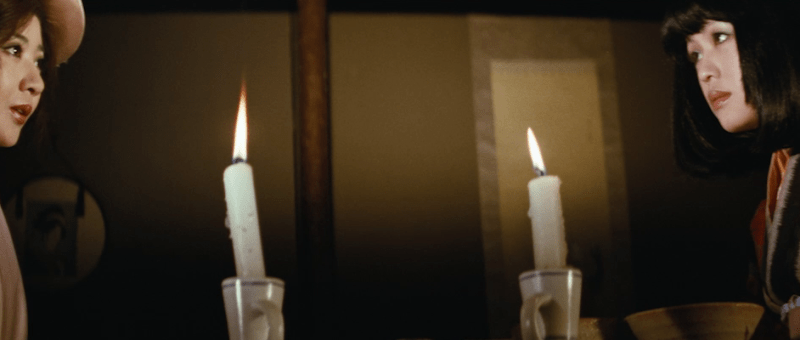
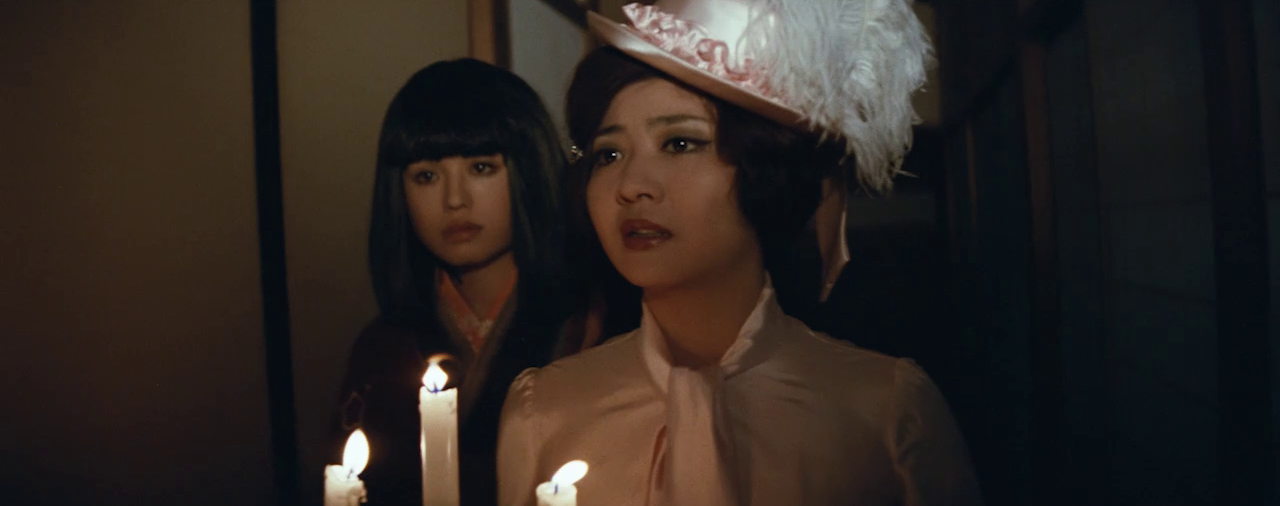
Out in the middle of nowhere, the mansion is a true gothic fantasy lit by candle light due to an absence of electricity because of the Depression. Ryunosuke has adapted it so that it contains a series of prison-like doors with iron bars and locks that allow him to trap Sachiko and others exactly where he wants them. He is vile and depraved, as is Yoko, though they later brand themselves as simply liberated and living “honestly” having embraced their true desires. Ryunosuke paints himself as a quiet revolutionary, asking why he should conform with rules and laws dictated by a distant authority to which he himself does not subscribe. He describes commonly held visions of morality as nothing more than a tool of social coercion designed to control the common man (which he is not), in which he may have a valid point despite the depravity of his apparently honest nature. 

This aspect of Ryunosuke as an anti-social force was apparently something very much intended by Kumashiro, who was himself rebelling against a moral panic which had seen Nikkatsu’s Roman Porno line condemned under public obscenity laws. To make a point, he inserts large black blocks and lines throughout the film to mimic those sometimes demanded by the censors, though enlarged to an absurd degree and often not actually covering what they would presumably be intended to or actually drawing attention to it. In any case, what the censors objected to in this case was not apparently the sex itself but the violence which accompanies it, notably in the scenes in which blood-soaked sex continues after Yoko has shot one of the male victims she effectively raped at gunpoint. 

The central part of the film is a lengthy orgy scene in which Ryunosuke has his maids whip the victims while he anally rapes them while they are forced to have sex with Yoko and Sachiko on the pretext of saving their lives. It only gets grimmer from there, though there’s a censoriousness about Sachiko’s insistence that happiness should come from correctness to counter the “happiness” that Yoko and Ryunosuke exude in their embrace of their baser desires that undercuts her role as the innocent heroine standing up to their depraved inhumanity amid the absurd interruption of a radio taiso broadcast signalling the arrival of the next unhappy guests to rock up for a less than pleasant stay at this decidedly unluxurious hotel.
The Twilight Years (恍惚の人, Shiro Toyoda, 1973)

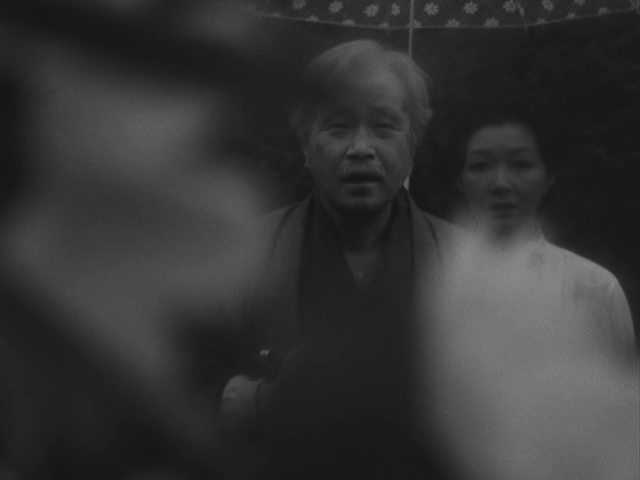
In the early 1970s Japanese society was not as concerned with population slowdown as it would come to be, but Shiro Toyoda’s sympathetic ageing drama The Twilight Years (恍惚の人, Kokotsu no Hito) is evidence of a growing consciousness that traditional ideas about how one cares for the elderly may now be becoming incompatible with the functioning of modern society. Based on a best-selling novel by Sawako Ariyoshi, the film has profound empathy both for the ageing patriarch once apparently a tyrant but now a meek and frightened child, and the daughter-in-law to whom his care largely falls.

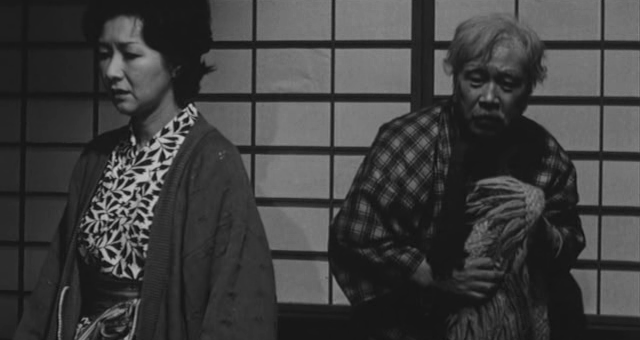
In fact, it’s caring for Shigezo (Hisaya Morishige) that some believed shortened the lifespan of his late wife who passes away in the film’s opening scenes. Already somewhat detached from reality, Shigezo simply reports that his wife won’t wake up no matter how much he tries to wake her, much like a child who’s discovered someone no longer living. While his daughter-in-law Akiko (Hideko Takamine) rushes to her room with a sense of foreboding, Shigezo merely stays in the kitchen eating boiled potatoes straight out of the pan. It’s the odd behaviour that seems to irk his son Nobuyoshi (Takahiro Tamura) but it’s only now that the couple seem to be realising that there’s something wrong especially as Shigezo does not appear to understand that his wife has died. Pitiably, he chides her for lounging around so late in the day when she’s already been laid out for her funeral.

When his daughter, Kyoko (Nobuko Otowa), arrives having actually missed the funeral itself due to transport issues and a conflicting responsibility to act as a matchmaker at a wedding, Shigezo doesn’t recognise her. He continues to ask for Akiko and gradually forgets most of the other people in his life, screaming when encountering Nobuyoshi and instructing Akiko to call the police to report a burglar in their home. According to both women, Shigeyoshi had treated Akiko poorly ever since she joined their family, which makes caring for him so much harder. The reason he becomes so attached to Akiko is likely simply that she is the person who is always around him so he has less time to forget her. He may realise on some level that she may not wish to care for him given his previous behaviour which may be why he becomes preoccupied with the idea she may “disappear” and cries out in the night when he can no longer see her.

But Akiko also has other responsibilities including a job outside the home and a teenage son studying for his exams. Nobuyoshi expresses regret that he hasn’t been more help and voluntarily tries to pitch in, but lets himself off the hook given that his father doesn’t recognise him and becomes anxious in his presence. Satoshi (Izumi Ichikawa) meanwhile does try to do his bit but is young and a little resentful of the responsibility. As his dementia becomes more severe, Shigezo begins calling Satoshi “Dad” as if he were a child again. Which is all to say, Shigezo becomes Akiko’s responsibility and the strain of caring for him begins to affect her own mental and physical health leading her to fear that she too may die younger than she otherwise might have. 

Yet in exploring her options, Akiko finds little by way of support. Most nursing homes won’t accept patients with complex needs like Shigezo and conditions such dementia are often regarded as mental illnesses meaning her only option might be to put him in an asylum. Shigezo was attending an old person’s daycare centre, but later says he doesn’t want to go anymore because it’s full of old people and therefore no fun. While the film is sympathetic towards Akiko and the difficulties she is facing in caring for her father-in-law it also has profound empathy for Shigezo for though he has so many people who are doing their best to look after him, his increasing mental confusion quite obviously leaves him isolated and he must be incredibly lonely while trapped within his own reality. He develops a habit of saying “hello, hello,” as if he were answering the telephone which may be his attempt to communicate while he is also fascinated with a caged bird which may reflect his own sense of being constrained by his condition.

Later, the bird seems to symbolise Akiko too, trapped as she is within the domestic environment where all responsibility seemingly falls to her. Even so a young student couple she rents the annex to for a lower price in exchange for keeping an eye on Shigezo during the day remark that he may be in the ideal state for a human being having returned to early childhood in which there are no concerns or responsibilities and he is therefore unburdened by the weight of what is to live. Toyoda often uses handheld camera to symbolise the desperation and destabilisation of Shigezo’s existence in which Akiko has become his only fixed point. One of Nobuyoshi’s friends remarks that perhaps it was better when the average life expectancy was 50 and Nobuyoshi’s mother might have been lucky passing away peacefully while otherwise in good health. Still, as Nobuyoshi says, it comes for us all in the end and we should all try to be kinder to each other while we’re here.


Female Yakuza Tale (やさぐれ姐御伝 総括リンチ, Teruo Ishii, 1973)

Having completed her quest for revenge, Ocho (Reiko Ike) returns in Female Yakuza Tale (やさぐれ姐御伝 総括リンチ, Yasagure anego den: Sokatsu Lynch) once again swept up in intrigue after being framed for a bizarre series of murders. With Teruo Ishii taking up the reins from Norifumi Suzuki, the film has a slightly more realistic aesthetic making frequent use of handheld particularly in the narrow backstreets of the late Meiji Society while eventually taking a bizarre detour into the cruel world of an early 20th century mental health institution. 

In any case, Ocho’s troubles start when she’s met at Kobe harbour by a woman who says she’s come to fetch her. On arrival at her destination, Ocho is chloroformed and sexually assaulted by three men who evidently think she’s think she’s someone else and decide to get rid of her after realising their mistake. She wakes up next to the dead body of another woman and is in danger of becoming the prime suspect in a series of murders the subtitles don the “crotch-gauge” killings. After managing to escape, she sets about trying to find out who set her up and what’s going on while getting involved in a succession crisis in the Ogi in which the old boss who was once good to her has been killed. 

Though with much less political subtext, the film nevertheless indulges in the Sinophobia common in many similarly themed dramas in revealing a Mr Lee of Yokohama to be a major player in a drug trafficking scam in which women are forced to smuggle drugs in their vaginas after the gang gets them hooked to manipulate them. Besides Ocho, another woman dressed eerily like Sasori in a black wide brimmed hat and loose dress known as “Yoshimi of Christ” is also on their tail and seeking revenge while echoing some of the religious themes of the first film. She later teams up with recently released yakuza Jyoji who is looking for the daughter of the old boss who has gone mysteriously missing while he is also convinced that present boss Gondo had something to do with it along with the old man’s death. 

This is however mainly a tale of female revenge, Ocho’s being on the yakuza who cut off the Old Boss’ finger after he stood up for her as a teeanger whens she was caught cheating at a gambling den. Nevertheless, what eventually emerges is a sense of female socildairy as Ocho, Yoshimi, and the other women abused by the gang come together to free themselves from its grasp in a strange orgy of violence utilising eerie green lighting to lend it an almost supernatural dimension even if in the end the final blow is struck by a man and not without a little irony. 

This sense of unreality otherwise out of keeping with the immediacy of Ishii’s handheld camera is also seen in the mental institution to which the film eventually travels, a foggy gothic building echoing the Western mansion in the first film but similarly filed with oppressed and abused women sent mad by a patriarchal society or perhaps merely sent there to become so by men who wanted them out of the way. Gondo himself seems to be a regular visitor bringing along his own electroshock machine but finally resorting to using his bare hands in order to tie up a loose end and preserve his own position as head of the clan. 

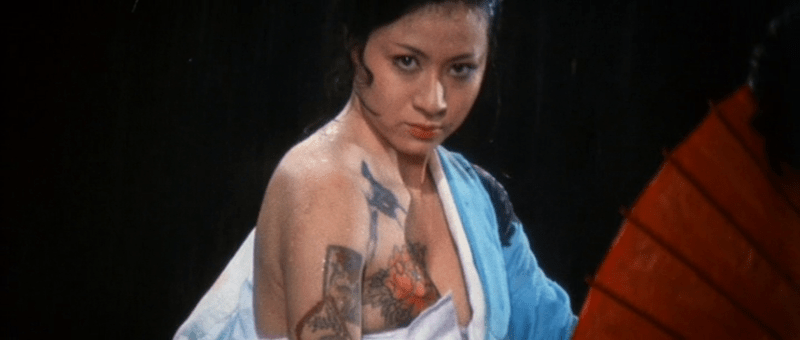
Ocho is not above using her sexuality to manipulate him, while Ishii maintains the naked sword fights from the first film both from the balletic opening of Ocho and her parasol to the chaos of the final sequence as the women come together to take their revenge as one. Perhaps strangely there isn’t an awful lot of gambling in the film, but Ocho nevertheless makes good use of her trademark hanafuda cards while in a moment of symmetry it’s the wife of her target who eventually settles the matter in a more diplomatic fashion by subjecting herself to the same humiliation to which Ocho had been subjected to bring the circle to a close. Having once again stood up against corrupt crooks and greedy men, Ocho later takes her sisters with her as she walks off this time into the sunset rather than the dark. 


Original trailer (no subtitles)

Sex and Fury (不良姐御伝 猪の鹿お蝶, Norifumi Suzuki,1973)

An orphaned daughter takes revenge against the corruptions of the late Meiji society in Norifumi Suzuki’s pinky violence classic Sex and Fury (不良姐御伝 猪の鹿お蝶, Furyo anego den: Inoshika Ocho). As the opening voiceover explains, the Japan of the early 1900s is already stoking imperial ambitions closely linked with the ideas of “modernisation” and “civility” it is seeking though in reality it is very much a gangster society as the three villains the heroine searches for have come to dominate the new Japan. 

This moment of schism is depicted in the opening sequence set in 1886 in which the little girl who will later take the name Ocho witnesses the murder of her policeman father by three unseen assassins who steal from him evidence of a scandal they then use for their own gain. The murder takes place in a shrine, the young Ocho rolling her paper ball onto a discarded charm that reads “misfortune”, while the film then jumps on to 1905 through a series of historical images prominently featuring the emperor Meiji along with a host of patriotic symbols that seem to signal the wrong path that is being taken. 

As for Ocho (Reiko Ike), she has survived by living on her wits as an excellent pickpocket and gambler but is otherwise uncorrupted continuing to dress in kimono and giving off an air of refined elegance that belies her toughness. In the course of her revenge, she is met by her opposite number, Shunosuke (Masataka Naruse), whose father was also killed by the same three duplicitous yakuza and is dragged into geopolitical intrigue by means of plot by the British to turn Japan into the site of the second opium wars using a spy disguised as a dancer played by Swedish starlet Christina Lindberg who is really in Japan for Shunosuke with whom she fell in love abroad only to be cruelly abandoned. 

Somewhat contradictorily, it’s these Western intrusions that are being resisted with Ocho the representative of an older Japan, and the gangsters that of a newer, largely amoral society of burgeoning militarism. Arch villain Kurokawa (Seizaburo Kawazu) lives in a huge Western-style mansion and is preparing to transition into national politics in the post-feudal society insisting that he and his organisation will soon control “everything”. His underling Iwakura (Hiroshi Nawa), who travels by motorcar, will also be handling the construction of Tokyo Harbour. When the girls from Ocho’s adopted family are kidnapped, they are taken to dance hall Panorama which is bedecked both with Christmassy tinsel and signs celebrating the victory in the Russo-Japanese conflict, while in an anachronistic touch scenes of the war are projected inside. Just to ram the point home, the man who throws a knife at Ocho is wearing stereotypical Chinese dress, while Kurokawa is later seen to have at his disposal a secret attack squad of nuns armed with switchblades and has Ocho whipped, by British spy Christina, in front of a large mural of Christ in some kind of underground chapel. 

In taking her revenge, Ocho is also in a sense attempting to right a historical wrong in removing these usurping men and their accomplice from power while fighting their perversion with her sexuality over which only she is master going so far as to kill one with poison rubbed on her own skin. In accidentally having exposed the equally duplicitous practices in a gambling hall, she is attacked while in the bath but instantly leaps into action entirely in the nude in a strangely beautiful sequence of elegant violence and poetic bloodletting that echoes the film’s conclusion in finally moving out into the snow. Eventually captured, she is bound tightly with rope and tortured but manages to cut herself free using only one of her trademark hanafuda cards which also symbolise her skill as a gambler even if her climactic game with Christina is played with Western cards for casino chips over a dining table. 

Suzuki signals the chaotic nature of this early 20th century world in his riotous use of colour and frequent anachronisms along with canted angles and a spinning top shot that seems to echo the world spinning out of control as Iwakura breaks a sacred promise between gamblers and rapes a young woman he had agreed to spare if Ocho was victorious in her bout with Christina. He saves his most expressionistic technique for the film’s closing moments in which Ocho singlehandedly puts a stop to Kurokawa’s corruption, another picture of Emperor Meiji looking down at her as she launches her final attack, and then stops to purify herself in the snow before wandering off into a storm of hanafuda cards with only darkness ahead of her.


Original trailer (English subtitles)

*Norifumi Suzuki’s name is actually “Noribumi” but he has become known as “Norifumi” to English-speaking audiences.

The Petrified Forest (化石の森, Masahiro Shinoda, 1973)

An angst-ridden medical student wrestles with truth and responsibility while drawn into a toxic relationship with a childhood friend and trying to avoid the estranged mother he resents in Masahiro Shinoda’s dread-laden melodrama The Petrified Forest (化石の森, Kaseki no Mori). Based on a novel by Shintaro Ishihara who later became a very conservative mayor of Tokyo and made his name with a series of “Sun Tribe” novels centring on the nihilistic hedonism of wealthy post-war youth, Shinoda’s noirish drama paints contemporary Tokyo as a duplicitous place in which hate is the only possible emotion and self-delusion the only path out of existential loneliness. 

Haruo’s (Kenichi Hagiwara) first conflict, however, is with the medical profession. He objects to the old-fashioned methods of his professor, Miyaji (Torahiko Hamada), who adopts the position of the physician as god only giving his patients the information he thinks they should have rather than the truth. A young boy, Kazuhiko (Masami Horiuchi ), is brought in with an aggressive brain tumour. Given how how quickly it regrows, there is a possibility that the boy cannot be cured while operating will likely mean he will lose his hearing. Though Miyaji knows all of this, he continues to give false reassurance to the boy’s mother, Kikue (Masako Yagi), even after making a snap decision on the table to excise the tumour knowing it will leave him deaf telling her that her son’s hearing might come back in time. Pressed for an answer, Haruo gives her the more honest prognosis that it “might”, “if he’s lucky”, but resents himself for “lying” knowing that Kazuhiko will be deaf all his life and the tumour may still recur. One of the reasons he wants Miyaji to tell the truth is so that the family can accept the situation and start working on the best ways to help Kazuhiko adjust, but Miyaji refuses to explain and in fact threatens to fire him if he won’t do as he’s told.

This resistance to a male authority figure might explain why he identifies so closely with childhood friend Eiko (Sayoko Ninomiya) now in Tokyo working at a barber’s offering male beauty treatments. Eiko is being sexually harassed by her middle-aged boss who is jealous and possessive. At one point she claims that he beat her and locked her up in a cupboard for two days after she told him she had slept with Haruo. The pair agree that he boss needs to die, rebelling against his corrupt and patriarchal authority. ”When you hate you must hate all the way” Haruo insists, explaining that the human race is “petrified”. They can only hate and loathe and lie to themselves in order to bear it. Haruo suggests they’ll eventually come to hate each other, but Eiko is certain that he’s her one exception though as will be revealed hate is eventually where they will end up. 

Fascinated by a high tech pesticide supposedly discovered by the Germans while they were testing poisonous gases but perfected by Japan Pharma, Haruo decides to use it poison to Eiko’s boss suggesting she put it in nail varnish and offer him a manicure. But once the deed is done he finds himself conflicted, unable to live with himself as a murderer which he now is seeing as he was present and applied the gauze soaked in the poison to the boss’ face while “treating” him after he had been “taken ill”. He distances himself from Eiko who irritates him by bringing over her hoover, somehow confused by her intention to move in now that they are married not least by their crime. Eiko, however, allies herself with his estranged mother Tatsuko (Haruko Sugimura) who is desperate to live with Haruo as it turns out by any means possible. 

There is an undeniable whiff of misogyny in the depiction of the two women, Eiko less damsel in distress than wilful manipulator and Tatsuko a classic overbearing mother though one apparently indifferent to her other two children including an apparently doting younger son. Haruo is caught between the two while otherwise drawn to Kikue in part because of her relationship with her son laying bare the apparent mother complex which defines his life as Eiko eventually points out calling him a coward who secretly craves his mother’s approval. Haruo’s resentment towards Tatsuko stems from having caught her with another man, his reaction both sexual jealously and puritanism unable to forgive for the transgression of adultery. Yet history later repeats itself, Kazuhiko who is at that point deaf walking in on Haruo and his mother. Haruo hugs him and covers his eyes only for the boy to later lose his sight and Kikue to go out of her mind wailing that she has destroyed her son through her sexual transgressions. 

Kikue had taken Haruo to a strange cult where she hoped Kazuhiko would be cured though he wouldn’t enter the church and later got into a conversation with the monk who is a former doctor but now believes medicine is a con because it cannot offer you salvation tacitly agreeing with Haruo’s assertion that doctors too are dishonest. This tendency to hate has rendered everyone lonely, Tatsuko’s daughter reminding her that she is lonely too even with her husband and children while Tatsuko later cruelly uses Eiko’s loneliness against her as a tool of manipulation. “Eiko trusted me too much” she explains, her attempt at female solidarity and forging a bond through their shared desire to possess Haruo obviously failing to overcome Tatsuko’s matriarchal machinations. The eerie blue colour of the poison vial, mirrored in the nebuliser forever used by Tatsuko, seems to loom behind them as a reminder of human loathing while mother and son are frequently caught in multiple mirrors in an echo of their duplicity yet in the end as Tatsuko says they share the same sin and it seems Haruo will never really be able to escape the matriarchal net.


Criminal Woman: Killing Melody (前科おんな殺し節, Atsushi Mihori, 1973)

“Five women like us could take on the whole world!” a woman exclaims after a very successful mission of revenge in which they didn’t have to do very much at all except play on male pride and yakuza honour. Criminal Woman: Killing Melody (前科おんな殺し節, Zenka onna: Koroshi-bushi) stars the two main players of Toei’s pinky violence line, Reiko Ike and Miki Sugimoto, and plays with their star rivalry by casting them as a pair of women eventually divided by the conflicting loyalties presented by the heroine’s desire for revenge. 

Ike stars as Maki, an intense young woman first seen hiding behind a door in the classic club scene that opens the film. Eventually she darts inside and slashes some yakuza with a knife, but her assassination attempt is very unsuccessful landing her in prison for a number of years where she largely spends her time glaring at the bars and plotting her revenge. Nevertheless, it’s the solidarity she finds with her cellmates that eventually allows her to carry out her plan. On her arrival, she first clashes with cell boss Masayo (Miki Sugimoto), a former yakuza moll inside for slashing some guys with a razor after they caught her cheating at hanafuda, but eventually wins her respect after a prison test of strength in which each woman is armed with a glass shard and grips a rope between their teeth until the loser gives in and lets go. Maki is not a skilled fighter and easily wounded by Masayo but refuses to surrender, getting right back up again every time Masayo knocks her down until Masayo finally concedes defeat.

The early prison fight is repeated at the end of the film only without the rope and with real knives, drugs replacing the white chalk that clouded around them as they fought in the prison yard. This time they are more evenly matched. Maki is no good with a knife, but more than able to hold her own and the fight is more about settling a score than it is about revenge so neither really wants to harm the other anyway. Though they found themselves temporarily on opposing sides, inevitably it turns out that Masayo is the woman of the yakuza Maki is trying to bring down, the sense of solidarity between them as women eventually wins out and though Masayo is unable to betray Oba (Ryoji Hayama) she cannot betray Maki either and ends up helping in her in quest for revenge if in a round about way.

It’s this sense of solidarity that brings the other cell mates back to the prison when Maki is released already having decided to help her get her revenge on the yakuza who forced her father to traffic drugs and then had him killed. Maki first refuses their help, as she had the opportunity of getting legal justice by telling the police everything that had happened including her own gang rape at the hands of the same yakuza, because it’s important that she’s the one who takes down Oba but later accepts their gesture and forms a tightly knit gang of her own fronted out of former sex worker Kaoru’s (Yumiko Katayama) bar. To fund the mission, Maki goes on a two week sex work spree mostly bedding American servicemen with whom she later makes a deal to buy a large number of guns and grenades she eventually sells to hotheaded yakuza son Tetsu (Takeo Chii) who is already resentful towards Oba for having stolen his father’s turf.

All Maki has to do to is light the touch paper on a simmering gang war between old school yakuza and the amoral corporatising Oba. She antagonises him by expertly offing one of his guys in a rain drenched assassination scene and getting one of the other girls to strongly hint it was Tetsu’s doing, then pretending to come to Tetsu’s rescue with the guns only to further provoke Oba. The girls even joke they’re doing a public service by cleaning up the town in taking out the corrupt politician who was propping up Oba for his own financial gain. It’s all expertly planned by Maki who appears in a series of quite stunning power suits and sporting giant hair, battling yakuza with killer style and an expert understanding of the way their brains work. But the reason the plan succeeds is the shared sense of solidarity between the women, Masayo included, as they strike back together against an oppressive and patriarchal society.


Bohachi Bushido: Code of the Forgotten Eight (ポルノ時代劇 忘八武士道, Teruo Ishii, 1973)

A nihilistic ronin falls into the hellish trap of the Yoshiwara in Teruo Ishii’s dazzlingly psychedelic period drama, Bohachi Bushido (ポルノ時代劇 忘八武士道, Porno Jidaigeki: Bohachi Bushido). Adapted from a manga short by Kazuo Koike, the film once again tackles Edo era corruption as a brothel owner with a special connection to the shogun attempts to wipe out the competition presented by an enterprising merchant class only to find himself hoist by his own petard.

Ishii signals his intentions early on with the artfully staged opening scequence in which wandering ronin Shino (Tetsuro Tanba) is attacked on a bridge at dusk. As he turns to slash at an opponent, the blood splatter morphs into the film’s title while the clang of swords gives off little blue sparks that turn into the listings for the cast and crew. By the time the title sequence has concluded, night has descended on the bridge and Shino finds himself engulfed in darkness. “To die is hell, but to live is also hell” he exclaims as he jumps into the water below, hoping to be free of his empty life of killing. 

Unfortunately, he is rescued and brought to the Yoshiwara where they try to persuade him to join the Bohachi clan so called because to do so you must abandon all eight human virtues. The Bohachi’s main line of work is the sexual torture of women until they become docile dolls for their brothel. Shino describes them as “revolting” but then adds “just like me” and agrees to join anyway only to earn their mistrust when he refuses to play along with their games, buying but not sleeping with a woman brought in over a debt. Though Shirakubi, the guy who recruited him, tries to kick Shino out and calls the police on him for good measure, the big boss, Shirobe (Tatsuo Endo), decides he’ll take him in for use as an attack dog taking down anyone who interferes with business be they lords or officials. 

The irony is that the nihilistic Shiro enthusiastically takes to his work because he dislikes the debauchery of the Edo-era society even while working for the “legitimate” brothel owner who is at least “licensed” to exploit women for financial gain. What Shirobe resents is the rise of quasi-brothels in the various teahouses that are obviously selling more than just tea but continue to undercut his business by selling women even cheaper than he does. He also feels betrayed by the various samurai lords who choose to visit the teahouses over his own establishment and therefore seeks to have them frightened into submission by ordering Shino to kill any man found with one of the tea house sex workers. Later he even declares a kind of sex worker amnesty promising to pay five ryo for any of the teahouse women brought to him, no matter by who, and then joking that he’s actually killing two birds with one stone by getting his hands on a high quantity of new stock for a very low price. 

Shino refuses to sleep with the women and is most offended when his male assistant is killed in an attack by the rival brothel owners yet the team of warrior women sent to protect him did nothing to help because their orders were only to protect Shino and Shirobe’s orders must be followed to the letter on the pain of death. He seems to know he’s living on borrowed time and Shirobe probably intends to finish him off once he’s finished his mission of removing all opposition and restoring Shirobe’s power to manipulate the shogun but barely does anything to resist until faced with the rather ironic punishment of being given opium and then forced to participate in a never-ending orgy intended to result in his death in an extraordinary psychedelic sequence from Ishii . 

Of course, what they didn’t reckon on was Shino’s ironic desire to live or at least not to be beaten in which he actively begins stabbing himself to overcome withdrawal symptoms and carry on fighting even when they try to ram him with a giant spear cart. Ears are cut off, flying across the screen followed by arms and then heads. Ishii lends a poetic sheen to the closing moments as Shino is caught in a hero pose alone in the snow but still standing, if barely, and freed at least from one kind of hell if not from many others. 


The Blossom and the Sword (日本侠花伝, Tai Kato, 1973)

After joining the studio in the mid-1950s, Tai Kato quickly made a reputation for himself with Toei’s key brand of ninkyo eiga yakuza movies set in the chivalrous world of pre-war gangsterdom. By the early 70s, however, the genre was already played out and Kato began to work more frequently with other studios and in various genres but 1973’s The Blossom and the Sword (日本侠花伝, Nihon kyoka den), produced for Toho the studio which he had first joined at the beginning of his career in 1937, takes him back to his ninkyo roots if less directly in a politicised tale revolving around the 1918 rice riots

The film opens, however, a few years earlier with the heroine, Mine (Hiroko Maki), attempting to sell children’s educational picture books aboard a train (an activity strictly prohibited). As she explains, they are in the middle of a recession and times are hard for everyone though as we discover the reason for Mine’s journey is that she is in the process of eloping with the mild-mannered Minoru (Kunio Murai), the son of a wealthy family with literary dreams, who is prevented from marrying her because of the class difference between them. The couple are doing well enough evading detection, but are caught out when accidentally implicated in the murder of a treacherous politician by left-wing agitator/noble gangster Seijiro (Tetsuya Watari) who fatefully locks eyes with Mine while trying to escape forever binding their fates together. 

Epic in length the film was originally released in two parts with an interval in-between, this first half focussing on Mine’s doomed romance which is thwarted in part by the outdated social codes of the early Taisho society and the moral cowardice of her lover who finds himself unable to resist them. The pair are thrown in prison as possible co-conspirators and beaten by the police, Mine striking up a friendship with a woman, Tsuru (Junko Toda), imprisoned for distributing pamphlets as a labour activist who later helps her to get a waitressing job and teaches her rudimentary writing while Minoru lounges around in their home sort of writing a novel. Tsuru seems to be touched by their cross-class romance, “where love is concerned to hell with social status!” she insists berating Minoru for giving in so easily when the pair are finally tracked down by his austere mother. Her socialist activism may not directly rub off on Mine but does perhaps inform her later actions after discovering the depths of Minoru’s spinelessness, rescued after a failed bid at double suicide by a truly good man, Kinzo (Meicho Soganoya), who also happens to be a traditional yakuza heading a harbour gang in Kobe. 

After becoming his wife, Mine comes to witness the persistent unfairness and exploitation all around her as mediated by the outcry surrounding the fluctuation of rice prices in the late 1910s caused by attempts at profiteering and the necessity of supplying the military forces then participating in the war in Europe. Meanwhile, would be local dictator and amoral yakuza Kishimoto (Toru Abe) is intent on squeezing the Osada gang out of the harbour further pushing up rice prices while in cahoots with corrupt local authorities. Seijiro re-enters her life when dispatched to assassinate Kinzo on the orders of Kishimoto but stabbing him as carefully as possible to make sure he doesn’t die, thereafter switching sides to fight for the rights of the poor who he warns face even greater oppression should a man like Kishimoto be allowed to dominate the harbour. 

With Kinzo out of action, Mine assumes her natural destiny as a local leader doing her best to stand up to Kishimoto and the corrupt authorities but still faces difficulty getting her voice heard without a man standing next to her. On taking Kinzo’s place at a meeting of local bosses, she is dismissed as “just a woman” before a sympathetic naval officer decides to hand her a lucrative job shifting rice intended for sailors overseas because of her knowledge of current affairs undercutting Kishimoto’s attempts to game the system. It’s the trust the navy have in her that later saves her again when she is arrested and brutally tortured by corrupt policemen working with Kishimoto intent on tracking down Seijiro for the murder on the train all those years previously. Mine’s rise is also in a sense Seijiro’s redemption as he atones for the attack on Kinzo, rejects his association with Kishimoto to re-embrace his socialist beliefs, and fulfils the romantic destiny sparked when their eyes met on the train. 

Drawing a direct line between burgeoning militarism and gangsterdom along with the amoral exploitations of an increasingly capitalist society, Kato makes his intentions clear by dropping a ninkyo eiga hero into a world of infinite corruptions in which he eventually becomes a defender of the poor. Kato’s striking composition and use of colour along with expressionistic imagery lend the air of legend implied by the title as Mine fights her way through the oppressions of her era as a figurehead for justice in an increasingly unjust society.


Horror of the Wolf (狼の紋章, Masashi Matsumoto, 1973)

“All I wanted was to live a quiet life alone” a teenage werewolf laments unfairly forced into a human world which has no real place for him while he can find no accommodation with its innate cruelty. Adapted from the manga by Kazumasa Hirai & Hisashi Sakaguchi, Horror of the Wolf (狼の紋章, Okami no Monsho) is part high school delinquent movie and part psychedelic werewolf exploitation film in which the hero finds himself drawn into a weird supernatural battle with a crazed nationalist while falling for his beautiful high school teacher who perhaps uncomfortably reminds him of his late mother. 

Akira Inugami (Taro Shigaki) spent the early years of his life in Alaska playing with the local wolves until his anthropologist parents were murdered “due to suspicions of spy activity”. After spending some time raised by the wolves, Akira was then taken in by his fantastically wealthy aunt, the CEO of the top chain of Japanese restaurants in the US where he was schooled until returning to Japan. As the film opens, he’s attacked by a gang of thugs, refusing to fight back and later stabbed but cooly removing the knife from his stomach as if it were only an inconvenience to him. Witnessing this strange event, school teacher Miss Aoshika (Yoko Ichiji) promptly faints, only to receive a shock the next day when the man she thought she saw murdered the night before shows up as a mysterious transfer student at her elite academy. 

Hinting at an underlying theme of class conflict and institutional corruption, the school doesn’t really want to take Akira because he’s a troublemaker who’s always getting into fights, though this claim seems to conflict with his ongoing refusal to engage with physical violence, but is reluctant to dismiss him because his aunt is so very wealthy. The same goes for his rival, Haguro (Yusaku Matsuda), whose father is a yakuza boss. Haguro is the leader of the school’s delinquent thugs, a distinctly cool presence who wanders around brandishing a katana which he is frequently seen unsheathing with the Japanese flag in the background while his family crest appears to feature an eagle reminiscent of those seen in Nazi Germany.

Nationalism aside, the film has an ongoing preoccupation with animal imagery not only with Akira’s wolfishness but Aoshika whose name literally means “blue deer” often appearing in front of a wooden deer ornament while Akira’s apartment seems to be kitted out with AstroTurf or at least a vibrant green carpet with the appearance of grass as well as occasionally shifting into an idyllic dreamscape where he can frolic cheerfully in the wild. When Aoshika comes looking for him, he tells her that he’s simply wearing a wolf mask and refuses to take it off, urging her to leave him in peace because “women are so lacking in delicacy and so overbearing it drives me nuts”. 

Akira is not alone in his apparent misogyny, Aoshika is violently raped on three separate occasions the first being by her own students which the headmaster brushes off as a rather frequent occurrence giving rise to the question of why she continues to work at the school, where she is apparently the only female member of staff, if she continually faces such traumatic violence. Her final assault meanwhile comes at the hands of Haguro who seems to be performing some kind of bizarre ritual while preparing to face off against Akira who saved her from a previous attack by street punks while in his werewolf guise.  

Aside from his brooding intensity, there are few clues to Akira’s true identity other than his ability to heal in rapid time following injury and skilful athleticism in dodging attacks. Repeatedly referred to as a “lone wolf”, partly an insult based on his name (which literally means “dog god” and is used to describe those possessed by the spirit of a dog), Akira adopts a pacifist stance towards his aggressors refusing to fight back later telling Haguro that they’re simply not worth the bother yet his refusal to fight is mistaken for a philosophical position that eventually makes him a figurehead for a gang of leftist teens trying to halt the culture of violence in the school in what seems to be an ironic swipe at the student protests even if also setting up a challenge to Haguro’s crypto-fascist authoritarian thuggery. 

A curiously avant-garde affair, Masashi Matsumoto’s teen wolf drama features striking composition with frequent use of solarisation and an almost mythical opening sequence detailing the hero’s origin story amid the snows of Alaska, along with incongruous practical effects such as the furry wolf mask Akira often wears in his apartment in his half-transformed state. It is also somewhat lurid, unnecessarily revelling in the sexualised violence directed at the heroine with three lengthy rape scenes of varying intensity. Even so in its undeniable strangeness and eventual pathos for those who cannot survive in “a cruel world made by humans” Horror of the Wolf reserves its sympathy for the outsiders unwilling to submit to a world of human cruelty.


Asia is One (アジアはひとつ, NDU, 1973)

“They came to beat us into a splendid Japanese future, to conquer us” according to an interview in a small Taiwanese mountain village towards the end of the Nihon Documentarist Union’s Asia is One (アジアはひとつ, Asia wa Hitotsu). Having documented Okinawa on the brink of its reversion to Japanese sovereignty, the collective return to examine more widely its legacies of oppression and exploitation under Japanese imperialism venturing first to its smaller islands and then all the way out to Taiwan from which many migrant workers had come to work in harsh conditions in Okinawan mines during the colonial era. 

One man describes himself as having been tricked in coming to the Marusan mine in 1933 in the mistaken belief he could work there for six months and then return home. “I thought it would be better to die than live there” he goes on, originally too afraid to attempt escape having seen others rounded up and punished but later managing to get away by blowing up a boat. A Japanese man who worked at the Noda mine in Iriomote, meanwhile, reveals that they were refused days off and sick workers were often cast out. Many simply died because they could not afford to pay for medical attention. Workers were paid in company script which could be spent only on the compound, the mine owners fearing workers would abscond if they were paid in cash. By his reckoning, however, the Taiwanese workers had it better because they were working on a contract basis and could get a better rate of pay. A third man, Masuda, meanwhile describes long days and early mornings, being unable to eat if they didn’t have money for the canteen, and the watchmen locking their bedroom doors at night to prevent them escaping. The conditions were so bad that one man took his own life by blowing himself up with dynamite tied around his waist. 

Even so, the second man then living in a nursing home, does not blame the mine owner, Mr. Noda, describing him simply as a “capitalist” and remarking that he was often kind and generous giving workers money for medical treatment etc, blaming instead the foreman. “It’s the people working under the capitalists who are bad” he explains, bearing out the extent to which oppressed people will often oppress others like them in order to feel less oppressed but also letting the system off the hook in failing to acknowledge that if Mr Noda had really been good and kind he could have improved conditions in the mine while still remaining “a capitalist”. Hsieh King-Fu, known as Dr. Seh, whose father worked as a doctor at the mines recalls a mass outbreak of malaria among the Taiwanese migrant workers leading to a shortage of morphine. Having bought supplies from a local pharmacy himself a rumour later circulated he was injecting them deliberately to get them addicted so he could drag them away so endemic had the sense of betrayal and exploitation become. 

Meanwhile since the reversion the islands have been fostering deeper connections with Taiwan which is after all geographically closer than the Japanese mainland. An older man explains that he’s instilling Taiwanese agricultural techniques in the local population and has successfully been cultivating pineapples on the island for the last 40 years. Fishermen too remark on how much easier it is to trade with Taiwan rather than the mainland because it’s simply closer meaning they can also trade live fish with a longer shelf life. Meanwhile an official details a potential agreement between the Ryukyu government and Taiwan to recruit workers developing new ties independently from those of mainland Japan. 

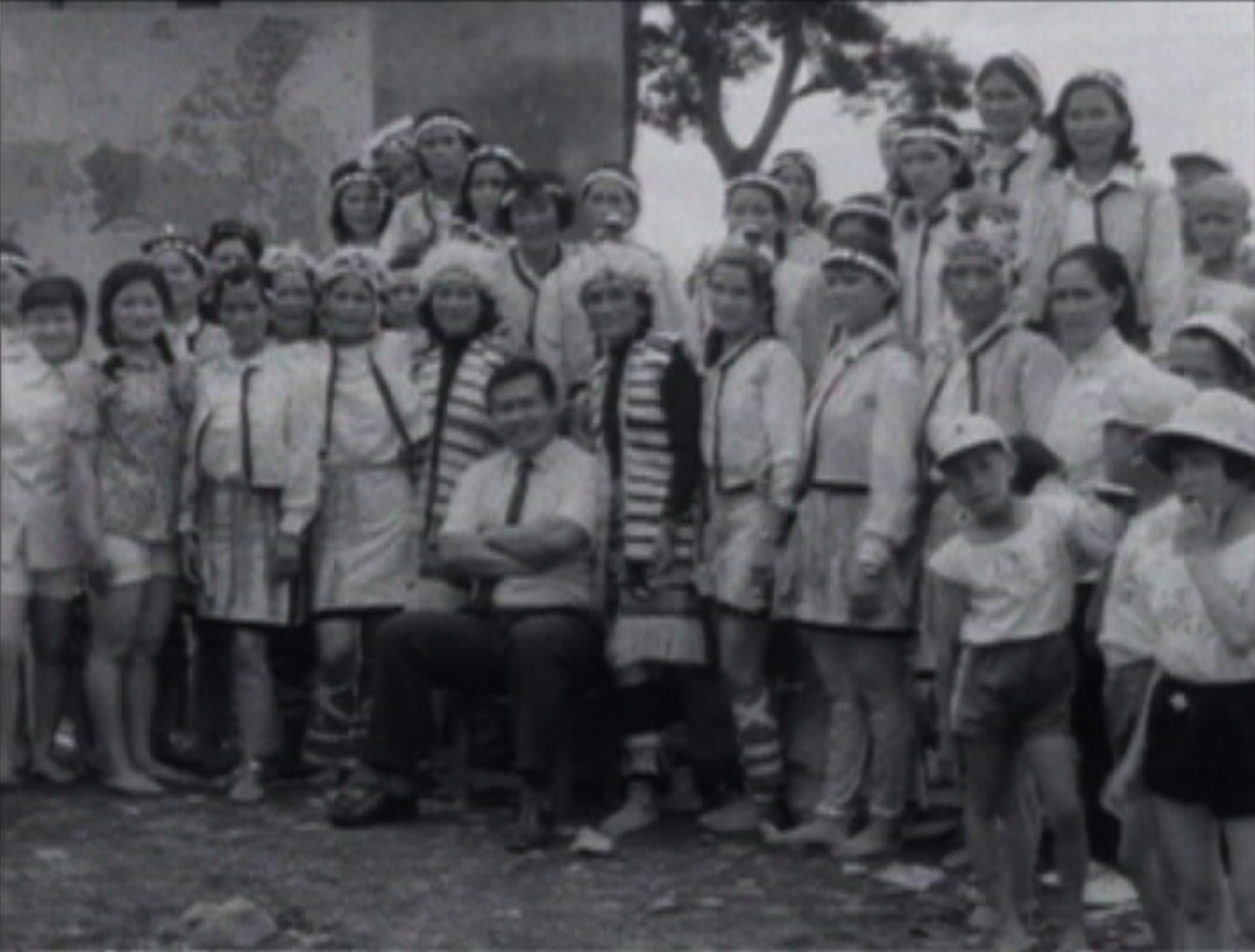
Yet in travelling to Taiwan itself, the documentary collective encounter surprising reactions to the legacy of Japanese colonialism in a small village inhabited by the indigenous Atayal community who still play the Japanese national anthem every day at noon. Many of them can still speak fluent Japanese having been forced to learn it during the colonial era and have almost a fondness for Japanese rule. “We owe everything to Japan” one woman states, uncomfortably grateful for her “civilisation” and thankful that the Japanese educated them out of some of their more “barbaric” customs such as the admittedly oppressive practice of beheading. Like the Korean man who obtained three names during his travels through the Japanese empire, many of the villagers have names in their indigenous language, names in Mandarin, and names in Japanese. “I’m still terrified of imperialism and oppression” one man admits though adding “I guess imperialism is different now” in lamenting that the emperor has never visited him but observing that he looked “free” on his last tour to Taiwan before going on to talk about a seal he received from the emperor after executing prisoners, by beheading, as a conscript soldier during the war. Asia may indeed be one if ironically, united in the destructive legacy of Japanese imperialism, but perhaps also finding new ways to repair itself which take less account of concepts such as sovereignty, diplomatic recognition, or man-made borders. 


Asia is One streams worldwide (excl. Taiwan and Japan) until June 3 as part of Japan Society New York’s Visions of Okinawa: Cinematic Reflections.