

“All I wanted was to live a quiet life alone” a teenage werewolf laments unfairly forced into a human world which has no real place for him while he can find no accommodation with its innate cruelty. Adapted from the manga by Kazumasa Hirai & Hisashi Sakaguchi, Horror of the Wolf (狼の紋章, Okami no Monsho) is part high school delinquent movie and part psychedelic werewolf exploitation film in which the hero finds himself drawn into a weird supernatural battle with a crazed nationalist while falling for his beautiful high school teacher who perhaps uncomfortably reminds him of his late mother.
Akira Inugami (Taro Shigaki) spent the early years of his life in Alaska playing with the local wolves until his anthropologist parents were murdered “due to suspicions of spy activity”. After spending some time raised by the wolves, Akira was then taken in by his fantastically wealthy aunt, the CEO of the top chain of Japanese restaurants in the US where he was schooled until returning to Japan. As the film opens, he’s attacked by a gang of thugs, refusing to fight back and later stabbed but cooly removing the knife from his stomach as if it were only an inconvenience to him. Witnessing this strange event, school teacher Miss Aoshika (Yoko Ichiji) promptly faints, only to receive a shock the next day when the man she thought she saw murdered the night before shows up as a mysterious transfer student at her elite academy.
Hinting at an underlying theme of class conflict and institutional corruption, the school doesn’t really want to take Akira because he’s a troublemaker who’s always getting into fights, though this claim seems to conflict with his ongoing refusal to engage with physical violence, but is reluctant to dismiss him because his aunt is so very wealthy. The same goes for his rival, Haguro (Yusaku Matsuda), whose father is a yakuza boss. Haguro is the leader of the school’s delinquent thugs, a distinctly cool presence who wanders around brandishing a katana which he is frequently seen unsheathing with the Japanese flag in the background while his family crest appears to feature an eagle reminiscent of those seen in Nazi Germany.
Nationalism aside, the film has an ongoing preoccupation with animal imagery not only with Akira’s wolfishness but Aoshika whose name literally means “blue deer” often appearing in front of a wooden deer ornament while Akira’s apartment seems to be kitted out with AstroTurf or at least a vibrant green carpet with the appearance of grass as well as occasionally shifting into an idyllic dreamscape where he can frolic cheerfully in the wild. When Aoshika comes looking for him, he tells her that he’s simply wearing a wolf mask and refuses to take it off, urging her to leave him in peace because “women are so lacking in delicacy and so overbearing it drives me nuts”.
Akira is not alone in his apparent misogyny, Aoshika is violently raped on three separate occasions the first being by her own students which the headmaster brushes off as a rather frequent occurrence giving rise to the question of why she continues to work at the school, where she is apparently the only female member of staff, if she continually faces such traumatic violence. Her final assault meanwhile comes at the hands of Haguro who seems to be performing some kind of bizarre ritual while preparing to face off against Akira who saved her from a previous attack by street punks while in his werewolf guise.
Aside from his brooding intensity, there are few clues to Akira’s true identity other than his ability to heal in rapid time following injury and skilful athleticism in dodging attacks. Repeatedly referred to as a “lone wolf”, partly an insult based on his name (which literally means “dog god” and is used to describe those possessed by the spirit of a dog), Akira adopts a pacifist stance towards his aggressors refusing to fight back later telling Haguro that they’re simply not worth the bother yet his refusal to fight is mistaken for a philosophical position that eventually makes him a figurehead for a gang of leftist teens trying to halt the culture of violence in the school in what seems to be an ironic swipe at the student protests even if also setting up a challenge to Haguro’s crypto-fascist authoritarian thuggery.
A curiously avant-garde affair, Masashi Matsumoto’s teen wolf drama features striking composition with frequent use of solarisation and an almost mythical opening sequence detailing the hero’s origin story amid the snows of Alaska, along with incongruous practical effects such as the furry wolf mask Akira often wears in his apartment in his half-transformed state. It is also somewhat lurid, unnecessarily revelling in the sexualised violence directed at the heroine with three lengthy rape scenes of varying intensity. Even so in its undeniable strangeness and eventual pathos for those who cannot survive in “a cruel world made by humans” Horror of the Wolf reserves its sympathy for the outsiders unwilling to submit to a world of human cruelty.



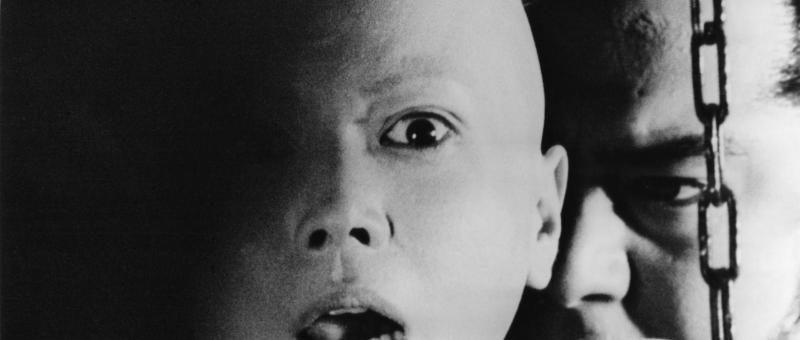

 Ogami (Tomisaburo Wakayama), former Shogun executioner now a fugitive in search of justice after being framed for treason by the villainous Yagyu clan who are also responsible for the death of his wife, is still on the Demon’s Way with his young son Daigoro (Akihiro Tomikawa). Five films into this six film cycle, the pair are edging closer to their goal as the evil Lord Retsudo continues to make shadowy appearances at the corners of their world. However, the Demon’s Way carries a heavy toll, littered with corpses of unlucky challengers, the road has, of late, begun to claim the lives of the virtuous along with the venal. Conflicted as he was in his execution of a contract to assassinate the tragic Oyuki in the previous instalment,
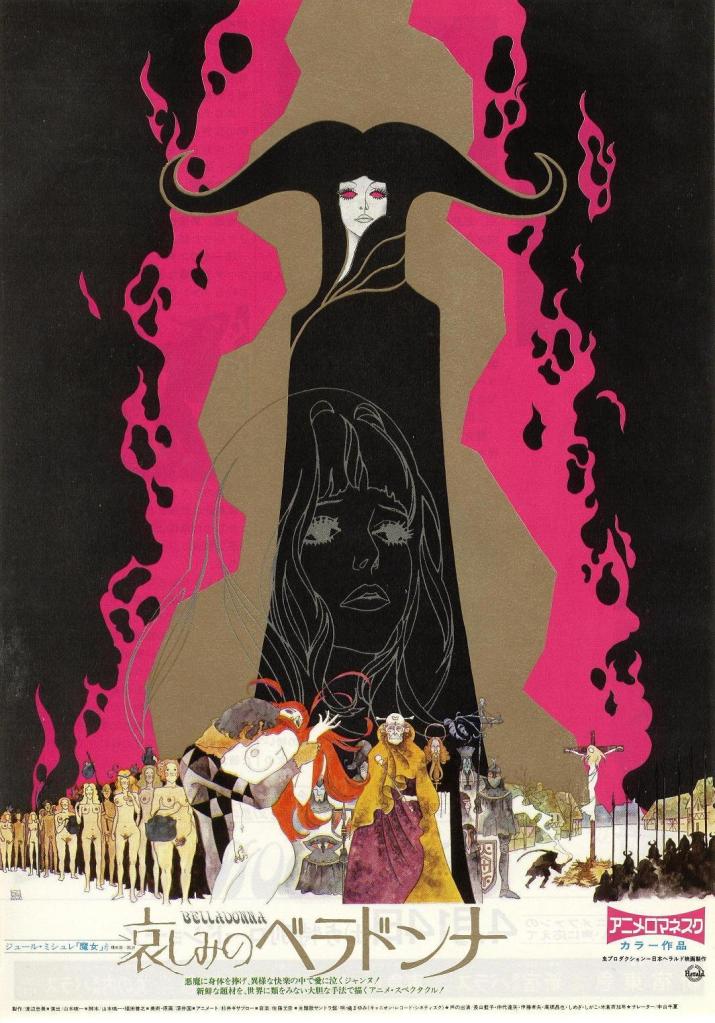 Loosely based on Jules Michelet’s La Sorcière (Satanism and Witchcraft) which reframed the idea of the witch as a revolutionary opposition to the oppression of the feudalistic system and the intense religiosity of the Catholic church, Belladonna of Sadness (哀しみのベラドンナ, Kanashimi no Belladonna) was, shall we say, under appreciated at the time of its original release even being credited with the eventual bankruptcy of its production studio. Begun as the third in the Animerama trilogy of adult orientated animations produced by legendary manga artist Osamu Tezuka’s Mushi Productions, Belladonna of Sadness is the only one of the three with which Tezuka was not directly involved owing to having left the company to return to manga. Consequently the animation sheds his characteristic character designs for something more akin to Art Nouveau elegance mixed with countercultural psychedelia and pink film compositions. Feminist rape revenge fairytale or an exploitative exploration of the “demonic” nature of female sexuality and empowerment, Belladonna of Sadness is not an easily forgettable experience.
 The saga seemed complete with the end of
  At the end of
 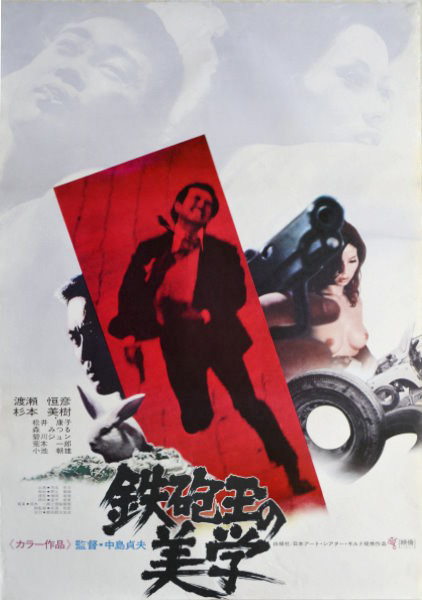 1973 is the year the ninkyo eiga died. Or that is to say, staggered off into an alleyway clutching its stomach and vowing revenge whilst simultaneously seeking forgiveness from its beloved oyabun after being cruelly betrayed by the changing times! You might think it was Kinji Fukasaku who turned traitor and hammered the final nail into the coffin of Toei’s most popular genre, but Sadao Nakajima helped ram it home with the riotous explosion of proto-punk youth movie and jitsuroku-style naturalistic look at the pettiness and squalor inherent in the yakuza life – Aesthetics of a Bullet (鉄砲玉の美学, Teppodama no Bigaku). This tale of a small time loser playing the supercool big shot with no clue that he’s a sacrificial pawn in a much larger power struggle is one that has universal resonance despite the unpleasantness of its “hero”.
