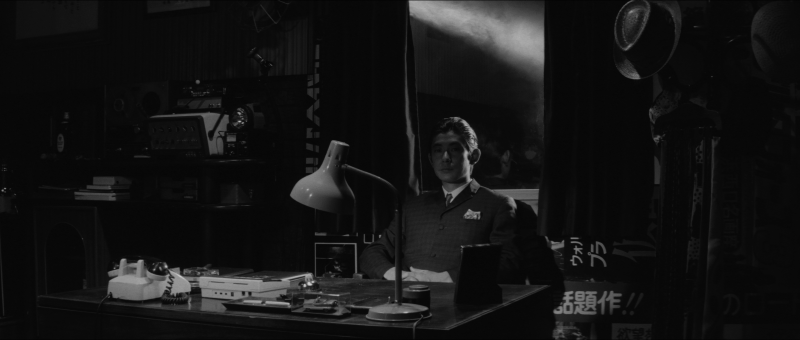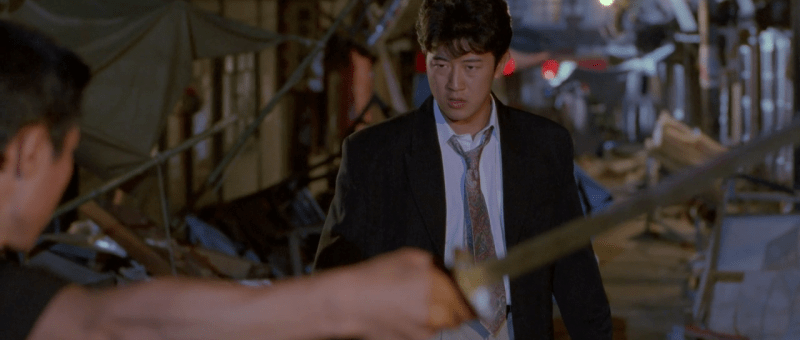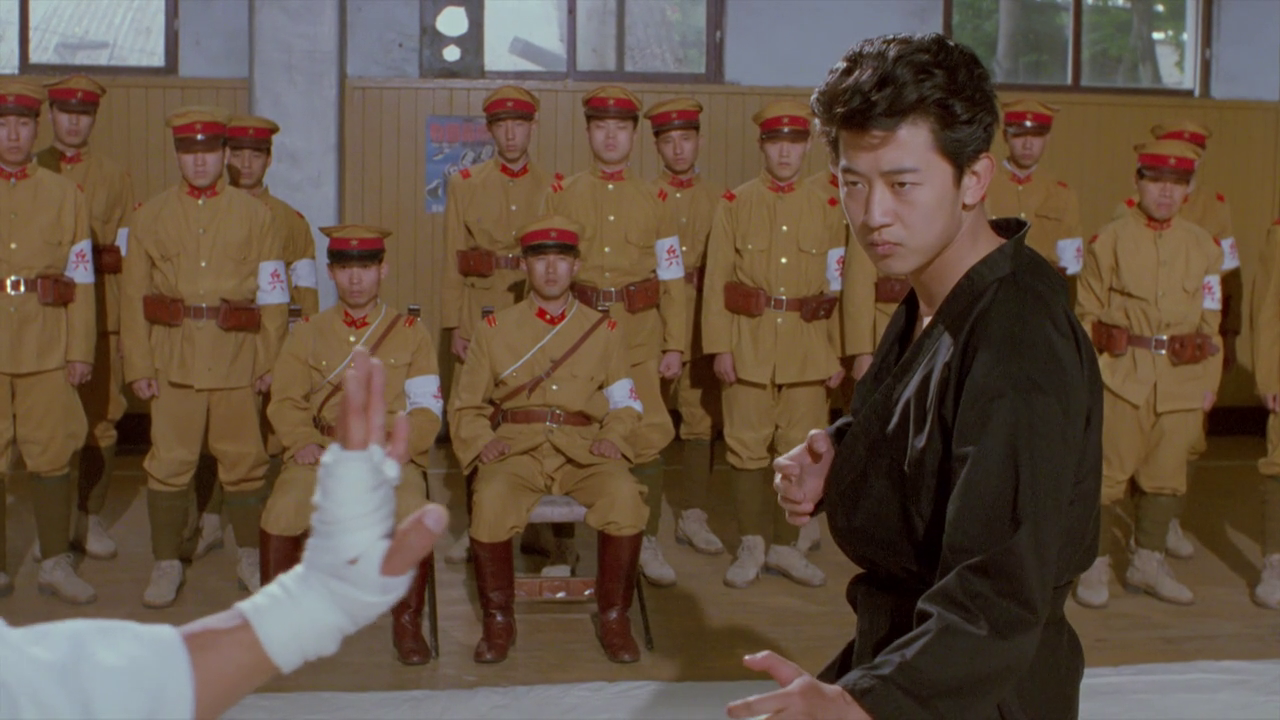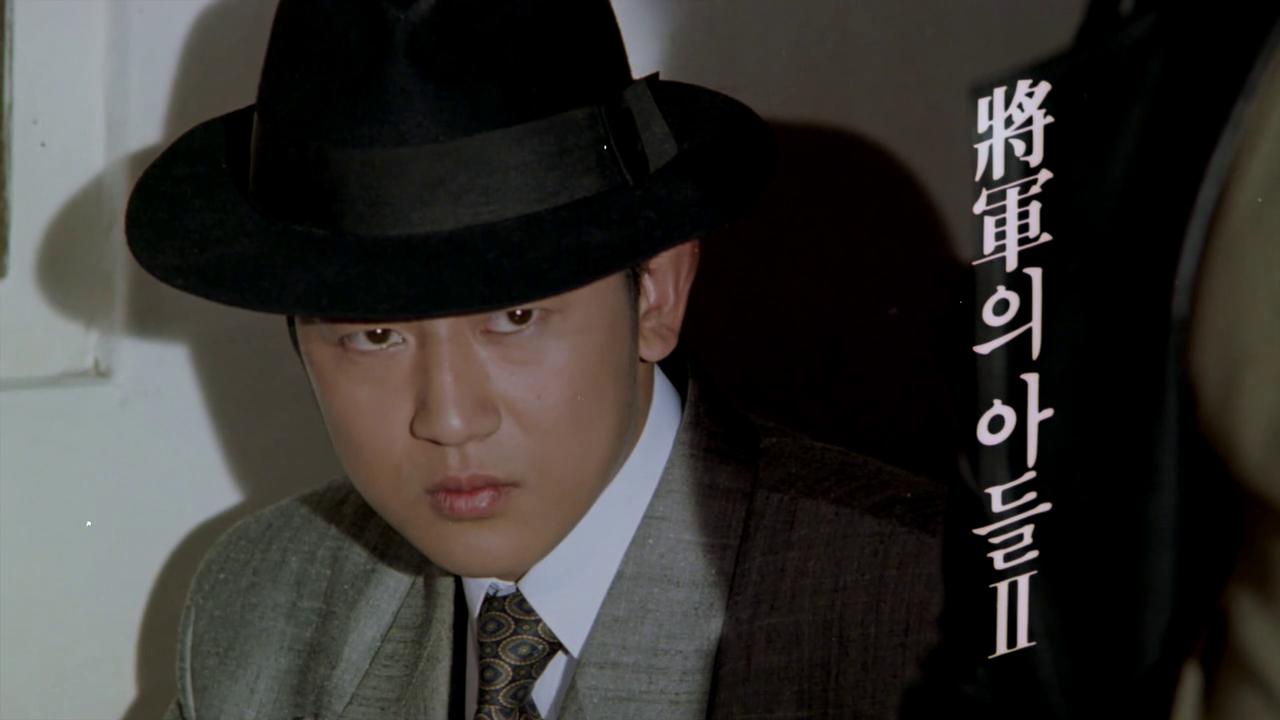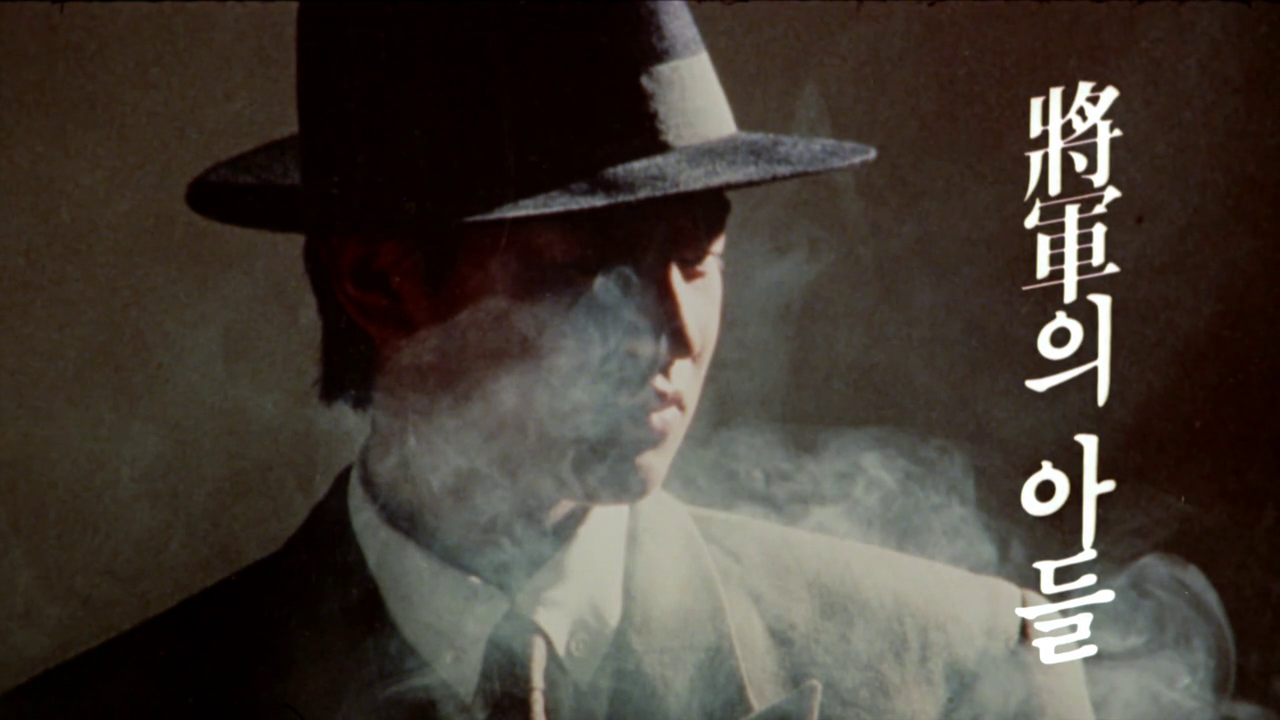
Luminous Moss (ひかりごけ, Kei Kumai, 1992)

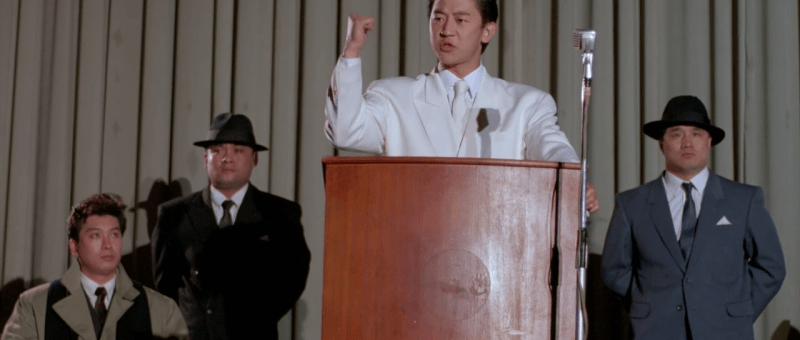
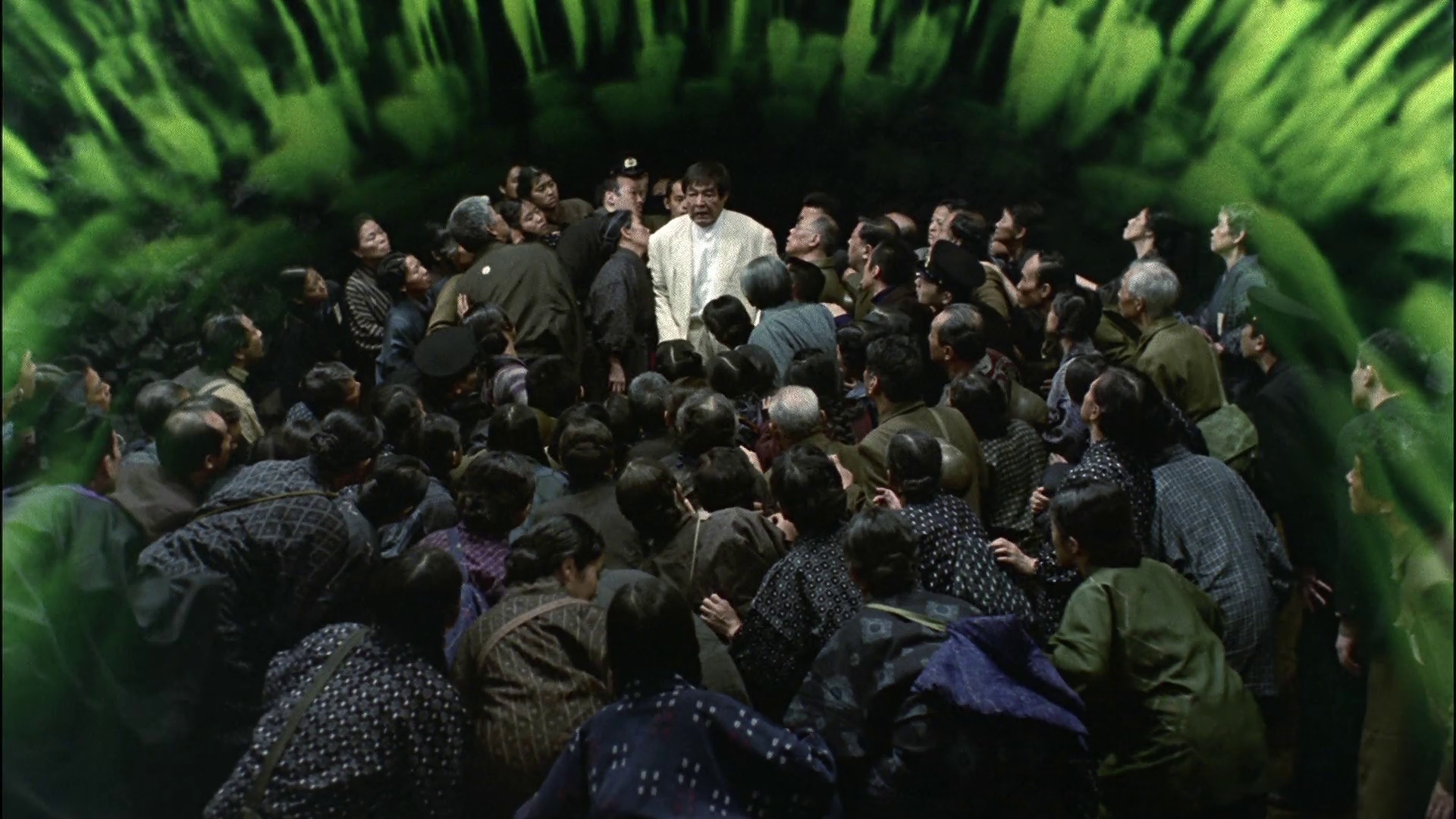
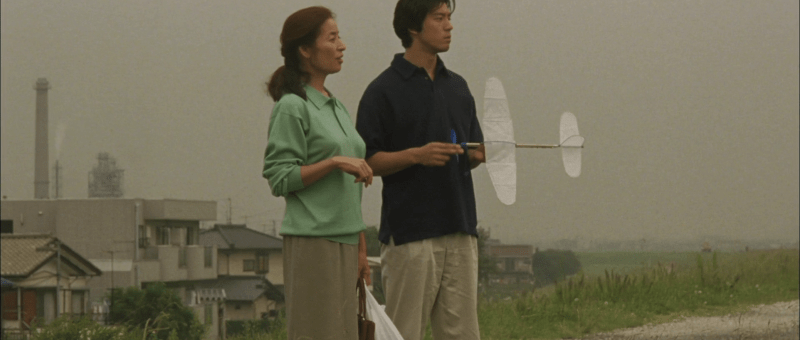
At the end of the increasing surreal trial which concludes the play within a play in Kei Kumai’s Luminous Moss (ひかりごけ, Hikarigoke), the protagonist turns to the people of the court and asks them to look at him. He wants to know if they see the ring of light around his head that looks like the luminescent plants inside the cave where he spent three months or so after being shipwrecked in the middle of the war. His plea is as much to ask what would you have done and if we can ever really judge him when we ourselves have never been faced with his dilemma.

It is however a dilemma many were faced with, and one tacitly suggested in other earlier films such as Kon Ichikawa’s Fires on the Plain though at that point too taboo and painful to address openly. In the framing sequence which bookends the film, an author visits a town in Northern Hokkaido in search of inspiration and is guided to a cave, now reachable by a roadway built after the war, where luminous moss grows. The man who takes him, a headmaster (Rentaro Mikuni), also tells him of an incident which took place there in which four shipwrecked men swam to shore and took refuge within the cave. Only the captain (also played by Rentaro Mikuni) survived, making a perilous trek across the ice a few months later when his food source depleted and he was left with no other choice.

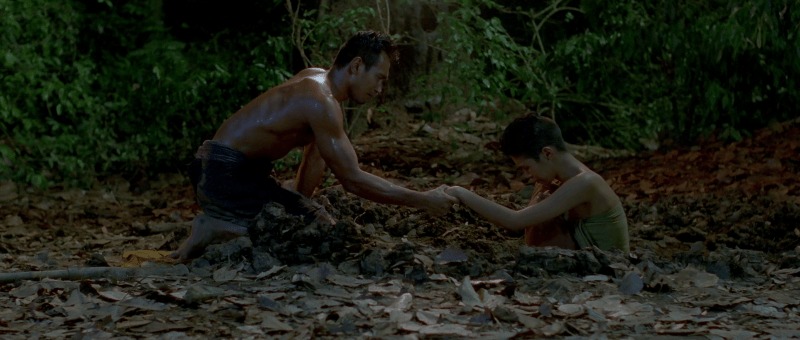
The middle of the film is presented as a flashback, but actually the play the author is writing based on the investigations of the headmaster who says that he increasingly came to sympathise with the captain because of his own experiences as a prisoner of war in Siberia. Hachizo (Kunie Tanaka), a middle-aged father to a large family who refuses to eat the corpse of the first man to die, Gosuke (Tetta Sugimoto), because he promised him he wouldn’t, describes the captain as a “resourceful man” in both positive and negative senses of the word. He assumes the captain is already calculating when the current supply will run out, and when his own body will have consumed, leaving him with a dilemma about what to do next. The captain is in no real doubt about the necessity of eating Gosuke’s flesh and feels no guilt about it, after all he died of natural causes after consuming seawater and is now, in the captain’s view, simply meat so not eating him is just a pointless waste. Perhaps the situation would be different if he had killed him deliberately in order to eat him, but on the other hand it would not really be advantageous to do so given that the captain’s end goal is surviving until the end of the winter when it will be possible to return to the mainland. Thus he waits for his men to die and leaves the rest up to fate. 

The situation only comes to light when a wooden box is washed to shore containing the bones of Private Nishikawa (Eiji Okuda), whom the captain did actually kill but accidentally while he was trying to commit suicide so that the captain would not be able to eat him. Nishikawa is originally a thorn in the side to the stranded men, a brainwashed militarist who insists they must survive out of loyalty to the emperor. He refuses to eat Gosuke’s corpse on moral grounds, but is eventually unable to resist unconsoled by Hachizo’s well-meaning advice that he should tell himself he did it for the emperor. Knowing that he did it solely for his own survival shatters his illusions of himself as a loyal subject and fractures his sense of identity. He cannot live with himself having eaten human flesh, while as the captain says those who were going to die were always going to while those who must survive must to everything to do so. 

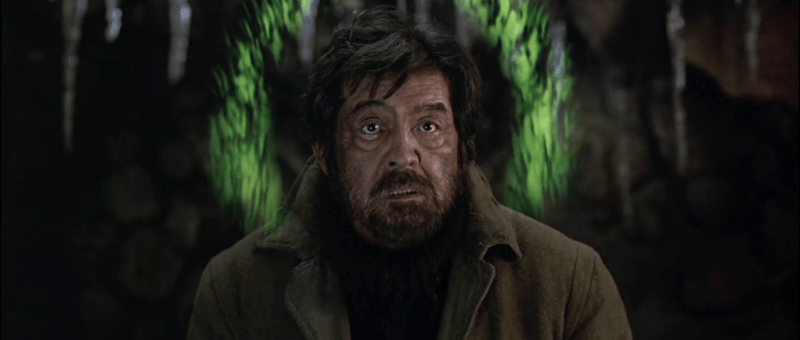
Thus at his trial, in which he appears to have lost his mind, he stresses that though he does not object to the legal process or its consequences he will not feel himself to have been judged by the prosecutor (Hisashi Igawa) as he has never eaten human flesh nor had his own flesh eaten. While in the cave, Hachizo had claimed to see a glowing ring around Nishikawa’s face which he attributed to a folk belief that such a ring resembling the green glow of luminescent moss was a signifier of his guilt visible only from a certain angle and for a short time only to those who look for it. It’s this ring that captain asks others to look for at his trial, to show him the signifier of his own guilt so that he may himself accept it. But then he may actually have a point that those who have never experienced what he has experienced are incapable of judging him. At the critical moment, the trial is interrupted by an air raid, there after becoming increasingly surreal as the location is shifted back to the cave as if it were all taking place within the captain’s mind. 

The prosecutor tries to attack him for attempting to blame it all on nation and society, suggesting that his actions have disgraced all of Japan and brought shame on the emperor about whom the captain makes an inappropriate remark suggesting that the emperor too is human and merely “enduring” his circumstances. Pressed to explain himself, the captain only says that he is “enduring” many things and that during his time in the cave he simply “endured”, doing what seemed to him the only thing he could do. The prosector points out that Hachizo refused and chose death, while Nishikawa attempted suicide to atone for his actions, asking what right the captain had choose survival but the only ones who can really judge him the three men he cannibalised each of whom appear as (almost) silent ghosts whose judgement cannot be interpreted. 

Though the film is not as visually striking as others in Kumai’s earlier career, he succeeds in conjuring a sense of primeval eeriness in the swirling mists and oddly shaped icicles of the cave while avoiding any sense of gore in the act of cannibalism itself which might otherwise unbalance the ethical dimensions he wishes to address. In the closing sequence, both the writer and the headmaster are positioned behind the bars which now protect the moss as if this kind of primal impulse could really be restrained or tempered by our civility. After the death of Gosuke and given the objections of the other two men, the captain suggests waiting a day or two to see how long their “human feelings” could hold in the face of their survival, the answer perhaps being less than you’d hope and about as long as you’d expect.


Tokyo Lullaby (東京夜曲, Jun Ichikawa, 1997)

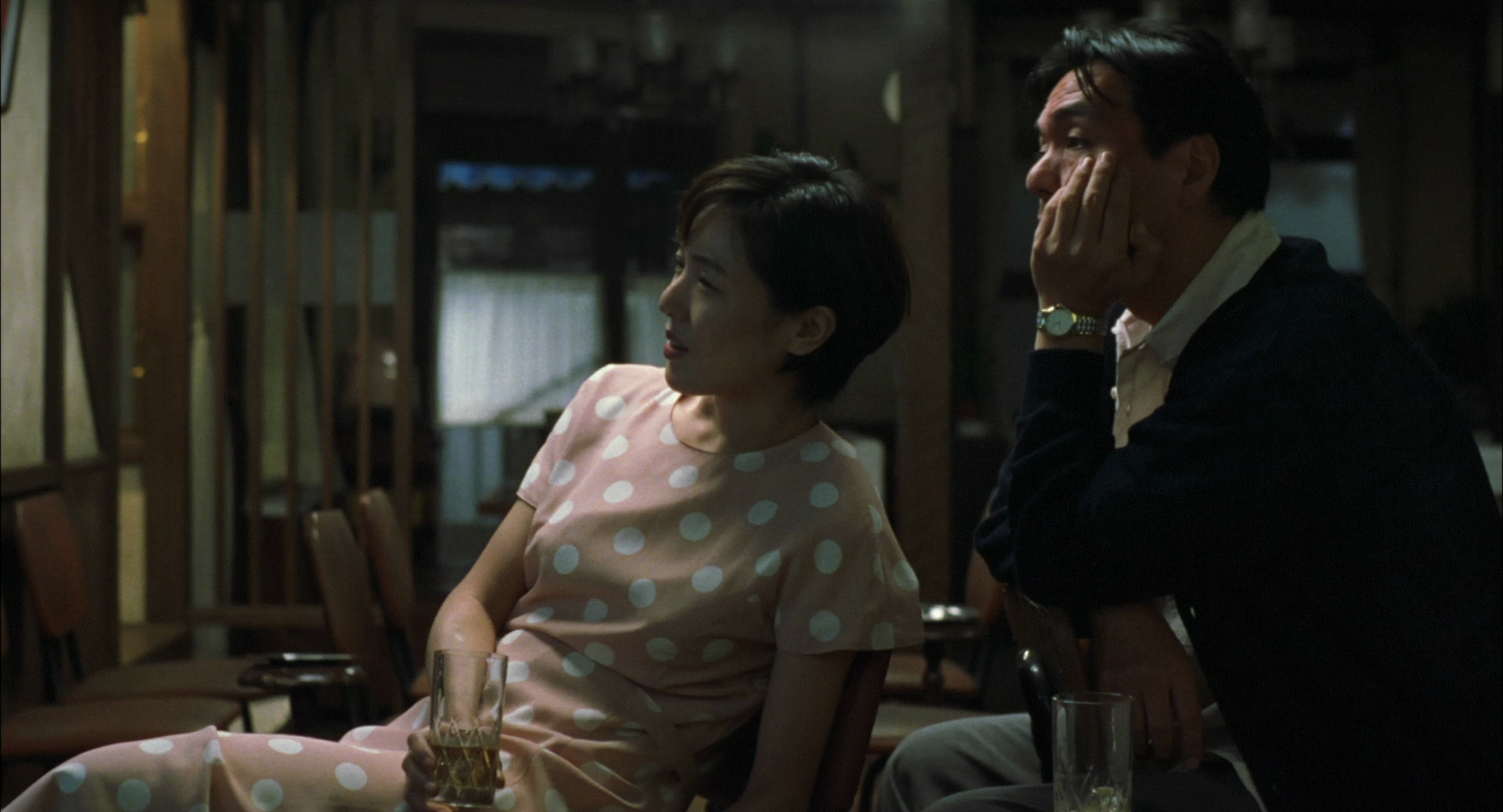
A meditation on lost love and middle-aged regret, Jun Ichikawa’s Tokyo Lullaby (東京夜曲, Tokyo Yakyoku) weaves a melancholy path through a lonely city but finds in it a sense of comfort or perhaps serenity in the gentle rhythms of ordinary lives that somehow become something greater. A diffident translator in love with an unhappily married middle-aged woman slowly uncovers a deep well of unresolved longing largely thanks to those around him who will remember for those who do not wish to speak. 

Ichikawa signals his intentions early on, transitioning from a nighttime shot of the city to a small cafe where a woman is sitting in the foreground looking forlorn while customers behind her discuss the reappearance of Koichi (Kyozo Nagatsuka), the son of the man who owns the electronics store opposite, who had walked out on his family several years previously but has abruptly returned. From this short scene, we can perhaps infer that there is some connection between Koichi and the woman, Tami (Kaori Momoi), though we aren’t quite sure what it is. In any case, the cafe, which bears the name of her late husband Osawa, becomes a kind of nexus uniting the lives of the various community members who each come there to play go and discuss the past. 

Like Tami, Koichi is reticent and melancholy. He says nothing of where he’s been and his wife, Hisako (Mitsuko Baisho), asks him no questions. She later tells the writer, Tei, whose affections she does not return, that she doesn’t really care about how Koichi is living his life because she is busy living her own and likes to do as she pleases. His sister asks him if he plans to stay this time, but Koichi can’t answer her seemingly uncomfortable in himself and unable either to stay or to go. Walking on crutches his injured foot seems to symbolise his emotional unsteadiness literally unable to find sure footing or move forward with his life. 

Piecing the tale together, Tei figures out that Koichi and Tami were once together but she suddenly married someone else who had a terminal illness and passed away shortly afterwards around the time that Koichi first went walkabout. Hisako, meanwhile, had been in love with Osawa though he loved Tami who did not love him. Somehow it’s all very complicated and incredibly simple, the way they’ve sabotaged their own lives and happiness though it couldn’t have been any other way. Tei watches something similar play out in the neighbourhood. One of the young men who works at the electronics shop had been dating a girl who worked at the record store, but he abruptly begins pursuing Ng, a Chinese woman who works at the cafe, and eventually marries her leaving the record store girl heartbroken. 

Things change and they stay the same. Ng takes over the cafe, Koichi’s foot heals while he also manages to resurrect the family business by turning it into a shop that video games as if taking a symbolic step into modernity that suggests this time he’ll stay just as Tami decides it’s time for her to leave. Paths cross endlessly, Ichikawa frequently cutting away to tiny vignettes of other cafe goers as their stories weave through each other, each one note in the great symphony of the city without which life would be impossible. Yet what’s more important is what is not said, the silences that exist between people and perhaps within them too. Things that are understood, and those which are not. 

Tami explains that she looked for answers but all she found was junk until the relief of boredom became her only frame of happiness. Only by escaping the city does it seem that she’ll be happy while Koichi seems as if he’s getting itchy feet and Tei, joining the cycle, decides to move on rather than remain in painful proximity to Hisako who as she said has her own life and does not seem to want to share it with anyone much less him. The pain of the past cannot fully be healed, only borne amid the cheerful scenes of city life, children playing, people doing business, the sun shining and elderly couples meeting in cafes. Pain and loneliness seem to be the natural conditions of urbanity, but Ichikawa paints them with a kind of rosiness, merely the sadness that unpins the lullaby of a city which is always changing yet remains the same in its unwalled alleyways and those that exist only in the deepest recesses of memory. 


Original trailer (no subtitles)

August in the Water (水の中の八月, Sogo Ishii, 1995)

How does the world, or perhaps the cosmos, attempt to communicate with us? As Douglas Adams once did, August in the Water (水の中の八月, Mizu no naka no Hachigatsu) suggests it maybe through the dolphins who here at least seem to be quasi-mystical beings existing in what is really the lifeblood of humanity. In the film’s opening scenes, we’re told that the hero, Mao (Shinsuke Aoki) whose name means “true fish” and his friend Ukiya (Masaaki Takarai) have taken part-time jobs at a marine part to learn how to communicate with dolphins, but it’s the heroine Izumi, whose name means “spring” who eventually claims to have learned to do so. 

At least, her final words are that the dolphins have taught her “the perfect balance” which has allowed her to open the floodgates both literal and metaphorical to return water to an arid land. We’re repeatedly told that there’s been a lengthy drought and a water shortage leading to rationing and locked pipes though the marine park remains open and the local festival goes ahead  hinting at the ways in which we do and don’t value our natural resources. Izumi’s science teacher tells the kids that humans don’t contribute to the Earth and waste the resources that it gives us which might help to explain the gradual ossification of the planet including a mysterious condition known as the Stone Disease which causes people to collapse in the street as their organs harden. 

Izumi’s sister Yo later remarks that she thinks humanity came from a distant planet long ago and yearns to go home but to do so we must become stone because water is a substance that exists only here on Earth. Turning to stone is however seen as quite a bad thing and also echoes a millennial distrust in increasing technology with TV pundits positing that if human brains were replaced with computer chips we wouldn’t need to worry about water shortages anymore. In Yo’s dream, after people’s brains have become computer chips they become connected to the universe and can transport their minds to the moon enabling them to communicate with anyone anywhere at any time. 

But then despite the potential for communication that computers were only just beginning to offer in the mid-90s, Izumi warns her sister to stay away from them as they leave you vulnerable to the Stone Disease. The boys’ ultramodern friend, Miki (Reiko Matsuo), is a computer addict and it’s she who eventually manages to unlock parts of the mystery but paradoxically as if she were some kind of seer correctly predicting that an accident will befall Izumi on 23rd August and discovering a prophecy that in the year humanity neglects the water god two meteorites will fall in close proximity and drought will follow. Only a ritual conducted by the chosen one under a full moon will be able to cure it. Two child-like old men also warn that nothing’s been the same since they moved the old shinto shrine over which there have also been sightings of UFOs.

After the diving accident in which Izumi plunges meteor-like into the pool, she herself feels as if she’s been split in two almost like the world itself which is divided between these ancient beliefs and modern advancements that have perhaps blocked the flow that once allowed us to communicate with each other and with the universe. A psychiatrist suggests that Izumi may be suffering with sudden onset schizophrenia as a result of her accident and that all of her talk about secret messages from dolphins and mysterious aliens who want to turn the world to stone is nothing but confused delusion though in the film’s closing scenes she herself takes on a supernatural quality as a kind of etherial saviour figure who realises that she may have been dead ever since the accident and is now something different, different and distant as her sister puts it, charged with the mission of rejuvenating a human spirit long since dulled by mechanisation.

In contrast to Ishii’s earlier films which brimmed with punkish energy, August in the Water unfolds at a leisurely pace with eerie yet nostalgic mood music and a new age sensibility speaking to millennial youth with a sense of turn of the century anxiety and human remorse that perhaps we’ve already poisoned our futures. Nevertheless, despite his youthful heartbreak, what Izumi bequeaths to Mao and humanity itself is seemingly the ability to live in the abundant fullness of existence until that existence is done and we return once again to water and the comforting embrace of the Earth.


August in the Water screened as part of this year’s JAPAN CUTS.

Christmas in August (8월의 크리스마스, Hur Jin-ho, 1998)

The cruel ironies of life are visited on a lovelorn photographer nearing the end of his days in Hur Jin-ho’s understated melodrama, Christmas in August (8월의 크리스마스, Palwolui Christmas). Christmas in August was Hur’s debut feature though he’d become primarily known for similar material in coming decades even if the romance was rarely as subtle and achingly poignant as in his first film. In some ways about life’s unfinished business, the impossibilities of communication, and coming to terms with impending death Hur allows his melancholy leads to discover a kind of serenity even in the depths of their yearning.

We never really find out the nature of Jung-woo’s (Han Suk-kyu) illness, only that it does not ostensibly interfere with his ability to live a normal life, though unfortunately terminal. After learning that he has only a short time to live, he simply goes home and washes the dishes, continuing with the mundanities of his life as if determined to get on with it. When someone asks him about his health, he tells them that he’s fine or that it’s not really serious, drunkenly letting slip to a friend that he will die soon but making it sound like a joke. Aside from a single moment of drunken railing against his fate, he accepts it with dignity and continues living quietly much as he always has while making preparations for after he’s gone, painstakingly writing down instructions for his father on how to use the TV remote and use the more modern printing facilities in his photography studio. 

There is perhaps a certain irony in the fact that he’s a photographer which is after all about trapping a memory or a point in time and preserving it for an eternity. He himself cannot move on, apparently hung up on his first love who married another man only to return later seemingly unhappy and regretful though she only asks him to remove the photo of her from the display in front of his store as if the memory of her youthful self is too painful to bear. And then, a young traffic warden wanders in looking for an urgent enlargement. For Da-rim (Shim Eun-ha), despite her youth, everything seems to be last minute, making several visits to the shop with an order that must be completed as soon as possible before visiting with no order at all. 

The relationship that arises between them is diffident and tender. It is also largely unspoken, Da-rim simply remarking on having a friend that can get them free tickets to an amusement park without exactly asking Jung-woo if he would like to accompany her. From his side, Jung-woo is passive, happy to be in her presence but also wary in knowing there is no possible future for them. He obviously cannot tell her that he’s ill or this brief respite from the futility of his life would disappear while she takes his diffidence as a lack of interest. It’s a love story that never quite gets started but is deeply felt all the same even its chasteness. 

Then again, perhaps words are unnecessary in situations such as this, a single photograph explanation enough on its own. In essence a gentle character study of a dying man’s learning to part with life as mediated through his yearning for a young woman though knowing that his love cannot be fulfilled, Hur presents death as something warm to be accepted rather than feared. Jung-woo takes a final photo with his friends whose eyes are all moist with tears as they pull him to the centre though he, like always, meant to stand on the end. He simply continues living, doing the dishes, retouching photographs, drinking with friends or else quietly crying himself to sleep. 

Though employing many of the tropes of romantic melodrama, Hur aims for subtlety and the eternal heartbreak of life’s unfairness that what we most desire arrives as soon as we can no longer have it. Even so, Jung-woo accepts his fate with good grace and treasures the memory of an unexpected love even as it slips away from him, storing it safely inside a photograph and a letter he may not actually intend to send. “Thank you and goodbye,” he signs off, which might be as a good a declaration of love as any other.


Original trailer (no subtitles)

A Quiet Life (静かな生活, Juzo Itami, 1995)

“One person is not a tool for another” the heroine of Juzo Itami’s 1995 melodrama A Quiet Life (静かな生活, Shizukana Seikatsu) eventually writes in her diary quoting her novelist father but also reflecting on herself and her life in which some have indeed attempted to use others for their own ends. Outside of international mega hit Tampopo, Itami is best known for a series of anarchic comedies each starring his wife Nobuko Miyamoto as forthright woman tackling the ills of contemporary Japan from tax evasion and increasingly amoral capitalism to the yakuza and shady cults. Based on a novel by his brother-in-law Kenzaburo Oe, A Quiet Life is therefore something of an outlier yet once again addresses a number of social issues from treatment of disability in the contemporary society to the relationships between parents and children and the dangers of a rapidly modernising society. 

Middle daughter Ma (Hinako Saeki) lives in a large Western-style in the country with her father, internationally renowned author K (Tsutomu Yamazaki), mother and two brothers the oldest of which, Eeyore, has some learning difficulties but is largely independent. Nevertheless, when K, who is experiencing a moment of crisis that leads him to consider suicide when he is unable to fix a problem with the drains and has to resort to a plumber, is offered a job at a university in Australia Ma is left in charge at home and therefore responsible for her brother. Though the family fully accepts Eeyore, it’s clear the world around them is not always so kind. As they approach a centre for the disabled on a walk, others around them openly express disgust, suggesting they are a “bad influence” and wanting to leave the area entirely. 

Meanwhile as the film opens two children are locked together in a game of magnets, a collection of adults attempting to pull them apart by force. The shot is later repeated as Eeyore holds his sister in the rain following a traumatic and unexpected incident and demonstrating the close and affectionate bond between the siblings. Yet there is an uncomfortable suggestion from some that Ma is being asked to sacrifice her life to look after her brother who after all is unlikely to marry and will require additional care as long he lives, while she is perhaps slightly overprotective and wilfully self-sacrificing. “Don’t expect another human to sacrifice their life for you” goes another of her father’s lines, “to expect such a thing is the worst kind of depravity”, the family otherwise committed to the insistence that Eeyore has his own life and interiority which must neither be sacrificed, nor sacrificed for, for to do so would be to deny his personhood. Eeyore is not a tool for Ma’s charity nor is she a tool for the family’s duty towards him. 

Nevertheless even she is not immune to negative stereotyping becoming increasingly concerned that her now adult brother may pose a threat to the local community in his lack of understanding and inability to control his impulses. When a child molester is on the loose in the village, she is terrified Eeyore may be involved having read a newspaper report about a similar crime committed by someone with learning difficulties uncomfortably echoing the prejudice of the walkers by the disabled centre not to mention to middle-aged women who openly gossip about it in front of their house. Meanwhile, her own naivety becomes a threat when she allows a smarmy young man, Arai, to give her brother swimming lessons later learning that he has a grudge against her father who he feels “used” him to facilitate his art having bought and drawn inspiration from his experiences of being accused of a crime but leaving readers with the impression that he was a sex offender. 

Arai may indeed be trying to use her for revenge and at any rate is not all he seems even if the implication of her father’s story is that he wanted to sacrifice himself to save the young man. While K works through his artistic block offscreen aided by his wife (whom he soon forgets once he’s well), Ma has a series of epiphanies of her own over an eventful summer you couldn’t really call “quiet” even if there’s a strange tranquility in its anarchy. Going to some dark and unexpected places, Itami’s gentle dramedy veers away from the zany comedies of his earlier career but discovers a kind of serenity in the quiet of life of the siblings getting on with business of living in the sometimes hostile Japanese countryside. 


Original trailer (no subtitles)

Tokarev (トカレフ, Junji Sakamoto, 1994)

The discovery of a pistol concealed under a vending machine provokes a prolonged crisis of power and masculinity in Junji Sakamoto’s tense psychological drama, Tokarev (トカレフ). So named for the guns at its centre, the film roots itself in post-Bubble anxiety in the push and pull between two very different men mediated through the kidnapping of an innocent child who in the end pays a very heavy price for the anxieties and resentments that drive his parents’ generation.

That said, the kidnappers are actually very nice to little Takashi who looks strangely happy in the videotaped ransom note as the friendly voice of a youngish man encourages him to look towards the camera. They take him to an amusement park, buy him new shoes and ice cream, and even let him wave the gun around during the money drop but are it seems otherwise callously indifferent to his fate.

The boy’s father, Nishiumi (Takeshi Yamato), has just moved onto a danchi housing estate with his wife Ayako (Yumi Nishiyama). They seem very excited to start their new life, yet the danchi itself speaks of a post-war aspiration which now seems dated and largely absent in the contemporary society. Nishiumi drives the bus to the local kindergarten picking up the surprisingly large number of children from their block each morning. Meanwhile, their neighbour, Matsumura (Koichi Sato) seems irritated by their presence perhaps jealous of their happy family life as he returns home alone and angrily flips the cover over his motorbike before opening the door. 

On the morning in question, Matsumura has trouble kickstarting his bike yet Ayako seems strangely drawn to him perhaps attracted by a different and older kind of masculinity. Unlike her husband, Matsumura wears a suit to work everyday and carries a little salaryman-style purse yet he works a job that could be considered manual in a printing press where they produce newspapers. He later excitedly tells Ayako that he gets to read the news before anyone else, though his hands glide over notices of violent crimes including a shooting which may seem additionally exciting to him given that he is the man who discovered a gun under a vending machine in Christmas-set opening sequence. His cluttered home otherwise at odds with the sense of order he projects is full of old newspapers while he seems to listen to the same weather broadcast every day. 

The gun is later used by another man who fires it at Nishiumi before abducting Takashi from the kindergarten bus. It takes Nishiumi a few seconds to realise it’s Takashi who’s been taken, suddenly taking off at speed after him endangering the lives of the other kids. The sense of guilt and inadequacy slowly consumes him. “Takashi must be so disappointed,” he later laments to Ayako over the phone in his failure to live up to the socially defined codes of masculinity. His son was taken from him in front of his eyes yet he couldn’t do anything to save him. Matsumura meanwhile turns up near the crime scene having been shot in the shoulder claiming the kidnapper stole his bike. 

Perhaps it’s this uncanny proximity along with his odd expression and obvious effect on Ayako that leads Nishiumi to believe that Matsumura was somehow involved in the crime. In another instance of mid-90s technophobia, the clue is once again discovered via videotape as a guiltridden Nishiumi spots Matsumura in the crowd at his son’s sports day which is odd considering he has no children of his own and no reason to be there. The kidnapper also films the random drop on camcorder, black and white images capturing a crowded Shibuya presumably as some kind of insurance plan.

After being attacked and seriously injured, Nishiumi ends up in hospital where he ironically discovers a gun of his own stashed in the restroom by a visiting yakuza. As it had Matsumura, the gun gives him a new sense of power but also drives him into a frenzied obsession, dressing like a yakuza himself in a suit and dark glasses having alienated Ayako who eventually leaves him for Matsumura who has by this point usurped him as a man and patriarch, taking everything he ever had. No longer wishing to live, he embarks on a suicide mission to get his revenge on Matsumura. The pair of them essentially trade places, Matsumura now in check shirt and jeans while Nishiumi approaches in a suit each of them corrupted by the illusionary power of the gun. 

It later transpires that the kidnapper was also facing a crisis of masculinity in that his business was about to go bust, though Nishiumi was not a wealthy man or particularly good candidate for a ransom. The police, who are in fact completely useless, bungling their only opportunity to retrieve Takashi because they were caught off guard by the kidnapper giving him the gun, keep asking him if there’s anyone who might have held a grudge but as he points out there must have been thousands of incidents of petty annoyance that may have pushed someone over the edge dating all the way back to his childhood. The battle he finds himself in is one of vengeance to reclaim his wounded sense of masculinity while Matsumura in turn is determined to defend the new life he’s bought for himself or perhaps stolen from Nishiumi as a happy family man. Sakamoto keeps the tension high through the near wordless closing sequence in which the two men square off against each other with the intention of meeting their endgame each victims of the pervading sense of futility of the post-Bubble era.


Postman (邮差, He Jianjun, 1995)

“You young people ask too many questions,” an exasperated postmaster tells a young man trying to refuse a job transfer but somehow embodying an authoritarian voice of order in post-Tiananmen China. The statement is in many ways ironic not least of them being that Xiao Dou (Feng Yuanzheng) barely speaks at all and mounts only a passive resistance to his dissatisfying existence. A portrait of repression, alienation, despair and hopelessness He Jianjun’s epistolary drama Postman (邮差, Yóuchāi) casts its hero as little different from the pillar boxes he instals on behalf of a distant authority, a soulless conduit for the thoughts and feelings of others. 

Xiao Dou is only “promoted” to the role of postman after his predecessor, an elderly man, confesses that he had taken to reading the letters he was supposed to be delivering and is ominously put into the back of a police van. In any case, it’s not long before Xiao Dou starts doing the same thing himself, transgressively relishing in his life as an epistolary voyeur reading the correspondence between an unhappily married woman and her lover with salacious obsession. Objecting to the affair on moral grounds he rejects his role as a passive messenger to interfere in their lives and put to a stop to it though later finds himself visiting a sex worker whose letters to a doctor he had stolen, while otherwise withholding a letter from a young man to his father in which he informs him of his intention to take his own life. 

Ironically assigned to the “Happiness District”, Xiao Dou encounters only yearning and confusion which echo the sense of hopelessness and despair among post-Tiananmen youth which continues to flounder in the changing China of the mid-90s. Then again in this rural backwater not much seems to have changed in the past few decades. The post-office where Xiao Dou works is marked by the maddening rhythms of his colleague Yun Qing (Huang Jianxin) rapidly stamping letters individually by hand before handing them off to Xiao Dou to deliver. The relentless sound and motion seems to reflect her own sexual repression which she eventually relieves by seducing the shy Xiao Dou who then takes another step forward towards transcending himself in completely abandoning conventional morality and compassion for others. 

Hitherto, Xiao Dou had not shown much interest in women and is annoyed when his sister suggests introducing him to a girl from the factory. His first visit to the sex worker, more out of voyeuristic curiosity than desire, ended in failure, yet he remains obsessively invested in the melancholy love letters he collects on his rounds detailing the longing and unhappiness of those around him. Perhaps the most surprising is between a gay writer who has become a drug user and his lover who seems to have disappeared. The writer later dies, presumably of an overdose if one provoked by a broken heart and despair for his life, but the existence of homosexual relationships usually considered so problematic by the censor’s board is otherwise depicted without comment save the uncomfortable implication that is a symptom of the moral decline of contemporary society. In any case, Xiao Dou does not seem to object to it or to the drug taking in the same way he does the affair though he may just assume it will eventually take care of itself. 

Like the writer’s lover, however, disappearances become common place. We see someone approach the pillar box to post a letter but when Xiao Dou turns around they have disappeared almost as if they too were sucked inside. Later he will disappear behind a pillar box he has just fitted in a new part of town the mail did not previously reach while his sister watches him fade out of view from the window of a bus as it rounds a corner. Xiao Dou’s sister had been keen for him to marry because she wanted to get married herself but was reluctant to leave the home their parents left them and wary of Xiao Dou’s ability to get by on his own. Yet through his various transgressions, Xiao Dou in a sense comes of age and is able of overcome his own repression to embrace his otherwise taboo desires in defiance of conventional morality. 

Xiao Dou asks his colleague why it is that things that are so hard to say come out easier in letters, but she answers him that for her it’s the opposite. She prefers to talk and once wrote a letter to a friend only to find herself unable to post it while standing in front of the box ironically enough because she doubted that it would arrive safely. His sense of reticence reflects the enforced silence of life in post-Tiananmen China, men and women afraid to speak their minds and imparting their true souls only to a trusted confidant in a letter but discovering that not even that is safe from prying eyes or the oppressive judgement of an unseen authority. Xiao Dou may see himself as a kind of angel, a passive emissary working on behalf of a higher power, but in liberating himself from his own repression falls still further a product of an ongoing moral disintegration born of nihilistic despair. 


The Last Dance (大病人, Juzo Itami, 1993)

A self-involved film director gets a lesson in what it is to live when he discovers that he has terminal cancer in a lighthearted melodrama from Juzo Itami, The Last Dance (大病人, Daibyonin). Itami was apparently inspired by his own stay in hospital after being attacked by yakuza offended by his previous film Minbo and like his debut The Funeral the film has a few questions to ask about the nature of death along with the functioning of the medical system. 

That’s partly because film director Buhei Mukai (Rentaro Mikuni) is not initially told of his diagnosis. His well-meaning doctor, Ogata (Masahiko Tsugawa) a old university friend of his wife, elects to tell him only that he has a stomach ulcer in keeping with an old-fashioned policy that worries patients may lose hope and give up too easily on discovering the extent of their illness. Buhei meanwhile continues to obsess about his condition, convinced it must be cancer and that his wife, Mariko (Nobuko Miyamoto), and the medical staff are lying to him, at one point pretending to be his own uncle in order to tease the truth out of Ogata over the phone and attempting suicide when he accidentally implies that Buhei may not have long left. 

His distress is compounded by the irony that in the film he was working on when he became ill he was starring as a composer with advanced cancer whose wife has also been diagnosed with a more aggressive form of the disease. Whatever we might think about Buhei, it’s fair to say that the film’s sexual politics have not aged well. Not only was he having an affair with the actress playing his wife, but continues to flirt inappropriately with the medical staff and at one point even tries to force himself on his wife who was in the process of leaving him when he was first diagnosed. His lechery seems primed to appeal to men of a similar age while hinting at his virility and desire for life, but is nevertheless crass and often uncomfortable. Nevertheless, as Mariko says he’s like a child inside cheekily joking with the doctors about his drinking and smoking habits while running away from anything unpleasant and trying to get out of having to undergo treatment. 

Itami had often remarked on the weaknesses of Japanese men who “can’t stand loneliness, can’t make decisions alone, can’t face anyone who disagrees with them and can’t accept responsibility for their mistakes,” Buhei seemingly possessing all four. In part regretting her decision to keep the seriousness of his illness from him, Mariko reflects that in the end all they did was leave Buhei alone in his fear and anxiety as the only one who didn’t know the truth, engineering a kind of conspiracy as they cheerfully told him to “soldier on” knowing there was no hope. Yet during his time in the hospital, Buhei is also confronted by the ethical dilemmas of medical treatment on witnessing doctors desperately try to resuscitate a man who was miserable, in pain, bedridden, and unable to communicate, just waiting for the end. As even his grieving wife calls out to the doctors to let him go, Buhei wonders if it’s right to preserve life at all costs especially when the patient has not been given a choice in his treatment and may not have been informed that they have no possibility of recovery. 

Coming to a new realisation he challenges Ogata’s conviction that death is his enemy, telling him that he should see it less as defeat than acceptance reflecting on the irony that he never felt so alive as when dying. Whimsical if occasionally maudlin, Itami throws in a surrealist dream sequence in which Buhei approaches the other side and comes to realise that death might not be so frightening after all even as he watches himself from above in an out of body experience witnessing the accidental violence inflicted on his body by those trying to save it. In some senses, Buhei is fairly unredeemed, winking at his indifferent mistress even on his death bed, but is in others humbled as he looks back on his life with its regrets and unfulfilled promises, repairing his relationship with his long suffering wife while admitting that under different circumstances he and Ogata might have become good friends. Offering a sometimes critical view of medical practice and ethics, Itami’s poetic meditation on what it is to die loses none of his ironic humour even in its unfolding tragedy. 


Wait and See (あ、春, Shinji Somai, 1998)

In the opening sequence of Shinji Somai’s Wait and See (あ、春,  Ah haru), a large grey cat growls as it creeps through a suburban home and out into the garden where it sits outside a henhouse and loudly miaows at the birds trapped inside. In many ways, this is exactly what’s about to happen to the Nirasakis when a prodigal father suddenly returns to disrupt the life of his incredibly dull and emotionally distant son. 

Hiroshi (Koichi Sato) is the epitome of the ideal salaryman and seems to be living a charmed life having married into his wife’s wealthy family but under the surface nothing is quite as it seems to be. His wife Mizuho (Yuki Saito) seems to be suffering with some kind of mental distress and Hiroshi often appears indifferent or even cold towards to her. At the memorial service for his late father-in-law, Mizuho’s mother (Shiho Fujimura) and aunt (Chisako Hara) reflect on the late patriarch in less than favourable terms remarking that “everything was half measures” with him. He didn’t commit himself fully to either his family or his career and consequently achieved success with neither. 

The implication is that Hiroshi is much the same, simply going through the motions whether at work or at home and largely closed off to his wife at one point even drawing a curtain and leaving her in the dark to escape a conversation. “He never tells you anything” Mizuho’s mother points out after reading in the paper that the company where Hiroshi works may be in financial trouble, while Mizuho too complains that he never discusses anything with her only announcing the results when it’s already finished. 

Hiroshi had always believed his own father to have died when he was five years old, so it’s quite a surprise when the gnomish Sasaichi (Tsutomu Yamazaki) accosts him in the street and claims to be his long lost dad. Like the cat outside the henhouse, he’s set to create a disturbance but not quite the one everyone assumes it will be. Hiroshi’s mother Kimiyo (Sumiko Fuji) warns him that his crass working class dad will only cause embarrassment in the refined elegance of the upper-middle-class family he has married into. Yet Mizuho and her mother actually find Sasaichi quite amusing for the first couple of days, the mother very impressed by Sasaichi’s unreconstructed manliness which she finds so in contrast to the comparatively meek Hiroshi. Sasaichi fixes the leaky bath and sticking door that Hiroshi never got round to symbolising his lack of regard and inability to care for his home, which is in a sense ironic because Sasaichi was never really able to take care of anything. 

Sasaichi later explains that he left because his business failed and he ended up with debts to loansharks so he divorced Kimiyo and moved away to prevent them coming after her money. A fatherless son, Hiroshi struggles to construct the image of himself as a father and cannot create intimate relationships with people, but has settled for fulfilling the role of a successful member of society who can support a family financially even though the sense of himself as a provider is an illusion as his wife’s generational wealth already guarantees them a comfortable existence. Even so, this being the difficult post-bubble economy Hiroshi lives with a sense of economic anxiety but buries his head in the sand refusing to listen to a more savvy friend who can see the writing on the wall and tries to convince him to take a job at another company where he’s just secured a position for himself. But Hiroshi is afraid of change and ironically clings fast to his corporate family even while fearing it will leave him. 

He desperately doesn’t want to think that he is like Sasaichi, that he may fail his family by failing in his career or that he too is an uncouth, unrefined country bumpkin incapable of taking care of himself let alone anyone else. The again perhaps they’re more alike that he’d like to think. Hiroshi and Mizuho object when they realise Sasaichi’s been teaching their son Mitsuru (Keita Okada) how to play craps, but as his friend points out stockbroking is also really just legitimised high stakes gambling. He too wanders around until late at night because he doesn’t want to go home and makes his wife worry so she has to take sleeping pills .

Yet there’s also a side of him that is still the gentle boy from the country as he painstakingly raises chicks in the back garden. In the end, it’s Sasaichi who shows them the maternal warmth they need to grow, gestating the eggs in a pouch inside his haramaki only for them to hatch at the most ironic moment. Hiroshi gives his son a brief life lesson in explaining that the chicks that hatch from these eggs will go on to lay their own in a circular process of renewal just as he is passing on knowledge from his childhood to the next generation. The film begins and ends with a ritual of mourning, though Somai takes us through the passing season moving from Setsubun to Hinamatsuri as Sasaichi continues to outstay his welcome while attempting to repair his corrupted paternity. “Don’t worry, life will go on,” Mizuho reassures a more open Hiroshi finally coming to terms with his anxieties and willing to share them with his family in full knowledge of who he is as a man and a father in a world that’s anything but certain.


Original trailer (no subtitles)

Door II: Tokyo Diary (Banmei Takahashi, 1991)

A sequel in name only, Banmei Takahashi’s Door II: Tokyo Diary has almost nothing to do with his previous film Door, the title was apparently tacked on at the behest of studio execs who noticed that it had sold well on home video. Nevertheless, the film has its own door motif as the aimless heroine searches for herself among the many available to her, temporarily trying on other personas while wilfully flirting with danger. 

A menacing voice message reminds Ai (Chikako Aoyama) that her work is dangerous, a woman telling her to back off but for unclear reasons either genuinely concerned for her safety or annoyed she’s infringing on her business. Ironically enough, Ai is a call girl who runs her own operation through the soon-to-be obsolete technology of a telephone answering service which unlike the phones in Door offer her a one way portal of communication that isolates her from her potential clients. She explains that she chooses the men for herself, watching idly having quadruple booked the same appointment until finally deciding which door to open though it seems unclear how far she is aware of her vulnerability given that working alone means there’s no one to call if something goes wrong as it eventually does. Even the first client we see her with changes the moment he steps over the threshold, becoming angry having realised that Ai doubled booked the appointment while playing rough with her and forcing her down onto the bed. 

Ai (whose name means love) seems to treat each of the doors as another world in which she must play her assigned role. As such, she submits herself to every degradation though it’s unclear if the act of submission is empowering or she is really just at the mercy of these wealthy mean who’ve paid to do what they like with her. Then again as Ai explains to sometime love interest Ichiro (Shingo Kazami), her real motive is sex and not money leading her to turn down an appointment with a sweet older gentleman who’s checking call girl experience off his bucket list but does not actually want to sleep with her only go on a date. Meanwhile, she finds herself bound and blindfolded while a man in heavy makeup and a nazi uniform dribbles wine down her face as part of a urination role-play. She later plays the piano for him while he curls up in a little ball at her side. 

Becoming involved with a mysteriously wealthy art dealer (Joe Yamanaka) who treats her with unusual tenderness seems to shift Ai’s world view, but equally does an incredibly dark encounter with a dangerous man who attacks Ai and her friend Tomoyo (Yukino Tobita) with a pair of scissors until Tomoyo bites one of his toes off so they can escape. This is the danger the middle-aged madam (Keiko Takahashi) tried to warn her about and causes her to reconsider her life as a call girl until she finally decides to try the same door again and bursts the fantasy bubble by telling the art dealer she loves him. 

A climatic and hugely inappropriate speech at a wedding which nevertheless earns the appreciation of the bride, allows Ai to begin to rediscover herself realising that it was the sense of anticipation that she craved not knowing what she’d discover beyond each and every door. She decides she’d like to swim in the great ocean of infinite possibility once again, ready to open more doors to find out what lies beyond possibly reassured by the art dealer’s assertion that though most of his paintings are fakes he’s discovered a handful of “originals” too restoring Ai’s sense of self as an individual rather than an anonymous call girl who comes when called and has no direction of her own. A melancholy tale of youthful anxiety in the fracturing economy of the Bubble on the eve of its implosion the film trades on Takahashi’s experience in pink film in its at times perverse eroticism but ultimately presents a tale of a young woman regaining control over her self and her life, willing to embrace new possibilities and their concurrent dangers so long as she chooses them for herself. 


Door II: Tokyo Diary is released in the UK on blu-ray 30th October courtesy of Third Window Films.

Restoration trailer (English subtitles)