Black Kiss (ブラックキス, Macoto Tezuka, 2006)

Black KissThe somewhat salaciously titled Black Kiss (ブラックキス) comes appropriately steeped in giallo-esque nastiness but its ambitions lean towards the classic Hollywood crime thriller as much as they do to gothic European horror. Directed by the son of the legendary father of manga Osamu Tezuka (not immune to a little strange violence of his own) Macoto Tezuka, Black Kiss is a noir inspired tale of Tokyo after dark where a series of bizarre staged murders are continuing to puzzle the police.

We witness the first of them as a sleazy producer type takes a prospective new sign out for a night on the town. He promises to make her a star but predictably the evening ends in a fairly grim love hotel. This early episode is brought to an abrupt halt as the man is conked on the head in the bathroom only to wake up tied to the bed for a spot of vivisection.

However, it turns out there is an unexpected witness to the crime in the form of aspiring model, Asuka, who we now meet by hopping back week as she moves into the flat opposite with the rather sullen and reluctant street punk Kasumi. The pair then get involved with the police as well as with a local paparazzo but what does Kasumi’s missing former roommate have to do with all of this and why does all the evidence keep pointing back to her? The reason may surprise you.

Black Kiss is playing with several genres during its running time but it certainly packs in its fair share of red herrings. Far too many, in fact, leaving its ultimate explanation feeling oddly hollow. Given this amount of build up and a careful arrangement of clues, Tezuka’s decision to end as a standard slasher leaves the viewer feeling cheated as our intrepid heroines make an admittedly exciting final run for it across the rooftops of Kabuki-cho. After throwing so many possible solutions on the screen, the one that is finally offered seems extremely dull in comparison and makes little to no internal sense.

That said, Black Kiss is actually quite good at painting its shady world with an appropriate layer of detail. Tezuka returns to the ideas of duality which play into his Vertigo homage, casting his two leading ladies as alike in some senses – both having been involved in the fashion industry, both half Japanese, both adrift in terms of their lives and ambitions, but is also careful place them on opposing sides as Asuka dresses in light colours to bring out her sweetness and innocence whereas Kasumi is all punk/goth darkness and aggression borne of self loathing. Though originally reluctant roommates, Asuka and Kasumi eventually bond though it’s another weakness of the film that aspects of their relationship appear curiously unresolved adding yet another layer of ambiguity to the already hard to pin down central narrative.

What Tezuka really seems to want to do is use the central mystery to explore notions of genre rather than actually follow or even blend them. He quotes Hitchcock both overtly onscreen with the oddly named “Bats Motel” and Vertigo night club as well as in his Rear Window and Dial M for Murder plot elements but then he veers widely off course into the world of giallo with his semi-explicit sex scene and leather clad avenging murderess. As an exercise in style, Black Kiss is frequently impressive with its innovative cinematography and unusual composition but dramatically it can’t unify its underlying concerns in a way which makes both visual and narrative sense.

A noble failure, there is much to admire in Black Kiss which is only let down by its non-sensical finale. Deliberately or otherwise, Tezuka constantly undercuts himself and pulls his punches just when it seems as if he may be about to move into a more interesting area. The final mystery makes no sense at all and, in what may be Tezuka’s biggest failed ambition, leaves the murders themselves as an odd kind of McGuffin. Quite a big ask in what is, essentially a serial killer movie with a significant lean towards giallo inflected horror. Nevertheless, though Black Kiss fails on many levels it does prove intriguing enough to maintain interest even if it ultimately loses all of the good will it accrues with its dramatically unsatisfying slide into slasher territory in the final quarter.


Unsubbed trailer:

Border Line (Lee Sang-il, 2002)

border lineThroughout his career Lee Sang-il has shown himself adept at creating ensemble character dramas but nowhere is this as much in evidence as in his well crafted debut, Border Line. Focussing on the unlikely overlapping stories of a number of people who each find themselves crossing a threshold of a more spiritual nature, Border Line traces back each of the fractures in contemporary society to the broken cord of the parental bond.
We begin with teenage technical school student Matsuda (Sawaki Tetsu) who’s been in trouble for refusing to wear the required overalls. Later he runs away after his father is murdered only to be knocked down by drunken taxi driver Kurosawa (Murakami Jun) who ends up driving him half way to Hokkaido which is where he said he was from. Meanwhile, housewife Aikawa (Aso Yumi) has just started a new job at the combini but her son keeps skipping school and she soon realises it’s down to aggressive bullying. If that wasn’t enough, her husband has gone incommunicado after abruptly revealing via telephone that he lost his job a month ago and hasn’t found another one. Taking a step down to the underworld, we also meet low life gangster Miyaji (Mitsuishi Ken) who’s having a very bad as his partner ran off with the takings from a pachinko parlour to pay for expensive medical treatment for his daughter.

These are the lives of ordinary modern day people each facing extreme stress from all angles be they financial, societal, or existential. Matsuda is a young man and it’s only natural that he rebels a little to try and figure out who he is but it seems there may have been more going on in his life than just not wanting to wear a uniform. His mother left when he was a child and we don’t find out much about his relationship with his father but he spends the rest of the film looking for parental figures to essentially give him the permission to become an adult. The first of these is the taxi driver, Kurosawa, who, for various reasons isn’t able to help him (and only really decides he wanted to when it was too late). Finally, after a series of coincidences, he runs into Miyaji who is still grieving over having lost contact with his daughter after running out on his suicidal wife. Miyaji is not a great role model in many ways but still has some wisdom to impart to the younger man which may save his life in ways both literal and figural.

Miyaji and Aikawa are both coming from the other direction but struggling with their parental responsibilities. Aikawa has taken the job at the combini to help pay their mortgage – the house is very important to her as she was always ashamed of the modest home she grew up in with her parents. Like Miyaji, her husband seems to have more or less abandoned his family in his shame over losing his job, leaving Aikawa to bear all the responsibility for herself and her son. Eventually the pressure becomes so intense that Aikawa’s typical Japanese housewife persona starts to crumble resulting firstly in fantasies of violence before a crime filled rampage and kidnapping plot threaten to destroy what’s left of her life.

Back with the kids, another coincidence turns up Miyaji’s estranged high school aged daughter now also orphaned following the death of her mother leaving her with no other option than visiting hotel rooms with dodgy businessmen. Shunned at school and alone at home, hers is a lonely life marred by the failure of her parents. Both she and Matsuda, whom she eventually meets through another set of random coincidences, have had their futures ruined by poor parenting but, ironically, it maybe Miyaji who is able to help them even in his continued absence.

For a debut film, Border Line is a remarkably assured affair. Elegantly shot with decent production values, it handles its complicated set up with ease affording each of its distressed protagonists a degree of sympathy and understanding without the necessity of moral judgement. However, Lee does seem to want to lay the ills of modern society at the feet of the crumbling family unit only to present his younger protagonists with the idea of salvation as self actualisation. Decidedly low key, Lee’s debut film has a less commercial, deeper sensitivity than his subsequent efforts but still offers the compassionate sense of humanity which continues to inform his filmmaking.


Black House (검은집, Shin Terra, 2007)

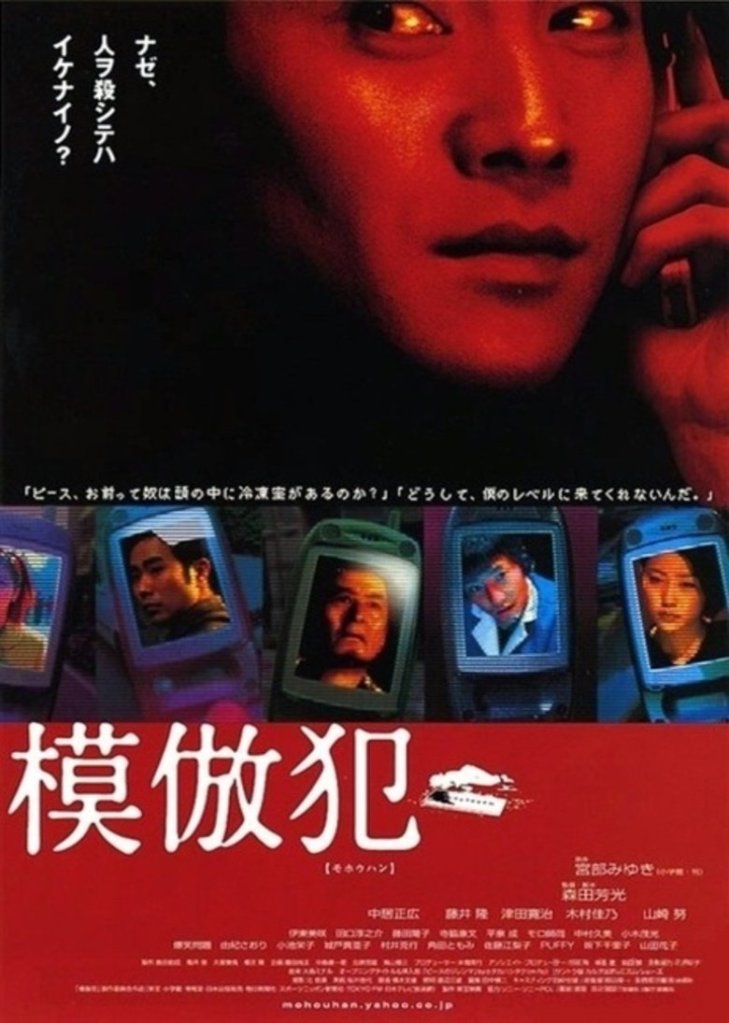
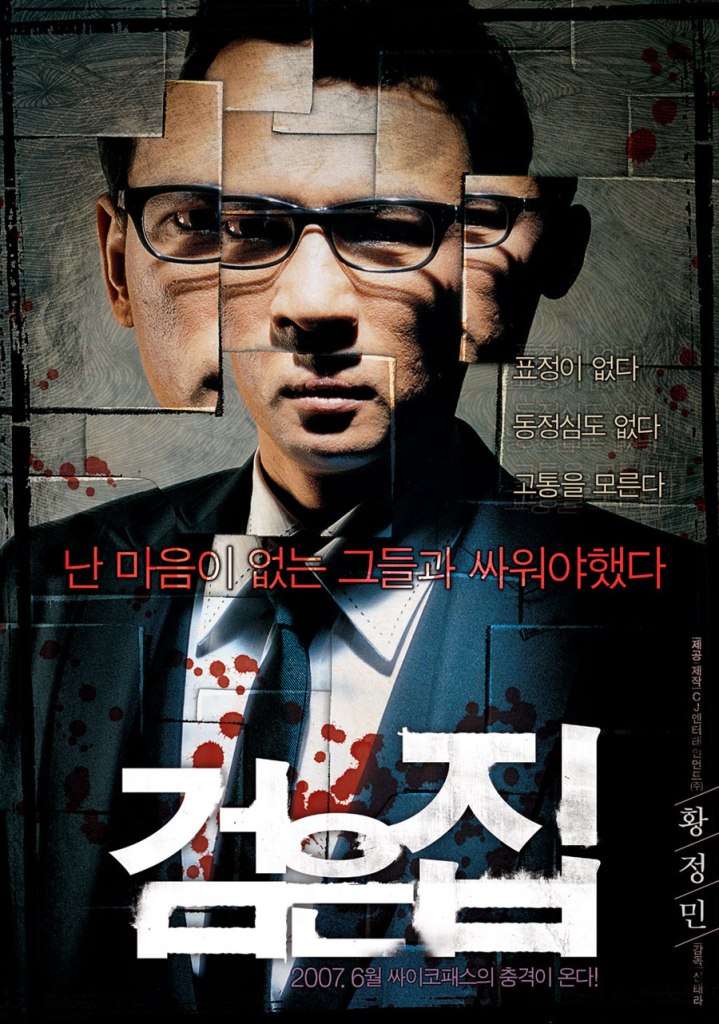
Black House (korea)Yusuke Kishi’s Black House source novel was previously adapted by Yoshimitsu Morita in its native Japan back in 1999, but eight years later the tale made its way to Korea by way of director Shin Terra who opts for a much more straightforward approach than Morita’s characteristically bizarre take. Sold as K-horror, the tone is closer to nasty thriller only giving way to classic slasher action in the final stretch. In eschewing Morita’s idiosyncratic tendency to insert himself into the material, Shin crafts a more mainstream aesthetic, but loses the various layers of social and psychological commentary that went with it.
Juno (Hwang Jung-min) is a mild mannered insurance clerk, new on the job and extremely naive. His first case involves a visit to a hospital with his boss to visit a persistent claimant whom they believe is deliberately scamming the system and possibly with the hospital’s help. In many ways, Juno is an innocent, he believed in insurance as a safety net and a power for social good so he’s shocked that anyone would deliberately manipulate the rules in this way – particularly when he discovers some people will go so far as to deliberately maim themselves just to claim on their insurance policies.

Not long after he starts working at the company, Juno gets a strange phone call from a man asking if insurance policies pay out in case of suicide. It’s possible, Juno says – he’ll need to check the policy to make sure. Suddenly worried the person he’s talking to is in a dark place, he starts trying to dissuade him from the idea of taking his own life and unwisely gives a lot of first hand advice despite the highlighted section in his employee guide cautioning him never to reveal personal information to clients. Soon enough, a client has asked for him personally to go out to their remote house and chat about a policy. When he gets there he receives a nasty surprise as the man’s young son has apparently hanged himself in the back room. Appalled, Juno waits to greet the police but becomes convinced the man has deliberately killed the boy, who was his step-son, to get the payout on his life insurance.

Juno refuses the claim but Choong-bae, the claimant, won’t give up and starts coming to the office everyday to ask for his money. Choong-bae is a scary looking guy and frightens most of the other staff with his vacant staring. He also has an insurance policy on his wife leading Juno to fear that she is next but his decision to try and alert her to her husband’s plans will prove a mistaken one, drawing him into the web of a dangerous and psychopathic serial killer.

Shin’s adaptation is most likely closer to the original novel but he is far less interested in the psychological or social implications than Morita was. There is no explanation offered for the actions of the killer though the childhood sequences with their reliance on dreams and hearsay remain intact, only with lesser impact. The question of insurance fraud and scamsters, people so desperate for money that they will literally sacrifice an arm or a leg, only exists as background and isn’t presented as a societal problem so much as just something that happens because there are some shameless people out there who would rather play the system than do an honest days work. Juno has also been given his own tragic backstory which tries to play him off as a mirror of the killer though somehow this never quite works and Juno’s own flashbacks are overplayed.

Beginning as a slow burn thriller where Juno plays the nervous, softhearted neophyte as yet uninured to the murkiness of the insurance world, Black House (검은집, Geomeun Jip) takes a huge detour during the final third which sends it into slasher territory when Juno decides to travel to the titular Black House, alone, during the middle of the night, because the police won’t listen to him and there are people in danger. When he gets there he finds a veritable house of horrors with body parts and nooses hanging from the ceiling, blood and carnage everywhere. Then it’s a straightforward fight to the death as Juno faces off against the psychopathic terror despite his nervous disposition culminating in some unexpectedly gory business with a key.

Like most slasher movies, Black House has several endings and finishes on a note of uncertainty but it never quite manages to make its sudden descent into violence work in its favour. Lacking the depth of Morita’s adaptation, Shin’s Black House may have stronger genre influences but with nothing to back them up all that remains at the end is a darker than usual serial killer tale with mild slasher tendencies. A decent enough mainstream thriller, Black House has a lot to offer despite stumbling in its final third but nevertheless lacks a distinctive element to mark it out from similarly themed genre efforts of recent times.


Unsubbed trailer:

3-Iron (빈집, Kim Ki-duk, 2004)

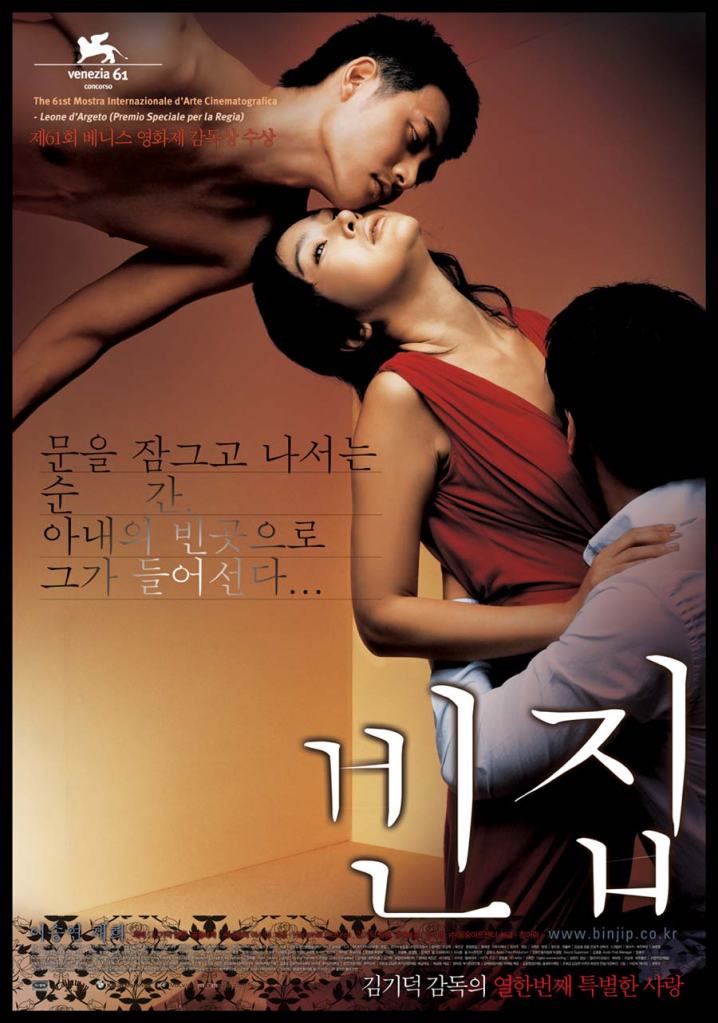
3-ironYou wouldn’t think it wise but apparently some people are so trusting that they don’t think twice about recording a new answerphone message to let potential callers know that they’ll be away for a while. On the face of things, they’re lucky that the guy who’ll be making use of this valuable information is a young drifter without a place of his own who’s willing to pay his keep by doing some household chores or fixing that random thing that’s been broken for ages but you never get round to seeing to. So what if he likes to take a selfie with your family photos before he goes, he left the place nicer than he found it and you probably won’t even know he was there.
Player 2 joins the young man (credited as Tae-suk but unnamed in the film) when he stays at an upscale mansion which turns out to be “haunted” by the still living but damaged figure of a battered wife. Tae-suk hurriedly leaves once discovered, but later thinks over his encounter with the sad seeming lady and decides to return. After an altercation with her violent husband, Sun-hwa leaves with Tae-suk and the pair sneak into various other “empty” homes together. After one particular dwelling reveals a nasty surprise the two bring themselves to the attention of the police who threaten to end their young love story before it’s hardly begun.

Like much of Kim’s work, 3-Iron (빈집, Bin-jip) is near silent and neither of the two protagonists speak one word to each other until final scene of the film. Tae-suk, in particular, seems to have an obsession with being invisible – hiding in blindspots and always making sure to tidy up after himself so well that no trace of his presence remains. Sliding into these mini universes, he seems oddly interested in their inhabitants as he gazes at their photographs and admires the decor. Despite his need to disappear, he builds connections with absent people even going so far as to take a photo with a photo of them, artificially generating some sort of kinship where there is none.

If Tae-suk is haunting the bourgeoisie, Sun-hwa is both spectre and spectee as she moves silently around her golden cage of a spacious villa like a frightened mouse locked inside the elephant house. Evidently further along the stealth game than Tae-suk has been able to progress, her discovery of him leads to a feeling of defeat. Yet, after reconsideration, he recognises a fellow lost soul and so returns to rescue her from her oppressive ogre of a husband by using his weapon of choice against him. The 3-Iron golf club is not only a symbol of the husband’s middle class pretensions, but its relative lack of wear also points to the lack of respect he reserves for his toys – even extending so far as his wife whom he also seems to regard as an “inautonomous” appendage to his image much like the golf club itself.

Kim ends the film with a caption to the effect that it’s hard to tell if the world we live in is reality or a dream. With the continued silence of the film’s protagonist, bizarre scenario of “borrowed” lives, and general surrealism, Kim creates an etherial atmosphere filled with heightened, everyday strangeness. This could be a ghost story – literally, or figuratively, as our haunted protagonists continue their visitations on the living, or a love story, or even an absurd comedy. Tae-suk and Sun-wha exchange roles, alternately comforting or rescuing one another before, perhaps, becoming one at the film’s conclusion. A strange, romantic fairytale, 3-Iron is Kim in an uncharacteristically cheerful mood though he’s careful to remind us that the world outside of this charming bubble is filled with violence, cruelty, and chaos.


3-Iron is available in the UK from Studiocanal and from Sony Pictures Classics in the US though the R3 Korean disc also includes English subtitles.

US release trailer:

Last Quarter (下弦の月 ラスト・クォーター, Ken Nikai, 2004)

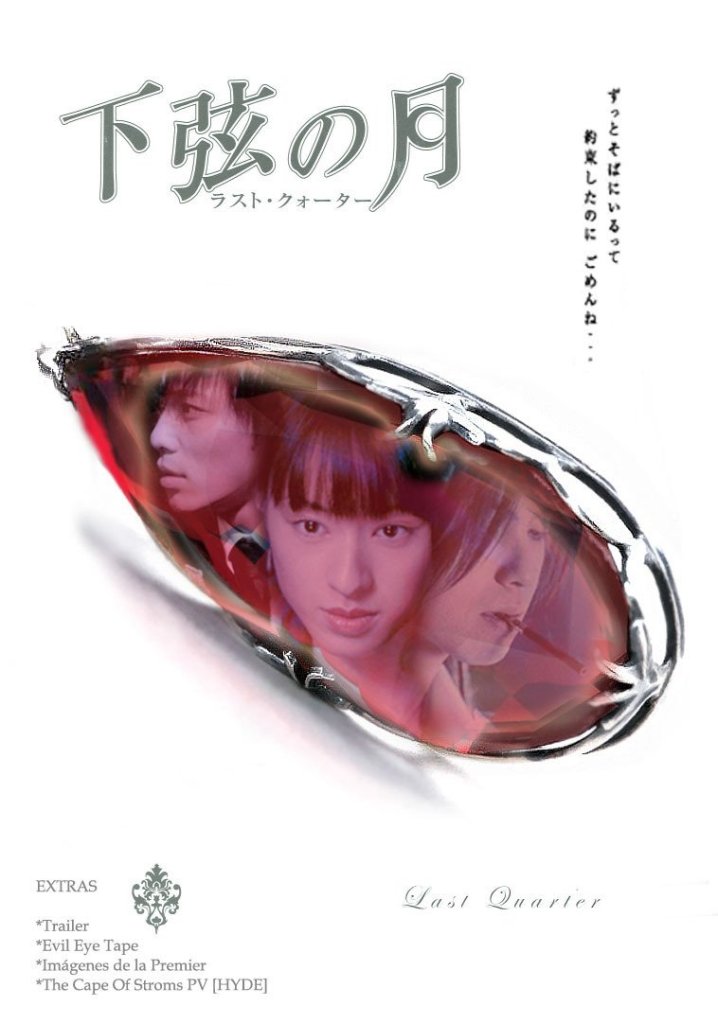
Last Quarter posterTo begin on a cynical note, Last Quarter (下弦の月 ラスト・クォーター, Kagen no tsuki Last Quarter) is a film with a wide variety of marketing hooks. The first being that it’s an adaptation of a much loved short manga series by the well respected mangaka Ai Yazawa (Paradise Kiss) so it has its shoujo pedigree firmly in place. Secondly, pop star HYDE of L’Arc-en-Ciel is central to the production as he both stars in the movie as the ghostly love interest/deathly spirit and repeatedly sings his own songs throughout the film including over the end credits. Thirdly, it also stars actress Chiaki Kuriyama well known to overseas audiences thanks to Kill Bill and Battle Royale. You’d think with all these high quality ingredients first time director Ken Nikai would be able to cook up quite a feast though he does somewhat over egg the pudding.

After a brief dream sequence, the action kicks off at the 19th birthday party of British rock obsessed Mizuki (Chiaki Kuriyama) which takes place in a Mod inspired bar. Unfortunately, her best friend gets very drunk indeed and takes this opportunity to show Mizuki a photo of herself and Mizuki’s boyfriend in a compromising position. Mizuki throws a shoe at the no good philanderer and walks out on her own party ending up at a mysterious Western style mansion occupied by a sad man playing a guitar. She hits it off with “Adam” and decides to jack in her unhappy family life with her father and step-mother to leave for England with him. Sadly, she gets hit by a car on her way home only to wake up trapped inside the house and having lost all memory of who she formerly was. Soon enough, another girl, Hotaru (Tomoka Kurokawa), turns up and, assuming she’s a ghost, decides to help her “cross over” , but it’s all a little more complicated than Hotaru and her team had bargained for.

Last Quarter takes on an oddly imbalanced feel as it veers into star vehicle territory putting HYDE and his title song centerstage at the expense of Mizuki who ought to be the protagonist of the story. Understandably, as she’s fallen under the curse of the house, Mizuki is a mostly passive force throughout the film, entirely reliant on the efforts of the gang of three who are trying to help her by figuring out what’s really going on. The mystery element itself is quite an intriguing one but is often frustrated by the importance placed on the supernatural romance. Stretching plausibility to the limit, the events in question span 30 years and two continents to spin a yarn of pure love enduring beyond the grave. Pure love and grudge movies aren’t usually allowed to mix and they don’t quite here although Last Quarter certainly has elements of both.

Last Quarter’s biggest failing is in its production values which are generally on the low side. Nikai aims for an urban gothic aesthetic and achieves something close to sense of European decadence but opts to avoid the darkness inherent in the genre for a fairytale atmosphere. The effects are very highly stylised and old fashioned but Last Quarter doesn’t even attempt to make that work in its favour so much as offering it at face value.

In essence, Last Quarter often feels like an overblown music video for its rock star actor even if he actually has a relatively small role. Director Nikai has often worked with the band before and (apparently) there is a degree of recurring symbolism here that long time fans will instantly pick up on but will leave the casual viewer a little confused. Very firmly aimed at a younger teen female audience, Last Quarter will play best to fans of non-threatening supernatural romance but even then they’d be best advised to avoid thinking any of this through and simply enjoy the ghostly shenanigans for the ridiculous rag tag narrative they are. An interesting mix of ‘60s mod rocker cool with its parkas and vespas, and full on gothic with byronic heroes sitting in decaying mansions in the middle of creepy forests singing about their broken hearts, Last Quarter is incoherent to say the least but fans of its rockstar leading man will likely find their perseverance rewarded.


Last Quarter is available with English subtitles on R1 DVD in the US courtesy of Geneon.

Unsubtitled trailer:

Hatsukoi (First Love) (初恋, Yukinari Hanawa, 2006)

hatsukoiThe 300 Million Yen Affair is one of the most famous and intriguing unsolved mysteries in Japan, not least because the missing cash has been lying dormant somewhere, apparently untouched, ever since that fateful day back in 1968. Seeing as the true story has never been discovered, the crime has taken on legendary status and become the focus of many kinds of fiction. Misuzu Nakahara’s fictionalised autobiography is just one of these as she retroactively claims responsibility for the robbery as a teenage girl in love with a detached revolutionary.

Misuzu (Aoi Miyazaki) begins her tale a couple of years before the crime as she lives a lonely and introverted life in the house of her uncle, her father having died and her mother apparently absconded with her older brother in tow but leaving her behind. It’s her 16th birthday, but no one cares. Soon enough she starts hanging around a shady jazz bar before another woman convinces her to come inside and join their group of layabout beatniks – a group which is actually lead by her estranged older brother, Ryo (Masaru Miyazaki). These are the heady days of students protests – against the old order, against the ANPO treaty, against the war in Vietnam, against just about everything. Misuzu grows closer to one of their number, the quiet and mysterious Kishi (Keisuke Koide), who has a proposition for her….

Hatsukoi (AKA First Love, 初恋) is a film which is thick with period detail from the authentically smokey, sweaty jazz bar and its counterculture denizens to the nostalgic atmosphere and 1960s street scenes. However, evoking Misuzu’s own sense of ennui, director Yukinari Hanawa opts for a detached, dispassionate tone which is entirely at odds with the otherwise searing, youth on fire tension of the time period. Misuzu is always on the edges of things, younger than the other members of the group she feels as if she’s merely being permitted to stay and listen rather than invited to participate. Nevertheless, even if it’s the case that Misuzu is a by nature a passive person, the film pushes the intense nature of the social revolution going on all around her into mere background, squandering its power to bring out the sense of passion that the film feels as if it needs.

At heart, the robbery is something of a mcguffin as the real story is the true love tragedy hinted at in the title. Misuzu and Kishi grow closer through their plotting of the crime which is born of his desire to commit a different kind of revolutionary act. The money is intended to pay the bonuses of Toshiba employees and Kishi feels the best way to make a protest against economic inequality and the power of large corporations is to hit them in the finances. Misuzu plays her part well enough and the robbery comes off OK despite minor hitches allowing only a brief honeymoon period for its would be Bonnie and Clyde before history begins to move forward and eventually rips them apart. For Misuzu the robbery becomes the defining event of her youth and the birth of the love that she seemingly cannot let go. After this the jazz club is over, the protest movement dies as do some of the protestors, or else they move on to more conventional lives. Not quite a coming of age, but a death of youth before it had hardly begun.

Some injuries never heal, says the kindly old man who teaches Misuzu how to drive. A prescient remark if ever there was one. Misuzu seems locked within this brief period of her youth, before her friends died, left, or disappeared once the turbulent atmosphere of protest and revolution gave way to the consumerist 1970s and everyone forgot about the necessity for social change in the hurry to make money.

Hatsukoi becomes less a about the first love itself than about the period that surrounds it. The love was lost, but so was the bubble in which Misuzu had begun to define herself as a young woman. What Hatsukoi lacks is a sense of personal tragedy, of a soul crushing, spiritual death which locks each of the group members into their own tragic fates and seems somehow dictated despite their insistence on defining themselves in the new, youth centric world. Often beautifully photographed, Hatsukoi’s air of desolation and cold, detached tone weaken its ability to engage making its painful end of youth journey all seem rather dull.


Hatsukoi was released with English subtitles on blu-ray in Taiwan, and on DVD in Hong Kong though both editions now appear to be OOP.

Unsubtitled trailer:

The Suicide Song (伝染歌, Masato Harada, 2007)

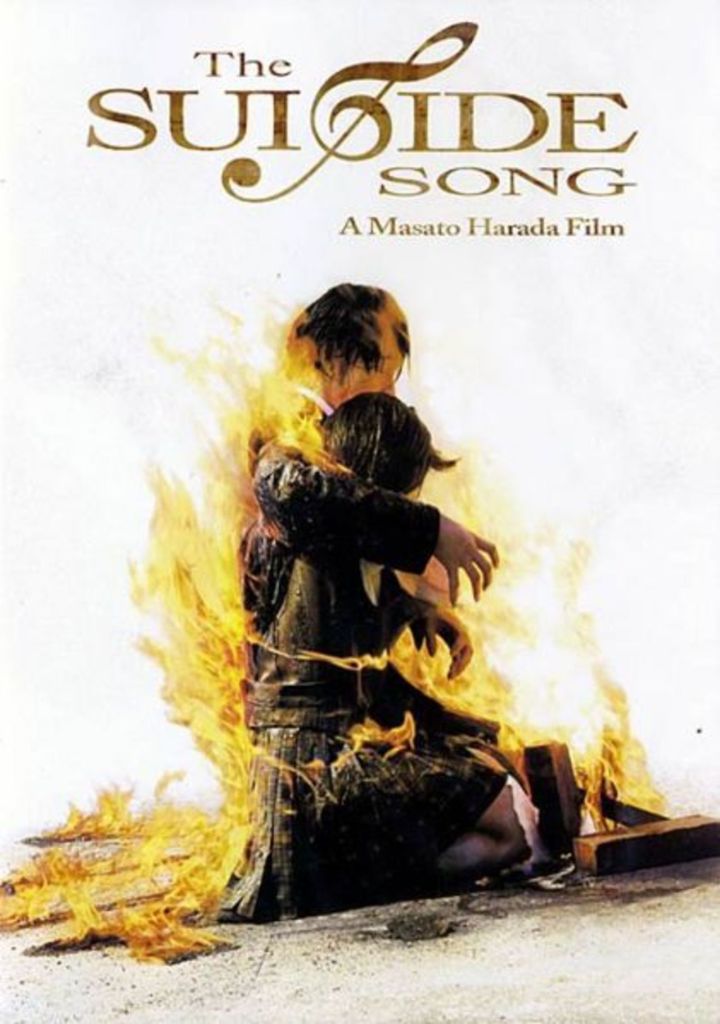
Suicide Song US Tokyo Shock DVD Cover
US Tokyo Shock DVD cover

There comes a time in every director’s life when fate leads them down the strangely tempting path of the idol movie. In recent years, sweet and innocent is no longer quite enough to cut it and when your film stars a bunch of kids from AKB48, you’re going to need 48x the kawaii factor so even though the DVD cover is suitably macabre and The Suicide Song (伝染歌, Densen Uta) is marketed as a J-Horror movie, there’s quite a lot more singing and dancing than might be reasonably expected.

In true idol star horror movie fashion, the film begins with some cutesy high school scenes before one student, Kana (Atsuko Maeda), starts in on her teacher who basically wants to skip a whole bit of the text book because it’s not on the exam. The potentially irrelevant teaching matter concerns famous Japanese playwright Chikamatsu whose big thing was, you guessed it, double suicides. Shortly after this, Kana is heard singing a weird song and then cuts her own throat with a kitchen knife right in front of her friend and classmate, Anzu (Yuko Oshima). It seems there has been a spate of these spontaneous suicides of teenage girls which occur after singing this particular song so skeevy newspaper guys Macasa, led by occult obsessed Riku (Ryuhei Matsuda ) and his ex-military buddy Taichi (Yusuke Iseya), decide to do some “investigative journalism”. Anzu and some of the other kids wind up helping out too, eventually coming under threat of that very same curse….

The idea of a “suicide song” isn’t a new one. Gloomy Sunday – a 1930s Hungarian folk song which achieved widespread acclaim thanks to an English language cover version recorded by Billie Holiday in 1941 became an urban legend after numerous suicides were linked to the doleful track and its extremely bleak lyrics. This time around, it’s AKB48’s inoffensive Boku no Hana which apparently drives anyone who tries to sing it to their deaths. Like Gloomy Sunday, the song features extremely nihilistic lyrics which echo the existential confusion and romantic disillusionment that many of its young listeners are undoubtedly experiencing. A perfectly rational explanation for why so many young women might be taking their lives with this particular song on their lips, yet Suicide Song is not particularly interested in exploring the various real world pressures which might push high school students towards death when their lives ought to be just beginning.

It’s not long before the curse makes the leap to supposedly solid adult males. Later, one character tries to weaken the importance of the song by suggesting that it just opened a door for the suppressed feelings that were already there. That each of the victims already wanted to die and and simply allowed themselves to make use of this real world meme to give themselves permission to end it all. This is an interesting idea in some ways, though comes close to victim blaming and conveniently lets the central characters off the hook for failing to save their friends who have already fallen for what is either a curse or mass hysteria. In any case, like most Japanese horror movies and mysteries, the real villain is a circle of buried secrets. The traumatic past must be faced, brought out into the light and then given a proper burial to end the ongoing chaos.

Harada is playing a very strange game. He adds in generic J-horrorisms such as odd jump cuts, stuttering, power outages and possessed video footage as well as a good deal of shadiness in the form of the low rent newspaper guys and the investigation turning up something as dark as a teenage gang competing to see how many kids they can get to kill themselves using the song as a marker. Yet, he generally keeps things cute and light just like your average teen idol romance movie. We’re even treated to a very special AKB48 performance at their club in Akihabara (“Japan’s Most Sophisticated Show” !) where they sing Aitakatta for a room full of devoted middle aged guys who are their biggest fans. There are also frequent cinematic quotations from such Hollywood classics as Vertigo and The Lady From Shanghai (not to mention a completely shoehorned in paintball sequence using Ride of the Valkyries a la Apocalypse Now) which seem to hint at some kind of greater plan, but whatever it is never quite materialises.

Whatever Harada’s intentions may have been, Suicide Song is a strange beast which veers widely in tone from wacky comedy to supposed horror film. In actuality there are very few real scares despite the J-horror aesthetic and the comedy never amps itself up to the level of parody. If the intention was to create some kind of weird, subversive genre hybrid, the punches have been well and truly pulled. Watched as a horror movie Suicide Song is prone to disappoint, though its moments of absurd comedy and cute schoolgirl drama prove enjoyable enough for those able to adjust their expectations on the turn of a dime.


The Suicide Song is available with English subtitles on R1 US DVD from Tokyo Shock.

English subtitled trailer (aspect ratio is slightly stretched):

Together (和你在一起, Chen Kaige, 2002)

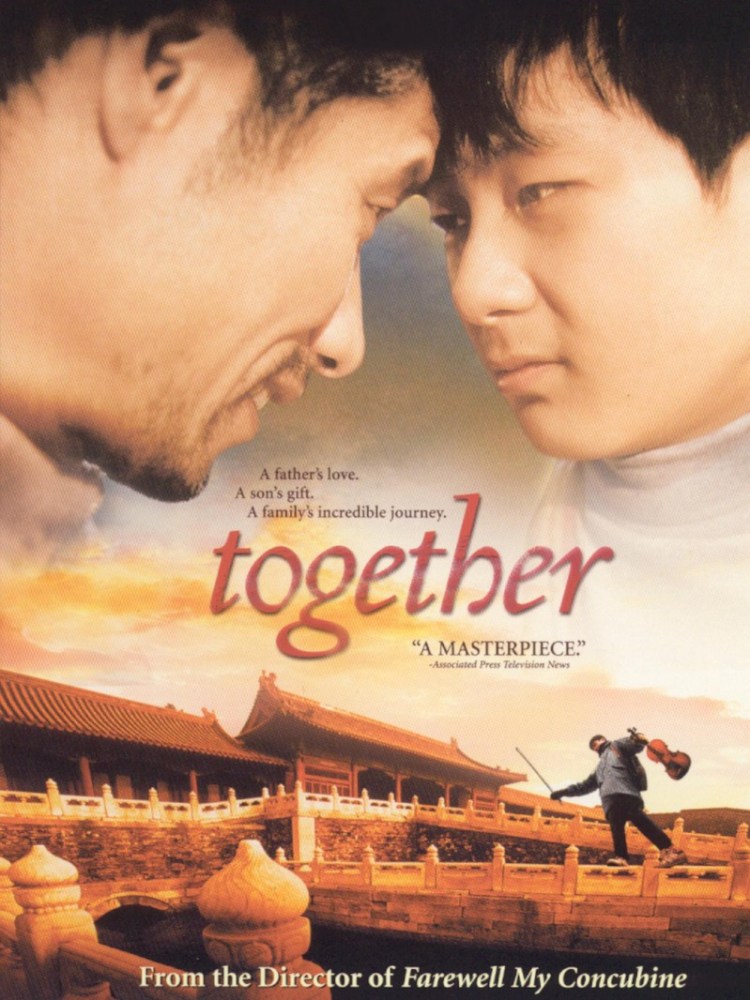
together engIt’s a sad truth, but talent isn’t enough to see you succeed in the wider world. In fact, all having talent means is that unscrupulous people will seek to harness themselves to you in the hope of achieving the kind of success which they are incapable of obtaining for themselves. 13 year old Xiaochun is about a learn a series of difficult life lessons in Chen Kaige’s Together (和你在一起, Hé nǐ zài yīqǐ), not least of them what true fatherhood means and whether the pursuit of fame and fortune is worth sacrificing the very passion that brought you success in the first place.

Xiaochun lives with his father Liu Cheng in a small rural town where he is known for his prowess with the fiddle. In fact, he even gets called in to play some calming violin music at the birth of a local bigwig’s child. After a little boy emerges safely into the world, the bigwig tries to give Liu some money which he refuses but Xiaochun later takes. The big wig congratulates Xiaochun on his understanding of how the world works, unlike his honest and sentimental father.

However, what Liu wants for his son is success so he takes the boy to the big city and enters him in a violin contest. He comes fifth but the contest is rigged in favour of donors to the school and no one wants to take on a poor country bumpkin for a pupil. Eventually Liu convinces an eccentric, lonely professor, Jiang, to give Xiaochun lessons and the pair start to build up a paternal relationship. Xiaochun also makes friends with the beautiful but equally eccentric woman from upstairs, Lili, while his father tries to find work to pay for all these lessons. Eventually Liu ends up at a swanky recital and tries to get Xiaochun to switch to the more successful professor Yu who’s all cold calculation and designer sweaters. This sudden bid for mainstream success drives a wedge between father and son who have very different ideas of what it means to be a “successful” person.

Together isn’t quite the film it seems to set out to be. You’d expect professor Jiang’s broken heart to take more of a centre stage but no sooner have we invested our time in Jiang’s back story of tragic romance than Xiaochun is swept away to the corporate music factory that is Yu’s upscale apartment. We’ve already seen how money and status are everything in this game, donate big bucks to the school and your kid gets the shiny trophy regardless of their actual talent. A depressingly realistic scene right after the contest sees Jiang trying to give a lesson to a clearly disinterested boy while his trashily dressed mother yells at someone on a blinged up cellphone from the other room. When the pair angrily declare they won’t be coming back, the boy is strangely grateful to Jian for “letting him quit” this annoying hobby that his mum obviously made him practice as a kind of status symbol despite the fact he has no ear for music.

Liu is just too bumpkinish for Beijing life, he’s simple and honest which are not good qualities to have in a big city. He insists on wearing a big red hat all the time which screams “not local”, and he even keeps his money in it so, of course, it gets stolen. That said, it’s Liu who wants his son to have the big bucks and a secure life of the kind that Yu can offer him. He sincerely wants this for Xiaochun and is prepared to get out of his way if necessary. Jiang wanted to teach him music and would have done it for free. Yu wants to use him to bolster his own success and is prepared to manipulate him in extremely cruel ways in order to get what he wants out of him. Tellingly, Yu already had a prize pupil living his apartment who is now forced to compete with Xiaochun for Yu’s attention. Now there’s a better prospect on the table, she is being abandoned despite a host of promises and all her hard work. Yu is a businessman, Jiang is an artist.

Now the boy has to choose between three fathers and three futures as he considers just giving up and going home with his father, giving in to Yu’s corporate demands and losing the love he had for playing his instrument in a simple and heartfelt way, or following Jiang’s teachings which, ironically, are all about following the heart. After an extremely late and cruelly presented revelation, Xiaochun has even more to think about with this question but ultimately what matters is heart more than money as a hand knitted sweater proves warmer than an expensive fur coat.

Together has a number of structural problems that frustrate its passage either as a Hollywood influenced feel good tale of a poor boy and his violin or a gritty indie movie about how talent doesn’t matter in a world ruled by social status and reputation (which is sort of like a futures market in an odd way, everyone buying into something which doesn’t quite exist). Liu and Xiaochun meet a lot of nice “salt of the Earth” people in the big city (except for Yu) but are perpetually locked out of the next stage of the game through not having the right connections. Liu, in his simple and honest way, doesn’t understand this so he’s able to pressure right through it but his son who is more pure hearted but also practical finds navigating its series of traps and temptations endlessly confusing. Edging into sentimentality in the final third, Chen can’t quite bring his sonata to the crescendo he seems to be aiming for but still finishes with a warmly received round of applause.


Together was released in the UK by Momentum under the title Together with You (presumably to avoid confusion with Lukas Moodyson’s film of the same title released not long before) which is a more literal, if slightly awkward, translation of the original Chinese. The disc itself and menu screen both remain “Together”. The UK disc may be technically OOP but the film is also available in the US from MGM.

Failan (파이란, Song Hae-sung, 2001)

FailanSometimes God’s comic timing is impeccable. You might hear it said that love transcends death, becomes an eternal force all of its own, but the “love story”, if you can call it that, of the two characters at the centre of Song Hae-sung’s Failan (파이란, Pairan), who, by the way, never actually meet, occurs entirely in the wrong order. It’s one thing to fall in love in a whirlwind only to have that love cruelly snatched away by death what feels like only moments later, but to fall in love with a woman already dead? Fate can be a cruel master.

The titular Failan (Cecilia Cheung) is a migrant from mainland China who’s travelled to Korea in search of her last remaining relatives following the death of her family. Unfortunately, they moved abroad some time ago and no one knows how to contact them. Stuck in Korea, Failan is running out of options but a “kindly” woman suggests a phoney visa marriage so she can legally stay in the country and earn her keep at the same time.

So, she ends up married to the feckless petty gangster-cum-video-store-proprietor Kang-jae (Choi Min-sik). We meet him around a year later and it’s his story we follow for the first half of the film as he gets out of jail after being arrested for selling adult videos to horny teenagers. Kang-jae quickly gets into an argument with his gangster boss, Young-sik (Son Byung-ho), but as they’re also old friends they patch things up over a drink only for the evening to go way south when Young-sik spots a rival gang member and ends up beating him to a bloody pulp whilst in a trance-like rage.

Young-sik is young and ambitious so when the crime is discovered he pleads with Kang-jae to take the rap for him, promising that he’ll buy him that fishing boat he’s always wanted so he can go back to his home town when he gets out. Kang-jae goes home to think it over and gets a knock on the door, two policemen are standing outside only they haven’t come to arrest him – the wife he’d forgotten all about has died. Kang-jae has hit a fork in the road both literal and metaphorical and takes a road trip with his best friend to finally meet his bride in a cold and lonely place.

Failan is almost a plot device in the film that bears her name, but her story is a sad and a hard one. Orphaned and alone she finds scant kindness in her adopted country but the woman who runs the laundry where she ends up working does at least develop an almost maternal feeling for her. Failan feels great gratitude to Kang-jae for agreeing to marry her so she could stay in Korea and is convinced he must be a very good, very kind person. She thinks this largely because she never meets him.

Kang-jae is rubbish at being a gangster. Young-Sik may have a point when he says he doesn’t have the heart for it. Early on, some of the youngsters try and rope him into an extortion scheme where they’re trying to get an old granny to pay back some of her loan. Apparently the granny had once been kind to Kang-jae when he was young and hungry so he doesn’t really put a lot of effort into being menacing towards her which makes him lose face with the young toughs who think of him as a joke anyway. Reading Failan’s letter, it’s the first time that anyone has ever said anything nice about him. The first woman who ever thought he was worth anything at all and she’s already lost to him before he even knew her.

Kang-jae is not a good man, he’s an underling just muddling through without thinking. He leaps from one thing to another always thrashing around landing where falls. He has a vague ambition to get the money together to buy a fishing boat and go home, but he’s not seriously pursing it. Even the group of gangsters he’s involved with are so laughably low rent that they can’t hold on to their completely worthless territory and have to put pressure on old ladies just to get by. After reading Failan’s letter and hearing that someone believed he was better than this, Kang-jae finally wakes up and starts thinking about his life with the ultimate realisation that he doesn’t have to live like this. Unfortunately, he might have just picked the wrong day to start living the rest of his life.

In many ways Failan is a typical melodrama filled with the pain of unrealised love and Fate’s ironic sense of timing. Based on a novel by the modern Japanese master of the tearjerker Jiro Asada (Poppoya), Failan seems engineered to rend hearts with its tale of true love frustrated by time and circumstance where every ounce of hope and goodness is well and truly trodden into the ground by the time the credits roll. Nevertheless, Song keeps things on the right side of schmaltzy, never racking up the misery and heartbreak beyond the threshold of plausibility. Like all the best melodramas, Failan’s sentimentality is sincere and, ultimately, moving. Another sad story of salvation arriving too late, Failan’s tale of tragic, unrealised love is an all too familiar one but effectively told it can’t fail to tear the heart.


You can currently stream Failan via Amazon Video in the US courtesy of Asian Crush, but the Korean R3 DVD and Region A blu-ray both contain English subtitles!

Unsubbed trailer:

Tsubaki Sanjuro (椿三十郎, Yoshimitsu Morita, 2007)

Tsubaki Sanjiro horizontalGenerally speaking, where a film has been inspired by already existing source material, it’s unfair to refer to it as a “remake” even if there has been an iconic previous adaptation. That said, in the case of Tsubaki Sanjuro (椿三十郎), “remake” is very much at the heart of the idea as the film uses the exact same script as the massively influential 1962 version directed by Akira Kurosawa which also starred his muse Toshiro Mifune. Director Yoshimitsu Morita is less interested in returning to the story’s novelistic roots than he is in engaging with Kurosawa’s cinematic legacy.

Sanjuro is a more populist offering from Kurosawa in any case and adheres to a fairly simple plot which picks up with the hero of the previous year’s Yojimbo, still a wandering ronin living on his wits and his sword. In actuality the script was altered a little to connect the two films even though the original novel has nothing to do with Yojimbo. Anyway, the story is set in a small town in which the hotheaded young men have got a bee in their bonnets about corruption at the higher levels and have taken it upon themselves to do something about it. Unfortunately they have no idea what they’re getting themselves into and are about to make things even worse. Sanjuro duly arrives, overhears their idiocy and gives them some advice before heroically saving all their lives through cleverness. Later, when one of the young men’s relatives is kidnapped, Sanjuro decides to stay and help them sort this giant mess out before they do themselves a mischief.

Obviously, Morita uses the same script so Tsubaki Sanjuro has exactly the same plot as the 1962 film. This does lend it a slightly uncanny quality as its use of language and the structure of the script itself are much more of their own time – a fact brought out by the very theatrical performances of the only two female faces in the film who speak in very pointed and deliberate manners. That said, what Morita attempts to do is bring out even more of the ironic, dark comedy that underpins Kurosawa’s film but is very much played as background. Morita isn’t playing it as farce or as parody, but brings the same wry, almost mocking eye to the proceedings as he brings to to his contemporary satirical comedies.

Bayside Shakedown star Yuji Oda is cast in the role of Sanjuro but really of course he’s expected to play Mifune. He doesn’t have Mifune’s sheer presence and force of personality – who does? but he does a good job of adopting his wiseguy, casual grifter with a sentimental heart persona. We don’t know who Sanjuro is – he gives what is fairly obvious to be a fake name and seems to be a masterless swordsman content to travel in rags and live on the “kindess” of strangers, but you get the feeling he’s already got it all figured out and always knows the best way to handle any situation no matter how desperate it might seem.

If what Morita is trying to do is make a modern Kurosawa movie, he somewhat succeeds. Though he throws in the odd homage to the Kurosawa corpus, mostly he opts for a contemporary approach though one with an old fashioned kind of stateliness – no handheld camera here, wide and tracking shots rule the day. The score too remains in the classical jidaigeki realm with obvious call outs to Sanjuro’s own western leaning themes.

Morita himself can be something of a chameleon in the director’s chair, his style isn’t so personally defined but tailored to the project itself which can make him seem a little dull where he isn’t trying to add a layer of experimentation which is the thing which really interests him. Tsubaki Sanjuro’s experimentation is closer to mirroring – he’s not doing a Gus Van Sant Psycho style experiment, but he’s refracting Kurosawa for a modern audience raised on TV drama and idol stars. It works, to be sure, but perhaps it worked better for Kurosawa (unfair as that is to say).

Ultimately, Tsubaki Sanjuro is something of a curate’s egg. As it is intended to, the film has its generic sides in its fairly ordinary modern samurai movie aesthetic, though it never overplays these and cleverly adds in a more modern approach with a perfectly matched subtlety. Its cast of young men skew younger than in the original film making their naivety even more believable and lending weight to Oda’s performance which captures both his character’s gruff aloofness and his instant born leader abilities. Enjoyable enough in its own right, Tsubaki Sanjuro can’t reach the heights of the film which inspired it, but then perhaps it is not intended to, but simply to entertain with a familiar tale retold as broad comedy rather than mild satire.


Available with English subtitles on region free DVD in the US from Bonzai Media Corp. RSP

Unsubtitled trailer: