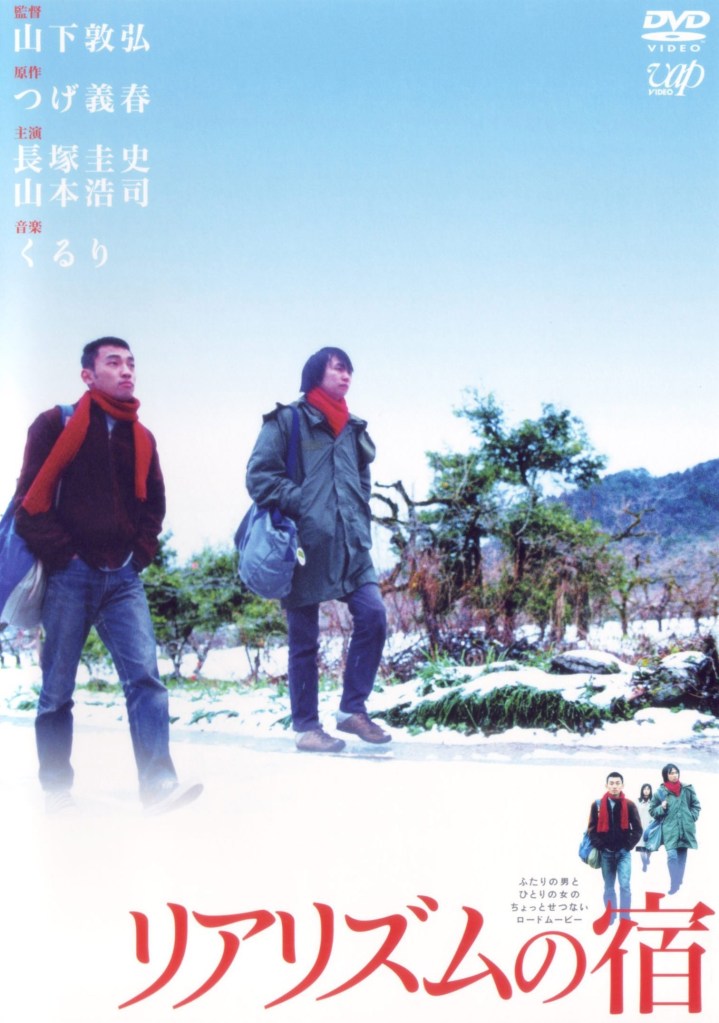
Ramblers (リアリズムの宿, Nobuhiro Yamashita, 2004)

ramblers-riarizumu-no-yado.39798

Nobuhiro Yamashita is well known for his low-key, naturalistic style often focusing on the everyday musings of youthful slackers. Ramblers (リアリズムの宿, Realism no Yado), his third feature film takes this idea and pushes it to the max as it follows two filmmakers wasting time in the mountains after their ultimate slacker actor friend lets them down at the last minute.

The two guys are Tsuboi, a screenwriter and the younger of the two, and Kinoshita – a director and a little bit older in his late twenties. The trip has been organised by a mutual acquaintance, Funaki, who’s an actor and the other two have met once or twice before but don’t exactly know each other. Funaki has overslept and will be late, or he might just come tomorrow or something. He tells the other two to go ahead without him. With nothing else to do the two guys wander off into the mountains to kill time while they wait for their Godot-like friend where they have various encounters with the strange mountain-folk all while a gentle friendship builds up in the background.

By far the most important episode occurs whilst the pair are sitting on the beach “rambling” on about nothing in particular when a scantily clad young woman, Atsuko, comes running towards them out of the sea. Hilariously, the pair try to run away as if she were some kind of terrifying sea monster but eventually decide to help her after she tells them that all of her belongings, including her wallet with her ID and money, have been washed away to sea. They end up adopting her for two or three days, paying for her new clothes, meals and board each a little taken with her but nothing untoward in mind. Suddenly this episode ends, leaving a curious hole in the young guys’ relationship.

Other than getting to know Atsuko, the guys waste time fishing, chatting with the interesting staff at the various inns they end up staying at and just generally hanging around wondering where the hell Funaki has got to. Having failed to arrange accommodation (slackers!) the pair decide to inn hop a little whilst roaming around the area though it’s definitely the off season. After their adventure with Atsuko the boys’ funds start to run down and they’re reduced to sharing meals which gets them noticed by a shady guy in cafe who insists they stay over with his friend – though it turns out to be not really his friend’s place at all and, feeling awkward, the pair attempt to find somewhere else last minute ending up at every traveller’s worst nightmare. The final “inn” is not even really a B&B, just a freezing room in someone’s house which is filled with children, a father who’s dying in the corner and a bathroom which would definitely not pass any kind of health and safety regulation. Getting a little fed up, the boys spend their final night laughing off the strange and sometimes rotten adventure they’ve been having – wondering first about Atsuko and then feeling annoyed about their “friend” who doesn’t seem to have been very invested in this particular enterprise.

As usual for a Yamashita movie, nothing really happens while quite a lot is happening. We get invested in Tsuboi and Kinoshita’s vacation as their friend pulls a Godot style stunt on them by repeatedly failing to appear but always promising to be there soon. Whilst travelling and killing time the two guys talk about various things and get to know one another better. Their time with Atsuko actually seems to bring them closer together rather forcing them into the roles of rivals, though a late stage revelation about Atsuko’s sudden disappearing act may also give them a collective sense of befuddlement mixed with mild guilt. The Ramblers ramble on for 83 minutes, though it never feels like an over extended stay. Once again Yamashita crafts a low-key, nuanced character piece that allows his naturalistic, humorous eye to shine through.


Suprisingly, you can actually buy this on UK iTunes with English subtitles!

 

The Foreign Duck, The Native Duck and God in a Coin Locker (アヒルと鴨のコインロッカー, Yoshihiro Nakamura, 2007)

YgoLt - ImgurReview of The Foreign Duck, The Native Duck and God in a Coin Locker over at uk-anime.net I really enjoyed this one – great movie!


Director Yoshihiro Nakamura once again returns with another adaptation of a Kotaro Isaka novel, The Foreign Duck, The Native Duck and God in a Coin Locker (アヒルと鴨のコインロッカー, Ahiru to Kamo no Coin Locker). Having previously adapted Fish Story (also available from Third Window in the UK and itself a very fine film) and Golden Slumber, Nakamura and Isaka seem to have formed a very effective working relationship and this latest effort is another very welcome instalment from the duo. Elliptical, melancholic and thought provoking The Foreign Duck, The Native Duck and God in a Coin Locker is a minor gem and every bit as whimsical as its name would suggest.

Shiina (Gaku Hamada) has just left the small town shoe shop his parents own to study law in Sendai. Moving into his new apartment he attracts the attention of his neighbour, Kawasaki (Eita), who overhears him signing Bob Dylan’s Blowing in the Wind. Kawasaki is himself a great admirer of Dylan remarking that his is ‘the voice of God’. Aloof, cold, at once dominating and indifferent the prospect of developing a friendship with the mild mannered, short and shy Shiina seems an odd one but nevertheless the two seem to develop a bond. Kawasaki therefore proposes Shiina help him with a rather peculiar problem.

Shiina’s other neighbour, who rudely rebuffed Shina’s introduction and moving in present, is apparently a foreigner – Bhutanese to be precise – and although speaks fluent Japanese cannot read. He’s particularly perplexed by the different between ‘ahiru’ – the native duck, and ‘kamo’ – the foreign duck, and is sure that if he had a good dictionary he’d be able to understand the two fully and thus perfect his Japanese. To this end Kawasaki has decided to steal a Kanji Garden Dictionary for him and wants Shiina to help. Understandably confused Shiina originally declines but is soon bamboozled into helping anyway. There’s a lot more to all of this than a simple semantic quandary though and the only thing that’s clear is that Shiina has gone and gotten himself embroiled in someone else’s story.

‘That sounds like something you just made up’ is one of the first things Shiina says to Kawasaki and indeed everything about him seems studied or affected in someway as if he were reciting someone else’s lines – essentially performing the role of himself. Half of the crazy stuff he comes up with, like his warning Shiina to avoid a particular pet shop owner completely out of the blue, sounds as if he’s just invented it on the spot for a laugh were it not for his distant and humourless manner. Without spoiling the plot too much, you start to get the feeling that there’s really something slightly off about everything you’re being told, that crazy as it seems it is the truth in one sense but perhaps not in another. This is where the mystery element of the film begins to kick in – who is Kawasaki really? What is he on about? Is any of this really happening?

Wistful in tone, The Foreign Duck, The Native Duck and God in a Coin Locker is only partly a mystery, it’s also a bittersweet coming of age tale and an, admittedly light, examination of the Japanese attitude to foreignness. Away from home for the first time Shiina is obviously keen to strike out on his own and be his own his own person but at the same time wants to fit in and be liked by his classmates. A particularly telling incident occurs when a confused Indian woman tries to get some information at a bus stop only to be ignored by those waiting. Shiina seems to feel as if he ought to help her but having just heard two of his classmates complaining about ‘stupid foreigners’ does nothing. Feeling guilty he tries to reach out to his Bhutanese neighbour but is again rebuffed. Kawasaki wants to know the difference between the foreign duck and the native one – is there such a fundamental difference? As one character says ‘you wouldn’t have talked to me if you’d known I was a foreigner’ ‘Of course I would’ Shiina replies ‘no, you wouldn’t have’ his friend responds with resignation. Isn’t it better to just help those who need it, whoever or whatever they happen to be?

The Foreign Duck, The Native Duck and God in a Coin Locker maybe a little darker than its title suggests but its tone is definitely to the wistful/whimsical side – this juxtaposition might irritate some who’d rather a more straightforward mystery or a lighter, more conventional comedy but its refusal to conform is precisely what makes it so charming. That it also manages to pack in a decent amount of social commentary in an interesting way is to its credit as is its ability to make the totally bizarre seem perfectly natural. The Foreign Duck, the Native Duck and God in a Coin locker is another impressive feature from the creators of Fish Story and fans of that earlier film will certainly not be disappointed by their latest work.


Original trailer (English subtitles)