Eungyo (AKA A Muse, 은교, Jung Ji-woo, 2012)

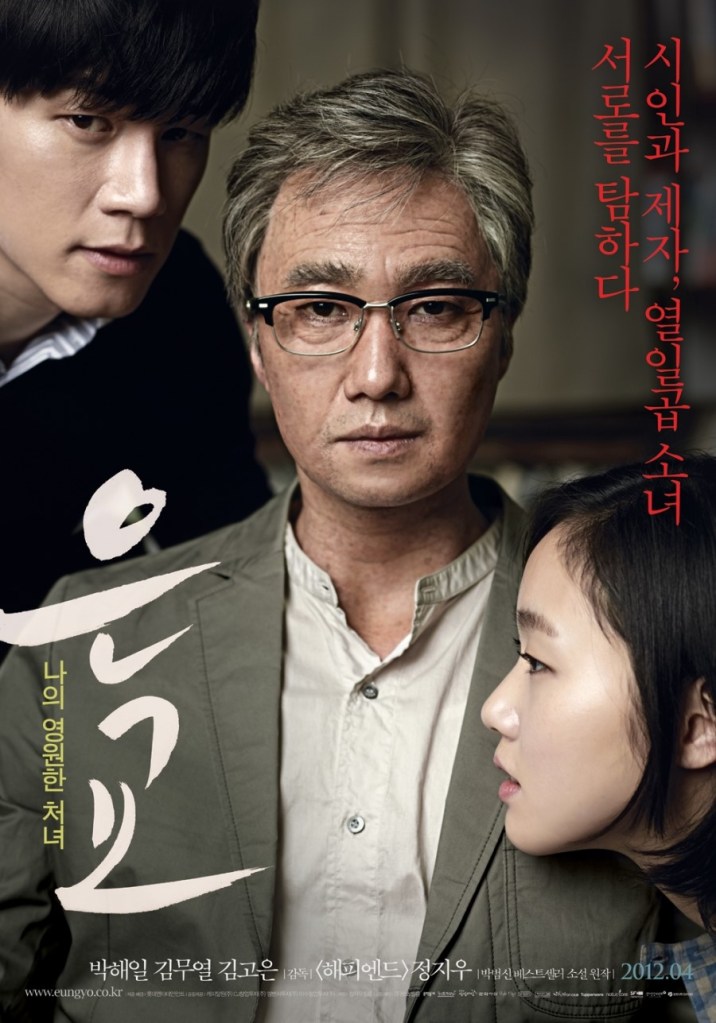
eungyoStories of old men trying to recapture their lost youth through projecting their fantasies onto pretty young women are not exactly rare and the protagonist of Jung Ji-woo’s Eungyo ( AKA A Muse, 은교) is just as aware as most that his dreams of youthful romance border on the ridiculous. A tale of loss, nostalgia, and jealousy both professional and personal, Eungyo is a poetic exploration of the burdens and benefits of age which are often invisible to those who can only look forwards.

At 70, Lee Jeok-yo (Park Hae-il) is a respected professor and literary giant who lives a quiet and solitary life in an out of the way villa. His only companion is his apprentice-cum-assistant, Seo Ji-woo (Kim Moo-yul), who is currently experiencing a period of success as his genre crossing novel Heart is topping the best seller list. When the pair return home one day to find pretty teenager Eungyo (Kim Go-eun) asleep in their garden chair, it sparks off a three way relationship which sees her working as part-time housekeeper for Jeok-yo.

Eungyo is a lively young girl and brings a little light and laughter into the otherwise stuffy villa but when she runs away from home one stormy night and stays over, the situation changes. Catching sight of Eungyo emerging from Jeok-yo’s bed, Seo jumps to the obvious conclusion and is filled with moral outrage in thinking his aged boss is conducting an inappropriate relationship with a schoolgirl. Or, perhaps, Seo himself is attracted to the girl and is angry that Jeok-yo has once again “beaten” him and proved himself superior on the fields of both literature and romance. Eungyo’s presence deepens the divide between master and pupil, threatening to change both of their lives forever.

Jeok-yo is under no illusions and never contemplates the idea of real relationship with Eungyo. His life had been a quiet and solitary one, though there’s little indication exactly how he felt about that. What is clear is that Jeok-yo dislikes his ageing body and the loss of his youth. In his fantasy romance, Jeok-yo is young, running and playing like a naive teenager in love but as soon as he wakes up the spell is broken, he’s old again and the idyllic world he’d conjured for himself no longer exists.

Even if he dreams another world for himself, Jeok-yo is perfectly aware of how things are in this one. Ji-woo, by contrast, attempts to solve all his problems by deluding himself into believing his future is brighter than it really is. His professional relationship with Jeok-yo turns out to have an unexpected dimension and Ji-woo’s literary success is a hollow pillow for his self esteem. Insecure about his talent, especially in comparison to his mentor, Ji-woo sets about casting himself as morally superior through his objection to Eungyo’s new role in their lives but this too is a thinly veiled way of trying to eclipse his master. All Ji-woo has to offer is his youth but even this cannot heal his loneliness and lack of self worth.

Eungyo becomes a symbol of something else for both men but she is also a young woman with a number of problems of her own. Faced with an apparently difficult home environment, Eungyo is seeking a connection from these two men but her borderline status as an adolescent girl means that the water is always coloured with both men viewing her as a potential lover rather than a child in need of shelter. Coming to admire Jeok-yo for his poetic soul and literary talent and siding with him against Ji-woo, Eungyo later makes a self destructive decision which ends her relationship with both men.

There are no happy endings here, even if the idea of a “happy ending” is not quite as ironic as in Jung’s previous film centring on marital infidelity, Happy End. Nobody gets what they wanted or what the audience wanted for them and each end up unable to come back from the whirlwind of self destruction which they’ve each helped to generate. A nuanced character piece in which age competes with youth, loss competes with gain, success competes with personal fulfilment, and true feeling is sacrificed for a relief from loneliness, Eungyo is deceptively named not for the young woman at its centre but for the collection of hopes, dreams and aspects of self which each of the men have imbued her with, eclipsing the real woman with an imagined prize and losing her in the process.


International trailer (English subtitles)
What a Wonderful Family! (家族はつらいよ, Yoji Yamada, 2016)

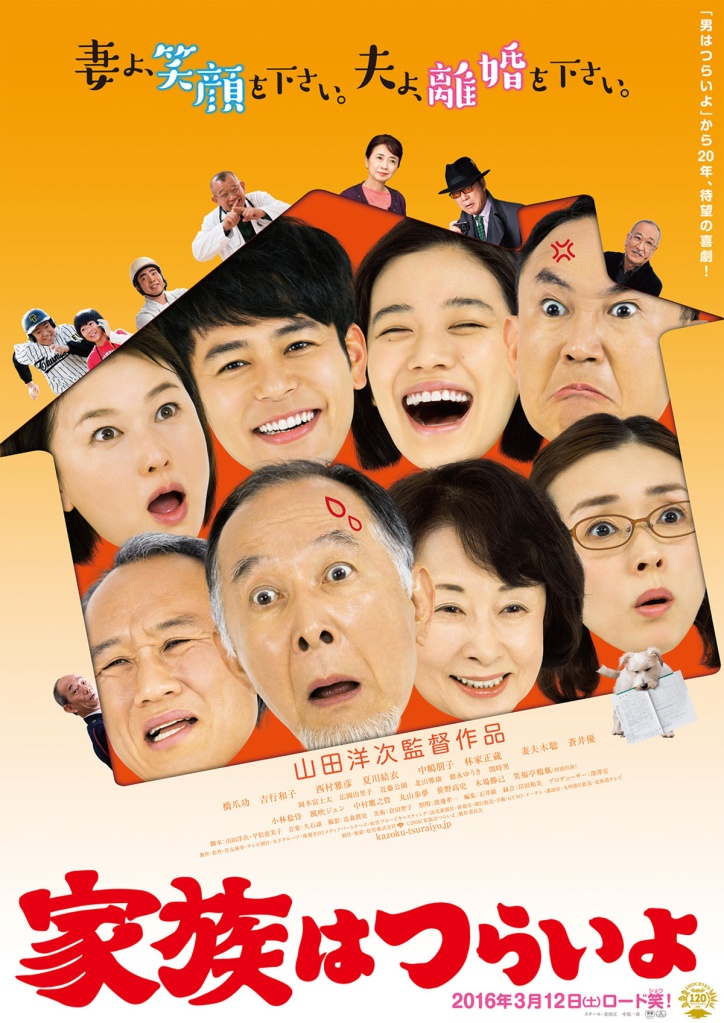
what-a-wonderful-familyProlific as he is, veteran director Yoji Yamada (or perhaps his frequent screenwriter in recent years Emiko Hiramatsu) clearly takes pleasure in selecting film titles but What a Wonderful Family! (家族はつらいよ, Kazoku wa Tsurai yo) takes things one step further by referencing Yamada’s own long running film series Otoko wa Tsurai yo (better known as Tora-san). Stepping back into the realms of comedy, Yamada brings a little of that Tora-san warmth with him for a wry look at the contemporary Japanese family with all of its classic and universal aspects both good and bad even as it finds itself undergoing number of social changes.
Once upon a time it was normal for the entire family clan to live together, sons bring their wives to their father’s house, become fathers and then grandfathers themselves passing the property on their eldest when they go. After the war everything changed, the return to prosperity brought about a greater need for mobility as well as increasing desire for privacy and individual freedom which saw the domestic environment shrinking.

The Hiratas still live the old way with “difficult” family patriarch Shuzo (Isao Hashizume) nominally in the lead but spending his retirement in the local bar flirting with the mama-san, Kayo (Jun Fubuki), who is gracious, but extremely skilled in her work which often involves deflecting the attentions of the clientele. His long suffering wife, Tomiko (Kazuko Yoshiyuki), eases her boredom with classes at the local community centre while the wife of eldest son Konosuke (Masahiko Nishimura), Fumie (Yui Natsukawa), has taken taken over the running of the household whilst also taking care of her two sons. The house is also still home to sensitive youngest son Shota (Satoshi Tsumabuki), and a point of refuge for daughter Shigeko (Tomoko Nakajima), during her inevitable fights with mild mannered husband Taizo (Shozo Hayashiya).

When Shuzo can’t really be bothered with his wife’s birthday, he asks her what she’d like as a present – as long as it’s not too expensive, he’s not made of money after all. That’s no problem she says, what I want only costs 450 yen. Shuzo’s confusion gives way to shock as he realises the bit of paper he’s just been handed is a petition for divorce….

Tomiko’s reasoning is sound, the position she’s been occupying for the last forty years is, effectively, a job. Now that the children are grown and another woman has taken over the domestic responsibilities, Tomiko wants to retire and enjoy some well earned freedom at last. The decision sends the entire family into a spiralling existential crisis as they contemplate this unexpected development and what it could mean for their previously ordinary way of life.

It would be nice to think men like Shuzo are a dying breed, so gruff and aggressive that his own daughter-in-law almost hangs up on him thinking he’s an “ore ore” scammer. Having worked hard for his family throughout his life, he feels a tremendous sense of entitlement in playing the king of his own domain. Tomiko, by side all these years putting up with his rudeness, selfishness, and inconsiderate behaviour is thoroughly sick of being taken for granted and unfavourably compared to a bar hostess whose job it is to stroke her husband’s ego.

More challenges to the domestic set up occur when youngest son Shota, still living at home into his 30s, decides to move out and get married. The polar opposite of his brash father, Shota has often been the mediator between different family factions which might well have gone to war and destroyed the household long before now were it not for his calming influence. A marriage would usually be a cause for celebration but Shota has picked exactly the wrong time to introduce his lovely new fiancée, Noriko (Yu Aoi), to the family right in the middle of this extended moment of crisis.

Divorce is still a taboo subject in Japan carrying its own degree of stigma whatever the circumstances which makes Tomiko’s sudden bid for individualistic freedom all the more difficult to understand for her family. This is thrown into sharp relief when Tomiko begins enquiring about Noriko’s family background and discovers she is actually the child of divorced parents only to have a momentary flash of distaste or perhaps mild disapproval before getting over it and trying to make her son’s future wife feel welcome even in this quite tense domestic environment. Disconnected from her own family, being suddenly thrown into the deep end with the boisterous and perhaps too closely involved Hiratas might be a little overwhelming for Hirata-in-waiting Noriko but luckily she takes to it well enough and perhaps finds the liberated frustrations of the large family unit a warm rather than intimidating experience.

It is, indeed, hard being a family. Total honesty is neither possible nor advisable and harmony is largely born of mutual compromise but the essential thing is understanding – both of everyone else’s feelings and of everyone’s unique places within the familial system. Like any good Japanese family drama things have to change so that everything can stay the same, and there’s a poignant moment towards the end where we observe the large number of vacant family homes in the neighbourhood where the elderly owners have either died or moved into residential care facilities while their children and grandchildren founded homes of their own. At the end of the day all anyone wants is a degree recognition as an individual rather than as an embodiment of a concept and if certain people are able to swallow their pride, there might still be hope for the old ways yet.


HK Trailer (English/Traditional Chinese subtitles)

Erased (僕だけがいない街, Yuichiro Hirakawa, 2016)

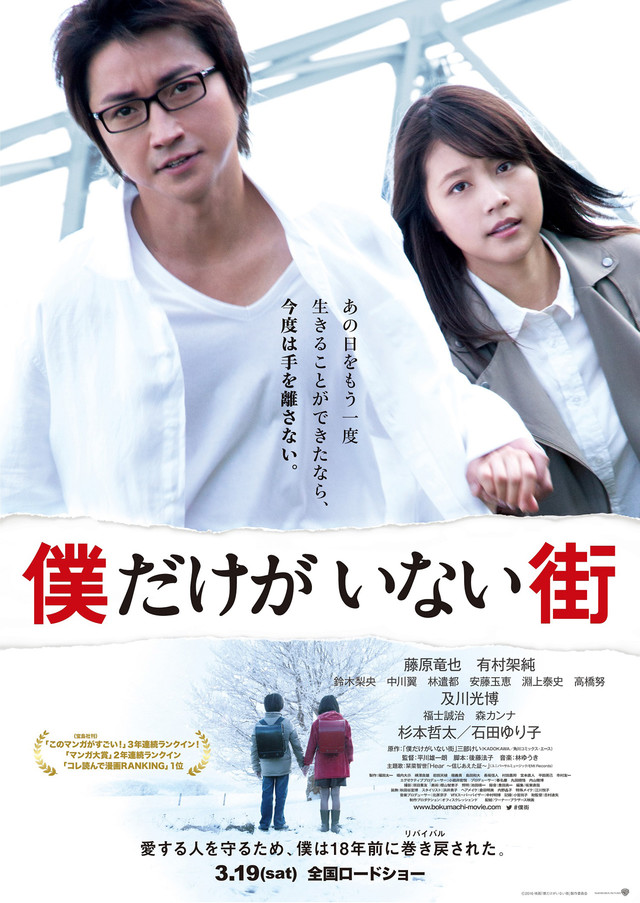
erasedErased (僕だけがいない街, Boku Dake ga Inai Machi), a best selling manga by Kai Sanbe, has become this year’s big media spectacle with a 12 episode TV anime adaptation and spin-off novel series all preceding the release of this big budget blockbuster movie. Directed by TV drama stalwart Yuichiro Hirakawa, the live action iteration of the admittedly complicated yet ultimately affecting story of a man who decides to sacrifice himself to ensure his friends’ happiness, acquits itself well enough for the most part but changes two crucial details in its concluding section which unwisely undermine its internal logic and make for an unsatisfying conclusion to the ongoing puzzle.
Beginning in the “present” of 2006, Satoru Fujinuma (Tatsuya Fujiwara) is an aspiring mangaka making ends meet with a part-time job as a pizza delivery guy (a kind of “Hiro Protagonist”, if you will). Aloof and sullen, Satoru has no real friends but does possess an unusual supernatural ability – if a tragedy is about to occur in his general vicinity, he will enter a “Revival” loop in which he temporarily rewinds time, allowing him to figure out the problem and save everyone’s lives. Rescuing a child about to be hit by an out of control lorry, Satoru rides his pizza delivery bike into an oncoming car and winds up in hospital.

When he comes to he finds cheerful co-worker Airi (Kasumi Arimura), who witnessed the accident, waiting for him as well as his mother (Yuriko Ishida) coming in for visit. Reconnecting with his mother and getting closer to Airi (albeit reluctantly) Satoru’s life appears to be brightening up but the good times are short lived as Satoru’s mother is brutally murdered in his apartment leaving him looking like the prime suspect. This time when Revival kicks in it doesn’t just rewind a few minutes but 18 years, back to the winter of 1988 when Satoru’s small town was rocked by a series of child murders and abductions which resulted in the arrest of a local boy (Kento Hayashi) whom Satoru had always believed to be innocent.

Repossessing his childhood body but with a grown man’s mind, the “younger” Satoru is considerably less jaded than his 2006 counterpart, determined to change the future and save his mother’s life. The root causes of her death, he is sure, rest in this unresolved and traumatic period of his childhood. Swapping back and forth between 2006 and 1988 as Satoru makes the best of his opportunity to investigate from both sides, Erased is a tightly controlled time travel puzzle of trial and error in which Satoru must use all of the evidence he can gather to unmask the criminal in order to save both the lives of his friends in 1988 and that of his mother in 2006.

As in many similarly themed franchises, the plot turns on the bonds formed in childhood as the connections between Satoru and his friends become the binding glue in an otherwise fluid time travel dilemma. Older Satoru is better equipped to recognise the trouble one of his friends is in – Kayo, a sad and lonely girl who, in the original timeline, eventually became one of the victims attributed to the serial murders plaguing the town. Trapped in an abusive home environment, Kayo isolates herself for reasons of self preservation, both too afraid and too ashamed to let anyone know what’s going on at home. Managing to befriend her, Satoru does indeed help to change something for the better but only finds himself becoming more deeply entrenched in the central mystery.

It’s at this point that the film begins to diverge from its source material as Satoru is attacked by the murderer and “wakes up” back in 2006 but rather than having been in a coma for 18 years has apparently been leading a much more successful life than his previous incarnation. Within the peculiar laws of the franchise which don’t always match standard time travel logic, Satoru’s central timeline does not change – only his mind moves between bodies, he retains full knowledge of his original timeline as well as the changes he brings about. However, he now seems to magically receive memories of the life he never lived whilst also retaining his previous ones. Now knowing the identity of the real murderer and the probability that they are still out there, Satoru decides to re-team with his old friends but his showdown with the psychotic killer is entirely contrived to engineer a “tragic” ending, oddly more like something that might have befallen the 11yr old Satoru than his older counterpart, further undermining the already shaken sense of internal consistency.

The film’s Japanese title, Boku Dake ga Inai Machi (the town where only I am missing), takes inspiration from the short story which Kayo writes in school. Wishing that she alone could be transported to another life free of abuse and loneliness, Kayo writes herself into a better place. Satoru reimagines a similar scenario with himself in the lead as he makes the decision to sacrifice himself to save his friends. The ending of the original source material both undercuts and reinforces this idea as Satoru’s friends are both extremely proud and grateful for his efforts, but are also keen to point out that the world is a much better place with him in it than without. In removing the opportunity for Satoru’s friends to come to his rescue, the live action version of Erased also removes its most crucial message – that heroes are never “alone”, and Satoru’s salvation lies in that of his friends and family.

Yuichiro Hirakawa mostly opts for a lighter tone than the children investigating a serial killer whilst also trying to rescue their friend from her abusive mother narrative might indicate. There are some nice visual ideas including a switch to POV during the first time skip to 1988, the repeated hero of justice hand gestures, and thoughtful use of manga, but given the obvious problems with internal consistency, the high quality of the performances and cinematography can’t reconcile the various cracks within the film’s structure. Uneven, but strong until its contrived and illogical end point, Erased is a slightly disappointing live action adaptation of its source material in which it might have been (ironically enough) better to have more faith rather than pushing for the predictably melodramatic conclusion.


Original trailer (no subtitles)

Library Wars: The Last Mission (図書館戦争-THE LAST MISSION-, Shinsuke Sato, 2015)

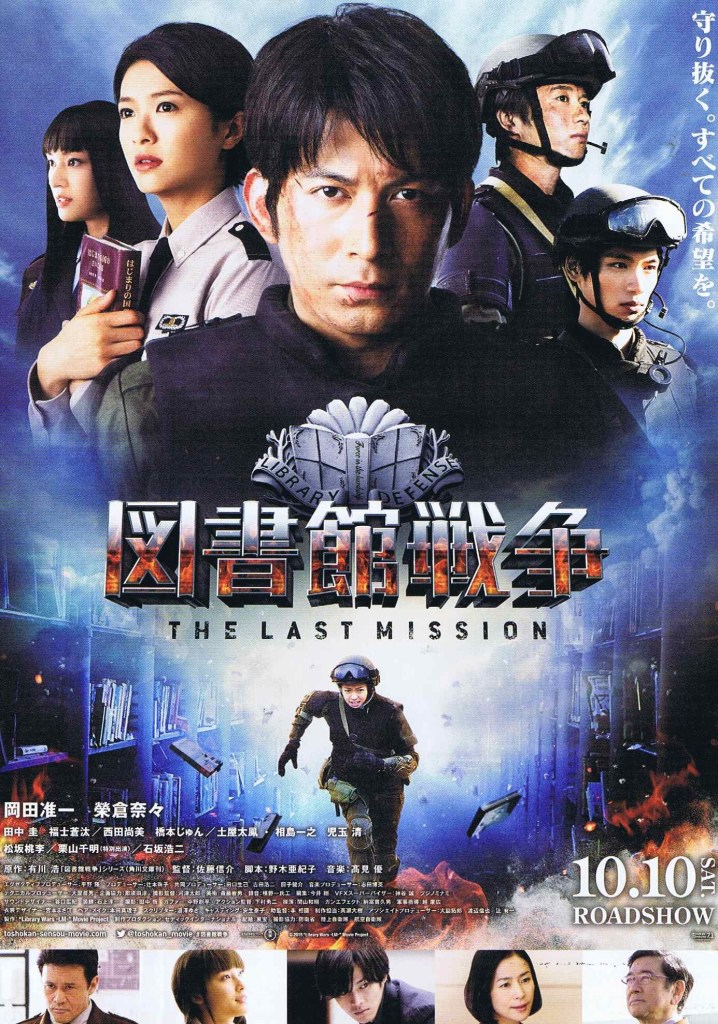
library-wars-last-missionWhen Library Wars, the original live action adaptation of Hiro Arikawa’s light novel series, hit cinema screens back in 2013 it did so with a degree of commercial, rather than critical, success. Though critics were quick to point out the great gaping plot holes in the franchise’s world building and a slight imbalance in its split romantic comedy/sci-fi political thriller genre mix, the film was in many ways a finely crafted mainstream blockbuster supported by committed performances from its cast and impressive cinematography from its creative team. Library Wars: The Last Mission (図書館戦争-THE LAST MISSION-, Toshokan Senso -The Last Mission-) is the sequel that those who enjoyed the first film have been waiting for given the very obvious plot developments left unresolved at the previous instalment’s conclusion.

18 months later, Kasahara (Nana Eikura) is a fully fledged member of the Library Defence Force, but still hasn’t found the courage to confess her love to her long term crush and embittered commanding officer, Dojo (Junichi Okada). As in the first film, The Media Betterment Force maintains a strict censorship system intended to prevent “harmful” literature reaching “vulnerable” people through burning all suspect books before they can cause any damage. Luckily, the libraries system is there to rescue books before they meet such an unfortunate fate and operates the LDF to defend the right to read, by force if necessary.

Kasahara is an idealist, fully committed to the defence of literature. It is, therefore, a surprise when she is accused of being an accomplice to a spate of book burning within the library in which books criticising the libraries system are destroyed. Needless to say, Kasahara has been framed as part of a villainous plan orchestrated by fellow LDF officer Tezuka’s (Sota Fukushi) rogue older brother, Satoshi (Tori Matsuzaka). There is a conspiracy at foot, but it’s not quite the one everyone had assumed it to be.

In comparison with the first film, The Last Mission is much more action orientated with military matters taking up the vast majority of the run time. A large scale battle in which the LDF is tasked with guarding an extremely important book containing their own charter (i.e. a symbol of everything they stand for) but quickly discovers the Media Betterment Force is not going to pass up this opportunity to humiliate their rival, forms the action packed centrepiece of the film.

The theme this time round leans less towards combating censorship in itself, but stops to ask whether it’s worth continuing to fight even if you feel little progress is being made. The traitorous officer who helps to frame Kasahara does so because he’s disillusioned with the LDF and its constant water treading. The LDF is doing what it can, but it’s fighting to protect books – not change the system. This is a weakness Satoshi Tezuka is often able to exploit as the constant warfare and tit for tat exchanges have begun to wear heavy on many LDF officers who are half way to giving up and switching sides. Even a zealot like Kasahara is thrown into a moment of existential despair when prodded by Satoshi’s convincing arguments about her own obsolescence.

Satoshi rails against a world filled with evil words, but as the head of the LDF points out in quoting Heinrich Heine, the society that burns books will one day burn men. The LDF may not be able to break the system, but in providing access to information it can spread enlightenment and create a thirst for knowledge among the young which will one day produce the kind of social change that will lead to a better, fairer world.

As in Library Wars all of these ideas are background rather than the focus of the film which is, in essence, the ongoing non-romance between Kasahara and Dojo. Remaining firmly within the innocent shojo realm, the romantic resolution may seem overly subtle to some given the extended build up over both films but is ultimately satisfying in its cuteness. Library Wars: The Last Mission masks its absurd premise with a degree of silliness, always entirely self aware, but gets away with it through sincerity and good humour. Shinsuke Sato once again proves himself among the best directors of mainstream blockbusters in Japan improving on some of the faults of the first film whilst bringing the franchise to a suitably just conclusion.


Original trailer (No subtitles)

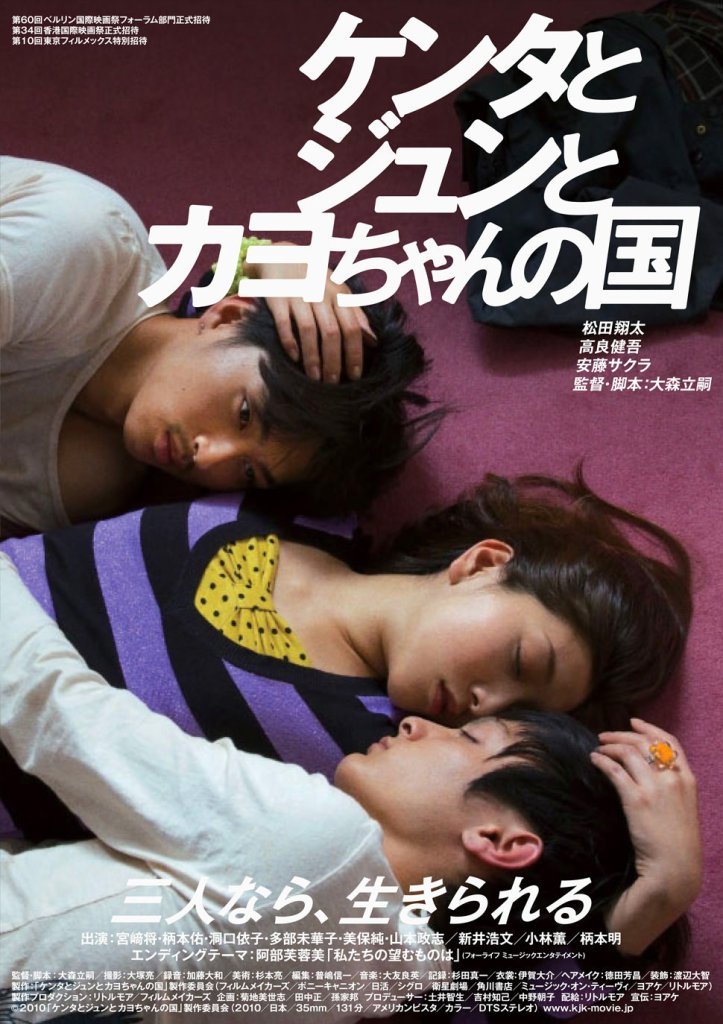
A Crowd of Three (ケンタとジュンとカヨちゃんの国, Tatsushi Omori, 2010)

crowd-of-threeTatsushi Omori’s debut feature The Whispering of the Gods proved so controversial that he was left with no choice other than to set up his own temporary cinema to screen it. Five years later he returned with another uncompromising look at modern society which is only a little less grim than its predecessor. A Crowd of Three (ケンタとジュンとカヨちゃんの国, Kenta to Jun to Kayo-chan no Kuni) takes what has become a staple of quirky indie comedy dramas – a small group of disconnected people taking a road trip to look for something better, and turns it into a depressingly nihilistic voyage to nowhere. Never quite achieving the kind of painful, angst ridden atmosphere of disaffected young men desperately trying to break out of a social straight jacket, A Crowd of Three is an oddly cold film, undercut with a pervasive layer of misogyny and hopelessness which makes its ultimate destination somewhere few will wish to travel.

Kenta (Shota Matsuda) and Jun (Kengo Kora) are young men working dead end construction jobs. Growing up together almost like brothers in the same orphanage the pair share an intense bond but also a shared sense of having been badly let down by life even at such a young age. Their main source of relief seems to be in picking up “loose women” from the street by asking random ladies on their own for their ages. One evening Jun picks up Kayo (Sakura Ando) – a melancholy woman with low self esteem who sleeps around because she is insecure about her own plain looks. After Kenta is assaulted by the foreman, he decides to take revenge by smashing up the office and his boss’ car before taking off on a journey north to see his (biological) brother who is currently in prison.

Kayo tags along with the pair after apparently having fallen in love with Jun who is only interested in her for easy sex and occasional cash tips. Despite the fact that the film’s original Japanese title is “Jun, Kenta, and Kayo’s Country”, Kayo is quickly cast aside by the pair of travellers who think it’s funny to throw all of her stuff out of the window and abandon her at a service station in the middle of nowhere. Getting thrown out of cars and left behind in remote places is something which happens to Kayo repeatedly throughout the film as she tries to follow Jun despite his obvious indifference towards her.

Kayo just wants to feel love, but at least as far as the film goes she’s looking for it in all the wrong places. Even if Jun does start to feel something more genuine for her in the end, it’s born of a kind of shared insecurity as he worries about a repetitive strain injury from using the pneumatic drill which turns his hand white at moments of stress. After literally jilting Kayo, Jun takes up with a vacuous bar hostess who does, indeed, recoil from his pale hand. The bar hostess has very ordinary dreams – a big house, wealthy husband, children. She’s even planned out her own death. These are all things which Jun could never give her, a middle school drop out with no family he already fears he has no future but at least he’s not railroaded onto a pre-determined course and is free to choose his destination even if he feels there is nowhere for him to go.

Kenta expresses this early in the film when he states that there are two kinds of people – those who choose how they’re going to live, and those who don’t. The boys feel as if they’re in the no choice category – unceremoniously kicked out of social care and expected to fend for themselves with no education or contacts, reliant on poorly paid temporary work to get by. In a slightly overworked metaphor, Kenta and Jun’s jobs on demolition projects point to their desire to dismantle their world but the more they smash away at it the less progress they make. Kenta’s literal smashing of the car and office belonging to his boss are his final act of choice but again it gets him nowhere. Even talking to his brother who is in prison for the most heinous of crimes, Kenta finds no encouragement but only cold rejection.

A Crowd of Three goes to some very dark places ranging from work place harassment to child abuse and sexualised violence, but it largely fails to capitalise on its grim atmosphere to make any kind of impact aside from the pervasive melancholia. Omori mostly sticks to a straight forward approach with some interesting editing choices and composition but largely relies on the quality performances of his leading players. Far from youth aflame with nihilistic rage, A Crowd of Three is bleaker than bleak and frozen throughout making the battling of its heroes to transcend their difficult social circumstances a forlorn hope of epic proportions.


Original trailer (no subtitles)

The Last Princess (덕혜옹주, Hur Jin-ho, 2016)

last-princessReview of Hur Jin-ho’s The Last Princess first published by UK Anime Network.

Filmic biopics of real life historical figures are not generally known for their fierce adherence to fact, but The Last Princess (덕혜옹주, Deokhyeongjoo) is unusually honest in its approach in the sense that it includes a brief opening statement to the effect that the film pays very little attention to historical veracity. Hur Jin-ho adapts the story of Korea’s last princess, Yi Deok-hye (Son Ye-jin), as recounted in a novel by Kwon Bi-young, whilst indulging the genre he’s best known for – romantic melodrama. Another of the recent spate of films to address Korea’s colonial past, The Last Princess is the story of a woman who was fiercely loyal to her homeland, even in the face of harsh opposition and final rejection by the very people she’d been striving so hard to protect.

Told in a non-linear fashion, The Last Princess spans the majority of Deok-hye’s life from her opulent childhood in the royal palace to her eventual repatriation to Korea in the mid 1960s. In 1919, nine years after Korea had been annexed by the Japanese, Deok-hye lives in the palace with her loving father, the former Emperor (Baek Yoon-sik), and her mother, the concubine Lady Yang (Park Joo-mi). Her carefree days soon end when she witnesses her father’s death by poison and comes to understand her precarious position as puppet royalty of a subjugated regime.

Her life, and those of her remaining family members, is largely in the hands of a traitorous civil servant, Han (Yoon Je-moon), whose fierce loyalty to the Japanese emperor knows no bounds. Deok-hye is unwilling to assist him in his desire to use her as a tool to promote the “Japanisation” of the country and so is packed off to the mainland to study with the promise that she can return to live with her mother in Korea after her studies have ended. Needless to say she does not return.

In a touch of cinematic romanticism, the film elides two characters into one in the otherwise fictional character of Kim Jang-han (Park Hae-il). The son of a resistance fighter loyal to the emperor, Jang-han was betrothed to Deok-hye when they were both children and later returns to her as an adult in Japan where he is active in the Resistance, before coming back to find her years after the war. Jang-han hatches a plan to help Deok-hye and the other royal family members escape for exile in Shanghai but the the pair are eventually separated.

Recalling other recent Korean Resistance movies Age of Shadows and Assassination, The Last Princess has its share of action as Deok-hye and Jang-han attempt to escape the Japanese occupation and foster the revolution from abroad. The villain of the piece this time around is not so much the Japanese but the Koreans who willingly helped them as as exemplified here by the odious Han. Han is the most typically melodramatic character and only lacks a moustache to twirl to complete the effect. Hellbent on ingratiating himself with the Japanese, Han is determined to harness his princess’ appeal to sell the virtues of the Japanese state. When Deok-hye resolutely refuses to play along, he threatens her family members and friends in an attempt to force her compliance but finds her love for her country too strong to be bent by his egocentric cruelty.

Sent away and kept a virtual prisoner far from home, there is little Deok-hye is able to do in service of her nation. Introduced to the Resistance operating in Japan, she begins to see a way to help and eventually finds herself taking a stand when blackmailed into reading out a propaganda speech in front of a collection of forced labourers. Beginning the speech in Japanese as ordered, Deok-hye finds she cannot continue and eventually makes her real feelings known in Korean as she instructs the people in front of her not to give up, she will be right along side them fighting to regain their homeland. In a touch of Casablanca inspired drama, a chorus of Arirang suddenly springs up among the crowd, much to the consternation of the Japanese officers expecting a show of contrition, as the Princess herself is whisked off to pay a heavy price for her “betrayal”.

The Last Princess forces its heroine through constant loss – of her home, of her position, of her family, of a future, of love, of a child, of happiness, of her mind, and most importantly of her nationality. Deok-hye never wanted to be Japanese, did not travel to Japan of her own volition, and did her best to resist even at great personal cost. Nevertheless she finds eventually finds herself barred from her homeland due to opposing political concerns when the fledgling Republic fears the misuse of a powerful symbol like a royal family to frustrate the democratic future. Played with wonderful sensitivity by leading actress Son Ye-jin, Deok-hye suffers as her nation suffers, longing for independence both personal and national but finding only new cages everywhere she goes. Despite the unconvincing ageing makeup of the latter part of the film and an overly intrusive score, The Last Princess is an impressively produced prestige picture which plays its melodrama credentials to the max but is also undoubtedly moving in recounting the tragic story of its heroine whose constant misuse and lack of agency mirror much of the history of the nation she holds so dear.


Reviewed at the 2016 London Korean Film Festival.

International trailer (English subtitles)

Cart (카트, Boo Ji-young, 2014)

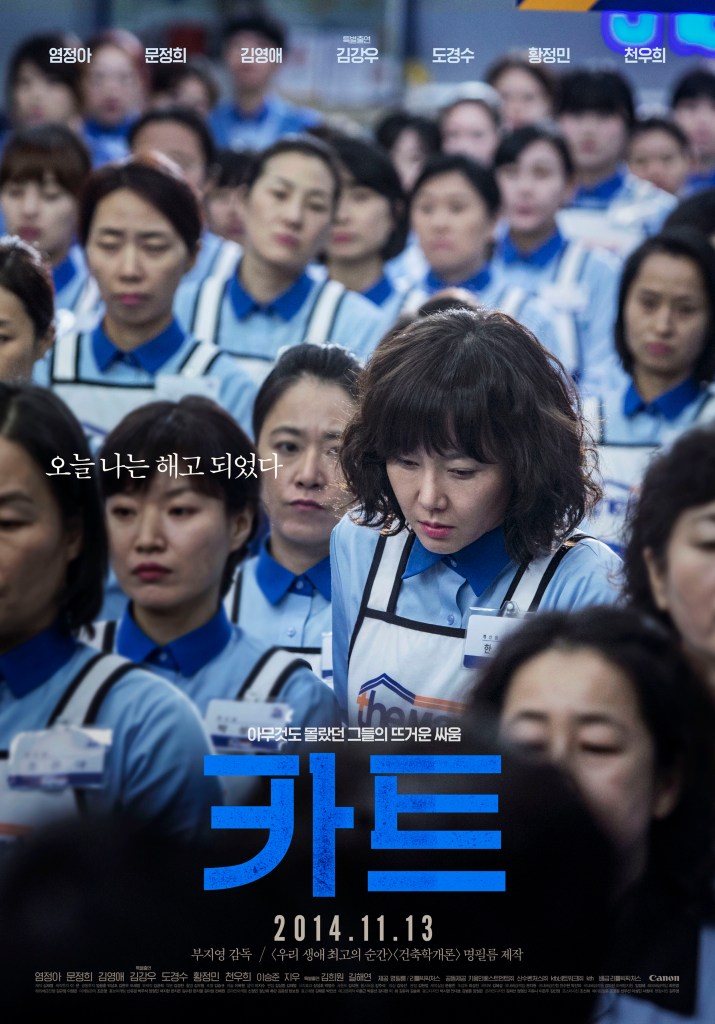
cartUp until very recently, many of us lucky enough to live in nations with entrenched labour laws have had the luxury of taking them for granted. Mandated breaks, holidays, sick pay, strictly regulated working hours and overtime directives – we know our rights, and when we feel they’re being infringed we can go to our union representatives or a government ombudsman to get our grievances heard. If they won’t listen, we have the right to strike. Anyone who’s been paying attention to recent Korean cinema will know that this is not the case everywhere and even trying to join a union can not only lead to charges of communism and loss of employment but effective blacklisting too. Cart (카트), inspired by real events, is the story of one group of women’s attempt to fight back against an absurdly arbitrary and cruel system which forces them to accept constant mistreatment only to treat their contractual agreements with cavalier contempt.

Sun-hee (Yum Jung-ah) is a loyal employee at the Mart. She’s had zero penalty points for five whole years and has been told that she’s about to be transferred from a temp worker contract to a regular employee position. Run more like a cult than a supermarket, the Mart’s workers all wear pristine blue and white uniforms and recite the dramatic sounding company credo every morning, vowing to increase sales whilst honouring customer service, and are instructed to say “Welcome Beloved Customer!” to each and every visitor. Eager to take on extra overtime with no extra pay and always at the beck and call of brusque manager Choi (Lee Seung-joon), Sun-hee is respected by her colleagues but perhaps not always liked as her goody two-shoes persona both makes them look bad and encourages the management to continue taking advantage.

Sun-hee’s dreams are about to crumble when the evil corporate suits at HQ decide it would be cheaper to fire all the temp workers and use outsourced labour instead. Despite all her long years of hard work and sacrifice, not only is she not getting her secure position, she might not have a job at all. Some of the other women decide they’ve had enough with their poor working conditions and it’s worth taking the chance on forming a union to fight head office together. Sun-hee is reluctant but is eventually convinced to become one of the spokespeople, after all, if they won’t listen to miss five years no penalties, who will they listen to?

It’s worth asking the question why all these terrible jobs with low pay and frequently exploitative conditions are being done exclusively by women. All of the workers on temporary contracts are female from the cleaning staff to the shelf stackers and cashiers, but all come from different backgrounds from young university graduates to old ladies and ordinary working wives and mothers. The management is unwilling to listen to the concerns of their staff because they are “only women”, “working for pocket money” and should just be grateful that the store gave them something to do rather than being bored at home. Pointing out that many of these women are single mothers or live in difficult economic circumstances meaning they need that money to eat would likely not go down well with these fiercely conservative, wealthy executives whose only response is to tell the women not to be so silly and to stop making a fuss over nothing because the men have business to do.

After just ignoring the women fails and they decide to go on strike eventually occupying the store for a longterm sit in, the company go on the image offensive, offering minor concessions including the reinstatement of some, but not all, workers and other small improvements designed to guilt some of the employees with more pressing circumstances to cross the picket line. Eventually, they go to the extreme measures of employing armed thugs and riot police to remove the women by force. In contrast with other similarly themed films from other countries, there is no attempt to get the press onside to expose the company’s workings and the only news reports seen in the film are extremely biased, painting the women as selfish loonies making trouble for everyone by refusing to shut up and accept the status quo.

Following a fairly standard trajectory, the main narrative thrust is the gradual blossoming of near brainwashed and timid employee Sun-hee into a firebrand campaigner for social justice. Through being encouraged to stand up for the other women, Sun-hee becomes concerned not just with her own treatment but the general working environment in Korea. This new found indignation also helps rebuild her relationship with her sullen teenage son after he experiences some workplace discrimination of his own which his mother is able to sort out for him now that she is not prepared to simply smile, nod, and apologise every time someone attempts to get their own way through intimidation.

Cart treats an important issue with the kind of levity and interpersonal drama which make it primed for a screen one hit rather than a later night run in screen five catering to those already aware of the issues. It probably isn’t going to agitate for any direct social change and according to the final caption the outcome of the original incident was more of a bittersweet accomplishment rather than an outright victory. Still, the fight goes on, even if you find yourself ramming a supermarket trolley into a riot officer’s shield to get the message across – an effect which Cart mimics in its quest to ensure as many people as possible get the memo that the time for passive acceptance has long since passed.


Reviewed at the 2016 London Korean Film Festival.

International trailer (English subtitles)

Our Love Story (연애담, Lee Hyun-ju, 2016)

cyaykwjucaav5frThe history of LGBT cinema in Korea is admittedly thin though recent years have seen an increase in big screen representation with an interest in exploring the reality rather than indulging in stereotypes. The debut feature from Lee Hyun-ju, Our Love Story (연애담, Yeonaedam), is among the first to chart the course of an ordinary romance between two women with all of the everyday drama that modern love entails. A beautiful, bittersweet tale of frustrated connection, Our Love Story is a realistic look at messy first love taking place under the snowy skies of Seoul.
Yoon-ju (Lee Sang-hee) is a busy fine arts graduate student working on her final project. Busy as she is, none of Yoon-ju’s friends can get their heads around her lack of interest in dating, but Yoon-ju is happy enough on her own and doesn’t get what all the fuss is about. Whilst perusing a local junk yard looking for interesting things for her art project, something unexpected catches her eye in the form of a young woman delivering magazines but after the woman completes her business she leaves Yoon-ju’s slightly stunned field of vision, presumably forever.

Because these things happen in a city, Yoon-ju runs into the same woman again in a convenience store where she is having trouble buying cigarettes because she’s forgotten her ID and the cashier is being pedantic about the rules. Coming to the rescue, Yoon-ju buys the cigarettes for her with her ID, which leads to the opportunity of sharing one outside. The mysterious woman is named Ji-soo (Ryu Sun-young) and works part-time at a nearby bar to which she invites Yoon-ju if she happens to fancy a drink of an evening. Yoon-ju doesn’t drink, particularly, but convinces some friends to accompany her to to Ji-soo’s bar – a plan which backfires when they drink too much and argue with each other causing a scene. The two women don’t get much of an opportunity to chat and it all seems like it might end there with Yoon-ju heading home to bed only to receive an unexpected phone call from Ji-soo inviting her over for a late night drinking session.

So begins Yoon-ju’s first romance, and Ji-soo’s 78th as she later jokes. The first night slips into the first day and before long the pair have established a happy domesticity but their original euphoria is short lived as Ji-soo is due to be moving back to her hometown to live with her recently widowed father for a while. The relationship also has adverse effects on Yoon-ju’s life as she begins to neglect her art project and lets her colleagues down by forgetting important meetings, while other events leave her questioning if Ji-soo is really as committed to Yoon-ju as Yoon-ju is to her.

After Ji-soo moves back home, the pair make sure to meet up every so often either in Ji-soo’s hometown of Incheon or in Seoul but there’s an undeniable change in their relationship aside from the distance. In the city, Ji-soo had been outgoing and unafraid but in Incheon she’s a completely different person, closed off and permanently anxious. Ji-soo’s father is a more conservative and religious type who has no idea that his daughter is gay and still expecting her to get married, preferably as soon as possible. Worried that Ji-soo “does not date” he sets her up with a family friend and she has little choice but to play along even if she’s not intending to let it get anywhere. Yoon-ju’s first visit occurs while Ji-soo’s father is away, but even so Ji-soo is uncomfortable with having her in the house. When her father turns up unexpectedly one day while Yoon-ju is there, Ji-soo describes her as “a friend” and makes a point of answering all of Yoon-ju’s questions for her in case she lets something slip.

Hurt and confused, spending time in Incheon becomes a painful experience for Yoon-ju considering the permanently jumpy Ji-soo doesn’t even want her father to know she smokes, let alone anything else he might not approve of. Earlier on the relationship, Yoon-ju made the decision to confide in an old friend from her hometown and found him broadly supportive, once he got over the surprise. Ji-soo, more experienced, warns Yoon-ju that she’ll lose friends if she isn’t careful. This Yoon-ju finds out to her cost when she decides to try talking to her roommate about her troubles with Ji-soo as even someone she felt close to and had trusted suddenly rejects her. Realising you’ve placed your trust in someone who wasn’t worthy of it is a terrible feeling, but it isn’t just familial opposition the two women will be facing if they decide to make a go of things together, even in the big city.

Post Incheon, awkwardness grows and the distance deepens prompting one to fight back and the other to retreat but eventually Ji-soo appears to make her choice in way which seems cuttingly final in its coldness. Later trying to fix what she broke, Ji-soo again goes about things in an inadvisable way, still only superficially committed and unable to fully connect on a deeper level. Ending on an ambiguous, bittersweet note which seems to offer either hope or the despairing vision of an ever repeating cycle of pain, Our Love Story is a beautifully nuanced and interestingly composed addition to the Korean indie scene finally bringing a very ordinary romance to the cinema screen in all of its everyday melodrama.


Reviewed at the 2016 London Korean Film Festival.

Clip from halfway through the film (English subtitles)

Vanishing Time: A Boy Who Returned (가려진 시간, Um Tae-hwa, 2016)

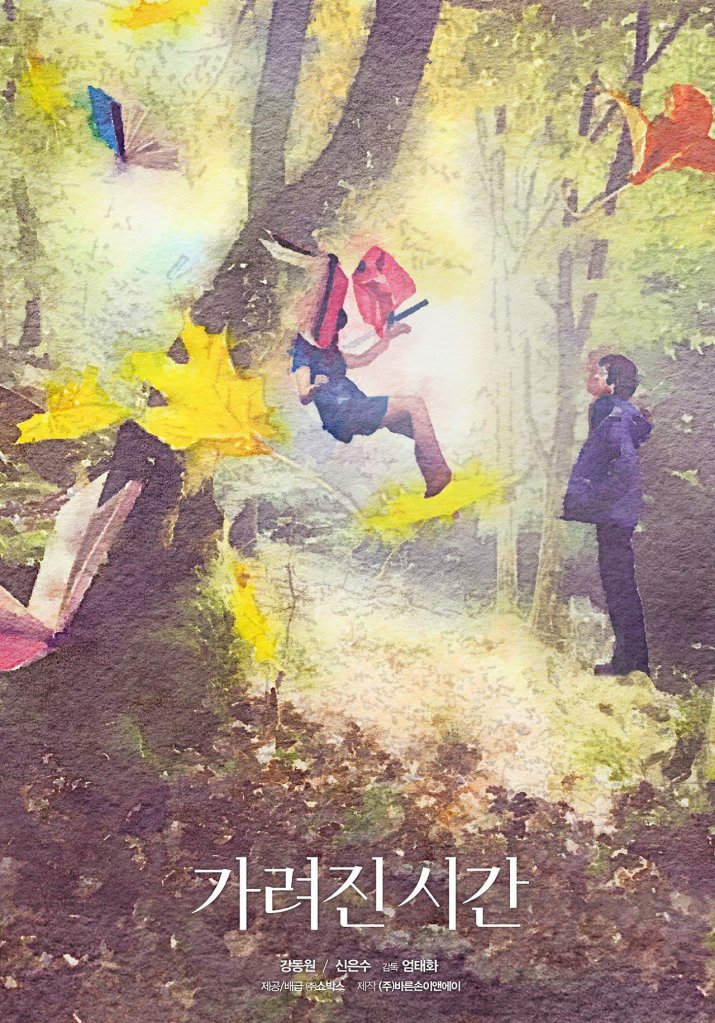
vanishing-timeWhen no time passes, does anything change? Yes, and then again, no, if Um Tae-hwa’s Vanishing Time: A Boy Who Returned (가려진 시간, Garyeojin Shigan) is to be believed. Dealing with the nature of time, connection, and faith Um’s film is a supernaturally tinged fairytale which never seriously entertains the more rational explanation offered by the naysayers, but is filled with the innocence of childhood and the essential naivety of adolescence. Melancholy, though somehow uplifting, Vanishing Time neatly avoids the pitfalls of romantic melodrama for a genuinely affecting coming of age story as its heroine is forced to make peace with her traumatic past through accepting the loss and sacrifice of her present.

Thirteen year old Su-rin (Shin Eun-soo) is an orphan, living with her step-father who has just moved to a small island where he is engaged in the construction work on a new tunnel. Sullen and lonely, Su-rin does not get on with her step-father whom she holds responsible for the death of her mother in a car accident. All Su-rin wants is to disappear into another world. In fact, she even has her own blog dedicated to exploring possible portals to alternate dimensions and the best methods for provoking an out of body experience. Needless to say, Su-rin does not fit in at school and has immense trouble making friends, especially when they stumble across her online activity and brand her a weirdo.

Su-rin does, however, bond with another boy, Sung-min (Lee Hyo-je), who (though not actually an orphan) lives at the orphanage. Sung-min seems to have some success with the methods Su-rin suggests for out of body experiences and the pair gradually build a up friendship complete with a secret written code and strange rituals. Though Sung-min’s friends Tae-sik (Kim Dan-yool) and Jae-wook (Jeong Woo-jin) don’t want any girls around, Sung-min convinces them to let her come when they sneak into the cordoned off construction area to witness the tunnel blasting. Whilst there, they discover a secret cavern in which there is a strange glowing egg at the bottom of a pool. The boys steal the egg and ponder over what it is until Tae-sik remembers a story his grandfather told about a time stealing goblin that turns children into adults and adults into old people by means of an egg found in a mysterious cave which only exists at a time of a full moon.

When Su-rin emerges from the cavern after nearly being buried by an explosion, the boys have vanished. The community begins to fear the worst – everything from child abduction to an industry conspiracy to cover up a blast related accident, but some time later Su-rin is approached by an older man who claims to be Sung-min.

Um begins the film with the lens cap of a camera as a woman gives a perfunctory voice over explaining that this is the record of her three month psychiatric evaluation of the teenager Su-rin which she hereby offers to us in the hope that we will understand her. When the lens cap comes off, a black and white montage sequence follows detailing the police investigation into the disappearance of the three boys before flashing back to Su-rin seated in front of the camera. It’s clear that Su-rin is sticking to her story, but also that she hasn’t been believed, has not managed to save any of her friends, and is, in some way, suspected of collusion in the events which have engulfed her.

Filmed with earthy browns and greens, the overall atmosphere is one of fairy tale with its supernatural rituals and stories of goblins which feast on time and misery. Obviously very affected by the death of her mother and by her resultant loneliness in having only the step-father she refuses to bond with, Su-rin has already retreated into a fantasy world despite being unable to actively cross over through any of the possible methods she explores in her blog. Bonding with Sung-min through their shared experimentation, the pair attempt a summoning ritual in which they each leave messages for a possible visitor – hers a question about her mother, his a wish that he grow tall and make enough money to retire by thirty. Su-rin’s question goes unanswered, but in the best fairy tale tradition Sung-min is going to get what he asked for, only in the most terrible of ways.

When the boys stop time it first seems like a paradise. They can do whatever they like, running round town stealing slices of pizza and peeking up ladies’ skirts but the novelty quickly wears off when they realise they’re stuck in this ever unchanging world with no means of escape. Thinking ahead, the boys study hard soaking up all the available knowledge in this completely silent universe whilst also stockpiling cash so they’ll be prepared if the hands on the clock ever start turning again. Trapped inside this bubble for more than a decade, the boys have grown into men but in body only. The lack of ongoing experience has also trapped them inside their fourteen year old minds rendering them adrift in either place. Some of them find escape in other ways yet tellingly, time comes only when despair reaches its critical mass.

Um’s painterly vision of the time stopped universe is a beautifully constructed one in which the suspended forward momentum of objects is depicted as a kind of anti-gravity where manga and crisp packets hover in the air while even the heaviest furniture can be trailed on a string like a balloon. Repeated motifs of Su-rin looking at her shadow and the occasionally strange angles give the picture an off kilter atmosphere which further brings out the creepy fairy tale quality of the abandoned Western-style cottage in the woods and its European gothic aesthetics.

Only Su-rin is prepared to believe Sung-min, convinced both by her gut instinct driven by the recognition of their original connection and the hard evidence of their unique code and the scar on Sung-min’s arm. The film never seriously entertains the “rational” explanation offered by the police, but focuses on Su-rin’s desire to restore her friend to his rightful place in society by ensuring he is recognised as Sung-min, the boy who disappeared and has returned as a man. Gang Dong-won, pale and gaunt, gives off just the right level of eerie uncanniness as this strangely innocent man-boy, desperately wanting to go home but having no home to go to other than Su-rin. A tale of innocent, selfless love, Vanishing Time: A Boy Who Returned is a melancholy, often dark exploration of the journey into adolescence captured with a beautiful, surrealist eye and a beating human heart.


Original trailer (English subtitles – select from settings menu)

Miss Ex (비치온더비치, AKA Bitch on the Beach, Jeong Ga-young, 2016)

bitch-on-the-beachDo you know Hong Sang-soo? So asks the heroine of Miss Ex (비치온더비치, Bitch on the Beach) as part of her nefarious mission to win back her childhood sweetheart. Unfortunately, his reply is to ask if he directed The Host, so Ga-young (Jeong Ga-young) is out of luck with her Dark Knight loving former love, but possibly in luck with us as her movie obsessed ramblings and strange stories about accidental AIDS tests during wisdom tooth extractions continue to dominate the screen for the next 90 minutes. Divided into three chapters and filmed in an oddly colourful black and white, director and leading actress’ Jeong Ga-young’s debut feature channels Hong Sang-soo by way of Woody Allen and the French New Wave but may prove funnier than all three put together.

Drunken Ga-young has invited herself over to her ex’s flat with the express intention of seducing him. Jeong-hoon (Kim-Choi Yong-joon) is sort of fed up with this kind of thing, in fact he has Ga-young listed in his phone under the name “do not answer” but she manages to bamboozle him into opening the door anyway. Ga-young has quit her job to pursue a career in the movies, though it seems she’s not having much success. Jeong-hoon knows she only calls him for a shoulder to cry on when she’s fed up but falls for it anyway. He has a girlfriend and makes it clear he’s not up for any funny business, but Ga-young is quite determined – only time will tell if Ga-young will get what she came for, or if she even really even knows what that is.

Miss Ex was originally titled “Bitch on the Beach” in Korean which, seeing as there are no beaches in this film, seems to be an obvious reference to the Hong Sang-soo movie Woman on the Beach – a similarly reflexive exercise about a film director and his relationships with a number of women who only really become fodder for his screenplay. Filming in black and white with simple, static camera set ups and concentrating on the amusing banter between its two leading characters credited only as “woman” and “man”, Hong’s influence is palpable. Ga-young is, however, a true cinephile who, after finding time to express her boredom with The Dark Knight, goes on to detail her strange dreams about other famous directors such as Bong Joon-ho (who really did direct The Host) and arguably Korea’s greatest living filmmaker Lee Chang-dong whom she asks to be her assistant director(!).

It’s fair to say the banter is more or less one sided as Jeong-hoon is forced to listen to Ga-young’s increasingly bizarre stories. Surprisingly frank and forthright in talking to her ex-boyfriend, Ga-young proceeds to tell him about various other men in her life, her sexual desires and preferences, and even those of her friends. Jeong-hoon listens patiently with occasional bemusement, but their relationship is close enough to be totally open without causing too much of a problem. Despite his protestations it’s clear Jeong-hoon is still on the hook for Ga-young, which she clearly knows, but it’s a little less clear whether she’s just keeping him there for convenience’s sake or is actively trying to win him back.

Even if Hong Sang-soo is the obvious reference point, he is after all referenced in the text, Miss Ex also owes a debt to the breeziness of the French New Wave and its freewheeling absurdity. Cutting between amusing silliness and understated emotional drama Miss Ex is perfectly posed to examine the various trials and tribulations of romance among contemporary young people. Ga-young is, perhaps, too modern for the slightly more conservative Jeong-hoon who tells her that her problems with men mostly stem from being too quick to take the lead and also constantly picks her up on her “unladylike” colourful language. One gets the impression Ga-young might not be very good for Jeong-hoon who eventually jeopardises his relationship with his current girlfriend to keep her happy, but whatever anyone else thinks about it, it seems as if he won’t be giving up on her any time soon. Cute, quirky and extremely smart, Miss Ex is an accomplished debut from director and leading lady Jeong Ga-young who marks herself out as an interesting new indie voice in Korean cinema.


Reviewed at the 2016 London Korean Film Festival.

Original trailer (no subtitles)