 It’s tough when parents don’t approve of their children’s romantic partners, but fortunately most realise there’s nothing they can do about it so the best thing is to feign civility (and avoid saying I told you so when it all goes wrong). Unfortunately the older generation of Kim Jin-young’s Enemies In-Law (위험한 상견례 2, Wiheomhan Sanggyeonrye 2), a kind of follow up to his 2011 effort Meet the In-Laws, are of a very much more hands on mindset. One side is a police family in which literally everyone for generations has worked in law enforcement, and the other is headed by a pair of international artefacts thieves determined to live life on their own terms. You might think this is a situation ripe for comedy, and it is. Only, in a very strange and not altogether successful way.
Park Young-hee (Jin Se-yeon) and her fellow Olympian sister Young-sook (Kim Do-yeon) are on the way back from a fencing competition when their policeman father, Man-choon (Kim Eung-soo), gets into a car chase with the son of the two criminals he’s been trying to catch for years. Chul-soo (Hong Jong-hyun), a high school student with an expensive sports car, comes out on top but displays unexpected heroism when he notices the Park family car is on fire and someone is still trapped inside. Dousing himself with water he valiantly rescues Young-hee just before the car explodes and the pair fall in love at first sight.
Man-choon most definitely does not approve of this union, but Chul-soo vows to leave the criminal world behind and join the police like the rest of the Park family. Seven years later he’s still trying to pass the police exam and in a committed relationship with the now successful policewoman (and former Olympic gold medallist) Young-hee. As it looks like Chul-soo is about to achieve his goal, both the Parks and his parents Dal-sik (Shin Jung-geun) and Gang-ja (Jeon Soo-kyung), become increasingly worried about the marriage of crime and justice. Accordingly they form an unlikely alliance to break the pair up at all costs.
Enemies In-Law has its share of oddness, but remains disappointingly conventional in its comedic approach. The most objectionable aspect manifests itself in a persistent layer of fat jokes, mostly at the expense of Olympian judoist Young-sook whose weight is the constant butt of every joke in which she is derided as unattractive, greedy, lazy, and mannish. Despite the fact that the sisters seemingly each hold high offices in the police force, the overriding tone is a socially conservative one, even shoehorning in a bathing beauty sequence in which policewoman Young-hee is forced to dance lasciviously in a red bikini followed by her sister in a much frumpier one in another predictable and unfunny joke, as part of an odd sequence investigating a “secret” hostess bar. The jokes are at least mitigated by the fact Yuong-sook could not care any less what anyone thinks about her and is fine with both her appearance and anything anyone might have to say about it.
The major crisis point in the relationship comes when Chul-soo becomes fed up with the situation and captures his parents, presenting them to Man-choon tied up like two prize turkeys. This, he hopes, will be enough to get them to give in and accept him as a son-in-law, but he makes a rookie mistake. Young-hee, disappointed in him and getting the impression she’s become the subject of a “trade”, resolutely rejects Chul-soo’s attempt to buy her hand in marriage from her father with a slap to the face and a swift exit. The women have been bypassed as Chul-soo attempts to deal directly with Man-choon and the decision of the two men to view their relations as objects to be exchanged is rightly criticised in its effect of almost ending the entire endeavour and causing a possibly permanent rift with Young-hee.
Things also take a darker turn with the ongoing investigation the sisters are working on which involves a number of rapes and murders of well to do single women. In contrast with Chul-soo’s parents whose criminal enterprise is apparently successful, the police are depicted as blithering idiots who couldn’t catch a chicken in a supermarket. Using such a serious and unpleasant crime spree for comic value seems in poor taste even given the obvious throw away quality of the film, though it does provide the final plot motivation to bring everyone together as the master criminals have to step in to point the police in the right direction, even if Chul-soon’s mother has to pretend to be President Park Geun-hye to do it.
For a film which involves the ability to talk to dogs as a major device, Enemies In-Law never fully embraces its absurdism, leaving it with a curiously uneven tone which might have benefitted from even more silliness. Shifting from romantic comedy to police procedural in an interesting series of straight to camera monologues with re-enactments, Enemies In-Law takes its cues from popular TV dramas and pushes them in a more interesting direction but the jokes are never really big enough to pay off. Amusing enough, at times, but poorly pitched and uneven, Enemies In-Law is not the film it claims to be, but fails to be much of anything else either.
Original trailer (English subtitles)
 This area has a weird magnetic field, claims one of the central characters in Takuro Nakamura’s West North West (西北西, Seihokusei), it’ll throw you off course. Barriers to love both cultural and psychological present themselves with almost gleeful melancholy in this indie exploration of directionless youth in modern day Tokyo. Three young women wrestle with themselves and each other in a complex cycle of interconnected anxieties as they attempt to carve out their own paths, each somehow aware of the shape their lives should take yet afraid to pursue it. The Tokyo of West North West is one defined by disconnection, loneliness and permanent anxiety but it is not the city which is the enemy of happiness but an internal unwillingness to find release from self imposed imprisonment.
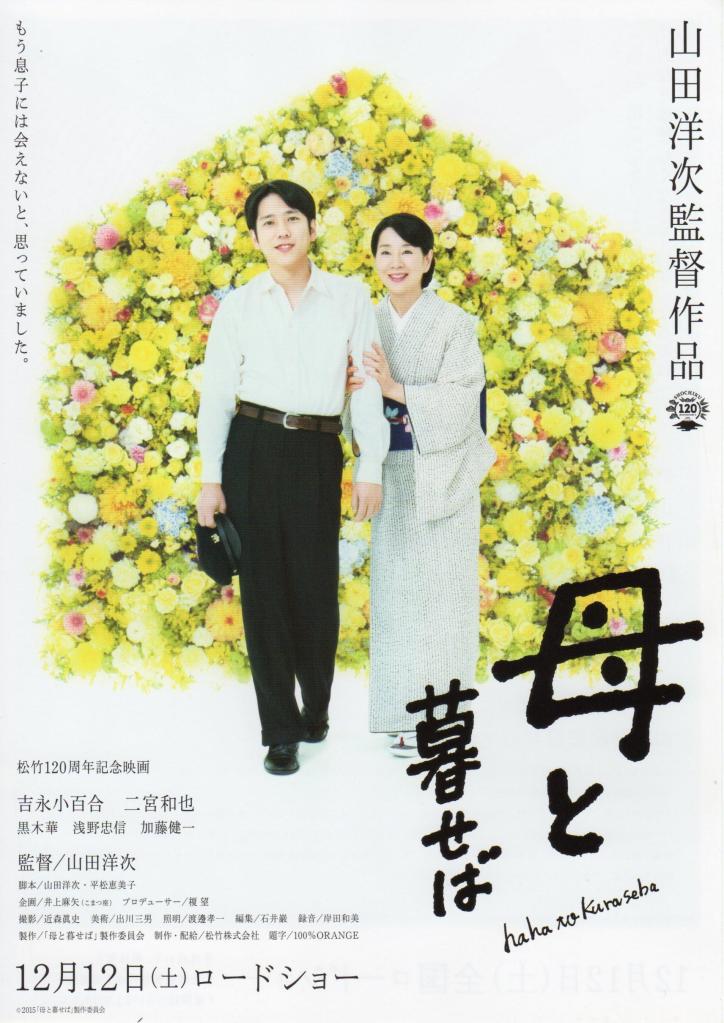 After such a long and successful career, Yoji Yamada has perhaps earned the right to a little retrospection. Offering a smattering of cinematic throwbacks in homages to both Yasujiro Ozu and Kon Ichikawa, Yamada then turned his attention to the years of militarism and warfare in the tales of a struggling mother,
 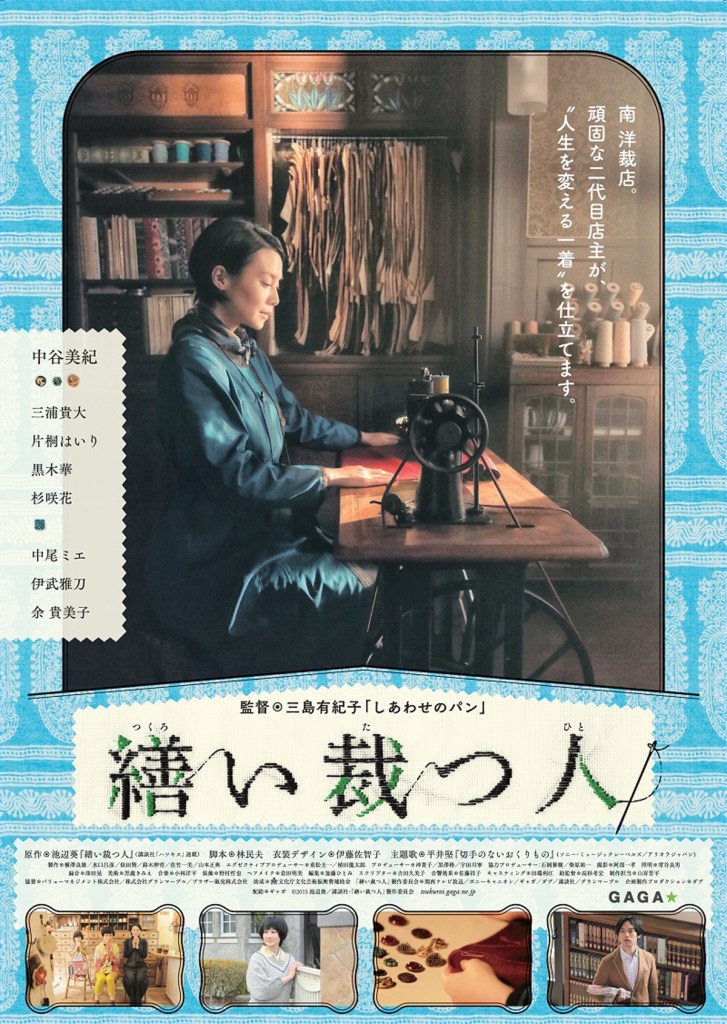 Tradition vs modernity is not so much of theme in Japanese cinema as an ever present trope. The characters at the centre of Yukiko Mishima’s adaptation of Aoi Ikebe’s manga, A Stitch of Life (繕い裁つ人, Tsukuroi Tatsu Hito), might as well be frozen in amber, so determined are they to continuing living in the same old way despite whatever personal need for change they may be feeling. The arrival of an unexpected visitor from what might as well be the future begins to loosen some of the perfectly executed stitches which have kept the heroine’s heart constrained all this time but this is less a romance than a gentle blossoming as love of craftsmanship comes to the fore and an artist begins to realise that moving forward does not necessarily entail a betrayal of the past.
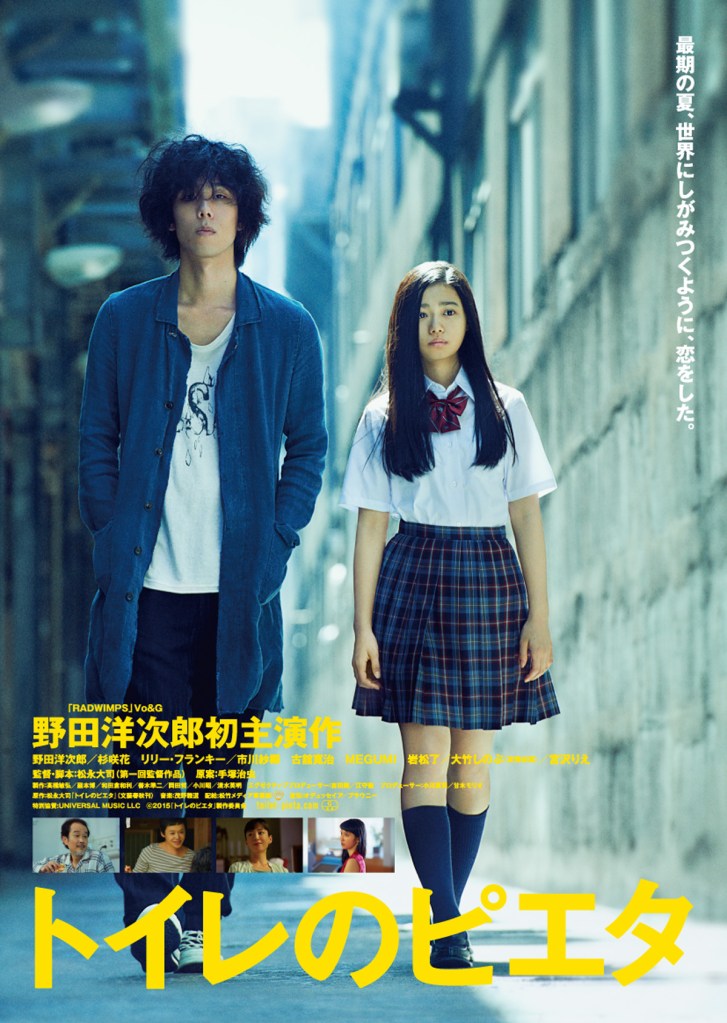 Somewhere near the beginning of Daishi Matsunaga’s debut feature, Pieta in the Toilet (トイレのピエタ, Toire no Pieta), the high rise window washing hero is attempting to school a nervous newbie by “reassuring” him that the worst thing that could happen up here is that you could die. This early attempt at black humour signals Hiroshi’s already aloof and standoffish nature but his fateful remark comes back to haunt him after he is diagnosed with an aggressive and debilitating condition of his own. Noticeably restrained in contrast with the often melodramatic approach of similarly themed mainstream pictures, Pieta in the Toilet is less a contemplation of death than of life, its purpose and its possibilities.
 They say the way to a man’s heart is through his stomach, but for some guys you’ll have to do a whole lot of baking. Based on the popular manga which was also recently adapted into a hit anime (as is the current trend) My Love Story!! (俺物語!!, Ore Monogatari!!) is the classic tale of innocent young love between a pretty young girl and her strapping suitor only both of them are too reticent and have too many issues to be able to come round to the idea that their feelings may actually be requited after all. This is going to be a long courtship but faint heart never won fair maiden.
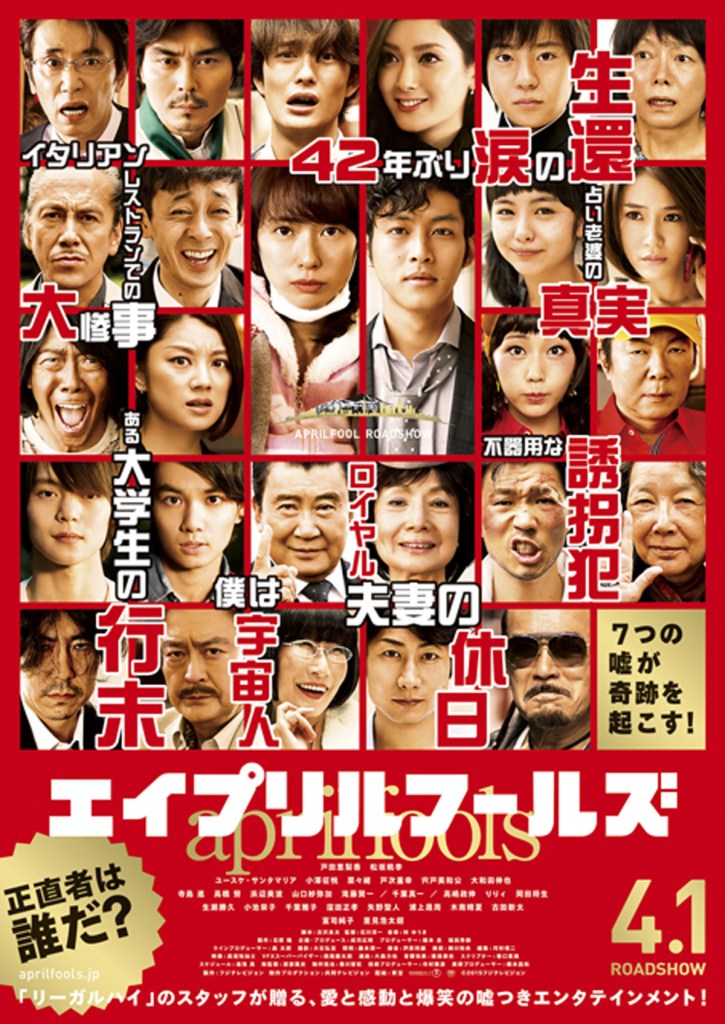 In this brand new, post truth world where spin rules all, it’s important to look on the bright side and recognise the enormous positive power of the lie. 2015’s April Fools (エイプリルフールズ) is suddenly seeming just as prophetic as the machinations of the weird old woman buried at its centre seeing as its central message is “who cares about the truth so long as everyone (pretends) to be happy in the end?”. A dangerous message to be sure though perhaps there is something to be said about forgiving those who’ve misled you after understanding their reasoning. Or, then again, maybe not.
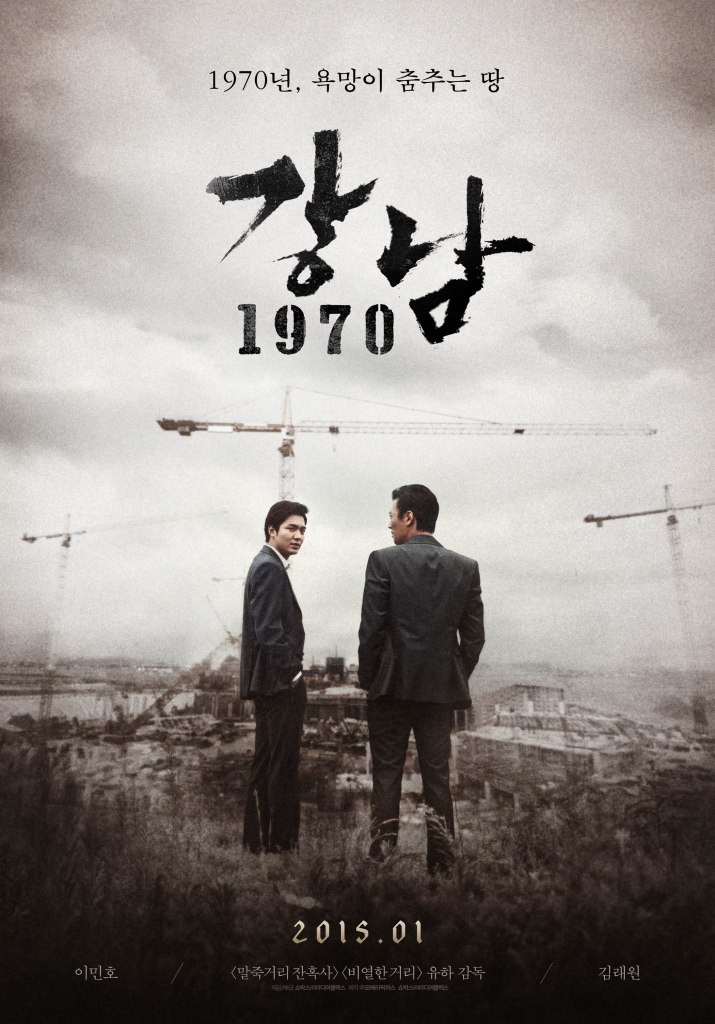 Yoo ha takes us back to the 1970s for some Gangnam Blues (강남 1970, Gangnam 1970) in a sorry tale of fatherless men caught up in dangerous times of ambition and avarice, very much at the bottom of the heap and about to be eclipsed by the “new world” currently under construction. Back then, Gangnam really was all just fields, owned by farmers soon to be cheated out of their ancestral lands by enterprising gangsters engaged in a complicated series of land grab manoeuvres, anticipating the eventual expansion of the bursting at the seams capital. Far from the shining city of today, Gangnam was a wasteland frontier town, the sort of place where a man can make a name for himself trading on his wits and his fists alone.
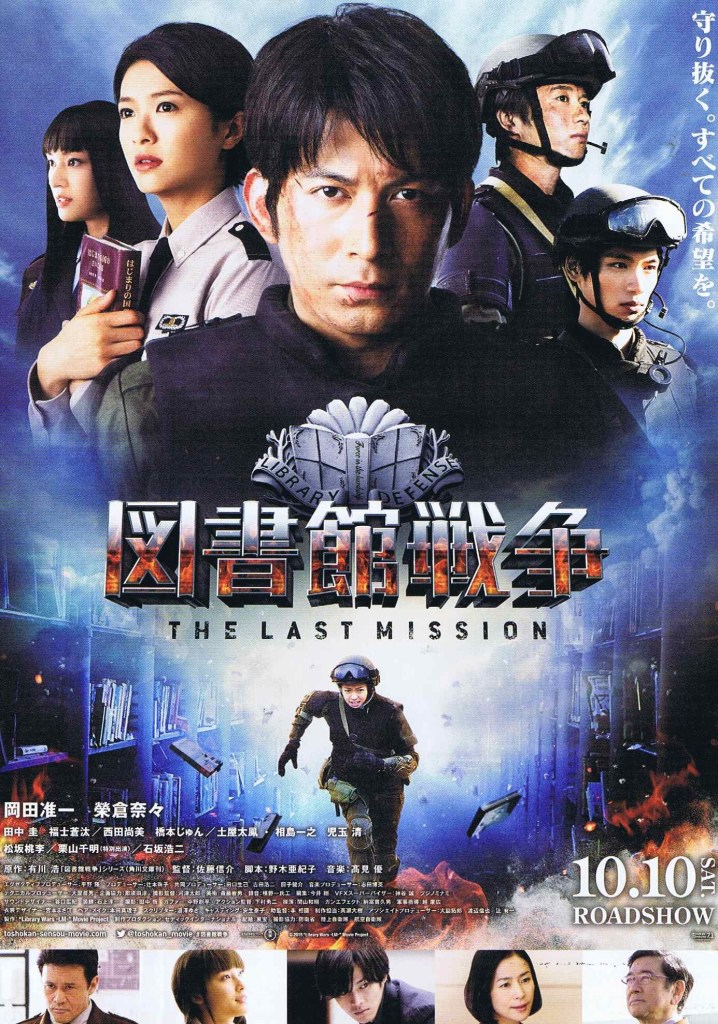 When
When 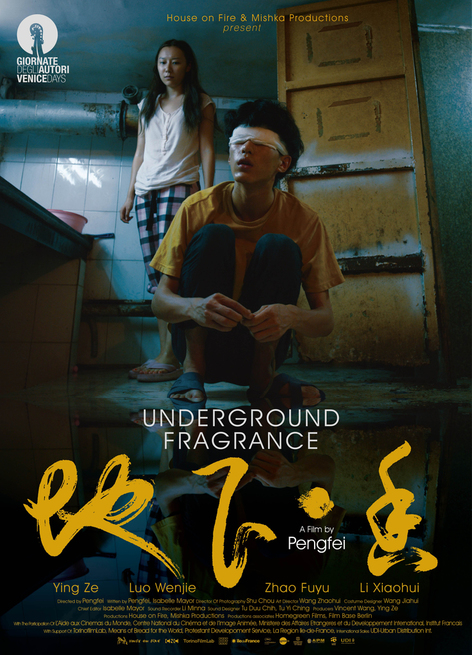 The original Chinese title of recent Tsai Ming-liang collaborator (Song) Pengfei’s debut feature 地下・香 (dìxìa・xiāng) has an intriguing full stop in the middle which the English version loses, but nevertheless these two concepts “underground” and “fragance” become inextricably linked as the four similarly trapped protagonists desperately try to fight their way to better kind of life. Recalling Tsai’s dreamy symbolism, Hou Hsiao-Hsien’s romantic melancholy, and Jia Zhangke’s lament for the working man lost in China’s rapidly changing landscape, Pengfei’s film is nevertheless resolutely his own as it chases the ever elusive Chinese dream all the way from dank basements and ruined villages to the shiny high rise cities which promise a tomorrow they may never be able to deliver.
 Windows on Worlds