

A young man’s dreams of flight are stamped out by a harsh reality only to be rekindled by a looming crisis in Pengfei’s warmhearted drama, Take Off (飞行家, fēixíngyuán). Beginning in the late 1970s and ending with a coda set in the present day, on one level at least the film attempts to chart the course of an ordinary man’s life through the tumultuous years of China’s economic and societal transformation in the late 20th century.
Viewed as something of an eccentric, Li Mingqi (Jiang Qimin), like his father before him, is obsessed with testing parachutes and the idea of breaking the record for the world’s highest jump. During the Cultural Revolution, Mingqi’s father was criticised for conducting unauthorised experiments, refused re-education, and was killed during his final, failed test flight. Mingqi’s fatherlessness and problematic background might explain why he is still an ordinary factory worker despite his obvious talent for engineering and has to conduct his experiments independently and in secret. Nevertheless, when given an ultimatum by his future father-in-law, Mingqi agrees to give up the parachute flights in order to marry his steadfast fiancée Yufeng (Li Xueqin).
In someways, Mingqi’s philosophy might be seen as subversive. He says that flying higher gives you a different perspective that changes the way you think and that by changing your thinking, the world around you also changes. China is already changing around Mingqi who remains more firmly grounded but continues to experiment with jetpacks in secret. Mingqi’s desire for success through his inventions is contrasted with that if Yufeng’s brother Xuguang (Dong Baoshi) who is forever studying to get into university for a better life outside the factory system and their small-town environment. When he’s injured by one of Mingqi’s experiments;, he begins to hold him responsible for his own ruined dreams while Mingqi also gives up his hopes of powered flight and further grounds his expectations.
But this decision to give up his dreams slowly starts to eat away at him even as the nation begins to move away from the planned economy towards a more capitalistic society. Mingqi and Yufeng open a dance hall as a “public-private” partnership in conjunction with the local factory and using donations from other factory workers who are supportive of their ambitions. Mingqi fills the place with various contraptions such as a novel system of delivering beer by machine, but after his jetpack is ridiculed by visiting foreign tech investors he begins to enter a depressive funk. A few years later the contraptions no longer work. Mingqi has taken to drink and gambling while the business founders as the factories begin to close and workers either leave the area in search of work, like Mingqi succumb to gambling, or simply have no money to spend on entertainment.
Xuguang too eventually returns from Beijing hiding the fact that he has failed in business amid the boom and bust economics of the day. He’s brought with him a “best friend” with whom he seems to have an unusually close, potentially queer coded connection, though Yufeng is right not to trust Dezeng (Dong Zijian) who turns out to be among the breed of amoral capitalists rising in conjunction with the economic reforms. Presumably having failed in someway himself if he’s bothering with this moribund factory town, Dezeng steals the dance hall out from under Mingqi’s feet by exploiting local workers’ desperation and then sells it to open a revolving restaurant at the top of a nearby tower designed for an economic elite which may not yet exist in this area.
The implication seems to be that increasing capitalism has poisoned Mingqi’s idealism, leaving him a broken shadow of a man who no longer has a reason to live now that he’s given up him dreams, but it’s better to live like this than be a man like Dezeng. A family crisis gives him the opportunity to rekindle his dreams by vowing to win a TV competition by jumping from Dezeng’s tower and landing at a spot a few kilometres away in return for a cash prize. Watched live on television, Mingqi’s attempt to fly becomes that of every other disenfranchised worker cast adrift by the 90s reforms as if giving them permission to stand tall and chase their dreams. It would not have been possible, however, without Yufeng’s support. She never wanted him to stop inventing things, just to be a bit more mindful of safety, and is happy to be reunited with the man she married. While the final message may seem contradictory, simultaneously encouraging the idea of dreaming big while emphasising solidarity, it is heartfelt and is clear in its advocation for the liberating power of dreams.
Take Off screened as part of this year’s New York Asian Film Festival.
Trailer (Simplified Chinese subtitles only)
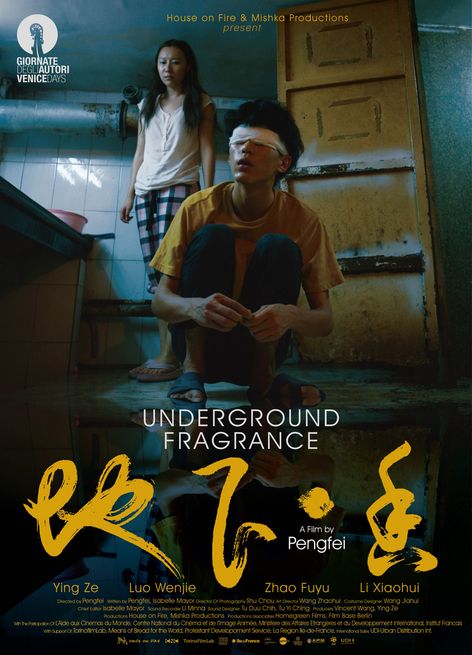 The original Chinese title of recent Tsai Ming-liang collaborator (Song) Pengfei’s debut feature 地下・香 (dìxìa・xiāng) has an intriguing full stop in the middle which the English version loses, but nevertheless these two concepts “underground” and “fragance” become inextricably linked as the four similarly trapped protagonists desperately try to fight their way to better kind of life. Recalling Tsai’s dreamy symbolism, Hou Hsiao-Hsien’s romantic melancholy, and Jia Zhangke’s lament for the working man lost in China’s rapidly changing landscape, Pengfei’s film is nevertheless resolutely his own as it chases the ever elusive Chinese dream all the way from dank basements and ruined villages to the shiny high rise cities which promise a tomorrow they may never be able to deliver.
