1 Girl Infinite (Lilly Hu, 2025)

There’s a moment in Lilly Hu’s gritty Changsha-set drama 1 Girl Infinite in which the heroine, Yinjia (Chen Xuanyu), watches as a fishmonger bashes a fish to death. He repeatedly smacks its head into the ground and, in a moment of foreshadowing, hits it with his meat cleaver while the fish flails around helplessly, gasping for air and twitching its tail. Yinjia winces and half looks away, but also sees something of herself in the way this poor creature is tossed around and eventually gutted in much the same way that she feels herself to be battered by her society.

Indeed, the film opens with her reading her suicide note in which she states that however she may die it has nothing to do with Xia Yutong (Lilly Hu), though in actuality it has everything to do with her. Abandoned by both of her parents, 19-year-old Yinjia has adopted a quasi-maternal role over Tong Tong who lives in her apartment and shares her bed, though the relationship, from Tong Tong’s perspective at least, remains curiously ill-defined. In the early light of morning, Yinjia silently gazes at her sleeping figure, but Tong Tong often rejects her gestures of intimacy. She won’t let Yinjia hug her in the street because she’s “too heavy,” and there is a clinginess to Yinjia that spills over into possessiveness and control that might be off-putting, but equally it seems that Tong Tong pushes her away because she herself doesn’t know how to process this relationship or her feelings for Yinjia. 

Then again, perhaps it is really about not having anywhere else to go as she unconvincingly tells her friends when they complain she’s brought “that girl,” again. Tong Tong tells them that Yinjia is just some girl who won’t stop following her around and acts like she’s a drag, but is at other times clingy herself and in rare moments of freedom expressing a silent affection for Yinjia. Nevertheless, there is a marked contrast between the more straight-laced Yinja and Tong Tong’s punkish friends who seem to represent two opposing worlds. Yinja glares at them constantly, resenting their indiscriminate use of drugs and the dangerous situations it could get them into, but appears to want to rescue Tong Tong who might not actually want to be rescued.

When Tong Tong gets involved in another ill-defined and possibly transactional relationship with local drug dealer Chen Wen (Bo Yang), it further disrupts their dynamic and pushes Yinjia towards the edge as she falls into a self-destructive obsession while convinced that she will lose Tong Tong. Tong Tong is convinced that Chen Wen will take her to America, which it seems clear that he has no real intention to do, where people live in big houses and everyone has a job. In this way, he represents a more literal kind of escape from the problems of contemporary China in which she is trapped in a dissatisfying socio-economic position from which she sees no way out. After she loses her virginity to Chen Wan, the camera cuts to a Burberry bag containing a designer dress that echoes Tong Tong’s need for consumerist affirmation. 

Tong Tong clearly aspires to his life of wealth and comfort, but it’s equally true that Chen Wen’s financial stability is rooted in illegality and moral dubiousness in his indifference to the harm his line of business causes. When the girls visit his apartment, there’s another woman there that is being fed drugs and is eventually manhandled out when her reaction to them begins to annoy Chen Wen and his henchman. She may be a harbinger of what may become of Tong Tong if she gives in to this bargain and a further provocation for Yinjia who is determined to prevent her from doing so by any means necessary. It’s never quite clear whether either relationship is any more than transactional from Tong Tong’s point of view, or whether she’s really aware of the realities of her relationship with Chen Wen which he clearly doesn’t view with much seriousness, though she continues to refer to herself as his girlfriend and evidently really believed he meant it when he said he’d take her to America. 

Yinjia meanwhile glares at the world around her and strikes back self-destructively. She scores a partial victory in seeming to have impressed Chen Wen in the depths of her devotion and the lengths that she would go to to maintain control over Tong Tong, though it’s also somewhat hollow and ironic given that he almost certainly never meant to take her to America anyway nor keep her around very long. Left with no parental input or societal safety net, the two women are each adrift and left with only each other to rely on. Though locked in a somewhat toxic embrace, the relationship between them is the only hint of purity in their otherwise impure world of betrayal and exploitation.


1 Girl Infinite screens at Rio Cinema 3rd May as part of this year’s Queer East.

Hit N Fun (臨時決鬥, Albert Mak Kai-Kwong, 2025)

“There’s no point looking back,” according to the heroes of Albert Mak Kai-Kwong’s surreal Muay Thai comedy Hit N Fun (臨時決鬥), but then again it seems like victory lies in staying in the ring. No matter how many times you lose, you have to keep fighting because precisely because you have no expectation of winning. Bruce’s (Louis Koo Tin-lok) gym in Macao is then a remnant of a world on the brink of eclipse that he’s been desperately trying to cling on to only to come to the slow realisation that it may be time to let it go.

His wife Carrie (Gigi Leung Wing-kei) is experiencing something similar after trying to make a comeback as an actress. A promising opportunity goes awry when she realises it’s for an advert for a menopausal tonic and protests that’s she’s far too young for all that but is immediately shut down by the producer, Elsa (Louise Wong Tan-ni), who says she doesn’t even know who she is but is only using her as a favour to her aunt, Bridget (Harriet Yeung), who is Carrie’s manager. Carrie complains that she can’t get a foothold in the contemporary cinema scene partly because of a dearth of parts for women her age, while she’s equally too afraid to let go of ingenue roles and her image of herself as one to make the irreversible shift to playing mothers of adult women. But then it also seems that you can’t get anywhere without a huge following on social media, which is largely powered by young actors from big agencies with hundreds and thousands of fans. 

Meanwhile, Elsa can’t let go of her long-term boyfriend Daniel (Peter Chan Charm-man) who has been unsuccessfully trying to break up with her but has not yet disclosed that he’s now in a relationship with Surewin (Chrissie Chau Sau-na), a Muay Thai champion who started out at Bruce’s gym but left with his best student, Arnold (German Cheung), to start up on their own. Unlike Bruce’s traditional gym, Arnold’s is a slick, modern facility that pushes expensive package subscriptions and has a sideline in merchandising and fitness-related goods. In many ways the battle is between the wholesome sense of community presented by Bruce’s rundown school, and Arnold’s soulless corporate enterprise which doesn’t even really care that much about Muay Thai anymore.

Then again, the unlikely champion of this wholesomeness is Elsa, who decides she has to fight Surewin not exactly for Daniel but to avenge and vindicate herself. Even though it’s very unlikely that she could really beat a champion after an intense three months of training, Elsa is determined to give it a go more out of stubbornness and pride than anything else. But then all she really needs to do is stick around, much like Bruce. Elsa only needs to be standing after four rounds and as Bruce is fond of reminding her, if the final bell hasn’t rung, then you haven’t lost yet. 

While training at the gym, Elsa begins to loosen up a bit and shifts more towards the world of Bruce’s gym than her high-powered job that is founded in consumerism and geared towards selling people things they don’t want or need to distract them from a sense of dissatisfaction about their lives. But on the other hand, perhaps there’s no point in the kind of stubbornness that prevents you from moving forward. Bruce has an old leather sandbag in his gym that seems to embody its soul, yet it’s already leaking sand as if the building itself were bleeding. Ironically, it’s Arnold who eventually tries to save it while Bruce seems resigned.

What they reach seems to be a kind of compromise, utilising Elsa’s skills to modernise and expand the gym, which is really just another way of fighting if also perhaps a concession and decision to leave something behind. You could also read this as an allegory for the Hong Kong film industry which is increasingly leaning towards the Mainland but still hanging on though some might say losing its soul in softening any hint of localness. On the other hand, Hit N Fun is quite defiantly a homegrown comedy starring some of the biggest local stars from Louis Koo and Gigi Leung to Tony Wu and the rising star Louise Wong. It ultimately seems to say, we’re still here, and we’ll pick our battles, but we’ll keep fighting even if we can’t win because perseverance can be a victory in itself.


Trailer (Traditional Chinese / English subtitles)

The Beetle Project (숙제, Jin Kwang-kyo, 2025)

“Cousins should get along,” according to a North Korean soldier who’s just found out his son has been bullying his nephew, ironically by drawing a red line down the middle of their bedroom to make it clear that this interloper isn’t wanted in his territory. Red lines become a theme in Jim Kwang-kyo’s charming childhood drama The Beetle Project (숙제, Sugje) in which the pure-hearted goodness of a series of children knows no borders and sees only common ground between themselves and a North Korean boy who’s lost his pet beetle that he was keeping as a homework project.

Luckily, the beetle is discovered by best friends Ah-ram and Jae-hoon who decide to finish the boy’s homework for him in the hope that they will somehow be able to get the beetle back to him. Of course, that’s easier said than done given that Lee Chul-min lives in the North so it’s not like they can they just pay him a visit to give it back. The irony is that the beetle only came to them because of a flood that was partly caused by the North’s sudden opening of its floodgates prompting calls for greater co-operation across borders to prevent potential tragedies such as these. 

Meanwhile, we discover that Lee Chul-min is experiencing a degree of familial discord as his younger brother Chul-kyu is resentful of the fact he’s been sent to the city to study in a better school while he’s been kept at home and is forced to work in the fields with his mother. The film’s depiction of North Korea is largely utopian in which the repressiveness of the regime is barely felt aside from the occasional presence of soldiers and a degree of foreboding in the threat that the growing feud between the boys poses to a carefully balanced order. Chul-min’s cousin Chul-ju is also resentful that he now has to share everything including his room and has been bullying Chul-min because of it, though Chul-min is a stereotypically good boy who puts up with everything without making a fuss and makes sure to tell his mother what a good time he’s been having in the city where they get to eat ice cream every day when it’s hot.

Both sets of children deeply care about the fate of the beetle and what’s best for it, only to become a political football that’s picked up by a shady conglomerate Ah-ram’s journalist father Jin-kyu tried to expose for a food contamination scandal only to have to make a humiliating retraction on air when the station is ordered to back off. Hooked on the PR potential, they try to use the beetle, and Ah-ram, for their own ends, while the family simultaneously becomes the target of scammers promising they can help return the beetle for a small fee, and rightwing trolls who harass them for being North Korean collaborators. When one of the other kids damages the beetle’s enclosure. Ah-ram and Jae-hoon find themselves drawing another red line to keep them out only to later think better of it.

Disappointed by the adults around them, including Jin-kyu who is still struggling to deal with the death of his wife and his changed relationship with Ah-ram whom he sent to live with her grandmother in the country, the kids decide they want to send the beetle back by themselves and hand it straight to Chul-min. Jin-kyu ends up getting involved with an online insect enthusiast group who unbeknownst to him are all children and strangely led by a little girl who for some reason talks like a middle-aged farmer’s wife. In any case, it’s very much children doing it for themselves and realising that they have a lot in common despite the border between them. Ah-ram is worried that Chul-min will get into trouble for losing his homework and probably misses his beetle while she herself is also still processing her mother’s death for which she blames herself and adjusting to her new life in the country where she’s supported by her forthright schoolteacher who can’t resist resorting to colourful language whenever she encounters “injustice”. In its way, the beetle becomes a kind of symbol for Korea itself with the children promising to meet again as adults so they can find out what happened to it while wishing the best for “Beety” and vowing to look after it together. Charming and wholesome, the film is a gentle advocation for a spiritual, if not necessarily literal, reunification and a sense of solidarity among the younger generation dedicated to doing the right thing in a world in which adults call lies “flexibility” and think one beetle is no better than another.


The Beetle Project screened in Chicago as part of the 19th edition of Asian Pop-Up Cinema.

Rainy Blue (レイニー ブルー, Asuna Yanagi, 2025)

“You never know when it will end,” Aoi mutters to a concerned teacher. “The streaming period, and my life.” Asuna Yanagi’s Rainy Blue (レイニー ブルー) is a semi-autobiographical tale of a young woman figuring out how to live in the world while immersed in cinema. Her father may insist that she look at the reality, but Aoi’s world is already quite surreal even as she pours all her efforts into writing screenplays and watching films but otherwise floundering for direction.

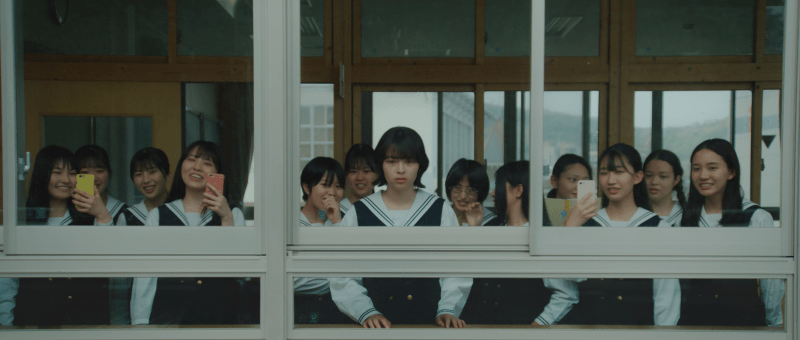
To begin with, Aoi isn’t interested in cinema She just gets sent to see a film as punishment after getting caught setting off fireworks on the school roof because a local cinema has a special retrospective dedicated to actor Chishu Ryu who attended the same high school though probably 100 years previously. Despite scoffing at the idea and chuckling that everyone in the cinema is “old” while even the usher double checks to make sure she’s in the right place, Aoi is captivated by Ozu’s filmmaking and becomes a true convert to cinema to the extent that it completely takes over her life. She becomes the only member of the school’s film club, or as she’s find of reminding people “society”, and regularly turns up late after staying up all night watching movies. 

To that extent, Aoi’s film obsession may not quite be healthy in that it leads her to make some questionable decisions with unintended consequences, such as getting arrested for “stalking” people after following them around as research for her screenplays. She also finds out that one of her old friends, who is also her father’s favourite example of a “good” daughter, is into compensated dating and in reality perhaps just as lost as she is. Aoi’s father no longer understands her and has become authoritarian and unforgiving. He regularly berates and shouts at her while making no real attempt at communication. He simply asks why she can’t be “normal” and concentrate on going to uni like the other girls while complaining about how “embarrassed” he would be if she doesn’t go because it would reflect badly on him as a parent. 

Perhaps it’s not surprising that Aoi retreats into cinema to escape, but it’s also true that she finds a more supportive paternal presence in the guy at the cinema who turns out to have been a classmate of her mother’s. There’s a kind of poignancy in Aoi and her sister’s moment of confusion on realising that their mother was interested in films but they rarely watch them at home because her father doesn’t like them, while her mother rarely has time to go alone. Aoi’s love of cinemas as mediated by an old script she finds in the club room is also a way of connecting with her mother as a potentially more supportive parental figure in contrast to her father’s hardline authoritarianism.

But then, in her love of cinema Aoi is absolutely certain and she’s no reason why she should hide it from anyone else. Her best friend at school is rather bafflingly played by 43-year-old film director Hirobume Watanabe who dresses in a pre-war school uniform complete with student’s cap and little round glasses that make him look strangely like a Studio Ghibli character. Usami is an otaku with a love of anime he thinks he’s kept hidden despite having several anime badges on his backpack and is too afraid to be out and proud about it because he knows he’ll be bullied, which he eventually is when Aoi enters a deeper moment of crisis and more or less abandons him and the school. Watanabe also appears as a weirdly inspirational film director who has a go at an audience member at a q&a who asks him why his film is so nihilistic only for him to turn the question back on her and angrily insist that film can illuminate the way forward for those like Aoi who feel themselves to be lost. 

Thanks to all these strange adventures, her various friendships, and even her father’s animosity, Aoi eventually figures out what she wants to do with her life and gains the courage to go after it no matter what anyone else might say. Set in the picturesque environment of rural Kumamoto, the film’s gentle, laid-back aesthetic belies the storm at its centre and the rainy blue that surrounds the heroine until she too finally finds her way through the labyrinths of cinema.


Rainy Blue (レイニー ブルー, Asuna Yanagi, 2025) screened as part of this year’s Osaka Asian Film Festival.

Original trailer (no subtitles)

Ne Zha 2 (哪吒之魔童闹海, Jiaozi, 2025)

By the end of 2019’s smash hit animation Ne Zha, the titular hero (Lü Yanting) and his opposite number Ao Bing (Han Mo) had figured out that they were two halves of the same whole and were much better off fighting alongside instead of against each other, but even after getting their physical forms reconstituted with the help of a little lotus flour, they discover that the evil Shen Gongbao (Yang Wei) isn’t done yet. The first film may have been in its way subversive in the hero’s bold assertion that he will defy his fate and define his own identity, but Ne Zha 2 (哪吒之魔童闹海, Nézhā zhī Mó tóng nào hǎi) takes things a step further as Ne Zha comes to discover that not even the Heavens are free of corruption or prejudice.

Indeed, it’s this idea of prejudice which lies at the heart of the film for even if Ne Zha had won the hearts of the townspeople by saving Chentang Pass in the first film, he realises that there are some among the immortals who wish to erase all demon kind. The conclusion he eventually comes to is that demon and immortal are arbitrary terms used to control those who are different. He’s sick of hiding his demon nature and thinks it’s time he reveal himself to the world while fighting the injustice that’s taken over the Heavens in the Master’s absence. 

Meanwhile, his desire to break free of oppressive authoritarianism is symbolised in his breaking Wuliang’s (Wang Deshun) cauldron and freeing those inside who were otherwise to be turned into pills of immortality and fuel the heavenly economy. While he and Ao Bing resolve that the real enemies are those who bully the weak and bring evil to the world, the villains insist that siding with the strong is the only way. Ne Zha and Ao Bing’s response to this is to insist that if there is no place for them, they will create it for themselves and if they are not accepted they will change people’s minds. As they later say, they are young and have nothing to fear echoing a spirit of resistance among contemporary youth confronting an oppressive and authoritarian society.

Then again, a key feature of Ne Zha’s goodness is his love for his parents and desire to be a “good son” by traditional standards. It’s clear that even Ao Bing’s father the Dragon King of the East, Ao Guang (Li Nan / Yu Chen), acted only in the best interests of his son and has otherwise been framed by ambitious forces around him who decided they were better off entering a more active partnership with a corrupt authority rather than appease them by accepting their oppression. Even so, both sets of parents eventually tell their sons that they should now follow their own paths and do what they think is right. The world is no longer as was is when they were young, and they are not well equipped to understand these problems nor to solve them. If the Heavens are to be purified once again, it will be up to Ne Zha and Ao Bing to do it.

Aside from this more series and potentially subversive message about asserting one’s identity and challenging authoritarianism, the film has a lot of fun with its anachronistic worldview as drunken Taiyi Zhenren (Zhang Jiaming) struggles to remember the password to open the lotus before remembering he can use a fingerprint instead, while another villain later runs into a problem trying to open a door that works by face recognition because he’s sporting so many bruises and swellings after getting a beating from Ne Zha. He then realises he’ll have to wait another 10 years to try again because he cursed the technician for laughing at his ridiculously battered face. The film’s action sequences are also tremendously well animated and exciting as Ne Zha’s parents try to fight off the demon hordes which mainly consist of the “Monsters of the Abyss,” various sea creatures such as octopuses and sharks that were previously held in check by the Loongs but have now been set loose because of a dragon queen’s ambition. In any case, improving on the original the sequel maintains its quirky humour and charming worldview while doubling down on its surprising messages of acceptance and diversity as Ne Zha and Ao Bing prepare to forge their own paths and fight for justice to clear the Heavens of their corruption.


Ne Zha is in UK cinemas now courtesy of CineAsia.

UK trailer (English subtitles)
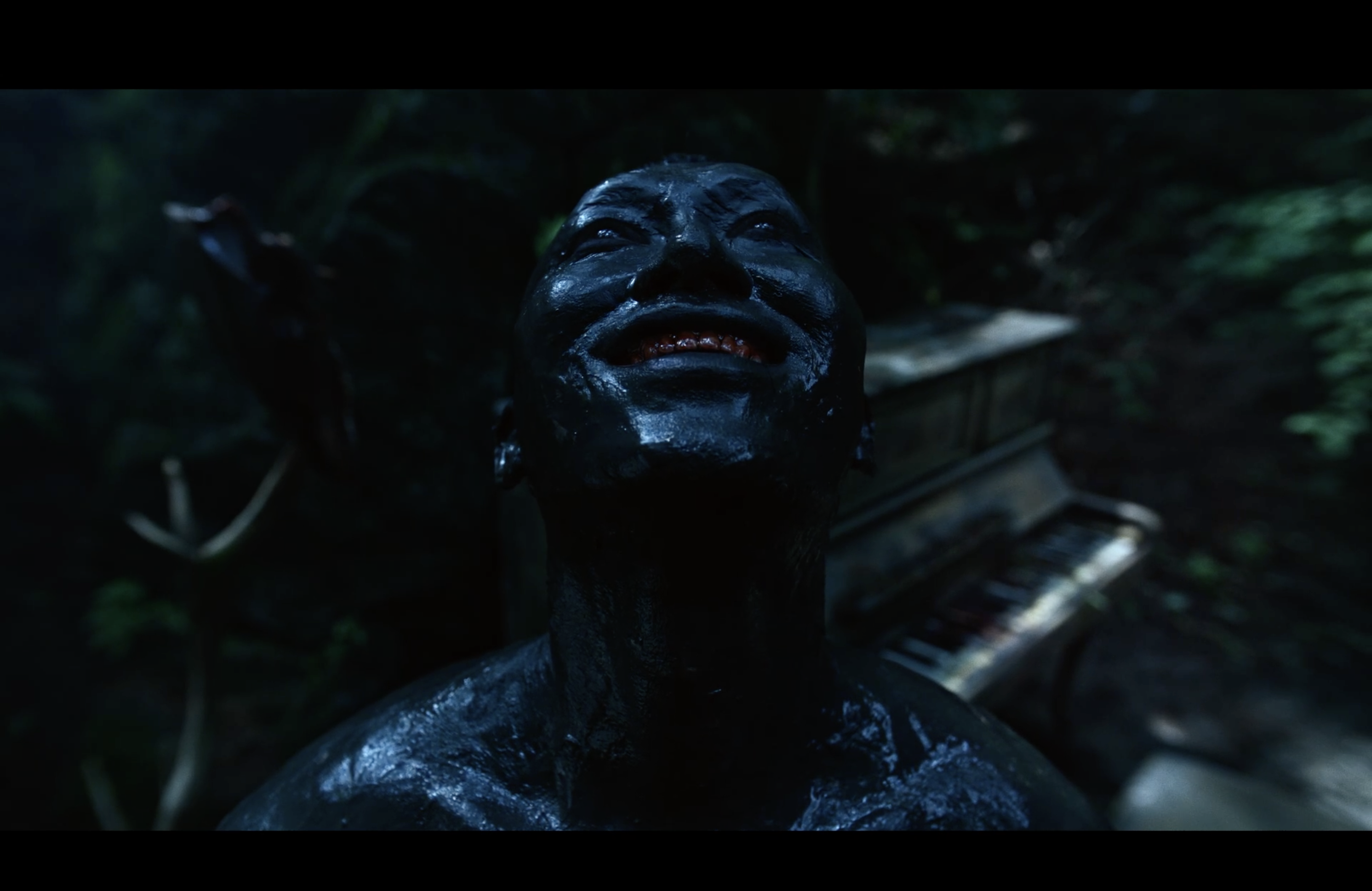
Manok (이반리 장만옥, Lee Yu-jin, 2025)

When Manok returns to her rural hometown in the wake of her mother’s death, the irony is that some accuse her of running away from the humiliation of the implosion of her life in Seoul, but in other ways she has unfinished business in Iban-ri and this time she isn’t going to let them drive her away. Lee Yu-jin’s warmhearted dramedy is at heart about a love of community, or rather communities that might not at first seem compatible or even mutually exclusive but are then integrated by the sheer force of Manok’s determination.

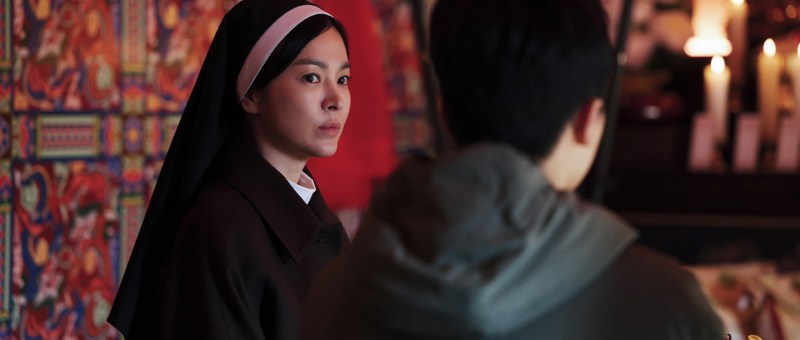
Now in her 50s, Manok (Yang Mal-bok) had owned a popular lesbian bar in Seoul and was at the forefront of queer activism in the city hosting the annual after party for the Pride parade for the last 20 years. But times have changed and the young queer community has begun to find new places to root itself while Manok struggles to adjust to the generational shift taking place. Finding out on the same day that her mother has died and her brothers don’t really want her at the funeral, she’s losing the parade after party and without it her bar will probably go out of business, and her long-term partner Geum-ja (Kim Jung-young) knew all along but didn’t say anything out of fear of her reaction, sends her into frenetic spiral in which she abruptly leaves town and decamps to the house her mother inexplicably left her back in Iban-ri.

Manok had left town to live a more authentic life having tried to accommodate herself to conventionality through marriage but finding it unbearable. She is not exactly welcomed back with open arms as her brothers repeatedly blame her for being a “nasty lesbian,” and using it as a justification for increasing their share of the inheritance to cut her out. Her ex-husband, meanwhile, has become the city chief and rules the local area with an iron hand while misusing his position to exploit the local community. Manok ends up coming to the rescue of his child, Jae-yeon, whose transgender identity he repeatedly rejects while Jae-yeon faces discrimination and harassment from his schoolmates.

Jae-yeon is in many ways the reason that Manok can’t simply leave again and try to reconstruct her life in Seoul because nothing’s really changed in Iban-ri and Jae-yeon is facing all the same problems she once did but without the well-earned armour the middle-aged Manok has managed to forge for herself that allows her to stare down injustice with a steely gaze. Then again, back in Seoul, younger members of the community had accused her of being self-aggrandising, that she was overfond of justifying her actions as being for their benefit when really she simply enjoyed the status of being a community leader. In Iban-ri, however, she gains some time to reflect and truly becomes a part of this community that she again wants to save, this time by challenging her ex to win the position of city chief herself and enact change through kindness and solidarity. While the young leave for the cities, many left behind are elderly and are in their way just as exiled as Manok with the city chief failing in his obligations to look after them.

Later Manok says that her ambition is to make Iban-ri a place where no one is lonely or feels the kind of isolation she once felt through being rejected by those around her because of her sexuality. As her ex pathetically tries to cling on to his patriarchal authority, Manok decides to do things the Iban-ri way by winning hearts and minds and eventually showing them that there’s nothing to fear as she too reoccupies her mother’s house with her partner in tow finally claiming her claiming her space in this place that had no place for her. As Geum-ja had said, Manok really does love her community and sets about making Iban-ri a happier and healthier town where people care for and about each other and no one is left behind. A warm and quirky exploration of small-town life and the power of authenticity the film’s infectious spirit is difficult to deny as the joy it finds in the queer identity even amid so much fear and hostility brokered by one woman’s determination not to back down because there are kids who need protecting in Iban-ri and they all they deserve a Manok in their lives.


Manok screened as part of this year’s BFI Flare.

Trailer (English subtitles)

Summer’s Camera (여름의 카메라, Divine Sung, 2025)

Summer can’t bring herself to press the shutter button on the last four exposures left on the unfinished roll of film her father left behind. Her unwillingness to do so and seeming abandonment of their shared passion for photography hints at her difficulty to come to terms with his passing along with her own sense of adolescent confusion. But just as her father had told her she would, she learned to hear the shutter for herself and took three of her four remaining photos without thinking, all of Yeonwoo, the star of the school’s football team by whom she is unexpectedly captivated.

Well, perhaps not all that unexpectedly. Summer appears to already be aware of her queerness even if she hasn’t explored it yet and quickly finds that her interest is returned by Yeonwoo who immediately responds to her roundabout confession of love by asking her out. Which is all to say, this world is quite different from that Summer’s father Jihoon inhabited in his youth even if it’s rosier than the still conservative reality of contemporary South Korea. Summer’s direct announcement to her best friend that she likes girls is met with a simple “I know,” having noticed that she never took photos of guys and only a little hurt that she never said anything before and hasn’t let her in on her recent dating news.

But what Summer discovers after taking one very deliberate photo of Yeonwoo and having the film developed is that her father also took pictures of someone he liked and that someone was a boy, Maru. Of course, this revelation is quite destabilising for her. She can’t get her head around her father’s relationship with herself and her mother if he was gay though as her friend points out, he may have been bisexual which actually didn’t occur to her. In a quest for answers, Summer approaches the now middle-aged Maru and eventually like her friends did of her simply accepts this unknown fact about Jihoon while finding in Maru someone who’s gone through the same things she’s experiencing and with whom she can discuss the things she can’t yet talk about with her mother or friends. 

In her recollections, we never see the face of the adult Jihoon. He always appears with her back to her or just out of frame reflecting the ways in which she no longer feels as if she knew her father and has lost sight of her relationship with him in the wake of her loss. Though told it was a traffic accident, Summer wonders if in reality he might have taken his own life and chosen to leave her behind. Through re-embracing photography, she begins to rediscover him and come into herself gaining not only the confidence to be who she is but to believe that loss is something she can bear while like Yeonwoo’s running hobby which apparently can alter the flow of time, photography is also a means of trapping a memory which means that nothing’s ever really gone.

With the universal love and acceptance that seems to surround Summer, the film implies that the world has moved on and if her father chose conventionality over love that’s a choice that she may not need to make. Even so, in Maru she finds a strong queer role model who even in his own sadness and grief in his lost love for Jihoon is able to help her move forward in showing her a different side of her father which she had never known. He helps her navigate young love and offers a safe space for her to be herself until she’s ready to confront the unresolved past and make peace with it. Though perhaps tinged with melancholy and longing, Summer’s world is otherwise bright and sunny. Filled both with the giddiness of first love and the deep sadness of a catastrophic loss, it is nevertheless warm and beautiful as Summer sees it through the camera lens. With the shutter button as her guiding light, Summer learns to see in new ways peering both back into the past and ahead into her future now less fearful and more certain of herself having reclaimed both something of the father she lost and the one she never knew.


Summer’s Camera screened as part of this year’s BFI Flare.

Trailer (English subtitles)

I Am Kirishima (桐島です, Banmei Takahashi, 2025)

In early 2024, an elderly man made a shocking confession. He told members of the medical staff at the hospital where he was being treated that his name was actually “Satoshi Kirishima” and that he was a fugitive from justice wanted for the terrorist bombing of Mitsubishi Industries in 1974 that resulted in the deaths of eight people. Banmei Takahashi’s I Am Kirishima (桐島です, Kirishima desu) attempts to chart the course of his lifetime on the run but may prove controversial in the depths of its sympathy for a man who was party to this kind violence and to a degree found it justified even if he could not justify that his organisation threatened the lives of ordinary people rather than simply the infrastructure of companies they believed to be fuelling corporate imperialism.

Takashi has visited this era before with 2001’s Rain of Light which like Wakamatsu’s United Red Army readdressed the Asama-Sanso Incident and the failure of the student movement in early 1970s of which both directors had been a part. In February 1972, five members of the URA fleeing a purge inside the group holed up in a mountain lodge taking the innkeeper’s wife hostage. The event was one of the first news events in Japan to be broadcast live and its aftermath exposed the cult-like depths of violence and abuse to which the URA had descended forever the souring the nation as a whole on the idea of left-wing revolution. Meanwhile, the fragmentary groups that remained shifted further towards the extremes such completing bombing campaigns to disrupt the new capitalistic prosperity of the economic miracle. Kirishima and his cell believe these large conglomerates, such as Mitsubishi, to be enacting a new kind of Japanese imperialism through exploitative labour practices often targeting migrant workers in much the same way they made use of the forced labour of Korean and Chinese people trafficked to Japan during the colonial period.

To this extent, Kirishima justifies acts of terrorism but thinks they should avoid ordinary people getting caught up in the blast. The film is keen to cast him as “a man behind the times,” an foolish idealist who is exiled from the modern society because of his outdated beliefs in equality and fairness. As such, it lends an elegiac quality to the tragedy of his life in which his 50 years on the run weren’t all that much better than prison given that he had to live under an assumed identity, forever watching his back and unable to put down roots. A tentative romance with a singer-songwriter is hinted at, but Kirishima forgoes his romantic desires out of a feeling that it would be irresponsible to marry without being able to reveal his true self. 

But the film equally seems to drawn a parallel with contemporary Japan in Kirishima finds himself working alongside a middle school drop out with openly xenophobic views who makes frequent racist remarks such as implicating a co-worker when he’s taken to task for being late by insisting that it must be the other guy’s fault because he’s Korean and Koreans always lie. He also says that the migrant workers whom he claims are working illegally should be grateful to be exploited in Japan and can always go home if they don’t like it. It’s all a little too much for Kirishima who sacrificed his life for an ideal this boy repudiates while Japan has become a nation ruled by capitalism and exploitation with the labour revolution he dreamed of now a distant memory. Watching a Shinzo Abe press conference in which he discusses revising the constitution, Kirishima throws a beer can at the TV in frustration. His old comrade dies in prison leaving only a book of poetry behind, while another is released after serving his time though he obviously can’t make contact with him without risking his identity being exposed and getting picked up after all these years. 

Indeed, the film romanticises this image of Kirishima as a man from a bygone age in which another Japan was possible but did not and now presumably cannot come to pass. In doing so, it gives tacit approval to some of the actions of the extremist groups of the 1970s while simultaneously declaring the end of an era as a “case closed” card is placed over the cheerfully smiling face of a young Kirishima which had graced wanted posters all over the country for the last 50 years. His life itself becomes a failed revolution, but also kind of victory in which he managed to “beat” the police by remaining a fugitive all that time even if in the end he seems to regret the life he was prevented from living along with the isolation and loneliness of which he may now at last be free.


I Am Kirishima screened as part of this year’s Osaka Asian Film Festival.

Trailer (no subtitles)

So Beautiful, Wonderful and Lovely (素敵すぎて素敵すぎて素敵すぎる, Megumi Okawara, 2025)

Is it better to have a dream that will never come true or to have no dreams at all? That’s a question that Nozomi can’t help asking herself after her world comes crashing down when she discovers her boyfriend is randomly marrying someone else. Nevertheless, she comes to realise that her life is and always has been So Beautiful, Wonderful, and Lovely (素敵すぎて素敵すぎて素敵すぎる, Sutekisugite, Sutekisugite, Suteki Sugite) in Megumi Okawara’s quirky indie dramedy of endless heartbreak and constant absurdity.

At least, there’s nothing more absurd than being haunted by the spirit of your very much still alive boyfriend in the form of a slice of castella cake. Nozomi’s mother has been tearfully trying to perfect a party trick to perform at the wedding of her daughter to boyfriend Chitose, but unbeknownst to her, Chitose has married someone else. Gatecrashing the ceremony, Nozomi teamed up with Chitose’s brother Susumu to hijack the wedding photo and then run off with the camera though she ended up crashing into a castella cake delivery guy and landing in hospital with a brace around her neck. The neck brace is perhaps a symbol of the way Nozomi’s world has been narrowed, preventing her from turning her head to find new directions in life. But those would be hard to find anyway when you’re being followed around by a guy who looks like your ex but also claims to be a piece of sentient cake. 

To begin with, she tries to have fun with Castella-Chitose by going on influencer-style dates such as a visit to his “birthplace” (a castella cake shop) while trying to understand her relationship with the “real” Chitose who not is particularly nice and very pissed off about everything that happened with his wedding along with Nozomi’s lingering attachment to him. She seems to want to continue with the relationship as it was even though he treats her poorly and has already married someone else, while he just seems to be paranoid that she plans to expose their affair even if he does accept responsibility in having behaved badly by never mentioning that he already had girlfriend and for an unknown reason also keeping his wedding and marriage a secret from his colleagues at the school where they both work. 

After making an “affair”-themed video it seems designed to blackmail him into getting back with her, Nozomi (whose name means “hope”) decides to make a fresh start by getting a job in a stationery shop which also turns out to be staffed by people with broken dreams. Her eccentric boss Yoko and the other clerk apparently live in adjacent wardrobes at a rented apartment while Anita, a middle-aged man too timid to interact with customers, worries for his daughter who has broken dreams of her own. Surreal as it is with its weird customers who turn up to see the “new products” or try to buy crab rice which they obviously don’t sell, Nozomi begins to find a new sense of belonging and solidarity as she grieves her failed relationship with Chitose which is set to expire in exactly two weeks’ time when the castella finally meets its best before date.

But then what she discovers is that the thing about dreams that don’t come is that they never expire. Perhaps it really is better to have a dream that won’t come true than not have a dream at all. Or at least, that’s what her new colleagues seem to show her even the midst of their loneliness as they latch on to each other and remind Nozomi that as Castella-Chitose said she matters and that there are people who love and care for her in ways that the real Chitose obviously never did. She wishes most of her life were a dream, while her dreams never come true but still her life is and has always been so beautiful, wonderful, and lovely even if she’s only just really becoming able to appreciate it thanks to her new friends who are giving her the courage to dream new dreams and move on from her disappointing relationship with Chitose while watched over by the spirit of castella cake. Defiantly weird but also warm and wholesome, the final message is that it’s best to embrace life’s strangeness along with its joys and heartbreaks while continuing to dream even if those dreams may never come true.


So Beautiful, Wonderful and Lovely screened as part of this year’s Osaka Asian Film Festival.

Trailer (English subtitles)

The Tales of Kurashiki (蔵のある街, Emiko Hiramatsu, 2025)

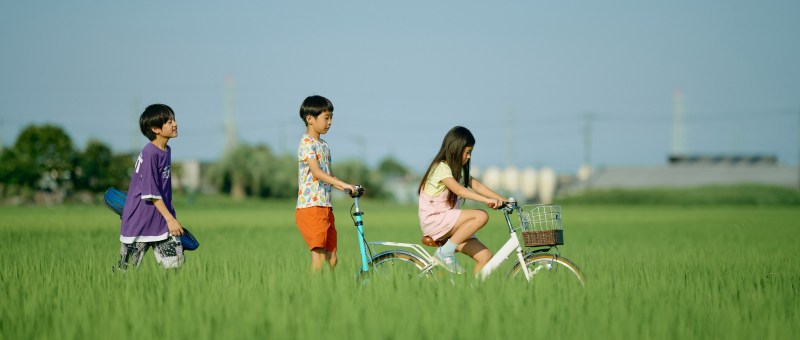
Beniko’s high school art project involves recreating a picture her mother left behind that immortalised a memory of a happy family moment during the rare sight of fireworks. But Beniko can’t seem to make progress with her artwork and she’s thinking of giving up art altogether along with her ambition of attending an art school because for her painting is intrinsically linked with her familial trauma and fears for the future. It is also, however, the force that keeps her family together though not perhaps in the way she intended.

The attempt to recreate her mother’s drawing is that to reclaim her family as it was though as she later realises attempting to recreate the past exactly is a futile effort. Resentful towards her mother for leaving and perhaps also towards her father for his emotional abandonment and the absurd jealousy that left her mother with no choice but to leave, she reinvents herself as a caretaker as a way of rooting herself in the domestic space by taking care of her autistic older brother Kyosuke, affectionately known around the neighbourhood as Kyon-kun. Looking after Kyon-kun is one reason she gives for not going to art school, but as her friend points out much to Beniko’s shame, perhaps that’s not really fair to him either if she’s exploiting his need as an excuse for her cowardice while denying him the right to his own life too. He is after all a little more capable than she might give him credit for, travelling to the correct station on his own and waiting for her patiently at the other end when she misses her regular train. 

Beniko’s childhood friend Aoi later realises that he did something similar. When Kyon-kun wandered off while Beniko was distracted and climbed a tree at the shrine to watch imaginary fireworks, Aoi and his friend Kiichi, who is the son of the shrine owner, promised to set off some real fireworks for him without really thinking it through or having much intention to actually do it. But as Beniko points out, Kyon-kun never forgets a promise so now he’s asking every day when the fireworks are and is continually disappointed. Chastened by Beniko, Aoi’s half-hearted attempt to keep his promise backfires and he realises that he too thought that it didn’t really matter because it was Kyon-kun and he wouldn’t know the difference. 

Aoi’s desire to make good on his word is partly a sense of guilt and shame in his realisation of the way he’d thought of Kyon-kun, partly due to his feelings for Beniko, and partly adolescent insecurity in the acceptance that his unnecessarily harsh father has a point when he says he never follows anything through. Kiichi too is experiencing similar anxieties as his father threatens to leave the shrine to his more studious younger brother and is exasperated by his goodhearted goofiness. The trio are all really looking for new paths towards adulthood by trying to make peace with their younger selves and gain the confidence to follow their dreams even if it takes them away from the picturesque settings of provincial Kurashiki.

Beniko’s mother was fond of saying that there was a deity of waiting in the town, and there is a white-clad figure perhaps visible only to Kyon-kun who follows the youngsters around and looks on cheerfully as if embodying the sense of fun and warmth that lingers in the city. Kurashiki does indeed look like a nice place to live with its continual sunniness and traditional architecture though as someone points out that’s largely because the bombers flew past here and hit somewhere else instead. Fireworks are as apparent disruptor but eventual healer Kojo says a way of bringing people together, a source of joy happiness even amid difficult times just as they were during the pandemic. There’s something quite wholesome and comforting about the way the whole community comes together to make Kyon-kun’s dream come true, overcoming the obvious objections of the powers that be that it’s not a good idea to have a fireworks festival in a town that’s almost entirely constructed in wood to create a small marvel of human kindness and solidarity. It’s this that finally allows Beniko to remake her family, giving it her own light and colour while keeping a place for her mother having come to an acceptance of why she couldn’t stay and a conviction that she will one day return when she too has begun to heal her heart.


The Tales of Kurashiki screened as part of this year’s Osaka Asian Film Festival.

Trailer (no subtitles)