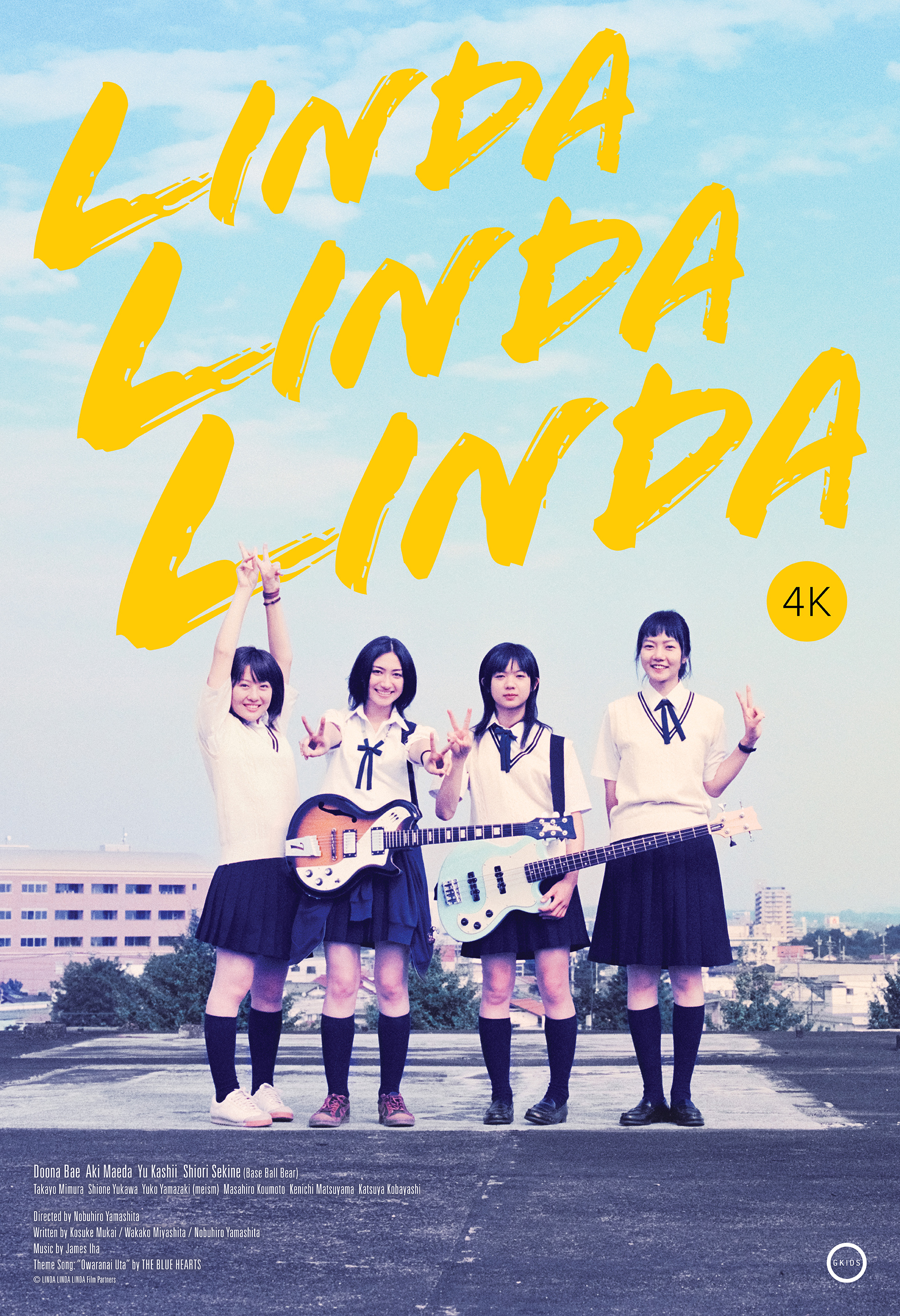
Linda Linda Linda (リンダ リンダ リンダ, Nobuhiro Yamashita, 2005)

“We’ve only got a little more time to be the real us,” according to a young woman making a promo video for the upcoming school festival, but who really is the “real us”? Now celebrating its 20th anniversary, Nobuhiro Yamashita’s wistful high school dramedy Linda, Linda, Linda (リンダ リンダ リンダ) is in many ways about the process of coming into being along with the anxieties of what comes next. “We won’t end here,” the girl later adds, “We won’t let our high school days become a memory,” yet they already are in a kind of contemporaneous nostalgia and elegy for idealised youth.

Or at least, there’s already a kind of reaching back taking place as the tracks the girls pick for a replacement act are by The Blue Hearts, a 1980s punk band that has become a kind of cultural touchstone echoing a sense of youthful alienation and rebellion. “Linda Linda” is the kind of song everyone knows, and even if for some reason they don’t or don’t even speak Japanese, can at least join in with the riotous chorus. It’s this sense of universality that eventually gives it its power as torrential rain brings the entire school inside just in time to see the girls’ belated act and find themselves captivated by its infectious energy and an identification with their own sense of insecure anxiety.

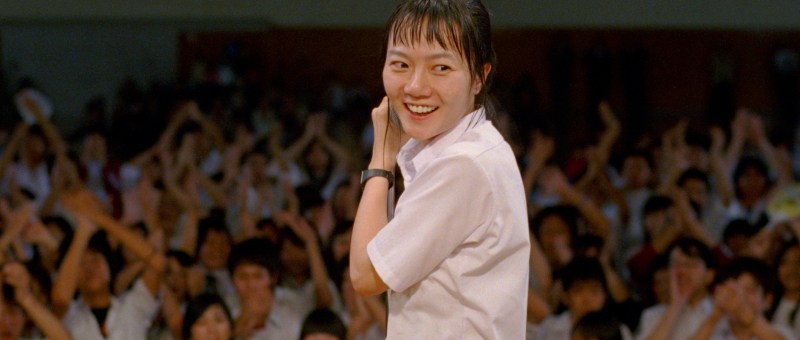
It’s also the serendipitous rain that allows lonely songstress Takako an opportunity to perform having previously declined to do because it’s no fun playing on your own and all her former bandmates graduated the previous year. Moe, the girl who broke her fingers playing basketball in PE leaving the original band members unable to take the to the stage, also gets an opportunity to sing having otherwise been denied a moment of closure in being prevented from taking part in her final school festival. While Moe feels intensely guilty about rendering all their time spent rehearsing somewhat pointless, it’s really the drama between founding members Kei and Rinko that leads to the band’s demise in Rinko’s conviction that it’s “meaningless” to continue while the others decide to go ahead anyway asking Korean exchange student Son (Bae Doona) to be their vocalist because she just happened to come down the stairs at the right moment and said yes because she didn’t really understand what they were saying.

Prior to her involvement with the band, Son had been a rather isolated figure trapped in the “Japan-Korea Culture Exchange Exhibit” which seems to have been more her teacher’s idea than her own and in any case gets no actual visitors. Her Japanese is a bit limited and most of her interactions are with a little girl who lends her manga to help her learn quickly, but becoming part of the band allows her to find her voice both literally and figuratively in taking the lead as the vocalist. A boy who claims to have fallen in love with her (Kenichi Matsuyama) goes to the trouble of learning a long speech in Korean to convey his feelings, yet a bemused Son replies to him in Japanese that she’s pretty indifferent to his existence before switching to Korean to explain that she’s leaving because she’d rather be hanging out with her friends with an expression that implies she’s only just realised that’s what they are. By contrast, she has a bilingual conversation with guitarist Kei (Yu Kashii) in which they seem to understand each other perfectly and each express how glad they are that they got to be in the band together. 

Similarly, it’s the concert itself that seems to heal rifts with a simple “Are you alright?” from Rinko (Takayo Mimura) to Kei whose friendship might, as someone says, essentially be too close for them to really get along. Drummer Kyoko (Aki Maeda) decides to declare her feelings for a longstanding crush before the concert. In the end she doesn’t manage it, but it doesn’t quite matter somehow because their performance is itself a kind of coming into being in which “the real us” comes into focus if also in a moment that itself becomes romanticised or idealised as an encapsulation of youth. Yamashita travels through the school festival as if it were a passage from one state of being to another, from the noodle stalls and crepe stands to haunted houses and the boy creating his own moment through encapsulating them on film, before ending with an unending song “so we can laugh tomorrow,” and the “real us” lives on.


Linda Linda Linda opens in US cinemas 5th September courtesy of GKIDS.

Trailer (English subtitles)
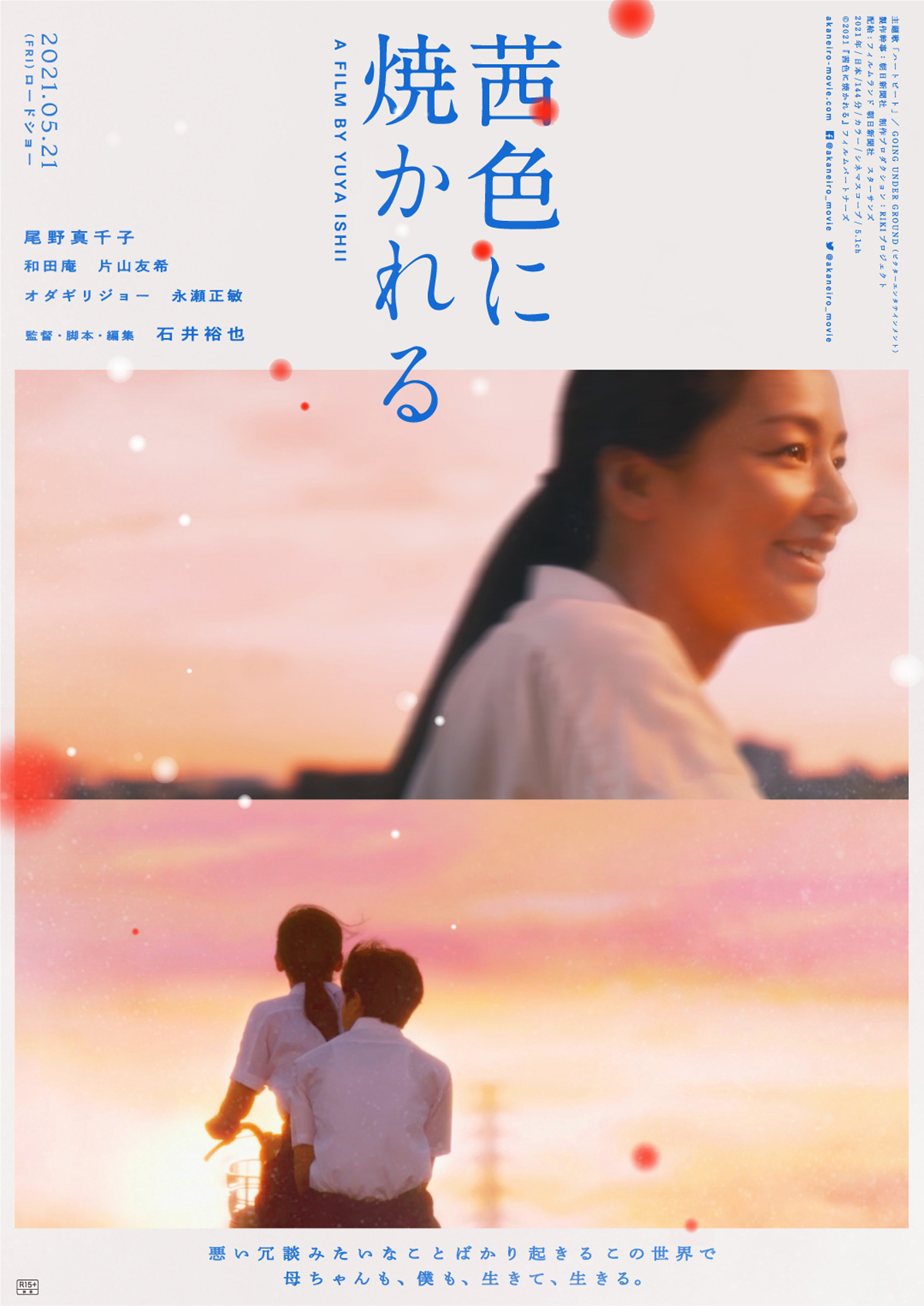
A Madder Red (茜色に焼かれる, Yuya Ishii, 2021)

©︎2021 "A Madder Red" Film Partners

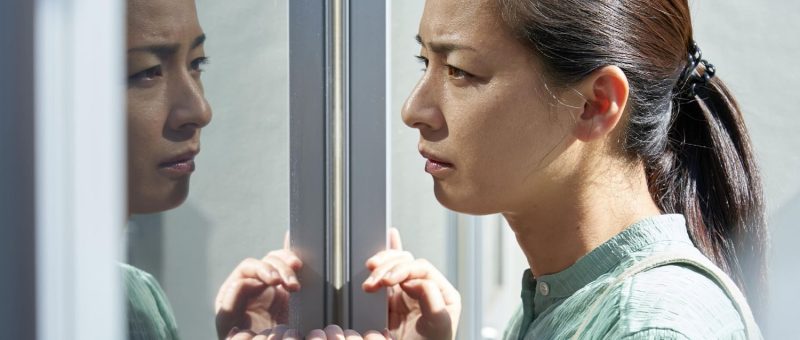
A single mother and her son face the myriad injustices of the modern society with dignity and grace in Yuya Ishii’s quietly seething pandemic-era social drama, A Madder Red (茜色に焼かれる, Akaneiro ni Yakareru). The heroine is constantly asked why she isn’t angrier, those around her confused by her stoical attitude and tendency to simply sigh and say “let’s get through this” rather than railing against the persistent unfairness that defines her life but then she doesn’t have a lot of time for being angry nor would it particularly help her situation or bring about change. All she can do is persevere in the hope that it won’t always be this way, her run of bad luck will end, and she will eventually be permitted to rest. 

Ishii opens the film with a 3D model simulation of a traffic accident in which a cyclist is killed by an out of control car on a zebra crossing in an otherwise tranquil residential area. Ryoko’s (Machiko Ono) husband Yoichi (Joe Odagiri) is sent flying and ends up squished like a bug on the windscreen of a vehicle travelling in the other direction. The driver, an elderly man later revealed to have been living with Alzheimer’s, mistook the accelerator for the brake but as he had been a prominent local official the matter was swept under the carpet and he faced no consequences. What people can’t seem to understand is why Ryoko chose to attend the old man’s funeral when he eventually died. It seems attend was all she did, but the man’s son had security throw her out and his lawyer accuse her of “harassment” while expressing anger and resentment that her presence tarnished his father’s lavish ceremony when he had been such a good a man. Her presence perhaps annoys him because he knows on some level he’s in the wrong, while her strength and dignity shame him knowing that they should have just apologised. The lawyer implies she’s being unfair targeting the family who were not themselves responsible for the accident, except that in a sense they were because they failed to protect the old man by continuing to allow him to drive by himself. 

Ryoko refused the compensation money for this reason, that they tried to settle it with cash as if her husband’s life had no meaning. She lives in subsidised government housing, but doesn’t claim any benefits supporting herself after she was forced to close her cafe through a part-time job in a supermarket floristry department and after hours sex work. “Break a rule, break your life” she teaches her 13-year-old son Junpei (Iori Wada) yet constantly falls foul of rules written or otherwise while doing nothing wrong in the eyes of those who rant about benefit scroungers and routinely belittle those without means. She’s taken to task by her manager for taking home flowers that were due to be thrown out and for taking a phone call outside the store after clocking off, but when they fire her on a pretext to hire the daughter of a prominent client who can’t find a part-time job because of the pandemic, they refuse to honour the two month notice clause in her contract. Similarly when bullies from Junpei’s school set fire to some books left outside their apartment, they are the ones who have to move for violating the rule about causing a disturbance to the other residents. 

Given all of this no one can understand why Ryoko isn’t seething mad. She still pays for her father-in-law’s nursing home and even child support for a girl she’s never met fathered by Yoichi with another woman. Struggling herself, the child’s mother later turns to a sleazy friend of Yoichi’s, Ryu (Tateto Serizawa), to petition Ryoko to increase the child support but like her also worries that it “doesn’t seem right” to further burden a woman who is also struggling to raise a child alone just like herself while Ryu, as he had unsuccessfully with Ryoko, attempts to extort sexual favours in return for his assistance. Ryoko does these things when she doesn’t strictly have to and many people wouldn’t less out of pride or stubbornness than because it’s the right thing to do and if she can satisfy herself that she’s done right by others even if they’ve not done right by her then she maintains her dignity and their scorn can’t harm her. 

Even so, sick of being treated like a bug Ryoko’s rage eventually begins to boil over her subdued outfits giving way to a fiery red as her hopes of escape are once again dashed on realising a potential romantic suitor only ever viewed as a plaything. Everyone is always telling Ryoko’s that she’s “strange”, “weird”, “crazy”, in her passive resistance living by her own rules while constantly betrayed by those of others which they only enforce when it suits them. Ishii flags up all of her various expenses on the screen making it clear just how much it costs for Ryoko to be this poor while she seemingly grins and bears it. Then again as the film’s only title card tells us Ryoko is a good actress, and perhaps she has to be to get by in this indifferent society filled hidden suffering and an almost sadistic lust for self-preservation. “Mom, it’s all too much” Junpei sighs as he comes to an appreciation of his mother’s fortitude and her desire to simply “get through this” as they ride a mamachari towards a glowing technicolour sunset which ironically enough refuses to end trapping in them in this space of grief and unfairness but carrying with it a far off hope perhaps cruel in its elusiveness.


A Madder Red streamed as part of this year’s Nippon Connection.

International trailer (English subtitles)

Images: ©︎2021 “A Madder Red” Film Partners

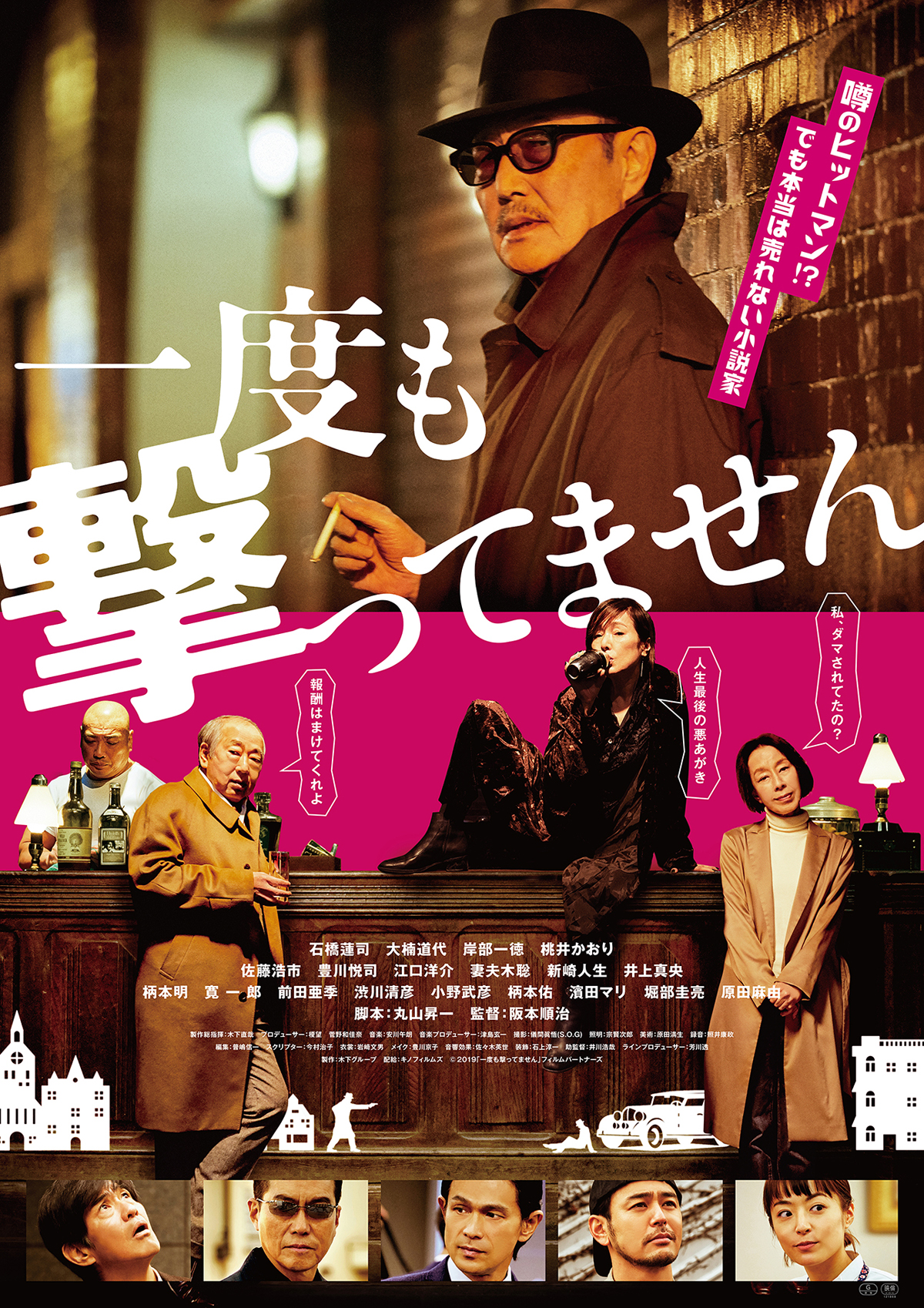
I Never Shot Anyone (一度も撃ってません, Junji Sakamoto, 2020)

“You don’t know the pain of being forgotten” laments an ageing actress attempting to move the heart of a heartless conman in Junji Sakamoto’s comedy noir I Never Shot Anyone (一度も撃ってません, Ichido mo Uttemasen), more as it turns out a melancholy meditation on age and disappointment than hardboiled farce. Sakamoto’s elderly heroes live in a world of night in which their dreams of youth never died, but are confronted with the realities of their lonely existences when the sun rises and exposes the shallowness of their escapist fantasy.

74-year-old Susumu Ichikawa (Renji Ishibashi) was once a promising novelist but veered away from the realms of literary fiction towards the allure of hardboiled noir, no longer permitting his wife Yayoi (Michiyo Okusu) to read his drafts claiming that she would find them too distressing. His publisher (Koichi Sato) meanwhile is more distressed by the quality of the prose than the content, partly because his novels are simply dull but also because they are far too detailed to be mere imagination and as each one seems to be based on a recent ripped from the headlines case he’s staring to worry that Susumu is the real life legendary hitman said to be responsible for a series of unsolved suspicious deaths. 

On the surface, it might be hard to believe. At home, Susumu is a regular old gent who reads the paper after breakfast and locks himself away in his study to write for the rest of the day but his wife complains that he stays out too late at night little knowing that he leads something like a double life, dressing like a shady character from a post-war noir and even at one point likening himself to Yves Montand in Police Python 357. He speaks with an affected huskiness and is fond of offering pithy epithets such as “women come alive at night” while reuniting with two similarly aged friends in a bar run by a former hitman nicknamed “Popeye” (pro wrestler Jinsei Shinzaki) who seems to have some kind of nerve damage in his hands he’s trying to stave off through obsessive knitting. 

What Susumu seems to be afraid of, however, is the sense of eclipse in his impending obsolescence. The guy who ran the local gun shop whom he’d known for 30 years recently passed away, while the guy from the Chinese herbalist apparently went home to die. His publisher’s retiring, and Popeye’s going to close the bar because his mother’s ill so he’s going back to his hometown. Susumu and his wife didn’t have any children and he perhaps feels a little untethered in his soon-to-be legally “elderly” existence while the now retired Yayoi is also lonely with her husband always off in another world he won’t let her share. His friend Ishida (Ittoku Kishibe) once a prosecutor and now a disgraced former mob lawyer working as a security consultant/fixer is estranged from his only daughter, while former cabaret star Hikaru (Kaori Momoi) never married and spends her days working in a noodle bar. They are all scared of being forgotten and fear their world is shrinking, living by night in order to forget the day. 

Perhaps you can’t get much more noir than that, but there’s a definite hollowness in Susumu’s constructed hardboiled persona that leaves him looking less like Alain Delon than a sad man in an ally with only a cigarette for a friend. Even his new editor is quick to tell him that no reads noir anymore, Susumu is quite literally living in the past battling a “hopeless struggle” as someone puts it against the futility of life by living in a hardboiled fantasy. We see him looking at target profiles for an investigative reporter proving a thorn in the side of yakuza and big business, and threaten a heartless conman (Yosuke Eguchi) whose investment frauds have caused untold misery, yet he’s not really a part of the story and his life is smaller than it seems or than he would like it to be. Perhaps in the end everyone’s is even if Susumu is as his new editor describes him “one step away from being insane”. Never quite igniting, Sakamoto’s lowkey tale of elderly ennui is less rage against the dying of the light than a tiny elegy for lives unlived as its dejected hero steps back into the shadows unwilling to welcome an unforgiving dawn.


I Never Shot Anyone screened as part of this year’s Camera Japan

Original trailer (no subtitles)