 One of the foremost avant-garde filmmakers of the New Wave era (though he detested this term which, in fairness, is a retrospective and often arbitrary label), Kiju (Yoshishige) Yoshida has remained largely unseen in the West. Some of this is his own fault – fiercely independent, Yoshida nevertheless found himself working with ATG after leaving Shochiku but the relationship was an unusual one and often far from easy. All but the latest film in Arrow’s Kiju Yoshida boxset, Coup d’Etat, were completed more or less independently and only distributed though ATG and as such not truly “ATG” films. Though it bears many of the hallmarks of a late ‘60s ATG movie, Eros + Massacre (エロス+虐殺, Erosu Purasu Gyakusatsu) is one such effort and the one which helped to make Yoshida’s name even if it was only seen in an abridged version.
Structurally complex, Eros + Massacre mixes the world of the Taisho anarchists, Osugi Sakae and Ito Noe, with the contemporary Tokyo of the sixties through the prism of two modern students who are running a research project into the events surrounding their ultimate assassination during the panic after the great Kanto Earthquake of 1923. Eiko is a sexually liberated modern woman who engages in casual prostitution and her boyfriend, Wada, is a sexually impotent young man with a traumatic past and habit of playing with fire. The vision we see of the Taisho era is filtered through the perceptions of Eiko and Wada and, in fact, we start to see them as living with us in a real sense as Ito wanders around modern Tokyo, observing the fruits of her struggle and in one notable episode being interviewed by Eiko.
The film exists in two distinct versions – this is less to do with any kind of censorship, either commercial or political, than a legal or possibly moral issue. The fact is, the other of Osugi’s mistresses, Kamichika Ichiko, was still alive at the time the film was completed and had also become a serving politician. Unhappy with her portrayal in the film and unwilling to have a potentially embarrassing event from her previous life dragged back into the spotlight, she threatened to sue and Yoshida voluntarily decided to recut the film to remove many of her scenes as well as renaming the character to distance her from her real life counterpart. The shorter version of the film is the one which helped make Yoshida’s reputation and though nothing in the shorter version is not in the longer one, this version feels a little less “avant-garde” in tone than the intended full cut of the film.
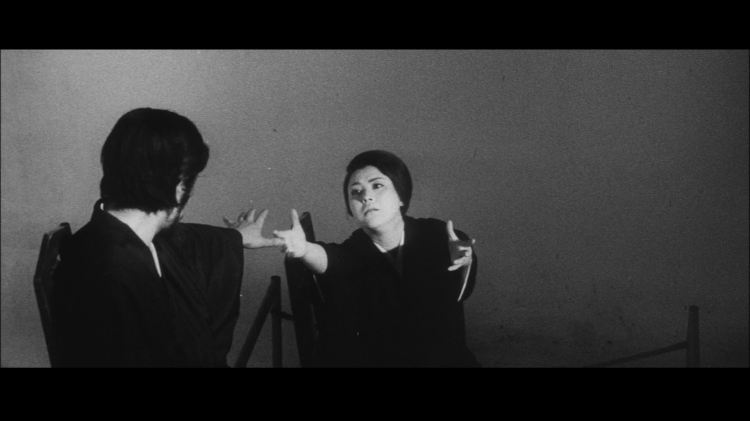
Yoshida often gives way to surreal incidents such as the clash between the Taisho era followers of Osugi and a group of young rugby players tussling over the white wrapped remains of Osugi, the expressionist scene in which the mistress, Itsuko, clutches at a knife hovering in mid air causing the screen to fill with blood raining down from above or the repeated stabbings of Osugi each re-imagined in differing scenarios. His framing is always beautifully idiosyncratic as he makes use of the edges of the frames, disembodying his actors or dividing them with walls and windows. There is no sense of conventional narrative as timelines blur into each other becoming evermore indistinct and the dialogue is often elliptical or poetic rather than offering naturalistic content. Nevertheless, the shorter version retains fewer of these flourishes than are present in the original cut of the film.
Eiko is interested in Osugi because of his free love philosophy rather than any other political aim. Other than their interest in sexual politics, Eiko and Wada do not appear to be particularly politically active in any other way. Osugi’s ideas of total freedom do not even go down very well with his comrades who don’t approve of the way he treats his various women and his disingenuous denial that there is any discord between his band of concubines seems wilfully naive. Osugi’s treatment of the three women in his life – his wife, Yasuko, mistress Itsuko (who is financially supporting both Osugi and his wife despite Osugi’s advocacy of free love insisting on financial independence of all parties), and now his latest lover Noe, is extremely self-centred and unfair. As the first to live in this unorthodox fashion, it’s unsurprising that the arrangement comes in for criticism from all quarters. Yoshida posits that it was Osugi’s free love lifestyle that eventually lead to his shock execution during the chaos following the Great Kanto earthquake as his modern ideals threatened the very idea of the traditional family and ultimately the state itself.
By contrast, Eiko’s modern sexuality appears merely an attempt to ward of her sense of ennui. Where for Osugi sex was a political action (or so he would have it), for Eiko it’s a means of trying and failing to add some kind of meaning to her life. Eiko and Wada are not committed to any kind of rebellious action – they’re simply bored. They literally play with fire without understanding its consequences. Yoshida’s other central tenet is that youth is not beautiful – it is destructive. By implication, Eiko and Wada’s selfish pursuit of personal freedom and the modern commodification of desire is nothing more than willful self destruction.
Yoshida has stated that his primary idea for the film is how to bring about a revolution and to ask the question of what it is that needs to change. Osugi is shown up as a hypocrite whose ideals are imperfect and self centred, though his eventual murder is dictated by his refusal to conform. The fact that he envisioned a different future, wished to live in a different way, was sufficient enough to necessitate his death. The modern couple misuse their own freedom and are willing to watch the world burn just to feel the heat. They are incapable of effecting real social change because their focus is always inwards rather than a dedication to the betterment of all mankind. Confounding, intriguing and beautifully shot Eros + Massacre is far from easy to digest but is an essential entry in the history of Japanese avant-garde cinema.
Available now in the UK as part of Arrow Films’ Kiju Yoshida: Love + Anarchism box set.
Reviews of the other movies in the set: