The Snowball on a Sunny Day (金多寶, Philip Yung Chi-Kwong, 2026)

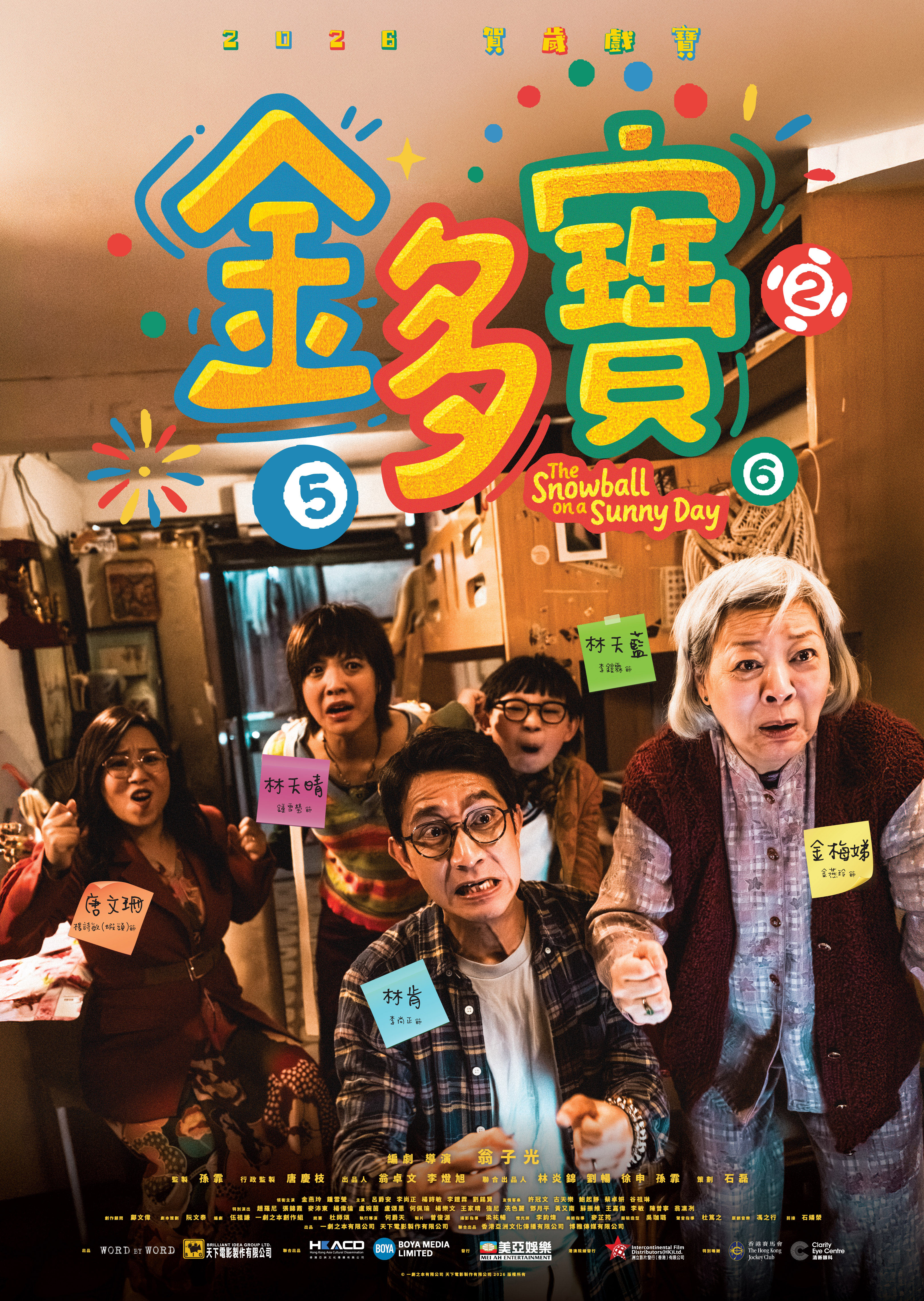
Philip Yung isn’t the first person you think of when it comes to Lunar New Year Comedies. His previous films have largely been hard-hitting crime dramas such as Port of Call and Papa. The Snowball on a Sunny Day (金多寶) is then a world away with its largely warmhearted story of an ordinary family pulled apart by the demands of modern living but brought back together through subterfuge when it becomes necessary to keep up the pretence that they’ve won the lottery.

As one of their neighbours says, every family needs its little white lies every now and then. Widowed grandmother Mui (Elaine Jin) has been playing the same lottery numbers for 30 years. Buying the ticket has become the responsibility of granddaughter Sunnie (Chung Suet Ying), but she is currently living a frantic life as a script supervisor/runner on film sets. Her plan to use her father’s Jockey Club account to buy one online is frustrated when he reveals he’s cancelled it after a run of bad luck at the tracks, meaning she’ll have to go to the shop in person. When she gets there, the security guard turns out to be someone she had an altercation with on a shoot, so they won’t let her in. A relative, Great Uncle Wah, says he’ll buy a ticket for her, but is escorted out by loan sharks before he can do so.

Inevitably, Mui’s numbers come up and Sunnie doesn’t have the heart to tell her that she never bought the ticket, so she embarks on an elaborate ruse to pretend they’re all millionaires by “borrowing” an expensive villa where her friend Jay (Edan Lui ) is currently “housesitting” for a film producer who’s apparently disappeared following rumours of some kind of financial impropriety. In some ways, Mui’s desire for a house where the whole family could live together is reflective of the current realities of the Hong Kong housing market. Even with a lottery win, the villa wouldn’t really be within their reach, which is why they have to make up excuses to convince her mother Charlotte (Harriet Yeung), an estate agent, that there are reasons it’s so “reasonably priced” that aren’t necessarily dealbreakers for the family such as being a stigmatised property where a violent death took place. 

Meanwhile, this tranquil, spacious environment and relief from financial pressures provide a place in which Sunnie’s parents, who are currently separated but keeping the breakdown of their marriage secret from Mui, a chance to work out their differences. Her father Ken (Jiro Lee) is a washed up former idol star who evidently didn’t make any financial plans for his or his family’s future and now makes a living as a taxi driver who refuses to move with the times by following GPS or working via apps. Sunnie, meanwhile, was sent to live with Mui so that her mother Charlotte could devote her attention to her younger brother Harry (Marek Li Hoi-Lam) who is neurodivergent and has health issues. 

While some tension exists between Mui, Sunnie, and Charlotte, Sunnie is reaching the age at which she begins to realise the sacrifices that were made on her behalf and is mindful of repaying them. Her career as a filmmaker is, however, off to a slow start with her life mostly spent at the beck and call of autocratic directors, managing extras and on occasion having to step in herself such as playing the part of a ghost when an actor doesn’t show up and wearing the costume that Mui has hand stitched for the production, presumably without any pay. There are various meta comments about the declining state of the Hong Kong film industry coupled with a sense of nostalgia for an earlier time when her grandfather hand painted posters and marquees for the latest releases after he and Mui migrated from Indonesia. 

Mui’s life on the public housing estate similarly evokes a sense of warmth in a community that’s otherwise disappearing. Aside from the jobsworth of an estate manager to goes around telling people off for drying their washing outside or breaking some sort of other rule, Mui is well liked by her neighbours and only wants to move to have more space so the family could all live together. Through all the zany, farcical action as they try to keep up the act for Mui, from whom you can’t can’t really hide anything, the family begins to repair itself in true New Year comedy style while apparently making friends with some of their other “enemies” such as an extra/ice cream van diver and a Liverpool fan with whom Manchester United devotee Ken has some kind of vendetta. Despite the silliness, the film has a degree of genuine poignancy in its closing moments as various truths are revealed and the family is forced to remember what it is that’s really most important. 


The Snowball on a Sunny Day screened as part of Hong Kong Film Fest UK

Trailer (Traditional Chinese / English subtitles)
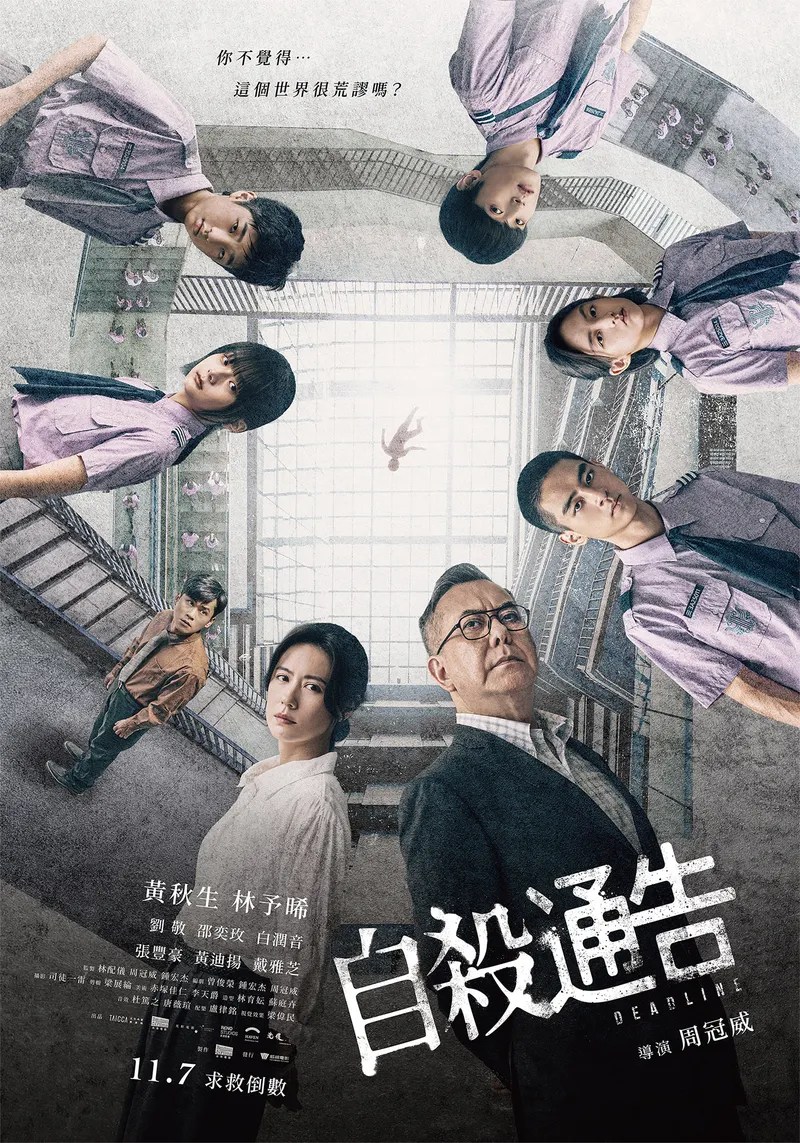
Deadline (自殺通告, Kiwi Chow Kwun-Wai, 2025)

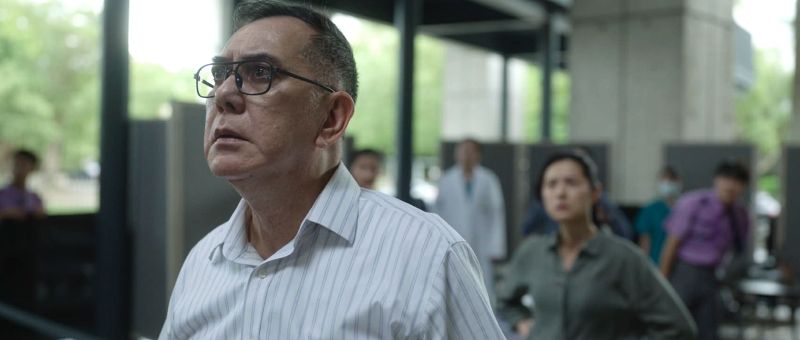
What does it mean to get “an education”? Is the school system only really there to brainwash the young into following accepted the path and prepare them to be receptive to authority, actively destroying both the ability and desire to think for oneself? The fact that Kiwi Chow’s Deadline (自殺通告, zìshā tōnggào) was not approved for release in Hong Kong on the grounds of “national security” may indicate the direction of its perspective on the interplay between the intensity of the education system and entrenched authoritarianism.

The mere fact that En Shan high school is described as “elite” already implies that it exists to perpetuate a kind of social inequality, though in other ways some might say that it also encourages social mobility in that the students come from all backgrounds and are selected for academic excellence rather than simply the ability to pay the fees. Education does seem to be life’s make or break. Students who don’t make it to university are perceived as being relegated to a kind of underclass from which there is no other escape. Yet at the same time, perhaps university isn’t right for everyone and not all of the pupils want to live a life dedicated to achieving conventional success that might otherwise leave them miserable.

Chun Chiu (Jimmy Liu) is one of the few brave ones who’s decided he doesn’t want to go to university and is happy enough pottering around with his plants. He doesn’t care if people look down on him because he knows he’s happy in himself, and they probably aren’t. Consequently, he’s also the only one to really see what’s going on at the school and to want to try to stop it. Despite its elegant name, there’s a kind of bloodthirstiness that underlines the survival of the fittest mentality at En Shan where they wear mildly fascistic uniforms and start the day with a haka-style dance in which they recite the school’s mantras about being the best of the best and that there’s no point coming second. These children are prevented from forming real friendships or developing social skills and empathy because they’ll always be rivals waiting for the ideal time to stab each other in the back.

The school reinforces this sense of judgment and hierarchy through adopting a social credit-style system in which pupils’ “privileges” are linked to their performance and obedience levels. Chun Chiu is at one point locked out of the garden because his scores have fallen so low he’s not allowed outside the prison-like school environment. Everyone at the school, including the teachers, is under constant surveillance with an AI programme responsible for assigning grades and points. Headmaster Kung wants to get rid of Mr Gao (Huang Di-yang) because the system says his performance is poor, while star teacher Mrs Tien tries to defend him. To begin with, Gao seems as if he might be resisting in another way by giving care and attention to struggling pupils like Heng (Bai Run-yin) who is taking medication for ADHD. But it turns out that Gao is so worried about losing his job as he has to pay maintenance for his ex-wife and child that he’s been giving the kids performance enhancing drugs in the hope of boosting his own approval ratings in the app.

Heng is also getting bullied by some of the other pupils, not just because he’s different but because they resent it that they think he’s being given special advantages by taking medicine that helps him concentrate and being given extra time to finish exams. This leads Heng to try and and cancel his accommodations in a bid to avoid being singled out and in a mistaken gesture of solidarity with the other kids to prove he’s not being given any extra privileges. Meanwhile, they’re all taking similar medication that’s designed to aid concentration and reduce the need for sleep for they can study for longer. But the drugs also prevent them from sleeping when they want to and suppress their appetites so they don’t eat. They cause low mood and suicidal ideation, which, coupled with the already high-stress environment, is a recipe for disaster.

To combat this culture, someone drops a series of ominous flyers threatening the school that there will be a suicide if they don’t “stop poisoning us” by ending the practice of holding exams under medication. While headmaster Kung appears oblivious to the monster he himself has created and has no real idea what’s going on in the school, to his credit he does seem keen to find out if there are any pupils in danger of harming themselves rather than solely trying to silence the whistleblower or save the school’s reputation. He has no idea about the drugs and is shocked on realising how prevalent they’ve become in the school. When they start doing drug tests and discover that over half the pupils are taking them, the director of the board of governors, who has the real power, tells him to stop the testing before they find any more.

But it turns out that this problem extends far beyond the school as in some cases it’s the parents who are making their kids take these drugs, and the head of the student council, Mo (Michael Chang), that’s been selling them. After a few deaths have occurred, Tien and Kung want to stop the exams, but are prevented from doing so, in part because the education system is a national machine. The kids can’t just take the exam on another day because they can’t come up with all new papers just for them at short notice. In a truly chilling moment, Mo gets up on his chair begins chanting the nonsensical mantra “exams are a human right” while insisting on being allowed to take them even if it means that more pupils end up dying. After all, that’s just less competition for him. They’re already locked into this system and refuse to be cast out of it, in part because they’ve learned how to manipulate it so perfectly.

Then again, obsessive study doesn’t leave you with much time to think about anything else even if you’re not also sleep deprived and malnourished as a result of long-term drug use. Chun Chiu’s friend Peiching (Tai Ya-chih), the current number one, becomes conflicted in part because she realises that she does not really know who she is and is incapable of determining what she wants out of life. She said she wanted to be a doctor because that’s what her parents were so she thought she was supposed to be too, but doesn’t know if that’s actually what she wants. Peiching seems genuinely worried about rival Ruoyan (Mimi Shao Yi-mei) who self-harms out of frustration and feelings of inadequacy, but equally only perhaps because thanks to the drugs she stands a real chance of knocking her off  the top spot. Mrs Tien may secretly be thinking of moving abroad precisely because her own daughter does not suit this rigid educational system, but remains largely unable to change it while the students have, it seems, already internalised its tenets unable to let go of a world in which everything is defined by numbers and ranking without the intrusion of independent thought or human empathy.


Deadline screened as part of Hong Kong Film Fest UK and opens in UK cinemas 16th October.

Trailer (English subtitles)

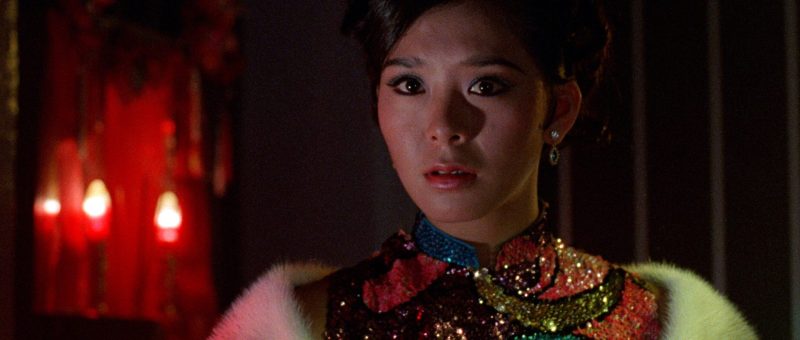
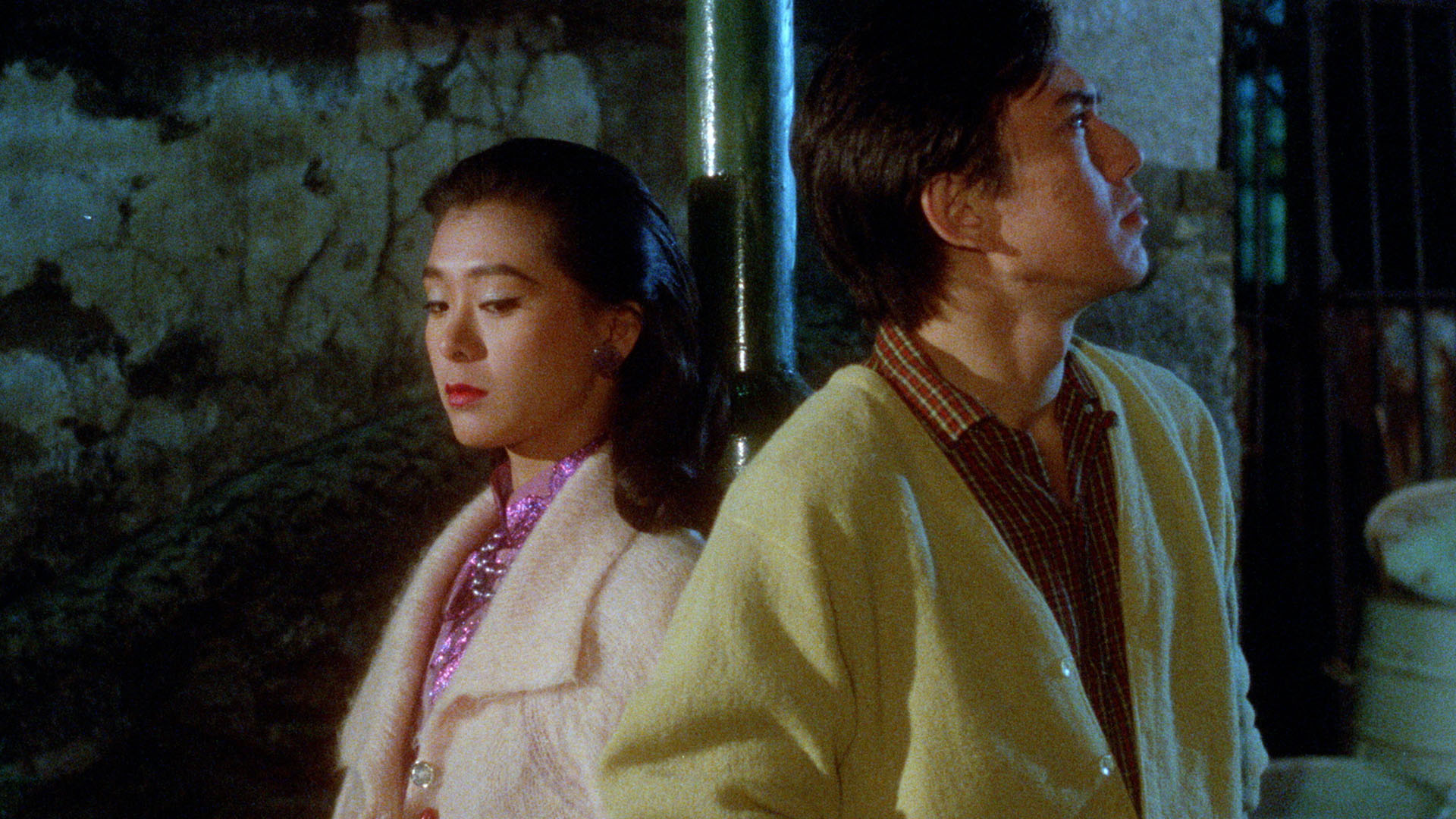
My Name Ain’t Suzie (花街時代, Angie Chen, 1985)

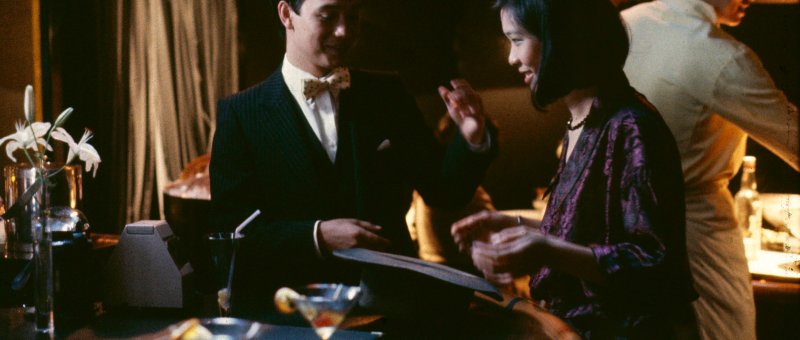
Angie Chen’s response to The World of Suzie Wong, My Name Ain’t Suzie (花街時代) opens in the present day with its heroine apparently a gothic mystery, a Miss Havisham-style recluse and ghost of old Hong Kong trapped within the apartment of a legendary madam from old Shanghai. This conception of her turns out to be something of a myth in itself, as accidental witness to history Dick recounts to a young man working as a delivery boy (Jacky Yeung Tak-Ngai) for his ever evolving chip shop that she is actually still a wildly successful restauranteur and fixture in the local nightclub scene. 

This small enclave of Wan Chai, however, seems to have become a kind of ghost town having been largely abandoned as the American sailors who were once its main clientele stopped coming after the twin waves of the Korean and Vietnam Wars. Shui Mei (Pat Ha Man-Jik) now owns this block which signals her eventual mastery over the world in which she lives, if also her loneliness and isolation, occasionally staying in Miss Xiao’s (Angela Yu Chien) old apartment as if unable to let go of the irresolvable past. Her story is then, at least in part, a chronicle of the nation’s own post-war history as she successfully adapts to the times, yet retains a sense of melancholy nostalgia for an older Hong Kong which is fast disappearing as the Handover looms closer.

Indeed, Shui Mei’s life begins in an impoverished fishing village which is set a stir by the return of Monroe, a seemingly glamorous woman dressed in the latest fashions and handing out sticks of gum to the awestruck locals. Sex work is seen as a pathway out of poverty and towards the new modern society that Monroe represents. Having been raped by three local boys, it is also in a way Shui Mei’s means of rejecting her victimisation and asserting full ownership over her body even if, in other ways, she is exploited by brothel owner Miss Xiao, herself an exile who fled to Hong Kong from the formerly glamorous and sophisticated international centre that was Shanghai.

While working as a bar girl in Wan Chai, Shui Mei falls for Miss Xiao’s adopted son, Jimmy, on whom she has a quasi-incestuous fixation. Rather than casting an actor already under contract to Shaw Brothers, Chen cast a then unknown Anthony Wong, billed under the name Anthony Perry, through extensive auditions largely for the similarities he shared with the role. Like Jimmy, Wong was abandoned as a small child by his father, a British colonial official who already had a wife and children in the UK with whom he later emigrated to Australia. Jimmy’s idolisation of Hollywood icon James Dean and desperate search for his biological father, an American seaman, are symbolic of the search for cultural identity in a Hong Kong caught between a series of colonial influences while denied the kind of mastery over itself that Shui Mei eventually achieves.

Shui Mei’s relationship with Jimmy causes a rift with Miss Xiao that leads to her exile from Wan Chai, though Jimmy proves to be a faithless lover. After years of boasting of the revenge he’ll take for his mother’s suicide when he finds his father, Jimmy is seduced by promises of American wealth and comfort and accepts his invitation to return with him to the US, callously abandoning Shui Mei. Years later, when he returns with his two young sons, he has become in some ways very much Americanised. He complains that his first wife lacked a strong work ethic while having adopted an orientalist idea of the submissive hometown wife who will work hard in his business and raise his children. Though still resentful over her abandonment, Shui Mei harbours a lingering desire to rekindle the romance of her youth only to be cruelly disillusioned. Jimmy has forgotten her. He has not come back for Shui Mei, but is clearly in the market for a much younger woman, eventually marrying one of Shui Mei’s proteges at the bar she has opened in another part of the city after saving money made through temporarily working as a streetwalker.

This does, however, reinforce the idea that Shui Mei cannot rely on a man to save her but only on herself and female solidarity. When her new bar is targeted by triads, she enters a partnership with Sister Ying (Deanie Ip Tak-Han), the former wife of a gang boss who has pull in the underworld and a habit of chasing off gangsters with meat cleavers. Though the relationship is heavily implied as both a romantic and business partnership of equals, Shui Mei does not quite accept its validity due its same sex nature and wonders if she can really stay with Ying forever while tempted by the prospect of a more conventional, heterosexual union with Jimmy along with an easy life in America having run herself ragged creating a business empire and suffering the physical affects of a violent triad attack.

Though the end of her story may seem sad, Dick explains to his young delivery boy that Shui Mei refused to be beaten and got back up again each time she was knocked down, which perhaps provides a more positive prognosis in the shadow of the Handover. In one sense, she may have become a ghost of old Hong Kong as her silhouette now appears at Miss Xiao’s window, but may otherwise have avoided her fate. Despite their falling-out, an ageing Shui Mei returned to care for Miss Xiao who unlike her had been left behind by changing times, abandoned by all including her adopted son Jimmy who returns only after her death following many years of estrangement. Though Shui Mei may be consumed by an irresolvable nostalgia, like the nation itself she has progressed from her life in the impoverished fishing village to become an economic powerhouse while achieving total mastery over herself as an independent woman.


My Name Ain’t Suzie screened as part of Hong Kong Film Fest UK.

Trailer (English subtitles)

Flowing Stories (河上變村, Jessey Tsang Tsui-shan, 2014)

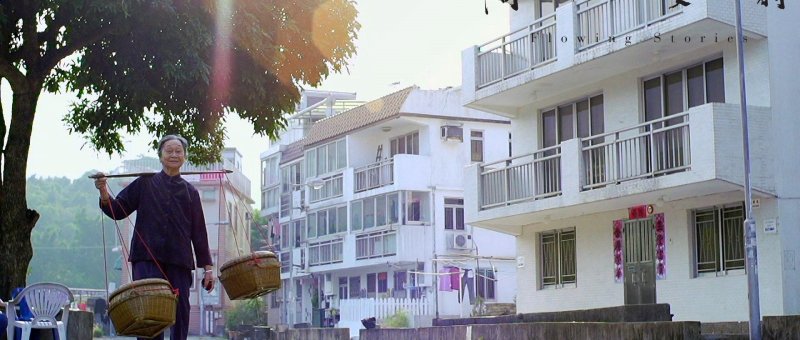
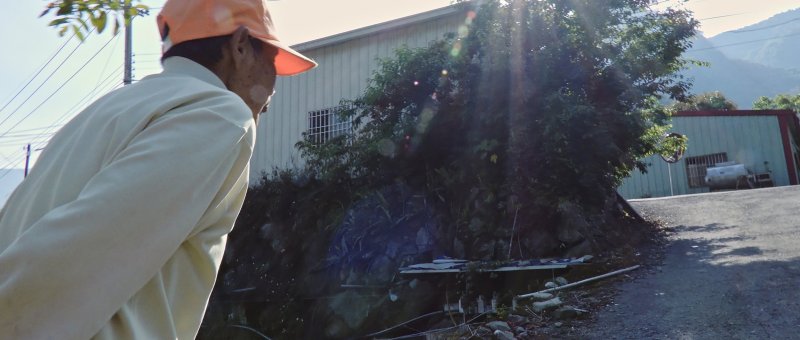
Shooting in her own home village, documentarian Jessey Tsang Tsui-shan spins a meandering tale of diaspora and dislocation in her 2014 documentary Flowing Stories (河上變村). Beginning in the small village of Ho Chung in which almost all of the residents have gone abroad to find work, the film charts the paths of migration along with the hardships discovered both at home and away while centring the village festival held every 10 years as a point of reunion as sons and daughters return in celebration of an idealised village life the modern world has denied them. 

Tsang begins her tale with Granny Lau, an elderly lady who lived next-door to her when she was a child whose relatives often brought her souvenirs from Europe. As Granny Lau explains, her life was always hard. She married Grandpa Lau at 19 in an arranged marriage but he left to find work abroad soon after, returning only a handful of times in 20 years during which they had several children Granny Lau had to raise alone. She describes her familial relationships as without affection, her husband a virtual stranger to her while she also had to work in the fields leaving her disconnected from her sons and daughters. Later, many of them traveled to Calais to work in the restaurant Grandpa Lau had set up with the intention of reuniting his family in France. 

The children who went also talk of hardship, being unable to speak the language and mixing only with other migrants from Hong Kong many from the same the village. Fourth daughter Mei Yong remarks that only the thought of the village festival kept her going when she came to Calais at 17 leaving all her friends behind and having nothing much to do other than work in the restaurant. Her sister-in-law says something similar, that when she arrived she was immediately put to washing dishes and only reprieved when the children were born but that wasn’t much better because the only source of entertainment available to them was to have dinner together. The second of the sisters Mei Lan moved to London with her husband and still doesn’t know the language, having regular mahjong parties with with her neighbours who are also from Hong Kong and many of them nearby villages. 

Most of the others say they don’t think they’ll ever move back, as Grandpa Lau eventually did, because they’ve spent more than half their lives abroad and have had sons and daughters who have grown up and made lives in other countries. But for Mei Lan it’s different because she has no children. She and her husband regret the decision to go abroad, suggesting they did so because their parents encouraged it thinking it would be easier for them to find work but really there were opportunities to be had in Hong Kong and they might have been happier living in a place where they spoke the language. 

But life is hard in every place, and equally for those who leave and those who are left behind. Some reflect on the changing nature of Ho Chung with its new settlement across the river dominated by detached houses which has, a daughter who moved to Edinburgh suggests, disrupted the sense of community. Where people once rarely closed their doors and neighbours wandered through each others homes helping each other out where needed, now everyone is scattered in disparate settlements. Then again, Granny Lau seems to think that sense of community is largely a myth explaining that in her day you had to do everything yourself, no one was going to feed your cow or plough your field if you couldn’t do yourself.

In her own way strangely cheerful in her stoicism, Granny Lau is a tough woman who asks why she would cry for a husband who was over 80 years old when he died, insisting that she had “nothing to be nostalgic about” and counting herself lucky as long as she has two meals a day. Now only around 900 people remain in the village, while it is said that the Shaolin Temple may be looking to build a new complex in the area as the natural vistas are disrupted once again by diggers further eroding the traditional qualities the village festival celebrates. The stories of migration flow in and out of Ho Chung taking pieces of the of the village with them as they go but equally leaving behind a melancholy sense of loss for a disappearing way of life.


Flowing Stories screened as part of this year’s Hong Kong Film Festival UK.

Original trailer (Traditional Chinese / English subtitles)
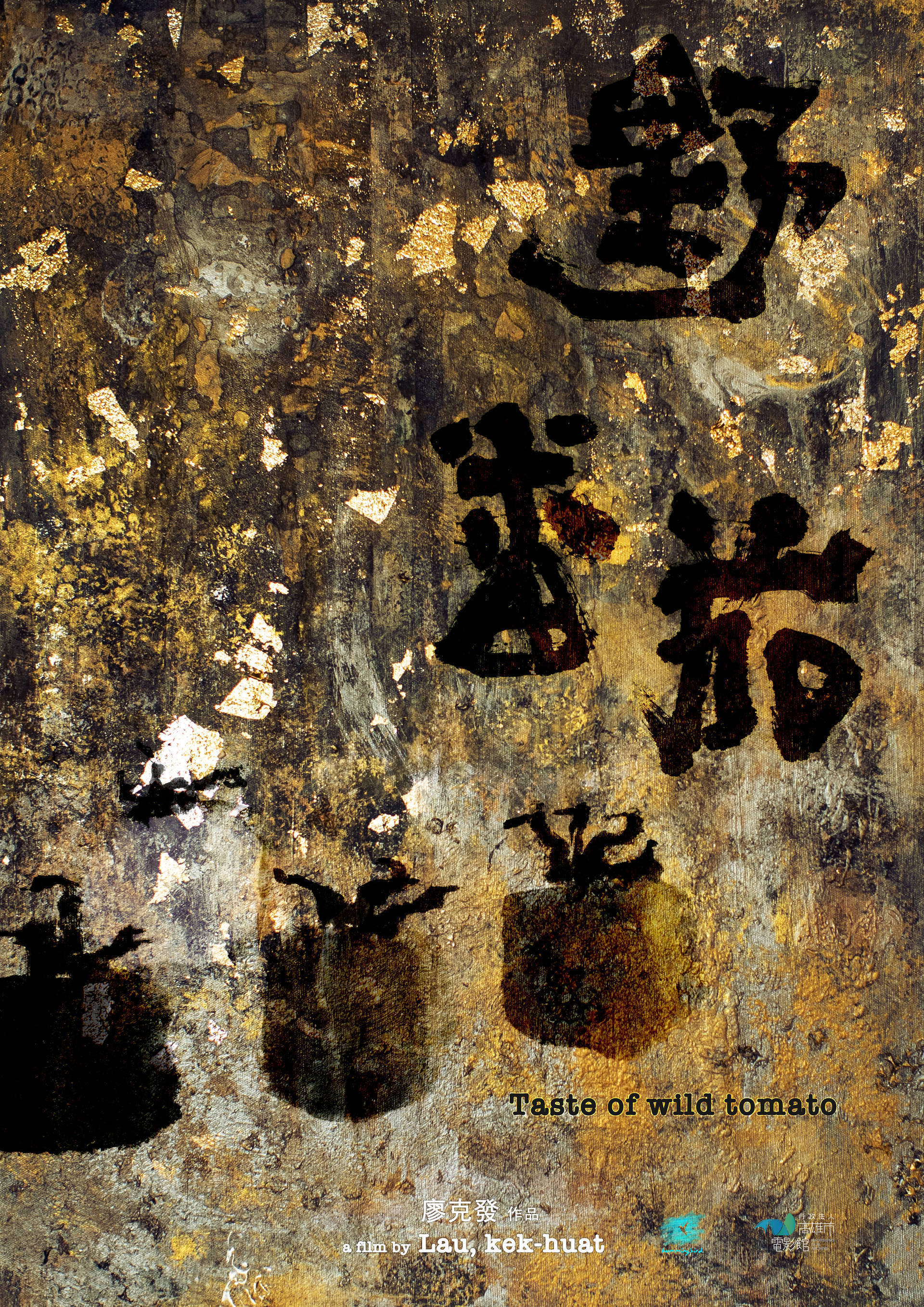
Taste of Wild Tomato (野番茄, Lau Kek Huat, 2021)

Towards the conclusion of Lau Kek Huat’s documentary Taste of Wild Tomatoes (野番茄, yě fānqié), a man whose father was murdered during the White Terror gets into a heated debate with a supporter of Chiang Kai-shek who asks him if he thinks things would have been better if the Japanese had stayed. It doesn’t seem to occur to her that Taiwan might have been just fine on its own, a free and independent nation no longer subject to any particular coloniser. Her attitude reflects the contradictions of the contemporary society still trying to understand and make peace with its past. The now middle-aged man thinks that Chiang Kai-shek’s presence in “Liberty Square” is inappropriate, “worshipped by tourists who do not know our history”, and that the lingering national trauma of the 228 Incident, in which a popular uprising against the rule of the KMT government in 1947 was brutally put down, has never fully been addressed. 

Another of Lau’s protagonists also lost her father to the White Terror and her mother to suicide shortly after. It’s her recollections that give the film its bittersweet title as she remembers being taken to her father’s grave as a small child but not knowing what was going on. She didn’t understand why her mother was crying and simply carried on eating some wild tomatoes that were growing near the grave. Their taste has stayed with her all these years as an ironic reminder of the fruits of oppression and the frustrated vitality of the Taiwanese society enduring even during its hardship. 

The film opens with a sequence featuring animation and stock footage from the colonial era over which a man gives a speech likening himself to the Japanese folk hero Momotaro and Taiwan to the island of barbarians to which he traveled. Kaohsiung had been an important military base under Japanese colonial rule, integral to imperial expansion to the South. The voice over describes it as an uncivilised land where they do not speak his language, but then emphasises that Taiwan has been transformed by Japanese intervention and is now the pearl of the empire. “As long as you work hard, you can be the true subjects of the Empire of Japan’” he ominously adds. 

Under the Japanese, the Taiwanese people were asked to give up their names and language, but they were also asked to do so under the KMT under whose rule Taiwanese Hokkien was actively suppressed in favour of Mainland Mandarin. A folk singer explains that traditional folk singing is tailored to the rhythms of the local language, Mandarin simply does not scan and if she cannot sing in Taiwanese then she cannot sing at all. She offers a caustic retelling of history in her songs reflecting on the 228 incident and the “unreasonable and cruel” rule of the KMT governor Chen Yi. Another man who took part in the uprising explains that the widow and son of a man who died next to him only came to ask how he died decades later because it was not only taboo but dangerous to make any mention of what happened on that day. 

Lau’s camera makes an eerie journey into a tunnel built by the Japanese military that was used as an interrogation room during the White Terror. A guide explains that the soundproofing wasn’t present in the colonial era but was added by the KMT so that people couldn’t hear what was going on inside. The woman who had tried to defend Chiang Kai-shek, irritated by the man continuing to speak in Taiwanese and answering him in Mandarin, had not tried to deny that such things had happened only that sometimes it is necessary to do “bad things” to survive much as an elderly conscript had recounted murdering an abusive Japanese officer and eating his flesh while hiding in the Philippine jungle during the war. “Justice always defeats authoritarian regimes” Chiang is heard to say in an incredibly ironic speech in which he also talks of the importance of rehabilitating “those who learned the wrong ideas in the fascist regimes” and making them accept Sun Yat-Sen’s Three Principles of the People (nationalism, democracy, and the peoples’s welfare). 

The woman who lost her parents now cares for her older sister who suffers with dementia, she thinks brought on by the hardship she endured because of her orphanhood. Closing with scenes of an air raid shelter repurposed as a children’s park, the film presents an ambivalent message as to how the past has been incorporated into contemporary life. Something good has been made of these relics of the traumatic memories, but in doing so it might also seem that the past itself has been forgotten or overwritten. The man who lost his father and himself went into exile defiantly holds up banners stating that Taiwan is not “Chinese Taipei” while insisting that the statue of Chiang Kai-shek must be removed from Liberty Square if it is to have any meaning, all while the folk singer continues to sing her song in her own language refusing to be silenced even if society does not always want to hear about its painful past.


Taste of Wild Tomato screened as part of this year’s Hong Kong Film Festival UK.

Original trailer (Traditional Chinese / English subtitles)
Ping Pong (乒乓, Leong Po-Chih, 1986)

A young woman wrestles with her cultural identity when tasked with executing a will she can’t even read in Leong Po-Chih’s 1986 diaspora drama, Ping Pong (乒乓). The dead man’s family members can agree on only one thing, that they hate the will and won’t sign it, but are also constantly reminding themselves that “the third principle” of being Chinese, according to uncle Siu Loong (Victor Kan), is to obey the elders’ wishes and never question them. 

Sam Wong (K. C. Leong) is found dead in a telephone box still clasping the receiver not far from his incredibly successful Chinatown restaurant. Elaine Choi (Lucy Sheen) is a young British-Chinese lawyer who arrived in the UK from Macao around the age of seven following the deaths of her parents. Her first problem is that she no longer remembers any Chinese and is unable to read the will she’s been charged with executing, eventually getting a family member to help her decode it while realising that it’s going to set the cat amongst the pigeons. Her sense of cultural dislocation is only deepened when she attends Sam’s Taoist funeral and admits to the British wife of Sam’s son Alan (Ric Young) that she has no idea what’s going on either. Sam’s wife Ying (Lam Fung), who came to the UK at 17 for an arranged marriage, hurriedly shoos her daughter-in-law out while berating her son for not knowing how inappropriate it is for a pregnant woman to attend a funeral. Elaine is also told that her presence is inappropriate and invited instead to a dinner at Sam’s restaurant the following day to read out the will. 

Of course, it’s not unusual to encounter discord among family members when it comes to settling an estate, but Sam seems to have either entirely misunderstood his relatives or else deliberately set out to teach them a lesson, one that will help them recover the Chinese identity they may each be in danger of losing. Alan has become a professor and married an upper middle-class British woman (Victoria Wicks). Their home is the epitome of a certain kind of stereotypical Englishness while Alan appears to show little interest in his cultural legacy. The absent Michael (David Yip) who doesn’t even attend the funeral or will reading runs a flashy fusion-style “Chinese” restaurant which is entirely staffed by Italians and holds regular cream pie parties. Michael is an embodiment of the spirit of the age. Educated in expensive boarding schools, he’s become an obnoxious English gentlemen in cricket jumpers and sharp suits who plans to build a seven-storey leisure complex on Gerrard Street with money from a Hong Kong millionaire looking to escape Handover anxiety. For Michael, his Chinese heritage is just something to be sold and repackaged to people to who don’t know any better. The design for the leisure centre is like some orientalist fever dream, a fairytale pagoda channeling Grauman’s Chinese Theatre and Cinderella’s Castle. 

Sam left him the restaurant on the condition he run it “the Chinese way”, which obviously isn’t something Michael was particularly keen on doing. Michael’s older half-sister, Cherry (Barbara Yu Ling), a child of Sam’s first marriage in China, is also resentful that her father left the warehouse she’d been managing to her step-mother Ying along with the family home, while leaving a farm they owned growing Chinese vegetables to family friend, Mr Chen (Robert Lee), rather than to one of the descendants. Her husband Siu Loong, a former Hong Kong cop, tries to teach their children “Chineseness” through rote learning and casual violence including the instruction that children should obey without question, but otherwise supports his wife’s hope of firing Elaine in favour of someone who knows the way Chinatown works and can be relied upon to reinterpret the will in their favour. 

That she wasn’t from “Chinatown” might be why Sam chose Elaine in the first place, realising that she’d carry out his wishes rather than her own interpretation of them. She becomes preoccupied with the identity of the person on the other end of the phone when Sam died while herself growing to like the Wongs and trying to smooth over their familial discord. What she comes to understand is that Sam knew exactly what he was doing, trying to engineer a course correction in the lives of his overly Westernised children to force them to get back in touch with their roots rather than lose their Chinese heritage. But then China is also changing. Sam wanted to be buried in his hometown back on the Mainland, and so Elaine heads to the embassy only to met by an ironic civil servant who has pictures of pandas and pagodas on the wall of his office. He hands Elaine a bunch of tourism pamphlets while instructing her that she should learn her Chinese so she can go back to her “homeland”. “Which one?” she scoffs, chuckling at the newly open China now also commodifying its cultural heritage as a destination for curious Westerners as she chucks the pamphlets in the bin directly outside the embassy. 

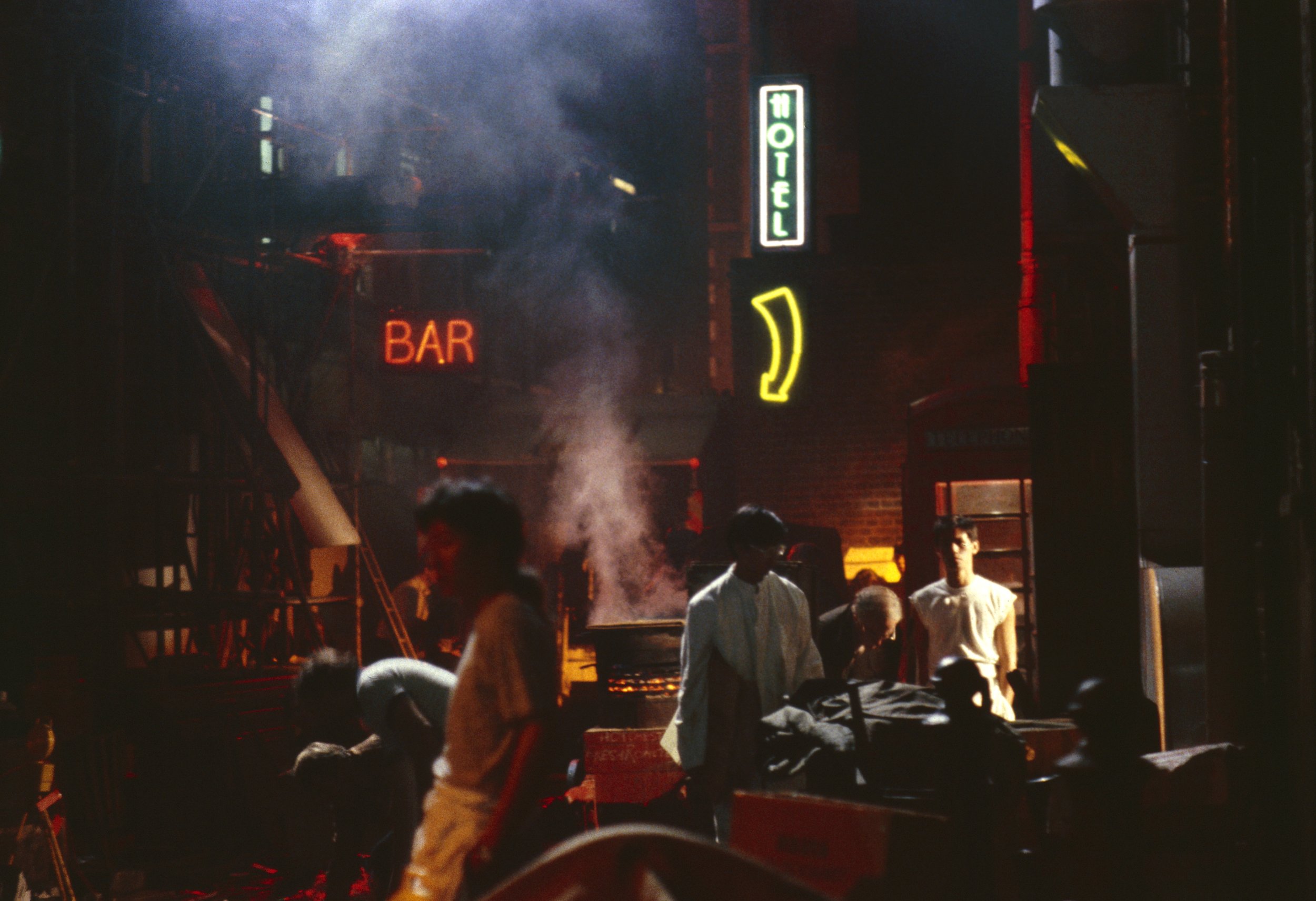
Sam’s will may be the ultimate act of patriarchal manipulation, not least in his passing over of his daughter in favour of the prodigal son who had seemingly rejected everything he stood for, but does ultimately allow the family to begin repairing itself while reclaiming their cultural identity. Elaine, who had deftly fended off the patronising overtures from her sleazy boss who refers to her as his “pretty little Chinese lawyer”, also gains a sense of herself as a female warrior like the wuxia comics she loved as a child in Macao while doing her best to protect Sam’s legacy in executing his wishes. An atmospheric evocation of  smokey ‘80s London Chinatown on the brink of change, Ping Pong allows its heroine to begin to find her answers only to discover they lead her right back to source. “Everything moves in cycles” Elaine philosophises envisaging her own new beginning in a changing society. 


Ping Pong screened as part of this year’s Hong Kong Film Festival UK.

The Grass is Greener on the Other Side (野草不盡, Crystal Wong, 2022)

Following the crackdown on the protest movement, many Hong Kongers began to think about seeking freer futures abroad, but what was it that those who decided to leave found there? Crystal Wong’s documentary the Grass is Greener on the Other Side (野草不盡) follows a collection of Hong Kongers who moved to the UK and explores the emotional complexity of life in exile as they attempt to hang on to their cultural identity in a society largely ignorant of their struggle. 

Wong mainly follows two protagonists, one a graphic designer about to become a father and the other a young student still fearing repercussions from his role in the protests whose friend is currently awaiting trial in Hong Kong. Both are clear that they reject a “Chinese” identity and defiantly describe themselves as Hong Kongers. Yet in the UK they are repeatedly asked to fill in forms asking for their ethnicity which generally offer only the choice of “Chinese” or a nebulous “other”, each time they write in Hong Kong as an alternative answer. One of the reasons the expectant father chose to leave is that he didn’t want his child growing up speaking Mandarin (both men are also ironically greeted with “ni hao” before explaining that they speak Cantonese in Hong Kong) but others ask him if he won’t end up losing his language to English instead, a removals man bringing up the case of his Australian niece who now refuses to answer her grandparents in Cantonese even when she understands what they’re saying. He and his wife insist they won’t let that happen, but even in job interviews they seem more interested in his ability to speak Mandarin than his design skills.  

Before he left, he attended a housewarming party for another friend who decided to stay and was able to buy a home thanks to a motivated seller emigrating in a hurry. Everyone seems to be leaving, even a shop attendant guesses that the student she’s serving is probably leaving soon when he mentions that he’s not sure if his card’s topped up enough. Yet another of the older men had said that it’s mainly those of their age who are planning to go abroad, the student protestors are deciding to stay and fight some of them resentful that the previous generation is dropping the ball by abandoning ship. The student, however, has taken the opportunity to study abroad to protect himself from repercussions from participating in the protests in Hong Kong heading to the UK while his friend prepares to leave for Germany vowing only to return should a war break out. 

Yet the designer asks himself if he’s really satisfied while a friend of his who’s been in the UK for a while cautions that he may get bored moving to a town like his which he says is better suited to retirees. He struggles to secure employment and considers moving out of London to save money but describes leaving Hong Kong as akin to an acrimonious divorce. He’s offended when someone asks him what he misses because what he misses is a disappeared Hong Kong to which he can never return. Some of his friends had described Hong Kong as like Goose Town in the 2010 Mainland comedy Let the Bullets Fly, a place completely oppressed by a corrupt authority. “You need to whole heartedly hate a place to decide to leave it permanently” he explains. 

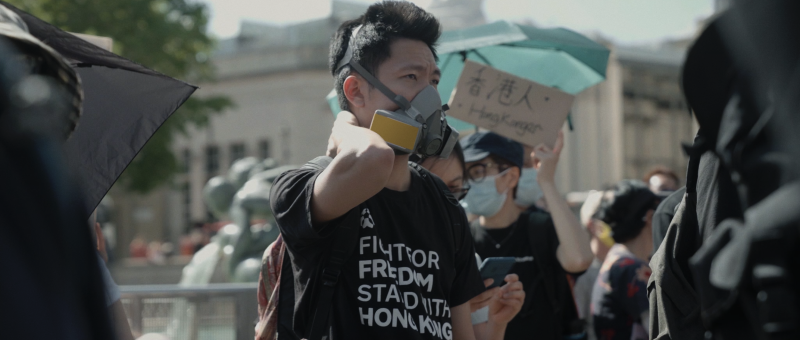
Both he and the student attend the central London protests attempting to raise awareness of Hong Kong’s plight while carrying on the fight even in exile. One encounters a man who asks him what the protest is about and if he really “hates” China while stating that it reminds him of the situation in Sri Lanka and expressing solidarity with his struggle. The student meanwhile makes his way towards Trafalgar Square where the protest merges with another one hosted by Nigerians protesting political oppression in Nigeria. He regrets that he won’t be able to return to Hong Kong in time for his friend’s trial (especially considering the quarantine procedures during the pandemic) while trying to get on with his studies. Each of them struggle with their decision, wondering if they’ve done the right thing and if they will ever return to a free Hong Kong while trying to hang on to their cultural identity as they forge new lives in an unfamiliar society.


The Grass is Greener on the Other Side screens in London 31st March as part of this year’s Hong Kong Film Festival UK.

Original trailer (Traditional Chinese / English subtitles)
A Holy Family (神人之家, Elvis Lu, 2022)

“Do you think the gods ever helped our family? Or, should I say, do the gods exist?” asks documentary filmmaker Elvis Lu of his brother, a spiritual medium who stayed behind with their devoutly Taoist parents while Lu left for the city 20 years previously and never returned. Lu admits that he likely never would have come back had his mother not contacted him with an ominous message about sorting out her funeral plans, but while filming seems to come to a new accommodation with his familial relationships guilty that he stayed away so long no longer a resentful young man but one beginning to consider the encroachment of mortality.

Lu’s mother confesses that she had pretended to herself that he didn’t exist, hurt that he rarely answered her calls and never visited home even as he points out that she never came to visit him him Taipei either. She feels she “achieved nothing as a parent” and is most regretful that she could not nurture Lu’s talent because she was forced to work long hours to support the family while also taking care of the household. In the opening conversation Lu had coldly answered the phone assuming his mother had called to ask for money, and the hollowness at the centre of the family is largely caused by Lu’s father’s longterm gambling problem which saw him fritter away most of the family’s property and savings leaving the couple financially dependent on their sons for support. Lu’s brother also feels a degree of resentment towards their near silent father, revealing that he does not want to do to his son what his father’s done to them in leaving them nothing but debt and disappointment. That’s one reason he’s always looking for new ways to support the family and has recently begun farming.

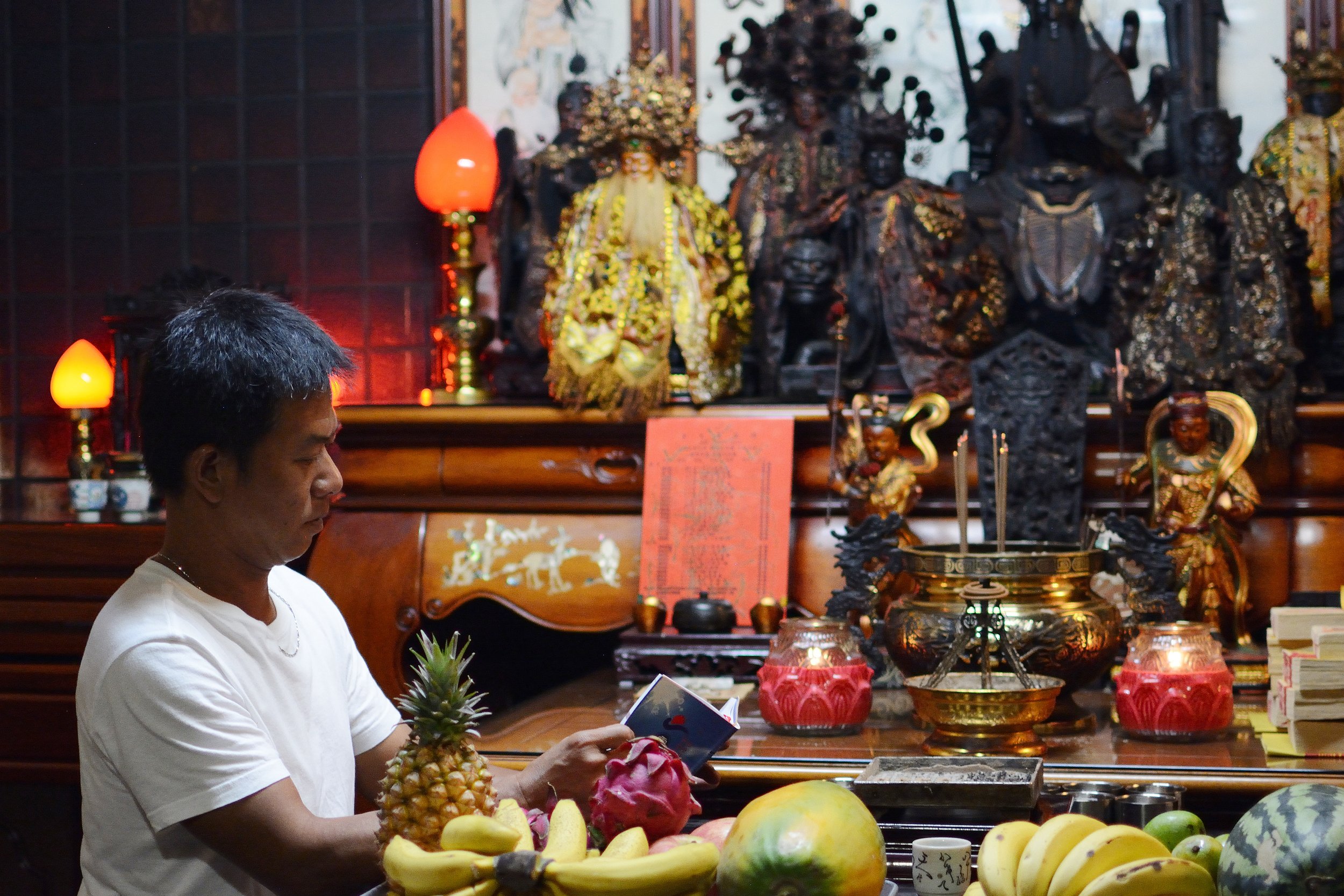
The obvious question when his tomato crop is destroyed by floods is why didn’t he ask the gods for guidance first, only it turns out that he did. As Lu points out, the family has endured long years of suffering despite their piety, if his brother is really so close to them why didn’t they help? It’s a question he obviously doesn’t have an answer for, nor does he have one when his son pleads with him to ask the gods for advice as to what to next with the ruined tomato field. His brother’s pained expression hints that he might have doubts despite being able to talk to the gods in his job as a spirit medium handing out advice on investments and other more Earthly worries for a small donation. The family’s upper floor is home to a large altar with several statues of the gods his mother describes as her only friends during the time that both her sons and husband were absent from the family home. Lu’s mother is tiny and now somewhat advanced in age. The stairs appear difficult for her, yet she climbs them every day to pay obsevance to the gods. 

After 20 years in the city all of this religiosity seems even more bizarre to the now adult Lu, but he also also captures ceremonies in the community in which people pray to the gods for health and prosperity suggesting that it’s not so odd after all and that the sense of community may be more important that the rituals themselves. Even so, it’s also true that this almost transactional view of spirituality feeds directly back in to his father’s gambling addiction in which he constantly looks for signs of lucky numbers to place bets or buy lottery tickets. After being diagnosed with glandular cancer and too ill to do much else, Lu’s father still picks up the phone to lay a sizeable bet even while his exasperated wife tries to control her resentment that if only he hadn’t lost his job he’d have had a pension, they’d have kept more of their property, and would all have happier, more comfortable lives. 

In any case, through adopting a more neutral position as a filmmaker Lu is able to better interrogate the realities of his family and his own relationship with it. As the documentary progresses, he sometimes appears on screen holding a large camera on a tripod while someone else films him from another angle. What began with frosty resentment slowly gives way to warmth and reconciliation even while underpinned by a melancholy practicality as Lu helps his parents choose pictures to use at their funeral underlining a sense of oncoming loss as Lu finally takes his mother to see the sea and gently tracks her as she walks along the shore, slowly moving away from him.


A Holy Family screens in London 24th March and in Edinburgh 25th March as part of this year’s Hong Kong Film Festival UK.

Original trailer (English subtitles)

If We Burn (血在燒, James Leong & Lynn Lee, 2023)

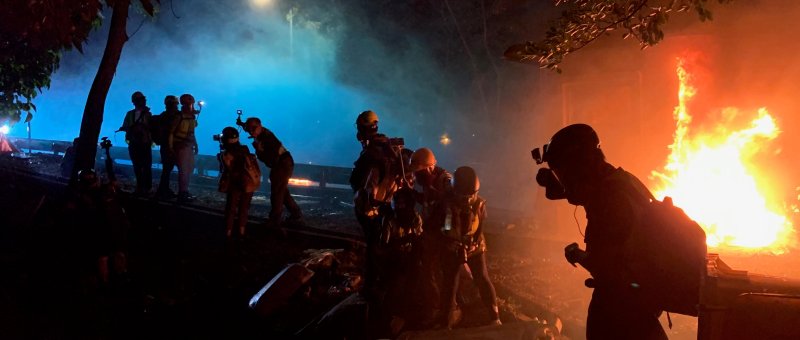
Clocking in at over four hours James Leong & Lynn Lee’s If We Burn (血在燒) provides the most comprehensive overview of the Anti-Extradition Law Amendment Bill Movement of any of the recent documentaries focussing on the events leading up to the passing of the Security Law in June 2020. Utilising professionally shot footage of the protests along with that captured by protestors via mobile phone, the film presents a tale of gradually escalating tensions provoked by increasing police violence and an expanding sense of hopeless desperation. 

Focussing largely on a series of climactic events such as the storming of the Legislature, the Yuen Long and Prince Edward Station attacks, and the sieges of the Chinese University and Hong Kong Polytechnic University, the film posits police brutality as a deliberate tactic that developed into state terrorism designed to intimidate society into submission. In the talking heads segments which occupy the first half of the film, the filmmakers interview a journalist who was present at the Yuen Long attack and was herself beaten by the mysterious vigilantes who raided the station. In this and the attack at the Prince Edward station which followed, it was clear that the target was not solely protestors but the people of Hong Kong who were simply attempting to catch a train in order to go about their ordinary business and became victims of, in the case of the Prince Edward MTR passengers, state violence in an unwarranted police intervention. As the journalist explains, given such a threat to their safety it is not surprising that many were radicalised and that some who had previously been committed to peaceful protest resolved to fight fire with fire. 

Some also regard the police action as a deliberate tactic, that in escalating violence the authorities attempt to provoke those protesting in order to justify even harder crackdowns. It’s also later revealed that police officers infiltrated the movement, dressing as protestors but suddenly attacking those around them giving rise to mistrust and paranoia. A lengthy sequence in which a mob at the airport protest catch a man they believe to be a Mainland police spy hints at the moral ambiguity of the protest movement as they argue with each other what to do with him while the man himself becomes a stand-in for the entirety of the violence inflicted so far. As tensions rise and duplicitous actions of the authorities increase, protestors begin to lose their sense of righteousness agreeing that there no longer is any line they will not cross to secure the freedom of Hong Kong. 

It’s clear that this period of instability has greatly affected the mental health particularly of younger protestors with many thrown into despondency and despair. During the university sieges, many state their intention to die and become martyrs while others talk of suicide and the toll the deaths of friends have already taken on them. During a rally in which older people offer thanks and support to the student protestors a young musician tearfully talks of how the the protest movement’s lack of success has exacerbated his depression and left him feeling hopeless with the only the solidarity of the people around him keeping him going. 

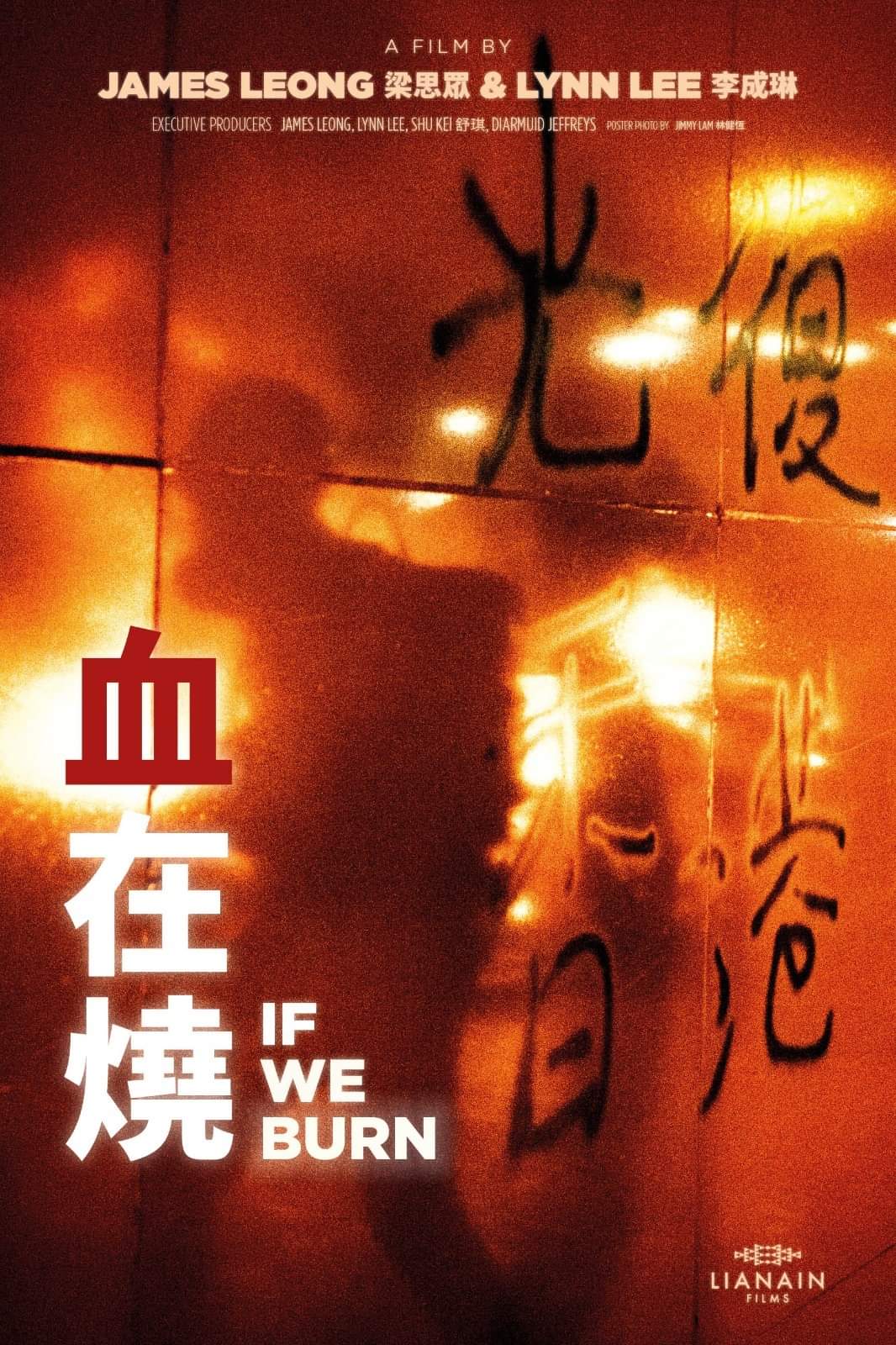
What had begun as a simple request to reject the Extradition Law Amendment Bill soon turns into a series of five demands and finally towards a desire for independence among the more hardline of the protestors who are now so mistrustful of Mainland authoritarianism that they can never consent to living under it. The documentary ends with alarm bells still ringing and a post-apocalyptic vision of battlefield destruction in the quad of the Polytechnic University peppered with small fires and piles of rubble while police drag protestors away from the scene. Talking heads who still appear in masks and goggles with disguised voices look back on the effects of the protests and the various ways they are changing Hong Kong while a piece of onscreen text coldly explains that the Security Law was passed and many have since been arrested or fled into exile. Still, as the alarm bells ring over the closing scene featuring the graffiti that gives the film its title, the documentary seems to suggest that all not yet lost while flame of resistance continues unextinguished.


If We Burn screens at London’s Genesis Cinema 18th March as the Opening Gala of this year’s Hong Kong Film Festival UK.