
Madadayo (まあだだよ, Akira Kurosawa, 1993)

It’s tempting to read Akira Kurosawa’s final film Madadayo (まあだだよ) as a kind of valediction, though he may not have thought of it as a “final” film and if he had, it would have been ironically for film’s title means “not yet” and thematically hints at a desire on hold to a life that is admittedly fleeting. Much of the film is indeed bound up with transience and the difficulties of accepting it, but it’s also a humorous tale of a man who was “pure gold” and managed to maintain his childish heart even into his 77th year. 

Inspired by the life of the writer Hyakka Uchida (Tatsuo Matsumura), the film rather curiously opens with his retirement as he abandons his teaching position to pursue writing full-time much to the disappointment of his doting students. The relationship between Uchida and the boys he taught is at the heart of the film, for much like Mr Chips he had no children of his own and is cared for in his old age by a collection of old boys who almost venerate him as if he were something precious which cannot be allowed to slip from the world. Soon after his retirement, Uchida achieves his Kanreki, that is his 60th birthday or the completion of one cycle of the Chinese zodiac which is also the beginning of a second never to be completed round, which some consider as a second childhood or the beginning of old age.

Uchida is indeed childishly innocent and generally lighthearted forever making incredibly silly puns and approaching even potentially serious situations with good humour. When his wife remarks that the rent may be reasonable on their new home because it is unlucky and prone to being burgled, Uchida simply puts up a series of signs directing thieves to the “burglars entrance” through the “burglars corridor” to the “burglars lounge” and “burglars exit” reasoning any potential robber would find the situation so odd as to want to leave as soon as possible. The house does turn out to be unlucky in a sense as it is burned down during the fire bombing of Tokyo leaving the Uchida and his wife to move into a tiny shack on the grounds of a ruined mansion. 

Signs of a sense of irony and an underlying darkness are, however, present in his improvised version of a march he would have taught the students during the years of militarism on which he comments on the disillusioning realities of new era of “democracy” under the Occupation ruled by bribery and corruption. The students decide to hold a birthday party for the professor they christen the “Not Yet Fest”, taking the lines from a child’s game of hide and seek to ironically ask if he’s ready to throw in the towel first, actually featuring a performance of his funeral which might seem insensitive but Uchida can be relied upon to see the funny side. During the party the former students give various speeches, one announcing he will recite the names of all the stations from one end of the country to the other, but no one really pays very much attention to them. The students even track on a large white dinner plate during a children’s song about the moon to hold behind Uchida’s head as if he were a buddha achieving enlightenment. 

Yet the crisis comes when, shortly after the students buy Uchida and his wife a new house to live in, their beloved cat Alley disappears, plunging the professor into a well of existential despair that leaves him unable to sleep or eat. The depths of his sorrow perhaps hint at his childish sincerity, though there is an undeniable poignancy in the attachment of the childless couple to this cat that chose them as its family. Despite the best efforts of the students along with the local community, Alley never returns though the professor and his wife learn to love a new cat who like Alley wandered into their garden and found a home. As in the poem that inspires Uchida in his “ascetic” life in the hut, life is an ever-flowing river. The waves of students that flowed through his classroom, the homes that were destroyed and rebuilt, the cats who stayed as long as they could and then made way for the new visitor all of them small circles of life that will continue long after he is gone. 

But as Uchida says, “Not Yet”. Like Kurosawa himself who feels the light dimming he asks for more time as if playing hide and seek with death whose presence he must eventually acknowledge even if he’s not quite ready to welcome him in. At the last Not Yet Fest that we see times have clearly changed. Uchida’s wife is now present along with the daughters and granddaughters of the students, one of whom points out they’ll soon be genuine old geezers themselves. For a moment we think we see the boy from 1943. Uchida tells the children to find their passion and give their lives to it, imparting one final not quite lesson while gifting them the cake they’ve just brought him in order of his 77th birthday. A 77th birthday is supposed to be lucky, though seven sevens are also 49 which is the length of a Buddhist mourning period and the time it takes to be reborn. The cycle begins again, as Uchida may know as he dreams of childhood hide and seek only to be distracted by a surrealist sky in its pinks and blues, a vista apparently painted by Kurosawa himself who lets the clouds roll into the credits an endless stream of dream and memory on which our lives are mere bubbles that disappear and form anew. But perhaps, not yet. 

Lovely Devils (可愛い悪魔, Nobuhiko Obayashi, 1982)

Until fairly recently, the work of Nobuhiko Obayashi had been largely unappreciated in the Anglosphere where he is associated most closely with his debut film House which was itself somewhat grudgingly respected as a “crazy” midnight movie. He was however surprisingly prolific and especially so for a director working through the difficult 1980s in a 60-year career which ended only with his death after a protracted illness itself ironically announced on the day his final film, Labyrinth of Cinema, should have opened in Japanese cinemas had it not been postponed in light of the coronavirus pandemic. Produced for television in the same year as I am You You Are Me, Lovely Devils (可愛い悪魔, Kawaii Akuma) is among those which Obayashi did not script for himself but is penned by Machiko Nasu and apparently inspired by The Bad Seed though Obayashi later revised the script to remove traces of the original work unwilling to create a simple homage. 

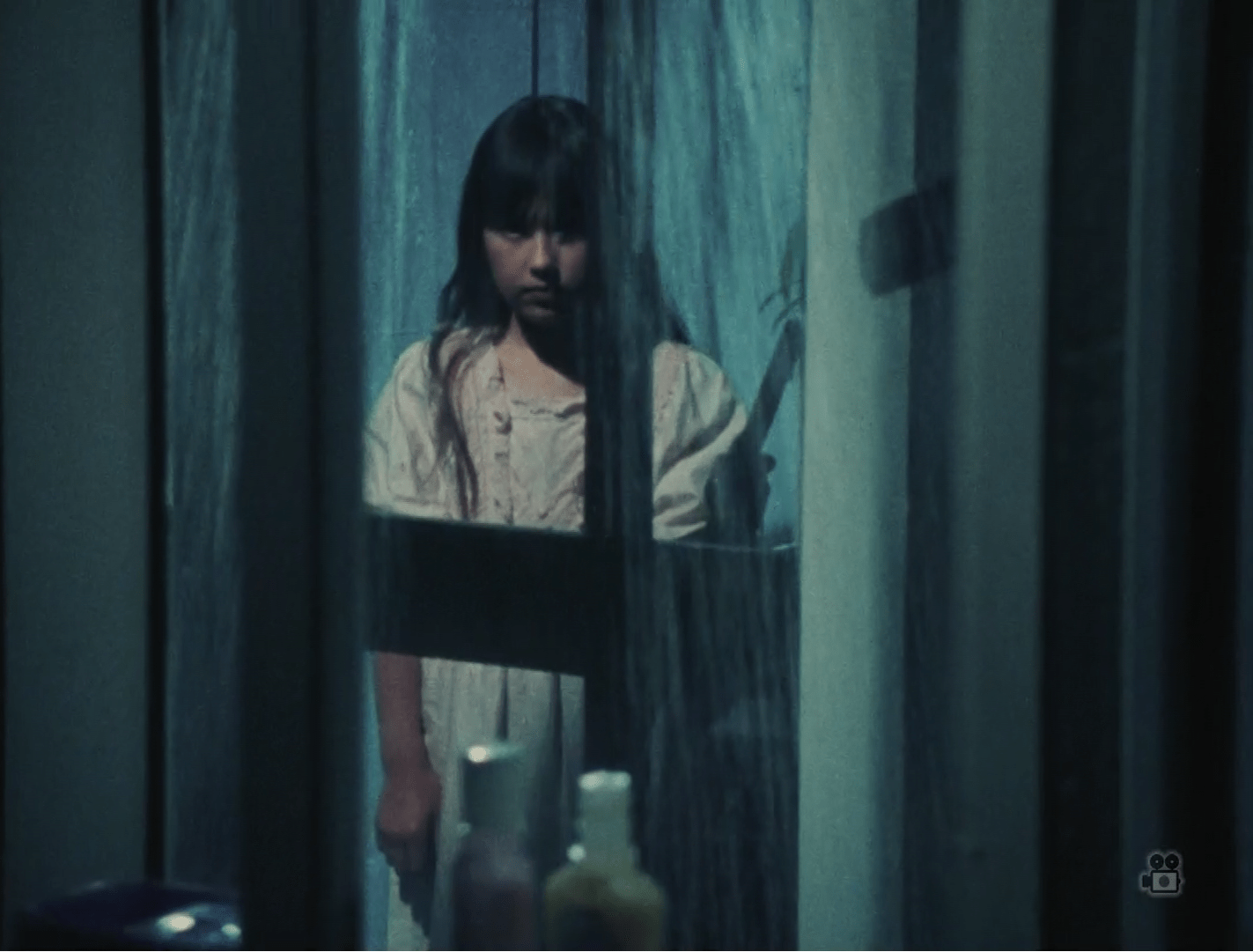
Similar in tone to Obayashi’s later The Deserted City, Lovely Devils is at heart a twisted gothic romance cautioning against the dangers of an excessive thirst for love. In ‘70s Japan, a wedding takes place at small church during which 5-year-old Alice, niece to Koji (Hiroyuki Watanabe) the groom, becomes overly attached to the veil of the bride, Fuyuko (Nao Asuka), and in the manner of entitled small children everywhere demands to be given it. Fuyuko tries to explain that she plans to hang on to the veil for the rest of her life as a keepsake and is sure that Alice will have an even prettier one of her own someday, but Alice creepily asks if that means she can have it when Fuyuko dies and, wanting to bring an end to the matter, she unwisely agrees. While everyone is busy assembling for the wedding photos in the garden, Fuyuko violently tumbles out of an upstairs window, her broken body landing on the patio below only to be met by Alice excited about collecting her veil. 

Meanwhile, at the same time in Vienna, Fuyuko’s exchange student sister Ryoko (Kumiko Akiyoshi) is in the middle of a difficult breakup with her local boyfriend Johann in which she, perhaps understandably, tells him to go die only to see him get hit by a car on his way out of her apartment. Overcome with guilt and grief in believing that she somehow killed Johann by wishing for his death, Ryoko goes quietly mad until her landlady contacts Koji who comes to bring her home and places her into a mental institution run by a convent in which the resident psychologist, Dr. Tsukahara (Toru Minegishi), is also a priest. After three years, Ryoko seems to be sufficiently recovered and so Koji asks his sister Keiko (Miyoko Akaza) to take her in as a governess to the now eight-year-old Alice (Tina Jackson). 

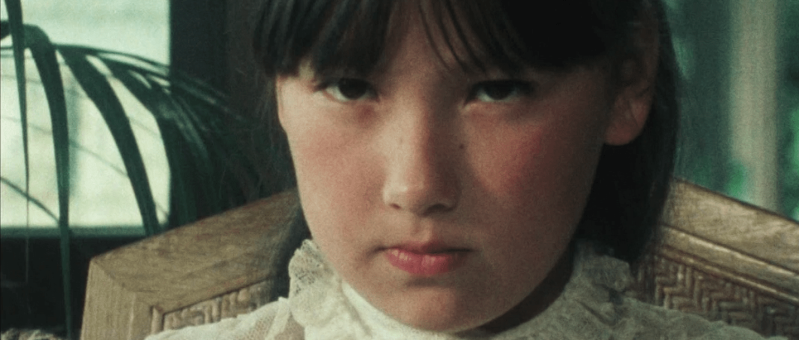
The central irony is that Ryoko is almost certainly not guilty of psychically killing Johann just someone who bitterly regrets saying something unkind in anger and having fate ironically follow through, where as Alice is definitely “demonic” and, as is later pointed out, a child who cannot discern right from wrong. In the liner notes for a later release for the film, Obayashi likened the figure of Alice who commits a series of murders with no conceptual understanding that it’s morally wrong to kill to that of himself as a thoroughly militarist boy in wartime who thought that Japan was just and everything outside Japan “bad”. Alice sees something she wants and has to have it. If someone else has it and won’t give it to her, they have to go (sometimes in quite elaborate ways). Ryoko’s battle is against the commonly held belief that eight-year-old girls are innocent angels, no one in their right mind (Ryoko has just been released from a psychiatric institution following a breakdown after all) would believe Alice capable of violent murder and especially not on the grounds that she simply wanted something trivial like a veil or a doll and was unable to accept that she could not have it. 

Later, Alice’s fragile, chain-smoking, dipsomaniac mother Keiko who always suspected there was something not quite right with her little girl attributes this extreme possessiveness to having discovered the body of her father after he unexpectedly hanged himself in their family home (it does not seem to occur to Keiko that perhaps he is merely the first victim, his ornate quill pen one of Alice’s favourite trophies). She thinks that lack of paternal love has made her seek attachment and permanence in objects but also dangerously in her uncle Koji whom she sees both as a surrogate paternal figure and as an incestuous love interest. It is also somewhat unfortunate that the actress playing Alice and the character herself is half-Japanese playing into an uncomfortable stereotype in gothic horror that posits these demonic qualities and romantic perversions as essentially an extension of foreignness, but in any case Obayashi leans in deep with the wedding imagery as Koji returns to rescue Ryoko in the white suit from his wedding firstly on her release from the hospital on which she too wears a white lace dress, and then subsequently with the still eight-year-old Alice who is dressed much the same only with the addition of an Edwardian-style sun hat to complete the look.  

It’s this final juxtaposition which pushes Ryoko towards accepting her imprisonment as a “criminal of love”, seeing herself and Alice as two of the same as if she really had caused Johann’s death through an excessive desire for a love he had but refused to give her in the same way Alice kills “out of a longing and thirst for love” sublimated into the acquisition of objects. Conjuring an intense and heady atmosphere of gothic unease with the remote country mansion and wandering ghostly brides, Obayashi once again plays with psychedelic surrealism with his romantic painted backdrops and characteristic use of colourplay particularly in flashback as Keiko recalls a sepia-tinged memory of the time they were “almost too happy”. Boasting high production values despite its TV movie genesis, Lovely Devils is defiantly an Obayashi production filled with his wistful sense of loss and nostalgia but also a deep darkness in its mildly disturbing, unconventional conclusion. 


Gu Gu the Cat (グーグーだって猫である, Isshin Inudo, 2008)

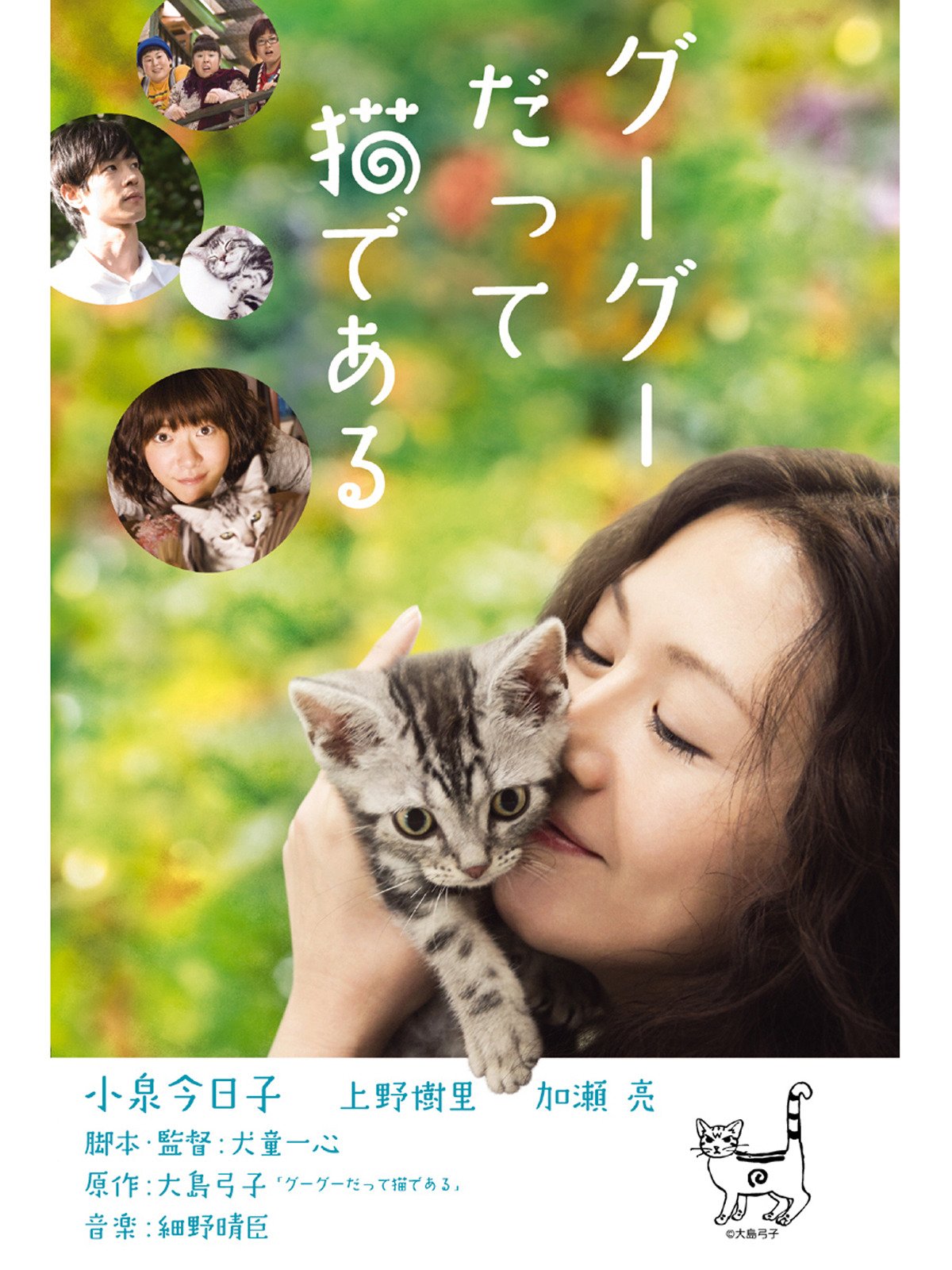
Gu Gu the cat posterJapanese cinema has long been in love with the local flavour movie. It may be true that many otherwise fantastic examples of the small subgenre have a “sponsored by the tourist board” aesthetic, but then the pure “furusato” love is usually genuine enough and often proves infectious. Gu Gu the Cat (グーグーだって猫である, Gu Gu Datte Neko de Aru) is a case in point in its fierce determination to sell the benefits of trendy Tokyo suburb Kichijoji – an upscale bohemian neighbourhood well known for being home to artists and dreamers who take care to foster the kind of hometown spirit you wouldn’t normally associate with city living. The film is also, however, the story of a struggling middle-aged mangaka who is forced to deal with a long delayed existential crisis after her elderly cat passes away.

Ça Va had been living with Asako (Kyoko Koizumi) for the last 15 years but passed away while she and her team were working flat out on a special Christmas issue. Asako is of course devastated and not least because she feels guilty that perhaps she was too busy to notice that Ça Va was ill until it was too late. According to her assistant Naomi (Juri Ueno), Asako’s career had been faltering even before Ça Va passed away – the Christmas issue had been the only thing she’d produced all year leaving her team of assistants out of pocket and worried for the future. Grief-stricken as she is, Asako eventually decides to get a new cat, Gu Gu, enabling a rebirth in her professional as well as personal lives.

Based on an autobiographical story by mangaka Yumiko Oshima, Gu Gu the Cat wastes no time in reminding us that being a mangaka is a precarious business. Asako is well acclaimed as an artist and has inspired countless young women with her shojo manga (Naomi not least among them) but is still pressed into working insane hours to meet publication deadlines and is constantly badgered by her publishing company to provide new material. Her mother (Chieko Matsubara), meanwhile, just wants her to settle down and get married before it’s “too late”.

Asako’s mother’s nagging may seem like the usual kind of conservatism that is a little embarrassed by an unmarried middle-aged woman, as well as with the idea of a woman having a career and especially in manga which is a “popular” art and therefore less respectable than literature or painting. It is also, however, born of knowing her daughter and seeing that there is a part of her that hasn’t quite matured thanks to working on manga all her adult life which has left her feeling isolated and lonely in a way a cat might not be able to satisfy. This is perhaps why potential love interest Seiji (Ryo Kase) describes all her manga as “sad”, and why Asako is somewhat uncomfortable with being treated as a “famous author” rather than as a person.

Gu Gu the cat takes a back seat to most of the action (as cats are want to do) but does help engineer a meeting with Seiji who, despite being much younger than Asako, begins to reawaken in her a sense of desire if not exactly for romance then perhaps for life. Following a familiar pattern, however, Asako re-channels that desire into her manga – coming up with an idea in which a teenager suddenly grows old, neatly mirroring her sudden sense of having become “a woman of a certain age” overnight without really noticing. Having lost Ça Va, Asako attempts to come to terms with lost time in accepting that many choices have already been made and opportunities lost. In that sense there is something sad in Asako’s decision to remain alone in knowing that in the end she lost love because she was too timid to claim it, but then, the answer isn’t new romance but an acceptance of being happy in the present in the knowledge that things change and people leave but it will all be OK in the end.

Based on Oshima’s real experiences, Inudo’s film takes a turn for the melodramatic towards its conclusion which feeds back into his “live every day” message but is perhaps a little heavy for the cheerful slice of life drama surrounding it. Likewise, his strange decision to sell the joys of Kichijoji (which appear to be many) through an American Eikaiwa teacher narrating a journey through the area in the manner of a TV programme aimed at tourists is a particularly strange one which in no way benefits from its surreal plot revelation. Nevertheless, Gu Gu the Cat is a warm and affectionate tribute to this seemingly warm and quirky area which acts as a kind of coming of age story for its middle-aged heroine who, in a sense, births herself in coming to an acceptance that life goes on and the best you can do go along with it for as long as you can.


Original trailer (English/Chinese subtitles)