No Other Choice (어쩔수가없다, Park Chan-wook, 2025)

Most of the time, when someone says they had no choice, they’re paradoxically admitting that they had one, but they expect to understand the choice they’ve made because we would have done the same or can’t reasonably expect them to accept the consequences of the alternative. “No other choice,” on the other hand, is self-contradictory, clearly stating that a choice does indeed exist. Perhaps that’s why it seems so irritatingly disingenuous every time it’s said to Man-su (Lee Byung-hun), even if he eventually succumbs to its self-absolving qualities.

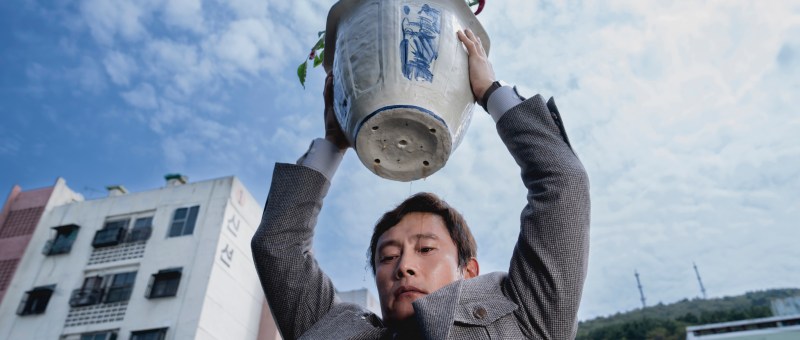
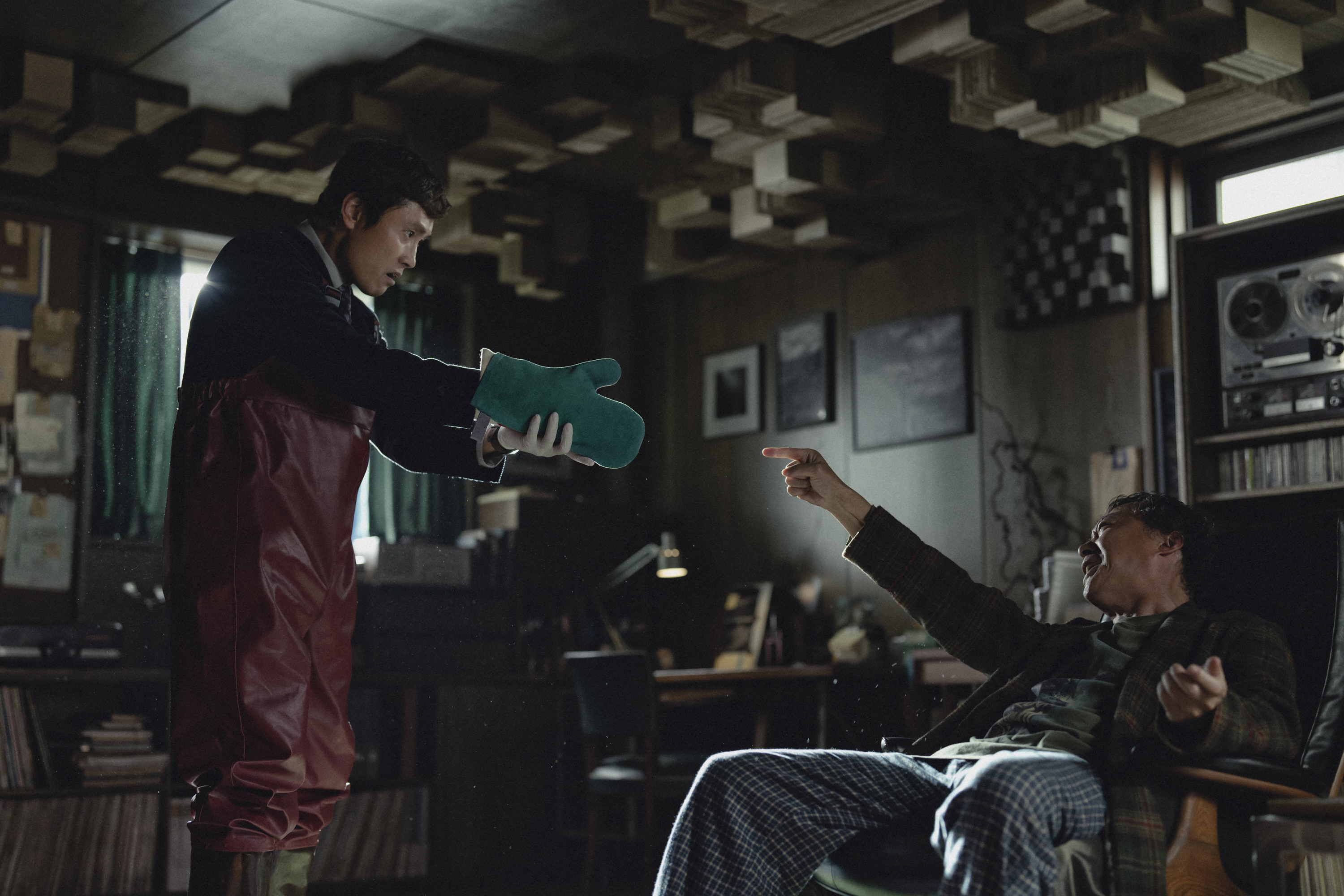
In any case, it’s this sense of powerlessness that’s at the centre of Park Chan-wook’s satirical drama as a middle-aged man finds himself suddenly exiled from the upper-middle-class lifestyle he’s worked so hard to build for himself when his company’s taken over by an American firm who have “no other choice” than to shed some staff. Man-su is blindsided by this corporate betrayal, attending self-help sessions that remind him there’s no such thing as jobs for life any more. Losing his job wasn’t his choice, but in some ways perhaps that makes it worse. 

What connects him with the other men in his position is that he’s obsessed with getting another job in the paper industry rather than exploring other options. All of these men are fixated on getting back what they feel has been taken from them. Not only is Man-su dead set on getting another job in paper, but on holding on to the family home from which he was displaced as a child and has only just managed to reclaim. To that extent, what he wants is a return to a past that doesn’t quite exist any more or exists only in his memory and is therefore unattainable.

Losing his job also leaves him displaced within his family as his sudden inability to keep them in the manner to which they’ve become accustomed eats away at his sense of masculinity. They’ve already had to exile the dogs, leaving his young daughter distraught, while his wife, Miri (Son Ye-jin), has started working again, further emphasising his failure as a provider. Witnessing one of the other men’s wives cheating on him with a much younger lover, Man-su too begins to fear that his wife no longer sees him as a man and will cheat on him too with someone who better fulfils the codes of masculinity. Yet it’s his stubborn male pride that undermines his positions much more than the unfortunate fact of having lost his job, which wasn’t after all something he had much control over. The wives are all much more pragmatic and come up with realistic solutions such as ruthless belt tightening and ceding a little ground by voluntarily giving up anything inessentials while encouraging their husbands to be a little more pragmatic and consider new directions rather stubbornly fixating on reclaiming the life they had before. 

That might be Miri decides to just sort of go with it even after beginning to suspect that Man-su has something to do with the disappearance of his rivals. At least he’s being proactive, even if it’s not really the best way to go about it, and by burying a few bodies there, he’s basically made it impossible to sell the house which is one goal achieved. It’s not losing your job that’s the problem, it’s how you deal with it, one of the other men’s wives insists as even Man-su ironically berates him for not listening to any of his wife’s “sensible” suggestions. Then again, the fact Man-su is eventually offered a job training AI replace him invites the suggestion that he’s basically killing all the other workers in the hope of clinging on to the wheel as soon as possible. The managers state they had “no other choice” about that too, and are grinning with the blinkered vision that prevents them from realising there’ll be no need for managers when there’s no one manage. 

In any case, the fact that Man-su walks around for with toothache for a significant amount of time echoes the hero of Aimless Bullet and suggests that perhaps things aren’t all that much different in the Korea of today caught between deepening wealth inequality, exploitative working conditions, and employment precarity presented by the rise of AI and increasingly globalisation. There is something quite sad about the devaluing of these skills in that what Man-su and the other men share is reverence for paper, the beauty and texture of it, along with the craftsmanship and pride in their work that now seems to belong to a bygone era. It seems that the dog-eat-dog world of capitalism leaves Man-su with “no other choice” than to do what he did and leave others with no other choice but him, but all he’s really done is seal his own fate in a futile attempt to hold on to a past that is rapidly slipping away.


No Other Choice screens as part of this year’s BFI London Film Festival.

Trailer (English subtitles)
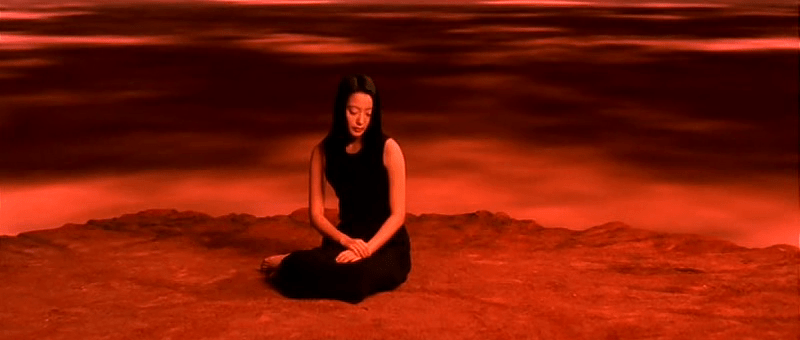
Ghost in Love (자귀모, Lee Kwang-hoon, 1999)

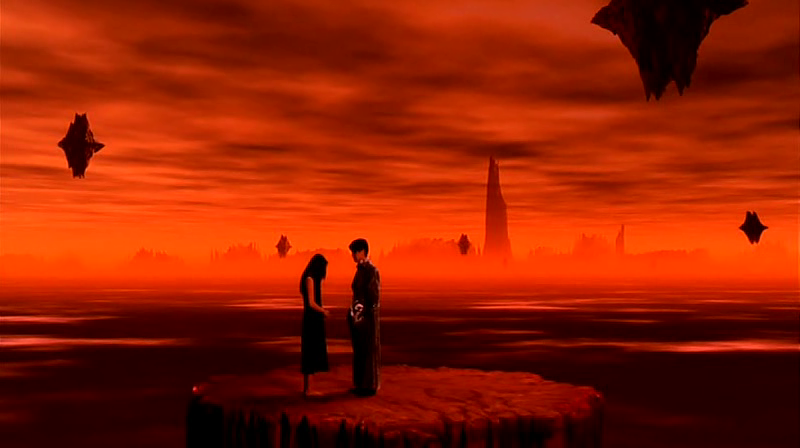
Caught in limbo, a young woman finds herself torn between the desire for revenge and letting go in Lee Kwang-hoon’s supernatural drama, Ghost in Love (자귀모, Jagwimo). Is love really what Chae-byul (Kim Hee-sun) was in, or is it more the sense of humiliation that’s she’s carried into the afterlife while obsessing over her cheating ex-boyfriend who was two-timing her with the boss’ daughter? Her colleague Kantorates (Lee Sung-jae), by contrast, had a love that was purer and reminds her that though it’s painful, if she really loved him, she’d be rooting for her ex’s future happiness rather than plotting how to mess up his life. 

Then again, the Korean title is “Suicide Ghost Club” and refers to the group into which Chae-byul is press-ganged after two of its grim reaper agents help her on her way having overheard her say she wanted to die because of all the romantic drama in her life. This literal purgatorial space located between heaven and hell is run like an exploitative company/cult in which the only metric of success is claiming more members. Chae-byul is warned that she doesn’t really have any choice but to join them, because otherwise she’ll become a vengeful spirit and lose all her memories, though she’s drawn to a mysterious presence known as Pale Face who does indeed become a terrifying spirit of vengeance, taking revenge primarily on the men who gang raped her while her fiancé, who later dumped her, looked on helplessly.

There is a kind of misogyny that’s most obvious in the afterlife but exists in the real world too. The film opens with a woman about to take her own life because of persistent fat shaming. She’s fat shamed by the grim reapers too and on into the afterlife, though in ghost form it’s revealed that she could be skinny if she wanted but is happiest in herself like this. Meanwhile, the grim reappears make other suggestive comments, leering over Chae-byul and remarking that a girl should have nice hips. Pale Face took her own life because of the trauma of her rape, the stigma of being a rape victim, and the betrayal of her fiancé who she says broke up with her because he thought that she was tainted. Even in the afterlife, she’s constantly washing in an attempt to make herself clean which is why she’s become so pale. 

Despite being told primarily from Chae-byul’s perspective, the film more or less normalises her boyfriend’s sexist views and behaviour in which he sees nothing really wrong with two-timing each of the women. Chae-byul tries to confront him, but he tells her Hyun-ju (Kim Si-won) was only visiting “to check on her stock transactions,” and shifts the blame onto Chae-byul for being paranoid and unreasonable. He says he liked her because she was “nice and comfortable,” but now she’s changed, so if she’s going to carry on “nagging” him like this, he may as well break up with her. HIs domineering attitude and characterisation of Chae-byul as a crazy girlfriend have the desired effect of causing her to back down and apologise to him. He may be a bit pathetic and materialistic in dating the boss’ daughter solely for advancement claiming it was his only chance to get on, but his behaviour isn’t really regarded as being particularly negative while Chae-byul’s desire for vengeance is, belittled in part because it involves disrupting not only his bright future but pointlessly harming Hyun-ju too.

Then again, perhaps these attitudes are intrinsic to the latent authoritarianism of the afterlife which is governed by the mysterious “messengers” who punish the transgressions of wandering ghosts. One grumpily rants about now having to work for a living, unlike in the old days in which some people would even try to bribe them for a longer life which they don’t do anymore in an allusion to Korea’s recent democratisation. The Messengers From Hades have a serious whiff of the KCIA mercilessly pursuing those who threaten to destabilise the system and then “disappearing” them. Nevertheless, Chae-byul eventually begins to come around to Kantorates point of view while quietly falling for him even as he struggles to move on from his own lost love. He knows he can’t be with her any more, but needs to find a way to tell her to move on so that he can do the same. A strange twist of fate gives them another chance at life and at love to live without wanting to die and try to find happiness even in a world of financial anxiety where consumerist desire has replaced spiritual fulfilment.


Night in Paradise (낙원의 밤, Park Hoon-jung, 2020)

Sometimes being too good at your job can be a definite liability. So it is for the hero of Park Hoon-jung’s melancholy gangster noir, Night in Paradise (낙원의 밤, Nagwonui bam). Park’s worldview is often nihilistic and sometimes downright unpleasant, though it’s a sense of fatalistic sadness that dominates this otherwise over familiar tale of a noble gangster cruelly misused by those who choose not to obey their shared code and thereafter finding himself on a dark path towards if not exactly redemption then at least an inevitable ending. 

Rising foot soldier Tae-gu (Uhm Tae-goo) has found himself in the middle of an old-fashioned gang war, serving an ambitious boss, Yang (Park Ho-san), who has unwisely decided to press into territory operated by the well established Bukseong gang. Getting some of his guys back after being kidnapped by Bukseong and held in an apartment block where the community is currently protesting the take over and demolition by gangster redevelopers, Tae-gu is told by his opposing number that Yang is a crazy upstart who would be a nobody without him and that he made a mistake turning down a job offer from Bukseong boss Doh. Tae-gu is however an old school mobster loyal to his gang which is why he doesn’t stop to think things through when someone close to him is killed in a car accident in which he assumes he was the intended target, believing Doh is striking a low blow. Encouraged by Yang, he meets with Doh in person and daringly knocks him off at a swimming pool sauna escaping through a window in the nude. Yang arranges to send him to Jeju Island to lay low before moving on possibly to Russia, but Yang has also been engaging in a failed pincer movement which left them all in hot water after failing to take out Doh’s no. 2, Ma. 

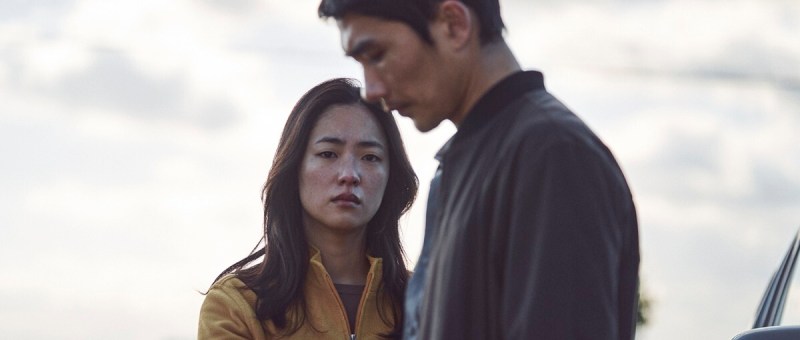
As the title might hint, even the island “paradise” of Jeju is not free of death and crime as Tae-gu discovers after bonding with their contact, Kuto (Lee Ki-young), a fixer smuggling guns from Russian mobsters hidden inside consignments of fish. Like Tae-gu’s sister, Kuto’s niece Jae-yeon (Jeon Yeo-been) is suffering from an undisclosed terminal illness that seems to have few obvious symptoms but has left her with suicidal tendencies. Kuto’s decision to take Tae-gu in is motivated by his desire for money to take Jae-yeon to America for treatment though she and Tae-gu are also much the same both having lost people close to them because of their proximity to the gangster world while he and Kuto search for ways to make up for the harm their lives of violence has caused. 

Jae-yeon is quick to remind Tae-gu that she will soon be dead and that therefore nothing really matters and her life has no meaning while he perhaps as a gangster feels something similar that his life ended the day he first picked up a gun yet there are also ways in which he must act in satisfaction of his code. His tragedy is that he’s operating under a misapprehension, blindly trusting in the wrong people when the truth is painfully obvious to all but him.

Park inserts a series of ironic pillow shots of the idyllic Jeju night scene with comforting lights swinging from tropical trees and gentle waves rolling on the horizon, before closing with a series of eerie daytime shots of familiar locations now devoid of people as if this were a hell our heroes had recently been haunting, ghosts of a violent landscape. His fight scenes are visceral yet also occasionally cartoonish, several taking place in the confined space of a car expertly framed by Park as the heroes fight desperately for life while constrained by their environment. A high octane chase through an airport with its ubiquitous escalators soon gives way to an impressive motorway-bound set piece with an unexpected resolution, the gangsters later scattering on hearing far off police sirens though as we also realise police collusion is an inescapable factor in the fragile equilibrium of the underworld even if it might not stretch all the way to idyllic Jeju. “Don’t waste your tears” Tae-gu unironically offers in weary resignation to his fate, a noble gangster to the last too good to survive in a world of nihilistic futility. 


International trailer (English subtitles)

Sinkhole (싱크홀, Kim Ji-hoon, 2021)

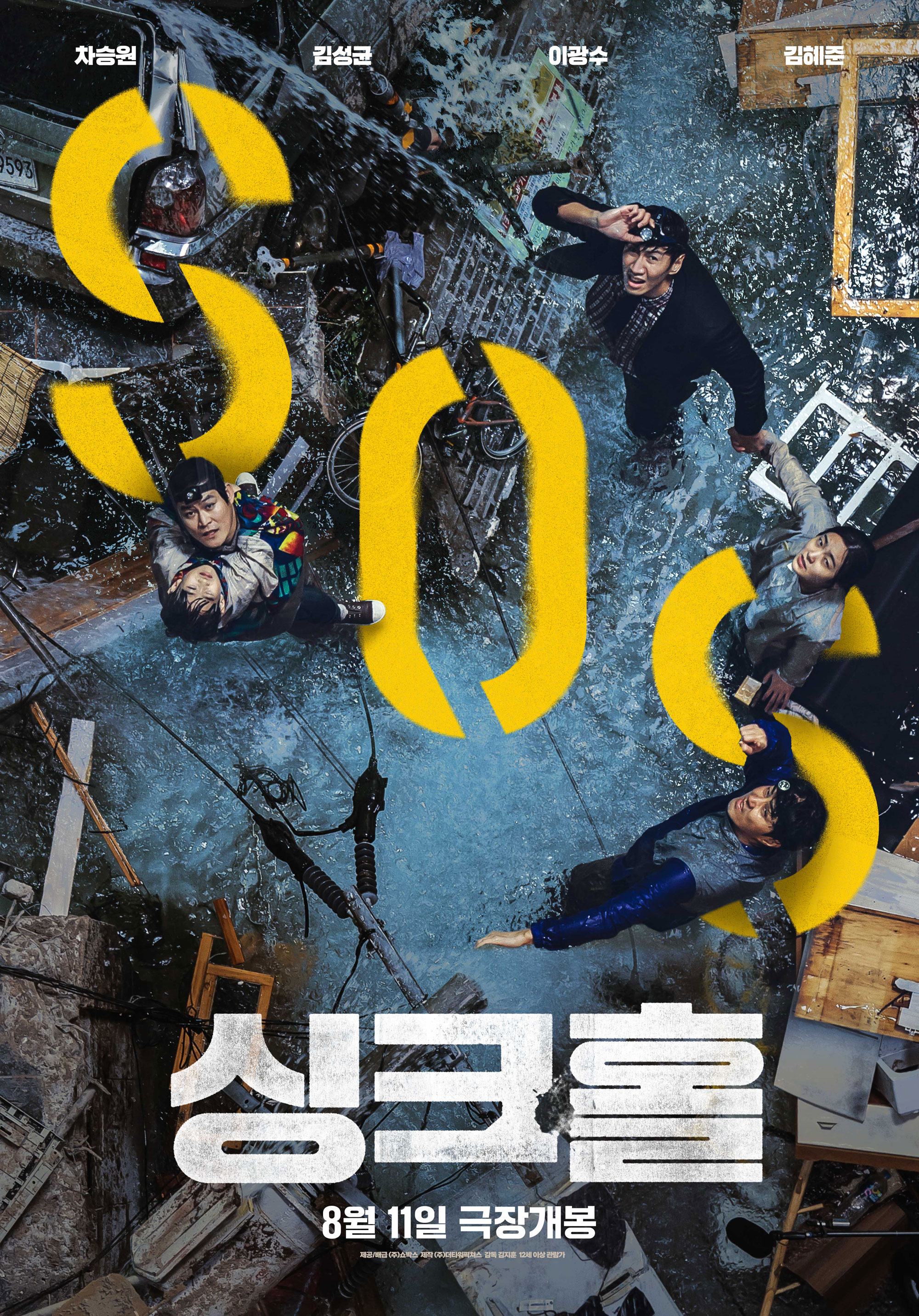
Financial security is built on shaky ground in Kim Ji-hoon’s harrowing disaster dramedy Sinkhole (싱크홀) in which one man’s home-owning triumph quite literally crumbles beneath his feet. The latest in a recent series of movies lamenting the sometimes lax safety culture of the Korean construction industry, Sinkhole is also a crushing indictment of a society ruled by house prices in which social status is largely defined by the owning of property while the young in particular struggle to climb out of a deep well of societal despair. 

As the film opens, the Park family is about to move in to their new flat, the first they’ve ever owned albeit with a frighteningly large mortgage, in the middle of a seasonal downpour. Only when they arrive, they discover the movers haven’t even started unloading because their apparently irresponsible neighbour Man-su (Cha Seung-won) has inconsiderately parked his car in front of the entrance and isn’t answering his phone. Patriarch Dong-won (Kim Sung-kyun) ends up in an awkward confrontation with the abrasive apartment dweller which is inconvenient because Man-su apparently works in just about every business in the area which means he continues to run into him just about everywhere he goes. 

Anyway, that’s the the least of his problems because, having made this giant investment, Dong-won can’t help thinking there’s something wrong with his new dream home especially when his adorably polite young son Su-chan points out that his marbles roll across the floor of their own accord. Worried they may have a subsidence problem, Dong-won checks his windows open properly and records evidence of ominous cracks in the pavement outside but struggles to get the other residents to agree to maintenance checks in fear that not getting the answer they want will bring down the value of their property. 

Property prices are apparently everything. Homeownership is an unobtainable dream for many, yet Dong-won already feels insecure in his purchase especially as his colleagues seem relatively unimpressed by the fact his flat is in a recently gentrified area and comparatively modest. Bamboozled into hosting a housewarming, he’s mildly embarrassed to realise the view from his balcony is of nicer, much more expensive luxury flats just across the river which are likely to remain far out of his reach. Nevertheless, his colleague, Seung-hyun (Lee Kwang-soo) declares himself jealous in part because he’s still renting a studio flat and feels that dating let alone marriage is impossible without being in a position to get a multi-room apartment. His colleague Eun-ju (Kim Hye-jun) is in the same predicament but prefers to see it as simply being at a certain stage on the ladder.  

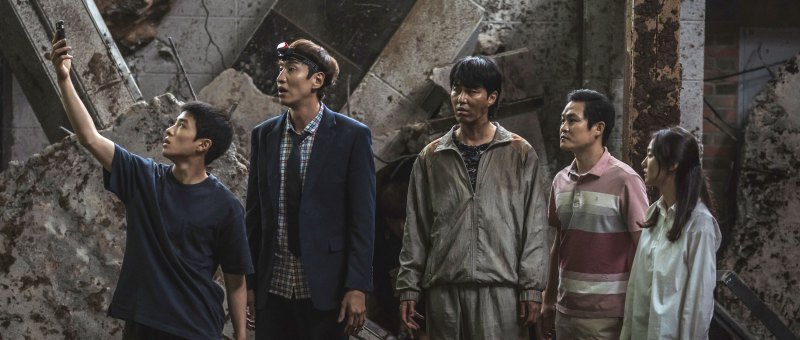
This dream of future security is however quite literally built on shaky ground. There are definitely problems with Dong-won’s new apartment which become increasingly severe from the tilting floors to cracked glass and interruptions with the water supply presumably caused by cost-cutting and shoddy construction practices. When the building collapses into a sinkhole, Dong-won is trapped inside with work colleagues Seung-hyun and Eun-ju along with Man-su and his teenage son Seung-tae (Nam Da-reum). Despite the inherent horror of the situation, Kim keeps the atmosphere light as the small band of survivors attempts to manage as best they can, finding an awkward solidarity while trying to attract the attention of the emergency services and eventually making a daring escape using whatever tools are available to them. 

Even so, as much as the small band of almost strangers bond thanks to their desperate circumstances, there is an uncomfortable conservatism at play especially in the film’s treatment of a working class single mother and her son living in an apartment on the floor below Dong-won’s. That aside, Sinkhole offers a fierce criticism of an increasingly consumerist society in which house prices are all anyone talks about and homeownership is the only badge of social success. 11 years of patient sacrifice is swallowed in an instant, sucked into an abyss of corporate malfeasance, while Dong-won is left to climb out of the hole he’s in on his own. It’s small wonder that some of the survivors decide to drop out of the system altogether, ditching the idea of rooted homeownership for nomadic freedom in buying a small caravan rather than participate in the property market or climb the corporate ladder. “Don’t be happy in 10 years, be happy today!” they enthusiastically chant. The entire society is, it seems, sitting on a sinkhole which might give any minute, what’s the point in investing in a future which could disappear from beneath your feet without reason or warning? 


Sinkhole screened as part of this year’s New York Asian Film Festival.

International trailer (English subtitles)

Believer (독전, Lee Hae-young, 2018)

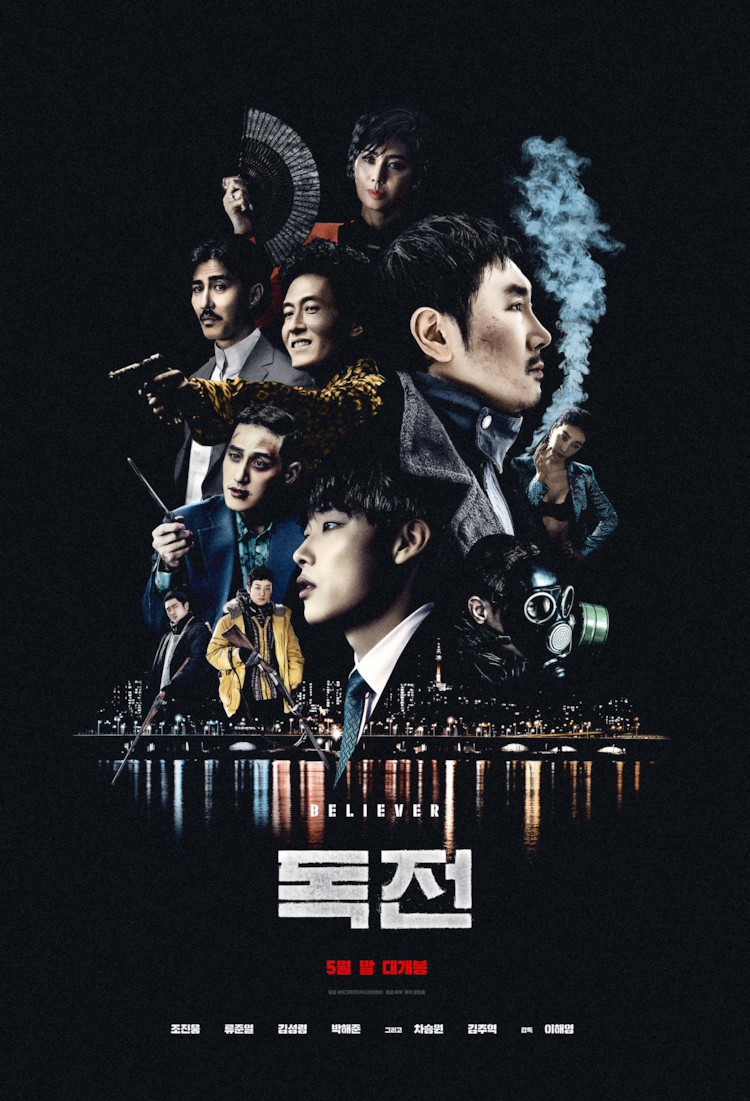
Believer posterJohnnie To’s darkly comical tale of a weaselly meth cook with an extremely strong survival instinct and the austere policeman who can’t resist taking his bait might seem perfectly primed for a Korean remake in its innate pessimism and awkward bromance. Lee Hae-young’s Believer (독전, Dokjeon), however, merely borrows the bones of To’s Drug War while doubling down on its central conceit as reckless obsession leads to the undoing of both our heroes, each forced to confront the futility of their respective, mutually dependent quests.

Obsessed with tracking down a mysterious drug lord known only as “Mr. Lee”, narcotics cop Won-ho (Cho Jin-woong) asks a favour from an old informant only to see her murdered, leaving him only a vague clue by tracing an infinity symbol on a crumpled receipt moments before passing away. Warned off the Mr. Lee case, Won-ho finally gets a lead when an explosion at a drug lab brings scorned righthand woman Oh (Kim Sung-ryung) into his office promising to spill the beans in return for protection and immunity. Sadly, Won-ho couldn’t protect her either, but there was another unexpected survivor in the form of low level middleman Rak (Ryu Jun-yeol).

Traumatised by the death of his mother in the same explosion, Rak initially says nothing under interrogation but suddenly wakes up on learning that the lab’s dog also survived and has been rescued by the police. Unlike the “hero” of To’s film, Rak is small fry (if well connected) and is not looking at anything more than significant prison time. Rak may not be fighting for his life but he has a number of reasons for switching sides, especially once Won-ho fills him in on Mr. Lee’s backstory and long history of abrupt purges.

Despite working for the organisation, neither Oh nor Rak had ever met “Mr. Lee”. No one knows anything about them – gender, nationality, name, or location. In fact, there may not even be a Mr. Lee. Perhaps “Mr. Lee” is merely the “god” of drug dealers – an abstract idea almost given flesh but existing in a spiritual sense alone. Nevertheless, the idea of a Mr. Lee has completely captured the heart of compassionate police detective Won-ho whose all encompassing need to find him has already severely destabilised his life. After failing to protect his informant, Won-ho’s complaint against Mr. Lee is now a personal as well as professional one. Not so much out of vengeance (though there is that too), but a need to make the deaths count and his mounting losses meaningful.

Yet as another Mr. Lee contender later puts it, salvation may not be a matter of faith and if your faith has been misplaced, death may be a healing. In believing so deeply in the idea of “Mr. Lee”, Won-ho has given him form and created an idol to be worshipped through devotion. “Brian” (Cha Seung-won), a higher ranking gangster and former preacher chased out of the US for getting his congregation hooked on cocaine, has his own particular brand of faith based problems but subscribes to much the same philosophy. He may really be Mr. Lee (as may anyone), but if he isn’t he’s determined to convince himself he is in order to see himself as something more than the failed son of a chaebol dad who couldn’t hack it in the family business or in the pulpit. Brian would be happy to die as Mr. Lee rather than going on living as “himself”. Won-ho, unable to understand why kids do drugs asks his informant who explains it’s mostly because life is rubbish. Later someone says something similar to Brian, that he’d rather delude himself with the belief that he’s “someone” rather than face the emptiness.

Despite himself, and as Rak is eager to remind him, Won-ho is dependent on his informant for the pursuit of his case. Won-ho is reluctant to trust him even though Rak seems to be actively working to protect him in this extremely dangerous and largely unfamiliar world. Rak, by contrast, is aware he hasn’t won Won-ho’s faith, but assures him that’s OK because Rak trusts him. Rak does indeed seem to have the upper hand along with mysterious motivations and a fishy backstory, but Won-ho’s desperation to get close to Mr. Lee leaves him wide-open, unwilling to trust his guide but too invested to consider cutting him loose. “Belief” becomes its own drug, a transformative ritual act which gradually erodes all other needs and leaves only emptiness in their place. Won-ho can’t even remember why he started chasing Mr. Lee, but all that remains of him is the chase – a true believer suddenly bereft of a cause. Lee Hae-young takes To’s nihilistic cynicism and subverts it with a focus on the personal as both men fight self created images of their individual demons but find themselves unable to escape from their mutually assured identities.


Believer was screened as part of the 2018 BFI London Film Festival.

The Map Against the World (고산자, 대동여지도, Kang Woo-suk, 2016)

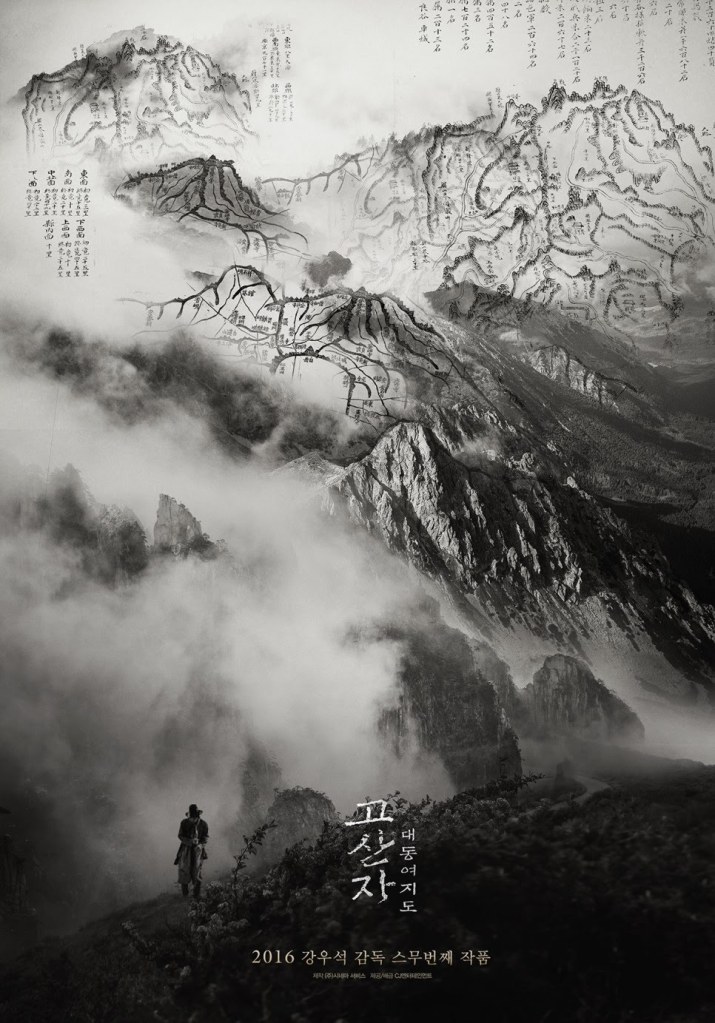
map-against-the-worldThe map is not the territory – as the old adage goes. There’s always a difference between the thing itself and the perception of it but, as the “hero” of The Map Against the World (고산자, 대동여지도, Gosanja, Daedongyeojido) points out, if you’re about to set off on a long journey it’s a good idea to not to rely on a linear map else you’ll run out of good shoes long before you reach your destination. Kim Jeong-ho (Cha Seung-Won) was, apparently, a real person (though little is known about him) who set out to make a proper map of the Korean peninsula after a cartographic error led to the death of his father and many other men from his village when they ran out of resources crossing what they thought was one mountain but turned out to be one mountain range.

The difficulty here is that The Map Around the World pivots around a man who is so crazed and obsessive in his quest that he causes serious problems not only for himself in a difficult political climate, but also for those close to him whose lives he ruins through neglect and abandonment. Is he a hero for following his dreams even though they cost others so dearly? The film seems to say yes, but it’s a difficult message to swallow.

Ever since Kim Jeong-ho’s father died, he’s been obsessed with the idea of creating an accurate map of the Korean peninsula from end to end including the “Dokdo” (or which ever name you wish to use) islands. Consequently, he spends much of his life wandering around on his own which has made him a bit strange. Returning home after a four year absence, Jeong-ho does not seem to be aware that time has been passing even in Seoul and his little daughter, Soon-sil (Nam Ji-hyun), is now all grown up. Jeong-ho also has a kind of relationship with his neighbour, Mrs. Yeonju (Shin Dong-mi), who has been looking after Soon-sil but it’s all a bit awkward.

Aside from Jeong-ho’s terrible performance as a family man, the main intrigue centres around his big philosophy – open access to information for everyone from the nobleman to the peasant. In order to make sure maps remain as accurate as possible, he’s hit on the idea of producing woodblocks so they can be reproduced en masse with fewer errors and then sold to anyone who wants one so that people are free to travel wherever they wish. This is an extraordinarily destabilising idea in the increasingly paranoid world of the late Joseon era under the Regent Heungseon Daewongun (Yu Jun-sang). The woodblocks are dangerous because the elites do not wish the common man to possess that kind of knowledge, would rather people did not travel very much, and there is always the old “national security” fear in which the rulers assert the danger of spies and invaders getting their hands on such an accurate guide to the terrain.

Of course, Heungseon Daewongun ruling as a Regent for his young son means there is also a simmering battle for power running in the background as second tier nobles snap away at each other trying to increase their status in the hope of making a bid for the big chair. Heungseon Daewongun has reason enough to be paranoid but his rule is an austere one in which all foreign elements are to be eliminated in their entirety.

Kim Jeong-ho’s world is difficult and often frightening but Jeong-ho cares for nothing but maps aside from the idea of the free exchange of information. The early part of the film is, broadly, a quirky comedy about an amiable eccentric laughing his way out of trouble whilst evading debt collectors and trying to earn the forgiveness of the women he’s abandoned with nary a word for the last four years.

Jokes about Jeong-ho’s awkward relationship with his neighbour, mild irritation with the idea that his now grown up daughter has a boyfriend, and buddy comedy with the guy helping him carve the woodblocks suddenly seem out of place when the film descends into a morass of cruelty and horror with no apparent warning. Jeong-ho himself is beaten by authorities determined to obtain his maps by underhanded means seeing as Jeong-ho wants them to be available to the people and therefore refuses to surrender them into the “care” of the state. When that doesn’t work, he places himself in line for more harassment, but that’s nothing compared to what happens when a secret sect of Christians (banned for fear of foreignness) is uncovered in the village. Brutally tortured and instructed to denounce others, the villagers are then publicly beheaded. Suddenly, maps don’t seem so important any more.

Nevertheless, Jeong-ho quickly gets over the stubbornness that has cost him the things he held most dear (aside, it seems, from maps) to get right back out there and do some hardcore cartography. The film ends on an oddly upbeat note as Jeong-ho ventures forth on another adventure, edging ever closer to completing his mission, but even if he is about to make his “dream” come true, that same dream has just got a number of people killed. Jeong-ho’s quest to make the maps available to all could be seen as resistance to the oppressiveness of the state, but it isn’t, he just really likes maps and thinks you should too. The Gangchi (otherwise known as “Japanese” sealions, apparently hunted into extinction by Japanese fishermen in the 1970s) frolic happily off the waters of Dokdo as Jeong-ho approaches, but it hardly seems like a cause for celebration.

Over long and tonally inconsistent, The Map Against the World is a frustrating and often dull experience. Hold the map against the world and see what you see, errors and imperfections everywhere. Yet fighting oppression through cartography is a difficult task, and when it comes down to it a map against the world is not enough on its own. Filled with picturesque shots of Korea’s natural beauty, The Map Against the World displays generally high production values but can’t decide if it’s the story of a valiant revolutionary waging a cultural war for freedom of information in the middle of a paranoid dictatorship, or just a film about a madman trying to map ever changing terrain. Jeong-ho’s quest may be a noble one, but his single minded determination and willingness to sacrifice other people’s lives in its service is far from heroic leaving the film’s bittersweet finale feeling very hollow indeed.


Reviewed at the 2016 London East Asia Film Festival.

Original trailer (English subtitles)