The Pit of Death (怪談おとし穴, Koji Shima, 1968)

The building at the centre of Koji Shima’s dread-fuelled horror noir Pit of Death (怪談おとし穴, Kaidan Otoshi Ana) is said to be haunted by the spirits of the many people who died during its construction. In his opening voiceover, anti-hero Kuramoto (Mikio Narita) likens the city to a hornet’s nest, the salaryman drones mindlessly buzzing around the business district as if driven by some supernatural force. In that sense, the office building itself becomes an eerie place, the nexus of the salaryman dream which in the end drags all to hell. 

Largely a retelling of Yotsuya Kaidan for the mid-20th century with a little A Place in the Sun thrown in, the film finds Kuramoto an ambitious man deluded by consumerism and resentful of the classism and snobbishness which limit his prospects as a man who has otherwise been able to pull himself out of poverty. His boss pointedly speaks of his talents which include the ability to speak several languages despite only having attended night school rather than university while it’s unusual for a man of his background to hold this kind of position even if he’s only a secretary and not yet an executive. Nevertheless, his boss clearly sees him as a potential successor and plans to marry him to his daughter (Mako Sanjo) who has in some ways inexplicably developed a crush on him.

But Kuramoto is already in a relationship with typist Etsuko (Mayumi Nagisa). In fact, the reason the boss is so pleased with him is largely down to her in that he asked Etsuko to sleep with their foreign client, Mr Hancock, to seal the deal which she duly did. Kuramoto plans to throw her over in order to pursue his dream of taking over the company so he can look down on those who once looked down on him. He tells Etsuko that the marriage will be in name only, that he isn’t attracted to the boss’ daughter Midori, and their relationship will continue as before only to be confused when Etsuko is not totally on board with the plan. She tells him she’s pregnant with his child though he callously points out it could be Hancock’s and insists on an abortion thereafter determining he must kill her so that he can fulfil his destiny by joining the executive class. 

His desires are obvious when he steps into Midori’s home and gazes at a painting crassly asking how much it’s worth, admitting that he’s the kind of poor person who has a fascination with luxury. His forward propulsion is driven by a fear of poverty, the trauma of the hard life he’s had and the futility he felt in his inability to escape it. Yet it’s also a kind of class rebellion motivated by resentment for the prejudice held against him as a man without means in a highly stratified society. Paradoxically, he will do anything and everything to be accepted as a member of the elite class including murdering Etsuko, the symbol of the working class past he fears will drag him down.

Etsuko does indeed drag him down eventually in her own revenge against his callousness and the double standards of a patriarchal society. Her relationship with Kuramoto seems to be a secret in the office while he uses and discards her when no longer useful to him. She too is trapped within this building of a newly corporatised society but can rise no further alone and is in a fairly bleak position without Kuramoto for she has already thrown away her only bargaining chip by entering a sexual relationship with him. Should she attempt to raise his child alone as a never married single mother, her life would be very difficult indeed if not actually impossible. Nevertheless, she does have real power over Kuramoto in her ability to expose the affair and ruin his chances of career advancement through dynastic marriage destroying any possibility of his future success. 

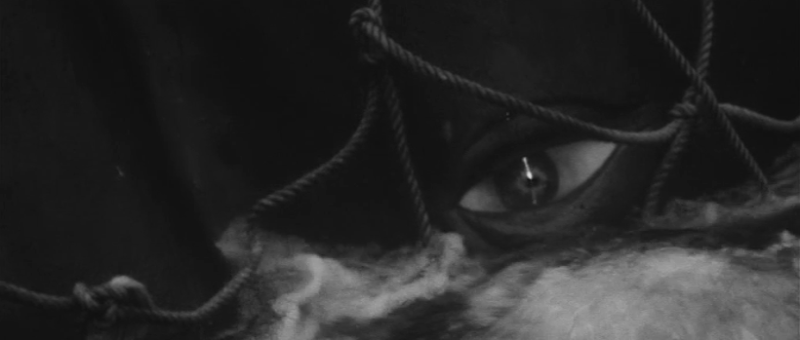
In Kuramoto’s mind, Etsuko cackles like a witch or evil spirit. Her hair billows out into the wind like a vengeful ghost, though the first few times Kuramoto only imagines her death. He sees himself push her off a roof, only to be surprised to see her still standing over him. Etsuko haunts Kuramoto while alive as an image of his destruction all while he silently plots hers. He plans to use the building against her, hiding her body inside it where he assumes no one will see. In the end, it’s as if this building, an edifice of soulless corporatising capitalism, consumes them both, drawing them in with their unfulfilled desires until they fall into the bottomless pit of post-war ambition. Shima makes frequent use of solarisation and film noir lighting to destabilise Kuramoto’s world as his mental state starts to fracture along with innovative use of split screens to lend the space a sense of eerie continuity but ultimately posits the salaryman society as a kind of death trap beckoning greedy souls towards their demise with an inexorable fatalism.
The Whale God (鯨神, Tokuzo Tanaka, 1962)

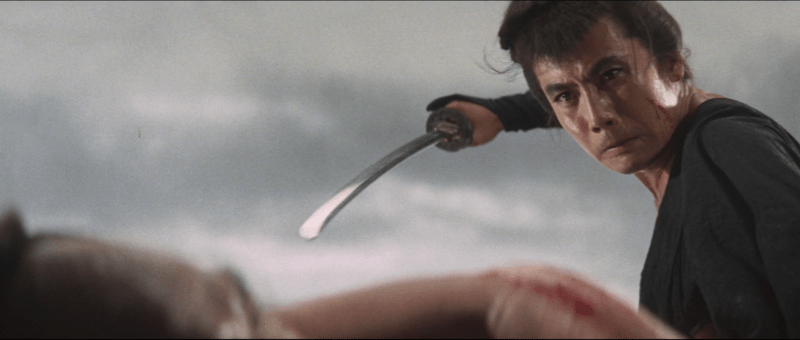
“You’re all mad” the hero of Tokuzo Tanaka’s The Whale God (鯨神, Kujiragami) finally exclaims, perhaps in a sense cured of the overwhelming mania that has defined his life but only at the cost of it. Adapted from the Akutagawa Prize-winning novel by Koichiro Uno which owes a significant debt to Moby Dick, Tanaka’s tokusatsu-adjacent drama is part haunting morality tale cautioning against the destructive absurdity of obsessive vengeance, and a kind of treatise on life in traditional village at a moment of eclipse as the burgeoning modernity of early Meiji washes up on its shores. 

Tanaka opens with a brief prologue in which an elderly man is killed attempting to destroy the “Whale God” only for his son to swear vengeance before being killed himself. The man’s mother instructs his sons to vow revenge, 10 years passing before she sends the oldest one out against the whale. He is also killed, instantly. The last of his line, young Shaki (Kojiro Hongo) is burdened with this piece of filial responsibility, forced to bear the weight of his family’s vengeance while the village elder (Takashi Shimura), a samurai, wants to ensure the Whale God’s destruction and offers up his own daughter, Toyo (Kyoko Enami), along with his lands and title to any who can bring him the snout of the whale. Shaki throws himself forward though he has little desire for the prize obsessed only with vengeance, while another challenger soon appears, Kishu (Shintaro Katsu), a uncouth drifter deciding to hang around after confirming that the offer is open to all no matter their origins. 

Origins do, however, matter. The village elder instructs Kishu to step back lest he spear his “stinking guts” for failing to know his place, a commoner with the temerity to encroach on a samurai’s personal space. The two men, Shaki and Kishu, in a sense represent two halves one whole, one resigned and contemplative and the other rough and greedy. Kishu attempts to challenge Shaki directly but is rebuffed, later settling for besting him through raping his girlfriend, Ei (Shiho Fujimura), who conceives a child as a consequence of the attack but somehow manages to keep the pregnancy entirely secret. Both the woman and the whale become a surrogate battleground for a contest of masculinity, Kishu symbolically ahead in having violated Ei while Shaki remained too consumed with vengeance to have consummated their union. 

Toyo, meanwhile, the samurai’s daughter, insists that she won’t be “the prize for a fisherman’s ambition”, rejecting the idea of becoming the wife of a lowly villager which would of course mean for her great shame. Nevertheless, she is as powerless as Shaki in her inability to shake off patriarchal authority or refuse her duty to obey her father’s orders even as he tells her it’s all a cruel joke, he doesn’t believe that any fisherman could kill the Whale God and survive. Nevertheless she develops a fascination with Shaki and is intensely offended to discover that he wants no part of her father’s bargain and has in fact married Ei claiming her child as his own. He does this in part in order to ensure that someone will exist in order to avenge his own death which he is sure is coming at the fins of the Whale God, resigned with fatalistic nihilism to the ancestral curse which has haunted him for almost all his life living only for vengeance. 

Yet he does in fact manage to kill the Whale God and live, if only for a brief time but long enough to hear Toyo echo that she must marry the man who killed the god in accordance with her father’s promise despite knowing he is already married with a child. His curse lifted, he understands that the whole village is affected by a kind of madness no longer understanding why a samurai’s daughter would agree to marry a man she didn’t love who was not her social equal. In a beatific state, he reflects on his rivalry with Kishu whom he comes to believe deliberately sacrificed himself in order to assure Shaki a survival he does not appear to want in order to ensure his own child would have a father. Discomfortingly, he asks Ei to forgive Kishu because of this fact, little acknowledging her suffering and reducing her once again to a token traded between men in their now concluded battle for masculine dominance. 

An old man having escaped the village’s madness had encouraged Shaki not to die for nothing, to live his life in rejection of his mother’s fatalistic deathbed instruction only to live until you die. In achieving his vengeance he reaches a kind of apotheosis becoming a Christ-like figure sacrificed on behalf of the village which has been liberated of the tyranny of the Whale God even if the Whale God has been exposed as merely a larger than average sea creature. Meanwhile, we can also see that modernity is hovering on the outskirts, the whale’s arrival is signalled by telegraph while Shaki’s childhood friend Kasuke (Yosuke Takemura) alone is able to see through the village’s “madness” leaving to study medicine in Nagasaki. When he returns a year later, Shaki relents and asks him to take his sister with him away from the maddening village towards a more enlightened land. 

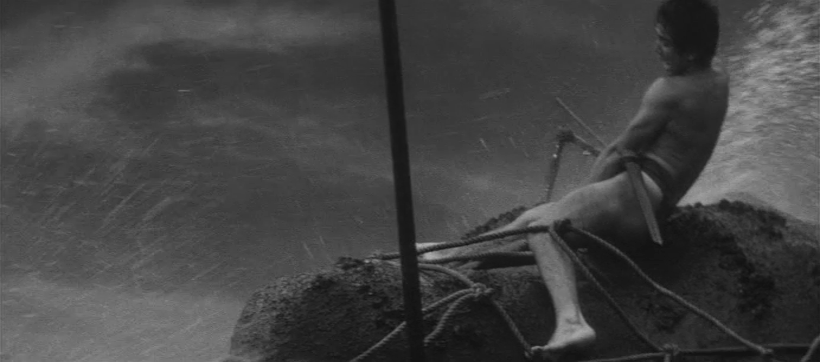
The village is also surprisingly enough Christian, though the new religion does not seem to have eclipsed their traditional beliefs or practices. The fishermen still perform a ritual dance before a whale hunt and continue to demand vengeance against the Whale God even when cautioned against it. Shooting in intense gloominess Tanaka emphasises the sense of spiritual dread that accompanies this “ludicrous” vendetta, the village seemingly always cloaked in darkness as if awaiting its own destruction eventually hastened by the elder’s transgressive offering which in itself represents a small revolution that would make a peasant a king and therefore implode a feudal order that is already on its way out. The elder wants vengeance for glory, Kishu wants vengeance for gold, but only Shaki desires vengeance for peace and later wins it only to have nothing left to live for, ominously telling Ei to raise their son to become “a proud whaler”. Making great use of miniatures, Tanaka’s parabolic drama may park itself in the realms of tokusatsu but is in its own way stranger, and darker, yet also poetic in its examination of destructive obsession, traditional masculinity, feudalistic patriarchy, and existential futility through the story of a young man born to die for a father’s transgressive failures. 


Original trailer (no subtitles)

A Wife Confesses (妻は告白する, Yasuzo Masumura, 1961)

Mountains are dangerous places in Japanese cinema. Yasuzo Masumura’s tense, claustrophobic courtroom noir A Wife Confesses (妻は告白する, Tsuma wa Kokuhaku Suru) was released in the same year as Toshio Sugie’s Death on the Mountain, adapted from a popular story by legendary mystery writer Seicho Matsumoto in which a veteran climber is ushered towards his death through a series of machinations by his friend which might or might not be regarded as “murderous” depending on your point of view. Masumura wants to ask us a similar question but from another angle as he puts a woman on trial not quite for the “murder” of her husband but the fact of her survival.

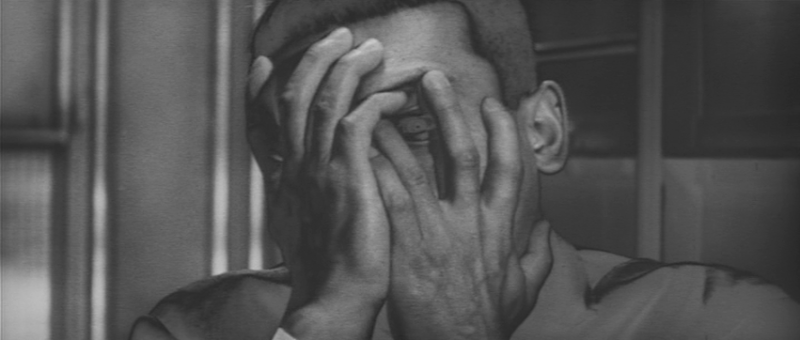
Opening outside the courthouse with a gum-chewing paparazzo, Masumura unwittingly makes us part of the baying mob watching intently as a young woman hides her face with her handbag while the press more than live up to their name, pinning her with questions about the salacious case at hand. Inside, however, he shifts the focus. We are now in the dock with Ayako (Ayako Wakao), looking up at the three men who will judge her for her “crime” from a literal moral high ground. A youngish widow, Ayako is charged with the murder of her husband who died during a freak mountain climbing accident. Caught between a handsome young man, Koda (Hiroshi Kawaguchi), and her abusive husband, Takigawa (Eitaro Ozawa), with no way up or down Ayako chose to cut the rope and let her husband fall. If she had not done so, both she and Koda would also be dead. Ayako is on trial because she refused to sacrifice herself for a wifely ideal. The question is, in many ways, if a woman’s or more to the point a wife’s life has worth, not just worth equal to that of her husband’s but any kind of worth at all. 

The first charge against Ayako is a lack of womanliness. A man at the scene testifies that they don’t usually allow wives or mothers to view bodies and Takigawa’s was in a particularly bad way but Ayako insisted on seeing it only to react with a calm he found suspicious. A policeman then echoes his sentiment, admitting that he arrested Ayako for her unwifeliness. “A wife should stick with her husband ’til the end no matter how tough it is” he says, adding that his own wife agrees with him. As her lawyer points out, had Ayako been a man, or the person below her on the rope a stranger, the policeman would not have arrested her but her refusal to die with her husband, which would have resulted in the “murder” of another man, is an arrestable offence. You can argue about the moralities of choosing to end someone else’s life to save your own, a kind of self defence permitted under Japanese law through the “necessity” legislation, but Ayako’s transgression is in believing that her life and her husband’s weigh the same and that she had a right to save herself. Many feel she should perhaps have cut the rope above her own head, saving Koda only in a lovers’ suicide with Takigawa. 

The policeman offers more grounds for suspicion having discovered that Ayako had taken out an insurance policy on her husband and hoped to profit from his “accidental” death, though as an act of premeditated murder this would certainly be quite an elaborate plot. Furthermore, the prosecution posit that she and Koda were having an affair but, for reasons which are not clear, Koda is not under suspicion or cited as a co-conspirator and is in fact testifying in her defence. He is also engaged to someone else, Rie (Haruko Mabuchi), though the marriage was arranged by his boss for strategic reasons because she is the daughter of a major client at their insurance firm and yes Koda drafted the policy which is currently being used as evidence against Ayako. All very Double Indemnity, but Ayako is certainly no cold and scheming Phyllis whether or not she made a conscious decision to free herself from a man who made her life a misery by literally cutting him loose. 

Yet Ayako’s victimisation is also used against her as further evidence of her unwomanly coldness. She testifies that she married Takigawa after he attempted to rape her and then proposed, confessing that she did so in order to escape a life of poverty that had already driven her into suicidal despair (she still has a vial of potassium cyanide she had taken from his office with just this in mind). She did not love him, but did her best to become a “good wife”, even beginning to wear kimono because he preferred it. Her predicament is no different than that of many other women who agreed to an arranged marriage and found themselves shackled to an unpleasant man with whom they could not get along but the marriage’s failure is laid squarely at Ayako’s feet for not trying hard enough and having insufficient love for the husband who treats her like a glorified maid, is cruel and emotionally abusive, and finally forces her to have an abortion against her will because he doesn’t want to spend money on a child. She asks for a divorce but he points out that as things stand a woman cannot escape a bad marriage without a husband’s consent and he has done nothing to break their marital contract and so to that extent he owns her. 

But for all she’s a cold woman who resented her husband and longed to be free of him, Ayako is also condemned for illicit passion in her secret love for Koda. Indeed we can see she is clearly fond of him, and in flashback we realise much of this is simply because he was kind to her though the extent of his kindness was only to the level of general civility. At heart, they are both “decent” people and so there is nothing more between them than unexpressed longing but still the kernel of their attraction remains and the prosecution has indeed found a grain of truth on which to found a motive for murder.

For his part, in another kind of film Koda would be the hero but here his “goodness” is intensely problematic in that he falls for Ayako precisely because of her suffering. His problem is that he later doubts her, swayed by arguments that paint her as a plotting femme fatale. Though amused by the whole affair, Koda’s boss warns him that women like Ayako are “trouble” and that he’s only been taken in because he is young and naive. Rie, meanwhile, is resentful and wounded, contemplating her own revenge but ultimately testifying in Ayako’s favour, she claims more for herself than for Koda or “justice” too embarrassed to take the stand and offer her own feminine “inferiority” as evidence against her romantic rival. Yet she later comes to admire her, seeing her as one who was bold enough to chase love at the expense of all else no longer caring what anyone might say or think. Ayako is the most liberated woman alive, and she would die for love but did not love her husband and so would not die for him. 

Koda is punished because he fell in love with an image of suffering womanhood but is afraid of Ayako’s transgressive femininity. He is conflicted in the knowledge that if she killed her husband her love for him may have been the reason, and is disturbed by her venality in that she would have taken the insurance money and lived well without finding it distasteful while he would have preferred to reject the settlement entirely lest it besmirch the innocence of their love. In real terms it doesn’t really matter why she did it, Ayako cut the rope and whether she did so out of an instinct for self preservation, in hate, or in love, the result is all the same. What she’s on trial for is defiance, that she acted, seized her own agency and made a choice to value her life over her husband’s which is still, as it turns out, a moral crime in the supposedly modern and democratic society of 1961. Masumura’s accusatory camera finds her pinned, confined, trapped at the edges of frames hiding her face with her single permitted feminine accessory while the subject of our judgemental gaze until the curtain finally closes leaving her in shadow but perhaps finally free of her cruel and oppressive society. 


Original trailer (no subtitles)

On the Road Forever (無宿者, Kenji Misumi, 1964)

“I take to the road whether or not I am alive” confesses the spiritually defeated hero of Kenji Misumi’s filiality drama, On the Road Forever (無宿者, Mushukumono). Two sons each seeking vengeance for a wronged father become first accidental friends, then almost enemies, and finally something more like brothers bound and ruined by the failures of the samurai code. The villain may not unfairly claim that the system of the world is one “dirty great monster”, but the implications of his revelations lead directly back into the infinite corruptions of the samurai order as mediated through the failures of fatherhood. 

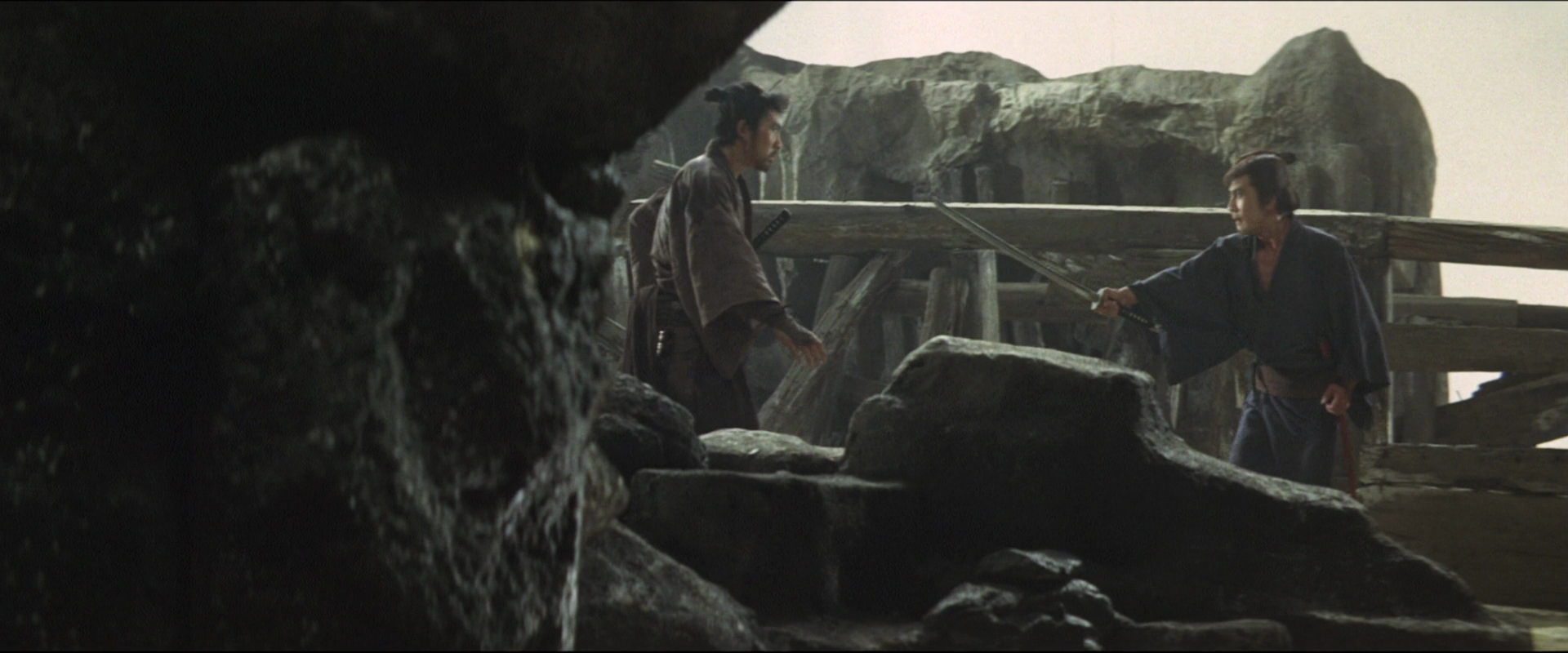
“Drifting crow” Ipponmatsu (Raizo Ichikawa) temporarily teams up with fallen samurai Kuroki Yaichiro (Jun Fujimaki) who has become desperate enough to unwisely attempt robbing a gambling den. Nevertheless, we are clued in to the idea that these are the good guys when they’re helped by a young village woman, Haru (Mikiko Tsubouchi), who lends them her father’s horse instructing them to return it to him at a nearby village which the guys later do even attempting to hand the old man some of their ill-gotten gains as a thank you though he refuses and warns them not to hang around too long because “it’s a rough neighbourhood”. All too soon we discover what he means. A big wig former yakuza who suspiciously came into massive amounts of money two years previously has pressed the villagers into debt and is currently inducting them into indentured servitude on Sado island in order to recoup costs. Perhaps Ipponmatsu doesn’t approve, but he’s on a journey for a reason and would have carried on by had he not heard word that that shady yakuza Shima-ya Jubei (Toru Abe) may be connected to the death of his father during a high stakes robbery on a mountain pass. 

Ipponmatsu, whose name literally means “a single pine”, is the archetypal wandering son who ran away from his clan without permission in rebellion against his authoritarian father who raised him alone after his mother’s death and tried to instil in him the values typical of his class through the medium of violence. Having come across a decomposed body with his father’s distinctive sword at the scene of the robbery, Ipponmatsu has had a change of heart and dedicated his wandering to avenging his memory. Sticking around in the town, he comes to suspect that Yaichiro’s father Hanbei may have been behind the theft of the missing imperial gold only later realising that he too is on a quest to learn the truth in the hope of clearing his father’s name. The two men end up raising swords against each other but discovering they are indeed different, Yaichiro a gentle soul who apparently excelled in the dojo but has no “courage” in the field and Ipponmatsu a fiery hothead who thinks killing is less a matter of skill than “courage and explosiveness”. 

There is, it has to be said, a fairly obvious twist that neither man perhaps too bound up in their own sense of responsibility fully considers. Nevertheless, they are both faced with the decision of what to do should they discover the truth considering that raising a sword against one’s father is an unforgivable sin while knowing that such a heinous betrayal of their code cannot go unpunished. The villains boast of their well connected networks and supposed untouchability laying bare the essential corruption of the samurai order as they wilfully manipulate and exploit impoverished peasantry for their own ends while cruelly joking that all classes are alike in their greed when tempted with riches, entirely unrepentant even as they lament the hypocrisy of the samurai who have no money yet continue in their arrogance. 

Despite having been raised in a homosocial environment told that falling in love with women is a pointless waste of time, Ipponmatsu picks up the affections of two firstly earnest farm girl Haru and secondly misused mistress and sister of Shima-ya, Osei (Eiko Taki). This is however a manly drama concerned with the ways in which men interact with other men, firstly in the awkward fraternity of Ipponmatsu and Yaichiro and then in their mutual and continually changing relationships with their absent fathers living in the shadow of patricide and justice. Elegantly composed as always, Misumi frequently shoots through obstacles imprisoning the men within the broken beams of ruined buildings or spying in a POV shot from an upstairs balcony while making full use of his trademark love for the natural world in closing with a painful confrontation in which the nature of filiality is turned inside out as a corrupt father falls on his sword for his noble son amid the rocks surrounded by rolling waves. As the title suggests, the melancholy ending severs the hero from his ancestral “home” leaving him forever a wanderer untethered yet in a sense never free of his paternal legacy. 


A Certain Killer (ある殺し屋, Kazuo Mori, 1967)

A nihilistic hitman safeguards the post-war future in Kazuo Mori’s chivalrous B-movie noir, A Certain Killer (ある殺し屋, Aru Koroshiya). Set against the backdrop of the Vietnam War with US airplanes flying constantly overhead, Mori’s crime thriller situates itself in the barren wasteland of a rehabilitated city in which betrayal, exploitation and duplicity have become the norm while a former tokkotai pilot turned killer for hire takes his revenge on social hypocrisy as a product of his society, a man who did not die but knows only killing. 

Shiozawa (Raizo Ichikawa) runs a stylish restaurant by day and supplements his income by night as a killer for hire, apparently highly regarded by the local underworld. As such, he’s approached by a yakuza underling, Maeda (Mikio Narita), on behalf of the Kimura gang who want him to off another gangster, Oowada (Tatsuo Matsushita), who double crossed them in contravention of the yakuza codes of honour. Shiozawa is resolutely uninterested in yakuza drama and so turns the job down but changes his mind when he’s paid a visit by boss Kimura (Asao Koike) himself who sells him a different kind of mission. Kimura characterises Oowada as a “bad” yakuza, one has subverted the traditional gangster nobility by dealing in the “dirty” sides of organised crime, corrupting the modern society by trafficking in illegal prostitution, drugs, and extortion, where as he is a “good” yakuza mostly running construction scams and therefore building the post-war future. His crime is, literally, constructive, where Oowada’s is not. 

Shiozawa doesn’t quite buy his justifications, but men like Oowada represent everything he hates. “They’re not worthy of this world. They’re nothing but cockroaches” he laments, recalling the young men who served with him and gave their lives because they believed in a country which betrayed them. He agrees to take the job in rebellion against post-war venality, but only at a price, asking for four times the original fee. Kimura is willing to pay, because his true aim is profit more than revenge. He plans to take over Oowada’s remaining business concerns. 

Fully aware of this, Shiozawa seems almost uninterested in the money despite having asked for so much of it. He runs his shop as a front for his side business and otherwise lives a quiet, unostentatious life keeping mostly to himself. He is not, it would seem, a cold blooded killer, often making a point of leaving those who get in his way incapacitated but alive. Targeted by a street punk for supposedly messing with his girl he cooly disarms him and walks away, only for the girl to follow attracted partly by his icy manliness and partly by the thickness of his wallet as glimpsed when he made the fatal decision to offer to pay for her meal in order to save the chef from embarrassment over her attempts to pay with things other than money. Unable to get by on her own, Keiko (Yumiko Nogawa) attaches herself to various capable men beginning with the pimp, transferring her affections to Shiozawa whom she petitions to marry her, and then to Maeda, eventually vowing to find a new partner and make lots of money. 

Both Maeda and Keiko chase Shiozawa and are rebuffed. Impressed by his cool handling of the Oowada affair, not to mention the amount of money he now realises you can make in his line of business, Maeda asks to become his pupil in order to become a “real man”. Shiozawa doesn’t regard his work as something “real men” do, and in any case prefers to work to alone. Maeda repeatedly asks to be allowed to accompany him even after plotting betrayal, only to be rejected once again as Shiozawa tells him that he doesn’t like people who don’t know the difference between the job and romance, flagging up the homoerotic subtext for those not paying attention. Maeda parrots his words back to Keiko with whom he had begun a halfhearted affair as joint revenge against Shiozawa’s indifference. 

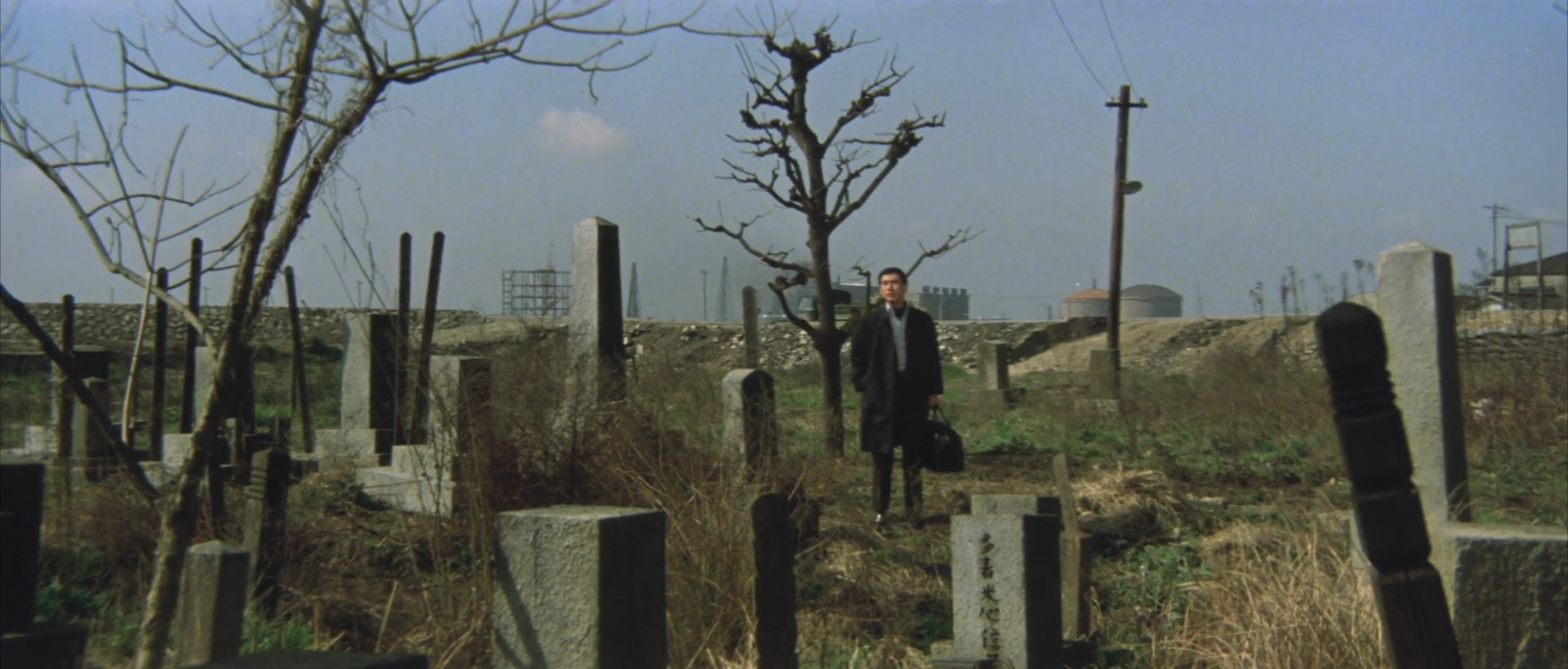
Following the successful offing of the mob boss, Shiozawa finds himself coopted into another job robbing a drug handoff between Oowada’s former associates, the illicit narcotics ironically packaged inside cartons intended for baby powder. Shiozawa apparently doesn’t object to profiting off the drug trade himself, but later abandons the loot in protest while the remainder is lost or squandered during the final battle with the remaining gang members, Shiozawa’s cartons left sitting ironically on top of a gravestone taken by no one. Cool as ice, Shiozawa places himself above petty criminality, always one step ahead, trusting no one and looking out for himself but reacting as a man created by his times, forged by a war he was a not intended to survive while looking on at another cruel and senseless conflict across the sea. Adapting the hardboiled novel by Shunji Fujiwara, Yasuzo Masumura’s jagged, non-linear script (co-written with Yoshihiro Ishimatsu) is imbued with his characteristic irony but also coloured with nihilistic despair for the post-Olympics society and its wholesale descent into soulless capitalistic consumerism.


Update, 13th February 2025: now available to stream via Arrow Player.

Original trailer (no subtitles)