Black Report (黒の報告書, Yasuzo Masumura, 1963)

When an overworked prosecutor is handed a murder case, his colleagues tell him he’s lucked out. Election fraud and bribery are dead ends, one says. They hire fancy lawyers, public prosecutors don’t stand a chance. But with a murder, it ought to be fairly straightforward to get a conviction. They are however fateful words, as Kido (Ken Utsui) finds himself squaring off against a ruthless opponent willing to subvert the law in all ways possible in order to get his client off the hook, 

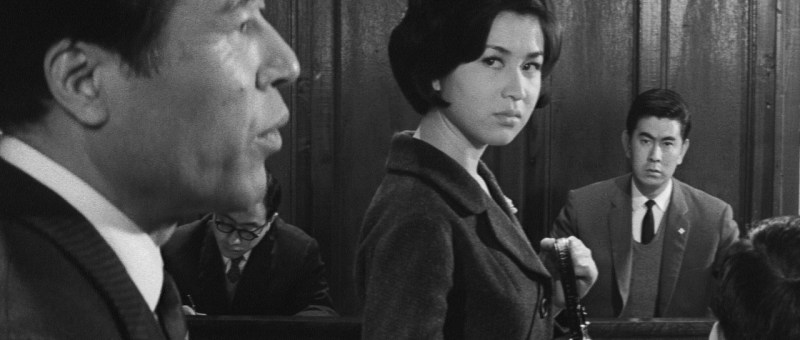
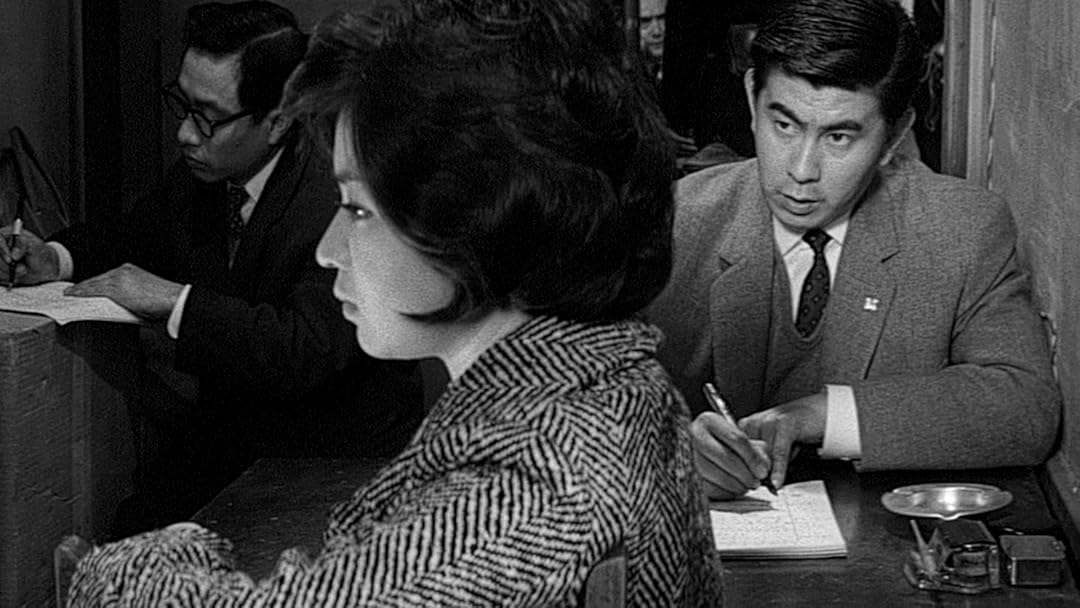
Part of Daiei’s “Black” series, Yasuzo Masumura’s Black Report (黒の報告書, Kuro no Hokokusho) is another in a line of films from the 1960s expressing a lack of confidence in a justice system that is increasingly compromised by social inequality. Kido has 200 cases on his docket. They’ve received seven new ones just this morning, and he’s under pressure to get through them quickly. His boss has told him that a successful conclusion of the murder case will get him a promotion and a transfer to Tokyo. They’ve recently failed to secure convictions in two previous cases, which means the boss’ reputation is on the line and they urgently need to correct the record. Make no mistake, these are the good guys from the film’s perspective, but it’s also true that there’s 99.9% conviction rate in Japan. Losing cases is something that isn’t meant to happen and an embarrassment for law enforcement. 

As his colleague said, however, there is an inequality when it comes to accessing justice given that wealthy people can afford to hire fancy lawyers, while poorer ones can’t and are at a disadvantage. After pinpointing their suspect, Kido is dismayed to find himself up against corrupt lawyer Yamamuro (Eitaro Ozawa) who is willing to use every dirty trick in the book, even buying off witnesses to lie on the stand. Meanwhile, one of Kido’s central arguments relies on leveraging a conventional view of morality in claiming that the suspect, Hitomi (Shigeru Koyama), committed the crime in part because he was having an affair with victim’s wife, Miyuki (Mieko Kondo). The dead man, Kakimoto, had been a womaniser himself, while Miyuki was his second wife and a former bar hostess. In the judgemental atmosphere of the times she is perceived as a woman of low moral character. 

But as Kido’s friend points out, proving things like affairs isn’t particularly easy and even if Miyuki and Hitomi are morally flawed people, that doesn’t make them murderers. Kido is essentially trying them for the wrong “crime” while leveraging salacious gossip and hearsay to bolster his case. His other main argument is that Hitomi killed Kakimoto in order to be able to keep money he had placed with him to earn high interest through illegal loans. Kakimoto had embezzled the money from his company and at some point needed to replace it. This again signals the corrupting influence of money in the post-war society as men like Hitomi take advantage of of people’s desperation through issuing high interest loans, while others like Kakimoto game the system in order to satisfy their greed. Kakimoto does after all seem to have been given to excess with his womanising lifestyle.

Miyuki seems to have taken against Kakimoto’s secretary Ayako (Junko Kano), believing she and Kakimoto were having an affair. Though Ayako declares herself outraged and says that she intends to avenge Kakimoto’s death, even she is eventually corrupted by the possibility of inheriting money from his will along with hush money from Miyuki. Similarly, Kakimoto’s resentful son seems to have come into money recently, having his bought the building where his theatre troupe rehearses. Pretty much everyone else seems to have loathed Kakimoto, so there’s little sympathy for his death and tremendous interest in what’s going to happen to his riches.

It never really occurs to Kido that his case could fall apart if everyone suddenly changed their story on the stand, which is what proceeds to happen. Yet, Kido maintains his faith in the justice system, certain the judges will find their way to the truth without fully considering the fact he’s built an incomplete case and left openings for Yamamuro to undermine it through bribing and intimidating witnesses. Kido seems to think he’ll win just because he’s on the side of righteousness, but the world doesn’t work like that. The film ends on a note of anxiety in which it appears the guilty parties are going to get off scot-free while Kido is exiled from the city, transferred to the provinces in Aomori rather to Tokyo with his career in ruins. Nevertheless, his faith in the justice system to right itself remains absolute as he declares himself ready to trust people again having been reassured by his prosecutor friend and police mentor that they will ensure justice is served so that he can once again return to a world less morally corrupt.


Trailer (English subtitles)

A Wife Confesses (妻は告白する, Yasuzo Masumura, 1961)

Mountains are dangerous places in Japanese cinema. Yasuzo Masumura’s tense, claustrophobic courtroom noir A Wife Confesses (妻は告白する, Tsuma wa Kokuhaku Suru) was released in the same year as Toshio Sugie’s Death on the Mountain, adapted from a popular story by legendary mystery writer Seicho Matsumoto in which a veteran climber is ushered towards his death through a series of machinations by his friend which might or might not be regarded as “murderous” depending on your point of view. Masumura wants to ask us a similar question but from another angle as he puts a woman on trial not quite for the “murder” of her husband but the fact of her survival.

Opening outside the courthouse with a gum-chewing paparazzo, Masumura unwittingly makes us part of the baying mob watching intently as a young woman hides her face with her handbag while the press more than live up to their name, pinning her with questions about the salacious case at hand. Inside, however, he shifts the focus. We are now in the dock with Ayako (Ayako Wakao), looking up at the three men who will judge her for her “crime” from a literal moral high ground. A youngish widow, Ayako is charged with the murder of her husband who died during a freak mountain climbing accident. Caught between a handsome young man, Koda (Hiroshi Kawaguchi), and her abusive husband, Takigawa (Eitaro Ozawa), with no way up or down Ayako chose to cut the rope and let her husband fall. If she had not done so, both she and Koda would also be dead. Ayako is on trial because she refused to sacrifice herself for a wifely ideal. The question is, in many ways, if a woman’s or more to the point a wife’s life has worth, not just worth equal to that of her husband’s but any kind of worth at all. 

The first charge against Ayako is a lack of womanliness. A man at the scene testifies that they don’t usually allow wives or mothers to view bodies and Takigawa’s was in a particularly bad way but Ayako insisted on seeing it only to react with a calm he found suspicious. A policeman then echoes his sentiment, admitting that he arrested Ayako for her unwifeliness. “A wife should stick with her husband ’til the end no matter how tough it is” he says, adding that his own wife agrees with him. As her lawyer points out, had Ayako been a man, or the person below her on the rope a stranger, the policeman would not have arrested her but her refusal to die with her husband, which would have resulted in the “murder” of another man, is an arrestable offence. You can argue about the moralities of choosing to end someone else’s life to save your own, a kind of self defence permitted under Japanese law through the “necessity” legislation, but Ayako’s transgression is in believing that her life and her husband’s weigh the same and that she had a right to save herself. Many feel she should perhaps have cut the rope above her own head, saving Koda only in a lovers’ suicide with Takigawa. 

The policeman offers more grounds for suspicion having discovered that Ayako had taken out an insurance policy on her husband and hoped to profit from his “accidental” death, though as an act of premeditated murder this would certainly be quite an elaborate plot. Furthermore, the prosecution posit that she and Koda were having an affair but, for reasons which are not clear, Koda is not under suspicion or cited as a co-conspirator and is in fact testifying in her defence. He is also engaged to someone else, Rie (Haruko Mabuchi), though the marriage was arranged by his boss for strategic reasons because she is the daughter of a major client at their insurance firm and yes Koda drafted the policy which is currently being used as evidence against Ayako. All very Double Indemnity, but Ayako is certainly no cold and scheming Phyllis whether or not she made a conscious decision to free herself from a man who made her life a misery by literally cutting him loose. 

Yet Ayako’s victimisation is also used against her as further evidence of her unwomanly coldness. She testifies that she married Takigawa after he attempted to rape her and then proposed, confessing that she did so in order to escape a life of poverty that had already driven her into suicidal despair (she still has a vial of potassium cyanide she had taken from his office with just this in mind). She did not love him, but did her best to become a “good wife”, even beginning to wear kimono because he preferred it. Her predicament is no different than that of many other women who agreed to an arranged marriage and found themselves shackled to an unpleasant man with whom they could not get along but the marriage’s failure is laid squarely at Ayako’s feet for not trying hard enough and having insufficient love for the husband who treats her like a glorified maid, is cruel and emotionally abusive, and finally forces her to have an abortion against her will because he doesn’t want to spend money on a child. She asks for a divorce but he points out that as things stand a woman cannot escape a bad marriage without a husband’s consent and he has done nothing to break their marital contract and so to that extent he owns her. 

But for all she’s a cold woman who resented her husband and longed to be free of him, Ayako is also condemned for illicit passion in her secret love for Koda. Indeed we can see she is clearly fond of him, and in flashback we realise much of this is simply because he was kind to her though the extent of his kindness was only to the level of general civility. At heart, they are both “decent” people and so there is nothing more between them than unexpressed longing but still the kernel of their attraction remains and the prosecution has indeed found a grain of truth on which to found a motive for murder.

For his part, in another kind of film Koda would be the hero but here his “goodness” is intensely problematic in that he falls for Ayako precisely because of her suffering. His problem is that he later doubts her, swayed by arguments that paint her as a plotting femme fatale. Though amused by the whole affair, Koda’s boss warns him that women like Ayako are “trouble” and that he’s only been taken in because he is young and naive. Rie, meanwhile, is resentful and wounded, contemplating her own revenge but ultimately testifying in Ayako’s favour, she claims more for herself than for Koda or “justice” too embarrassed to take the stand and offer her own feminine “inferiority” as evidence against her romantic rival. Yet she later comes to admire her, seeing her as one who was bold enough to chase love at the expense of all else no longer caring what anyone might say or think. Ayako is the most liberated woman alive, and she would die for love but did not love her husband and so would not die for him. 

Koda is punished because he fell in love with an image of suffering womanhood but is afraid of Ayako’s transgressive femininity. He is conflicted in the knowledge that if she killed her husband her love for him may have been the reason, and is disturbed by her venality in that she would have taken the insurance money and lived well without finding it distasteful while he would have preferred to reject the settlement entirely lest it besmirch the innocence of their love. In real terms it doesn’t really matter why she did it, Ayako cut the rope and whether she did so out of an instinct for self preservation, in hate, or in love, the result is all the same. What she’s on trial for is defiance, that she acted, seized her own agency and made a choice to value her life over her husband’s which is still, as it turns out, a moral crime in the supposedly modern and democratic society of 1961. Masumura’s accusatory camera finds her pinned, confined, trapped at the edges of frames hiding her face with her single permitted feminine accessory while the subject of our judgemental gaze until the curtain finally closes leaving her in shadow but perhaps finally free of her cruel and oppressive society. 


Original trailer (no subtitles)