18×2 Beyond Youthful Days (青春18×2 君へと続く道, Michihito Fujii, 2024)

Screenshot

Apparently inspired by a real life viral blog, the latest from the prolific Michihito Fujii, 18×2 Beyond Youthful Days (青春18×2 君へと続く道, Seishun 18×2 Kimi e to Tsudzuku Michi) is in many ways in dialogue with Shunji Iwai’s Lover Letter which itself makes an appearance in the film in a allusion to a love that as the hero says never quite even began. Even so, the he, as the heroine had, undertakes a journey not so much to find himself as to recover the young man he once was before romantic heartbreak and professional strife left him emotionally numb and filled with despair.

Jimmy (Greg Hsu Kuang-han) says he’s on a journey with no destination, and perhaps, he is though it’s clear there is an end point in sight only one he’s reluctant to go to. It’s never quite clear to what extent the film intends its big reveal to be quite so obvious, though it seems clear enough that this is a tale of lost love and a circular journey towards a new beginning. After being kicked off the board at the games company he started, Jimmy catches sight of an old postcard soaked in the perfume of a girl he once new perhaps ironically called the flow of time. It does indeed call him back to the past, sending him on a trip to Japan where he too encounters various people who help him to reaffirm himself during a solo trip towards the nexus of his emotional pain.

Back in Tainan 18 years previously, he developed a crush on a young Japanese woman, Ami (Kaya Kiyohara), who rocked up at the karaoke bar he was working at the summer before uni and asked for a job having lost her wallet. Ami is four years older than him and perhaps sees his clumsy attempts at courtship as childish even as he earnestly brushes up his Japanese to be able to converse with her but otherwise treats him warmly if keeping him at arms length. In his own recollections, Jimmy was a clueless teenager who never really picked up on the pregnant hints Ami was leaving him in her sometimes cryptic comments and confusing behaviour but nevertheless went into a massive sulk on hearing she planned to return to Japan wasting precious time with her and almost ruining the memories of their tentative relationship by allowing it to end on a sour note.

The 36-year-old Jimmy is only a little wiser, a lonely, melancholy man who appeared to have little aside from the work that been taken away from him. This apparent mid-point of his life, a double 18 split in the middle, affords him the opportunity for self-reflection as many of those he meets along his way remind him. What he’s doing in a way is travelling on the flow of time, heading back into the past in order to travel through it and out the other side as he later says leaving this moment of youth behind to move into a more settled adulthood and an end to his frustrated inertia. 

As in Love Letter, he ends up deep in frosty snow country reflecting the emotional coolness of his adult self in contrast with the tropical temperatures of Tainan and sunniness of his memories of the summer with Ami. What he discovers is also a kind of love letter as yet undelivered but waiting for him at the destination he was afraid to approach as a kind of closure that will allow him to begin moving forward while carrying his memories with him rather than remaining trapped inside them. Reflecting that the people we meet along the way each leave something of themselves behind in our hearts, Jimmy is finally able to recognise himself and discover a way forward in reaccepting the memories of his summer that never quite blossomed into love as warm and comforting rather than the chilly sadness of the pure white vistas of snow country on Ami’s postcard. Travel doesn’t as much broaden his horizons as remove them, leaving him with an endless, meandering journey open to the possibilities of life and a spirit of adventure born of a lost but not forgotten love.


18×2 Beyond Youthful Days screened as part of this year’s Nippon Connection

Trailer (English subtitles)
The Cabbie (運転手之戀, Chen Yi-wen & Chang Hwa-kun, 2000)

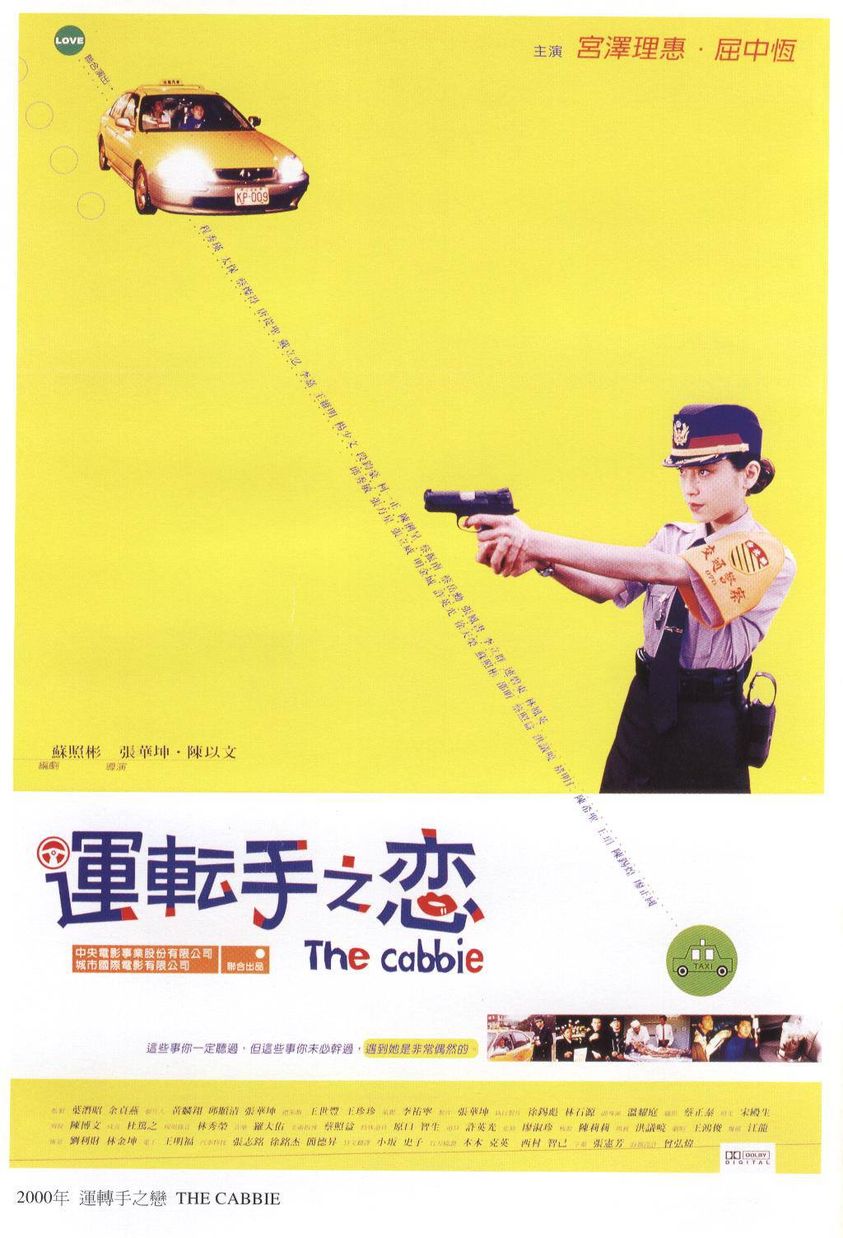
The crazy freewheeling life of a lovestruck taxi driver eventually takes a turn for the contemplative in Chen Yi-wen & Chang Hwa-kun’s infinitely charming comedy, The Cabbie (運転手之戀, yùn zhuǎn shǒu zhī liàn). Despite the film’s sunny atmosphere, darkness does indeed hang around the edges in the frequent references to car accidents and dismemberment yet it seems to be something that the affable hero can live with as he narrates a series of strange incidents from his ordinary life while meditating on his zany family when faced with mortal anxiety. 

As taxi driver Quan (Chu Chung-heng) points out, life can be pretty strange. His taxi can sometimes act as an unofficial confessional as his fares take the opportunity to unburden themselves to a complete stranger in a confined space, confessing the embarrassing details of their lives and even at one point seemingly confessing to a murder. Quan takes it in his stride, feeling as if he is one with his cab, Ah Di, and duty-bound to deliver his charges to their rightful destinations physical and emotional. Yet in an odd way it’s almost as if we’ve become the driver in this story and Quan is our fare, breaking the the fourth wall to speak to us directly of his strange life and the circumstances which led to this present turn of events. 

Quan is however unusual in that he tells his mother and father quite directly that he has no intention of marrying, giving a fairly logical reasoning based on the fact he believes women do not like him and he is not apparently much interested in them. This is of course a source of anxiety for his parents, his taxi driver father also turning fare in ranting at an old lady at the convenience store about his wayward son before trying to awaken something within him by gifting him porn. His mother meanwhile, the local coroner, decides to give up on him while ordering Quan to freeze his sperm so she can have a grandchild with or without his direct involvement at some point down the line. 

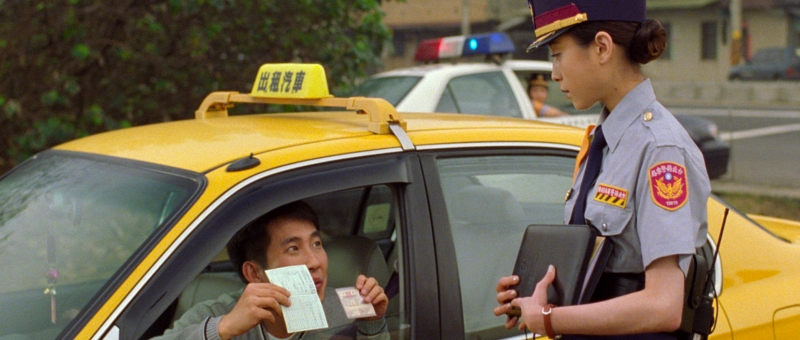
In any case, Quan changes his mind on falling in love at first sight with grumpy policewoman Jingwen (Japanese actress Rie Miyazawa, dubbed into Mandarin). Taking his mother’s advice about making an impression (not necessarily a good one) to heart, Quan decides the best way to woo his crush is to get fined by her as many times as possible. Even so there’s an undeniable Romeo and Juliet vibe to their relationship given the natural animosity between taxi drivers and traffic cops, along with a sense of cosmic irony that feeds directly back into the film’s darker themes. So much of life for Quan is coincidence, an act of cosmic collision not unlike the car crashes that occur so frequently outside the taxi depot. Quan encounters Jingwen by chance and then continues to push his luck by meeting her again in similar circumstances until she gives in to his unusual ardour. Yet not all of these accidents end well. One of Quan’s neighbours earns extra cash turning up at crash sites and making sure that the family gets all of the deceased’s body parts, reaching under twisted metal to retrieve pieces of severed flesh while his mother is indeed a coroner with a severed head in a jar sitting proudly in her office. 

In the end it might be that Quan is a mere passenger of fate, relating his life to us as it flashes before his eyes while threatened by a weird fare. What begins as absurd nonsense comedy as Quan tells us about his crazy family and the strangers who climb into his cab eventually takes an unexpected, poignant turn for the existential even as Quan continues to closely identify himself with Ah Di which might beg the question of who is driving who. Madcap and anarchic, there is something genuinely cheerful in Quan’s often simple existence governed both by chance and the rules of the road lending a fatalistic pall to all of his otherwise freewheeling adventures. Things don’t always always go right for him, but even when they go wrong it’s generally in the right way. Fast-forwarding though the “boring bits”, Quan races us through his life in the cab before taking us where we need to go keeping it cheerful while preparing for the inevitable collision with cosmic irony. 


The Cabbie screens 20th October as part of this year’s Taiwan Film Festival Edinburgh.

Original trailer (Traditional Chinese / English subtitles)

Stand By Me (陪你很久很久, Lai Meng-jie, 2019)

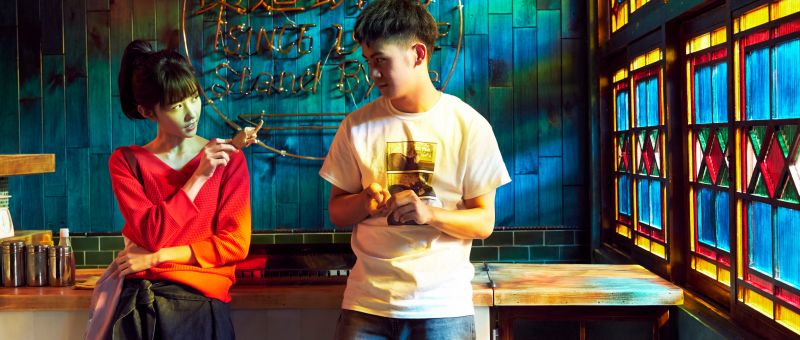
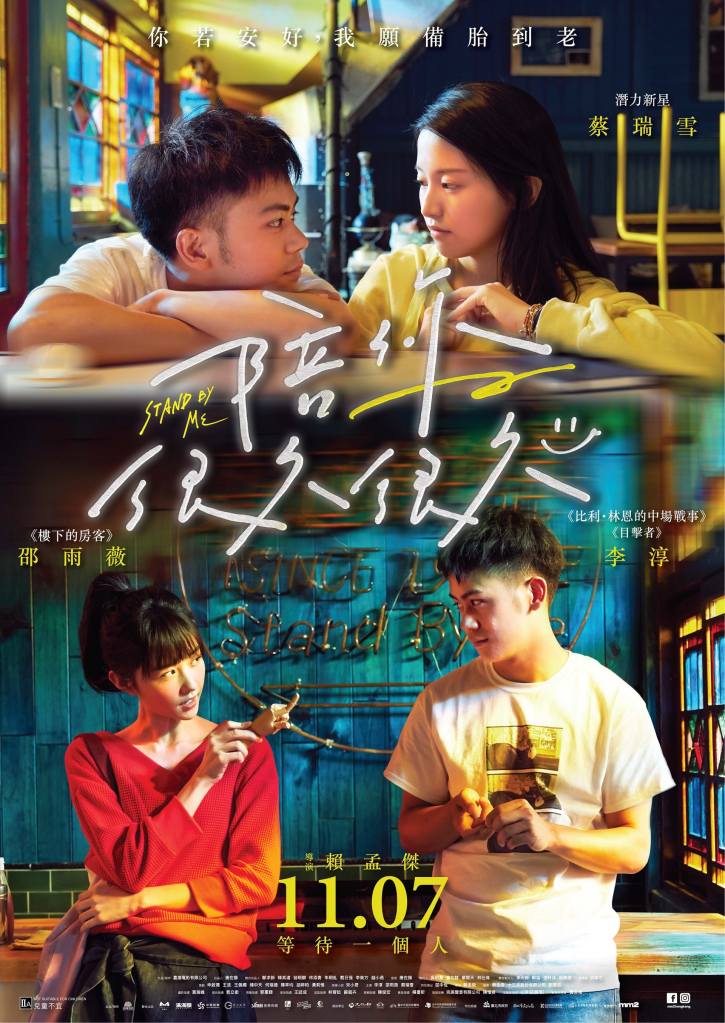
“Teenage days we all need a romance that hurts” exclaims a rejected teen, too shy to declare her crush directly but trying to achieve a kind of closure by literally shouting it from the rooftops in Lai Meng-jie’s charming teenage rom-com, Stand By Me (陪你很久很久, Péi Nǐ Hěn Jiǔ Hěn Jiǔ). For Jiu-Bing (Mason Lee), however, his romance has gone on a little longer than just his teenage years. He’s been silently in love with Bo-he (Ivy Shao Yu-Wei) since he was 12, but their relationship has remained at the innocent level of childhood friendship. Nevertheless, all of his subsequent decisions have been taken with one aim in mind, being at Bo-he’s side to protect her. Now that they’re grown, he’ll have to come to terms with the fact that their relationship is inevitably going to have to change in one way or another. 

As with most youngsters, those changes arrive as they set off for university (he’s enrolled in the same one as her for that reason alone). No matter how close you are, it can be quite claustrophobic having someone buzzing around you all day and Bo-he is beginning to get fed up with Jiu-Bing’s continuing immaturity. He’s promised to “protect” her, but often ends up in trouble himself and needs her to rescue him. It’s Bo-he that finds him a place to stay after he accidentally blows up his new student dorm and gets kicked out, only it turns out to be half of a teenage girl’s bedroom above a family bakery, rented out by high schooler Xia-Tian (Tsai Jui-Hsueh) without her father’s (Chu Chung-heng) permission as an enterprising way to get a little more pocket money. Meanwhile, Bo-he has fallen for a handsome, heroic classmate, Mai-zi (Edison Song Bai-Wai), who is, in every stereotypical way, the perfect man. 

In an ironic twist, Jiu-Bing’s part-time job is as a “pacer”, supporting other runners as they make their way towards the finish line but eventually dropping back himself. He takes pride in being there for people, protecting and encouraging them, but still struggles to accept the fact that his chosen role inevitably means he’ll spend his life celebrating the successes of others rather than his own. Jiu-Bing eventually has this fact thrown in his face when a romantic rival describes him as nothing more than a rebound guy, implying that Bo-he only sees him as a fallback she can rely on when some other boy breaks her heart but will never really want to be with in the long term. 

On one level, Jiu-Bing is fine with that. He really does just want Bo-he to be happy even if it’s with someone else, but still struggles with the decision of whether to speak his feelings out loud and risk ruining their friendship or keep silent and live with the pain of being just her friend forever. As one of his eccentrically nerdy friends puts it, companionship is the “dark matter” that supports a relationship, but the jury’s still out on whether companionship alone is enough to go the distance. Meanwhile, he remains entirely oblivious to the fact that Xia-Tian is beginning to develop feelings for him that place her in exactly the same place as he is with Bo-he. Maybe he just thinks of Xia-Tian as a crazy little sister, and maybe Bo-he just thinks of him as a troublesome little brother who will always need looking after despite his constant protestations that all he wants is to be able to “protect” her. 

What Jiu-Bing learns however is that being a pacer is no bad thing. It’s much better to run with someone than to run alone, but there are times when you just need to set a pace for yourself so you can figure out how far you can run. There are more ways to love than just the romantic, though maybe that’ll come in time but perhaps not from the direction you’d expected. “Being heard and accepted is nothing we can decide” Xia-Tian adds, and what is teenage romance other than coming to an acceptance that sometimes you love people who don’t love you back? But then sometimes they do, and if you never say anything you’ll never know. Jiu-Bing has some growing up to do, and a few decisions to make so he can figure out where it is he ought to be – supporting from the sidelines or waiting with flowers near the podium. Either way, Lai Meng-Jie’s charming teenage rom-com is a refreshingly progressive take on the genre which allows it’s “nice guy” hero to find solace in the authenticity of his generosity while its heroine embraces her own sense of agency entirely independent of her romantic destiny. 


Stand By Me screens at Chicago’s Gene Siskel Film Center on Feb. 17 where the full lineup for the upcoming 10th season of Asian Pop-Up Cinema will also be unveiled. Director Lai Meng-jie will be in attendance for an introduction and post-screening Q&A.

Original trailer (English/Traditional Chinese subtitles)